50 S2aaS Real-World Platforms
More
Depth: Practitioner
Progress saves as you read. Mark sections complete as you go; your progress appears in the sidebar.
50.1 Start Simple
This section: Start Simple — Picture a campus sharing room-air readings with students, caretakers, and a research team.
Choose a Shared Platform That Can Be Left Safely
Picture a campus sharing room-air readings with students, caretakers, and a research team. The first platform can look easy while only ten sensors and one group use it. The real choice appears when devices change, a second user arrives, data needs correction, or the campus must move away.
Write one service promise before comparing products. Name the source owner, users, identity, unit, time, quality mark, access rule, correction route, price limit, export form, end date, and exit owner.
Test a new sensor type, a changed schema, a revoked user, a late record, a wrong unit, a service outage, a bulk export, and a move to a simple replacement. Check whether meaning and access survive. A polished dashboard is not proof of a portable service.
Keep urgent room action at the site when the platform is late. Shared tools can compare and retain data, but they should not be the only path to a time-bound safe step.
This opening does not select a brand or claim that one platform fits every stage. Practitioner compares duties, cost, support, and exit. Under the Hood examines interfaces, storage, identity, event flow, limits, migration, and the proof needed through change.
Use a small exit drill. Export one normal record, one corrected record, one late record, and each access rule. Load them into a plain replacement and repeat one user query.
Run the drill after a data form, user, price, device family, or service promise changes. If the team cannot move the meaning and rights, the platform choice is still open.
Close with four plain questions. Can data get in? Can the right user get it out? Can a wrong user be shut out? Can the team leave with the same meaning? A good tool must pass all four.
Start with one sensor stream that another team wants to reuse. In S2aaS Real-World Platforms, the practical question is who owns the sensing resource, what quality is promised, and what policy keeps the service safe to consume.
50.2 Learning Objectives
This section: Learning Objectives
By the end of this chapter, you will be able to:
- Evaluate a real-world sensing platform by responsibilities instead of brand names.
- Distinguish platform archetypes such as managed ingestion, community data exchange, sector marketplace, and federated institutional service.
- Identify the minimum contract records a platform must expose before sensor data can be reused safely.
- Check portability and exit readiness without relying on dated product comparisons.
- Apply a structured evaluation flow to a campus or public-interest sensing platform.
50.3 Prerequisites
This section: Prerequisites
- S2aaS Architecture Patterns: reusable implementation responsibilities.
- S2aaS Multi-Layer Architecture: physical, edge, virtual-resource, delivery, and operations layers.
- S2aaS Data Ownership: ownership, stewardship, privacy, and lifecycle controls.
50.4 Real-World S2aaS Platform Examples
This section: Real-World S2aaS Platform Examples — The safest way to study real-world S2aaS platforms is to classify what they do for participants.
The safest way to study real-world S2aaS platforms is to classify what they do for participants. A platform may be a device-ingestion service, a public data exchange, a community sensing network, a sector marketplace, or a federation of institutional services. Those categories overlap, but the same questions apply.
50.4.1 Community Data Exchange
Many contributors publish observations, the platform normalizes and qualifies them, and consumers use public or governed feeds.
50.4.2 Institutional Service
One organization exposes internal sensing resources to multiple approved teams through virtual resources and policy controls.
50.4.3 Sector Marketplace
Multiple owners publish domain-specific sensing resources with contracts, quality records, and controlled delivery.
50.5 Responsibility Map
This section: Responsibility Map — The overview depth layer shows the platform responsibilities to inspect before trusting a real-world S2aaS service.
The overview depth layer shows the platform responsibilities to inspect before trusting a real-world S2aaS service.
Use the map as a checklist. A platform can be simple and still be well designed if each responsibility is explicit.
50.6 Platform Archetypes
This section: Platform Archetypes — Different real-world platforms emphasize different responsibilities.
Different real-world platforms emphasize different responsibilities. The archetype tells you where to look for risk.
50.6.1 Managed Ingestion Platform
Strong at device onboarding, message receipt, and routing. Check whether it exposes virtual resources, quality state, and governed consumer delivery.
50.6.2 Community Sensing Network
Strong at collecting many volunteer or third-party observations. Check calibration, placement records, outlier handling, contributor identity, and data-quality disclosure.
50.6.3 Public Data Exchange
Strong at publishing datasets and feeds. Check freshness, provenance, versioning, license terms, and whether raw and derived data are clearly distinguished.
50.6.4 Operational Service Platform
Strong at dashboards, alerts, controls, and workflows. Check whether those workflows can be audited and whether service logic can be moved or reproduced.
50.6.5 Federated Institutional Platform
Strong at keeping data under local owners while sharing approved results. Check identity federation, policy alignment, quality vocabulary, and cross-site incident handling.
50.6.6 Thin Device Dashboard
Good for viewing readings, but not enough for S2aaS if it lacks consumer contracts, quality states, governed access, and exit paths.
50.7 What to Evaluate
This section: What to Evaluate — The evaluation should focus on the platform contract that consumers and operators can inspect.
The evaluation should focus on the platform contract that consumers and operators can inspect.
Resource discovery:
- Can consumers search by observed property, location or asset scope, quality, owner, and allowed use?
- Does the catalog distinguish raw sources, virtual resources, aggregates, reports, and derived indicators?
- Does each resource have a stable id and versioned description?
Data contract:
- Are units, timestamps, feature of interest, source scope, and transformation rules clear?
- Are freshness, uncertainty, completeness, and calibration state visible?
- Can the consumer tell whether a value is raw, normalized, estimated, aggregated, or suppressed?
Governance and delivery:
- Are purpose, retention, redistribution, export, and revocation rules enforced before delivery?
- Are all delivery modes covered: API, stream, dashboard, report, and export?
- Does the platform record denied requests and degraded delivery decisions?
Operations:
- Who responds to stale data, failed source replacement, quality degradation, policy conflict, and consumer complaint?
- Are incidents linked to affected resources, consumers, source groups, and policy versions?
- Can operators trace a consumer value back to source records?
This section:
Do not confuse “we can ingest sensor messages” with “we operate an S2aaS platform.” S2aaS also needs discovery, service contracts, quality visibility, governed delivery, and audit.
This section:
50.8 Evaluation Flow
This section: Evaluation Flow — A structured evaluation prevents the work from becoming a feature checklist.
A structured evaluation prevents the work from becoming a feature checklist.
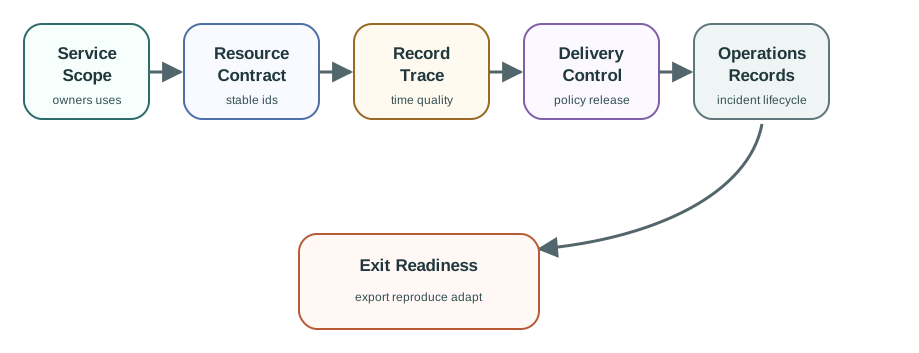
Follow the flow in order:
- Define service scope. Identify who owns sources, who consumes results, and what use cases are allowed.
- Inspect resource contracts. Confirm that virtual resources are stable, versioned, and discoverable.
- Trace data records. Verify time, unit, source, quality, transformation, and provenance across handoffs.
- Check delivery controls. Confirm purpose, entitlement, retention, redistribution, revocation, and rate controls.
- Check operations records. Confirm incident, lifecycle, policy-change, and deletion traces.
- Test exit readiness. Prove that data, metadata, policy rules, and integrations can move or be reproduced.
50.9 Platform Portability
This section: Platform Portability — Portability does not mean every platform is interchangeable.
Portability does not mean every platform is interchangeable. It means the service contract is not trapped behind hidden implementation details.
50.9.1 Portable by Design
- Standard device and consumer interfaces where possible. Check whether onboarding and consumer access can be adapted during a platform move.
- Stable virtual-resource ids. These keep consumer contracts connected to resources as physical sources and internal tools change.
- Exportable resource catalog. Preserve descriptions, owners, observed properties, quality rules, and policy terms with resource identity.
- Exportable observation and audit history. Retain time, unit, source, quality, and provenance so exported values remain interpretable.
- Versioned schemas and policy rules. These help reconstruct data meaning and allowed use.
- Minimal direct dependency on internal queue, table, or workflow names. Hidden implementation dependencies can make migration require application changes.
50.9.2 Hard to Move
- Consumer apps call internal platform constructs directly. Internal tool changes can then require changes to consumer integrations.
- Quality rules live only in dashboards. Moving observations alone leaves the replacement without the rules needed to interpret quality.
- Source-to-resource mapping is undocumented. This makes it harder to trace a consumer value back to its source.
- Historical data cannot be exported with provenance. Exported values may lose the context needed for safe reuse.
- Policy and consent state cannot be reconstructed. Allowed uses and consumer access become harder to reproduce.
- Operators rely on manual knowledge outside records. Migration then depends on reconstructing operational responsibilities and service meaning.
If the platform has no exportable catalog, no clear schema versions, and no source-to-resource mapping, migration becomes reconstruction. That is expensive, risky, and often incomplete.
50.10 Community Platform Quality
This section: Community Platform Quality — Community and shared platforms are valuable because they can cover more places than a single owner could instrument alone.
Community and shared platforms are valuable because they can cover more places than a single owner could instrument alone. They also introduce quality variation.
Quality risks to check:
- Sensors installed in unusual locations.
- Inconsistent calibration and maintenance.
- Consumer-grade devices mixed with reference sources.
- Duplicate sources reporting the same condition.
- Contributors changing location or ownership without notice.
- Outliers caused by local events, drift, or misuse.
Quality controls to expect:
- Placement metadata and contributor guidance.
- Source health and last-seen state.
- Calibration or comparison records when available.
- Outlier flags and local-event notes.
- Confidence or quality state visible to consumers.
- Clear separation between raw observations and corrected outputs.
A platform can publish imperfect data responsibly if it makes quality state, source context, and correction rules visible. Hiding uncertainty is the bigger failure.
50.11 Exit Readiness
This section: Exit Readiness — Exit readiness protects the learner, operator, and consumer from future platform change.
Exit readiness protects the learner, operator, and consumer from future platform change. It also improves normal operations because it forces the platform to document the data contract.
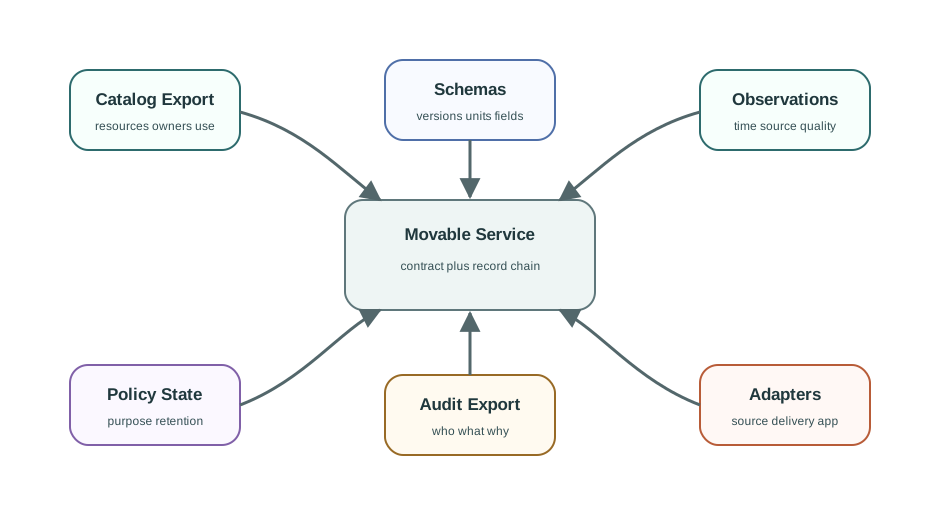
An exit-ready platform can answer:
- Can the resource catalog be exported with ids, descriptions, owners, observed properties, locations, quality rules, and policy terms?
- Can observations be exported with timestamps, units, source ids, virtual-resource ids, quality states, and provenance?
- Can consumer subscriptions and allowed uses be reconstructed?
- Can audit records show who received what, when, and under which rule?
- Can source onboarding, delivery, and consumer access be adapted without rewriting every application?
50.13 Platform Readiness Checklist
This section: Platform Readiness Checklist
- Platform archetype is identified before features are compared.
- Catalog supports discovery by capability, location or asset, quality, owner, and allowed use.
- Consumers interact with virtual resources, not hidden physical or internal platform ids.
- Observations preserve source, time, unit, quality, provenance, and transformation state.
- Delivery controls cover API, stream, dashboard, report, and export modes.
- Quality states are visible and actionable.
- Audit records link request, consumer, resource, source, policy, quality, and decision.
- Exit readiness covers catalog, schema, observations, policy, audit, and integration adapters.
- Assertions about scale, availability, support, and commercial terms are verified outside the chapter before procurement.
50.14 Knowledge Check
This section: Knowledge Check
50.15 Concept Relationships
This section: Concept Relationships
- Platform archetype frames the evaluation by showing where risk is likely to appear.
- Resource catalog connects source owners, virtual resources, allowed use, and consumer discovery.
- Virtual-resource contract keeps consumer integrations stable while physical sources and internal tools change.
- Quality state makes freshness, uncertainty, maintenance, and degraded data visible.
- Governed delivery applies policy before data leaves the platform boundary.
- Audit records explain delivery, denial, correction, export, and incident decisions.
- Exit readiness proves the service contract can survive platform change.
50.16 Common Pitfalls
This section: Common Pitfalls
50.16.1 Feature List First
Comparing feature tables before defining the service contract hides the responsibilities that matter most.
50.16.2 Device Dashboard as Platform
A dashboard can be useful, but S2aaS also needs discovery, quality state, governed delivery, and audit records.
50.16.4 No Exit Test
If you have never exported the catalog, schemas, observations, policy state, and audit records, you do not know whether the service can move.
50.17 References and Further Reading
This section: References and Further Reading
- OGC SensorThings API, for resource-oriented sensing entities and observations.
- W3C SSN/SOSA, for modeling sensors, observations, observed properties, procedures, and systems.
- oneM2M functional architecture, for service-layer responsibilities and resource modeling.
- MQTT Version 5.0 specification, for portable publish/subscribe interaction and message metadata.
50.18 Responsibilities, Not Brands
This section: Responsibilities, Not Brands — If you only need the operating rule, this layer is enough: a platform is suitable for S2aaS when it can expose, enforce, explain, and move the service contract, not merely ingest device messages.
If you only need the operating rule, this layer is enough: a platform is suitable for S2aaS when it can expose, enforce, explain, and move the service contract, not merely ingest device messages.
Figure 50.3 shows resource contracts, delivery rules, audit records, and portability define S2aaS platform responsibilities.
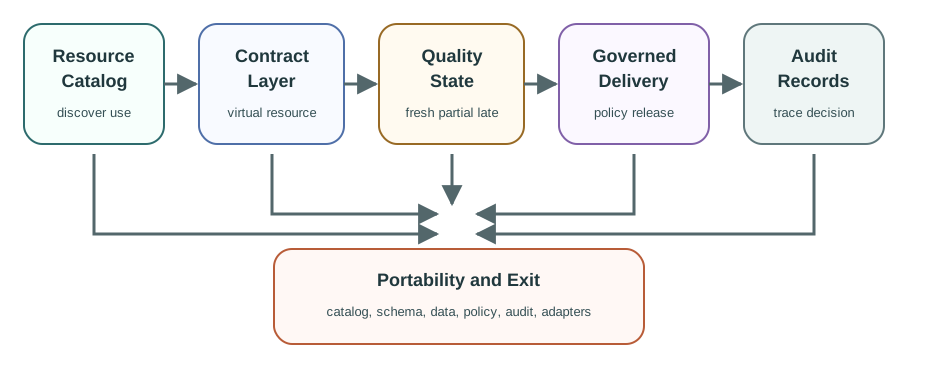
Mobile summary: Evaluate platforms by resource catalog, contract layer, quality state, governed delivery, audit records, and portability instead of brand names or dashboard polish.
Expose
Catalogs and virtual resources show what exists, who owns it, what it measures, what quality rules apply, and which uses are allowed.
Enforce
Governed delivery checks purpose, entitlement, quality, retention, redistribution, revocation, rate, and output mode before release.
Explain and move
Operations, audit, and exit records preserve source mapping, policy, quality history, subscriptions, incidents, and migration proof.
50.19 Platform Exit Record
This section: Platform Exit Record — For a campus shared-sensing platform, treat exit readiness as an ordinary evaluation artifact, not a last-minute migration plan.
For a campus shared-sensing platform, treat exit readiness as an ordinary evaluation artifact, not a last-minute migration plan.
Treat platform Exit Record as one connected review. Begin with resource contract: export virtual-resource ids, names, owners, observed properties, locations, freshness rules, quality vocabulary, and allowed uses. With that boundary fixed, examine observation record: export timestamps, units, source ids, virtual-resource ids, quality states, transformation versions, provenance, and correction notes. Then connect it to governance record: export subscriptions, purposes, retention rules, redistribution limits, consent or authority state, revocations, and policy versions. Then connect it to operations record: export incidents, denied requests, quality overrides, source replacements, deletion actions, operator owners, and recovery proof. Close the review by checking integration record: document adapters, APIs, streams, dashboards, reports, and consumer dependencies that must be reproduced or retired. The order matters: each later judgment depends on the owner, state, constraint, or failure evidence retained by the preceding step, so the resulting record can support the next chapter decision.
Portability test
Recreate one resource, one historical query, one denied request, one stale-data state, and one audit trace outside the current platform boundary.
Procurement block
Hold adoption when quality rules live only in dashboards, policy cannot be exported, or consumer apps depend on internal table, queue, or device names.
50.20 Why Feature Lists Age Badly
This section: Why Feature Lists Age Badly — Product features change faster than platform responsibilities.
Product features change faster than platform responsibilities. A platform can add dashboards, alerts, and integrations while still failing the core S2aaS test: can a consumer trust the service contract and can an operator explain or move it later?
Treat why Feature Lists Age Badly as one connected review. Begin with hidden contract: resource meaning, quality rules, and policy terms are visible only through screens, not exportable records. With that boundary fixed, examine hidden coupling: consumer integrations depend on physical device ids, internal topics, table names, or vendor-only workflows. Then connect it to hidden quality: corrections, estimates, stale values, and suppressed data are shown without a durable quality-state history. Close the review by checking hidden exit cost: observations can be exported, but subscriptions, policy, audit, and provenance must be reconstructed manually. The order matters: each later judgment depends on the owner, state, constraint, or failure evidence retained by the preceding step, so the resulting record can support the next chapter decision.
50.21 Summary
This section: Summary — Real-world S2aaS platforms should be evaluated by responsibilities, not by brittle feature lists.
Real-world S2aaS platforms should be evaluated by responsibilities, not by brittle feature lists. A defensible platform exposes a discoverable catalog, stable virtual-resource contracts, visible quality state, governed delivery, operations records, audit traces, and an exit path. Community, institutional, marketplace, and federated platforms may emphasize different risks, but the same record chain determines whether consumers can trust and reuse the data.
50.22 What’s Next
This section: What’s Next
- S2aaS Deployment Considerations: readiness, lifecycle, operations, and governance controls.
- S2aaS Deployment Models: placement choices for centralized, regional, edge-assisted, and federated operation.
- S2aaS Architecture Patterns: implementation pattern boundaries.
- S2aaS Implementations: roadmap and implementation gates.
- S2aaS Readiness Check: capstone readiness check across the S2aaS section.
50.23 Key Takeaway
This section: Key Takeaway — Choose S2aaS platforms for ingestion, device management, API exposure, billing, governance, reliability, and tenant isolation.
Choose S2aaS platforms for ingestion, device management, API exposure, billing, governance, reliability, and tenant isolation. The platform must support both the data product and the operating model.
Find help
3 reviewed answers.
Where should I start in a module?
Open the module page from the sidebar to see its chapters in order. Use the module map to return to a topic you need.
Modules and pathsReviewed
What can I try when a project does not work?
Check the symptom, then work through the diagnostic steps. Keep the error message and the smallest example that reproduces it.
When you are stuckReviewed
How do interactive examples work?
Use the interactive guide to check how examples and simulations work before changing your project.
Interactive examples guideReviewed