8 DSR Worked Examples
More
Depth: Practitioner
Progress saves as you read. Mark sections complete as you go; your progress appears in the sidebar.
8.1 Start Simple
This section: Start Simple — Picture a rescue tracker discovering a route, using it twice, then losing a relay as the team moves.
Follow One Packet From Search to Repair
Picture a rescue tracker discovering a route, using it twice, then losing a relay as the team moves. A protocol means the agreed rules and message order devices use to exchange routing information.
Name the request, reply, source route, cache entry, failed link, error, and repair choice. Step through discovery, forwarding, cache reuse, break detection, and rediscovery.
Keep every packet path, identifier, cache change, delay, and delivery result. This proves one worked lifecycle, not every mobility pattern; the deeper examples compare good reuse with stale knowledge and repair costs.
8.2 Start With the Route Lifecycle
This section: Start With the Route Lifecycle — A worked DSR example is easiest to read as a lifecycle: discover a route, use it, cache it, notice when it breaks, and repair or rediscover it.
A worked DSR example is easiest to read as a lifecycle: discover a route, use it, cache it, notice when it breaks, and repair or rediscover it. Each packet carries part of that story.
Start with one source route in the header and follow how the network treats it. The example matters because it shows when cached knowledge saves airtime and when that same knowledge becomes a liability.
8.3 Overview: Read DSR as a Route Lifecycle
This section: Overview: Read DSR as a Route Lifecycle — Dynamic Source Routing examples are useful only when they show the whole route lifecycle.
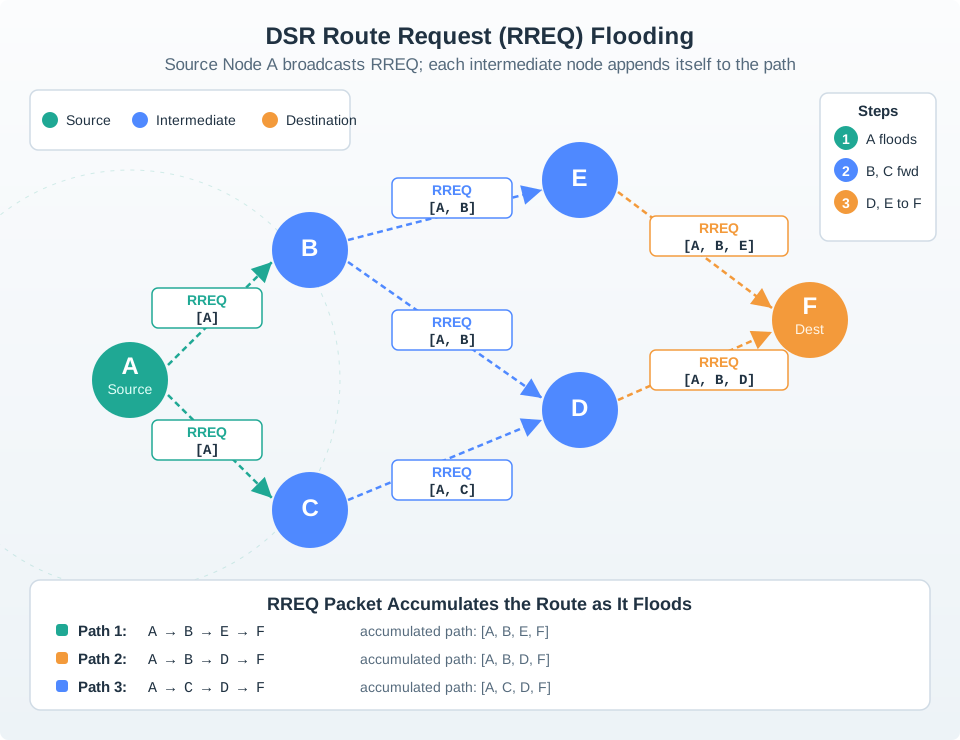
Dynamic Source Routing examples are useful only when they show the whole route lifecycle. A source broadcasts a Route Request, relays append themselves to the route record, the destination returns a Route Reply, and the source then sends packets with the complete source route in the header.
That lifecycle lets you trace why DSR can be efficient for sparse traffic and why it can stumble in mobile networks. The same cache that saves a flood on one packet can become stale after nodes move, causing a route error and a fresh discovery.
A worked trace should separate the first route that reaches the destination from the total work done by the network. The first route is governed by hop count, per-hop delay, contention on the chosen path, and the reply path back to the source. The wider flood cost is different: many other nodes may hear, forward, and then suppress duplicate copies even though only one route becomes the first usable answer.
That split is the reason DSR examples can look deceptively simple. A three-hop path in a large network may be found quickly, while the surrounding flood still consumes enough airtime to matter for battery and channel occupancy. The example is complete only when it names both values: first-packet delay for the application and aggregate discovery overhead for the mesh.
Use a worked example to answer four questions: which route was learned, how old that route is, how much airtime the discovery used, and what happens when the next hop is no longer reachable.
8.3.1 Selection Workflow: Route Discovery Walkthrough
- Source asks: the incident commander has no cached path to firefighter F3, so it broadcasts a RREQ containing the source, destination, request ID, and an initial route record.
- Relays append: neighboring relays add their node IDs before forwarding. A relay that has already seen the same source and request ID drops the duplicate.
- Destination replies: the destination returns a RREP along the selected route, commonly the first valid route it receives unless the implementation keeps evaluating alternatives.
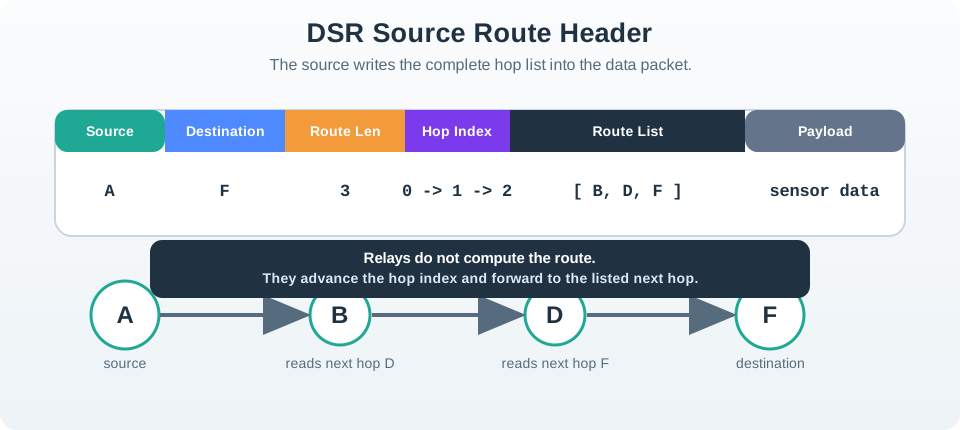
- Source sends: the source caches the route and places the ordered hop list in each data packet so relays know exactly which next hop to use.
DSR source routing narrated tour
Narrated audio tour. The full transcript is below.
Play the tour to open the simulator. Pause, replay a beat, or read the full transcript below.
Some beats explain situations this teaching model cannot show; those beats keep the existing frame and provide captions only.
Full transcript — DSR source routing (8 beats)
B1 — Cache miss
You are the engineer responsible for a rescue tracker as a response team moves. The incident commander needs a route to a firefighter before sending data. A saved route could save a search, but a relay may have moved. How long must the first packet wait?
Model caption: A rescue tracker needs a route before sending data. With no cached route, discovery must come first.
B2 — Route Request
Dynamic Source Routing, or DSR, discovers a route when the sender needs one. The sender broadcasts a Route Request, or RREQ. The destination returns a Route Reply, or RREP. After discovery, every data packet carries the complete route as an ordered list of device addresses.
Model caption: Dynamic Source Routing: a Route Request searches; a Route Reply returns a route; each data packet then carries that route.
B3 — Route Reply
A relay is a device that forwards a message along the path. As relays forward the request, they add their own addresses to its route record. A relay drops a duplicate with the same source and request identifier. The reply brings the selected route back to the sender.
Model caption: Relays add addresses to the request record and suppress duplicate source/request pairs. The reply brings the selected route to the sender.
B4 — Discovery wait
Take the chapter's emergency example: the selected route has three hops, meaning three steps between neighboring devices. Allow ten milliseconds per hop for processing and transmission. The request travels three hops outward; the reply travels three hops back. Six times ten gives about sixty milliseconds before data can use the route.
Model caption: Chapter model: three request hops plus three reply hops equals six traversals. Six times ten milliseconds is about sixty milliseconds until the route is usable.
B5 — Source-route data
For your tracker, that sixty milliseconds is the modeled discovery wait. Once the reply arrives, the sender stores the route in a cache, a record kept for reuse. It also writes the route into each data packet. Each relay reads which address comes next.
Model caption: Discovery took about sixty milliseconds in the chapter's model. The sender saves the route and carries it in each data packet; relays read the next address.
B6 — Cache hit
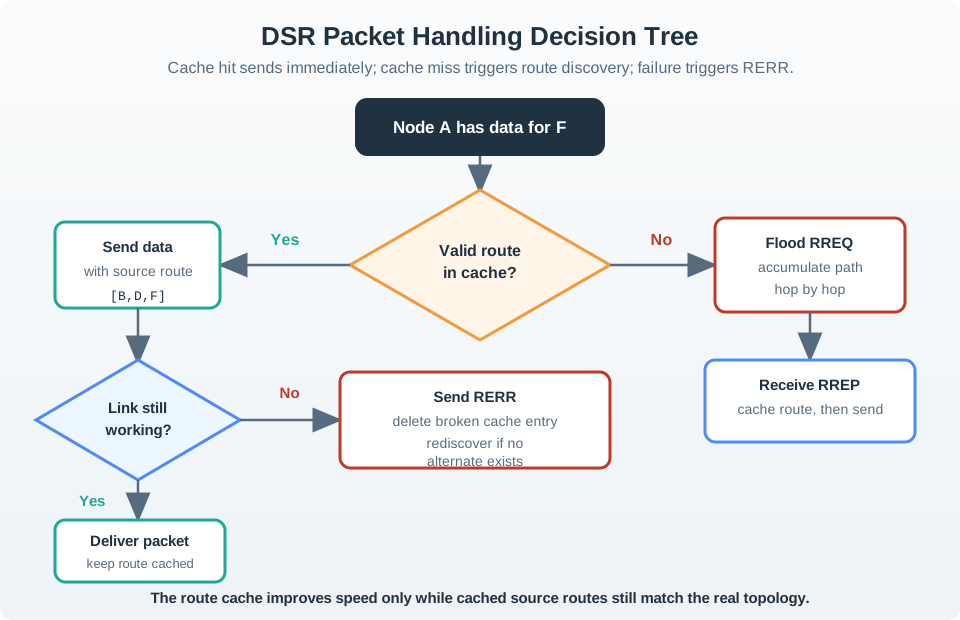
The workbench's cache hit example starts with a usable saved route. The sender skips another request flood and sends data along the stored path. The packet reaches its destination. Reusing a valid route saves another search when the same destination is needed again.
Model caption: A valid cached route carries data to F without a new request flood in this example.
B7 — Route Error
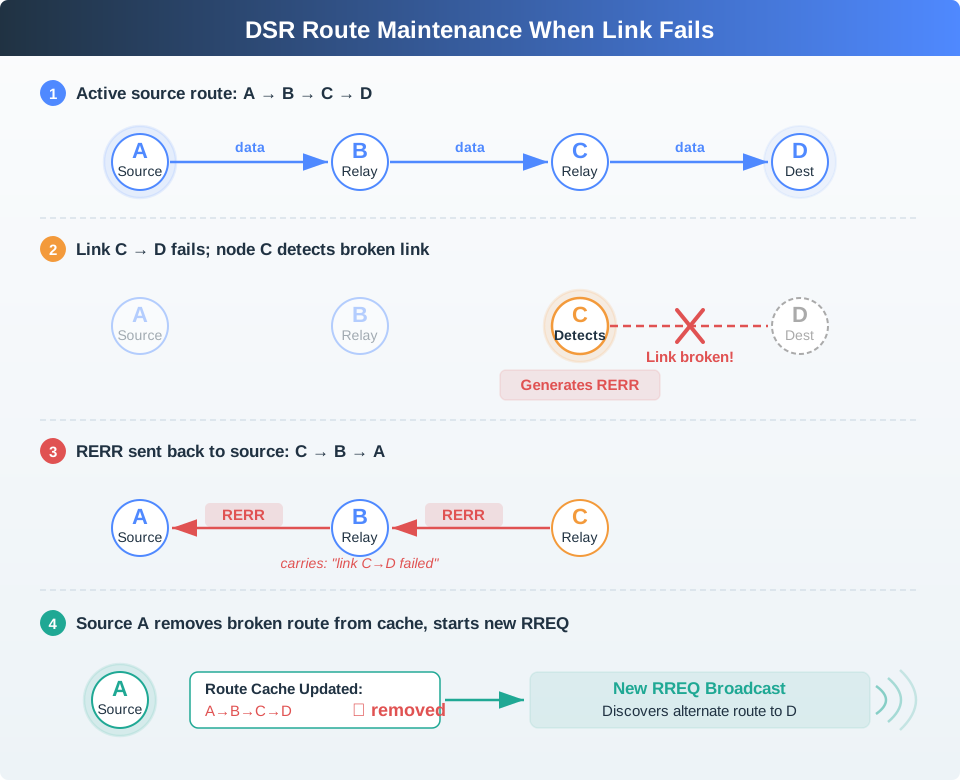
The misconception is that a cached route proves the path still works. A stored address list can outlast a working link. In the broken link example, the final relay cannot reach the destination. It sends a Route Error toward the source, which removes routes containing the failed link.
Model caption: A saved route can be stale. D cannot reach F; its Route Error invalidates cached routes containing D-F.
B8 — Repaired route
In that example, the source starts discovery again. A reply supplies an alternate route, and the repaired data packet reaches the destination along the new path. Your tracker can use the replacement route. Treat a saved route as temporary knowledge that failure can erase.
Model caption: Fresh discovery supplies an alternate route and data reaches F. Treat a saved route as temporary knowledge that failure can erase.
8.3.2 Emergency Route Example
In a small response network, IC can reach F3 through IC-R1-R3-F3 or IC-R2-R4-F3. If the IC-R1-R3-F3 request reaches the destination first, F3 can send a RREP for that path. With a 3-hop route and a modeled 10 ms per-hop processing plus airtime budget, discovery is roughly 3 hops outward plus 3 hops back, or about 60 ms before the first data packet can use the route.
8.3.3 Latency Driver
First-route latency depends mainly on the number of hops traversed and the delay at each hop. On a cache miss, the timing includes the Route Request traveling towards the destination and the Route Reply returning to the source. Per-hop processing, airtime and contention on those paths contribute to the wait before data can use the learned route. Network size affects a different measure: the aggregate work of discovery. More nodes may receive and forward requests, increasing shared airtime use and contention even when the first successful route is short. Assess discovery by recording both the delay until a usable reply arrives and the wider flood overhead.
8.3.4 Duplicate Guard
Relays recognize repeated Route Request copies using the combination of source identity and request ID. When a relay has already seen that pair, it drops the duplicate rather than forwarding it again. This matters because requests spread along different paths, and repeated forwarding through loops can multiply transmissions and consume shared airtime. The guard requires each relay to retain recent source and request ID pairs, so duplicate suppression also has a memory cost. Those records should remain available through the discovery window rather than expiring immediately after forwarding. In a trace, distinguish a request being forwarded from a repeated copy being suppressed: both contribute to understanding the flood’s behavior.
8.3.5 Route Knowledge
The source should trust routes that reach it through a RREP or a valid cache entry. It should not assume every path observed somewhere in the flood is ready to use.
8.4 Tune Cache Age to Mobility
This section: Tune Cache Age to Mobility — DSR cache settings should be chosen from deployment behavior, not from a generic default.
DSR cache settings should be chosen from deployment behavior, not from a generic default. A cached route is valuable when traffic reuses it before the topology changes. It is harmful when it points through a relay that has moved, powered down, or become unreachable.
The field measurement should therefore pair route-cache decisions with the events that made them good or bad. Record the reporting interval, the observed time between useful neighbor changes, route-error frequency, and the cost of one new discovery. Those four values turn “short cache” or “long cache” from a guess into an engineering decision that can be defended after a mobility test.
8.4.1 Cache Timeout Example
Consider a port-yard exercise where container trackers move often and report every 60 seconds. If movement changes useful paths about every 90 seconds, a 300-second cache timeout is too long. The source is likely to reuse a path after the physical neighbor relationships that made it valid have changed.
| Setting | Operational meaning | Likely result | When to use it |
|---|---|---|---|
| Very short cache | Expire routes after only a few seconds. | Fresh routes, but frequent discovery floods. | Fast-moving vehicles or high route-error rates. |
| Mobility-aligned cache | Keep routes for about half to one mobility interval. | Balanced freshness and discovery overhead. | Moderate movement with repeated traffic on the same flow. |
| Long cache | Keep routes for many minutes. | Low discovery overhead if topology is stable; stale-route failures if it is not. | Slow-moving or fixed deployments with sparse but repeated traffic. |
8.4.2 Energy Example
In a wildlife tracking exercise, collars report periodically and move slowly relative to the reporting interval. A fresh discovery before every report would flood the network repeatedly. If the route remains usable for about 45 minutes, caching across several reports can cut discovery energy substantially while preserving a workable stale-route risk.
8.4.3 Fresh Every Time
Starting a fresh discovery before each report favors route freshness but incurs repeated discovery overhead. Each discovery uses shared airtime, consumes energy and adds a wait for the request and reply before data can use the returned route. This policy is appropriate when the cost of attempting stale routes outweighs the cost of flooding, or when reports are so infrequent that useful route reuse is unlikely. Where paths remain usable across several reporting intervals, repeated discovery gives up the energy savings available from caching. Choose this approach using measured movement, reporting intervals, route-error frequency and discovery cost, including the effect of delayed first packets on the application.
8.4.4 Fixed Cache Window
A fixed timeout gives cached routes a defined reuse window chosen from measured movement and reporting intervals. The useful relationship is whether another report is likely to occur while the stored relay sequence remains valid. A longer window can reduce discovery floods when paths are stable, while a window extending beyond useful topology changes can lead to stale-route failures. A route lifetime observed in a slowly moving deployment should therefore be reassessed before use in a vehicle-speed topology. Expiry and failure feedback serve separate purposes: reaching the timeout ends age-based trust, while a Route Error identifies a failed hop that can invalidate a younger entry. Evaluate the setting against field measurements and discovery costs.
8.4.5 Adaptive Cache
Adjust the cache timeout using evidence from route reuse and failure. Rising Route Error frequency is a reason to shorten the period for which stored routes are trusted, because cached relay sequences may no longer match reachable links. When routes remain stable and repeated discovery consumes battery unnecessarily, a longer timeout can allow more reuse between floods. Assess these changes alongside reporting intervals, observed movement, discovery cost and delays caused by stale routes. Timeout adjustment complements targeted invalidation: a Route Error still requires affected cached paths to be removed or marked unusable. Record cache age, failure feedback and the resulting repair or discovery action so the policy can be assessed against deployment behavior.
8.4.6 Route Error Recovery Example
When W1 can no longer reach W2 on a cached path TL-W1-W2-W3-CP, W1 reports the broken link with a Route Error. The source removes affected cached routes and either uses a known alternate path or starts a new RREQ. For urgent traffic, backup route records or lightweight route checks reduce the time spent discovering after a failure.
Do not tune cache timeout from a static testbed alone. Measure route-error rate, movement interval, reporting interval, and the cost of delayed first packets in the actual deployment environment.
8.5 DSR Header, State, and Repair
This section: DSR Header, State, and Repair — The mechanics behind DSR examples are small enough to audit, but each one has a scaling consequence.
The mechanics behind DSR examples are small enough to audit, but each one has a scaling consequence. Source routes grow with path length, duplicate filters consume state, route caches can become asymmetric, and route repair is triggered only after a forwarding failure is detected.
8.5.1 Audit the Packet Math
| Mechanic | What to calculate | Why it matters | Design response |
|---|---|---|---|
| Discovery delay | RREQ hops outward plus RREP hops back, multiplied by per-hop delay. | Controls first-packet latency on a cache miss. | Pre-warm critical routes or use proactive routing for hard latency limits. |
| Source-route header | Route entries times bytes per node ID, compared with payload size. | Small telemetry payloads can become mostly route header on long paths. | Limit path length, compress route identifiers, or use hop-by-hop routing. |
| Duplicate filter | Recent source and request ID pairs held by each relay. | Prevents broadcast multiplication but requires enough memory for active discoveries. | Expire duplicate state after the discovery window, not immediately after forwarding. |
| Repair delay | Ack timeout, RERR propagation, cache lookup, and possible new discovery. | Stale routes turn one packet into a delay spike and extra airtime. | Track route-error rate and maintain alternates for critical destinations. |
8.5.2 Source Routing Overhead Example
If a packet carries an 8-hop route and each compact node ID takes 2 bytes, the route list alone is 16 bytes. With a 20-byte sensor payload, the route list is 16 / (16 + 20), or about 44 percent of the packet before other headers. That is acceptable for some sparse traces and too expensive for many high-rate flows.
8.5.3 Repair Timing Example
A stale cached route fails only after a relay tries to use it and cannot reach the next hop. If detection takes 100 ms, the RERR takes 15 ms to reach the source, and a new discovery takes 200 ms, the source spends roughly 315 ms before it can send on a new route. A valid alternate cached route can skip the discovery part, but only if the source actually has that alternate route record.
8.5.4 Asymmetric Knowledge
An intermediate relay can answer a Route Request using a cached route. The reply gives the source a route record it can store and use, but it does not transfer the relay’s wider cache contents. Nodes can therefore hold different route knowledge within the same network.
This distinction matters during repair. An alternate path known by another node is not automatically available to the source. The source can skip rediscovery only when it holds a valid alternate route record itself. When reading a trace, separate the route returned in the reply from other paths observed or cached elsewhere. Then check the source’s actual cache before deciding whether recovery can use an alternate.
8.5.5 False Confidence
A successful transmission shows that a route carried traffic at that time. Movement, sleeping devices, or changed radio links can make the stored hop sequence unusable before the next packet. Keeping the entry in a cache does not establish current reachability.
Assess reuse through cache age, route-error history, and observed mobility. Age and failure evidence have different meanings: an old route may still work, while a recently learned route may already contain a reported broken hop. Expiry limits how long an entry remains trusted; a Route Error identifies a specific link failure. Remove affected routes and check alternates for that failed hop before reuse. Otherwise, confidence based on earlier delivery can become repeated failure and additional repair delay.
8.5.6 Protocol Boundary
Standard DSR repairs after failure. Applications with strict alert deadlines may need route probes, backup routes, or a different routing family.
8.6 DSR Caching and Route Maintenance
This section: DSR Caching and Route Maintenance
8.6.1 Start Simple
Reject the Route That Worked Yesterday
Picture a mobile sensor reusing a saved path after one relay has moved away. A protocol means the agreed rules and message order devices use to exchange routing information.
Name the source route, cache entry, relay, link-failure signal, expiry rule, and rediscovery action. Test a fresh route, a broken link, a stale alternate, and repeated movement.
Keep cache age, packet path, failure notice, repair choice, delay, and traffic cost. This proves one maintenance rule and movement pattern, not every network; the deeper sections cover caching, errors, salvage, expiry, and rediscovery.
8.6.2 Start With a Cached Route That Might Be Wrong
A DSR cache is helpful until it becomes stale. The node remembers a route so it can avoid rediscovery, but mobility, failed links, and changing traffic can turn that memory into a bad forwarding decision.
Start with one cached route and ask what evidence would make you trust it today. Maintenance is the discipline of detecting broken links, removing bad assumptions, and deciding when discovery must run again.
8.6.3 Cached DSR Routes Expire
Dynamic Source Routing can reuse paths it has discovered or overheard. That reuse is valuable in quiet ad-hoc IoT networks because a sender can avoid another Route Request flood when the same destination is needed again.
The cache is not a permanent map. A cached source route names specific relays, so a moving node, a sleeping device, or a changed radio link can make the route wrong even though it is still stored locally. DSR route maintenance is the discipline that removes broken promises before they become repeated packet loss.
The practical question is therefore not “does the node have a route?” but “can this particular hop list still be defended?” A route learned seconds ago from a stable rack of sensors may be safe enough for another burst, while a route learned before a robot turned a corner may be stale. The cache policy has to match the deployment’s movement, duty cycle, and traffic pattern.
Maintenance also needs the right fault scope. If one adjacent hop fails, every cached source route containing that hop is suspect, but unrelated routes do not have to be discarded. That distinction matters in constrained IoT devices: clearing too little repeats the same broken path, while clearing too much forces avoidable floods, latency, and battery cost. Good DSR operation keeps those two mistakes visible in logs and tests.
For a learner, the mental model is a route notebook with expiration and correction marks. The notebook speeds up forwarding only when each entry has a source, an age, a recent success signal, and a rule for what happens when a relay reports that part of the path no longer works.
Think of DSR caching as a short-lived operational record: it is useful only while the path, link quality, and application tolerance still match the route that was learned.
Inspect Figure 8.4 and look for the event that lets a relay learn without originating another route request.
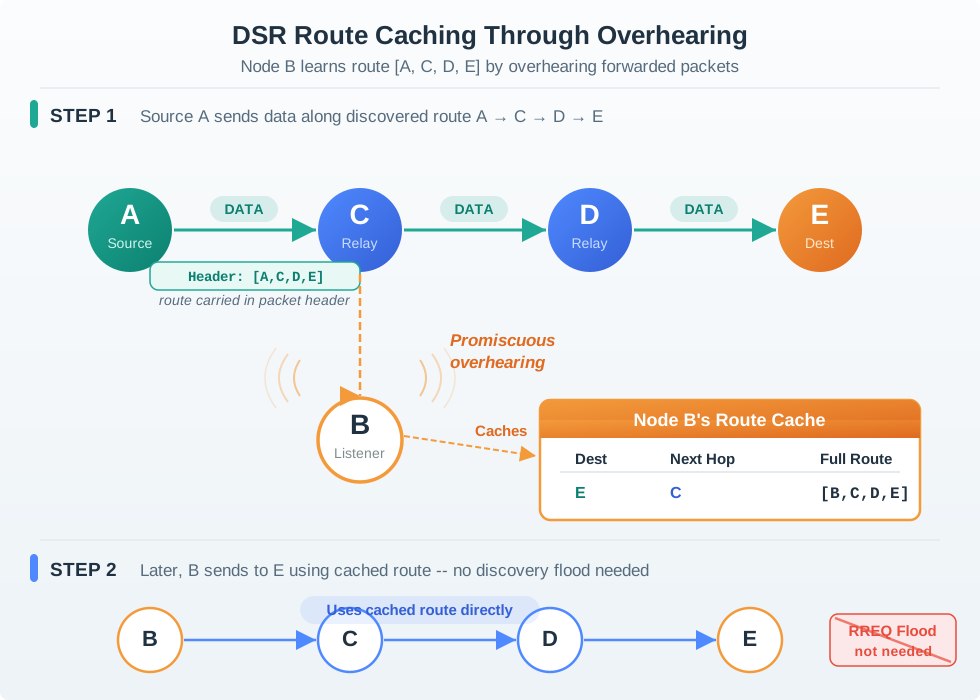
Follow Figure 8.4 from the packet’s source route to the overhearing relay and its cache. Because DSR carries the route inside the packet, a node that hears the transmission can learn a path even when it was not the intended receiver. A later cache hit lets the source reuse that knowledge and avoid another route-request flood. The validity guard is the critical final element: movement, sleep, interference, or a changed link can invalidate the stored sequence. This supports the chapter’s trade-off between discovery overhead and stale state. Overhearing is useful only when cache age, failure feedback, and route revalidation keep an old shortcut from becoming repeated packet loss.
8.6.3.1 Checkpoint: What to Remember
- Cache hit: a valid cached route can skip discovery delay and reduce control traffic for repeated sparse communication.
- Cache age: the acceptable lifetime depends on link churn. Faster movement or more variable links require shorter trust windows.
- Broken link: when a relay cannot reach the next hop in the source route, the route must be invalidated instead of retried blindly.
8.6.4 Bind Cache to Field Signals
A field-ready DSR cache policy needs more than a fixed timeout. The team should record how routes enter the cache, which destinations are worth caching, when a route is too old to trust, what happens after a forwarding failure, and whether a relay is allowed to salvage a packet with an alternate cached route.
8.6.4.1 Cache Maintenance Ledger
| Decision | Record | Why it matters | Failure signal |
|---|---|---|---|
| Cache admission | Which learned or overheard routes may be stored, and whether partial or overheard routes are trusted. | Unfiltered caching can fill memory with routes that will never be reused. | Many entries age out unused or crowd out the route actually needed. |
| Cache lifetime | Expiration rule tied to observed mobility, link churn, traffic cadence, and device sleep behavior. | A route that is safe in a stable sensor mesh may be stale in a moving robot or vehicle scenario. | Packets repeatedly fail on routes that are old but still accepted. |
| Route Error handling | How the source receives a Route Error and removes every cached route containing the failed hop. | Targeted invalidation preserves good alternatives while removing known-bad paths. | The source keeps retrying the same broken relay sequence. |
| Salvage policy | Whether an intermediate relay may replace a broken route with another cached path, and how that action is logged. | Salvage can save a packet, but hidden rerouting can make debugging difficult if it is not bounded. | Packets arrive by unexpected paths with no record of the repair. |
8.6.4.2 Selection Workflow: Operational Flow
- Learn the route: store routes from successful discovery or trusted overhearing with a timestamp and destination.
- Reuse deliberately: use a cached source route only if its age and link history still fit the deployment.
- Detect the break: treat failed next-hop delivery, link-layer feedback, or missing acknowledgement as a route-maintenance event.
- Purge narrowly: remove routes containing the failed hop, then use a valid alternate or begin fresh discovery.
8.6.5 Maintenance as State Transition
Inside a DSR node, a cache entry is not just a list of hops. It has a destination, a source-route sequence, a time learned, a confidence boundary, and a removal trigger. Route maintenance moves entries between usable, suspect, invalidated, and replaced states as link observations arrive.
The invalidation key is usually more precise than the destination. A Route Error identifies an adjacent-hop pair that failed, so cache maintenance should search for every stored source route containing that pair and mark only those entries unusable. This keeps unrelated paths available while preventing the failed hop from reappearing through a different cached route for the same destination.
Age is a separate signal. A route can be old without being proven broken, and a route can be young but already invalid because a relay reported a failed next hop. Robust implementations keep those reasons distinct: timeout removes entries because confidence has decayed, while a Route Error removes entries because evidence says a specific link no longer carries traffic.
Salvage adds another state transition. If an intermediate relay has an alternate cached path, it may forward the packet without sending it all the way back to the source first. That can reduce delay, but it must still generate maintenance evidence: which route was replaced, which hop failed, which alternate was used, and whether the source cache should be corrected. Without that record, a successful salvage can hide the original fault and let the sender reuse the bad path later.
Backoff closes the loop. When no valid cached path remains, the node returns to route discovery, but repeated discovery floods for the same unreachable destination should be paced. The implementation state machine should therefore connect cache lookup, expiration, Route Error processing, salvage, and discovery backoff rather than treating them as isolated helper functions.
8.6.5.1 Selection Workflow: Cache States
- Usable: the route is young enough, the destination is still needed, and no known failed hop appears in the sequence.
- Suspect: the route is aging, a relay has weak recent delivery, or mobility suggests that a fresh discovery may be cheaper than repeated failure.
- Invalidated: a Route Error or delivery failure has identified a broken hop. All entries containing that hop are removed or marked unusable.
Do not let salvage hide failure. If an intermediate relay substitutes another cached path, the source still needs a record that the original hop failed, otherwise the same stale route may be reused later.
8.6.5.2 Checkpoint: Implementation Checks
- Cache lookup rejects expired routes before packet transmission.
- Route Error processing removes every route containing the failed adjacent-hop pair.
- Alternate cached routes are checked for the same failed hop before reuse.
- Discovery backoff prevents rapid repeated floods for the same unreachable destination.
- Logs expose the route used, the cache age, the invalidation trigger, and the final retry action.
8.6.6 Summary
DSR route caching reduces route discovery overhead when cached source routes remain valid. The same mechanism becomes a liability when mobility, sleep cycles, or link churn make cached relay sequences stale. Route maintenance keeps the cache trustworthy by expiring old entries, reacting to forwarding failures, sending Route Error information back toward the source, and purging only the routes affected by the failed hop.
The practical rule is qualitative: trust cached DSR routes only for as long as the deployment can defend them. Stable, sparse sensor traffic can benefit from longer reuse windows; moving nodes and unstable radio links need shorter trust windows, targeted invalidation, and clear retry behavior.
8.6.7 Key Takeaway
A DSR cache entry is not proof of a current path. It is a temporary route promise that must expire, be invalidated by Route Errors, or be replaced by fresh discovery when the topology changes.
8.6.8 See Also
8.7 Summary
This section: Summary — DSR worked examples should trace the protocol from discovery to repair.
DSR worked examples should trace the protocol from discovery to repair. The route request and reply explain first-packet latency. The cache explains why sparse traffic can save energy. Route errors explain why stale entries become delay spikes. Source-route headers explain why long paths and small payloads can make DSR expensive even when discovery itself succeeds.
8.8 Key Takeaway
This section: Key Takeaway
DSR is strongest when traffic is sparse, routes are short enough for source headers to stay modest, and cache lifetimes are matched to measured mobility. The practical skill is not memorizing one timeout or path rule; it is reading each trace for freshness, overhead, and repair cost before trusting the route.
8.9 See Also
This section: See Also
Find help
3 reviewed answers.
Where should I start in a module?
Open the module page from the sidebar to see its chapters in order. Use the module map to return to a topic you need.
Modules and pathsReviewed
What can I try when a project does not work?
Check the symptom, then work through the diagnostic steps. Keep the error message and the smallest example that reproduces it.
When you are stuckReviewed
How do interactive examples work?
Use the interactive guide to check how examples and simulations work before changing your project.
Interactive examples guideReviewed