64  S2aaS Value Creation and Challenges

In 60 Seconds

Sensing-as-a-Service (S2aaS) creates a multi-sided marketplace where sensor owners monetize idle capacity and consumers pay per-query rather than deploying infrastructure. A smart home with 20 sensors could generate $5-50/month in data revenue, but privacy is the critical barrier: 67% of consumers will not share home sensor data without strong anonymization. The S2aaS business model succeeds when per-sensor data acquisition cost drops below $0.01/reading – achievable through aggregation across 10,000+ data consumers.

64.1 Learning Objectives

By the end of this chapter, you will be able to:

  • Analyze Stakeholder Value: Quantify benefits for sensor owners, data consumers, platform providers, and society
  • Evaluate Success Factors: Assess technological enablers, economic incentives, and regulatory drivers supporting S2aaS
  • Design Smart Home Data Markets: Balance personal privacy with value creation through selective sharing and compensation
  • Diagnose Adoption Barriers: Classify technical, business, social, and ethical challenges blocking S2aaS ecosystem growth
  • Plan Future Directions: Evaluate emerging technologies like federated sensing, AI-driven quality, and blockchain provenance
Minimum Viable Understanding
  • S2aaS creates value for four stakeholder groups simultaneously: sensor owners earn passive income (40-200% ROI improvement), data consumers save 80-90% versus building their own sensor infrastructure, platform providers earn 15-30% transaction fees with network effects, and society benefits from reduced redundant infrastructure.
  • Smart home data is the frontier and the biggest privacy challenge: 50+ sensor streams per home require privacy-preserving aggregation, granular consent, and fair compensation models (e.g., tiered pricing where users choose privacy level versus cost).
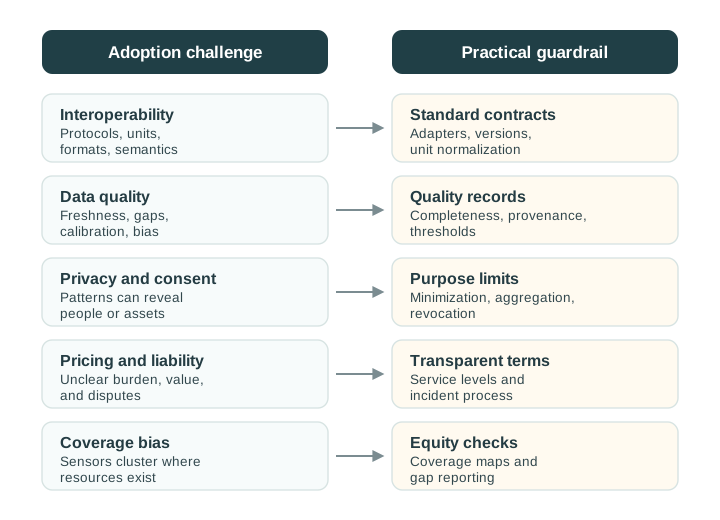
  • Five challenge categories block mass adoption: technical interoperability, business model pricing uncertainty, social digital divide, ethical surveillance risks, and regulatory frameworks that lag behind the technology.

Sammy the Sensor is really good at measuring temperature in the school hallway. But most of the time, the hallway is empty and nobody is looking at the readings!

Lila the Lightbulb says: “That’s like having a library book you never read. What if someone else could borrow your data while you’re not using it?”

Max the Microcontroller explains: “Imagine our school has 100 sensors. Instead of every science teacher buying their own thermometer, they could all share Sammy’s readings! The school saves money, the teachers get data faster, and Sammy feels useful all day long.”

Bella the Battery warns: “But we have to be careful! If Sammy is in someone’s bedroom, sharing that data could tell strangers when they’re sleeping or away. We need to ask permission first and make sure private stuff stays private.”

Think of it like a lemonade stand: the person with lemons (sensor owner) teams up with someone who has sugar (the platform), and together they sell lemonade (data) to thirsty customers (data consumers). Everyone wins – but only if they agree on a fair recipe and price!

Sensing-as-a-Service (S2aaS) is like a sharing economy for sensor data. Instead of every organization buying and installing its own sensors, they can rent access to data from sensors that already exist.

Why does this matter? Consider a simple example: a city wants air quality data from 500 locations. Building a dedicated sensor network costs $750,000 plus ongoing maintenance. With S2aaS, they subscribe to data from sensors already installed on buildings, streetlights, and vehicles for a fraction of the cost.

The four groups who benefit:

  1. Sensor owners – earn money from sensors they already have (like renting out a spare room on Airbnb)
  2. Data consumers – get data immediately without buying hardware (like streaming music instead of buying CDs)
  3. Platform providers – earn fees for connecting buyers and sellers (like how eBay makes money)
  4. Society – fewer redundant sensors means less waste, and more people can access data

The catch: sensor data can be very personal (especially from smart homes), so privacy, fairness, and trust are essential challenges to solve before S2aaS can reach its full potential.

Full MVU Context

If you only have 10 minutes, focus on these three essentials:

  1. Multi-stakeholder value creation: S2aaS generates value for four groups simultaneously – sensor owners monetize idle infrastructure (ROI improvement of 40-200%), data consumers reduce costs by 80-90% compared to dedicated deployments, platform providers earn 15-30% transaction fees with network effects, and society benefits from reduced redundant infrastructure and democratized data access.

  2. Smart home data is the frontier: The average smart home generates 50+ sensor data streams (temperature, motion, energy, cameras, voice). Personal data markets require privacy-preserving aggregation, granular consent (not buried in terms of service), and fair compensation models (e.g., tiered pricing where users choose between paying $20/month for full privacy or receiving free service with data sharing).

  3. Five challenge categories block adoption: Technical (interoperability across heterogeneous sensors), business (fair pricing in nascent markets), social (digital divide where wealthy areas have more sensors), ethical (surveillance risks from ubiquitous sensing), and regulatory (evolving frameworks like GDPR struggling to keep pace with sensor data markets).

Key insight to remember: S2aaS follows the same trajectory as cloud computing (ownership to service model) and the sharing economy (monetizing underutilized assets). Both analogies suggest S2aaS will succeed, but sensor data raises unique privacy and quality challenges that cloud VMs and spare bedrooms do not.

64.2 Prerequisites

Before diving into this chapter, you should be familiar with:

  • S2aaS Core Concepts: Understanding the S2aaS service model and ecosystem provides foundation for value analysis
  • S2aaS Data Ownership: Knowledge of ownership models and privacy considerations informs value and challenge discussions

Key Concepts

  • Value Proposition for Sensor Owners: Revenue generation from existing infrastructure — a $50/month sensor generating $500/month in data sales achieves 10× ROI by serving multiple consumers simultaneously
  • Value Proposition for Data Consumers: Access to sensor data without infrastructure investment — consumers pay only for data they use, avoiding capex, maintenance, and geographic coverage limitations
  • Platform Provider Value: Commission revenue (typically 20–30%) from every transaction between owners and consumers, plus premium services (analytics, quality certification, SLA guarantees)
  • S2aaS Adoption Success Factors: Standardized data formats, transparent quality metrics, clear data rights, and critical mass of sensors creating a network effect that attracts consumers
  • Technical Challenges: Heterogeneous device protocols, inconsistent data quality, real-time delivery requirements, and scale management across millions of sensors
  • Business Challenges: Establishing trust between owners and consumers, preventing free-riding (data scraped without payment), building critical mass (chicken-and-egg marketplace problem)
  • Privacy and Social Challenges: Sensor data revealing individual behavior patterns, cross-sensor re-identification, and the need for transparent privacy controls that build consumer trust

64.3 Introduction

Sensing-as-a-Service transforms how organizations and individuals access sensor data, but the critical question is: who benefits, and at what cost? This chapter examines S2aaS through the lens of value creation and the real-world challenges that stand between the current state of fragmented sensor deployments and a thriving sensor data marketplace.

The S2aaS value proposition is inherently multi-sided. Unlike a simple vendor-customer relationship, S2aaS creates a marketplace where sensor owners, data consumers, platform operators, and society at large each derive distinct benefits. Understanding these value flows is essential for designing sustainable S2aaS ecosystems.

However, value creation does not happen automatically. Technical barriers (heterogeneous sensors that do not interoperate), business uncertainties (how do you price data from a temperature sensor?), social concerns (digital divide in sensor coverage), and ethical dilemmas (ubiquitous sensing enabling surveillance) all threaten adoption. We examine each challenge category and survey emerging solutions, from federated sensing to blockchain-based data provenance.

S2aaS challenge landscape mindmap showing five challenge categories radiating from a central S2aaS Adoption node: Technical challenges (interoperability, data quality, scalability), Business challenges (pricing, liability, market concentration), Social challenges (digital divide, access equity), Ethical challenges (surveillance, bias, consent), and Regulatory challenges (GDPR, data portability, evolving frameworks)

How It Works: S2aaS Multi-Stakeholder Value Flow

The Core Mechanism: S2aaS creates a multi-sided marketplace where sensor owners, data consumers, platform providers, and society each extract unique value from the same sensor infrastructure.

Step-by-Step Value Creation:

  1. Sensor Owner Onboarding: A building owner with 200 environmental sensors (originally deployed for facility management at $50K) registers sensors on the S2aaS platform with metadata (location, type, accuracy, SLA guarantees)

  2. Platform Abstraction: The platform virtualizes physical sensors into standardized API endpoints (REST/MQTT), handling data collection, quality validation (outlier detection, uptime monitoring), and multi-tenant access control

  3. Data Consumer Discovery: Urban planners, researchers, and real estate analysts search the platform’s sensor registry using geospatial queries (all sensors within 5km radius) or type-based filters (air quality PM2.5 sensors only)

  4. Subscription and Payment: Data consumers subscribe to sensor streams at tiered pricing: Real-time tier ($50/month per sensor, <1s latency), Standard tier ($10/month, <5min latency), or Research tier ($2/month, hourly aggregates)

  5. Value Distribution: Platform collects $62/month per sensor average across three tiers, pays sensor owner $5/month (passive income totaling $1,000/month for 200 sensors), keeps $57/month as transaction fee and infrastructure cost, and society benefits from reduced redundant deployments

  6. Network Effects: As more sensors join (10,000 total), data consumers get broader coverage at same cost, attracting more consumers, which increases revenue per sensor, incentivizing more sensor owners to join – creating a virtuous growth cycle

Real-World Numbers: In a city with 10,000 shared sensors, a single air quality monitoring application can access citywide data for $5,000/month subscription versus $750,000 to deploy dedicated sensors – an 84% cost reduction over 2 years. The sensor owners collectively earn $50,000/month passive income from assets that were already deployed and paid for.

Why This Works: The key insight is that sensor data is non-rivalrous (1,000 applications can consume the same temperature reading without interfering with each other), enabling one-to-many value multiplication that physical assets cannot achieve.

64.4 Stakeholder Value

⏱️ ~8 min | ⭐⭐ Intermediate | 📋 P05.C15.U03

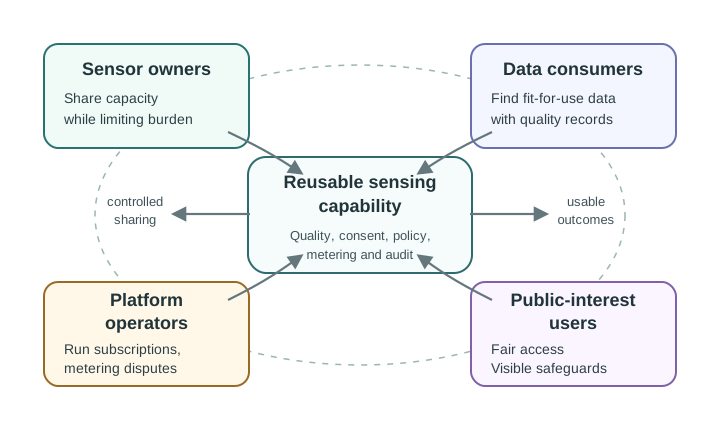
S2aaS creates value for multiple stakeholders through different mechanisms, driving ecosystem growth and sustainability. The following diagram illustrates how value flows between the four key stakeholder groups.

S2aaS value flow diagram showing four stakeholder groups (sensor owners, data consumers, platform providers, society) connected by value exchange arrows including revenue, reduced costs, transaction fees, network effects, innovation enablement, and resource efficiency

Think of S2aaS like a library system. Sensor owners are like people who donate books – they already own them and get tax benefits (or in this case, rental income). Data consumers are like library users – they get access to thousands of books without buying any. The platform is the library itself – it earns funding by connecting readers to books. Society benefits because knowledge (data) flows more freely, enabling research and innovation that would otherwise be too expensive.

The key difference from a library: sensor data can be “read” by millions of people simultaneously without anyone losing access. This makes shared sensing even more powerful than shared physical assets.

64.4.1 Value for Sensor Owners

Revenue Generation: Monetize infrastructure investments through data sales, subscription fees, or usage charges. A building owner with 200 environmental sensors (originally deployed for facility management at $50,000 total cost) can generate $500-2,000/month in passive income by offering anonymized data to urban planners, researchers, and real estate analysts – achieving full ROI within 2-4 years while the sensors continue serving their primary purpose.

Asset Utilization: Maximize return on sensor investments by serving multiple purposes and customers. Traffic cameras deployed for law enforcement (costing $5,000-15,000 each) can simultaneously provide data streams to urban planners (traffic flow patterns), transportation companies (congestion routing), and emergency services (incident detection) – effectively turning a single-purpose investment into a multi-revenue asset.

Infrastructure Optimization: Insights from third-party analytics improve the owner’s own operations. When a municipality shares air quality data with university researchers, those researchers may identify pollution sources and seasonal patterns that enable targeted remediation – improving the municipality’s environmental outcomes at zero additional cost.

Social Good: Contributing to public welfare and sustainability through data sharing. The Weather Underground network demonstrates this: over 250,000 personal weather station owners voluntarily share data, creating hyperlocal forecasts that improve accuracy by 30-40% compared to national weather service stations alone.

64.4.2 Value for Data Consumers

The cost advantage for data consumers is dramatic. The following comparison illustrates why S2aaS is transformative for organizations that need sensor data but lack the infrastructure.

Factor Dedicated Deployment S2aaS Subscription Savings
500 air quality sensors $750,000 capital $5,000/month subscription 84% over 2 years
Time to first data 6-12 months Same day 99% faster
Maintenance staff 2-3 FTEs ($200K/year) Included 100% savings
Geographic coverage Single city Nationwide 50x broader
Sensor replacement Owner responsibility ($50K/year) Provider handles $0 ongoing

Reduced Capital Costs: Eliminate the need to purchase, deploy, and maintain sensors. For a research university studying urban heat islands, accessing 500 temperature sensors through S2aaS at $120K over 2 years replaces $750K in dedicated deployment costs.

Faster Deployment: Move from concept to operational data in hours rather than months. A startup building a health advisory app can access nationwide air quality data on day one, rather than spending 12 months deploying and calibrating thousands of sensors.

Broader Coverage and Diverse Sources: Access sensing across larger geographic areas than any single organization could feasibly deploy, combining data from multiple sensor types and locations. A logistics company optimizing delivery routes can fuse traffic sensors, weather stations, and road condition monitors from different S2aaS providers into a unified intelligence layer.

Scalability and Reduced Risk: Scale sensing capacity up or down based on needs without infrastructure constraints. Test hypotheses and validate business models with $500/month of sensor data before committing to a $500,000 deployment – reducing the risk of failed IoT projects from 75% (industry average for large deployments) to manageable levels.

64.4.3 Value for Platform Providers

Transaction Fees: Revenue from facilitating connections between owners and consumers.

Data Aggregation Value: Creating valuable datasets by combining multiple sensor sources.

Analytics Services: Providing value-added processing and insights.

Network Effects: Platform value increases with more sensors and users.

Example: Sensor data marketplace grows more valuable as it attracts both sensor owners and data consumers, creating virtuous cycle.

64.4.4 Value for Society

Resource Efficiency: Reduced redundant sensor deployments conserve resources.

Environmental Benefit: Less electronic waste and energy consumption.

Innovation Enablement: Lower barriers to entry foster innovation in sensing applications.

Public Good Applications: Research, public health, environmental monitoring, and emergency response benefit from shared data.

Democratic Data Access: Smaller organizations and individuals access capabilities previously limited to large institutions.

Example: Community organizations access environmental data to advocate for local improvements, enabled by S2aaS reducing data access barriers.

64.5 Why This Could Work

Diagram showing three S2aaS pricing models: pay-per-use (charged by API call or data volume), tiered subscriptions (basic/research/enterprise levels), and revenue sharing arrangement (70-85% to sensor owners, 15-30% platform fee)
Figure 64.1: Pricing models in sensor cloud platforms - pay-per-use, subscription, and revenue sharing mechanisms
Context-aware Visualization (CoVI) architecture showing adaptive data presentation layer that adjusts visualization format, detail level, and interface based on user role, device capabilities, network bandwidth, and task context
Figure 64.2: Context-aware Visualization (CoVI) for sensor data enabling intelligent data presentation based on user context

Despite challenges, several factors suggest S2aaS has strong potential for widespread adoption and success.

64.5.1 Proven Analogies

Cloud Computing Success: S2aaS mirrors cloud computing’s transformation of IT infrastructure from ownership to service model.

Parallels:

  • Shared infrastructure → lower costs
  • Pay-per-use → flexibility
  • Reduced capital investment → accessibility
  • Economies of scale → efficiency

Sharing Economy Momentum: Success of Airbnb, Uber, and similar platforms demonstrates viability of monetizing underutilized assets.

Application to Sensors:

  • Sensors often underutilized (especially fixed infrastructure)
  • Multiple parties can benefit from same data
  • Technology platforms facilitate marketplace

64.5.2 Technological Enablers

Cloud Platforms: Scalable infrastructure for data storage, processing, and delivery.

IoT Standards: Interoperability protocols enable heterogeneous sensor integration.

API Ecosystems: Easy integration of sensor data into applications.

Edge Computing: Local processing enables privacy preservation and bandwidth optimization.

Blockchain/Distributed Ledger: Potential for transparent, auditable data transactions and provenance.

AI/ML: Automated data quality assurance, anomaly detection, and value extraction.

64.5.3 Economic Incentives

Win-Win Proposition: Owners generate revenue, consumers reduce costs—mutual benefit drives adoption.

Network Effects: Each additional sensor and user increases platform value, creating growth momentum.

Reduced Barriers: Lower costs enable new applications previously economically infeasible.

Example: Precision agriculture startup accesses weather and soil sensors across farm regions, providing services to small farmers who couldn’t afford dedicated sensing.

### Use Case Breadth

Environmental Monitoring: Air quality, water quality, noise, weather—multiple stakeholders interested.

Smart Cities: Traffic, parking, infrastructure health—municipalities, businesses, researchers.

Building Management: Occupancy, energy, comfort—owners, tenants, facility managers.

Agriculture: Soil moisture, weather, crop health—farmers, agronomists, commodity traders.

Transportation: Vehicle location, road conditions, traffic—logistics, planners, commuters.

Health and Wellness: Personal health metrics, environmental exposures—individuals, researchers, healthcare providers.

Retail and Marketing: Foot traffic, demographics, behavior—retailers, advertisers, property owners.

64.5.4 Regulatory Drivers

Open Data Mandates: Governments requiring public access to publicly-funded sensor data.

Example: European Union’s Public Sector Information Directive requires member states to make public sector data available for reuse.

Environmental Regulations: Monitoring requirements creating sensor infrastructure that can serve multiple purposes.

Smart City Initiatives: Municipal investments in sensor infrastructure seeking broader value and cost recovery.

64.6 Smart Home and Personal Data

Smart homes represent a particularly interesting and challenging domain for S2aaS, balancing personal privacy with potential value creation.

Smart home data sensitivity spectrum showing sensor types arranged from low sensitivity (outdoor temperature, ambient light) through medium sensitivity (energy usage, appliance patterns) to high sensitivity (indoor cameras, voice recordings, health monitors), with corresponding privacy controls required at each level: open sharing for low, anonymized aggregation for medium, and explicit opt-in consent with encryption for high sensitivity data

64.6.1 Smart Home Sensing Landscape

Device Proliferation: Modern smart homes contain dozens of sensors across various systems:

Environmental:

  • Temperature and humidity sensors
  • Air quality monitors
  • Light sensors
  • Motion detectors
  • Smoke and carbon monoxide detectors

Security:

  • Door/window sensors
  • Cameras (indoor and outdoor)
  • Microphones (smart speakers)
  • Glass break detectors

Energy Management:

  • Smart meters
  • Appliance monitors
  • Solar production sensors

Comfort and Convenience:

  • Presence detection
  • Occupancy sensors
  • Voice assistants

Health and Wellness:

  • Sleep tracking
  • Activity monitors
  • Weight scales

64.6.2 Personal Data Value

Internal Value (to Homeowner):

  • Automation and convenience
  • Energy optimization
  • Security and safety
  • Health insights
  • Comfort management

External Value (to Third Parties):

  • Energy utilities: Load forecasting and demand response
  • Researchers: Behavioral patterns, energy usage, health studies
  • Marketers: Consumer behavior and preferences
  • Urban planners: Occupancy patterns, commute patterns
  • Insurance: Risk assessment (health, property)
  • Real estate: Property value analytics

64.6.3 Privacy Challenges

Sensitive Information Exposure: Home sensors reveal intimate details of private life: - Daily routines and schedules - Presence and occupancy - Sleep patterns and quality - Relationship dynamics (number of occupants, visitors) - Health conditions and behaviors - Entertainment preferences - Financial status (indirectly through energy use, appliances)

Security Risks:

  • Burglars determining when home is empty
  • Stalking through location patterns
  • Surveillance without consent
  • Data breaches exposing private information

Lack of Control: Many smart devices controlled by manufacturers, not homeowners, limiting data governance.

64.6.4 Enabling Personal Data Markets

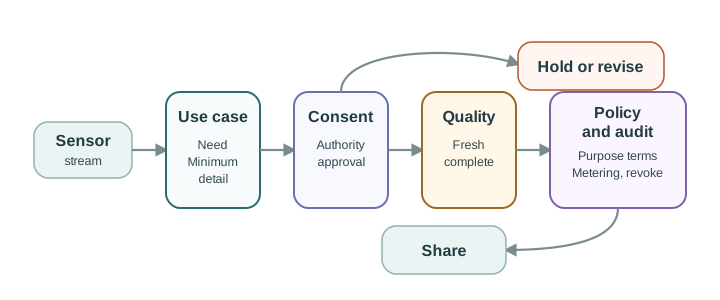
Personal data store architecture for smart home S2aaS showing sensor data flowing from smart home devices into a homeowner-controlled personal data vault, with granular permission controls branching to different third-party consumers: energy utilities receive anonymized energy data, researchers receive aggregated behavioral data, and insurance companies are blocked by default, with audit logs tracking all access and a compensation engine calculating payments to the homeowner

Privacy-Preserving Aggregation: Combining data from many homes provides value while protecting individuals.

Example: Energy utility accesses aggregated thermostat data from 1000 homes for load forecasting without identifying individual homes.

Selective Sharing: Homeowners choose what data to share with whom under what conditions.

Example: Share occupancy patterns with city planners (anonymized) but not with marketers; share energy data with utility but not with insurance companies.

Compensation Models: Fair value exchange for personal data.

Models:

  • Direct payment for data access
  • Service discounts (energy bill reduction for sharing data)
  • Improved services (better insurance rates, personalized recommendations)
  • Contribution to research (altruistic motivation with compensation)

Personal Data Stores: Individuals maintain control through personal data management platforms.

Approach:

  • All home sensor data flows to personal data store
  • Homeowner grants granular permissions to third parties
  • Audit logs of all data access
  • Ability to revoke access anytime

Example Platform: Personal data vault aggregates smart home data; homeowner reviews requests from utilities, researchers, or businesses and grants time-limited, purpose-specific access with compensation.

64.6.5 Regulatory Framework

Ownership Rights: Clarifying homeowners’ rights over data generated in their homes.

Consent Management: Requiring explicit, informed consent for data collection and use beyond primary device functionality.

Portability: Right to export data from proprietary systems.

Deletion: Right to have data deleted from third-party systems.

Transparency: Clear disclosure of what data is collected, how it’s used, who has access.

Accountability: Mechanisms for enforcing data governance and compensating privacy violations.

64.6.6 Success Factors for Personal S2aaS

Trust: Demonstrating responsible data practices builds confidence in sharing.

Control: Empowering individuals with granular control over their data.

Value: Providing meaningful benefits (monetary or otherwise) for data sharing.

Simplicity: Making consent management and privacy controls easy to understand and use.

Defaults: Privacy-protective defaults (opt-in rather than opt-out).

Transparency: Clear communication about data practices and uses.

64.6.7 Case Studies

Nest Thermostat (Google):

  • Aggregates temperature data from millions of homes
  • Uses for energy grid optimization
  • Provides energy reports to homeowners
  • Privacy approach: Anonymization and aggregation
  • Value proposition: Better grid management, energy savings

Opower (Oracle):

  • Access home energy data from smart meters
  • Provides comparative energy reports
  • Helps utilities with demand response
  • Privacy approach: Utility already has data; Opower adds analytics
  • Value proposition: Energy savings for homeowners, grid optimization for utilities

Open Humans:

  • Platform for individuals to share personal data for research
  • Includes health, genomic, activity data
  • User controls data access
  • Privacy approach: Explicit consent for each research project
  • Value proposition: Contributing to science, personal insights

64.7 Challenges and Future Directions

Multi-tier caching architecture for sensor cloud showing edge cache (sensor gateway level), regional cache (fog nodes), and central cloud cache, with cache invalidation policies and time-to-live mechanisms for balancing freshness versus performance
Figure 64.3: Architecture of caching in sensor cloud platforms for efficient data access and reduced latency
Performance measurement graphs showing sensor cloud throughput (queries per second versus number of concurrent users), response time latency (average 100-500ms for cloud processing, 10-50ms for edge processing), and data ingestion rates (thousands of sensor updates per second)
Figure 64.4: Performance metrics of sensor cloud platforms showing throughput and response time characteristics
Comparative performance analysis showing centralized cloud deployment (high latency, high throughput) versus edge-fog hybrid deployment (low latency, moderate throughput) versus fully distributed deployment (lowest latency, limited throughput), with trade-offs between response time, scalability, and infrastructure cost
Figure 64.5: Performance comparison of different sensor cloud deployment strategies and configurations

64.7.1 Technical Challenges

Interoperability: Heterogeneous sensors, protocols, and data formats complicate integration.

Solution Approaches:

  • Standardization efforts (IoT standards, APIs)
  • Translation layers and adapters
  • Semantic data models

Data Quality: Varying sensor accuracy, calibration, and reliability.

Approaches:

  • Quality ratings and certifications
  • Redundancy and cross-validation
  • Automated anomaly detection

Scalability: Managing millions of sensors and vast data volumes.

Solutions:

  • Cloud infrastructure
  • Edge processing
  • Efficient data compression and summarization

64.7.2 Business Model Challenges

Pricing: Determining fair value for sensor data in nascent markets.

Approaches:

  • Usage-based pricing
  • Tiered subscriptions
  • Auction mechanisms
  • Dynamic pricing based on demand

Liability: Who’s responsible for inaccurate data or service failures?

Considerations:

  • Service level agreements (SLAs)
  • Limited liability clauses
  • Insurance mechanisms
  • Quality guarantees

Market Concentration: Risk of monopolistic platforms controlling access.

Mitigations:

  • Open standards
  • Federated platforms
  • Regulatory oversight

64.7.3 Social and Ethical Challenges

Digital Divide: Ensuring equitable access to sensing capabilities.

Concerns:

  • Wealthy areas have more sensors
  • Cost barriers for disadvantaged communities
  • Data deserts in rural areas

Surveillance: Ubiquitous sensing enabling oppressive surveillance.

Safeguards:

  • Purpose limitations
  • Judicial oversight for sensitive applications
  • Transparency requirements
  • Sunset provisions

Bias and Discrimination: Sensor deployments and data access reflecting existing inequalities.

Example: Air quality sensors concentrated in affluent neighborhoods while industrial pollution affects poorer areas.

Mitigations:

  • Equitable sensor deployment policies
  • Community engagement
  • Public interest requirements for platforms

64.7.4 Future Directions

S2aaS future technology roadmap showing six emerging technologies in a timeline from near-term to long-term: AI-driven quality assurance and IoT standards harmonization in the near term, blockchain data provenance and federated sensing in the mid-term, and privacy-preserving computation such as homomorphic encryption and personal data cooperatives in the long term, each with arrows showing how they address current challenges

Federated Sensing: Decentralized platforms avoiding single points of control while enabling data sharing.

AI-Driven Quality Assurance: Automated validation, calibration, and anomaly detection improving data reliability.

Blockchain for Data Provenance: Transparent, auditable records of data collection, ownership, and transactions.

Privacy-Preserving Technologies: Homomorphic encryption, secure multi-party computation enabling analytics on sensitive data without exposure.

Personal Data Cooperatives: Collective bargaining for data rights and compensation, empowering individuals.

Regulatory Evolution: Frameworks balancing innovation, privacy, and public good in sensing ecosystems.

Common Pitfalls in S2aaS Value and Challenge Analysis

1. Assuming anonymization equals privacy. Anonymized sensor data can often be re-identified through correlation attacks. The Netflix Prize dataset (2006) showed that supposedly anonymous movie ratings could identify 99% of users by correlating with public IMDB reviews. Smart home data is even more vulnerable – energy usage patterns alone can reveal when occupants wake up, cook meals, or leave for work.

2. Overestimating willingness to share data for money. Studies consistently show that most consumers value privacy over small financial incentives. Offering $5/month for smart home data will not achieve high participation rates. Successful models provide tangible utility (better energy efficiency, personalized services) rather than purely monetary compensation.

3. Ignoring the digital divide in deployment planning. S2aaS platforms naturally have more sensors in affluent areas (more smart homes, more IoT devices). Building services on this biased infrastructure perpetuates inequality – air quality monitoring concentrated in wealthy neighborhoods while industrial pollution affects underserved communities. Equitable deployment requires active intervention, not market forces alone.

4. Treating sensor data pricing like software pricing. Sensor data depreciates rapidly (real-time traffic data is worth far more than yesterday’s data), varies enormously in quality (a calibrated industrial sensor versus a $5 consumer sensor), and has complex provenance requirements. Copy-pasting SaaS pricing tiers without accounting for data freshness, quality, and coverage leads to market failure.

5. Underestimating regulatory complexity across jurisdictions. GDPR in Europe, CCPA in California, LGPD in Brazil, and POPIA in South Africa all have different requirements for sensor data consent, portability, and deletion. A global S2aaS platform must handle dozens of regulatory frameworks simultaneously – building for one jurisdiction and assuming others are similar is a recipe for compliance failures.

64.8 S2aaS Value Creation Calculator

Quantify the multi-stakeholder value generated by your S2aaS platform:

64.10 Worked Example: S2aaS Revenue Model for Urban Air Quality Monitoring

Worked Example: Building a Sensor Marketplace for 10,000 Personal Weather Stations

Scenario: A startup creates an S2aaS platform connecting 10,000 personal weather station owners (who already have outdoor air quality sensors) with data consumers: a city government (urban planning), a real estate platform (neighborhood quality scores), and an asthma research hospital. The question: can this be a viable business?

Step 1: Sensor Owner Value Proposition

Parameter Value
Weather stations with PM2.5 sensor (already owned) 10,000 across a metro area of 5 million people
Average sensor cost to owner $200 (already paid, sunk cost)
Data generated per station 1 reading/5 min = 288 readings/day = 8,640/month
Data quality tier Tier 1 (consumer grade, +/-10 ug/m3) – NOT EPA reference grade
Monthly payment to sensor owner $3-8/month (based on location value and uptime)

Step 2: Data Consumer Pricing

Consumer Data Need Volume Price
City government City-wide PM2.5 heatmap, hourly resolution, all 10K stations 10,000 x 288/day x 30 = 86.4M readings/month $5,000/month (enterprise license)
Real estate platform Neighborhood-level averages (500 zones), daily resolution 500 zones x 30 days = 15,000 data points/month $2,000/month (API access)
Asthma research hospital Raw individual readings for 200 stations near patient homes, 5-min resolution 200 x 8,640 = 1.7M readings/month $1,500/month (research license)
50 small app developers API access, limited queries 50 x 10,000 queries/month $50/month each = $2,500 total

Step 3: Platform Economics (Monthly)

Revenue Amount
City government $5,000
Real estate platform $2,000
Hospital $1,500
App developers (50x) $2,500
Total monthly revenue $11,000
Cost Amount
Sensor owner payments (10,000 x avg $5) $50,000
Cloud infrastructure (ingestion + storage + API) $800
Data quality validation (automated + 10% manual spot-check) $2,000
Platform development amortized (24-month) $4,200
Total monthly cost $57,000
Monthly loss -$46,000

Step 4: The Cold Truth and Path to Viability

The platform loses $46,000/month because sensor owner payments ($50K) exceed all revenue ($11K). This is the fundamental S2aaS chicken-and-egg problem: you need sensor density to attract buyers, but paying owners for density is expensive.

Path to viability (break-even at 18 months):

Strategy Impact
Reduce owner payments to $0.50-1.50/month (owners get value from community features, not cash) Costs drop from $50K to $10K/month
Add 5 more enterprise consumers at $3K avg Revenue rises to $26K/month
Reach 25,000 stations (network effect, free tier owners) Attract premium consumers willing to pay $8K+/month
Break-even ~$26K revenue vs $17K cost at 25K stations with low owner payments

Key insight: S2aaS platforms fail when they treat sensor owners as employees (paying them cash). Successful platforms (like Waze for traffic) provide community value instead – leaderboards, hyperlocal weather alerts for the owner, and the intrinsic motivation of contributing to public health monitoring. The business model must minimize owner payments and maximize consumer diversity.

The break-even condition for an S2aaS platform balances subscription revenue against operational costs and owner payments. Given \(N\) sensors, monthly operational cost \(C_{\text{ops}}\) per sensor, subscription price \(P\), and platform revenue fraction \(f_{\text{p}}\) (with \(1 - f_{\text{p}}\) going to owners):

\[ N_{\text{subscribers}} \geq \frac{N \cdot C_{\text{ops}}}{P \cdot f_{\text{p}}} \]

From the example: \(N = 10{,}000\) sensors, \(C_{\text{ops}} = \$2\)/month, \(P = \$5\)/month, \(f_{\text{p}} = 0.2\) (20% platform fee) yields \(N_{\text{subscribers}} \geq \frac{10{,}000 \times 2}{5 \times 0.2} = 20{,}000\) subscribers needed. But with reduced owner payments (\(C_{\text{ops}} = \$1.50\)), only \(15{,}000\) subscribers break even.

Challenge: You are building an S2aaS platform for smart home energy monitoring. You have 5,000 homeowners with smart thermostats and energy monitors. Three potential customers want data:

  1. Local utility company: Wants aggregated energy usage patterns from all 5,000 homes for load forecasting (offers $10,000/month)
  2. HVAC manufacturer: Wants individual thermostat data from 500 beta tester homes to improve algorithms (offers $5/home/month = $2,500/month)
  3. University researcher: Wants anonymized energy patterns from 100 homes near campus for 6 months (offers $3,000 total = $500/month)

Your Task: Design the platform economics and answer these questions:

Question 1: What is total monthly revenue from all three customers? - Answer: $10,000 + $2,500 + $500 = $13,000/month

Question 2: If you adopt a 70-30 revenue split (70% to homeowners, 30% platform fee), how much does the platform keep monthly? - Answer: 30% × $13,000 = $3,900/month platform revenue

Question 3: The 70% homeowner share ($9,100/month) must be distributed to participating homeowners. The utility company data uses all 5,000 homes, the HVAC manufacturer pays 500 homes directly, and the researcher uses 100 homes. How do you fairly distribute the utility company’s $7,000 homeowner share ($10K × 70%)? - Option A: $7,000 ÷ 5,000 homes = $1.40 per home per month (equal distribution) - Option B: Weight by data quality score (homes with 99% uptime get 2× vs. 90% uptime) - Option C: Auction model where homeowners bid minimum acceptable price

Question 4: The HVAC manufacturer wants individual home data (not aggregated), raising privacy concerns. What privacy tier should you implement? - Answer: Require explicit opt-in consent with clear disclosure (“Your thermostat data will be shared with ABC Corp for algorithm testing. You will receive $5/month compensation. You can withdraw at any time”). Do NOT use default opt-in or buried consent in terms of service. Implement audit logs showing when consent was granted and data access occurred.

Question 5: Calculate the annual ROI for a participating homeowner whose smart thermostat cost $200: - Earnings: $1.40/month (utility data share) + $5/month (HVAC beta if selected) = up to $6.40/month = $76.80/year - ROI: $76.80 / $200 investment = 38.4% annual ROI (plus the original energy savings from owning the smart thermostat)

Bonus Challenge: The researcher’s 6-month $3,000 budget exhausts in Month 6. How do you handle the 100 homes who were earning $3.50/month (their share of $500 × 70%) when that revenue stream disappears? Do you notify them in advance? Auto-enroll them in other research projects? This is a real platform design challenge.

What to Observe:

  • Low per-home payments ($1-6/month) are typical in S2aaS – most value comes from aggregating many small contributors
  • Privacy tier differentiation is essential – aggregated utility data has different sensitivity than individual HVAC data
  • Platform fee percentage (30%) must cover cloud infrastructure, quality validation, and customer acquisition costs
  • Homeowner churn risk when revenue streams expire – successful platforms maintain multiple concurrent data consumers

64.11 Concept Relationships

Concept Relates To Relationship Type Significance
Multi-stakeholder value Cloud computing IaaS/PaaS/SaaS Economic transformation S2aaS follows the same ownership-to-service trajectory as cloud computing (AWS EC2/S3), but sensor data has unique privacy challenges that virtual machines do not – requires additional privacy-preserving layers
Privacy-preserving aggregation k-anonymity and differential privacy Technical mitigation Aggregating data from 1,000+ homes provides statistical utility for urban planning while preventing individual home re-identification – mathematically guarantees privacy through noise addition and group size thresholds
Smart home data sensitivity GDPR Article 9 special categories Regulatory framework Indoor sensor data can reveal health conditions, religious practices, and intimate activities – classified as sensitive personal data under GDPR requiring explicit consent and heightened protection
Digital divide in sensor coverage Environmental justice Social equity Affluent neighborhoods have 5-10× more IoT sensors than low-income areas, creating data deserts that perpetuate inequality – S2aaS platforms must implement equitable deployment policies rather than relying on market forces
Network effects in S2aaS Metcalfe’s Law Platform economics Platform value grows proportional to n² (number of sensors × number of consumers) – creates winner-take-most dynamics where dominant platforms attract both sensor owners and data consumers, requiring antitrust considerations
Blockchain data provenance Trust frameworks Transparency mechanism Immutable audit trails solve the “who touched this data” problem for S2aaS – enables consumers to verify sensor calibration history, ownership chain, and access logs, critical for enterprise adoption

64.12 Summary

This chapter examined S2aaS value creation across four stakeholder groups and the five categories of challenges that must be overcome for widespread adoption.

Key Takeaways:

  • Multi-Stakeholder Value: S2aaS creates simultaneous value for sensor owners (40-200% ROI improvement through passive data income), data consumers (80-90% cost reduction with same-day deployment versus 6-12 months), platform providers (15-30% transaction fees with compounding network effects), and society (reduced e-waste, democratized data access, lower innovation barriers)
  • Proven Model Trajectory: S2aaS follows the same ownership-to-service trajectory as cloud computing and the same asset-sharing model as the sharing economy, but with unique privacy and quality challenges that physical assets do not pose
  • Smart Home Data Frontier: The average smart home generates 50+ sensor streams spanning low sensitivity (outdoor temperature) to high sensitivity (indoor cameras, health monitors). Successful personal data markets require privacy-preserving aggregation, granular consent management, fair compensation models (tiered pricing), and personal data vaults with audit logs
  • Five Challenge Categories: Technical (interoperability across heterogeneous sensors, data quality validation, scalability to millions of sensors), business (data pricing in nascent markets, liability allocation, market concentration risks), social (digital divide in sensor coverage, data deserts in rural areas), ethical (surveillance potential, algorithmic bias from uneven deployment), and regulatory (GDPR/CCPA compliance across jurisdictions, frameworks lagging behind technology)
  • Future Technology Solutions: Near-term AI-driven quality assurance and standards harmonization, mid-term blockchain data provenance and federated sensing platforms, and long-term privacy-preserving computation (homomorphic encryption, secure multi-party computation) and personal data cooperatives for collective bargaining
  • Critical Design Principle: Successful S2aaS platforms must treat privacy as a first-class architectural requirement (not an afterthought), implement equitable deployment policies (not rely on market forces alone), and provide transparent value exchange (not buried in terms of service)

64.13 See Also

  • S2aaS Implementation Platforms - ThingSpeak, AWS IoT Core, Azure IoT Hub – real-world S2aaS platform comparisons with pricing and feature analysis
  • Data Ownership and Privacy - Legal frameworks for sensor data ownership, GDPR compliance, consent management, and data portability rights
  • Cloud Computing Economics - Pay-per-use pricing models, total cost of ownership (TCO) analysis, break-even calculations for cloud versus on-premises
  • Privacy-Preserving Data Aggregation - k-anonymity, differential privacy, homomorphic encryption, and secure multi-party computation for sensitive sensor data
  • Platform Business Models - Multi-sided marketplace economics, network effects, platform governance, and revenue sharing mechanisms

64.14 What’s Next

If you want to… Read this
Get complete S2aaS implementation guidance Sensing as a Service
Study S2aaS core concepts and service models S2aaS Concepts and Models
Understand S2aaS data ownership and privacy S2aaS Data Ownership
Explore S2aaS architecture patterns S2aaS Architecture Patterns
Review all S2aaS concepts S2aaS Review