10 Sensing as a Service
More
Depth: Practitioner
Progress saves as you read. Mark sections complete as you go; your progress appears in the sidebar.
10.1 Start With the Shared Sensor Record
This section: Start With the Shared Sensor Record — Picture a farm team using a soil reading supplied by another company.
Treat a Shared Reading as a Claim
Picture a farm team using a soil reading supplied by another company. The number is easy to download. That does not yet make it safe evidence for watering a field.
Follow the shared soil reading from an outside feed to a farm decision.
-
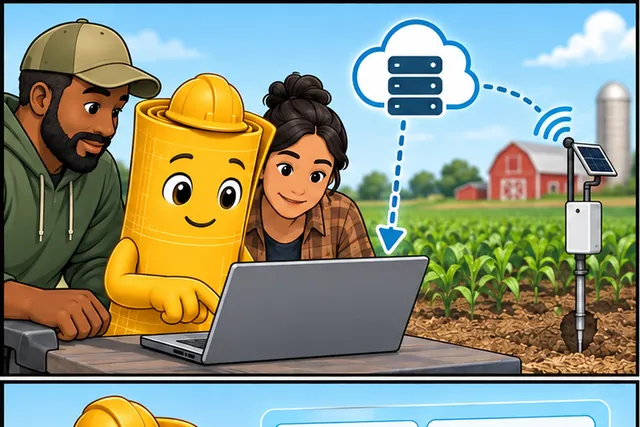
A farm team downloads a soil reading from another company.
-
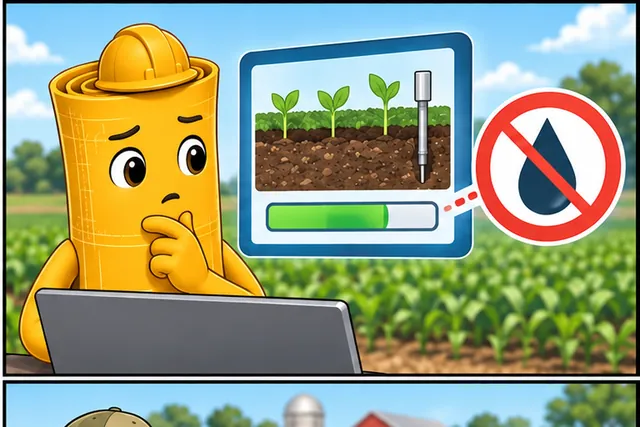
A reachable number is not yet safe evidence for watering.
-
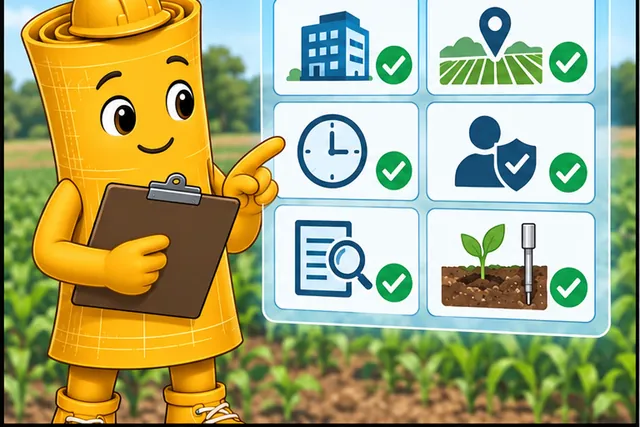
Check its source, place, time, permission, quality, and known field test.
-
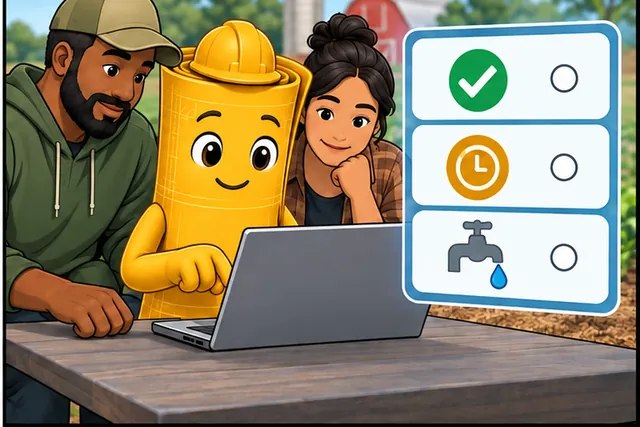
The team records whether it accepts, delays, or uses a safer fallback.
Start with the source. Name the sensor or feed, where it observes, what it measures, and when it last changed. Then check permission. State who may use the reading and for which task. Next check quality. Look for missing time, stale values, poor coverage, and a known test against the real world.
Link the reading to one decision. Record whether the team accepted it, used a safer fallback, or delayed action. Keep the reason and the remaining doubt. Set a new review when the source, service, permission, place, or quality rule changes.
This is sensing as a service: one party offers measured data for another party to use. A reachable feed is not the same as a trustworthy fact.
Use Practitioner to compare services and write the review record. Use Under the Hood to inspect ownership, quality, change, and trust limits.
Sensing as a service starts when one sensing system becomes useful to another team, application, or organization. The hard part is not publishing a feed; it is deciding who may use it, what quality state they see, what ownership remains, and what the service cannot promise.
Read this chapter by following one shared record from sensor to consumer. The service boundary should make access, quality, permission, liability, and retest evidence visible before the record is trusted.
10.2 In 60 Seconds
This section: In 60 Seconds — Sensing as a Service means a sensing capability is offered through a service boundary instead of being controlled only by the local device owner.
Sensing as a Service means a sensing capability is offered through a service boundary instead of being controlled only by the local device owner. The key review question is not whether sharing sensor data is attractive. The key question is whether the service record makes access, ownership, data quality, use limits, and retest conditions clear enough for a downstream decision.
This chapter treats Sensing as a Service as an architecture boundary. A good review separates the physical sensor, the service interface, the consumer decision, and the evidence that proves the data is fresh, permitted, and fit for use.
10.3 Learning Objectives
This section: Learning Objectives
By the end of this chapter, you will be able to:
- Explain Sensing as a Service as a boundary between sensor owners, service operators, and data consumers.
- Identify the evidence needed before shared sensor data is trusted.
- Distinguish access permission, ownership, quality, and decision-use questions.
- Build a review record for shared sensing data.
- Define retest triggers for service changes, stale data, permission changes, and quality conflicts.
10.4 First Step: Sensing as a Service Evidence
This section: First Step: Sensing as a Service Evidence
10.5 Minimum Viable Understanding
This section: Minimum Viable Understanding — Sensing as a Service is a shared-data boundary, not merely a pricing model.
Sensing as a Service is a shared-data boundary, not merely a pricing model. A consumer must know the sensor source, service interface, quality state, permission, and use limit before accepting a reading. Availability alone is not evidence of fitness. Service records therefore preserve freshness, provenance, uncertainty, and retest triggers; when ownership, permission, or quality evidence is unclear, the consumer decision uses a lower-confidence or unavailable state.
10.6 Prerequisites
This section: Prerequisites
- Sensor Node Behaviors: Taxonomy: how evidence labels prevent overconfident decisions.
- Sensor Node Behavior Classification: how observations, confidence, actions, and retest triggers are recorded.
- Sensor Applications Route Map: how sensor data supports application decisions.
10.7 Boundary Scope
This section: Boundary Scope — Keep the review focused on architecture evidence.
Keep the review focused on architecture evidence. Avoid turning the chapter into a vendor comparison, marketplace plan, cost calculator, or legal guide. The service boundary should answer:
- who controls the physical sensor;
- who exposes the service interface;
- who consumes the data;
- what measurement and context are represented;
- what quality checks apply;
- what access and use limits apply;
- what should happen when the service changes or the data becomes stale.
If those questions are not reviewable, the service may still exist, but it is not yet reliable evidence for a decision.
10.8 Service Boundary
This section: Service Boundary — The service boundary separates a physical sensing source from the consumer decision that uses its data.
The service boundary separates a physical sensing source from the consumer decision that uses its data. Before treating a shared value as decision evidence, follow Figure 10.1 to see where source identity, access permission, quality, and accountability must survive the hand-off.
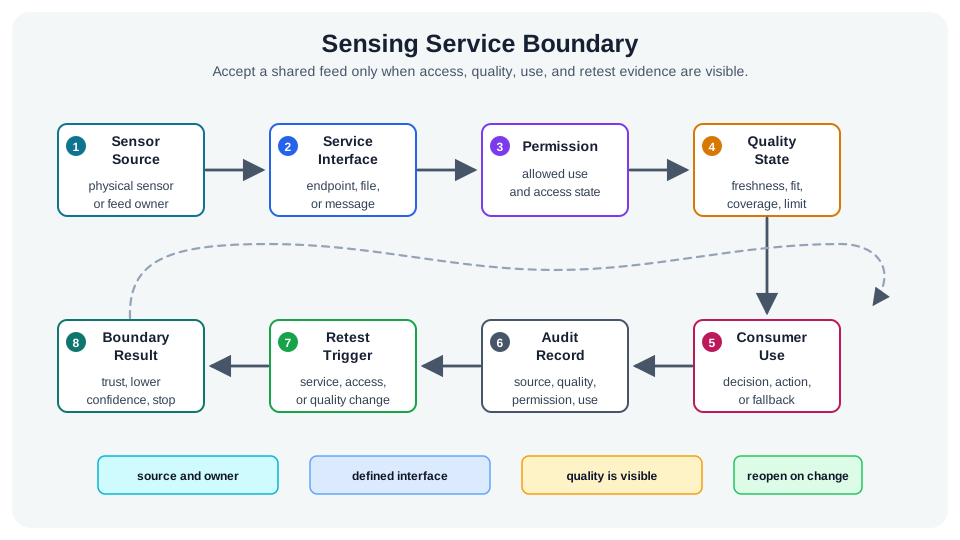
Read Figure 10.1 from the sensor source through the interface, first identifying the physical or logical producer and the endpoint, feed, file, or message contract that exposes it. Permission then constrains who may use the record and for what purpose. Continue through quality evidence—freshness, plausibility, calibration, coverage, or confidence—to the specific consumer action or interpretation. The audit record preserves those conditions, and the final retest trigger names the service, permission, source, or quality change that reopens acceptance. This sequence keeps a reachable feed from becoming an unqualified source of truth.
10.9 Evidence Questions
This section: Evidence Questions — A sensing-service review should separate four questions.
A sensing-service review should separate four questions.
Access
Can the consumer retrieve the data through a defined interface, and does the record show whether access was permitted at the time of use?
Ownership and use
Does the record show who controls the source or feed, what use is allowed, and whether the consumer decision is inside that boundary?
Quality
Does the service expose freshness, coverage, missing intervals, uncertainty, or validation evidence? If it only provides a value, the consumer may need a lower-confidence decision.
Change
What happens when the sensor, interface, sampling pattern, permission state, or quality rule changes? The review needs a retest trigger, not an assumption that the service stays stable.
10.10 Service Review Record
This section: Service Review Record — The review record should be short enough to repeat and specific enough to audit.
The review record should be short enough to repeat and specific enough to audit. Inspect Figure 10.2 when accepting or rejecting a feed so the source and interface can be traced through permission and quality to the exact consumer use.
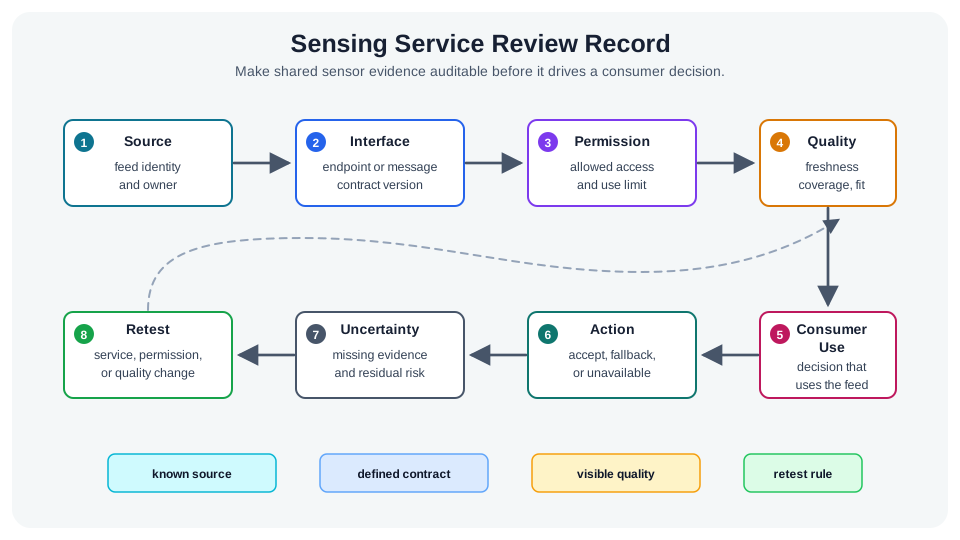
Read Figure 10.2 from source identifier and measurement context into interface version and access state. Those fields establish which feed was used and whether that use was permitted. Freshness and quality then constrain the consumer decision, after which the record captures the accepted action or fallback, residual uncertainty, and retest trigger. This order makes hidden assumptions visible: if the feed changes sampling interval, drops a location, changes access status, or reports stale values, the consumer can determine whether the earlier decision still stands.
10.11 Fit Checks
This section: Fit Checks — Before using a sensing service, check that the service evidence fits the decision.
Before using a sensing service, check that the service evidence fits the decision.
Measurement fit
The service should measure the condition that the consumer decision actually needs. A nearby measurement, aggregate feed, or proxy source may be useful, but the record should state the limit.
Time fit
The observation time and receive time should be clear enough to decide whether the data is current, historical, or stale.
Context fit
The service should preserve the context needed to interpret the reading, such as source class, location boundary, sampling rule, or aggregation state.
Quality fit
Quality evidence should be visible. When confidence, coverage, or validation status is missing, the consumer action should reflect that uncertainty.
Permission fit
The use should match the permitted access state. If access is revoked, narrowed, or unclear, the review should not silently continue using the feed.
10.12 Named Architecture: Sensor-Cloud
This section: Named Architecture: Sensor-Cloud — Sensor-cloud is one published instantiation of the service boundary above.
Sensor-cloud is one published instantiation of the service boundary above. It is not simply sensor data pushed into a generic cloud store; it adds a virtualization layer so that one physical sensor node, or a whole physical sensor network, can appear to multiple consumers as if each had a dedicated feed.
Three actors sit on either side of the boundary. The sensor-owner purchases and deploys the physical hardware and lends it to the service. The sensor-cloud service provider (SCSP) takes on redeployment, maintenance, and overhead, and manages the virtualization layer between owners and consumers. The end-user consumes the service through an application and is not expected to know which physical sensor answered the request. Naming these three roles explicitly is what the “who controls the physical sensor” and “who exposes the service interface” evidence questions above are asking for.
The virtualization layer composes physical sensors into virtual sensors at two granularities: CoV-I groups homogeneous physical nodes within the same geographic region into one virtual sensor, and CoV-II spans heterogeneous nodes across multiple regions into a virtual sensor group. Composition granularity is itself review evidence — a consumer decision that assumes a single-region reading should not silently receive a multi-region composite without knowing it.
The layer also runs an internal and external caching mechanism motivated by a specific observation: physical conditions often change slowly enough that constant re-sensing wastes energy for no gain. An internal cache answers end-user requests directly when it can, and only pulls a re-cache from an external cache — which itself refreshes from the physical layer on an interval — when the cached value is no longer good enough. This is a concrete version of the quality-evidence and change questions above: the consumer’s freshness requirement decides how far back through the cache the request has to travel.
10.13 Named Architecture: Rentable IoT Infrastructure (S²aaS)
This section: Named Architecture: Rentable IoT Infrastructure (S²aaS) — The same model is used to rent nearby infrastructure rather than only publish sensed data.
A related published model routes the boundary through sensor publishers and extended service providers between the sensor-owner side and the data-consumer side, and treats sensor ownership as a spectrum: personal and household devices sit at the consumer end, while organizational, public, and commercial sensor-data-provider deployments sit at the enterprise end. Which end of that spectrum a source sits on changes what ownership and permission evidence should look like.
The same model is used to rent nearby infrastructure rather than only publish sensed data. In one illustrated use case, a marketing company rents street- and venue-level infrastructure through a broker to gather crowd data around a stadium event for the event window only, rather than acquiring the sensors — a bounded-time, bounded-purpose access grant instead of ownership.
10.15 Worked Review: Rented Infrastructure, Different Priorities
This section: Worked Review: Rented Infrastructure, Different Priorities — Scenario: two consumers can reach the same rented infrastructure through their own devices, but their constraints for using it are different.
Scenario: two consumers can reach the same rented infrastructure through their own devices, but their constraints for using it are different.
Concrete example: a tourist wants a rich augmented-reality experience at a historic site and is willing to rent nearby infrastructure so his device can offload map, weather, and translation processing to it, trading a fee for a longer, richer session with lower device battery drain. A budget traveler nearby has a tighter constraint: she needs her own phone battery to last until she is back at her hotel. The same rented infrastructure is reachable by both, but the orchestration each of them should accept is not the same.
Observation
The service is reachable to both consumers, and both can access it. Reachability alone does not decide how much of the service either consumer should actually use.
Evidence check
The reviewer records what constraint is driving each consumer’s decision — one consumer’s willingness to pay for a richer session versus the other’s remaining-battery budget — because the acceptable orchestration differs by consumer, not by a single application-wide setting.
Action
Each device’s use of the shared service is scoped to its own consumer decision. The lighter use is not a degraded version of the richer one; it is the correct bounded action for its stated constraint.
Retest trigger
Retest if either consumer’s constraint or priority changes, if the rented infrastructure’s terms change, or if offloading no longer delivers the latency or battery benefit it was chosen for.
10.16 Common Mistakes
This section: Common Mistakes — A shared feed is not trustworthy merely because it is reachable.
A shared feed is not trustworthy merely because it is reachable. Keep ownership, permission, and quality as separate checks, and do not accept a value without both observation and receive times. Missing intervals and changed sampling rules must remain visible, as must stale or low-confidence states. Keep the chapter centred on evidence rather than vendor lists or cost comparisons, and always record which service, permission, source, or quality change will trigger retest.
10.17 Knowledge Check
This section: Knowledge Check
10.18 Matching Quiz
This section: Matching Quiz
10.19 Ordering Quiz
This section: Ordering Quiz
10.20 Specialized Architectures Route Map
This section: Specialized Architectures Route Map
10.20.1 Begin With the Odd Part of the System
A gateway is a node that joins one network to another. Picture a small sensor that sleeps, wakes, sends one value, and goes quiet again. A normal box-and-arrow map may show where its data goes. It may not show why the node sleeps, what happens when it stays quiet, or who may reuse its data. Start with the odd or risky behavior that the broad map fails to explain.
Name one constraint. It may be power, movement, weak links, trust, repair, or shared use. Then choose the route that owns that question. Do not mix a behavior label with a cause. Do not treat one missed message as proof of harm. Run a simple evidence check: state what you saw, what you expected, which decision it affects, and what new fact would reopen the review.
Each route has a trade-off. More awake time may aid contact but drain the cell. More trust rules may block bad data but also reject a weak honest node. This page cannot settle those choices. Use the Practitioner routes for review records, bounded actions, and field choices. Use the Under the Hood routes for timing, topology, trust, and service limits. The deeper chapters extend this map; they do not turn a route name into proof.
10.20.2 Start With the Architecture Question
A specialized architecture starts when a normal IoT diagram does not answer the hard part of the design. The node may be asleep, weak, selfish, malicious, recovering, acting as a relay, or feeding a shared service where ownership and data quality matter.
Read this guide by naming the constraint first. Once the constraint is visible, the module routes show which chapter helps you classify the behavior, review the schedule, change the topology, trust the record, or define the service boundary.
10.20.3 In 60 Seconds
Specialized architectures are useful when a standard sensor-to-gateway-to-cloud path does not explain the real design problem. In this module, the focus is narrower: sensor node behavior, duty cycling, topology management, trust and recovery, production review, and sensing as a service.
Use this route map to choose the next chapter. Each route starts with the concept, then moves toward diagnosis, examples, review, or production framing. Keep your reading evidence-bound: identify the behavior, state the constraint, record the trade-off, and explain what change would require another review.
10.20.4 Learning Objectives
By the end of this module route map, you will be able to:
- Explain why specialized architecture choices start from a behavior or constraint.
- Choose a route for node behavior, duty cycling, topology management, trust, production review, or sensing as a service.
- Separate behavior classification from recovery, trust, and production decisions.
- Identify the evidence needed before accepting a specialized architecture decision.
- Use the module sequence without relying on broad deployment or performance claims.
10.20.5 First Evidence Check
10.20.6 Minimum Viable Understanding
A specialized architecture is justified by a specific constraint or behaviour. Node-behaviour review asks what a node senses, communicates, forwards, drops, or falsifies, while duty cycling and topology management change when nodes are available, connected, or responsible for coverage. Those trade-offs must be explicit. Trust and recovery decisions require observed behaviour rather than assumptions about intent, and production review checks whether the behaviour, governing rule, data path, and retest trigger are documented together.
10.20.7 How To Use This Module
Start with the route that matches your current question:
- Node behavior route: use this when the main question is how nodes fail, cooperate, refuse work, or behave maliciously.
- Duty cycling and topology route: use this when the main question is how sleep schedules, active sets, or topology choices affect sensing and communication.
- Application and review route: use this when the main question is how to apply behavior concepts to a scenario, trust rule, production review, or quiz.
- Sensing service route: use this when the main question is how shared sensing infrastructure is framed and reviewed.
10.20.8 Node Behavior Route
Use this route to classify and reason about node behaviour before choosing a response. Start with Sensor Node Behaviors: Taxonomy for the vocabulary, then practise separating observed states in Sensor Node Classification. Selfish & Malicious Nodes distinguishes resource-conserving behaviour from active harm, while Dumb Nodes & Recovery covers accidental failure, weak behaviour, and bounded recovery. Throughout the route, ask what evidence supports failed, weak, selfish, malicious, or merely unobserved—not which label sounds most decisive.
10.20.9 Duty Cycling And Topology Route
Use this route when the architecture changes which nodes are awake, connected, or responsible for sensing. Duty-Cycling and Topology Management first connects sleep decisions to network roles, and Duty Cycle Fundamentals then exposes the states, transitions, and evidence behind a schedule. Apply those ideas in Duty Cycle Worked Examples before comparing adaptive roles and acceptance evidence in Topology Management Techniques. The running review question is what the schedule preserves, what it trades away, and which event requires retest.
10.20.10 Application And Review Route
Use this route when behaviour concepts must become scenario, trust, or production decisions. Sensor Behaviors Quiz checks classification reasoning before Mine Safety Case Study applies it to a bounded safety scenario. Trust Management connects evidence to a limited trust action, and Sensor Behaviors Review consolidates findings and retest triggers. Finish with the production framing and assessment in Sensor Production Framework and Sensor Production Quiz. At each step, preserve the evidence behind the classification, rule, recovery decision, and retest trigger.
10.20.11 Sensing Service Route
Use this route when the architecture is about sharing sensing infrastructure rather than only managing a single network.
- Sensing as a Service: review how shared sensing, access, ownership, data quality, and service boundaries are framed.
Review prompt: who can use the sensor record, what quality state is visible, and what claims remain outside the service boundary?
10.20.12 Example Route Choice
A facilities team reviewing a battery-powered air-quality node should start with the duty-cycling route if the question is whether the node wakes often enough to preserve freshness. The same team should switch to the node behavior route if the node is awake but sends readings that contradict nearby sources, and to the sensing service route if another application wants to reuse the feed through a shared interface. The route is chosen from the decision evidence, not from the device name alone.
10.20.13 Review Checklist
Before leaving this route map, state the question your next chapter must answer. It may be a node behaviour that needs classification, a duty-cycle or topology decision that lacks evidence, or a trust, recovery, or production rule that needs review. It may instead be a scenario requiring a bounded interpretation or a sensing-service boundary that needs clarification. In every case, name the evidence that would show whether the specialised architecture still works after a change; that evidence is what keeps the route choice purposeful.
10.20.14 Knowledge Check
10.20.15 Common Mistakes
Specialised architecture is not a catalogue of advanced terms, so do not begin with a protocol or product name before stating the behaviour or constraint. Avoid inferring intent without sensing, communication, forwarding, or data evidence. A duty-cycle claim must preserve accepted, unavailable, stale, and missed-observation states, and a topology change must record the coverage, connectivity, or review condition that changed. Most importantly, use the route map to choose the next question rather than treating every linked chapter as an undifferentiated reading list.
10.20.16 Summary
This module focuses on specialized architecture choices that need explicit behavior and constraint evidence. Start with the question you need to answer, then choose the route for node behavior, duty cycling, topology management, application review, production framing, or sensing as a service.
The common thread is reviewability: record the observed behavior, the constraint, the decision rule, the evidence supporting the response, and the retest trigger.
10.20.17 Key Takeaway
Use specialized architecture patterns when ordinary IoT designs need explicit treatment of duty cycling, topology, behavior, trust, and production review.
10.20.18 What’s Next
Begin with Sensor Node Behaviors: Taxonomy if you are new to the module. Continue to Duty-Cycling and Topology Management when the main decision is about active nodes, schedules, or topology, or jump to Sensing as a Service when the architecture is about shared sensing boundaries.
10.21 Summary
This section: Summary — Sensing as a Service is an architecture boundary for shared sensing evidence.
Sensing as a Service is an architecture boundary for shared sensing evidence. The important review work is to make access, ownership, permission, quality, consumer use, residual uncertainty, and retest triggers visible. A shared feed should not be trusted just because it is reachable, and it should not be rejected just because it is shared.
The safest consumer decision uses the feed only when the service record shows that the data is fresh, permitted, relevant, and fit for the bounded use.
10.22 Key Takeaway
This section: Key Takeaway — Sensing as a service only works when ownership, quality, privacy, access control, pricing, and lifecycle responsibilities are explicit.
Sensing as a service only works when ownership, quality, privacy, access control, pricing, and lifecycle responsibilities are explicit.
10.23 Concept Relationships
This section: Concept Relationships — Sensor Node Behaviors: Taxonomy explains why labels and decisions remain evidence-bound, and Sensor Node Behavior Classification supplies the confidence, action, and retest record pattern.
Sensor Node Behaviors: Taxonomy explains why labels and decisions remain evidence-bound, and Sensor Node Behavior Classification supplies the confidence, action, and retest record pattern. Sensor Applications Route Map connects that evidence to consumer decisions. S2aaS Fundamentals then provides the broader service-model background outside this specialised-architecture review.
10.24 What’s Next
This section: What’s Next — Next, continue with Sensor Behavior Applications: Quiz Implementation to apply behavior and service-boundary evidence in assessment-style review decisions.
Next, continue with Sensor Behavior Applications: Quiz Implementation to apply behavior and service-boundary evidence in assessment-style review decisions.
Find help
3 reviewed answers.
Where should I start in a module?
Open the module page from the sidebar to see its chapters in order. Use the module map to return to a topic you need.
Modules and pathsReviewed
What can I try when a project does not work?
Check the symptom, then work through the diagnostic steps. Keep the error message and the smallest example that reproduces it.
When you are stuckReviewed
How do interactive examples work?
Use the interactive guide to check how examples and simulations work before changing your project.
Interactive examples guideReviewed