3 Duty-Cycling and Topology Management
More
Depth: Practitioner
Progress saves as you read. Mark sections complete as you go; your progress appears in the sidebar.
Start With the Sleeping Network
This section: Start With the Sleeping Network — Picture flood sensors spread along a river.
Give Every Role the Wake Time It Needs
Picture flood sensors spread along a river. A leaf wakes, measures, sends once, and sleeps. One leaf is later asked to relay readings from two others, but it keeps the old sleep plan. The new path now exists on paper and is absent when a child tries to send.
Follow a flood warning through the sleep plan of its relay nodes.
-
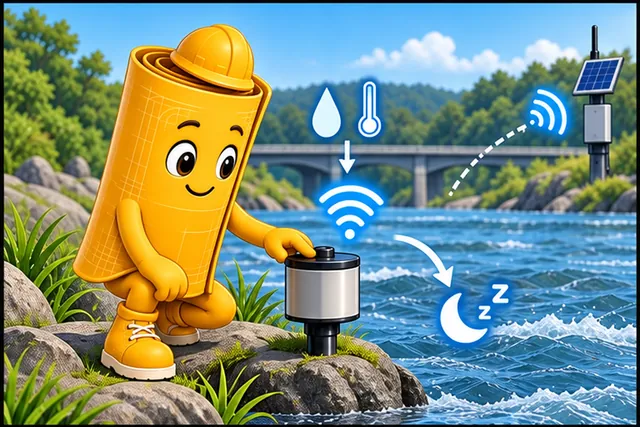
A river sensor wakes, measures, sends once, and sleeps.
-
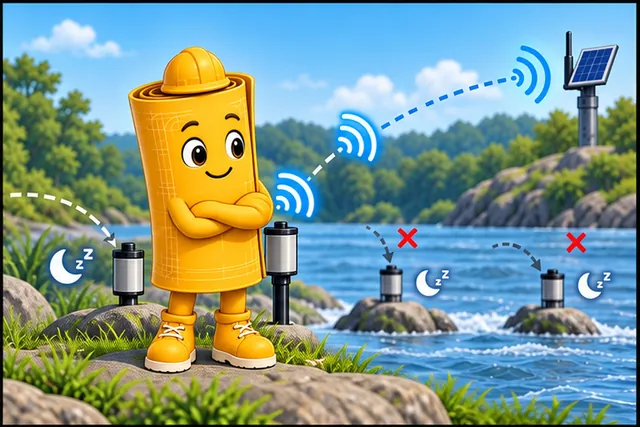
It becomes a relay but keeps a sleep plan that misses other readings.
-
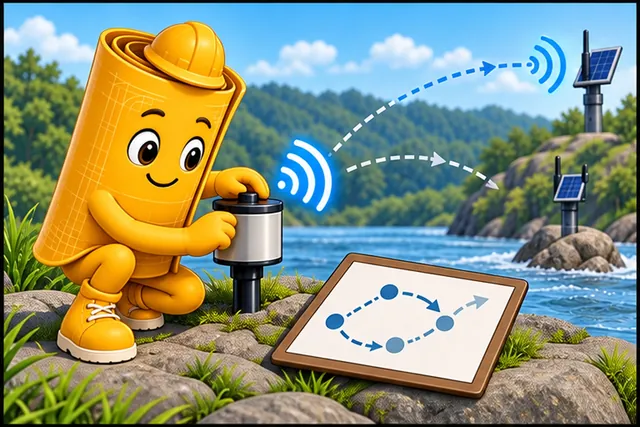
Give the relay time to listen and forward, then test role and route changes.
-
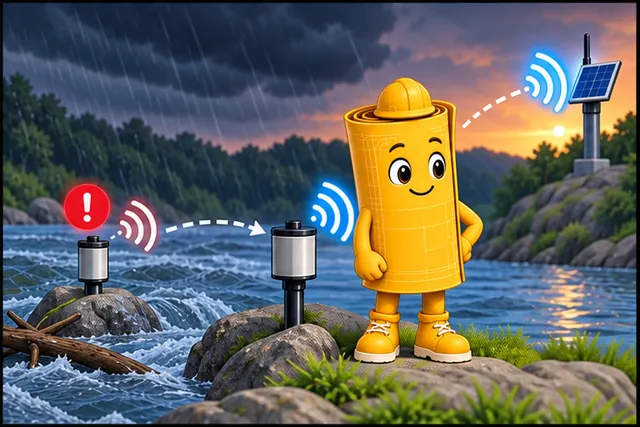
The warning path stays awake long enough or exposes a late, missing event.
Write the end-to-end event path and each node role. Record wake times, listen windows, send slots, stored energy, buffer size, parent, fallback route, and response deadline. A relay needs time to receive and time to forward, not only time for its own sample.
Test a missed meeting, a full buffer, a failed parent, a role change, low energy, and a route that takes more hops. Measure delivery age and lost observations as well as node life. Long life is not success if the warning arrives too late.
Keep urgent local flood warning able to act when the wider path is asleep or broken. A distant record can support later review, but it should not hide a stale or missing event.
This opening does not choose one shape or sleep plan. Practitioner joins role, schedule, and deadline. Under the Hood examines rendezvous, clock drift, buffers, route repair, coverage, and the energy cost of keeping the right paths awake.
Imagine a network that saves power by letting devices sleep, but now the team has to prove that sensing, forwarding, and coverage still work when the right nodes are awake. Duty cycling and topology management are connected because a schedule changes which paths and observations exist at any moment.
Use this chapter by following one needed observation through sleep, wake, rendezvous, relay, and retest. The architecture is acceptable only when the evidence survives the schedule and the topology change.
In 60 Seconds
This section: In 60 Seconds — Duty cycling and topology management are connected decisions.
Duty cycling and topology management are connected decisions. A node can save stored energy by sleeping, but a sleeping node cannot receive, forward, acknowledge, or sense unless the schedule makes that possible. Topology management decides which nodes must stay available, which nodes can sleep, how routes recover, and what evidence shows the network still supports the application decision.
This chapter is a section overview. It keeps claims bounded and gives a review pattern for deciding whether a duty-cycle schedule and topology role fit together.
Learning Objectives
This section: Learning Objectives
By the end of this chapter, you will be able to:
- Explain why sleep schedules and topology roles must be reviewed together.
- Identify how star, tree, mesh, and clustered roles affect wake requirements.
- Trace the evidence needed for sensing, forwarding, rendezvous, latency, and stale data.
- Separate local node energy reasoning from network-level connectivity reasoning.
- Define retest triggers for duty-cycle and topology changes.
First Evidence Review
This section: First Evidence Review
Minimum Viable Understanding
This section: Minimum Viable Understanding — Duty cycling controls when a node is available, while topology management determines which roles must be available for sensing, forwarding, and recovery.
Duty cycling controls when a node is available, while topology management determines which roles must be available for sensing, forwarding, and recovery. A low active fraction can create missed rendezvous, stale readings, or delayed forwarding, so relays, gateways, and cluster heads usually need schedules different from leaf sensors. A schedule is acceptable only when it supports the application’s latency and data-quality needs, and it must be retested after changes to traffic, role, route, clock behaviour, quality rules, or the schedule itself.
Prerequisites
This section: Prerequisites
Review these chapters as needed:
- Wireless Sensor Networks: network topologies, multi-hop communication, and node roles.
- Sensor Node Behaviors: Taxonomy: vocabulary for node behavior and role changes.
- Dumb Nodes & Recovery: recovery thinking for weak or limited nodes.
Why These Decisions Belong Together
This section: Why These Decisions Belong Together — A duty-cycle decision that looks reasonable for a single node can fail at the topology level.
A duty-cycle decision that looks reasonable for a single node can fail at the topology level. The node may wake long enough to sense a value, but not long enough to receive from a child node, forward to a parent, or align with a neighbor’s listen window.
A topology decision can also change the duty-cycle plan. A leaf sensing node may wake briefly and return to sleep. A relay or cluster node may need longer listen windows, route-maintenance checks, buffering behavior, or a recovery rule for missing neighbors.
Review these decisions together whenever the architecture relies on sleeping nodes, multi-hop routing, scheduled communication, or adaptive topology roles.
Decision Map
This section: Decision Map — The local energy target is only useful if the network can still carry the required evidence.
The local energy target is only useful if the network can still carry the required evidence. Use Figure 1 to connect the application need to the responsible topology role, then test whether its wake schedule and neighbours can meet that need.
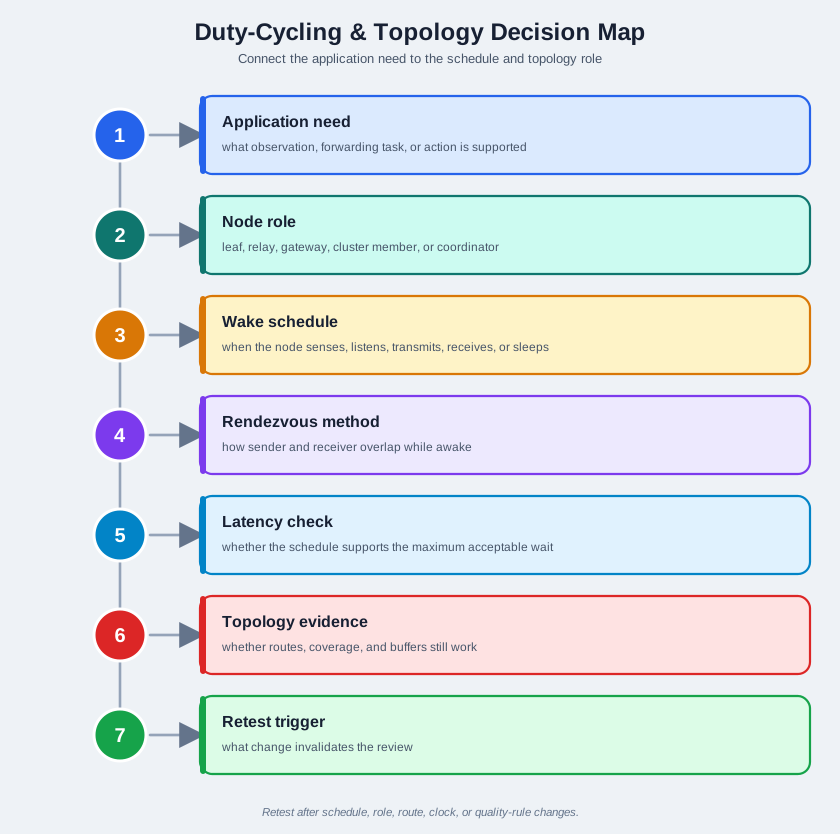
In Figure 1, start with the observation, forwarding task, or action the application needs, then identify whether the responsible node is a leaf, relay, gateway, cluster member, or coordinator. Next trace its sensing, listening, transmitting, receiving, and sleeping windows into the rendezvous method used to overlap with a neighbour. The latency check tests the maximum wait, while topology evidence tests the route, coverage, and buffer behaviour. The final retest trigger records what change invalidates that result. This order prevents a locally efficient schedule from being accepted when it breaks the end-to-end path.
Topology Roles And Wake Requirements
This section: Topology Roles And Wake Requirements
Leaf Sensing Node
A leaf sensing node mainly measures a local condition and sends a record to its receiver. Its wake schedule therefore needs time for sensing and the communication attempt, with the send window matched to receiver availability. A successful local measurement does not establish that the record reached the next step.
Review the sensing interval against the application’s acceptable wait and stale-data rule. State whether an unavailable receiver leads to buffering, a retry, or a missing record, and keep those outcomes visible. Test a known reading and an unavailable-receiver case. If the node later takes on forwarding duties, revisit its schedule: receiving other nodes’ records and forwarding them introduces availability needs beyond its original sensing task.
Relay Node
A relay forwards readings received from other nodes, so its wake schedule must support both reception and onward transmission. Receive windows need to overlap with sending children or neighbours, while transmit windows need to match the next hop’s availability. Time for the relay’s own sensing task does not cover these forwarding obligations.
Review a known reading through both windows and compare its delivery age with the application’s permitted wait. Record buffering behavior when either neighbour is unavailable, and test missed rendezvous and a full buffer. Preserve source identity, unit, timestamp and validity state during forwarding. Changes to the relay role, neighbours, wake windows or buffering behavior require a new review because the earlier evidence applies to the previous arrangement.
Gateway Or Coordinator
Other nodes depend on a gateway or coordinator being available at the times their communication requires. This dependency may justify a broader availability window than a leaf sensor needs. The review should state whether availability is continuous for the exercise or scheduled, and whether an unavailable period is handled through buffering or another recovery path.
For scheduled availability, check that incoming transmission windows overlap with the gateway or coordinator’s receiving window. Record what happens when that meeting is missed and compare the resulting wait with the application’s latency requirement. A buffered reading still needs its age and quality state reviewed. Changes to the availability window, route or buffering behavior require retesting of the dependent communication path.
Cluster Member And Cluster Head
Clustered topologies assign different responsibilities to ordinary members and the cluster head. A member can often follow a simpler schedule, while the head’s schedule must support member collection, aggregation and onward forwarding. Reviewing only the head’s own sensing activity leaves those coordinating responsibilities unexamined.
Pair member send windows with the head’s collection windows, then trace the accepted readings through aggregation and forwarding to the expected next step. The evidence should record waiting time and buffering behavior when a required neighbour is unavailable, with stale or missing readings kept visible. If a node changes between member and head roles, review its wake requirements again. Evidence from the earlier role may not support the collection and forwarding duties of the new role.
Mesh Participant
Mesh participation can provide additional path options, but those options depend on the relevant neighbours being available when communication is needed. A route shown in the topology record may be unusable during a particular sleep window. The review therefore needs to name the neighbours required for rendezvous and connect their availability to the node’s receive and transmit windows.
Trace a known reading along the expected path, then examine what happens when that path is unavailable. Record the fallback route or buffering behavior and compare delivery age with the application deadline, including when recovery uses more hops. Changes to the neighbour set, route, clock behavior or wake schedule reopen the review because they can change rendezvous and forwarding conditions.
Specialized Pattern: Self-Organizing Virtual Topology
This section: Specialized Pattern: Self-Organizing Virtual Topology — Some environments make static role assignment impractical.
Some environments make static role assignment impractical. An underwater sensor field is one example: nodes drift with the current and radio does not propagate, so connectivity itself has to be discovered rather than planned in advance. One published architecture for this case, Tic-Tac-Toe-Arch, builds its virtual topology and duty cycle from the same three steps this chapter uses for ordinary networks, just automated: a node broadcasts a neighbor-discovery request and collects replies, computes an expected connectivity duration for each neighbor and selects the one with the longest duration, then sets that link active for a duty-cycle window sized to the selected duration before repeating the cycle.
The pattern is worth naming because it makes the general principle concrete: the wake schedule is not chosen first and checked against topology afterward. The topology evidence — which neighbor will stay reachable longest — is what decides the wake schedule. A review of this pattern should still ask the same questions as any other duty-cycle and topology decision: which neighbor was selected and why, how long the active window lasts, and what retest condition, such as a neighbor drifting out of range or a new discovery round, reopens the choice.
Review Evidence
This section: Review Evidence — A duty-cycle and topology review begins with the application need and acceptable latency, then records the node role and whether that role can change.
A duty-cycle and topology review begins with the application need and acceptable latency, then records the node role and whether that role can change. It pairs the wake schedule and active states with the communication rendezvous method, expected route or neighbour, and buffering behaviour when that neighbour is unavailable. Quality rules must keep stale, missing, duplicate, and rejected data distinct. The evidence should include a known reading reaching the expected next step and a failed or unavailable case, not only the normal path. Finally, the record names the schedule, role, route, clock, or quality-rule change that requires retest.
Evidence Record
This section: Evidence Record — The evidence record should show how a local schedule supports a network role.
The evidence record should show how a local schedule supports a network role. Before approving the relay or leaf configuration, inspect Figure 2 to connect each active state to its neighbour, forwarding result, and review condition.
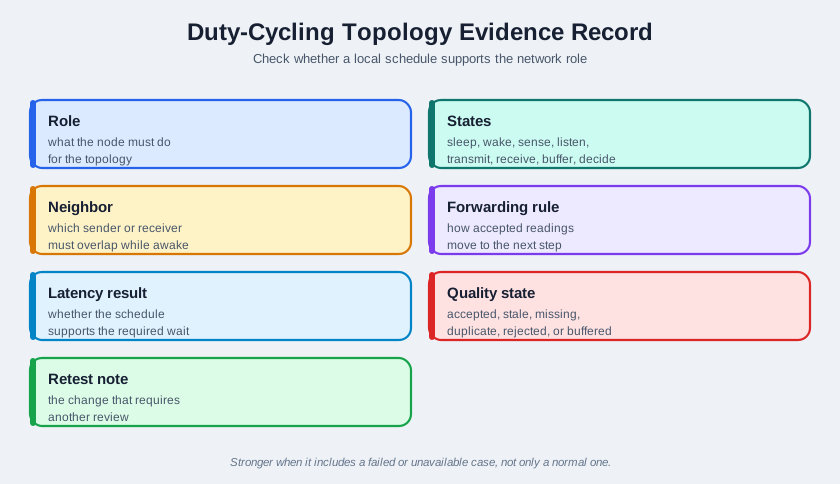
Read Figure 2 from role to states: the topology obligation determines whether the node must sleep, wake, sense, listen, transmit, receive, buffer, or decide. Then follow the neighbour and forwarding fields to verify which sender or receiver overlaps and how an accepted reading reaches the next step. The latency result tests the permitted wait, and the quality state preserves whether the record was accepted, stale, missing, duplicated, rejected, or buffered. End at the retest note, which makes a later role, route, clock, or schedule change reopen the decision instead of silently inheriting old evidence.
Worked Review: Scheduled Relay
This section: Worked Review: Scheduled Relay — Scenario: a small network uses one relay node between a sensing node and a gateway.
Scenario: a small network uses one relay node between a sensing node and a gateway.
Concrete example: a greenhouse leaf node measures soil moisture, a shelf-mounted relay forwards accepted records, and a gateway uploads the review stream. If the relay sleeps through the leaf node’s send window, the topology is not merely slower; it produces a missing-evidence state that the dashboard must show.
Application need
The network must preserve a periodic status reading for later review. It is not an immediate alarm path.
Topology role
The middle node is a relay. It must receive from the sensing node and forward toward the gateway.
Wake schedule
The relay has a listen window for the sensing node and a separate forward window for the gateway. The schedule record states what happens when either neighbor is unavailable.
Rendezvous check
The sensing node sends a known test record during the relay listen window. The relay forwards that record during the gateway window without dropping source identity, unit, timestamp, or validity state.
Latency and quality
The review compares the observed wait with the application need. If the record arrives late, duplicated, stale, or missing, the state is recorded rather than hidden.
Decision
Accept the schedule only for the stated periodic review use. Do not reuse it for faster response behavior without a new latency review.
Retest trigger
Retest if the relay role changes, a neighbor changes, the wake window changes, the gateway window changes, buffering behavior changes, or the data-quality rule changes.
Common Mistakes
This section: Common Mistakes
Reviewing The Node But Not The Route
Successful sensing shows that a node obtained a local observation; it does not establish that the observation reached the required next step. A node may wake long enough to measure while its receiver is asleep, or a relay may receive the reading without having a suitable forwarding window. Local energy savings therefore need to be assessed alongside route availability.
Follow a known reading from the source through reception and onward forwarding. Check the overlapping communication windows, buffering behavior and observed wait against the application need. Include an unavailable neighbour or missed rendezvous in the review. Record late, stale, duplicated or missing results explicitly, so successful local sensing does not hide a failure in the delivery path.
Treating All Roles The Same
Leaf nodes, relays, gateways, and cluster heads have different availability needs.
Ignoring Receiver Availability
A sender’s wake window is useful only if the intended receiver can listen during the communication attempt, or a valid buffering and retry rule supports later delivery. Check the overlap between sending and listening at each step of the route. A relay needs a receive window for incoming readings and a forwarding window that matches the next receiver’s availability.
When a neighbour is asleep or unavailable, record what happens to the reading and compare the resulting wait with the application deadline. Test a known reading reaching the expected next step, together with an unavailable-receiver case. Keep buffered, stale and missing outcomes visible so that a successful sensing operation is not mistaken for successful delivery.
Lowering Duty Cycle Without Checking Latency
Reducing the active fraction can save stored energy, but the revised schedule may introduce missed rendezvous or delayed forwarding. Assess the change against the application’s permitted wait, following the reading from sensing through relay reception and onward delivery. A relay’s own sensing window does not establish whether it can receive and forward other nodes’ records in time.
Compare the observed delivery age and maximum wait with the stated application need. Include missed meetings, unavailable neighbours and buffering behavior in the review. A schedule accepted for periodic status review may need a new latency assessment before supporting faster response. Record late, stale or missing outcomes alongside node life, and retest when wake windows, routes or roles change.
Hiding Stale Or Missing Readings
The review record should distinguish accepted readings from stale, missing, duplicate, rejected and buffered states. These distinctions matter because successful sensing does not establish that a usable reading reached the required next step. A relay that sleeps through a send window can leave missing evidence, while a record that arrives late must still be assessed against the application’s latency and quality requirements.
Preserve source identity, unit, timestamp and validity state as a known test reading passes through the route. Record the observed wait and the outcome when a neighbour is unavailable. Keeping these results visible supports review of the schedule and forwarding behavior without treating delayed or absent evidence as an ordinary accepted reading.
Forgetting Retest After Topology Changes
A successful review applies to the role, route, neighbours and schedule that were tested. Changing those conditions reopens the decision because the node’s availability may no longer match its network obligations. A leaf assigned a relay role needs evidence for receiving and forwarding, rather than relying on its earlier sensing schedule.
Name retest triggers in the evidence record, including changes to clock behavior, traffic patterns, buffering and quality rules. Repeat the relevant rendezvous, delivery and unavailable-neighbour checks against the application’s latency and data-quality needs. Preserve the revised role, active windows, forwarding result and quality state in the record. This makes acceptance depend on evidence for the changed configuration rather than silently carrying forward an earlier result.
Knowledge Check
This section: Knowledge Check
Matching Quiz
This section: Matching Quiz
Ordering Quiz
This section: Ordering Quiz
Research Frontier: Nanonetworks And Underwater Networks
This section: Research Frontier: Nanonetworks And Underwater Networks — These are not one exotic network family.
These are not one exotic network family. Molecular nanonetworks, electromagnetic nanonetworks, and underwater acoustic networks use different carriers, channel models, clocks, node capabilities, and evidence. They belong together here only as a comparison exercise in how a physical medium changes topology and duty-cycle assumptions.
| Frontier | Carrier and node scale | Mobility and propagation | Localization evidence | Honest limit |
|---|---|---|---|---|
| Molecular nanonetwork | Molecules encode or trigger information among very small biological or synthetic devices | Diffusion and flow can dominate delay; the medium may move the carrier and the node | Often inferred from concentration, timing, gradients, or an external reference rather than ordinary radio ranging | Strongly application- and medium-specific; a simulation result is not in-vivo validation |
| Electromagnetic nanonetwork | Electromagnetic signaling among highly constrained nanoscale devices or interfaces | Antenna/material behavior, absorption, short range, and severe energy limits reshape the link | May depend on a larger gateway, known geometry, or cross-scale sensing | Device fabrication, channel measurement, safe exposure, and practical powering remain research constraints |
| Underwater acoustic network | Acoustic signaling among submerged sensors, vehicles, relays, or gateways | Slow propagation, multipath, Doppler, variable sound speed, and moving water create long and changing links | Travel time can help, but clock error, sound-speed profile, depth, motion, and anchor geometry must be recorded | A pool, tank, or one sea trial does not establish performance across seasons, depths, and environments |
The topology lesson is concrete. A radio-style always-on neighbor table is a weak assumption when propagation delay is long, contacts move, energy is scarce, or the carrier itself diffuses. Schedules may need long guard times, store-and-forward behavior, sparse rendezvous, mobile data collection, or a cross-scale gateway. “Connected” must therefore state the time horizon and delivery contract: immediate path, eventual contact, bounded delay, or only statistical evidence of transfer.
Do not transfer a result across frontier families by analogy alone. An acoustic packet-delivery trace does not validate molecular diffusion, and a nanoscale electromagnetic simulation does not validate underwater localization. Record medium, carrier, geometry, mobility, environmental conditions, energy source, model assumptions, and the independent observation used to check the result.
Summary
This section: Summary — Duty cycling controls availability.
Duty cycling controls availability. Topology management assigns the roles that need availability. A schedule is reviewable only when it fits the node role, communication rendezvous, forwarding path, latency requirement, quality-state behavior, and retest trigger.
Keep claims bounded. A schedule that works for a periodic review path may not work for faster response, a new relay role, a different neighbor set, or a changed quality rule.
Key Takeaway
This section: Key Takeaway — Duty cycling and topology management should be designed together because node sleep behavior changes reachability, routing, and maintenance visibility.
Duty cycling and topology management should be designed together because node sleep behavior changes reachability, routing, and maintenance visibility.
Concept Relationships
This section: Concept Relationships — Duty Cycle Fundamentals defines active and sleep windows, and Duty Cycle Worked Examples shows how to inspect their calculations.
Duty Cycle Fundamentals defines active and sleep windows, and Duty Cycle Worked Examples shows how to inspect their calculations. Topology Management Techniques extends that schedule review to adaptive roles and policies, using the star, tree, mesh, and cluster vocabulary from Wireless Sensor Networks. Node-behaviour review then explains why a role change also changes the evidence and retest obligation.
What’s Next
This section: What’s Next — Use Duty Cycle Fundamentals to review active and sleep windows in more detail.
Previous: Dumb Nodes & Recovery
Next: Duty Cycle Fundamentals
Use Duty Cycle Fundamentals to review active and sleep windows in more detail. Continue to Duty Cycle Worked Examples when you need scoped arithmetic, and use Topology Management Techniques for adaptive topology policies.
Find help
3 reviewed answers.
Where should I start in a module?
Open the module page from the sidebar to see its chapters in order. Use the module map to return to a topic you need.
Modules and pathsReviewed
What can I try when a project does not work?
Check the symptom, then work through the diagnostic steps. Keep the error message and the smallest example that reproduces it.
When you are stuckReviewed
How do interactive examples work?
Use the interactive guide to check how examples and simulations work before changing your project.
Interactive examples guideReviewed