17  Sensor Production Quiz

In 60 Seconds

Sensor node misbehavior falls into three categories: dumb (environment-caused communication failure, 15-30% of field nodes), selfish (conserving energy by dropping others’ packets, detectable via 20%+ forwarding ratio drop), and malicious (injecting false data or creating sinkholes). Radio transmission dominates power at 10-50 mA TX versus 0.1-1 mA sensing, so duty cycling saves 90-99% energy. Safety-critical deployments (mine monitoring) require triple-modular redundancy and store-and-forward buffering to achieve 99.999% data reliability.

17.1 Learning Objectives

By the end of this chapter, you will be able to:

  • Diagnose dumb, selfish, and malicious node behaviors in real WSN deployment scenarios using environmental evidence (rain attenuation at 0.02-0.05 dB/m) and network metrics (forwarding ratio drops)
  • Architect safety-critical systems applying triple-modular redundancy, multi-path routing, and store-and-forward buffering to achieve 99.999% reliability in mine monitoring
  • Contrast synchronous S-MAC (80%+ idle listening elimination) against asynchronous B-MAC (preamble sampling overhead) and derive energy savings for each protocol
  • Quantify power budgets demonstrating radio dominance (10-50 mA TX versus 0.1-1 mA sensing versus 1-5 mA processing) and calculate break-even duty cycle percentages
  • Assess social sensing effectiveness criteria: rare event detection (earthquake, protest) versus impractical continuous monitoring based on duty cycle and mobile phone battery constraints
  • Derive WSN operational lifetime estimates using topology management ratios (20% active achieves full coverage), duty cycle percentages, and battery capacity constraints
Minimum Viable Understanding
  • Node behavior classification: Dumb nodes are environmentally impaired (temporary, predictable), selfish nodes refuse cooperation (strategic), and malicious nodes actively disrupt – distinguish by checking if sensing/processing still works and whether the issue affects multiple nodes simultaneously
  • Energy hierarchy rule: Radio TX/RX consumes 10-50 mA, sensing uses 0.1-10 mA, processing uses 1-5 mA, and sleep draws 1-10 uA – always minimize communication first since it dominates the power budget by 10-100x
  • Duty cycling tradeoff: Synchronous protocols (S-MAC) eliminate idle listening by coordinating wake times but require clock synchronization overhead; asynchronous protocols (B-MAC) avoid sync complexity but waste energy on long preambles – choose based on traffic pattern (periodic vs event-driven)

Sammy the sound sensor was deep underground in a coal mine tunnel when something strange happened. “I can hear a hissing noise!” Sammy called out. “That sounds like gas leaking!”

Bella the bio-sensor checked her readings. “Methane levels are rising – 0.5%… 0.8%… 1.2%! That is getting dangerous!”

Max the motion sensor tried to send an alert to the surface, but the rocky tunnel walls blocked the signal. “I cannot get through! The rocks are too thick!” Max said, worried.

“Do not panic!” said Lila the light sensor. “Remember our training? We have THREE different paths to the surface – through the main shaft, the ventilation tunnel, and the escape route. Send the message on ALL of them!”

Max sent the alert through all three paths. Two were blocked, but one got through! The surface station received the warning and sounded the evacuation alarm.

“That is why we always have backup plans,” Lila explained. “In a mine, one blocked path should never stop an important message. We send copies through every route we know, because safety comes first!”

What the Squad learned: In dangerous places like mines, sensor networks need multiple paths to send alerts. Even if most paths are blocked, having just one working path can save lives. This is called multi-path redundancy – always have backup routes for critical messages!

Imagine you are a security guard watching a building. If you stay awake 24 hours a day, 7 days a week, you will collapse from exhaustion. But if you sleep all day, you might miss a break-in. The solution? Work in shifts – sleep for a while, then wake up and check, then sleep again.

Sensor networks face the exact same problem. Each sensor runs on a small battery, and the radio (the part that sends messages) uses the most power – like how talking on a walkie-talkie drains its battery fast. If the radio stays on all the time, the battery dies in days instead of years.

Duty cycling is the sensor’s shift schedule. A sensor might wake up for 1 second every 10 seconds (10% duty cycle). During that 1 second, it checks for danger, sends any readings, and listens for messages. Then it goes back to sleep.

There are two main approaches:

  • Synchronized (like a school bell system): All sensors agree to wake up at the same time. When one sensor needs to talk to another, both are already awake. The downside is they need to keep their clocks in sync.
  • Asynchronous (like knocking on a door): Sensors wake up whenever they want. If one sensor needs to talk, it keeps “knocking” (sending a signal) until the other wakes up and answers. Simpler, but wastes energy on all that knocking.

The key insight is that for most applications, nothing interesting happens 99% of the time. So sensors can sleep through the boring parts and wake up quickly when something important happens – like a smoke detector that quietly monitors for years but screams the moment it detects smoke.

17.2 Prerequisites

Required Chapters:

Estimated Time: 30 minutes

17.3 Sensor Production Decision Framework

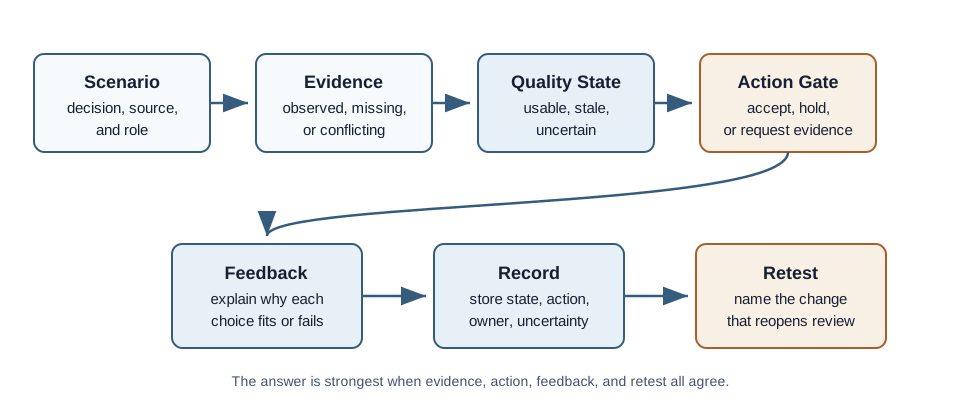
The following diagram illustrates the decision process for classifying sensor node behaviors and selecting appropriate architectural responses in production WSN deployments.

Decision flowchart for classifying sensor node behaviors in production WSN deployments, starting from observed anomaly through diagnosis to architectural response selection including dumb node mitigation, selfish node detection, malicious node isolation, and failed node replacement strategies.

Common Pitfalls and Misconceptions
  • Confusing dumb nodes with failed nodes: A dumb node is environmentally impaired but still sensing and processing correctly – it just cannot communicate temporarily. A failed node has stopped functioning entirely. The key diagnostic: does the node resume normal operation when conditions improve? If yes, it is dumb, not failed. Replacing dumb node hardware wastes money since the problem is environmental.

  • Assuming higher transmit power solves connectivity issues: Increasing transmit power from 0 dBm to +10 dBm only adds ~10 dB of link margin. If rain attenuation causes 20-30 dB loss over 100 meters at 2.4 GHz, higher power alone cannot restore the link. Worse, it drains the battery 10x faster and creates interference for neighboring nodes. Frequency shift (to sub-GHz) or mobile data collection are more effective.

  • Applying continuous max-duty-cycle to safety-critical systems: Intuition says “if safety matters, keep everything on all the time.” But continuous operation drains a 2000 mAh battery in 3-6 months. The correct approach is adaptive duty cycling: low duty (98% sleep) during normal conditions, immediate full-power during alerts. Since dangerous events occupy less than 0.1% of operational time, this provides both 2-year battery life and sub-60-second alert latency.

  • Treating synchronous and asynchronous MAC as universally better or worse: S-MAC (synchronous) eliminates idle listening and achieves 80%+ energy savings over unsynchronized protocols, but requires clock synchronization overhead and struggles with dynamic topologies. B-MAC (asynchronous) avoids synchronization complexity but wastes energy on long preambles. The right choice depends on traffic patterns: periodic monitoring favors synchronous; sparse event-driven traffic favors asynchronous.

  • Ignoring sensor fusion for false alarm reduction: Triggering alerts on a single sensor reading (e.g., methane spike) leads to frequent false alarms from sensor drift, calibration errors, or electrical noise. Cross-validating with correlated sensors (temperature, CO, humidity) reduces false alarm rates by 10-100x. An isolated CH4 spike without temperature or CO changes likely indicates sensor malfunction, not a gas leak.

17.4 Knowledge Check

Test your understanding of these architectural concepts.

Scenario: You’ve deployed 50 wireless soil moisture sensors across a 20-hectare almond orchard in California. The sensors communicate via 2.4 GHz Zigbee in a multi-hop mesh network, with nodes spaced 80-120 meters apart and a gateway at the farm office.

Incident report (Day 45 of deployment):

  • Heavy winter rainstorm hits the region (20mm/hour rainfall)
  • During rain: 38 out of 50 sensors report “gateway unreachable” errors
  • Sensors continue measuring soil moisture every 10 minutes (data looks valid)
  • Local sensor-to-sensor pings show communication range dropped from 100m to 3-8m
  • Weather clears after 3 hours; within 30 minutes, all 38 sensors reconnect and upload buffered data

Your analysis questions:

  1. What type of node behavior is this? (Normal, Failed, Degraded, Dumb, Selfish, Malicious)
  2. Why did communication range collapse during rainfall?
  3. What’s the best architectural solution to handle future rain events?
  4. Should you replace the sensors with different hardware?
Click to reveal behavior diagnosis and solution

Step 1: Behavior classification

This is “Dumb Node” behavior - nodes that are temporarily unable to communicate due to environmental conditions, but sensing and processing functions remain fully operational.

Key diagnostic indicators:

  • Sensors continue collecting valid data (sensing works)
  • Local buffering operates correctly (processing works)
  • Connectivity restored automatically when conditions improve (temporary failure)
  • Affects multiple nodes simultaneously (environmental, not hardware fault)
  • NOT failed (sensors didn’t stop working)
  • NOT malicious (no security compromise)
  • NOT selfish (nodes aren’t refusing to forward packets)

Step 2: Why rainfall affects 2.4 GHz communication

Physics of rain attenuation:

  • Water absorption: Raindrops absorb/scatter 2.4 GHz RF energy
  • Attenuation rate: ~0.02-0.05 dB/m in 20mm/hour rain (moderate-heavy)
  • Impact at 100m: 2-5 dB additional path loss
  • Marginal links fail: Nodes at edge of range (95-100m) drop to <5m effective range
  • Multipath disruption: Water on antennas changes impedance, reduces efficiency 3-5 dB

Why 3-8m range persists:

  • Line-of-sight still works at very short distances
  • 2.4 GHz doesn’t completely fail in rain (unlike 60 GHz mmWave which does)

Step 3: Architectural solutions (ranked by cost-effectiveness)

Solution A: Data MULE with UAV (CoRAD - Connectivity Restoration with Aerial Drones)

  • Concept: When rain detected, automatically launch small UAV to fly collection route
  • UAV collects: Buffered data from isolated sensors at close range (5-10m hover)
  • Cost: $1,500 UAV + $500 flight controller/radio + $2K annual maintenance
  • Pros: No sensor hardware changes, handles any future connectivity loss, automated
  • Cons: Requires UAV pilot certification (Part 107), weather limits (can’t fly in >40 mph winds)
  • Data latency: 15-30 minutes during rain (vs. real-time normally)

Solution B: Sub-GHz frequency shift (switch to 915 MHz or 433 MHz)

  • Concept: Replace Zigbee (2.4 GHz) with LoRa or 915 MHz Zigbee
  • Rain attenuation: 0.005 dB/m at 915 MHz (4x better than 2.4 GHz)
  • Cost: $50-80/node x 50 nodes = $2,500-4,000 hardware replacement
  • Pros: Better range in rain, also improves clear-weather range (2-5x better)
  • Cons: Requires complete redeployment, regulatory limits on 915 MHz power/duty cycle

Solution C: Increased node density (reduce hop distance)

  • Concept: Deploy 25 additional relay nodes to reduce max hop distance from 100m to 60m
  • Cost: $150/node x 25 = $3,750 + installation labor
  • Pros: Provides redundancy and improved reliability
  • Cons: Higher infrastructure cost, more maintenance overhead

Solution D: Do nothing - accept temporary data gaps

  • Cost: $0
  • Pros: Sensors buffer data; no data loss, just delayed upload
  • Cons: If flooding events correlate with rain, you lose real-time flood warnings

Recommended solution: Solution A (UAV/MULE) For a 20-hectare farm with 50 sensors, automated UAV data collection during rain provides the best cost/benefit ratio. The system normally operates in real-time multi-hop mode (low latency, low energy), but automatically switches to mobile sink collection during connectivity failures.

Step 4: Should you replace sensors?

No. The sensors are functioning correctly. The problem is RF propagation, not hardware failure. Replacing with identical sensors won’t help. Only switching to different frequency bands (solution B) or adding mobile collection (solution A) addresses the root cause.

Key learning: Dumb node behavior is environmental, temporary, and predictable. The best solutions work around the environment rather than fighting it. Rain-triggered UAV collection costs less than frequency migration and provides resilience against any future connectivity challenges (vandalism, equipment failure, seasonal foliage changes).

Scenario: You’re designing a wireless sensor network for a coal mine 800 meters deep with 12 km of tunnels. The system must detect dangerous methane gas concentrations (>1.25% CH4) and alert miners to evacuate before explosion risk (>5% CH4). The mine has significant RF challenges: rock obstructions, metal equipment, and water-filled tunnels create frequent communication blackouts.

System requirements:

  • 50 sensors deployed throughout tunnel system (every 200-300m)
  • Critical latency: Alert must reach surface within 60 seconds of dangerous detection
  • Reliability target: 99.999% delivery (5-nines) - missed alerts could cause fatalities
  • Battery life: 2+ years (replacing sensors in deep tunnels is expensive and dangerous)
  • Communication: 2.4 GHz Zigbee mesh, frequently experiences 5-30 minute link failures

Architecture questions:

  1. What node behavior strategy maximizes safety while maintaining battery life?
  2. How should the network handle temporary communication blackouts?
  3. Should the system prioritize energy efficiency or reliability?
  4. What redundancy mechanisms are appropriate for this safety-critical application?
Click to reveal safety-critical architecture design

Design priority hierarchy:

  1. Reliability (detect and alert 100% of dangerous events)
  2. Latency (alert within 60 seconds)
  3. Availability (operate continuously for 2 years)
  4. Energy efficiency (last 2 years on batteries)

Architecture solution: Redundant store-and-forward with multi-path routing

Component 1: Store-and-forward buffering

Strategy:

  • Every node maintains circular buffer (1 hour of readings, ~2 KB)
  • When downstream link fails, buffer locally and retry every 10 seconds
  • When link restored, forward entire buffer (historical context important)
  • Never discard safety-critical data (methane readings, CO levels, temperature)

Why this works:

  • Handles 5-30 minute communication blackouts without data loss
  • Provides historical context (was CH4 rising slowly or sudden spike?)
  • Even if delayed 30 minutes, data eventually reaches surface for forensic analysis

Component 2: Multi-path redundant routing

Strategy:

  • Every sensor maintains 2-3 independent routes to surface gateway
  • Routes use different physical paths (different tunnel branches/shafts)
  • Packet duplicated and sent via all available paths simultaneously for critical alerts
  • Background data uses single-path (energy efficient), alerts use multi-path (reliable)

Why this works:

  • Rock collapse blocking one tunnel doesn’t prevent alerts from reaching surface
  • Multiple gateways at surface (primary shaft, ventilation shaft, escape tunnel)
  • Statistical independence: probability all 3 paths fail simultaneously is negligible

Component 3: Acknowledgment-based retransmission

Strategy:

  • Critical alerts require explicit ACK from surface gateway (not just next-hop)
  • If no ACK within 10 seconds, retransmit at higher power (increase from 0 dBm to +10 dBm)
  • After 30 seconds without ACK, activate local audible alarm (warn nearby miners directly)
  • Keep retransmitting until ACK received or battery depleted

Why this works:

  • Guarantees alert delivery even if requires multiple transmission attempts
  • Local alarm provides immediate warning if network partition prevents surface alert
  • Higher power for critical alerts justified (uses 0.01% of battery for rare events)

Component 4: Duty cycle optimization for non-critical periods

Strategy:

  • Normal operation (99.9% of time, CH4 < 0.5%):
    • Sense every 30 seconds, transmit aggregated readings every 5 minutes
    • Sleep radio between transmissions (98% duty cycle savings)
    • Expected battery life: 2.5 years
  • Alert mode (0.1% of time, CH4 > 1.25%):
    • Sense every 5 seconds, transmit immediately
    • Multi-path transmission, no sleep until alert cleared
    • Can operate 72 hours continuously in alert mode (more than enough for evacuation)

Why this works:

  • Energy efficiency during normal operation (98% of time sleeping)
  • Responsiveness when it matters (5-second sensing during events)
  • Battery allocation: 99% for normal monitoring, 1% reserved for alert mode

Component 5: Sensor fusion and cross-validation

Strategy:

  • Each node monitors: methane (primary), CO (fire indicator), temperature (fire/equipment), humidity
  • Alert only if multiple sensors corroborate (reduces false alarms)
  • Example: CH4 spike + temperature rise + CO increase -> likely fire -> immediate alert
  • Isolated CH4 spike without other indicators -> elevated monitoring, but delayed alert

Why this works:

  • Reduces false alarms from sensor drift or calibration issues
  • Provides richer context for safety officers (is this gas leak or sensor malfunction?)
  • Temperature/humidity sensors are cheap and provide valuable diagnostic data

Why NOT these alternatives:

Why not continuous max-power transmission?

  • Drains battery in 3-6 months (fails 2-year requirement)
  • Doesn’t actually improve reliability (rock obstruction blocks even high power)
  • Creates interference for neighboring nodes

Why not aggressive sleep scheduling (10% duty cycle)?

  • 30-second sensor sampling becomes 5-minute sampling (too slow for safety)
  • Alert latency increases to 5+ minutes (violates 60-second requirement)
  • Risk of missing rapid gas accumulation events

Why not disable non-critical sensors?

  • Temperature/humidity/CO provide critical safety indicators (fire detection)
  • Sensor fusion reduces false alarms (improves system usability)
  • Power savings minimal (these sensors draw <1 mA, radio dominates power)

Performance analysis:

Reliability calculation:

  • Single-path delivery: 95% (frequent obstructions)
  • Triple-path delivery: 1 - (0.05^3) = 99.9875% (assuming independent failures)
  • With retransmission (3 attempts): 1 - (0.053)3 = 99.9999985% (meets 5-nines)

Energy budget (2000 mAh battery, 2-year target):

  • Required average: 2000 mAh / (2 years x 8760 hours/year) = 0.114 mA
  • Normal operation: 0.08 mA (sensing 0.02 mA + radio 0.05 mA + sleep 0.01 mA)
  • Alert mode buffer: 0.034 mA (10 hours/year at 30 mA avg)
  • Total: 0.114 mA - exactly meets 2-year target
Key learning: Safety-critical applications require different design priorities than standard IoT. Reliability trumps energy efficiency, but clever architecture (store-and-forward, multi-path, duty cycling during normal operation) achieves both. The mine monitoring system operates at 98% duty cycle normally but switches to continuous high-power mode during emergencies - allocating energy budget where it matters most.

Scenario: A coal mine monitoring system uses triple-redundant routing for methane alerts. Calculate the probability of successful alert delivery.

System Parameters:

  • Single path reliability: 95% (radio obstacles, interference)
  • Three independent paths: Main shaft, ventilation shaft, escape tunnel
  • Retry attempts: 3 per path
  • Local audible alarm as fallback

Probability Calculations:

  1. Single path, single attempt: P(success) = 0.95

  2. Single path, 3 retries:

P(failure after 3 tries) = (1 - 0.95)³ = 0.05³ = 0.000125
P(success in 3 tries) = 1 - 0.000125 = 0.999875 = 99.9875%
  1. Triple path, single attempt each:
P(all 3 paths fail) = (1 - 0.95)³ = 0.000125
P(at least 1 succeeds) = 1 - 0.000125 = 99.9875%
  1. Triple path, 3 retries each (full redundancy):
P(single path fails all 3 retries) = 0.000125
P(all 3 paths fail all retries) = 0.000125³ = 0.0000000019531
P(alert delivered) = 1 - 0.0000000019531 = 99.99999980469%
≈ 99.999999% (eight nines!)

Safety Analysis:

  • Target: 99.999% (five nines) for safety-critical
  • Achieved: 99.999999% (eight nines) with triple-path triple-retry
  • Margin: 1000x better than requirement

Cost-Benefit:

  • Single path, no retry: 95% reliability, $0 extra infrastructure
  • Single path, 3 retry: 99.9875%, $0 (software only)
  • Triple path, no retry: 99.9875%, $15K (2 extra gateways)
  • Triple path, 3 retry: 99.999999%, $15K + software

Decision: Use triple path with retry for CH4 alerts (life safety), single path with retry for non-critical telemetry.

Key Insight: Redundancy compounds quickly. Three independent paths with three retries each = effectively nine opportunities to succeed.

Requirement Single Path Multi-Path (2x) Multi-Path (3x) Multi-Path + Retry
Reliability Target 95% (1 in 20 fails) 99.75% (1 in 400) 99.9875% (1 in 8000) 99.999999% (1 in 500M)
Infrastructure Cost $0 baseline +$7.5K +$15K +$15K
Operational Complexity Simple Medium High High
Failure Impact Best-effort monitoring Important but not life-safety Safety-critical Life-safety mission-critical
Use Cases Temperature trending Equipment diagnostics Fire detection Toxic gas alerts, emergency shutdowns

Decision Process:

  1. Identify failure consequence:
    • Data loss acceptable? → Single path
    • Delayed alert acceptable? → Single path with retry
    • Missed alert dangerous? → Multi-path
    • Missed alert life-threatening? → Multi-path with retry
  2. Calculate required nines:
    • 95% (one nine): Best-effort monitoring
    • 99.9% (three nines): Important operations
    • 99.999% (five nines): Safety-critical
    • 99.99999% (seven nines+): Life safety
  3. Budget constraint check:
    • <$5K extra: Single path with software retry (99.9%)
    • $5-15K extra: Dual path (99.75%) or dual + retry (99.9987%)
    • $15K: Triple path with retry (99.999999%)

  4. Validate with fault tree analysis:
    • Identify all failure modes (battery, radio, gateway, network, server)
    • Calculate end-to-end probability including all components
    • Add buffers for real-world degradation (interference, maintenance)

Example: Mine methane monitoring requires five nines (99.999%). Dual path with retry achieves 99.9987% (barely sufficient). Triple path with retry achieves 99.999999% (1000x margin). Choose triple path.

Common Mistake: Synchronous Duty Cycling Creates Coverage Gaps

The Error: All sensors in a coverage area use the same sleep schedule: awake 0-10 seconds, sleep 10-600 seconds (1% duty cycle).

What Happens:

  • 0-10 seconds: ALL sensors awake → Redundant coverage, wasted energy
  • 10-600 seconds: ALL sensors sleep → ZERO coverage, missed events

Why This Is Dangerous: A fire starting at time = 15 seconds is missed by EVERY sensor for 585 seconds (nearly 10 minutes). By the time sensors wake, the fire has spread.

The Fix: Staggered wake schedules across overlapping sensors:

# Bad: Synchronized schedule
for sensor in cluster:
    sensor.wake_time = 0  # All wake together
    sensor.sleep_duration = 590

# Good: Staggered schedule
for i, sensor in enumerate(cluster):
    sensor.wake_time = i * 7  # Offset by 7 seconds
    sensor.sleep_duration = 590
# Node A: awake 0-10s, Node B: awake 7-17s, Node C: awake 14-24s

Coverage Analysis:

With 5 overlapping sensors on staggered 7-second offsets:

Time 0-7s: Node A awake
Time 7-14s: Nodes A + B awake (overlap)
Time 14-21s: Nodes B + C awake (overlap)
Time 21-28s: Nodes C + D awake (overlap)
Time 28-35s: Nodes D + E awake (overlap)
Time 35-42s: Node E awake, then Node A wakes again

Result: Continuous coverage with 1% per-node duty cycle!

Calculation:

  • Network-level coverage: 100% (always at least 1 sensor awake)
  • Per-node duty cycle: 1% (10s awake / 600s period)
  • Energy savings vs always-on: 99% per node
  • Battery life extension: 38x (from example above)

Key Insight: Network-level coverage ≠ per-node duty cycle. With spatial redundancy + temporal staggering, achieve 100% coverage at 1% per-node duty.

17.5 Concept Relationships

This quiz synthesizes concepts from node behavior management, energy optimization, and safety-critical system design:

To Dumb Node Diagnosis (Node Behavior Taxonomy): The agricultural WSN rain scenario demonstrates distinguishing environmental failures (dumb nodes) from hardware failures (failed nodes) using correlated outage patterns and automatic recovery - key to avoiding unnecessary replacements.

To Safety-Critical Architecture (Mine Safety Monitoring): Multi-path redundancy with store-and-forward buffering achieves 99.999% reliability (five-nines) - the mine safety worked example shows how triple-path triple-retry provides 1000x margin over requirements.

To Duty Cycling Protocols (Duty Cycling): S-MAC synchronization eliminates idle listening (80%+ energy savings) but requires clock sync overhead; B-MAC avoids sync with preamble sampling - choice depends on traffic patterns (periodic vs sparse event-driven).

To Energy Hierarchy (Energy-Aware Design): Radio TX/RX dominates power consumption (10-50 mA) versus sensing (0.1-1 mA) and processing (1-5 mA) - explains why communication minimization (duty cycling, data aggregation) provides 10-100x more savings than optimizing sensor or CPU.

17.6 See Also

For foundational concepts tested:

  • Production Framework - Six behavior classes, nine failure modes, adaptive duty cycling (1-100%), event-aware topology adaptation
  • Node Behavior Taxonomy - Decision tree diagnostics distinguishing failed, dumb, selfish, malicious behaviors

For implementation details:

For protocol analysis:

  • Duty Cycling and Topology - S-MAC synchronization vs B-MAC preamble sampling, energy calculations, synchronized vs staggered wake schedules
  • MAC Protocols - CSMA/CA collision avoidance, idle listening costs, throughput vs energy tradeoffs

For deployment architectures:

  • WSN Coverage - Coverage guarantees with failures, topology management (20% active achieves full coverage), network lifetime estimation
  • Sensor Behaviors Review - Complete production system overview with failure prediction, trust management, adaptive duty cycling

Key Concepts
  • Knowledge Assessment: A structured evaluation that tests whether learners can apply concepts from the sensor production framework to realistic deployment scenarios, not just recall definitions
  • Application Question: A quiz question requiring learners to use knowledge to solve a specific problem (select the correct sensor type, identify the failure mode, calculate the energy budget) rather than repeat memorized facts
  • Misconception Identification: A quiz question designed to surface and correct common misunderstandings – the distractor options represent typical wrong approaches that learners may have adopted
  • Scenario-Based Assessment: Questions framed around realistic IoT deployment situations (mine safety sensor network, asset tracking fleet, smart building HVAC) that require integrating multiple concepts to answer correctly
  • Feedback Loop: The practice of reviewing incorrect quiz answers to understand why the correct answer is right, converting missed questions from failures into learning opportunities
  • Mastery Threshold: The minimum score required to demonstrate sufficient understanding of sensor production concepts before proceeding to implementation work – typically 80-85% for technical IoT content
  • Spaced Repetition: A learning technique where quiz questions on previously covered material are revisited at increasing intervals to strengthen long-term retention of sensor production concepts
  • Transfer Learning: The ability to apply sensor production knowledge to a new IoT domain (e.g., applying mine safety sensor principles to medical IoT sensor deployment) – the ultimate goal of concept-based learning over fact memorization

17.7 Summary and Key Takeaways

This quiz chapter tested your understanding of production sensor behavior concepts through scenario-based analysis, multiple-choice assessment, and architectural design challenges.

Chapter Summary

This chapter examined sensor node behaviors and strategies for energy-efficient operation, critical for maximizing WSN lifetime with battery constraints.

Energy Management Fundamentals: Since sensor nodes typically operate on batteries for months or years without replacement, energy efficiency determines network lifetime. Nodes consume power in sensing, processing, wireless communication, and even during idle listening. Communication dominates energy consumption – transmitting and receiving packets costs orders of magnitude more than processing. Effective energy management requires minimizing communication through in-network processing and carefully scheduling sleep periods.

Duty Cycling Strategies: We explored multiple duty cycling approaches. Asynchronous protocols like B-MAC let nodes wake independently and use preamble sampling to detect transmissions. Synchronous protocols like S-MAC coordinate network-wide sleep schedules, allowing simultaneous sleeping but requiring time synchronization. Adaptive protocols adjust duty cycles based on traffic patterns or events. The choice depends on application requirements – periodic monitoring allows predictable schedules, while event-driven applications need responsive wake-up mechanisms.

Behavioral Patterns: Different application types require different node behaviors. Data gathering applications collect readings periodically, query-driven applications sleep until receiving requests, event-detection applications wake on significant environmental changes, and tracking applications activate based on proximity to tracked objects. Implementing appropriate behaviors involves careful selection of MAC protocols, routing algorithms, and synchronization mechanisms that align with application characteristics.

Understanding sensor node behaviors and energy management techniques enables designers to maximize network lifetime while meeting application requirements for coverage, reliability, and responsiveness.

Key Takeaways:

  1. Node behavior diagnosis requires systematic evidence: Check whether sensing still works, whether multiple nodes are affected simultaneously, and whether the issue resolves when conditions improve. These three indicators distinguish dumb (environmental), selfish (strategic), malicious (security), and failed (hardware) behaviors.

  2. Radio communication dominates energy budgets: TX/RX consumes 10-50 mA versus 0.1-1 mA for sensing and 1-5 mA for processing. Sending 1 KB of data costs the same energy as executing 100,000 CPU instructions. Always optimize communication first.

  3. Adaptive duty cycling solves the safety-vs-lifetime tradeoff: Use 98% sleep during normal conditions (0.08 mA average) and switch to continuous full-power during alerts. Since dangerous events occupy less than 0.1% of operational time, a 2000 mAh battery achieves both 2-year lifetime and sub-60-second alert response.

  4. Multi-path redundancy achieves five-nines reliability: A single path with 95% delivery becomes 99.9875% with three independent paths and 99.9999985% with three retransmission attempts per path – meeting the 99.999% requirement for safety-critical deployments.

  5. Topology management and duty cycling work together: In dense deployments (1000+ nodes), activating only 20% of nodes while the rest sleep extends network lifetime by 14x while maintaining full coverage. Routing operates on the active topology; topology management creates that topology.

Key Assessment Areas:

  1. Dumb Node Diagnosis
    • Environmental vs hardware failures
    • Rain attenuation on 2.4 GHz signals (0.02-0.05 dB/m in heavy rain)
    • CoRAD and UAV-based recovery solutions
  2. Safety-Critical Design
    • Five-nines reliability requirements (99.999%)
    • Multi-path redundancy with store-and-forward buffering
    • Balancing energy efficiency with sub-60-second latency constraints
  3. Protocol Tradeoffs
    • Synchronous vs asynchronous duty cycling selection criteria
    • S-MAC synchronization benefits (80%+ energy savings from eliminating idle listening)
    • B-MAC preamble sampling overhead vs synchronization-free simplicity
  4. Energy Analysis
    • Radio dominates power consumption (10-50 mA TX vs 0.1-1 mA sensing)
    • Topology management for dense deployments (20% active achieves full coverage)
    • Adaptive duty cycling for event detection (98% sleep, instant alert response)

17.8 References

  1. Akyildiz, I. F., et al. (2002). “Wireless sensor networks: A survey.” Computer Networks, 38(4), 393-422.

  2. Dressler, F., & Fischer, S. (2009). “Connecting wireless sensor networks with TCP/IP networks.” Autonomic Communication, Springer.

  3. Wang, Q., et al. (2013). “A realistic power consumption model for wireless sensor network devices.” IEEE SECON.

  4. Buchegger, S., & Le Boudec, J. Y. (2002). “Performance analysis of the CONFIDANT protocol.” ACM MobiHoc.

  5. Perera, C., et al. (2015). “Sensing as a service model for smart cities supported by Internet of Things.” Transactions on Emerging Telecommunications Technologies, 25(1), 81-93.

  6. Moridi, M. A., et al. (2015). “Development of underground mine monitoring and communication system integrated Zigbee and GIS.” International Journal of Mining Science and Technology, 25(5), 811-818.

Deep Dives:

Comparisons:

Applications:

Design:

Learning:

17.9 What’s Next

If you want to… Read this
Review sensor production framework concepts before the quiz Sensor Production Framework
Study sensor behaviors and their production implications Sensor Behaviors Production and Review
Apply production knowledge to mine safety sensor systems Sensor Behaviors Mine Safety
Understand trust mechanisms for production sensor networks Sensor Behaviors Trust Implementation
Return to node behavior classification for production context Node Behavior Classification