4 Duty Cycle Fundamentals
More
Depth: Practitioner
Progress saves as you read. Mark sections complete as you go; your progress appears in the sidebar.
Start With One Battery Promise
This section: Start With One Battery Promise — Think of a trail sensor that checks for an animal every few seconds.
Think of a trail sensor that checks for an animal every few seconds. It can stay awake all day, but its battery will soon run down. A duty cycle is the share of time the sensor stays active. Latency means the delay between an event and the system response.
Start by naming the event that must not be missed. Then choose how long the sensor may sleep and how quickly it must wake. Count the energy used for sensing, thinking, and sending a message. Test an event that begins during sleep, a slow wake-up, and a full message queue. A schedule is useful only when those failures still meet the real need.
The simple average can hide short bursts and changing radio conditions. It also cannot prove how a battery ages outdoors. The Practitioner section turns the promise into timing and energy checks. Under the Hood explains the models and limits behind those checks.
A duty cycle is a promise that the node can save energy without hiding the event the system cares about. That promise is easy to state and hard to prove because sleep, wake, sensing, radio time, buffering, and latency all change the meaning of a reading.
Read this chapter from one battery-powered node outward. Track when it is awake, what it can observe, when it can communicate, and which evidence shows that the schedule still fits the application.
In 60 Seconds
This section: In 60 Seconds — Duty cycling is the practice of keeping a node asleep for most of a repeating schedule and waking it only long enough to sense, listen, communicate, or decide.
Duty cycling is the practice of keeping a node asleep for most of a repeating schedule and waking it only long enough to sense, listen, communicate, or decide. It is one of the basic design patterns for specialized IoT architectures where continuous listening is unnecessary or impractical.
A reviewable duty-cycle plan does not simply say “sleep more.” It records the active states, sleep state, wake rule, communication rendezvous method, latency bound, data-quality rule, and retest trigger.
Learning Objectives
This section: Learning Objectives
By the end of this chapter, you will be able to:
- Define duty cycle as a relationship between active windows and a repeating cycle.
- Identify the node states that shape average current.
- Explain how wake schedules affect latency and missed communication.
- Compare synchronous and asynchronous rendezvous patterns at a high level.
- Build a review record for a duty-cycle choice in a specialized IoT architecture.
First Evidence Review
This section: First Evidence Review
Minimum Viable Understanding
This section: Minimum Viable Understanding — Duty cycle describes how much of a repeating cycle a node spends awake.
Duty cycle describes how much of a repeating cycle a node spends awake. Its average current depends on active current, sleep current, and wake overhead, so lowering the active fraction can reduce energy use while also increasing latency or the chance of missing an event. Communication adds a rendezvous requirement: sender and receiver must overlap while awake. The suitable protocol therefore depends on traffic pattern, latency need, clock drift, and coordination overhead, and the design must be retested whenever those conditions or the wake schedule change.
Prerequisites
This section: Prerequisites
- Duty-Cycling and Topology Management: why sleep schedules and topology choices appear together in sensor-network design.
- Sensor Node Behaviors: Taxonomy: node roles and behavior vocabulary.
- Topology Management Techniques: topology decisions that interact with wake schedules.
What Duty Cycle Means
This section: What Duty Cycle Means — The active window can include sensing, local processing, receiving, transmitting, and wake overhead.
A duty cycle is the active portion of a repeating schedule:
The active window can include sensing, local processing, receiving, transmitting, and wake overhead. The sleep window is the part of the schedule where the radio and other subsystems are not available for normal communication.
The average-current estimate usually starts with:
That simple estimate is useful for first-pass reasoning, but a review should also note wake overhead, listen windows, retransmissions, clock drift, and missing-data behavior.
State Sequence
This section: State Sequence — Most duty-cycled nodes repeat a small state sequence, but the energy and availability consequences depend on which states are actually entered.
Most duty-cycled nodes repeat a small state sequence, but the energy and availability consequences depend on which states are actually entered. Before estimating current or latency, inspect Figure 1 to see how the node moves from its lowest-power state back to useful work and communication.
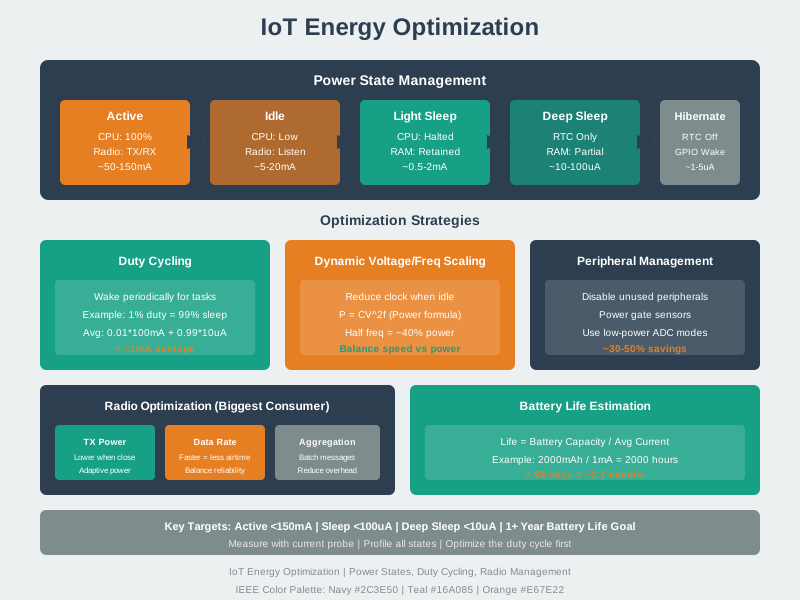
Read Figure 1 from the lowest-power state toward the active states. Deep sleep gives the smallest representative current but leaves the node unavailable; light sleep and idle restore progressively more circuitry before active work begins. Once active, sensing, listening, transmitting, and processing may each extend the high-current window even when the application describes them as one wake event. The review should therefore state which transitions are present, how long readiness takes, and which states are deliberately absent. A node that only samples periodically has a different duty-cycle promise from one that must also receive and forward neighbour traffic, which is the distinction used in the later average-current and rendezvous decisions.
Average-Current Reasoning
This section: Average-Current Reasoning — Average-current reasoning is not a promise of operating life.
Average-current reasoning is not a promise of operating life. It is a way to compare design choices with the assumptions visible.
Record:
- active-current estimate and what counts as active;
- sleep-current estimate and what remains powered;
- wake overhead per cycle;
- communication retry or acknowledgement rule;
- cycle window and active window;
- latency bound the application can tolerate;
- evidence source for any numbers used in a worked exercise.
If the chapter or lab does not provide measured current, keep the calculation symbolic or mark the value as an assumption. Do not turn a classroom estimate into a deployment claim.
Latency And Missed Events
This section: Latency And Missed Events — Lower duty cycle usually means the node is unavailable for longer spans.
Lower duty cycle usually means the node is unavailable for longer spans. Detection latency grows when the node waits longer before checking a condition, while communication latency grows when a sender must wait for the receiver to wake. A short event may occur entirely during sleep, and even a successfully stored reading may be too old for the downstream decision by the time it is delivered. The design question is therefore not “how low can the duty cycle be?” but “what wake schedule still preserves the application decision and makes missed or stale evidence visible?”
Rendezvous Patterns
This section: Rendezvous Patterns — Duty cycling becomes harder when nodes need to communicate.
Duty cycling becomes harder when nodes need to communicate. Sender and receiver must overlap while awake.
Synchronous Rendezvous
Synchronous approaches coordinate neighboring wake windows. They can reduce idle listening when schedules stay aligned, but they need schedule exchange and drift handling. They fit stable neighborhoods and predictable traffic better than highly variable traffic.
Review questions:
- How is the schedule shared?
- What happens when clocks drift?
- How much schedule-maintenance overhead is acceptable?
- What latency bound does the shared schedule provide?
Asynchronous Rendezvous
Asynchronous approaches avoid a shared schedule. A sender may use repeated short wake-up signals or listen for a receiver’s periodic checks. They can be more flexible, but the sender may spend extra time trying to catch the receiver awake.
Review questions:
- How does the sender discover the receiver’s wake window?
- How long can the sender wait before giving up?
- How are duplicate or stale messages handled?
- What overhead comes from preamble, strobe, or repeated attempt behavior?
Adaptive Schedules
Adaptive schedules change wake behavior after traffic, events, or local state changes. They can be useful, but they need safeguards so the node does not oscillate between states without evidence.
Review questions:
- What condition changes the schedule?
- What condition returns it to the normal schedule?
- Is there a cooldown or hysteresis rule?
- How is the schedule change recorded for review?
Named Adaptive Schemes
This section: Named Adaptive Schemes — Two published approaches show what an adaptive-schedule review record can look like once the “changes schedule” and “returns to normal” conditions are made concrete.
Two published approaches show what an adaptive-schedule review record can look like once the “changes schedule” and “returns to normal” conditions are made concrete.
Information-theoretic self-management (InTSeM) adjusts a node’s transmission rate, and so its sleep time, by comparing how informative the node’s own currently sensed data is against how informative its neighbors’ data is. If neither the node’s own reading nor its neighbors’ readings add new information, the node drops to a minimum transmission rate; if the node or a neighbor has something more informative to report, the rate is raised instead. The energy savings come directly from not transmitting or relaying a reading that would not have changed the decision anyway.
Social-sensing-based duty-cycle management targets rare-event monitoring, such as submarine or intrusion detection, where a node has to stay ready for an event that is uncommon by definition. Ordinary duty-cycle management does not distinguish rare events from regular ones, so a fixed schedule tends to under-sample the event that actually matters. The open challenge is the same pair of questions any adaptive schedule needs answered: how to tell a rare event apart from a regular one, and how to adapt the duty cycle to the event’s occurrence probability rather than to a fixed clock.
Both schemes still need the same review fields as any adaptive schedule in this chapter: the condition that changes the rate, the condition that restores it, and a record of when the change happened.
Review Record
This section: Review Record — A duty-cycle plan should preserve the reasoning behind the schedule, not just its percentage.
A duty-cycle plan should preserve the reasoning behind the schedule, not just its percentage. Inspect Figure 2 before accepting a plan so that the application decision, physical state sequence, communication opportunity, and invalidation condition can be checked together.
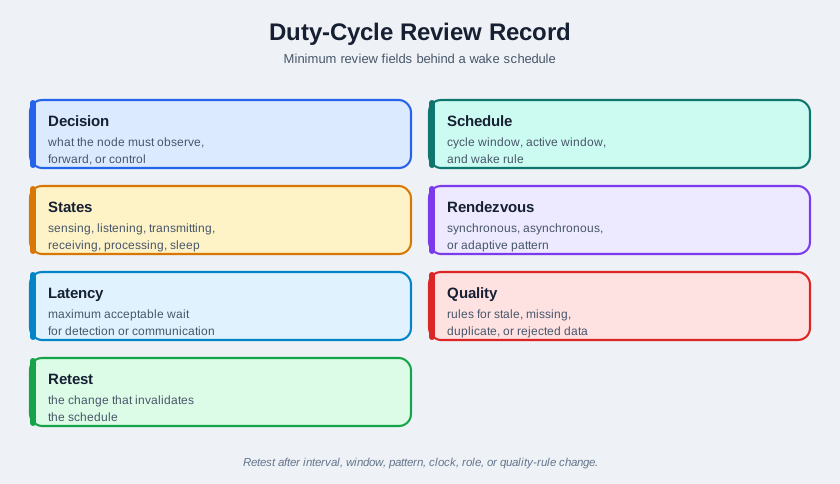
Read Figure 2 from the decision field at the top through schedule and states, because the required observation or action determines which awake work belongs in the cycle. Continue through rendezvous and latency to verify that another node can actually exchange data within the permitted wait. Finish with quality and retest: stale, missing, duplicate, or rejected records must remain distinguishable, and a changed traffic pattern, role, clock, or response requirement must reopen the review. These fields connect the power estimate to an operational promise that can be tested rather than leaving the duty-cycle number isolated.
Worked Review: Periodic Condition Check
This section: Worked Review: Periodic Condition Check — Scenario: a small sensor node checks a local condition and sends a short status record only when the reading passes the quality rule.
Scenario: a small sensor node checks a local condition and sends a short status record only when the reading passes the quality rule.
Concrete example: a battery-powered soil-moisture node in a greenhouse wakes every few minutes, powers its sensing circuit, checks whether the reading is fresh and plausible, listens briefly for a gateway opportunity, and transmits only when the record should update the irrigation review. The review must count the wake and listen states, not only the sensing state.
Decision
The node needs to support a periodic condition review, not immediate alarm behavior.
Schedule
The plan defines a repeating cycle with a short active window. The active window includes wake overhead, sensing, a brief listen check, and optional communication.
Rendezvous
The node uses an asynchronous pattern because traffic is sparse and neighbors are not expected to keep a shared wake schedule.
Latency
The acceptable latency is tied to the review interval. If the application later needs faster response, the schedule must be revisited.
Data quality
The record separates accepted readings from stale, missing, duplicate, or failed communication states.
Retest trigger
Retest after changing the review interval, active window, communication pattern, clock source, routing role, or quality rule.
Common Mistakes
This section: Common Mistakes — A duty-cycle percentage is incomplete unless its cycle window is defined, and counting sensing time while omitting radio listen time makes even that estimate misleading.
A duty-cycle percentage is incomplete unless its cycle window is defined, and counting sensing time while omitting radio listen time makes even that estimate misleading. A symbolic current calculation must not be presented as a measurement. Lowering the active window also requires a latency and missed-event check: synchronized schedules must account for clock drift, while asynchronous ones must account for retries. Missing or stale data must remain visibly different from a normal reading. Finally, any routing-role change reopens the schedule because a relay’s receive and forwarding obligations differ from those of a leaf node.
Knowledge Check
This section: Knowledge Check
Matching Quiz
This section: Matching Quiz
Ordering Quiz
This section: Ordering Quiz
Summary
This section: Summary — Duty cycling reduces average current by letting a node sleep between useful work periods, but it also changes latency, communication availability, and data freshness.
Duty cycling reduces average current by letting a node sleep between useful work periods, but it also changes latency, communication availability, and data freshness. A defensible plan records the schedule, active states, rendezvous method, latency requirement, data-quality rule, and retest trigger.
Use symbolic calculations when measured values are unavailable. Keep the claim scoped to the stated assumptions and revisit the schedule whenever the application decision or node role changes.
Key Takeaway
This section: Key Takeaway — Duty cycling is a system-level tradeoff: sleep schedules, wake triggers, latency, data freshness, and recovery behavior must fit the application.
Duty cycling is a system-level tradeoff: sleep schedules, wake triggers, latency, data freshness, and recovery behavior must fit the application.
Concept Relationships
This section: Concept Relationships — Duty cycle links active and sleep windows inside a repeating cycle, while average current combines the current drawn in those windows with wake overhead.
Duty cycle links active and sleep windows inside a repeating cycle, while average current combines the current drawn in those windows with wake overhead. Latency sets how long the application can wait for detection or communication, and rendezvous determines whether sender and receiver actually overlap during that wait. Data-quality rules keep accepted readings separate from stale, missing, duplicate, or rejected records. Retest triggers close the reasoning chain by reopening the schedule when traffic, clock behaviour, node role, or application needs change.
What’s Next
This section: What’s Next — Return to Duty-Cycling and Topology Management when you need the module context around sleep schedules and topology.
Return to Duty-Cycling and Topology Management when you need the module context around sleep schedules and topology. Continue with Duty Cycle Worked Examples to practise scoped calculations and review records. When a wake schedule changes network shape or forwarding responsibility, move next to Topology Management Techniques.
Find help
3 reviewed answers.
Where should I start in a module?
Open the module page from the sidebar to see its chapters in order. Use the module map to return to a topic you need.
Modules and pathsReviewed
What can I try when a project does not work?
Check the symptom, then work through the diagnostic steps. Keep the error message and the smallest example that reproduces it.
When you are stuckReviewed
How do interactive examples work?
Use the interactive guide to check how examples and simulations work before changing your project.
Interactive examples guideReviewed