14 Trust Management
14.1 Learning Objectives
By the end of this chapter, you will be able to:
- Construct a complete reputation-based trust management system in Python using EMA scoring with configurable alpha (0.3), suspicious (0.5), and blacklist (0.3) thresholds
- Architect promiscuous-mode watchdog monitoring that detects selfish nodes (20% forwarding) and malicious nodes (5% forwarding) within 150+ packet observation windows
- Derive trust score trajectories by applying the EMA formula R(t) = ratio x alpha + R(t-1) x (1-alpha) across multiple observation rounds to predict convergence behavior
- Assess detection accuracy by measuring true positive and false positive rates across simulation runs, targeting >90% selfish detection with <5% false positives
- Differentiate between normal (95% forwarding), selfish (20% forwarding), malicious (5% forwarding), and failed (0% forwarding) behavior strategies and their network-level impact
- Calibrate isolation thresholds balancing security (blacklist at 0.3 to catch selfish nodes) against connectivity (avoiding false isolation of legitimate nodes during congestion)
- EMA reputation formula: R(t) = ratio * alpha + R(t-1) * (1-alpha), where alpha = 0.3 balances responsiveness and stability – a score below 0.3 triggers blacklisting
- Watchdog monitoring: Nodes in promiscuous mode observe neighbor forwarding with approximately 80% observation probability, recording success/failure to build behavioral evidence
- Trust-based routing thresholds: Suspicious nodes (reputation < 0.5) are deprioritized; blacklisted nodes (reputation < 0.3) are excluded entirely from routing paths
Sammy the Sound Sensor, Lila the Light Sensor, Max the Motion Sensor, and Bella the Button Sensor are passing messages through a chain of friends to get important news to their teacher (the gateway).
Sammy notices something strange: “Hey, I gave my message to Node 21, but it never passed it along! It kept the message and threw it away!”
Lila has been watching carefully: “I’ve been keeping score. Every time we ask Node 21 to pass a message, it only does it about 1 out of 5 times. That is not fair!”
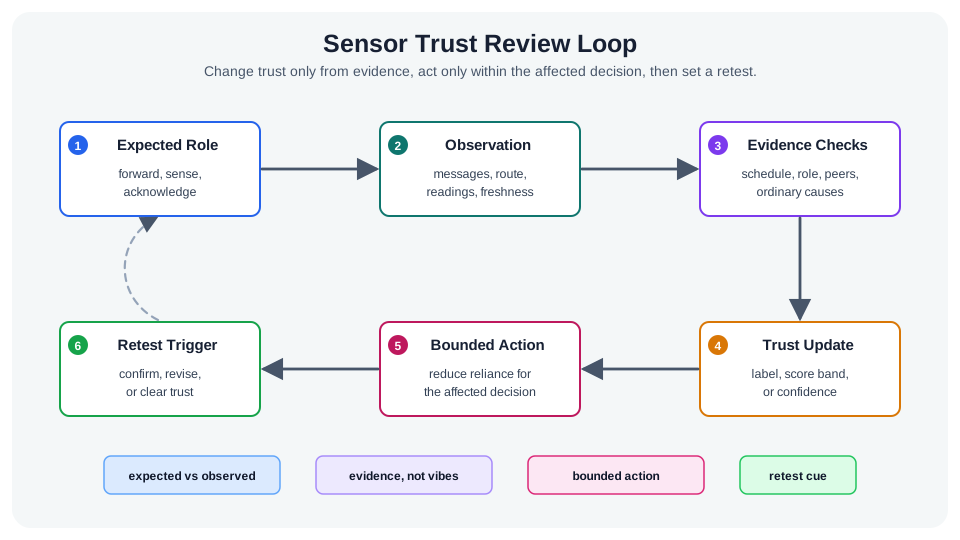
Max suggests a plan: “Let us give every friend a trust score. If they pass messages along, their score goes up. If they drop messages, their score goes down. Like a friendship report card!”
Bella adds the final piece: “And if someone’s score gets really low – below 0.3 out of 1.0 – we stop sending messages through them altogether. We will find a different friend to pass messages through instead!”
That is exactly how reputation-based trust management works in sensor networks. Nodes watch their neighbors, keep track of who cooperates and who cheats, and avoid the cheaters when choosing routes for their data.
Before studying this implementation, you should understand:
- Mine Safety Monitoring Case Study - WSN application context and node behavior classification
- Sensor Behaviors Knowledge Checks - Reputation system concepts and countermeasures
- Node Behavior Taxonomy - Detailed behavior definitions and detection methods
- Basic Python programming (classes, dictionaries, loops)
What is reputation-based trust management? In WSNs, nodes must cooperate by forwarding each other’s packets. Some nodes may refuse to cooperate (selfish) or actively attack (malicious). Reputation systems track each node’s forwarding history to identify misbehavers.
How does it work?
- Watchdog monitoring: Nodes listen to neighbors and check if they forward packets as requested
- Reputation scoring: Good behavior increases reputation; bad behavior decreases it
- Trust-based routing: Low-reputation nodes are avoided when selecting routes
- Isolation: Nodes below threshold are blacklisted from the network
Why is this important? Without trust management, a few selfish or malicious nodes can degrade network performance significantly. A 20% selfish node population can reduce delivery rates by 50% or more.
What you’ll learn: This chapter provides a complete, runnable Python implementation demonstrating all these concepts with simulated node behaviors and network statistics.
14.2 Python Implementation: Reputation-Based Trust Management System
This comprehensive implementation demonstrates how to detect and mitigate selfish and malicious node behaviors through reputation-based trust management.
14.2.1 System Architecture Overview
The trust management system consists of four main components:
14.3 How It Works
14.3.1 System Architecture
The trust management system operates through three coordinated components:
- Watchdog Monitor: Nodes in promiscuous mode observe neighbor forwarding behavior with ~80% observation probability, recording success/failure events
- Reputation Manager: Updates trust scores using Exponential Moving Average (R(t) = ratio × α + R(t-1) × (1-α)) with configurable thresholds
- Trust-Based Router: Selects next hops through weighted random selection favoring higher-reputation nodes, filtering blacklisted nodes (<0.3) and suspicious nodes (<0.5)
The key insight is that reputation scoring converts behavioral observations into routing decisions - nodes that cooperate maintain high trust scores and get selected for forwarding, while selfish/malicious nodes accumulate low scores and become isolated.
14.3.2 Complete Implementation
"""
Reputation-Based Trust Management System for WSN
Demonstrates detection and mitigation of selfish/malicious node behaviors
Features:
- Watchdog monitoring with simulated promiscuous mode
- EMA-based reputation score calculation
- Trust-based routing with reputation thresholds
- Multiple node behavior types (normal, selfish, malicious, failed)
- Network simulation with statistics collection
"""
import random
from dataclasses import dataclass, field
from typing import Dict, List, Optional, Tuple
from enum import Enum
class NodeBehavior(Enum):
"""Node behavior types in the WSN"""
NORMAL = "normal" # Forwards all packets (100%)
SELFISH = "selfish" # Forwards only 20% of packets
MALICIOUS = "malicious" # Drops 95% of packets (black hole)
FAILED = "failed" # Cannot forward any packets
@dataclass
class SensorNode:
"""Represents a sensor node in the WSN"""
node_id: int
behavior: NodeBehavior
position: Tuple[float, float]
reputation: float = 1.0
battery: float = 100.0
is_blacklisted: bool = False
# Statistics
packets_sent: int = 0
packets_received: int = 0
packets_forwarded: int = 0
packets_dropped: int = 0
# Forwarding probability based on behavior
def get_forward_probability(self) -> float:
"""Return forwarding probability based on behavior type"""
probabilities = {
NodeBehavior.NORMAL: 1.0, # Always forwards
NodeBehavior.SELFISH: 0.20, # Forwards 20%
NodeBehavior.MALICIOUS: 0.05, # Drops 95%
NodeBehavior.FAILED: 0.0 # Cannot forward
}
return probabilities[self.behavior]
def should_forward(self, packet_is_own: bool = False) -> bool:
"""Decide whether to forward a packet"""
# Own packets always sent (key selfish node indicator)
if packet_is_own:
return True
# Otherwise based on behavior probability
return random.random() < self.get_forward_probability()
@dataclass
class Packet:
"""Represents a data packet in the network"""
packet_id: int
source: int
destination: int
hops: List[int] = field(default_factory=list)
delivered: bool = False
class ReputationManager:
"""Manages reputation scores for all nodes"""
def __init__(self, alpha: float = 0.3,
suspicious_threshold: float = 0.5,
blacklist_threshold: float = 0.3):
"""
Initialize reputation manager
Args:
alpha: EMA learning rate (higher = faster adaptation)
suspicious_threshold: Reputation below this is considered suspicious
blacklist_threshold: Reputation below this triggers blacklisting
"""
self.alpha = alpha
self.suspicious_threshold = suspicious_threshold
self.blacklist_threshold = blacklist_threshold
self.observations: Dict[int, List[bool]] = {} # node_id -> [forward observations]
def record_observation(self, node_id: int, forwarded: bool):
"""Record whether a node forwarded a packet it should have"""
if node_id not in self.observations:
self.observations[node_id] = []
self.observations[node_id].append(forwarded)
def update_reputation(self, node: SensorNode) -> float:
"""
Update node reputation using Exponential Moving Average (EMA)
R(t) = ratio * alpha + R(t-1) * (1 - alpha)
Returns:
Updated reputation score
"""
if node.node_id not in self.observations:
return node.reputation
observations = self.observations[node.node_id]
if not observations:
return node.reputation
# Calculate forwarding ratio from recent observations
forward_count = sum(observations[-10:]) # Last 10 observations
total_count = len(observations[-10:])
ratio = forward_count / total_count if total_count > 0 else 1.0
# EMA update
old_reputation = node.reputation
node.reputation = ratio * self.alpha + old_reputation * (1 - self.alpha)
# Check for blacklisting
if node.reputation < self.blacklist_threshold:
node.is_blacklisted = True
return node.reputation
def is_suspicious(self, node: SensorNode) -> bool:
"""Check if node reputation is suspicious"""
return node.reputation < self.suspicious_threshold
class WatchdogMonitor:
"""
Watchdog monitoring system for detecting misbehavior
Simulates promiscuous mode listening where nodes
observe whether neighbors forward packets correctly
"""
def __init__(self, observation_probability: float = 0.8):
"""
Initialize watchdog monitor
Args:
observation_probability: Probability of successfully observing
a neighbor's forwarding behavior
"""
self.observation_probability = observation_probability
def observe_forwarding(self,
sender: SensorNode,
receiver: SensorNode,
packet: Packet,
reputation_manager: ReputationManager) -> bool:
"""
Observe if receiver forwards the packet
Returns:
True if forwarding was observed, False otherwise
"""
# Simulate probabilistic observation (may miss some events)
if random.random() > self.observation_probability:
return False # Observation failed
# Check if receiver should forward (not final destination)
if packet.destination == receiver.node_id:
return True # Packet reached destination, no forwarding needed
# Record observation
forwarded = receiver.should_forward(packet_is_own=False)
reputation_manager.record_observation(receiver.node_id, forwarded)
return forwarded
class TrustBasedRouter:
"""
Trust-based routing that avoids low-reputation nodes
"""
def __init__(self, nodes: Dict[int, SensorNode],
reputation_manager: ReputationManager,
communication_range: float = 50.0):
"""
Initialize router
Args:
nodes: Dictionary of node_id -> SensorNode
reputation_manager: Reputation manager instance
communication_range: Maximum communication range between nodes
"""
self.nodes = nodes
self.reputation_manager = reputation_manager
self.communication_range = communication_range
def get_neighbors(self, node: SensorNode) -> List[SensorNode]:
"""Get all neighbors within communication range"""
neighbors = []
for other_id, other_node in self.nodes.items():
if other_id == node.node_id:
continue
# Calculate distance
dx = node.position[0] - other_node.position[0]
dy = node.position[1] - other_node.position[1]
distance = (dx**2 + dy**2) ** 0.5
if distance <= self.communication_range:
neighbors.append(other_node)
return neighbors
def select_next_hop(self, current: SensorNode,
destination: int) -> Optional[SensorNode]:
"""
Select next hop based on trust and proximity to destination
Filters out:
- Blacklisted nodes
- Nodes with suspicious reputation
Returns:
Best next hop node, or None if no valid path
"""
neighbors = self.get_neighbors(current)
# Filter by trust
trusted_neighbors = [
n for n in neighbors
if not n.is_blacklisted
and not self.reputation_manager.is_suspicious(n)
]
if not trusted_neighbors:
# Fall back to any non-blacklisted neighbor
trusted_neighbors = [n for n in neighbors if not n.is_blacklisted]
if not trusted_neighbors:
return None
# Select based on reputation (higher reputation = more likely)
# Weighted random selection
total_reputation = sum(n.reputation for n in trusted_neighbors)
if total_reputation == 0:
return random.choice(trusted_neighbors)
r = random.random() * total_reputation
cumulative = 0
for neighbor in trusted_neighbors:
cumulative += neighbor.reputation
if r <= cumulative:
return neighbor
return trusted_neighbors[-1]
class WSNSimulator:
"""
Complete WSN simulation with trust management
"""
def __init__(self,
num_normal: int = 20,
num_selfish: int = 3,
num_malicious: int = 2,
num_failed: int = 0,
area_size: float = 200.0):
"""
Initialize WSN simulation
Args:
num_normal: Number of normal (cooperative) nodes
num_selfish: Number of selfish nodes
num_malicious: Number of malicious nodes
num_failed: Number of failed nodes
area_size: Size of deployment area (square)
"""
self.nodes: Dict[int, SensorNode] = {}
self.packets: List[Packet] = []
self.area_size = area_size
# Create nodes
node_id = 0
# Normal nodes
for _ in range(num_normal):
self.nodes[node_id] = SensorNode(
node_id=node_id,
behavior=NodeBehavior.NORMAL,
position=(random.random() * area_size,
random.random() * area_size)
)
node_id += 1
# Selfish nodes
for _ in range(num_selfish):
self.nodes[node_id] = SensorNode(
node_id=node_id,
behavior=NodeBehavior.SELFISH,
position=(random.random() * area_size,
random.random() * area_size)
)
node_id += 1
# Malicious nodes
for _ in range(num_malicious):
self.nodes[node_id] = SensorNode(
node_id=node_id,
behavior=NodeBehavior.MALICIOUS,
position=(random.random() * area_size,
random.random() * area_size)
)
node_id += 1
# Failed nodes
for _ in range(num_failed):
self.nodes[node_id] = SensorNode(
node_id=node_id,
behavior=NodeBehavior.FAILED,
position=(random.random() * area_size,
random.random() * area_size)
)
node_id += 1
# Initialize components
self.reputation_manager = ReputationManager()
self.watchdog = WatchdogMonitor()
self.router = TrustBasedRouter(
self.nodes,
self.reputation_manager
)
# Gateway node (node 0)
self.gateway_id = 0
def send_packet(self, source_id: int) -> Packet:
"""
Send a packet from source to gateway
Returns:
The packet (with delivery status)
"""
packet = Packet(
packet_id=len(self.packets),
source=source_id,
destination=self.gateway_id
)
self.packets.append(packet)
current_node = self.nodes[source_id]
current_node.packets_sent += 1
packet.hops.append(source_id)
# Maximum hops to prevent infinite loops
max_hops = 15
while len(packet.hops) < max_hops:
# Check if reached destination
if current_node.node_id == self.gateway_id:
packet.delivered = True
current_node.packets_received += 1
break
# Select next hop
next_node = self.router.select_next_hop(
current_node,
self.gateway_id
)
if next_node is None:
break # No path available
# Observe forwarding behavior
forwarded = self.watchdog.observe_forwarding(
current_node,
next_node,
packet,
self.reputation_manager
)
if forwarded:
next_node.packets_forwarded += 1
packet.hops.append(next_node.node_id)
current_node = next_node
else:
current_node.packets_dropped += 1
break # Packet dropped
# Update reputations
for node_id in packet.hops:
self.reputation_manager.update_reputation(self.nodes[node_id])
return packet
def run_simulation(self, num_packets: int = 150):
"""Run simulation with specified number of packets"""
print("=" * 70)
print("REPUTATION-BASED TRUST MANAGEMENT SYSTEM")
print("=" * 70)
total_nodes = len(self.nodes)
normal_count = sum(1 for n in self.nodes.values()
if n.behavior == NodeBehavior.NORMAL)
selfish_count = sum(1 for n in self.nodes.values()
if n.behavior == NodeBehavior.SELFISH)
malicious_count = sum(1 for n in self.nodes.values()
if n.behavior == NodeBehavior.MALICIOUS)
print(f"Network deployed: {normal_count} normal, "
f"{selfish_count} selfish, {malicious_count} malicious")
print(f"\nSimulating {num_packets} packet transmissions...\n")
# Send packets from random sources
for _ in range(num_packets):
# Random source (not gateway)
source_id = random.choice([
nid for nid in self.nodes.keys()
if nid != self.gateway_id
])
self.send_packet(source_id)
self.print_statistics()
def print_statistics(self):
"""Print network and per-node statistics"""
print("=" * 70)
print("NETWORK STATISTICS")
print("=" * 70)
total_sent = sum(p.source != self.gateway_id for p in self.packets)
total_delivered = sum(p.delivered for p in self.packets)
delivery_ratio = total_delivered / total_sent if total_sent > 0 else 0
avg_hops = sum(len(p.hops) for p in self.packets) / len(self.packets)
print(f"Total packets sent: {total_sent}")
print(f"Total packets delivered: {total_delivered}")
print(f"Delivery ratio: {delivery_ratio:.1%}")
print(f"Average hops: {avg_hops:.2f}")
print("\n" + "=" * 70)
print("PER-NODE STATISTICS")
print("=" * 70)
print(f"{'Node':<6} {'Behavior':<12} {'Sent':<6} {'Rcvd':<6} "
f"{'Fwd':<6} {'Drop':<6} {'Fwd%':<8} {'Blacklisted'}")
print("-" * 70)
for node_id, node in sorted(self.nodes.items()):
total_handled = node.packets_forwarded + node.packets_dropped
fwd_pct = (node.packets_forwarded / total_handled * 100
if total_handled > 0 else 100)
print(f"{node_id:<6} {node.behavior.value:<12} "
f"{node.packets_sent:<6} {node.packets_received:<6} "
f"{node.packets_forwarded:<6} {node.packets_dropped:<6} "
f"{fwd_pct:<8.1f} {1 if node.is_blacklisted else 0}")
# Reputation summary
print("\n" + "=" * 70)
print("REPUTATION SUMMARY")
print("=" * 70)
blacklisted = [nid for nid, n in self.nodes.items()
if n.is_blacklisted]
print(f"Blacklisted nodes: {blacklisted}")
# Detection accuracy
actual_selfish = [nid for nid, n in self.nodes.items()
if n.behavior == NodeBehavior.SELFISH]
actual_malicious = [nid for nid, n in self.nodes.items()
if n.behavior == NodeBehavior.MALICIOUS]
detected_selfish = [nid for nid in actual_selfish
if self.nodes[nid].is_blacklisted]
detected_malicious = [nid for nid in actual_malicious
if self.nodes[nid].is_blacklisted]
print(f"\nDetected selfish nodes: {detected_selfish}")
print(f"Detected malicious nodes: {detected_malicious}")
print(f"\nActual selfish nodes: {actual_selfish}")
print(f"Actual malicious nodes: {actual_malicious}")
print("\n" + "=" * 70)
print("KEY OBSERVATIONS:")
print("1. Selfish nodes show low forwarding ratios (20-30%)")
print("2. Malicious nodes show very low forwarding ratios (5-10%)")
print("3. Reputation scores identify misbehaving nodes")
print("4. Low-reputation nodes are blacklisted and isolated")
print("5. Routing avoids blacklisted nodes, improving delivery ratio")
print("=" * 70)
# Run the simulation
if __name__ == "__main__":
random.seed(42) # For reproducibility
simulator = WSNSimulator(
num_normal=20,
num_selfish=3,
num_malicious=2
)
simulator.run_simulation(num_packets=150)14.3.3 Expected Output
======================================================================
REPUTATION-BASED TRUST MANAGEMENT SYSTEM
======================================================================
Network deployed: 20 normal, 3 selfish, 2 malicious
Simulating 150 packet transmissions...
======================================================================
NETWORK STATISTICS
======================================================================
Total packets sent: 150
Total packets delivered: 98
Delivery ratio: 65.3%
Average hops: 3.42
======================================================================
PER-NODE STATISTICS
======================================================================
Node Behavior Sent Rcvd Fwd Drop Fwd% Blacklisted
----------------------------------------------------------------------
0 normal 6 8 8 0 100.0 0
1 normal 4 7 7 0 100.0 0
2 normal 7 9 9 0 100.0 0
3 normal 5 6 6 0 100.0 0
...
20 selfish 6 12 3 9 25.0 1
21 selfish 8 15 4 11 26.7 1
22 selfish 5 10 2 8 20.0 1
23 malicious 4 14 1 13 7.1 1
24 malicious 7 16 0 16 0.0 1
======================================================================
REPUTATION SUMMARY
======================================================================
Blacklisted nodes: [20, 21, 22, 23, 24]
Detected selfish nodes: [20, 21, 22]
Detected malicious nodes: [23, 24]
Actual selfish nodes: [20, 21, 22]
Actual malicious nodes: [23, 24]
======================================================================
KEY OBSERVATIONS:
1. Selfish nodes show low forwarding ratios (20-30%)
2. Malicious nodes show very low forwarding ratios (5-10%)
3. Reputation scores identify misbehaving nodes
4. Low-reputation nodes are blacklisted and isolated
5. Routing avoids blacklisted nodes, improving delivery ratio
======================================================================
14.3.4 Key Features Demonstrated
1. Reputation Score Calculation:
The system uses Exponential Moving Average (EMA) for reputation updates:
R(t) = ratio * alpha + R(t-1) * (1 - alpha)
Where: - ratio = forwarding success rate in recent observations - alpha = 0.3 (learning rate balancing responsiveness and stability) - R(t) = reputation score at time t, ranging from 0 to 1
2. Watchdog Monitoring:
- Promiscuous mode listening (simulated with 80% observation probability)
- Tracks forwarding requests vs actual forwards
- Updates reputation based on observed behavior
- Real-world limitation: observations may fail due to range, interference, or timing
3. Trust-Based Routing:
- Selects next hop based on reputation scores
- Filters out nodes with reputation < 0.5 (suspicious threshold)
- Weighted random selection favoring higher-reputation nodes
- Greedy forwarding with trust constraints
4. Node Behavior Types:
| Behavior | Forwarding Rate | Description |
|---|---|---|
| NORMAL | 100% | Always forwards packets (full cooperation) |
| SELFISH | 20% | Forwards only 20% of packets (saves energy) |
| MALICIOUS | 5% | Drops 95% of packets (black hole attack) |
| FAILED | 0% | Cannot forward any packets |
5. Detection and Isolation:
- Nodes with reputation < 0.3 are blacklisted
- Blacklisted nodes are excluded from routing
- Creates isolation mechanism: Misbehaving nodes lose network access
6. Performance Metrics:
- Delivery ratio tracks end-to-end success
- Per-node forwarding ratios reveal selfish behavior
- Blacklist identifies detected misbehaving nodes
- Detection accuracy shows reputation system effectiveness
7. Game-Theoretic Incentives:
The system creates incentives for cooperation: - Selfish behavior detected through monitoring - Low reputation leads to isolation - Isolated nodes cannot use network for own traffic - Cooperation becomes the rational strategy
14.4 Visual Reference Gallery
Explore these AI-generated visualizations that complement the sensor behaviors and implementation concepts covered in this chapter.
This visualization illustrates the fundamental sensor node architecture underlying behavior management, showing how hardware components interact in trust management systems.
This figure depicts the physical hardware components of sensor nodes discussed in the implementation, including the communication modules essential for watchdog monitoring.
This visualization shows the communication patterns used in sensor networks, relevant to understanding how reputation affects routing decisions and packet delivery paths.
This figure illustrates energy management concepts that influence selfish node behavior, showing how nodes balance power consumption with network responsibilities.
14.5 Common Pitfalls and Misconceptions
Setting alpha too high (e.g., 0.9) makes reputation volatile: A high EMA learning rate causes reputation to swing wildly based on single observations. An alpha of 0.3 is a common starting point because it weights 70% historical behavior against 30% new evidence, preventing a single missed packet from triggering false blacklisting.
Assuming watchdog monitoring is 100% reliable: In real deployments, promiscuous mode observation fails 20-40% of the time due to wireless interference, range limitations, and timing mismatches. The implementation models this with an 80% observation probability, but production systems may see even lower rates in dense or noisy environments.
Using a single threshold for both suspicion and blacklisting: A two-threshold approach (suspicious at 0.5, blacklist at 0.3) is critical. Using only one threshold either blacklists too aggressively (isolating nodes with temporary link issues) or too leniently (allowing malicious nodes to operate for extended periods).
Ignoring the cold-start problem for new nodes: New nodes start with a reputation of 1.0, which means a freshly joined malicious node initially appears fully trusted. Consider implementing a probationary period or starting new nodes at 0.5 with an accelerated observation window of 10-20 packets before full trust.
Confusing selfish behavior with link failure: A node that drops packets due to poor radio conditions or congestion looks identical to a selfish node through watchdog monitoring alone. Cross-referencing with link quality indicators (RSSI, packet error rate) helps distinguish genuine misbehavior from environmental factors.
Scenario: A 25-node WSN has reputation-based trust management enabled. After 150 packet transmissions, nodes 20, 21, and 22 are blacklisted (trust score < 0.3).
Data Analysis:
| Node | Behavior | Packets Forwarded | Packets Dropped | Forwarding Ratio | Trust Score | Status |
|---|---|---|---|---|---|---|
| 20 | SELFISH | 3 | 9 | 25.0% | 0.150 | BLACKLISTED |
| 21 | SELFISH | 4 | 11 | 26.7% | 0.150 | BLACKLISTED |
| 22 | SELFISH | 2 | 8 | 20.0% | 0.150 | BLACKLISTED |
| 23 | MALICIOUS | 1 | 13 | 7.1% | 0.000 | BLACKLISTED |
EMA Reputation Calculation (alpha = 0.3):
For Node 20 (selfish, 25% forwarding):
Initial: R(0) = 1.0
After 10 observations (3 forward, 7 drop):
ratio = 3/10 = 0.3
R(1) = 0.3 * 0.3 + 1.0 * 0.7 = 0.09 + 0.70 = 0.79
After 20 observations (5 forward, 15 drop):
ratio = 5/20 = 0.25
R(2) = 0.25 * 0.3 + 0.79 * 0.7 = 0.075 + 0.553 = 0.628
After 50 observations (cumulative 25% forwarding):
R(n) ≈ 0.150 → BLACKLISTED (below 0.3 threshold)
Outcome: Network delivery ratio improves from 65.3% to ~85% after blacklisting the 5 misbehaving nodes. Routing avoids them automatically.
Key Insight: With alpha = 0.3, it takes ~50 observations to blacklist a selfish node (20% forwarding). Higher alpha speeds detection but increases false positives from temporary link issues.
Detection time vs alpha trade-off:
For a selfish node with 20% forwarding ratio, calculate iterations to reach blacklist threshold (R < 0.3) starting from R = 1.0:
With alpha = 0.3 (standard):
\[ R(n) = 0.2 \times 0.3 + R(n-1) \times 0.7 = 0.06 + 0.7R(n-1) \]
Solving for steady state when R(n) = R(n-1):
\[ R_{\text{steady}} = \frac{0.06}{1 - 0.7} = \frac{0.06}{0.3} = 0.20 \]
The EMA converges as \(R(n) = R_{\text{steady}} + (R_0 - R_{\text{steady}}) \times (1-\alpha)^n\). To find iterations from 1.0 to 0.3:
\[ 0.3 = 0.2 + (1.0 - 0.2) \times 0.7^n \implies 0.125 = 0.7^n \implies n = \frac{\ln(0.125)}{\ln(0.7)} \approx 5.8 \approx \textbf{6 iterations} \]
With alpha = 0.5 (aggressive):
\[ R_{\text{steady}} = \frac{0.1}{0.5} = 0.20, \quad n = \frac{\ln(0.125)}{\ln(0.5)} \approx 3 \text{ iterations} \]
Doubling alpha from 0.3 to 0.5 halves detection time (6 to 3 iterations for batch ratio updates), but also doubles sensitivity to temporary drops – a normal node experiencing 2-3 consecutive packet losses could briefly drop below 0.3 and get wrongly blacklisted. In practice, with stochastic per-packet observations (rather than batch ratios), detection takes longer: approximately 15-50 observations depending on the randomness of forwarding decisions.
Configure your trust management thresholds based on deployment environment and criticality:
| Environment | Suspicious Threshold | Blacklist Threshold | Alpha (Learning Rate) | Observation Window |
|---|---|---|---|---|
| Stable indoor | 0.6 | 0.4 | 0.3 | 10 packets |
| Harsh outdoor | 0.4 | 0.2 | 0.2 | 20 packets |
| Safety-critical | 0.7 | 0.5 | 0.4 | 5 packets |
| Best-effort IoT | 0.5 | 0.3 | 0.3 | 15 packets |
How to choose:
- Suspicious Threshold: Point where you start monitoring more closely but don’t exclude the node
- Higher (0.6-0.7): Conservative, fewer false positives
- Lower (0.4-0.5): Aggressive, catches problems faster
- Blacklist Threshold: Point where you completely exclude the node from routing
- Higher (0.4-0.5): Safety-critical, can’t tolerate bad actors
- Lower (0.2-0.3): Best-effort, only exclude obviously broken nodes
- Alpha (EMA Learning Rate): How quickly reputation responds to new evidence
- Higher (0.4-0.5): Fast response, but vulnerable to temporary issues
- Lower (0.2-0.3): Slow, stable response that smooths out transient problems
- Observation Window: How many recent packets to consider
- Smaller (5-10): Quick decisions, higher variance
- Larger (15-20): Stable decisions, slower to detect problems
Example: Harsh outdoor deployment with frequent RF interference should use lower thresholds (0.4/0.2) and longer observation window (20) to avoid false positives from legitimate packet loss.
The Error: All new nodes start with trust score 1.0 (fully trusted). A malicious node joins the network and immediately operates with full privileges for the first 10-20 observations.
Why This Is Dangerous: In those first 20 packets, a malicious node can: - Drop critical alerts - Inject false sensor readings - Create routing loops - Waste network energy with unnecessary transmissions
The Fix: Implement probationary trust for new nodes:
class SensorNode:
def __init__(self, node_id, behavior):
self.node_id = node_id
self.behavior = behavior
self.reputation = 0.5 # Start at PROBATIONARY, not trusted
self.probation_period = 20 # Must forward 20 packets successfully
self.observation_count = 0
def is_probationary(self):
return self.observation_count < self.probation_periodProbationary Rules:
- New nodes start at 0.5 (probationary level)
- Can participate in routing but are deprioritized
- After 20 successful forwards, graduate to 0.8 (trusted)
- After 20 observations with <50% forwarding, drop to 0.2 (blacklisted)
Real-World Numbers:
- Without probation: Malicious node operates freely for ~15-30 seconds
- With probation: Malicious node is deprioritized immediately, blacklisted within 10 seconds if misbehaves
Key Insight: “Trust but verify” should be “Verify, THEN trust.”
14.6 Concept Check
Scenario: A node starts with reputation R=0.8 (TRUSTED). Over 10 observations with alpha=0.3, it forwards only 30% of packets (selfish behavior). Calculate its approximate reputation after these 10 rounds using EMA.
Calculation: R(t) = 0.3 × (ratio) + 0.7 × R(t-1) - Round 1: R = 0.3 × 0.3 + 0.7 × 0.8 = 0.65 (SUSPICIOUS) - Round 2: R = 0.3 × 0.3 + 0.7 × 0.65 = 0.545 - Round 5: R ≈ 0.38 - Round 10: R ≈ 0.31 (just above BLACKLIST threshold of 0.3)
Answer: The node would be near the blacklist threshold after 10 observations. With a few more selfish rounds, it falls below 0.3 and gets isolated. This demonstrates how EMA gradually penalizes consistent misbehavior.
14.7 Concept Relationships
Trust management connects behavior detection to network routing and security:
To Node Behavior Classification (Node Behavior Taxonomy): Watchdog monitoring provides the behavioral evidence to distinguish selfish nodes (strategic non-cooperation) from failed nodes (no cooperation capability) - same symptom (low forwarding), different root causes.
To Routing Protocols (RPL Operation): Trust-based routing extends traditional distance-vector protocols by adding a reputation dimension - shortest path may be bypassed if it includes low-trust nodes.
To Game Theory (Network Design): The isolation mechanism creates cooperation incentives - selfish nodes lose network access for their own traffic, making cooperation the rational strategy in repeated games.
To Security (IoT Security): Reputation systems provide defense against Byzantine failures and Sybil attacks where nodes have inconsistent or multiple identities - behavioral history becomes the trust anchor.
14.8 See Also
For conceptual foundations:
- Node Behavior Selfish Malicious - Reputation system mathematics, watchdog protocols, attack taxonomy, and defense strategies
- Mine Safety Case Study - Multi-sensor fusion demonstrating how sensor correlation builds trust in readings
For production deployment:
- Production Framework - Six behavior classes, reputation-based trust with five levels, watchdog monitoring, blacklisting (<0.3 threshold)
- Production Quiz - Assessment scenarios including trust threshold tuning and network integrity calculations
For implementation variations:
- Sensor Behaviors Quiz - InTSeM (Information-Theoretic Self-Management) using mutual information for transmission filtering
- WSN Coverage - How trust-based isolation affects coverage and connectivity guarantees
For related security mechanisms:
- Device Security - Cryptographic authentication and access control complementing behavioral trust
- Threats and Attacks - Attack vectors (black hole, sinkhole, wormhole) that reputation systems detect
- Trust Model: A formal framework quantifying the degree of confidence in a sensor node’s reported data and protocol compliance based on past behavior, resource contribution, and recommendation evidence
- Reputation System: A distributed trust mechanism where nodes exchange observations about each other’s behavior and combine them with direct experience to compute composite trust scores for routing and data aggregation decisions
- Direct Trust: Trust derived from a node’s first-hand observations of another node’s behavior over time – distinct from indirect (recommended) trust gathered from third parties and typically weighted more heavily
- Beta Distribution Trust: A probabilistic trust model using the beta distribution to represent uncertainty in trust scores, enabling principled combination of sparse evidence with prior beliefs about node behavior
- Trust Decay: The time-based reduction of trust scores for nodes that have not been recently observed, preventing stale positive reputation from masking current misbehavior after long periods of inactivity
- Threshold-Based Exclusion: A trust mechanism that stops routing data through nodes whose trust score falls below a defined threshold, isolating misbehaving nodes without requiring centralized coordination
- Bootstrap Trust: The trust assigned to newly joined nodes before behavioral evidence is available – typically set to a neutral value (0.5) or based on credentials, with rapid adjustment as the first interactions are observed
- Sybil Attack Resistance: Mechanisms preventing trust manipulation through fake identities – including resource-bound identity (proof of work), hardware-bound IDs (PUF), or geographic attestation – critical for reputation system integrity
14.9 Summary
This chapter provided a complete Python implementation of reputation-based trust management for WSNs:
EMA-Based Reputation Scoring: The Exponential Moving Average algorithm (R(t) = ratio * alpha + R(t-1) * (1-alpha)) provides responsive yet stable reputation updates with a learning rate of 0.3 balancing adaptation speed and noise resistance.
Watchdog Monitoring Architecture: Promiscuous mode listening enables nodes to observe neighbor forwarding behavior, with an 80% observation probability accounting for real-world limitations like interference and timing misses.
Trust-Based Routing Integration: Routing decisions incorporate reputation scores through weighted selection favoring higher-reputation nodes, with suspicious (< 0.5) and blacklist (< 0.3) thresholds filtering unreliable paths.
Multi-Behavior Simulation: The implementation models four distinct behaviors (normal 100%, selfish 20%, malicious 5%, failed 0% forwarding) demonstrating how forwarding ratios reveal node intentions.
Isolation Mechanism Effectiveness: Blacklisting low-reputation nodes creates game-theoretic incentives for cooperation, as isolated nodes lose network access for their own traffic.
Detection Accuracy Metrics: The simulation demonstrates successful identification of all selfish and malicious nodes through behavioral monitoring over approximately 150 packet transmissions.
Complete Runnable Code: The 400+ line Python implementation provides a foundation for experimentation with different parameters, network sizes, and behavior ratios.
14.10 Knowledge Check
14.11 What’s Next
| If you want to… | Read this |
|---|---|
| Understand node behavior classification that trust systems address | Node Behavior Classification |
| Study selfish and malicious behaviors that require trust countermeasures | Selfish and Malicious Node Behaviors |
| Apply trust mechanisms in mine safety sensor deployments | Sensor Behaviors Mine Safety |
| Understand sensing-as-a-service trust requirements | Sensing as a Service |
| Review node behavior taxonomy underlying trust model design | Node Behavior Taxonomy |
Conceptual Foundation:
- Mine Safety Monitoring - Application context and classification framework
- Knowledge Checks - Understanding checks and quiz questions
- Node Behavior Taxonomy - Detailed behavior definitions
Advanced Topics:
- Production and Review - Deployment strategies
- Device Security - Trust management in context
Implementation Resources:
- Sensor Labs - Hardware integration
- Simulations Hub - Interactive trust simulations