27 WSN Coverage: Fundamentals

More
Depth: Practitioner
Progress saves as you read. Mark sections complete as you go; your progress appears in the sidebar.
27.1 Start With the Field Story
This section: Start With the Field Story — Picture an orchard where sensors should warn when frost reaches young trees.
Prove Coverage for the Event That Matters
Picture an orchard where sensors should warn when frost reaches young trees. A map of circles may look complete, yet wind, leaves, height, dead units, and sleeping schedules can leave the coldest row unseen. The grower must decide what covered means for this event.
-

A frost warning system watches young trees across an orchard.
-
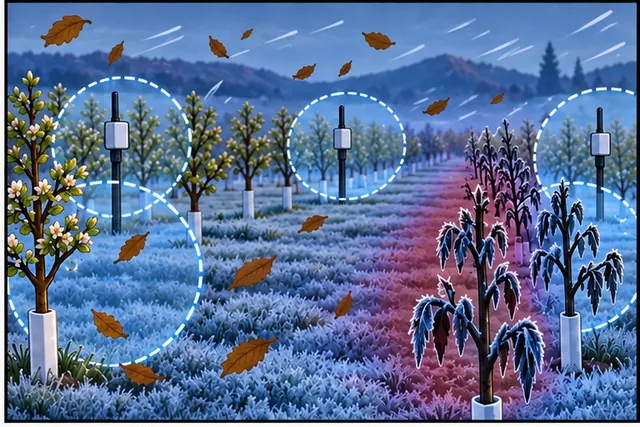
Wind, leaves, sleep, or dead units can hide the coldest row.
-

Define coverage, then test known points as conditions and paths fail.
-
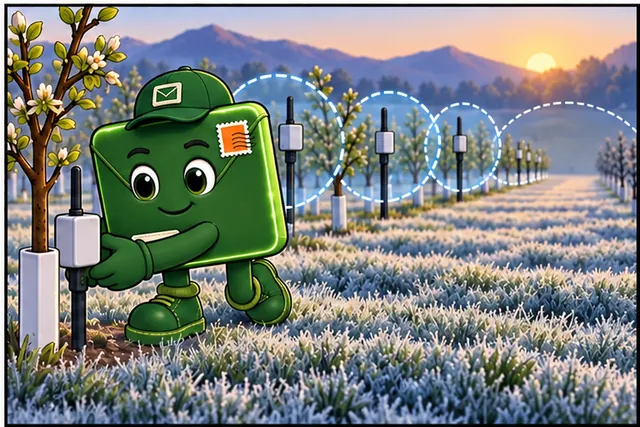
Claim coverage only where sensing and delivery both meet that rule.
Write the claim before placing devices. Name the area or path, the physical event, the smallest event to detect, the allowed delay, the number of independent observations, and the route to the reader. Mark blocked ground, changing seasons, power limits, and who owns each field check.
Measure known test points in warm, cold, wet, windy, day, and night conditions. Turn units off, move one, block a path, drain a battery, and lose a relay. Check both sensing and delivery. Record where the plan fails, why it fails, and which move or added unit closes the gap.
Keep urgent frost action near the field when a distant link cannot meet the deadline. A remote map can help compare seasons, but it must not hide a missing local reading or become the only path to protection. Preserve place, event time, quality, and active-state evidence.
This opening does not choose one shape or prove every season. Practitioner turns the claim into a field survey and retest plan. Under the Hood examines sensing models, overlap, barriers, paths, sleep schedules, connectivity, and uncertainty.
Check the hard field point. Check it again in winter.
Coverage starts with the question “covered for what?” A field can be covered for area monitoring, point events, barriers, paths, or redundancy, and each meaning needs a different sensing model and different proof.
27.2 In 60 Seconds
This section: In 60 Seconds — WSN coverage fundamentals turn a monitoring goal into a reviewable coverage claim.
WSN coverage fundamentals turn a monitoring goal into a reviewable coverage claim. A good claim says what must be sensed, what kind of coverage is needed, which sensing model is being trusted, what redundancy is required, which sensors are active, how readings reach the sink, and when the decision must be retested.
This chapter is the planning gateway for the coverage sequence. It avoids treating coverage as a single formula. The right answer depends on the application, environment, active state, and evidence standard.
27.3 Learning Objectives
This section: Learning Objectives
By the end of this chapter, you will be able to:
- Translate a monitoring goal into an area, point, barrier, or path coverage claim.
- Choose a sensing model that matches the environment and evidence available.
- Explain how redundancy, duty cycling, and connectivity affect coverage acceptance.
- Identify common ways a coverage plan drifts between design and deployment.
- Build a compact planning record that links to deeper coverage analysis.
27.4 Quick Check: WSN Coverage: Fundamentals
This section: Quick Check: WSN Coverage: Fundamentals
27.5 Coverage Planning Questions
This section: Coverage Planning Questions — Start coverage planning with questions, not with node counts.
Start coverage planning with questions, not with node counts.
27.6 Planning Route
This section: Planning Route — Why place Coverage Claim beside event, region, route here?
Why place Coverage Claim beside event, region, route here? The figure at Figure 27.1 answers that question and prepares the evidence needed for planning route.
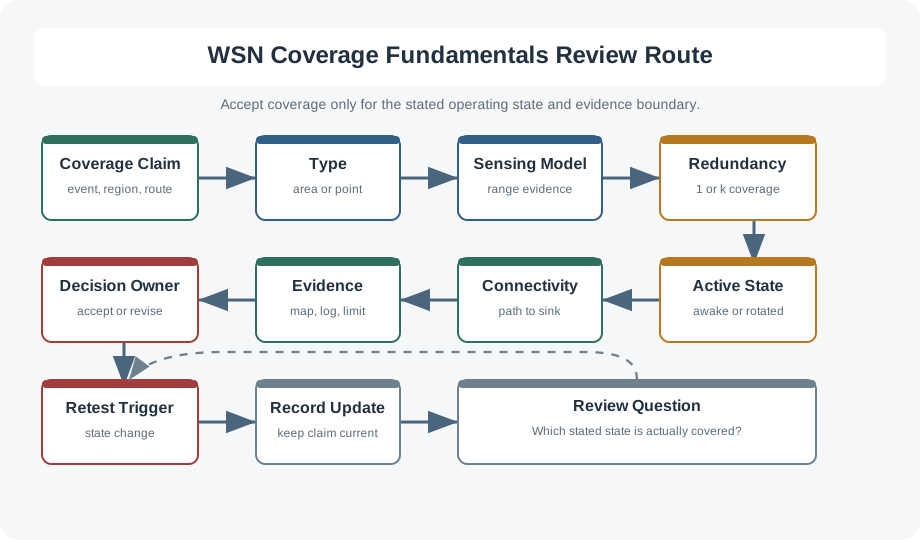
The diagram in Figure 27.1 opens with Coverage Claim, which defines what the design promises. Its event, region, route checkpoint fixes the spatial boundary, before Type adds a distinct review condition. That sequence gives the visual its meaning: WSN coverage fundamentals review route from monitoring claim through coverage type, sensing model, redundancy, active state, connectivity proof, evidence record, decision owner, and retest trigger. The same boundary now governs planning route.
27.7 Coverage Types
This section: Coverage Types — Coverage type controls the rest of the review.
Coverage type controls the rest of the review. A design that is excellent for one type can be wrong for another.
The coverage type should appear in the first line of a review record. If it is hidden, the team may accidentally optimize the wrong problem.
27.8 Sensing Model and Evidence
This section: Sensing Model and Evidence — The sensing model explains what “covered” means.
The sensing model explains what “covered” means. The evidence explains why the team believes that model applies.
The model can change over time. A greenhouse fills with foliage, a warehouse adds shelving, a gateway moves, or a perimeter grows vegetation. A fundamentals review must name what change reopens the decision.
27.9 Redundancy and k-Coverage
This section: Redundancy and k-Coverage — Redundancy should match consequence and failure mode.
Redundancy should match consequence and failure mode.
k-coverage is not a magic safety label. The record should explain what failures the redundancy tolerates and what failures still break the claim.
27.10 Energy and Operating State
This section: Energy and Operating State — Coverage that only exists when every node is awake is often not the deployed coverage.
Coverage that only exists when every node is awake is often not the deployed coverage.
Energy planning is part of coverage, not a separate afterthought. Sleep schedules, sampling intervals, local processing, and routing load can all change which coverage claim is true.
27.11 Claim-State Boundary
This section: Claim-State Boundary — The merged coverage and core-concepts chapters reinforce a simple rule: coverage is accepted for one stated operating state, not for every state the network might enter.
The merged coverage and core-concepts chapters reinforce a simple rule: coverage is accepted for one stated operating state, not for every state the network might enter.
Keep these boundaries explicit:
a coverage claim names the region, target, boundary, route, or event class and says when the claim applies. sensing range is a model assumption that can be Boolean, probabilistic, exposure-style, or field-evidence based. a coverage hole is any region, target, or route segment outside the accepted sensing condition in the reviewed state. k-coverage is a redundancy level applied to a coverage type, and the sensors should not all share the same obstruction, relay, power domain, or maintenance risk. connectivity is separate from sensing coverage: active sensors must be able to deliver evidence to a sink, gateway, or local decision point. all-awake maps, active sets, rotation schedules, degraded states, and mobile states can each require a separate evidence record.
Do not count sleeping, failed, uncalibrated, disabled, unreachable, or out-of-role sensors as live coverage unless the accepted rule states exactly why they still support the claim.
27.12 Evidence Record
This section: Evidence Record — A design can appear sound at Goal, type, location, time and still fail at Sensing evidence.
A design can appear sound at Goal, type, location, time and still fail at Sensing evidence. The illustration in Figure 27.2 frames that exact concern for the chapter’s discussion of evidence record.
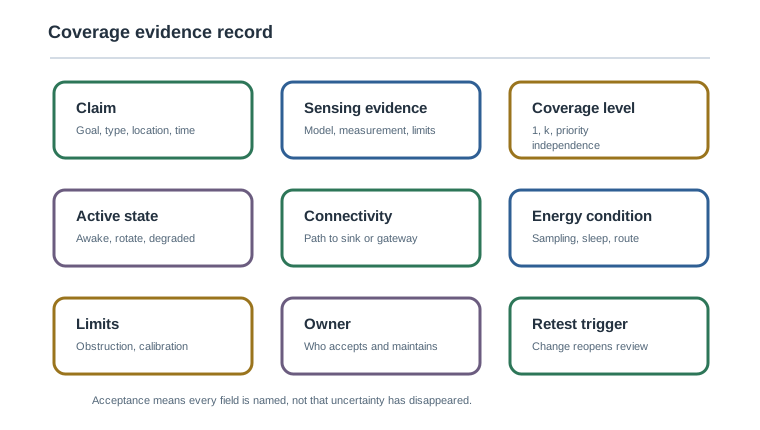
Trace the labelled evidence in Figure 27.2 beginning at Goal, type, location, time, the element that sets the timing constraint. Pause at Sensing evidence because it states how the claim is checked; resolve the path at Model, measurement, limits, which marks the acceptance limit. What the visual establishes is that wSN coverage fundamentals evidence record showing claim, sensing evidence, active state, redundancy, connectivity, limits, owner, and retest trigger. This is the bounded result needed for evidence record.
27.13 Worked Review: Storage Facility
This section: Worked Review: Storage Facility — A storage facility wants WSN coverage for temperature alarms in three rooms.
A storage facility wants WSN coverage for temperature alarms in three rooms. The initial map shows one sensor per room and a gateway in the office.
27.14 Worked Review: Outdoor Perimeter
This section: Worked Review: Outdoor Perimeter — A site wants alerts when equipment crosses a boundary.
A site wants alerts when equipment crosses a boundary. The first proposal uses area coverage language, but the real requirement is crossing detection.
27.14.1 Decision
Change the claim to barrier coverage. The evidence record must review weak crossing segments, sensor orientation, active alarm state, maintenance ownership, and vegetation-change retest triggers. A high area-coverage percentage is not enough to accept this perimeter claim.
27.15 Implementation Checklist
This section: Implementation Checklist — Use this checklist before sending a coverage plan into deeper analysis.
Use this checklist before sending a coverage plan into deeper analysis.
27.16 Common Mistakes
This section: Common Mistakes
27.17 Knowledge Check: Coverage Type
This section: Knowledge Check: Coverage Type
27.18 Knowledge Check: Operating State
This section: Knowledge Check: Operating State
27.19 Match the Coverage Planning Term
This section: Match the Coverage Planning Term
27.20 Order the Coverage Planning Workflow
This section: Order the Coverage Planning Workflow
27.21 Active-State Coverage Record
This section: Active-State Coverage Record — The body chapter names the coverage type, sensing model, redundancy target, active state, connectivity path, limits, owner, and retest trigger.
The body chapter names the coverage type, sensing model, redundancy target, active state, connectivity path, limits, owner, and retest trigger. The deeper rule is that those fields form one acceptance state, not a general promise about the whole network. A coverage record should answer which claim was accepted, which sensors were allowed to count, which evidence time was used, and which change would reopen the review.
The next Active-State Coverage Record step depends on WSN active-state coverage map. Read Figure 27.3 first, focusing on Monitored region and overlap.
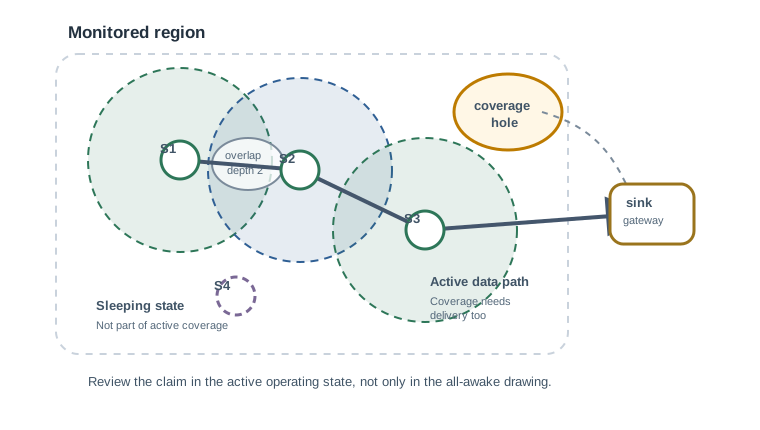
Figure Figure 27.3 shows why an all-awake drawing is not a coverage record. The monitored region has overlap at depth two, but it also has a hole. A sleeping sensor is explicitly excluded from active coverage, even if its disk appears on the plan. The active data path to the sink matters too: sensing a point is not enough if its evidence cannot be delivered. The section therefore binds the claim to geometry, sensing model, active set, delivery path, evidence time, and retest trigger. Review the actual operating state whenever nodes sleep, rotate, move, or lose a path.
Use the active-state map as the deeper check: a node only contributes live coverage when it senses the claim, remains in role, and can deliver evidence to the sink or local decision point.
A useful state record is closer to a small contract than a picture. It binds claim_type, geometry, sensing_model, coverage_level, active_set, delivery_path, evidence_time, and retest_trigger. If any one field changes, the old acceptance may still be historically true, but it is no longer proof of the current deployment. This is why all-awake planning maps, rotation schedules, degraded states, and mobile states need separate evidence records when their active nodes or delivery paths differ.
The same contract also prevents false comparisons between designs. A plan with a higher nominal coverage percentage can be weaker if it counts sleeping nodes, assumes an obsolete shelf layout, or omits the gateway path. A plan with a lower percentage can be stronger for the real mission if it names the priority zone, preserves the active set, and records exactly which uncovered region is outside the accepted claim. The state record is what lets those judgments be compared honestly.
27.22 Rehearse the Claim Against State Changes
This section: Rehearse the Claim Against State Changes — A fundamentals review becomes practical when the team tests the accepted claim against the first failures that will happen in the field.
A fundamentals review becomes practical when the team tests the accepted claim against the first failures that will happen in the field. The goal is not to imagine every possible accident. It is to separate decisions that stay true after a normal state change from decisions that must be narrowed, repaired, or retested. Each rehearsal should preserve the same fields as the record: claim, model, active set, delivery path, owner, and retest trigger.
| State change | Failure to test | Review response |
|---|---|---|
| Shelves or foliage move after acceptance. | The planned sensing model still assumes a clear path. | Narrow the claim until a walk test or calibration pass updates the evidence. |
| A rotation schedule puts two nodes to sleep. | The active set no longer provides the accepted redundancy level. | Review the weakest step and transition, not only the average schedule. |
| A relay or gateway is unreachable. | The region may be sensed but the evidence cannot leave the field. | Mark the state as sensed-but-undelivered unless local decision rules are accepted. |
| Two redundant sensors share a mount, battery, or obstruction. | The k-coverage label overstates independence. | Record the common-mode risk and lower the accepted redundancy or repair placement. |
The strongest field review language is usually explicit and limited. Write “accepted for rooms A, B, and C during the night rotation while gateway G1 is reachable” instead of “site covered.” Write “barrier segment three needs repair after vegetation growth” instead of “perimeter coverage failed.” That wording keeps the learner from treating coverage as a permanent badge. It also creates a maintainable queue: accept the parts with evidence, narrow the parts with uncertainty, repair the parts that fail, and retest the parts whose assumptions changed.
For coverage fundamentals, a good practitioner record is not longer than the deployment. It is just specific enough that the next reviewer can replay the acceptance state without guessing which nodes, model, and delivery path were trusted.
27.23 Sensing vs Delivery Predicates
This section: Sensing vs Delivery Predicates — The geometric shortcut most often taught in coverage fundamentals is useful only when its assumptions are visible.
The geometric shortcut most often taught in coverage fundamentals is useful only when its assumptions are visible. Let Rs be the sensing range and Rc the communication range. In a convex region with complete coverage by active nodes, Rc >= 2Rs is enough to make neighboring sensing disks communicate, so complete coverage implies network connectivity. The shortcut fails when the region is not convex, the coverage is partial, the active set changes, the radio range is obstructed, or the sink path depends on sleeping relays.
A robust implementation therefore stores two predicates. The sensing predicate asks whether location or target x is accepted by the chosen model at time t: C(x,t). The delivery predicate asks whether the active node that supports that claim can deliver evidence to a sink, gateway, or accepted local decision point: D(s,t). A coverage claim is operationally true only where the accepted sensing predicate and delivery predicate are both true for the same state. This avoids a common error: reporting a beautiful coverage ratio while the supporting readings are stranded behind a sleeping relay.
In practice, those predicates are evaluated over a finite review grid, named targets, boundary samples, or path segments. Each sample should carry the sensor or sensors that satisfy C, the route or local rule that satisfies D, and the interval for which both remain true. That interval matters: a node can satisfy sensing during a sample window and lose delivery during a later store-forward gap. Treating the two predicates as timestamped graph checks keeps the coverage record honest when duty cycling, gateway movement, and maintenance windows change the graph.
27.23.1 Knowledge Check: Sensing and Delivery
27.24 Summary
This section: Summary — WSN coverage fundamentals are about disciplined claim framing.
WSN coverage fundamentals are about disciplined claim framing. Before choosing algorithms or counting sensors, state the monitoring goal, coverage type, sensing model, redundancy level, operating state, connectivity path, limits, owner, and retest trigger. This keeps the coverage plan meaningful as the deployment moves from drawing to field operation.
27.25 Key Takeaway
This section: Key Takeaway — WSN Coverage: Fundamentals should connect coverage goals to sensing model, placement density, redundancy, obstacles, energy use, mobility, and deployment evidence.
WSN Coverage: Fundamentals should connect coverage goals to sensing model, placement density, redundancy, obstacles, energy use, mobility, and deployment evidence.
27.26 Concept Relationships
This section: Concept Relationships — WSN Coverage Problem Types expands area, point, barrier, and path coverage choices.
WSN Coverage Problem Types expands area, point, barrier, and path coverage choices. WSN Coverage Algorithms helps select verification, active-set, rotation, and gap-repair algorithm families. WSN Coverage Worked Examples applies the planning route to concrete field scenarios. WSN Coverage Implementations turns accepted coverage claims into placement, active-set, validation, and retest decisions. WSN Energy Duty Cycling explains how sleep schedules affect active coverage states.
27.27 What’s Next
This section: What’s Next — WSN Coverage Problem Types for selecting the right coverage formulation.
WSN Coverage Problem Types for selecting the right coverage formulation. WSN Coverage Algorithms for verification, active-set, rotation, and gap-repair algorithm families. WSN Coverage Worked Examples for applying the planning workflow to concrete scenarios. WSN Coverage Implementations for implementation patterns after the fundamentals are clear.
Find help
3 reviewed answers.
Where should I start in a module?
Open the module page from the sidebar to see its chapters in order. Use the module map to return to a topic you need.
Modules and pathsReviewed
What can I try when a project does not work?
Check the symptom, then work through the diagnostic steps. Keep the error message and the smallest example that reproduces it.
When you are stuckReviewed
How do interactive examples work?
Use the interactive guide to check how examples and simulations work before changing your project.
Interactive examples guideReviewed