4 WSN Application Domains

More
Depth: Practitioner
Progress saves as you read. Mark sections complete as you go; your progress appears in the sidebar.
4.1 Start With the Field Story
This section: Start With the Field Story — A gateway is the local point that gathers readings and passes them onward.
A gateway is the local point that gathers readings and passes them onward. A protocol is a shared set of message rules. Picture twenty soil sensors spread across a field, with one pump manager waiting for a clear dry-soil warning.
Begin with that warning. Name what must be sensed, how often, where each reading came from, and what action follows. Only then ask whether many small radio nodes help more than one wired or local device.
Check the awkward day, not just the calm one. Nodes may sleep, collide, lose power, move, or report stale values. Saving radio energy can reduce updates. Joining readings can hide which place failed.
The field story does not prove that one network fits farms, bridges, homes, and clothing. It cannot settle range, life, accuracy, or care effort. Each setting needs its own limits and field evidence.
Use the Practitioner sections to build the application record and review route. Use Under the Hood for node identity, shared radio access, and data meaning. The deeper work tests the opening claim without changing its goal-first rule.
Walk one dry-soil event. Mark the field spot. Mark the sensor. Check its clock. Check its unit. Check its battery. Send the reading. Keep its identity. Join nearby readings with care. Show missing nodes. Reach the pump owner. Record the action. Check the soil again.
Do not choose a WSN because the domain sounds sensor-rich. Choose it when the application has a clear sensing goal, a place where distributed nodes help, and evidence that readings can be trusted, delivered, and acted on. The domain label only matters after that story is clear.
4.2 In 60 Seconds
This section: In 60 Seconds — A WSN application is ready for review only when the sensing goal, node identity, channel behavior, gateway meaning, and operating limits all support the same claim.
A WSN application is ready for review only when the sensing goal, node identity, channel behavior, gateway meaning, and operating limits all support the same claim. A list of sensors or a protocol name is not enough. The review must show what the network is trying to observe, which node produced each reading, how shared radio access is controlled, what the gateway preserves, and what evidence would make the application acceptable.
Application fit is also a scope decision. Environmental sensing, structural monitoring, agriculture, buildings, city infrastructure, and wearable sensing use different rhythms, risks, maintenance models, and evidence records. The job is not to label one domain as “easy” or “hard.” The job is to prove that the chosen WSN behavior matches the application claim.
4.3 Learning Objectives
This section: Learning Objectives
By the end of this chapter, you will be able to:
- review WSN application fit from sensing goal, event rhythm, placement, gateway path, and operations evidence
- explain why node identity, time, units, quality state, and location context must survive aggregation and gateway forwarding
- choose channel-access and collision-control evidence that matches periodic, event-driven, or mixed traffic
- compare application domains without copying unsupported lifetime, range, cost, or accuracy promises
- build an application evidence record with acceptance limits and retest triggers
4.4 WSN Apps and Node Identity
This section: WSN Apps and Node Identity
4.5 Prerequisites
This section: Prerequisites — This chapter assumes you know the WSN role model from WSN Overview Fundamentals, the energy constraints from WSN Overview Energy and Architecture, and the gateway boundary from WSN and IoT Integration.
This chapter assumes you know the WSN role model from WSN Overview Fundamentals, the energy constraints from WSN Overview Energy and Architecture, and the gateway boundary from WSN and IoT Integration. For route health and link evidence, review WSN Routing and Monitoring Review.
4.6 Application Fit Scope
This section: Application Fit Scope — Start with the application claim before choosing node count, radio behavior, gateway design, or dashboard views.
Start with the application claim before choosing node count, radio behavior, gateway design, or dashboard views. The claim should name the physical condition being observed and the decision the network is expected to support.
4.7 Application Evidence Map
This section: Application Evidence Map — Before treating application evidence map as settled, compare Placement with point, zone, route in the diagram at Figure 4.1.
Before treating application evidence map as settled, compare Placement with point, zone, route in the diagram at Figure 4.1. Their relationship shows which part of the claim still needs evidence.
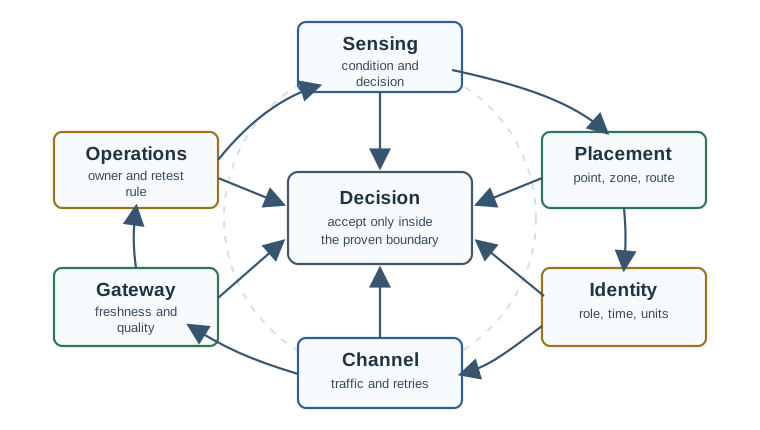
In the diagram at Figure 4.1, Placement comes first because it fixes the spatial boundary. The next checkpoint, point, zone, route, fixes the spatial boundary, while Identity adds a distinct review condition. Together those labels show that wSN application evidence map linking sensing goal, node placement, node identity, channel access, gateway meaning, and operations evidence into one review decision. That is the evidence chain the running application evidence map argument now relies on.
4.8 Requirements Shape Behavior
This section: Requirements Shape Behavior — Different applications ask the same WSN building blocks to do different work.
Different applications ask the same WSN building blocks to do different work. Review the behavior rather than accepting a domain name as proof.
The same application domain can contain several traffic patterns. For example, a greenhouse may send routine climate readings while also sending urgent frost, overheating, pump, or gateway-health alerts. The channel-access review must handle both rhythms.
4.9 Delivery, Energy, Routing Evidence
This section: Delivery, Energy, Routing Evidence — Domain labels do not choose network behavior by themselves.
Domain labels do not choose network behavior by themselves. The delivery model does. A reviewer should state whether the application expects continuous reporting, event-driven alerts, query-driven answers, or a hybrid mix, then check whether energy use, routing state, gateway records, and acceptance limits match that promise.
| Delivery model | Application promise | Evidence to review |
|---|---|---|
| Continuous | A recent stream is available at a known interval | Missing samples, clock drift, relay load, aggregation membership, stale-node flags, and gateway buffering |
| Event-driven | A rare change is reported quickly enough to act | Wake policy, threshold rule, debounce logic, burst retries, hidden-terminal risk, acknowledgement, and event age |
| Query-driven | The sink can ask a bounded question and receive usable answers | Query scope, response timeout, freshness labels, partial-answer handling, duplicate suppression, and sleeping-node behavior |
| Hybrid | Routine and urgent paths are both supported | Separate acceptance limits for routine reports and exception traffic, with gateway records showing which path was used |
Use the visual in Figure 4.2 to test Delivery, Energy, Routing Evidence. Its Leaf sensors and Event nodes labels anchor WSN communication pattern map in named system parts.
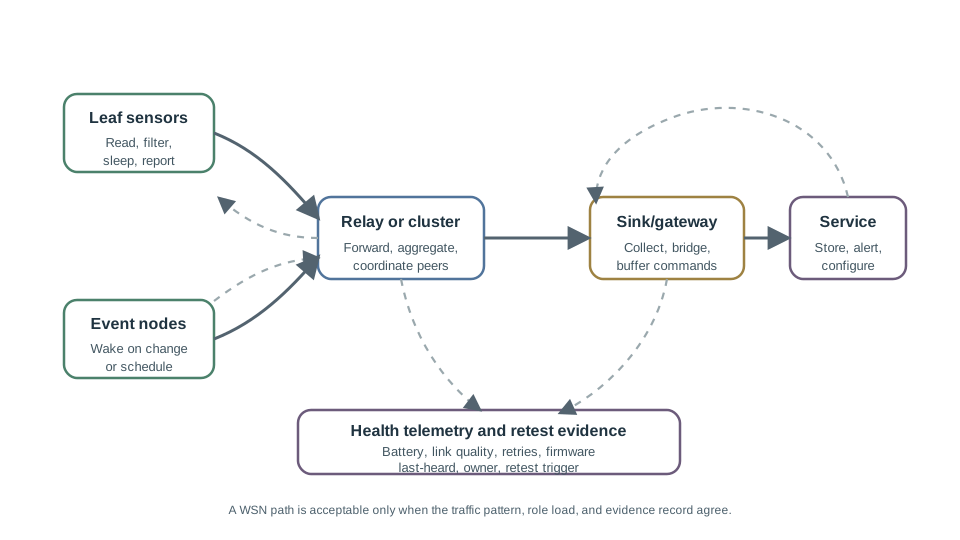
Figure Figure 4.2 follows different traffic roles through a WSN. Leaf sensors read, filter, sleep, and report; event nodes wake on change or schedule. A relay or cluster may forward and aggregate their traffic before the sink bridges it to a service that stores, alerts, or configures. The health record includes battery state, link quality, retries, firmware, last-heard time, owner, and retest trigger. These labels matter because a continuous stream, rare event, and query response place different demands on wake policy and relay load. The delivery claim must match the traffic pattern and the evidence from those roles.
4.10 Question: Event-Driven Energy Tradeoff
This section: Question: Event-Driven Energy Tradeoff — Routing style should be reviewed as a consequence of the delivery model.
Routing style should be reviewed as a consequence of the delivery model. Continuous delivery can justify a stable aggregation tree because the setup cost is amortized over many readings. Event-driven delivery often favours reactive path setup plus fast wake-up because maintaining a permanent tree may waste energy during long quiet periods. Query-driven delivery fits data-centric routing such as directed diffusion, where the sink sends an interest and matching data flows back along reinforced paths. Hybrid applications need both routine and exception evidence; a route that is fine for hourly summaries may still be too slow for an alarm.
4.11 Delivery Model and Routing Style
This section: Delivery Model and Routing Style
4.12 Node Identity Is Application Meaning
This section: Node Identity Is Application Meaning — Node identity is not only an address used by the radio.
Node identity is not only an address used by the radio. It is how the application knows what a reading means.
- node identifier and physical location
- sensor type, units, and calibration context
- role such as leaf, relay, cluster head, sink, or mobile collector
- measurement time and gateway receive time
- quality, freshness, missing-node, and maintenance state
- aggregates that hide which members contributed
- dashboards that show a zone value while a node is stale
- renumbered nodes without installation history
- gateway records that drop units or calibration status
- alerts that cannot identify the source node or route context
Addressing schemes, join procedures, cluster membership, and gateway mappings are useful only if the application can still interpret the result. If the dashboard cannot distinguish a quiet node from a dead node, a stable zone from a missing member, or a real event from a stale relay path, the identity design is not ready.
4.13 Channel Access And Collision Boundaries
This section: Channel Access And Collision Boundaries — WSN nodes often share constrained radio channels.
WSN nodes often share constrained radio channels. Collision management should be reviewed from the traffic claim, not from a formula copied into the design.
Avoid approving an application only because packets arrived during a clean demonstration. The review should also show what happens during bursts, retries, temporary link weakness, missing nodes, relay changes, and gateway outages.
4.14 Application Review Route
This section: Application Review Route — The next choice depends on separating Application Claim from Condition observed,.
The next choice depends on separating Application Claim from Condition observed,. The figure at Figure 4.3 makes that boundary visible before the chapter commits to application review route.
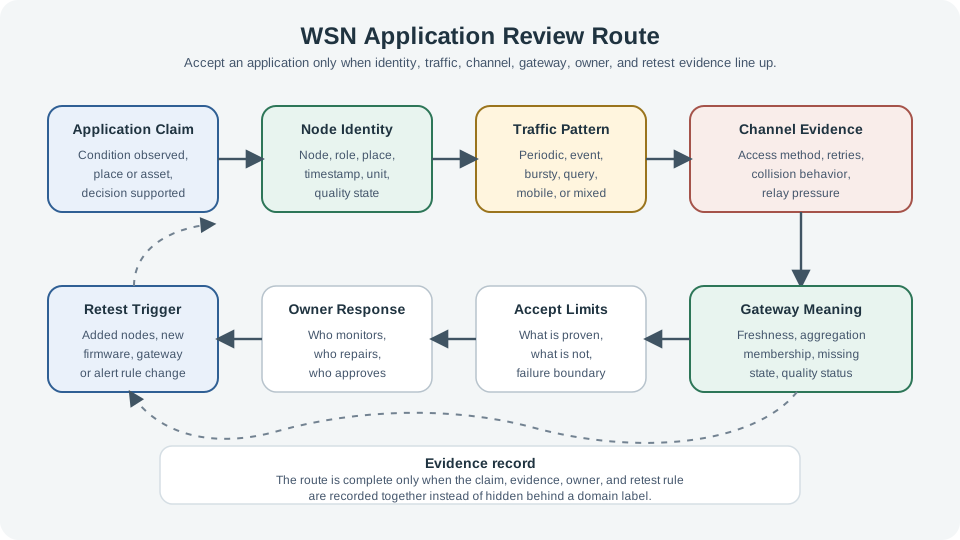
Enter Figure 4.3 at Application Claim, which defines what the design promises. Continue to Condition observed,, where the visual adds a distinct review condition; then check place or asset,, which adds a distinct review condition. This progression makes the point concrete: WSN application review route from application claim through node identity, traffic pattern, channel evidence, gateway meaning, acceptance limits, owner, retest trigger, and evidence record. The result feeds the chapter’s application review route decision with the boundary still attached.
4.15 Domain Review Patterns
This section: Domain Review Patterns — Use domain patterns as prompts for evidence, not as fixed recipes.
Use domain patterns as prompts for evidence, not as fixed recipes.
4.16 Worked Review: Greenhouse Climate Zones
This section: Worked Review: Greenhouse Climate Zones — A greenhouse team wants a WSN to support zone-level climate decisions.
A greenhouse team wants a WSN to support zone-level climate decisions. The application claim is not “we installed humidity sensors.” The claim is that each zone condition can be trusted enough to guide local action.
Review the design:
- Map each node to a zone, height, sensor type, gateway path, and expected reporting rhythm.
- Record whether the gateway preserves node identity, units, timestamp, quality state, and stale-node status.
- Check whether aggregation keeps source membership visible so a zone average cannot hide a missing corner node.
- Review whether routine readings and urgent climate events use channel access that fits their different timing needs.
- Accept the design only inside the tested greenhouse layout, gateway placement, firmware version, and alert policy.
Better record:
Claim: zone readings can support greenhouse climate decisions without hiding stale, missing, or mislocated sensors.
Evidence: node map, zone mapping, gateway identity record, timestamp source, unit mapping, quality state, routine report behavior, and urgent-event behavior.
Decision: acceptable only where node identity and missing-node state remain visible after aggregation.
Retest trigger: node relocation, new sensor model, changed gateway, new aggregation rule, seasonal enclosure change, or changed alert threshold.
4.17 Bridge Structural Monitoring
This section: Bridge Structural Monitoring — A bridge monitoring team wants a WSN to report structural condition indicators from several asset zones.
A bridge monitoring team wants a WSN to report structural condition indicators from several asset zones. The review must connect physical placement to route and gateway evidence.
Review the design:
- Label each node by asset zone, mounting method, sensor orientation, route role, and gateway path.
- Record baseline route state and which relays carry forwarded traffic.
- Trigger or simulate a weak-link or relay-change condition, then check missed reports, route change, duplicate summaries, and gateway status.
- Confirm that aggregated summaries preserve member count, time window, missing members, and quality status.
- Reject the design if the dashboard reports a single healthy summary while hiding a failed node, stale member, or overloaded relay.
Better record:
Claim: structural readings can be associated with asset zones and remain reviewable during a route or relay change.
Evidence: mounting record, node identity map, route-state log, relay-load observation, aggregate membership, gateway timestamps, and missing-member state.
Decision: acceptable only if gateway records show both the measurement meaning and the route-health context.
Retest trigger: changed mounting, new gateway location, firmware update, added structural zone, new sampling policy, or maintenance access change.
4.18 Application Evidence Record
This section: Application Evidence Record — A compact evidence record helps reviewers compare domains without depending on brittle benchmark claims.
A compact evidence record helps reviewers compare domains without depending on brittle benchmark claims.
Application claim: the physical condition, decision, user, and acceptance boundary.
Node evidence: identity, location, role, sensor type, units, calibration context, power source, and maintenance owner.
Network evidence: traffic rhythm, route behavior, channel access, retries, relay pressure, gateway path, and failure visibility.
Gateway evidence: timestamp, unit, quality, aggregation membership, stale state, missing-node state, and alert or dashboard mapping.
Operations evidence: owner, response action, maintenance trigger, privacy or safety boundary, and retest rule.
4.19 Common Mistakes
This section: Common Mistakes
4.20 Application Review Checklist
This section: Application Review Checklist — The application claim states the physical condition, decision, user, and acceptance boundary.
Before accepting a WSN application design, confirm:
The application claim states the physical condition, decision, user, and acceptance boundary. Node identity, location, role, units, timestamp, quality, and missing-node state remain visible where the application needs them. Placement evidence connects each node to the point, zone, route, barrier, or asset it claims to observe. Traffic behavior is classified as periodic, event-driven, bursty, query-based, mobile-collected, or mixed. Channel-access evidence covers normal reporting, event bursts, retries, relay pressure, and gateway outages where relevant. Aggregation preserves source membership, time window, quality status, and missing-member evidence. The gateway record maps readings to the application view without losing freshness, units, identity, or health state. The final record names acceptance limits, owner, maintenance trigger, and retest trigger.
4.21 Knowledge Check: Application Fit
This section: Knowledge Check: Application Fit
4.22 Knowledge Check: Channel Evidence
This section: Knowledge Check: Channel Evidence
4.23 Match: Application Review Terms
This section: Match: Application Review Terms
4.24 Order: WSN Application Review
This section: Order: WSN Application Review
4.25 Summary
This section: Summary — WSN application review is an evidence problem.
WSN application review is an evidence problem. A useful design connects the sensing goal to node placement, identity, channel behavior, gateway meaning, operations ownership, acceptance limits, and retest triggers.
Domain examples are useful only when they sharpen the evidence question. Do not approve a WSN application because a domain sounds familiar, a node count seems plausible, or a protocol name appears in the design. Approve it when the evidence shows that readings keep their meaning from sensor to gateway to application decision.
4.26 Key Takeaway
This section: Key Takeaway — WSN Applications and Node Identity Review should connect WSN design choices to measurable deployment evidence, operational constraints, and retest triggers.
WSN Applications and Node Identity Review should connect WSN design choices to measurable deployment evidence, operational constraints, and retest triggers.
4.27 Concept Relationships
This section: Concept Relationships — Application fit depends on the WSN roles introduced in WSN Overview Fundamentals.
Application fit depends on the WSN roles introduced in WSN Overview Fundamentals. Energy and duty-cycle limits should be reviewed with WSN Overview Energy and Architecture. Gateway meaning and data preservation connect directly to WSN and IoT Integration. Channel-access, route-health, and relay-load evidence prepare learners for WSN Routing and Monitoring Review.
4.28 What’s Next?
This section: What’s Next? — Next, WSN Overview Fundamentals revisits the core WSN concepts that support sensor nodes, topology, communication, energy, and implementation review.
Next, WSN Overview Fundamentals revisits the core WSN concepts that support sensor nodes, topology, communication, energy, and implementation review.
Find help
3 reviewed answers.
Where should I start in a module?
Open the module page from the sidebar to see its chapters in order. Use the module map to return to a topic you need.
Modules and pathsReviewed
What can I try when a project does not work?
Check the symptom, then work through the diagnostic steps. Keep the error message and the smallest example that reproduces it.
When you are stuckReviewed
How do interactive examples work?
Use the interactive guide to check how examples and simulations work before changing your project.
Interactive examples guideReviewed