33 WSN Coverage: Mobile Sensors

More
Depth: Practitioner
Progress saves as you read. Mark sections complete as you go; your progress appears in the sidebar.
-

Can the rover cover the gap without weakening safety?
33.1 Start With the Field Story
This section: Start With the Field Story — Picture a farm where one sensor cannot see behind a tall crop row.
Picture a farm where one sensor cannot see behind a tall crop row. A small rover can visit the gap, take a reading, and return to charge. Mobile coverage means using a moving sensor to observe places that fixed sensors do not cover well.
Start with the fixed network and mark the exact gap. Decide how often the rover must visit and what happens while it travels or charges. Count travel energy, sensing time, contact time, and recovery time. Then test a blocked route, a missed contact, and a rover failure. Safety must not depend on a rover that is absent when the event occurs.
Use a simple patrol record. Draw the fixed coverage first. Mark the gap. Set the visit period. Choose a safe route. Measure travel and sensing time. Mark where data can be sent. Reserve energy for return and recovery. Record the charge plan. Name weather or access limits. Give the rover an owner. Keep the static alarm boundary clear.
Run the patrol with one blocked path. Run it with a late start. Run it while a fixed node is down. If the service claim breaks, narrow the claim or strengthen the fixed layer.
This patrol story does not find the best route for every changing site. The Practitioner section compares mobile patterns and evidence. Under the Hood examines path planning, coverage, and energy limits.
Mobile sensors can repair gaps, but movement is not free coverage. Begin with the static baseline, name the gap or patrol purpose, then check route feasibility, energy, contact windows, recharge, and recovery before claiming improvement.
33.2 In 60 Seconds
This section: In 60 Seconds — Mobile sensors can improve a wireless sensor network when the monitored area is large, changing, hard to access, or only needs periodic confirmation.
Mobile sensors can improve a wireless sensor network when the monitored area is large, changing, hard to access, or only needs periodic confirmation. They can patrol, inspect gaps, replace failed coverage temporarily, or carry sensors through zones where permanent nodes are impractical.
Mobile coverage is not a free replacement for a static layer. A mobile platform has travel time, recharge time, localization error, path risk, communication gaps, and maintenance needs. It should not be used to support a continuous safety requirement unless the active static layer still satisfies the required coverage degree while the mobile unit is moving, charging, or unavailable.
33.3 Learning Objectives
This section: Learning Objectives
By the end of this chapter, you will be able to:
- distinguish static-only, mobile-only, and hybrid static-mobile coverage designs
- decide when a mobile platform is a gap-repair tool, a patrol tool, or a primary sensor
- review the operational evidence behind a mobile coverage claim
- identify failure modes that make mobile coverage unreliable
- write a mobile-coverage evidence record with route, recharge, ownership, and retest triggers
33.4 Quick Check: WSN Mobile Coverage
This section: Quick Check: WSN Mobile Coverage
33.5 Mobile Coverage Role
This section: Mobile Coverage Role — A mobile sensor changes the coverage problem from “where do we place sensors” to “when, where, and how reliably can a sensor arrive.” That added flexibility is valuable, but it also creates new evidence requirements.
A mobile sensor changes the coverage problem from “where do we place sensors” to “when, where, and how reliably can a sensor arrive.” That added flexibility is valuable, but it also creates new evidence requirements.
Mobile coverage is strongest when:
monitored conditions change slowly enough for patrol or periodic confirmation. a static baseline already covers critical zones. mobile routes are safe, reachable, and repeatable. recharge, docking, weather, terrain, localization, and communication constraints are known. missed visits, failed movement, and stale coverage maps trigger a clear recovery process.
Mobile coverage is weakest when:
the event needs continuous detection at every point. the mobile unit is the only sensor for a high-consequence zone. recharge or docking downtime creates unacceptable blind periods. route planning assumes ideal terrain, weather, or localization. the system cannot prove which zones were covered during the patrol window.
33.6 Review Route
This section: Review Route — Use the visual in Figure 33.1 to test Review Route.
Use the visual in Figure 33.1 to test Review Route. Its WSN Mobile Coverage Review Route and Static Baseline labels anchor the sequence behind Review Route in named system parts.
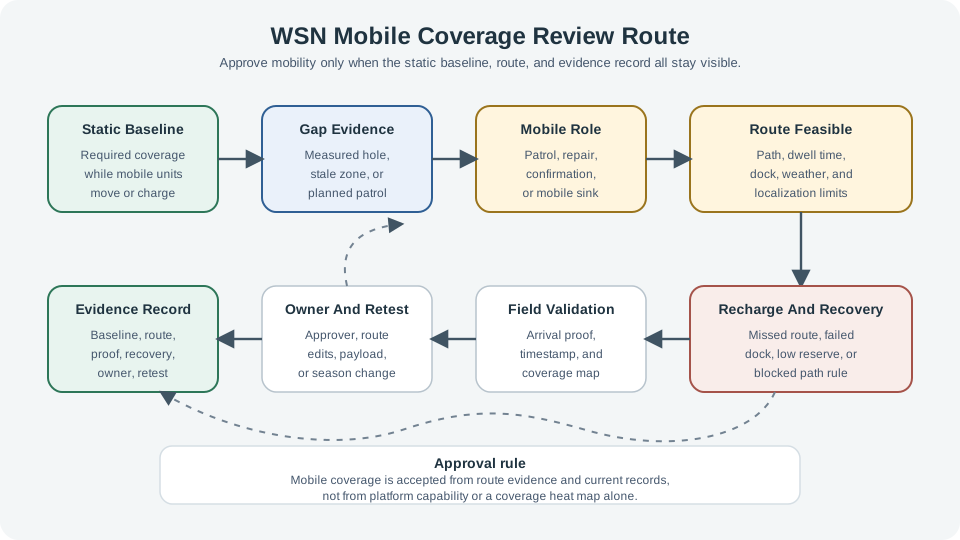
Figure Figure 33.1 follows a greenhouse patrol from its fixed baseline to field proof. Fixed nodes keep alert coverage while the mobile unit visits hard-to-wire aisles for a weekly humidity map. The route records zones, checkpoints, communication handoff, and docking. A completed visit still needs a timestamp, location confidence, calibration, and route completion evidence before its readings support coverage. A route edit, obstruction, docking failure, firmware change, or missed checkpoint reopens the review. The planned path alone cannot prove the claim; the completed run and the fixed baseline must both be checked.
The review separates the moving platform from the coverage evidence:
33.7 Choosing A Mobile Pattern
This section: Choosing A Mobile Pattern — Different mobile patterns answer different coverage problems.
Different mobile patterns answer different coverage problems. Choose the pattern from the monitoring need, not from the availability of a robot, drone, vehicle, or mobile sink.
33.8 Gap Evidence
This section: Gap Evidence — Mobile coverage should respond to evidence.
Mobile coverage should respond to evidence. Useful evidence includes a coverage map, missed checkpoint, failed node, detected obstruction, stale zone, or planned patrol requirement. A visual heat map is not enough unless it is tied to the same sensing model and field conditions used by the design.
A mobile coverage review should answer:
Which exact zones need mobile help? What condition proves the zone is currently uncovered, stale, or due for inspection? Can the mobile platform reach the zone within the required time? What is covered while the platform moves or charges? How is the visit logged, verified, and linked to the coverage record? What happens if the platform cannot complete the route?
33.9 Evidence Record
This section: Evidence Record — Evidence for Evidence Record starts in Figure 33.2.
Evidence for Evidence Record starts in Figure 33.2. Look at WSN Mobile Coverage Evidence Record beside 1. Static Baseline before accepting the sequence behind Evidence Record.
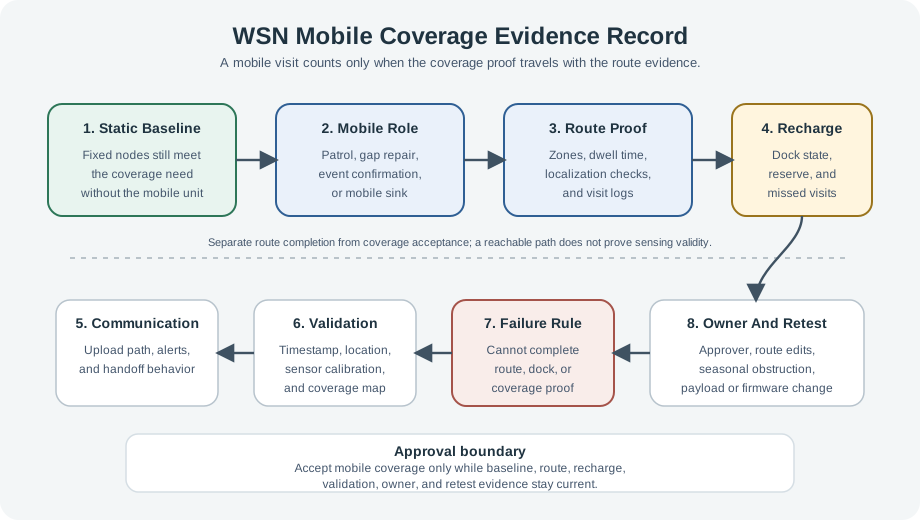
Figure Figure 33.2 defines what a mobile visit must leave behind. Its static baseline asks whether fixed nodes still meet the coverage need without the mobile unit. The mobile role and route proof then record the intended zones, dwell time, location checks, and visit logs. Recharge and communication fields show whether docking, reserve, upload, and handoff can support the patrol. Validation links time, place, calibration, and coverage map to the reading. A failure rule handles an incomplete route, while an owner and retest trigger keep later route or firmware changes visible. Reachability alone does not prove sensing validity.
Example record: A greenhouse uses fixed sensors for continuous temperature coverage and a mobile platform for weekly humidity-map validation in hard-to-wire aisles.
Baseline: Fixed nodes maintain the minimum required alert coverage while the mobile platform is docked or moving.
Route: The approved route lists zones, dwell time, localization checkpoints, communication handoff, and docking behavior.
Validation: Mobile readings are accepted only when timestamp, location confidence, sensor calibration, and route completion are recorded.
Retest trigger: Repeat validation after route edits, seasonal obstruction, payload change, docking failure, firmware update, or repeated missed checkpoints.
33.10 Mobile Self-Healing and Virtual Forces
This section: Mobile Self-Healing and Virtual Forces — Before applying Mobile Self-Healing and Virtual Forces, view Figure 33.3 and compare Mobile Wireless Sensor Network - Mobile Sensors with Sink.
Before applying Mobile Self-Healing and Virtual Forces, view Figure 33.3 and compare Mobile Wireless Sensor Network - Mobile Sensors with Sink. Their relationship makes the relationship behind Mobile Self-Healing and Virtual Forces reviewable.
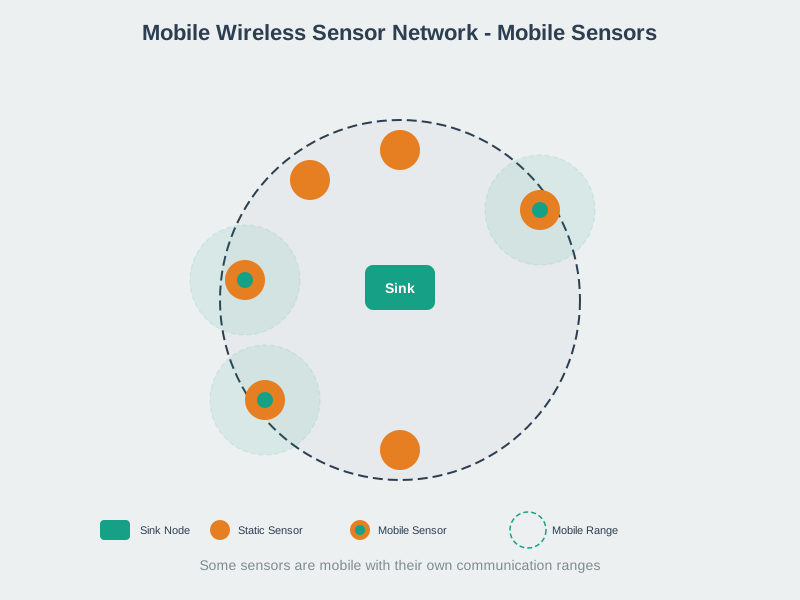
Figure Figure 33.3 distinguishes static sensors from mobile sensors and marks the sink and each mobile range. Those labels help frame the self-healing question: moving a sensor toward a hole may improve one area but remove coverage or a relay path at its starting point. The sink shows why the new position must still deliver readings. The sketch is a model of roles and reach, so it cannot alone approve a move. The section’s review compares the gained coverage with the origin state, route constraints, and movement energy before selecting a redundant node.
The review question is not “which node is closest to the hole?” A nearby node may be load-bearing: if it moves, the original zone loses coverage or loses the only relay path to the sink. A farther redundant node can be safer when its origin remains covered, its route is clear, and the coverage gained per meter is better.
The common algorithmic pattern is a Virtual Force Algorithm (VFA). It treats nodes as if they feel forces from neighboring nodes, holes, priority areas, obstacles, and boundaries.
| Force | Direction | Review effect |
|---|---|---|
| Repulsive from close neighbors | Push apart | Reduce overlap and spread nodes out. |
| Attractive toward holes or priority areas | Pull in | Draw redundant nodes toward uncovered regions. |
| Obstacle or boundary | Push away | Keep mobile nodes inside the allowed area and off blocked paths. |
VFA should be treated as a planning aid, not as automatic approval. The planner can compute target positions first, then move a selected redundant node once, instead of physically creeping node-by-node and wasting locomotion energy.
| Candidate | Hole filled | Travel | Origin after move | Decision |
|---|---|---|---|---|
| A | 38 m^2 | 4 m | Still covered by two neighbors | Strong choice: high gain per meter. |
| B | 46 m^2 | 13 m | Leaves one weak edge cell | Revise: bigger gain but creates risk. |
| C | 31 m^2 | 5 m | Shares the only relay path | Reject until relay backup exists. |
The practitioner check is concrete: simulate the post-move geometry, check connectivity to the sink or gateway, estimate movement energy, and verify the new map in the field. If the node cannot prove that it arrived, sensed, and remained connected, the planned move should remain a recommendation rather than accepted repaired coverage.
33.11 Worked Reviews
This section: Worked Reviews
33.11.1 Review 1: Agriculture Patrol
Scenario: field conditions change slowly, and periodic sampling is useful for irrigation or crop-health decisions.
Review path:
Keep fixed sensors at critical irrigation points, representative zones, and weather references. Use a mobile patrol for route-based sampling where continuous detection is not required. Record route completion, sample position confidence, and time since the last valid visit. Avoid treating the latest patrol map as current after weather, irrigation, or field access changes.
Repair pattern: use the mobile platform to validate or recalibrate static zones, not to replace every critical fixed node.
33.11.2 Review 2: Facility Gap Repair
Scenario: a fixed network covers a building or campus, but node failure creates temporary weak zones.
Review path:
Define the minimum static coverage that must remain available without the mobile platform. Use mobile units to inspect or temporarily cover failed zones while repairs are scheduled. Ensure the mobile path, radio backhaul, and recharge plan survive normal building operations. Log the time window where mobile coverage was active so the evidence record is auditable.
Repair pattern: trigger reserve-node wakeup or maintenance when mobile coverage is repeatedly needed in the same zone.
33.11.3 Disaster or Temporary Monitoring
Scenario: fixed infrastructure is damaged, unavailable, or too slow to deploy.
Review path:
Treat mobile sensing as temporary coverage with explicit uncertainty and expiry. Separate route safety from sensing validity; a reachable path does not prove coverage quality. Record failed route segments and zones that were not observed. Plan handoff to static or semi-static nodes when monitoring becomes longer-term.
Repair pattern: use mobile units for rapid situational awareness, then stabilize critical zones with fixed coverage.
33.11.4 Review 4: Mobile Sink
Scenario: static sensors collect data, and a mobile platform passes through to upload readings.
Review path:
Decide whether mobility solves a communication problem rather than a sensing problem. Check data age, buffer capacity, contact window, and missed-collection recovery. Keep sensing coverage separate from data collection coverage in the evidence record. Verify that delayed upload is acceptable for the application.
Repair pattern: add local alerts or fixed relays where delayed mobile collection would hide a high-consequence event.
33.12 Implementation Checklist
This section: Implementation Checklist
33.13 Movement Energy Budget
This section: Movement Energy Budget — Because locomotion usually dominates the mobile node’s energy cost, the objective is not simply “best coverage.” It is better coverage per meter traveled, without creating a new hole at the origin.
Because locomotion usually dominates the mobile node’s energy cost, the objective is not simply “best coverage.” It is better coverage per meter traveled, without creating a new hole at the origin.
Write the movement budget as a small contract. In a toy budget, a node that spends 0.4 J on a sensing burst and 0.9 J on a short upload spends 1.3 J before it moves. If the actuator cost is 1.8 J per meter, a 6 m relocation costs 10.8 J by itself, so the move consumes 12.1 J before retries, route correction, or docking loss are counted. Those numbers are not universal actuator values; they show why unnecessary repositioning can erase the lifetime gain from better coverage.
The movement budget also changes the failure model. A moving node can fail to leave, fail to arrive, arrive with poor localization, block another route, lose communication while moving, or deplete the reserve that was supposed to handle the next fault. Static coverage proof asks whether a point is inside enough sensing disks. Mobile coverage proof must add time: departure, travel, arrival, dwell, recharge, and rollback.
Approve a move only when the post-move coverage map is better, the original zone remains acceptable, the movement energy is inside the lifetime budget, and the evidence record includes arrival proof plus a retest trigger. If any one of those is missing, the mobile unit can still be useful for inspection, but it should not be counted as permanent repaired coverage.
33.14 Common Mistakes
This section: Common Mistakes
33.15 Knowledge Check: Mobile Role
This section: Knowledge Check: Mobile Role
33.16 Knowledge Check: Evidence Record
This section: Knowledge Check: Evidence Record
33.17 Knowledge Check: Virtual Force Move
This section: Knowledge Check: Virtual Force Move
33.18 Match Concept To Review Evidence
This section: Match Concept To Review Evidence
33.19 Order The Mobile Coverage Review
This section: Order The Mobile Coverage Review
33.20 Summary
This section: Summary — Mobile sensors add flexibility to WSN coverage when they are used for the right job: patrol, gap repair, temporary monitoring, event confirmation, or mobile data collection.
Mobile sensors add flexibility to WSN coverage when they are used for the right job: patrol, gap repair, temporary monitoring, event confirmation, or mobile data collection. They are weakest when a design uses them as a substitute for continuous coverage in high-consequence zones.
The quality standard is evidence. A mobile-coverage design should record the static baseline, mobile role, route, recharge behavior, communication assumptions, validation method, failure response, owner, and retest trigger. It should not claim reliability or savings from mobility alone.
33.21 Key Takeaway
This section: Key Takeaway — Use mobile sensors only when the evidence record proves the static baseline, the reason for movement, the completed route, recharge and failure behavior, coverage after the visit, and the retest trigger.
Use mobile sensors only when the evidence record proves the static baseline, the reason for movement, the completed route, recharge and failure behavior, coverage after the visit, and the retest trigger.
33.22 Concept Relationships
This section: Concept Relationships
33.23 What’s Next
This section: What’s Next — WSN K-Coverage and Rotation for static-layer redundancy and sleep scheduling.
Continue with these chapters when you need deeper coverage and mobility context:
WSN K-Coverage and Rotation for static-layer redundancy and sleep scheduling. WSN Coverage Algorithms for active-set selection and crossing verification. Mobile WSN Fundamentals for mobility models and mobile sensor roles. WSN Tracking Fundamentals for moving-target sensing and prediction. WSN Coverage Fundamentals for broader coverage review practice. WSN Energy Management for energy budgets, duty cycling, and mobile-operation costs.
Find help
3 reviewed answers.
Where should I start in a module?
Open the module page from the sidebar to see its chapters in order. Use the module map to return to a topic you need.
Modules and pathsReviewed
What can I try when a project does not work?
Check the symptom, then work through the diagnostic steps. Keep the error message and the smallest example that reproduces it.
When you are stuckReviewed
How do interactive examples work?
Use the interactive guide to check how examples and simulations work before changing your project.
Interactive examples guideReviewed