39 Human-Centric Sensing

More
Depth: Practitioner
Progress saves as you read. Mark sections complete as you go; your progress appears in the sidebar.
39.1 In 60 Seconds
This section: In 60 Seconds — Human-centric sensing extends a WSN by involving people, phones, wearables, vehicles, or carried devices in the sensing path.
Human-centric sensing extends a WSN by involving people, phones, wearables, vehicles, or carried devices in the sensing path. The human may be the subject being measured, the operator who chooses when to collect data, the carrier who moves data, or the participant whose device contributes local observations. That flexibility can improve coverage and context, but it also adds consent, privacy, bias, calibration, incentive, safety, and operations risks.
Good review treats human-centric sensing as a claim about trustworthy data collection. The claim should state who participates, what their device senses, what consent and privacy boundary applies, how data quality is checked, how coverage bias is handled, and what happens when participation, device behavior, or policy changes.
39.2 Learning Objectives
This section: Learning Objectives
By the end of this chapter, you will be able to:
- Classify human roles in WSN sensing as target, operator, carrier, contributor, or affected stakeholder.
- Compare participatory, opportunistic, wearable, and carried-device sensing without overclaiming coverage or quality.
- Identify consent, privacy, device, incentive, bias, and safety evidence needed before accepting a human-centric sensing claim.
- Review crowdsourced or mobility-assisted readings for calibration, context, duplicates, spoofing, and missing populations.
- Build a human-centric sensing evidence record with ownership, retention limits, and retest triggers.
39.3 Quick Check: Human-Centric Sensing
This section: Quick Check: Human-Centric Sensing
39.4 Start With the Human Role
This section: Start With the Human Role — Use a people-first review.
Use a people-first review. Name every group involved. Include people who do not join. State the public or personal benefit. State the possible harm. Keep both in view.
Describe the action. Who carries the device? Who chooses to report? Who is measured? Who sees the result? Who can correct it? Who may be left out?
Check the weak cases. Try an older phone. Try a lost connection. Try a quiet area. Try a busy area. Look for missing groups. Look for repeated reports. Show uncertainty on the result.
Make exit real. Let a person pause. Let them withdraw. Explain what remains. Give complaints an owner. Recheck when the purpose, reward, device mix, or affected group changes.
Picture a city asking people to report icy paths with their phones. The reports can cover places with no fixed sensors. They can also miss people who do not own a phone. A useful map must show both the added view and the missing view.
Human-centric sensing puts people or their carried devices inside the sensing process. A person may be measured. They may choose when to report. They may carry a device through an area. They may add context that a machine cannot see. They may also be affected by the result.
Begin with the human role. Then state the purpose. Ask what is collected and for how long. Make consent clear. Offer a way to stop. Protect people who do not take part. A useful service should not punish silence or lack of access.
Check data quality with care. A phone model may change the reading. People may visit some areas more often. Rewards may change behavior. Bad weather may reduce reports when they matter most. Keep these gaps visible in the result.
This first view assumes willing people and a simple public task. Health, work, and private spaces need stronger safeguards. The Practitioner layer builds the study and operations record. Under the Hood examines bias, trust, calibration, and the limits of conclusions drawn from uneven human participation.
The first review question is not “which app?” It is “what role do people play in the sensing system?” A person may be measured, may operate a sensor, may carry a device, may contribute context, or may be affected by decisions made from the data.
These roles can overlap, but the evidence should not blur them. A wearable comfort study, a pothole-reporting app, a phone-based noise map, and a data-mule route all need different acceptance evidence.
39.5 Human-Centric Sensing Review Route
This section: Human-Centric Sensing Review Route — For Human-Centric Sensing Review Route, inspect Figure 39.1 before deciding how Sensing constrains Claim.
For Human-Centric Sensing Review Route, inspect Figure 39.1 before deciding how Sensing constrains Claim. That labelled relationship grounds WSN human-centric sensing review route.
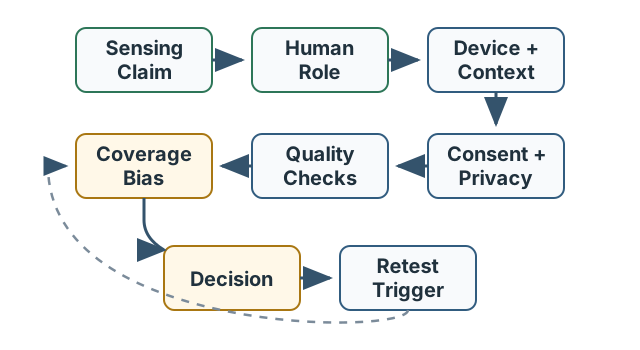
Figure Figure 39.1 tests a phone-based noise map before it compares neighborhoods. People may contribute readings and may also be affected by the published result. Device evidence covers placement, microphone permission, background state, calibration, and local context; permission by itself does not establish quality. The coverage check compares neighborhoods, times of day, device types, and participation levels. Those gaps can narrow the claim to aggregated area trends instead of precise street routes. New publication detail, a new data partner, or a shift toward enforcement reopens review. Missing reports cannot prove a place is quiet.
The route is a loop. A new app version, changed consent text, shifted participant group, operating-system sensor change, device calibration issue, campaign incentive, or new use of the data can reopen the decision.
39.6 Participation Modes
This section: Participation Modes — Human-centric sensing should be described by how data enters the system and how much participant action is required.
Human-centric sensing should be described by how data enters the system and how much participant action is required.
The chosen mode should follow the monitoring question. Do not use opportunistic sensing for a claim that needs explicit context unless there is a validation path. Do not use participatory sensing for broad coverage unless recruitment and bias evidence support it.
Inspect Figure 39.2 to see why receiving a participant report is not the same as accepting it as evidence.
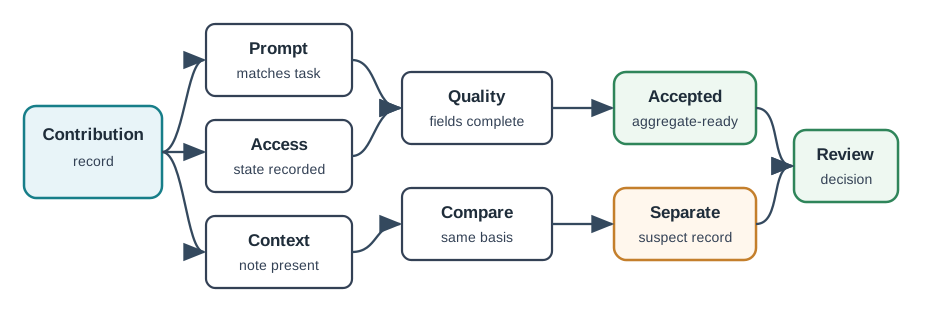
Begin with the contribution record, which preserves what the participant was asked to observe and what the device actually captured. Prompt match and access state come next because a valid upload may still answer the wrong question or omit permission context. Quality fields and the comparison basis decide whether records can be combined. Only then does the route separate accepted, aggregate-ready evidence from suspect records. The review decision must preserve that separation so a large response count cannot hide duplicates, stale samples, or biased coverage.
The acceptance gates keep permission, measurement quality, and claim scope separate. Consent or notice may allow collection, but it does not prove that a phone microphone measured comparable noise, that a wearable was worn correctly, that a hiker passed every disconnected node, or that a campaign represents all neighborhoods.
| Human role | Acceptance evidence | Revision signal |
|---|---|---|
| Sensing target | Sensor suitability, placement, calibration, safety boundary, participant control, and meaning of the inferred state | The output is reused for a more serious decision than the validation supports |
| Sensor operator | Prompt clarity, training, context labels, duplicate handling, spoofing checks, and unsafe-task prevention | Reports increase but validation, context, or safety evidence does not improve |
| Mobile carrier | Contact logs, data age, custody transfer, upload success, duplicate suppression, and missed-zone visibility | Delayed uploads are described as live coverage or missed contacts stay invisible |
| Opportunistic contributor | Consent, minimization, background state, device variation, sampling bias, and aggregation boundary | High-volume areas are overclaimed while quiet or low-access populations disappear |
| Affected stakeholder | Allowed use, dashboard action, appeal or correction path, retention limit, and retest trigger | The output starts driving service, enforcement, or resource allocation outside the approved claim |
39.7 Consent, Privacy, and Data Minimization
This section: Consent, Privacy, and Data Minimization — Human-centric sensing often touches sensitive location, behavior, device, or context data.
Human-centric sensing often touches sensitive location, behavior, device, or context data. The review should avoid treating “anonymous” as a complete protection. The stronger question is whether the system collects only what it needs, protects it while it is useful, aggregates or removes detail when possible, and makes the participant boundary visible.
Privacy review is not a one-time checkbox. It should be revisited when participants change, collection becomes more frequent, data is joined with other sources, or the output starts affecting services or people.
39.8 Device and Data Quality Evidence
This section: Device and Data Quality Evidence — Phones, wearables, and carried devices are not identical field instruments.
Phones, wearables, and carried devices are not identical field instruments. They differ in sensor accuracy, mounting, operating system behavior, battery state, permissions, sampling rate, and user handling.
Ask these questions:
- Is the device sensor suitable for the physical claim?
- Is placement or carrying style part of the evidence?
- Are timestamps, locations, and device identifiers handled consistently?
- Are calibration checks or reference comparisons available?
- Are duplicates, stale uploads, and repeated reports from the same participant controlled?
- Are spoofed, malicious, accidental, or low-context submissions detectable?
- Does the system record uncertainty rather than pretending every reading is equally strong?
Quality evidence should match the decision being made. A rough city trend map, a maintenance dispatch, a safety alert, and a participant feedback message do not need the same evidence standard.
For WBAN or wearable sensing, add body-specific checks instead of treating the device as a generic phone. Posture, placement, skin contact, clothing, sweat, movement, short-range on-body links, battery limits, and participant feedback use can all change what a reading means. Activity-recognition outputs need validation for the population, wearing position, and allowed use before they are treated as safety, health-adjacent, or operational evidence.
39.9 Coverage Bias and Representativeness
This section: Coverage Bias and Representativeness — Human mobility can fill gaps that fixed WSNs miss, but it can also create new blind spots.
Human mobility can fill gaps that fixed WSNs miss, but it can also create new blind spots. People do not move randomly, carry devices the same way, or represent every place equally.
The review record should state what the data does not cover. Missing data is not proof that a place is healthy, quiet, safe, or unchanged.
39.10 Human-Centric Sensing Evidence Record
This section: Human-Centric Sensing Evidence Record — Use Figure 39.3 to check whether a human-centred sensing claim has both permission evidence and a defensible measurement boundary.
Use Figure 39.3 to check whether a human-centred sensing claim has both permission evidence and a defensible measurement boundary.
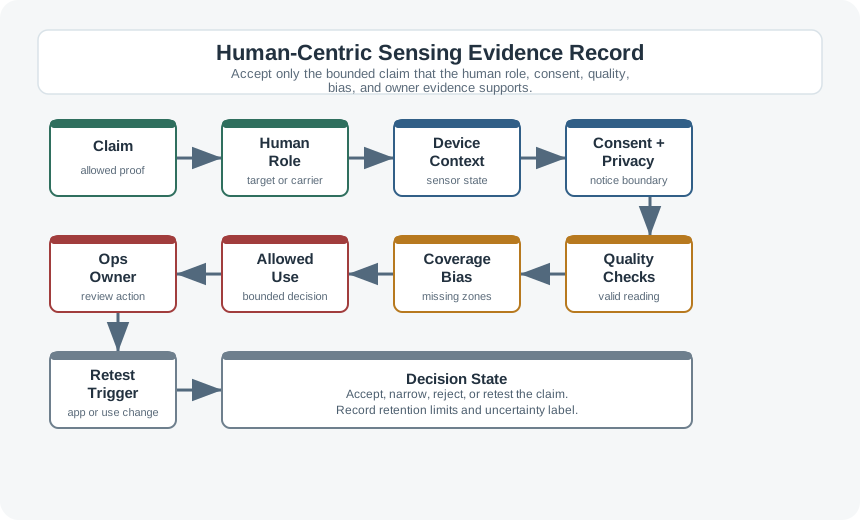
Read the record from the bounded claim into the human role and device context, because the same sensor reading can mean different things when a person carries, wears, or ignores the device. Next inspect consent, privacy, and quality as separate gates: permission to collect does not prove that the measurement is representative. Coverage bias and allowed use then limit what the result may support. The final owner and retest trigger keep the decision operational when recruitment, firmware, placement, or the intended use changes.
Claim: State what the human-centric sensing system is allowed to prove.
Role: Name whether people are targets, operators, carriers, contributors, context providers, or affected stakeholders.
Evidence: Attach device, consent, privacy, quality, coverage, bias, and operations evidence.
Decision: Accept, narrow, reject, or retest the claim with owner, retention limit, and trigger.
The record should be usable by technical, operations, and governance reviewers. If the campaign changes its app, data use, participant group, or dashboard action, the record should make the retest condition obvious.
A practical record should preserve enough bounded evidence to explain why a reading was accepted, separated, aggregated, delayed, or rejected, then minimize or delete detail when the accepted claim no longer needs it.
| Review state | Technical check | Governance check | Failure label |
|---|---|---|---|
| Allowed collection | Permission state, task prompt, sensor access, and pause or exit behavior are recorded | Collection purpose, retention, and new-use rule match the notice | Outside consent boundary |
| Record quality | Sensor range, placement, timestamp, calibration, duplicate, and spoofing checks pass | The record is not over-weighted because it came from an easier-to-recruit group | Suspect or low-context record |
| Coverage meaning | Route, sampling window, upload delay, and missing-zone information are visible | Unobserved people or places are not shown as confirmed normal | Coverage gap or delayed evidence |
| Allowed use | Dashboard action, owner, freshness, and uncertainty label are present | Use stays within the approved decision and aggregation boundary | Retest before use |
39.11 Worked Review: Community Noise Mapping
This section: Worked Review: Community Noise Mapping — A city wants a phone-based noise map to identify places where residents regularly experience high noise.
A city wants a phone-based noise map to identify places where residents regularly experience high noise. The first proposal stores precise routes and timestamps from every phone, then publishes street-level heat maps.
Review the claim:
Finding: narrow the claim to aggregated neighborhood trend evidence unless the team can justify finer detail, stronger privacy protection, and a clear use boundary. The retest trigger includes a new publication granularity, a new data partner, or a change from planning insight to enforcement action.
39.12 Worked Review: Carried Sensor Patrol
This section: Worked Review: Carried Sensor Patrol — A park monitoring system uses visitor-carried tags to upload stored readings from fixed trail sensors when people pass a kiosk.
A park monitoring system uses visitor-carried tags to upload stored readings from fixed trail sensors when people pass a kiosk. The design claims it can replace daily staff collection.
Review the claim:
Finding: accept the carried-sensing approach for delay-tolerant trend data, but reject any claim that requires timely alerts until a separate connected path or active patrol evidence is provided.
39.13 Common Human-Centric Sensing Mistakes
This section: Common Human-Centric Sensing Mistakes
39.14 Review Checklist
This section: Review Checklist — Use this checklist before accepting a human-centric sensing claim.
Use this checklist before accepting a human-centric sensing claim.
39.15 Knowledge Check: Human Role
This section: Knowledge Check: Human Role
39.16 Knowledge Check: Privacy Boundary
This section: Knowledge Check: Privacy Boundary
39.17 Knowledge Check: Evidence State
This section: Knowledge Check: Evidence State
39.18 Matching: Human-Centric Sensing Evidence
This section: Matching: Human-Centric Sensing Evidence
39.19 Ordering: Human-Centric Sensing Review
This section: Ordering: Human-Centric Sensing Review
39.20 Summary
This section: Summary — Human-centric sensing can extend WSN coverage and context by involving people, phones, wearables, vehicles, or carried devices.
Human-centric sensing can extend WSN coverage and context by involving people, phones, wearables, vehicles, or carried devices. It is strongest when the review separates human roles, device evidence, consent, privacy, data quality, coverage bias, and operations ownership. It is weakest when a design treats people as free infrastructure, assumes phone data is automatically accurate, or publishes detailed traces when aggregated evidence would support the claim.
The acceptance standard is bounded evidence. A human-centric sensing system should state what it can prove, who participates, what data is collected, what detail is minimized, how readings are validated, where the data is biased or missing, who acts on the result, and what change requires retesting.
39.21 Key Takeaway
This section: Key Takeaway — Human-Centric Sensing should treat people, delay, consent, data quality, custody, privacy, intermittent connectivity, and deployment evidence as part of the sensing architecture.
Human-Centric Sensing should treat people, delay, consent, data quality, custody, privacy, intermittent connectivity, and deployment evidence as part of the sensing architecture.
39.22 Concept Relationships
This section: Concept Relationships — Human-centric sensing extends Emergent Swarm Behavior in WSNs when local human/device movement shapes network coverage or data flow.
Human-centric sensing extends Emergent Swarm Behavior in WSNs when local human/device movement shapes network coverage or data flow. Human-centric sensing depends on Sensor Node Characteristics because device sensing, storage, firmware, and diagnostics affect evidence quality. Human-carried upload paths connect to Delay-Tolerant Networks for IoT, where store-carry-forward timing and custody become the main review question. Participatory collection is expanded in Participatory Sensing.
39.23 What’s Next
This section: What’s Next — Delay-Tolerant Networks for IoT for store-carry-forward review and delayed upload evidence.
Continue with these chapters when you need deeper mobility-sensing context:
Delay-Tolerant Networks for IoT for store-carry-forward review and delayed upload evidence. MWSN Types and Mobile Entities Review for the broader mobility-sensing entity route. Participatory Sensing for campaign design, platform evidence, and participant operations. Mobile Coverage Optimization for route, recharge, and temporary-coverage review.
Find help
3 reviewed answers.
Where should I start in a module?
Open the module page from the sidebar to see its chapters in order. Use the module map to return to a topic you need.
Modules and pathsReviewed
What can I try when a project does not work?
Check the symptom, then work through the diagnostic steps. Keep the error message and the smallest example that reproduces it.
When you are stuckReviewed
How do interactive examples work?
Use the interactive guide to check how examples and simulations work before changing your project.
Interactive examples guideReviewed