37 MWSN Nodes, Sinks, and Data MULEs

More
Depth: Practitioner
Progress saves as you read. Mark sections complete as you go; your progress appears in the sidebar.
37.1 Assign the Mobile Network Roles
This section: Assign the Mobile Network Roles — Imagine field nodes save readings until a service van drives past and takes a copy.
Imagine field nodes save readings until a service van drives past and takes a copy. The team must decide which part senses, which part stores, and which part carries the data onward. Latency means the wait from a real event to the result that a person or machine receives.
On the van route, fixed sensor nodes gather readings, a moving carrier collects them, and a sink or upload point passes them onward. Give each part a distinct role so a reading’s storage, travel, and receipt can be traced even when a visit is missed.
37.1.1 Trace Reading Custody
- Which node measured the field condition?
- Where is the reading buffered before the van arrives?
- How long is the contact and who confirms collection?
- What happens after a missed stop or a full buffer?
Keep node identity, measurement time, contact receipt, remaining storage, and upload receipt together. A collected reading is not yet delivered until the next handoff is confirmed.
37.1.2 When Collection Is Not Delivery
A moving collector can reduce relay traffic by taking readings from sources during contact, but collection is only one handoff in the delivery path. Readings may remain buffered before contact and may be carried afterward until an upload point becomes available. These waits increase data age and create custody questions about which component retains each record.
Review contact receipts and upload receipts separately, keeping node identity and measurement time with the reading. Compare delivery age with the application deadline, and check remaining storage when a visit is missed or a transfer is partial. Each component needs evidence for its role and a fallback for failed contact or delivery. Assign an owner to retry before buffer capacity or acceptable data age is exceeded.
37.1.3 Before Using a Van Upload
When the van uploads a batch, compare each measurement time with the application deadline. Missing contact receipts should reveal which node still holds data. Assign the route operator or system owner to retry before the buffer or data age exceeds its limit.
37.2 Start With the Field Story
This section: Start With the Field Story — Mobile nodes, mobile sinks, and Data MULEs solve different problems.
Mobile nodes, mobile sinks, and Data MULEs solve different problems. Start by naming which role is moving and what it carries, then check contact evidence, buffer limits, route ownership, and whether data age remains acceptable.
37.3 In 60 Seconds
This section: In 60 Seconds — Mobile wireless sensor networks add movement to the sensing system.
Mobile wireless sensor networks add movement to the sensing system. The moving part may be the sensor, the sink, a data ferry, a user device, an animal tag, a vehicle, a robot, or a scheduled maintenance route. The review question is not “which mobile component sounds best?” It is whether the moving role can prove contact, freshness, storage, energy, location meaning, failure visibility, and operations ownership for the monitoring claim.
This chapter reviews the major MWSN components: mobile sensor nodes, mobile sinks, Data MULEs, stationary sources, rendezvous points, gateways, and delay-tolerant forwarding behavior. A component is acceptable only when its movement pattern, contact window, buffer behavior, radio schedule, data custody, and recovery path are visible enough to trust the collected data.
37.4 Learning Objectives
This section: Learning Objectives
By the end of this chapter, you will be able to:
- distinguish mobile sensor nodes, mobile sinks, Data MULEs, rendezvous points, gateways, and stationary sources
- review how each component changes latency, energy use, buffer risk, route state, and maintenance ownership
- identify when mobility helps a WSN and when it hides missing data or stale readings
- build a component evidence record for contact windows, storage, transfer, data custody, and retest triggers
- compare planned routes, opportunistic movement, and event-driven visits without turning them into unsupported guarantees
37.5 MWSN Nodes, Sinks, Data MULEs
This section: MWSN Nodes, Sinks, Data MULEs
37.6 Prerequisites
This section: Prerequisites — This chapter builds on Stationary WSN Fundamentals, Mobile WSN Fundamentals, WSN Energy Management, and WSN Routing Introduction.
This chapter builds on Stationary WSN Fundamentals, Mobile WSN Fundamentals, WSN Energy Management, and WSN Routing Introduction.
If a learner cannot explain sensing claims, gateway boundaries, route roles, duty cycling, buffers, freshness, and maintenance ownership, review those chapters before accepting a mobile WSN component design.
37.7 Component Review Scope
This section: Component Review Scope — MWSN component review starts with the monitoring claim and the mobility assumption.
MWSN component review starts with the monitoring claim and the mobility assumption. A route, animal path, vehicle schedule, drone flight, user movement pattern, or maintenance visit is not evidence until it is observed, bounded, and tied to a recovery action.
37.8 Component Role Map
This section: Component Role Map — To challenge Component Role Map, examine the visual at Figure 37.1.
To challenge Component Role Map, examine the visual at Figure 37.1. Its Monitoring claim and Stationary labels reveal the structure behind Component Role Map.
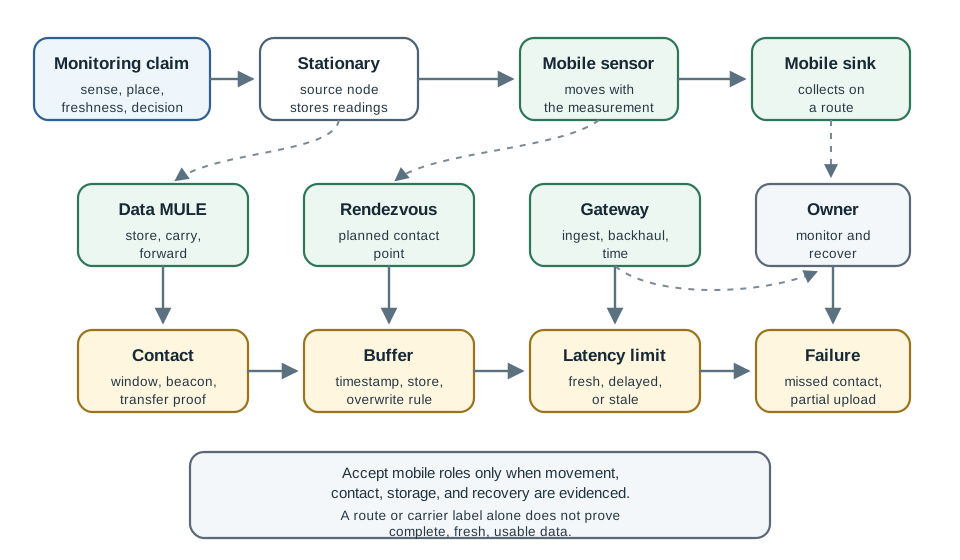
Figure Figure 37.1 begins with the monitoring claim, location meaning, and freshness need. It then separates stationary sources, moving sensors, mobile sinks, Data MULEs, rendezvous points, and gateways by what each does with readings. Contact windows and transfer proof show whether movement actually delivered data; buffer timestamps and overwrite rules show what was retained. Latency and missed-contact fields expose stale or partial uploads. An owner must monitor and recover from those failures. The map matters because a component can change role: a vehicle that starts scheduling collection is no longer merely a carrier, and its evidence contract must change with it.
The role map prevents component drift. A vehicle used as a Data MULE can become a mobile sink if it actively schedules collection. A mobile sensor node can become a relay if it forwards for other nodes. A gateway can become a bottleneck if every mobile contact depends on it. Each role change reopens the evidence record.
Treat every mobile component as an evidence contract. A reading may be measured by one device, stored by another, carried by a vehicle or human, transferred at a rendezvous point, and ingested later by a gateway. The review must show who held the data, when it was measured, where the location claim applies, how old it was at delivery, and what made a missed contact visible.
37.9 What Each Component Can and Cannot Prove
This section: What Each Component Can and Cannot Prove
37.10 Evidence Record
This section: Evidence Record — Treat the map at Figure 37.2 as the evidence boundary for evidence record.
Treat the map at Figure 37.2 as the evidence boundary for evidence record. Its sense, location, and freshness labels identify the conditions that must be checked together.
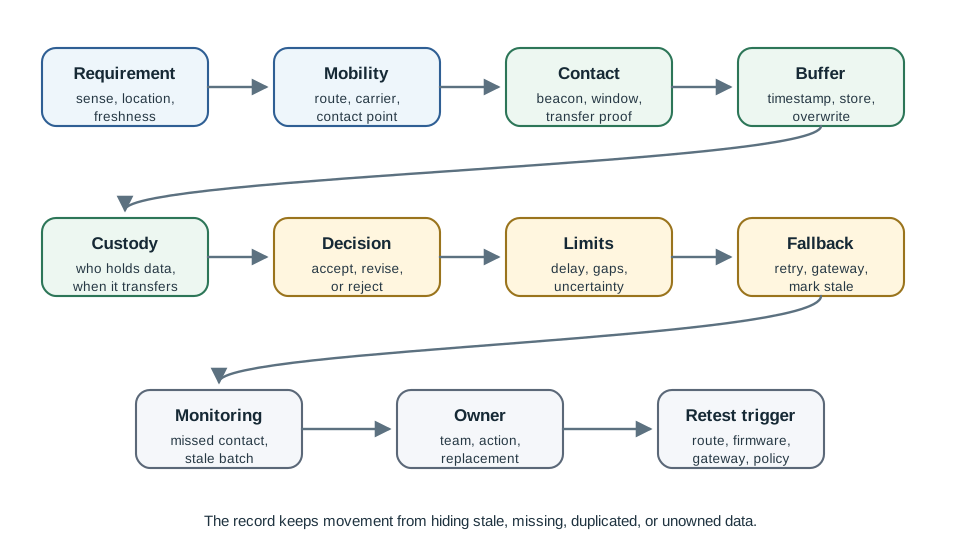
The evidence changes character across the diagram at Figure 37.2: sense, location, identifies the field observation, freshness sets the timing constraint, then Mobility adds a distinct review condition. The transition explains the caption’s core point — mWSN component evidence record from requirement and mobility assumption through contact evidence, buffer evidence, custody, decision, accepted limits, fallback, monitoring, owner, and retest trigger. That point is the next premise in evidence record.
Requirement: Record the sensed condition, location meaning, freshness need, tolerated gaps, and decision that uses the data.
Mobility assumption: Record route, contact point, movement pattern, visit schedule, owner, and what makes a missed contact visible.
Observations: Record contact logs, transfer confirmation, buffer state, timestamps, route traces, battery state, and gateway ingestion evidence.
Decision: Accept, revise, or reject the component role for this sensing claim and operating environment.
Operations: Name the owner, monitoring signal, fallback action, uncertainty rule, replacement rule, and retest trigger.
37.11 Reviewing Mobile Sensor Nodes
This section: Reviewing Mobile Sensor Nodes — Mobile sensor nodes combine sensing, movement, storage, and opportunistic communication.
Mobile sensor nodes combine sensing, movement, storage, and opportunistic communication. The review must prove both the measurement and the movement context.
Do not accept a mobile sensor plan because a device can move. Accept it only when the reading, location context, storage behavior, and delivery evidence support the monitoring claim.
37.12 Reviewing Mobile Sinks
This section: Reviewing Mobile Sinks — A mobile sink is a moving collection point.
A mobile sink is a moving collection point. It may be a vehicle, drone, robot, handheld gateway, maintenance tool, or scheduled collector. The review is about collection evidence, not just path planning.
A planned route is not automatically better than opportunistic movement. It is better only when it gives stronger evidence for the requirement: contact, freshness, buffer margin, recovery, and operations visibility.
37.13 Reviewing Data MULEs
This section: Reviewing Data MULEs — Data MULEs carry data between disconnected or weakly connected parts of the system.
Data MULEs carry data between disconnected or weakly connected parts of the system. They are useful when delay is acceptable and contact can be observed.
A Data MULE architecture deliberately trades latency for lower and more even sensor-node energy. In a static multi-hop network, nodes near the sink may relay traffic for many sources and die first. With a MULE-style path, each source can make a short transfer to the passing carrier, return to sleep, and avoid serving as a permanent relay. That helps lifetime uniformity only when the contact plan and buffer plan are honest about the delay they create.
A quick budget check keeps the trade visible. A source that produces r bytes per second and may wait T seconds between successful contacts needs more than r * T usable buffer after metadata, retries, compression overhead, and safety margin are counted. If useful contact lasts C seconds and the transfer rate is b bytes per second, the carrier can move at most about b * C bytes before range, interference, authentication, or dwell time ends the opportunity.
| Budget | What changes it | Evidence to keep |
|---|---|---|
| Buffer | Sampling rate, visit interval, retransmissions, compression, and overwrite policy. | Source storage level, age of oldest reading, overflow flag, and retained metadata. |
| Contact | Path speed, dwell time, antenna orientation, wake schedule, authentication, and interference. | Discovery log, transfer size, partial-transfer state, and missed-contact signal. |
| Energy | Beacon interval, radio-on time, transmit distance, retry count, and route predictability. | Battery trend, wake duty, failed attempts, and retest trigger after route changes. |
The budget explains why component roles cannot be reviewed in isolation. A mobile sink may lower relay energy but raise buffer pressure. A Data MULE may make a sparse deployment practical but make urgent action impossible. A rendezvous point may improve discovery while creating a single place where missed meetings accumulate.
37.14 Knowledge Check: Data MULE Tradeoff
This section: Knowledge Check: Data MULE Tradeoff
37.15 Comparing Component Choices
This section: Comparing Component Choices — The same sensing requirement may be served by different mobile components.
The same sensing requirement may be served by different mobile components. Compare them by evidence, not by labels.
Choose a mobile sensor node when the sensor must move with the phenomenon or asset, and the review can prove location meaning, exposure, storage, and delivery.
Choose a mobile sink when stationary or mobile nodes can wait for a collector, and route evidence proves contact, freshness, and missed-visit recovery.
Choose a Data MULE when the data can tolerate delay, movement already passes useful contact points, and custody plus delivery evidence is visible.
Choose a fixed gateway or relay path when the decision needs lower delay, continuous monitoring, downlink control, or faster failure response than the mobile path can prove.
37.16 Farm Service Vehicle Collector
This section: Farm Service Vehicle Collector — Scenario: Soil-moisture nodes are spread across a farm.
Scenario: Soil-moisture nodes are spread across a farm. A service vehicle passes each field during routine inspection and can collect buffered readings.
Requirement: Field-level moisture trends, missing-field visibility, and enough freshness for irrigation planning.
Mobility assumption: The service route passes each field often enough for the planned decision, and field nodes can detect the collector before their buffers become risky.
Evidence: Route traces, contact logs, transfer confirmations, buffer-state reports, low-battery signal, gateway upload record, and missed-field alert.
Decision: Accept the vehicle as a mobile sink or Data MULE only if delayed data is acceptable and missed contact is visible before decisions depend on stale readings.
Fallback: Add a fixed gateway, add a rendezvous point, adjust sampling, change the route, or mark affected fields uncertain.
37.17 Worked Review: Wearable Exposure Nodes
This section: Worked Review: Wearable Exposure Nodes — Scenario: Worker-carried nodes measure environmental exposure during shifts and upload at a dock at the end of the route.
Scenario: Worker-carried nodes measure environmental exposure during shifts and upload at a dock at the end of the route.
Requirement: Exposure evidence tied to worker location, shift timing, and exception review.
Mobility assumption: The worker carries the node correctly, timestamps are reliable, and the dock contact completes before data is overwritten.
Evidence: Carry-state checks, timestamp and location evidence, buffer status, dock upload confirmation, missing-upload alert, calibration record, and privacy boundary.
Decision: Accept only if the data remains meaningful while carried and operations can detect missing, stale, or mis-mounted readings.
Fallback: Require manual sync, add route beacons, shorten retention risk, replace the node, or flag the shift record uncertain.
37.18 Common Mistakes
This section: Common Mistakes
37.19 Review Checklist
This section: Review Checklist — sensing claim, location meaning, freshness need, tolerated gaps, and decision owner.
Before accepting an MWSN component design, verify that the record includes:
sensing claim, location meaning, freshness need, tolerated gaps, and decision owner. component role: mobile sensor, mobile sink, Data MULE, rendezvous point, gateway, or stationary source. observed movement pattern, contact window, transfer confirmation, and missed-contact signal. buffer behavior, timestamp policy, overwrite rule, custody transfer, duplicate handling, and gateway ingestion evidence. energy, radio, enclosure, mounting, calibration, and maintenance assumptions that affect the mobile role. fallback action, uncertainty rule, replacement rule, monitoring owner, and retest trigger.
37.20 Knowledge Check: Component Role
This section: Knowledge Check: Component Role
37.21 Knowledge Check: Data MULE Limits
This section: Knowledge Check: Data MULE Limits
37.22 Match Components to Evidence
This section: Match Components to Evidence
37.23 Order a Mobile Component Review
This section: Order a Mobile Component Review
37.24 Summary
This section: Summary — MWSN components are design roles that must be accepted with evidence.
MWSN components are design roles that must be accepted with evidence. Mobile sensor nodes, mobile sinks, Data MULEs, rendezvous points, gateways, and stationary sources all change the data path. They also change latency, energy, storage, contact, custody, and operations risk.
The accepted design should show how movement supports the monitoring claim, how contact is detected, how buffers and timestamps are protected, how custody transfers, what happens when contact is missed, and which change would force retesting. Mobility is useful only when the evidence record keeps delayed or intermittent data from being mistaken for complete, fresh, or reliable data.
37.25 Key Takeaway
This section: Key Takeaway — MWSN Nodes, Sinks, and Data MULEs Review should compare stationary nodes, mobile nodes, sinks, and data MULEs using coverage, latency, buffer pressure, routing cost, energy, and deployment evidence.
MWSN Nodes, Sinks, and Data MULEs Review should compare stationary nodes, mobile nodes, sinks, and data MULEs using coverage, latency, buffer pressure, routing cost, energy, and deployment evidence.
37.26 Concept Relationships
This section: Concept Relationships
37.27 What’s Next?
This section: What’s Next?
Continue with MWSN Types and Mobile Entities to compare terrestrial, aerial, underwater, human-carried, and vehicle-assisted mobility; WSN Human-Centric Sensing and Delay-Tolerant Networks for IoT for carried devices and delay-tolerant collection; WSN Production Deployment for operations evidence; and WSN Mobile Sinks in Production when a collector route becomes a production design decision.
Find help
3 reviewed answers.
Where should I start in a module?
Open the module page from the sidebar to see its chapters in order. Use the module map to return to a topic you need.
Modules and pathsReviewed
What can I try when a project does not work?
Check the symptom, then work through the diagnostic steps. Keep the error message and the smallest example that reproduces it.
When you are stuckReviewed
How do interactive examples work?
Use the interactive guide to check how examples and simulations work before changing your project.
Interactive examples guideReviewed