32 WSN K-Coverage and Rotation

More
Depth: Practitioner
Progress saves as you read. Mark sections complete as you go; your progress appears in the sidebar.
32.1 Begin With One Point That Must Stay Seen
This section: Begin With One Point That Must Stay Seen — Picture a store room where one leak must not go unseen.
Picture a store room where one leak must not go unseen. One sensor may cover the risky point. Two separate sensors may let one fail while the other still watches. The first choice is the number of sound, awake sensors that must cover each important place. Tie that number to harm, repair time, and the chance that failures share one cause.
Draw the area and mark each sensor reach. Check every key point. Then turn one sensor off. Repeat for the failures the claim says it can bear. If you plan to rotate awake sets, test each set on its own. Record gaps, overlap, power, switch time, and the rule that wakes a spare. A count on a drawing is not enough when walls, weather, or weak cells change reach.
More overlap can improve fault cover, but it costs hardware and may add radio traffic. Longer sleep can save energy, but it may delay a wake or leave a hidden gap. This first pass does not prove lifetime or safe independence. Use the Practitioner sections to choose the cover level, test sets, and write the field record. Use the Under the Hood sections to inspect disjoint sets, lifetime claims, failure links, and switch rules. The deeper routes show when a neat rotation plan breaks in the real area.
Make the first check with a grid. Mark each key point. For each awake set, write the sensors that can see that point. Cross out one failed sensor. Count again. Repeat for each failure in the claim. Keep edge points and blocked areas in the test.
Now run the sets in time. Wake the next set before the old set sleeps. Check that the app can tell which set is live. Check a failed wake. Check a weak cell. Check a clock gap. Record the uncovered time, even if it is short.
Do not turn a simple cell sum into a life promise. Real use includes wake cost, radio retries, cold cells, and repair delay. Measure a full cycle. Keep the rule that ends rotation and wakes more nodes. Safety needs a clear fail state.
32.2 Start With the Field Story
This section: Start With the Field Story — K-coverage is a redundancy promise, not a magic lifetime multiplier.
K-coverage is a redundancy promise, not a magic lifetime multiplier. Start by asking which events require multiple independent sensors, then prove that rotation preserves the required layers when nodes sleep, fail, or age.
32.3 In 60 Seconds
This section: In 60 Seconds — k-Coverage means every point in the monitored region is covered by at least k independent sensors at the same time.
k-Coverage means every point in the monitored region is covered by at least k independent sensors at the same time. It is a reliability requirement, not a decorative density target. If the design requires k = 2, a single local sensor failure should not immediately create a coverage gap. If the design requires k = 3, two local failures should still leave one valid observation path, assuming the sensors are genuinely independent and the sensing model is valid.
Rotation scheduling uses redundant sensors to save energy by changing which nodes are active over time. Rotation is useful only when each active set can still satisfy the stated coverage requirement. A schedule that saves battery but drops the system below its required coverage degree is not an approved rotation schedule.
32.4 Learning Objectives
This section: Learning Objectives
By the end of this chapter, you will be able to:
- explain the difference between single coverage, k-coverage, and rotation sets
- choose a coverage degree based on consequence, independence, and repair access
- review whether a rotation schedule preserves the required coverage degree
- identify assumptions that can invalidate k-coverage or rotation evidence
- write a k-coverage evidence record with failure, repair, and retest triggers
32.5 Quick Check: WSN K-Coverage & Rotation
This section: Quick Check: WSN K-Coverage & Rotation
32.6 Why k-Coverage Matters
This section: Why k-Coverage Matters — Single coverage answers whether each point is watched by at least one sensor.
Single coverage answers whether each point is watched by at least one sensor. k-Coverage asks whether each point is watched by enough independent sensors to survive failure, maintenance, drift, or uncertain readings. The extra layers can improve reliability, but they also increase deployment cost, coordination complexity, radio traffic, and energy demand.
k-Coverage should be justified by the consequence of a missed event. A low-risk environmental trend may only need one useful observation path. A safety, security, or high-value asset monitoring system may need redundant sensing paths, independent power zones, or separate communication routes.
The key review question is:
If one local sensor, power source, or communication path fails, does the monitored point still have enough valid coverage?
That question is broader than geometry. The review must consider sensing range, direction, mounting, calibration, local hazards, power dependency, communication dependency, and operations response.
32.7 Review Route
This section: Review Route — Make Review Route testable with the visual in Figure 32.1.
Make Review Route testable with the visual in Figure 32.1. The Consequence and Missed-event risk checkpoints frame WSN k-coverage and rotation review route.
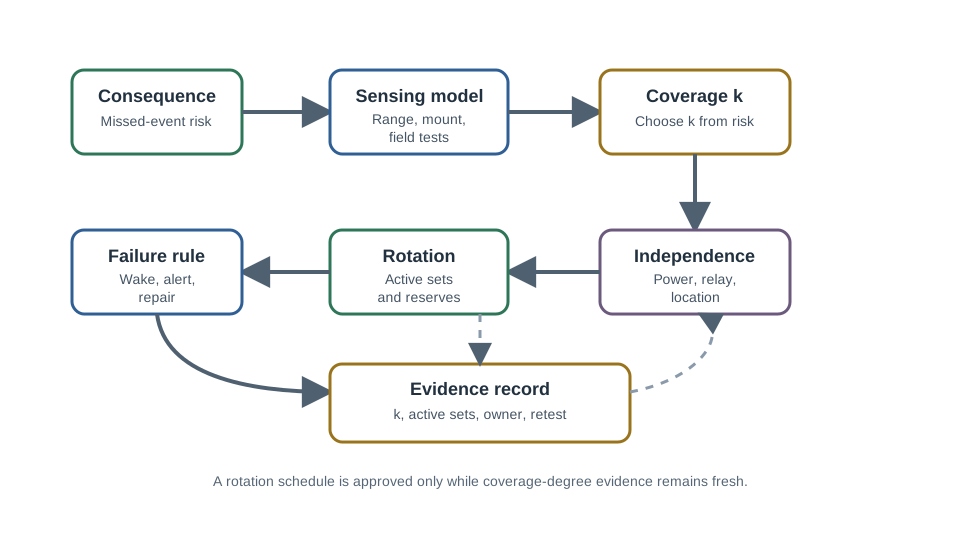
Figure Figure 32.1 begins with the consequence of a missed event. That risk guides the sensing model: range, mounting, and field tests define where a node can really detect the event. The chosen coverage degree k then needs independent power, relay, and location paths; counting nearby sensors alone may leave a shared failure. Rotation names active sets and reserves, while the failure rule says when to wake, alert, or repair. The evidence record keeps k, the active set, an owner, and a retest trigger together. A rotation schedule stays valid only while that coverage evidence remains fresh.
The route separates the reliability decision from the energy-saving schedule:
32.8 Choosing A Coverage Degree
This section: Choosing A Coverage Degree — A coverage degree is a design requirement.
A coverage degree is a design requirement. It should be traceable to risk, repair access, and evidence quality.
For target localization, the meaning of k changes from fault tolerance to position evidence. One sensor can show presence, but not a position fix. Two sensors can constrain the location, but practical two-dimensional localization normally needs at least three independent observations. The review should state whether k means survival after failure, confirmation by another sensor, localization, or confidence in a fused estimate.
32.9 Try k-Coverage Failure Cases
This section: Try k-Coverage Failure Cases — Use the interactive to separate the coverage degree from the sensor count.
Use the interactive to separate the coverage degree from the sensor count. A zone can have many sensors and still fail a k = 2 claim if two sensors share the same weak position or support path. It can also pass a lower k claim while clearly needing repair before a higher-risk schedule is approved.
32.10 Estimating Sensor Requirements
This section: Estimating Sensor Requirements — This is only a planning estimate.
A simple area estimate can start the discussion:
required sensors >= coverage degree x single-coverage baseline x placement marginThis is only a planning estimate. It does not prove coverage. The single-coverage baseline depends on the monitored shape, sensing model, obstacles, placement constraints, and acceptable hole rule. The placement margin accounts for non-ideal positions, uncertainty, and overlap that does not contribute useful redundancy.
Use the estimate to check whether the proposal is in the right order of magnitude. Use coverage verification, field checks, and failure review to approve the design.
32.11 Rotation Sets
This section: Rotation Sets — Rotation sets are groups of sensors that take turns being active.
Rotation sets are groups of sensors that take turns being active. A rotation schedule can extend useful lifetime when the deployment has more sensors than the active requirement needs at one time. It can also create hidden risk if an active set is too sparse, if synchronization fails, or if sleeping nodes are needed for immediate detection.
A rotation set should be approved only when:
each active set satisfies the required coverage degree. sleeping nodes can wake reliably when scheduled or when a fault occurs. the schedule does not rely on a single controller or clock without a fallback. communication overhead is included in the energy review. the system records which set was active when an event or missed event occurred. repair rules are defined for low battery, failed nodes, and stale coverage evidence.
32.12 Disjoint Cover Sets and Lifetime
This section: Disjoint Cover Sets and Lifetime — A strong rotation plan uses disjoint cover sets.
A strong rotation plan uses disjoint cover sets. If the deployed nodes can be partitioned into m groups where each group by itself satisfies the required coverage degree, the system can activate one group at a time and let the others sleep. Each node is then active for roughly 1/m of the schedule, so lifetime can improve by about m before wake, synchronization, repair, and health-reporting overheads are counted.
This is why redundancy is not automatically waste. The same extra sensors that protect coverage can also create rotation groups. A simple example is an 18-node deployment that can be divided into three six-node sets, where each six-node set independently provides full k = 2 coverage. A round-robin schedule gives each node about one third of the active time, while each schedule window still satisfies the same coverage requirement.
Higher k changes the tradeoff. If the requirement rises from k = 2 to k = 3, each valid cover set may need more nodes, and the same deployment may form fewer independent covers. The review should therefore record both the instantaneous coverage proof and the number of valid disjoint covers. More reliability per instant can mean less lifetime multiplication from rotation.
Finding the maximum number of disjoint k-covers is hard enough that practical systems use heuristics. That is acceptable only when the result is auditable: a reviewer should be able to pick any approved schedule window, identify the active nodes, and verify why they still satisfy the mission’s coverage degree and independence rule.
32.13 Knowledge Check: Disjoint Cover Rotation
This section: Knowledge Check: Disjoint Cover Rotation
32.14 Rotation Evidence Record
This section: Rotation Evidence Record — This stage of rotation evidence record calls for evidence at both Required k by zone and Active set.
This stage of rotation evidence record calls for evidence at both Required k by zone and Active set. In the visual at Figure 32.2, the two labels make the required comparison explicit.
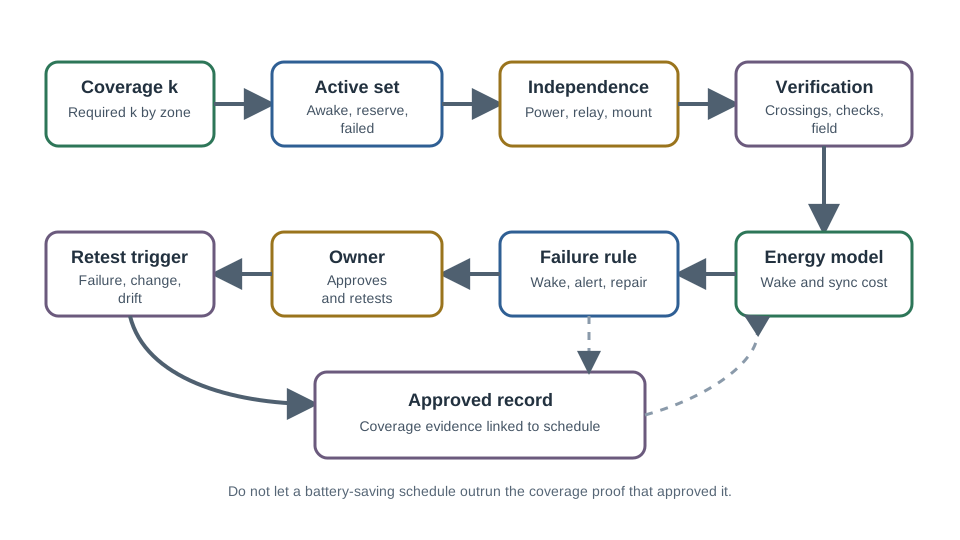
Three labels carry the instructional work in the chart at Figure 32.2. Required k by zone fixes the spatial boundary; Active set adds a distinct review condition; Awake, reserve, exposes the energy consequence. Read together, they establish this specific relationship: Evidence record for WSN k-coverage rotation linking coverage degree, active set, independent layers, energy model, failure response, owner, and retest trigger. The ongoing rotation evidence record analysis should preserve all three.
Example record: Cold-chain storage requires k = 2 temperature coverage in high-value zones during normal operation.
Independence check: The two sensors counted for a point must not share the same enclosure, mounting blind spot, or relay-only path.
Rotation rule: Sleeping reserve nodes rotate in only after the active set is verified against the same k = 2 requirement.
Failure response: If a zone drops below k = 2, the system wakes a reserve node and flags the zone for repair review.
Retest trigger: Repeat validation after sensor replacement, firmware update, room reconfiguration, battery alarm, or sustained communication loss.
32.15 Worked Reviews
This section: Worked Reviews
32.15.1 Review 1: Environmental Trend Monitoring
Scenario: soil or air-quality measurements are used for trend analysis, and short local gaps can be tolerated.
Review path:
Confirm the decision does not depend on immediate single-event detection. Use k = 1 or low redundancy where field variation is slow and repair access is practical. Rotate active nodes only after checking that the active set still covers the sampled zones. Keep enough health reporting to distinguish real environmental change from sensor absence.
Repair pattern: use conservative sensing ranges and keep reserve nodes available for failed or drifting sensors.
32.15.2 Security or Asset Monitoring
Scenario: a single failed sensor should not create a blind spot in a high-value area.
Review path:
State where k = 2 is required and where single coverage is acceptable. Check whether paired sensors are physically and electrically independent enough. Verify each active rotation set against the k = 2 zones, not only against whole-building coverage. Log active-set identity with alarms so investigations know which redundancy layer was awake.
Repair pattern: keep the most critical zones on a stricter wake rule and rotate lower-risk zones more aggressively.
32.15.3 Review 3: Safety-Critical Monitoring
Scenario: a missed event has serious consequence, and a single confirmation path is not acceptable.
Review path:
Choose k from the hazard analysis and required response time. Treat shared power, shared relay, shared mounting, and shared calibration errors as common-mode failure risks. Avoid sleeping all redundant sensors in a zone unless the remaining active set still meets the required k. Define alarm behavior when coverage falls below the required degree, even before an event is detected.
Repair pattern: separate coverage redundancy from communication redundancy so a local sensing layer is not hidden behind one weak relay path.
32.15.4 Review 4: Maintenance Rotation
Scenario: the network rotates active nodes to balance battery wear and allow planned maintenance.
Review path:
Verify that each set can satisfy the requirement by itself or with approved reserve nodes. Include wake-up cost, synchronization messages, retries, and failed wake attempts in the energy model. Limit how long a stale schedule can run after node failure or topology change. Record who approves schedule changes and how the system rolls back a bad rotation rule.
Repair pattern: make the schedule evidence-bound. A rotation rule is valid only while the node health and coverage evidence that supported it remain valid.
32.16 Implementation Checklist
This section: Implementation Checklist
32.17 Common Mistakes
This section: Common Mistakes
-

Wrong: Extra nodes guarantee coverage. Test shared software, housing, clocks, and gateway failures.
32.18 Knowledge Check: k-Coverage Requirement
This section: Knowledge Check: k-Coverage Requirement
32.19 Knowledge Check: Rotation Approval
This section: Knowledge Check: Rotation Approval
32.20 Match Concept To Review Evidence
This section: Match Concept To Review Evidence
32.21 Order The k-Coverage Review
This section: Order The k-Coverage Review
32.22 Summary
This section: Summary — k-Coverage adds reliability by requiring multiple valid sensing paths for each monitored point.
k-Coverage adds reliability by requiring multiple valid sensing paths for each monitored point. Rotation scheduling uses redundancy to save energy by changing which nodes are active. The two ideas must be reviewed together: a rotation schedule is useful only while it preserves the required coverage degree.
The quality standard is evidence. A strong design records the coverage degree, sensing model, independence assumptions, active sets, energy model, failure response, owner, and retest trigger. It does not treat a larger sensor count or a longer battery estimate as proof of reliable coverage.
32.23 Key Takeaway
This section: Key Takeaway — Choose k from consequence and independence evidence, then approve rotation only when each active set still satisfies that coverage degree with a fresh energy, failure, owner, and retest record.
Choose k from consequence and independence evidence, then approve rotation only when each active set still satisfies that coverage degree with a fresh energy, failure, owner, and retest record.
32.24 Concept Relationships
This section: Concept Relationships
32.25 What’s Next
This section: What’s Next — WSN Coverage Algorithms for crossing verification and active-set selection.
Continue with these chapters when you need deeper coverage and deployment evidence:
WSN Coverage Algorithms for crossing verification and active-set selection. WSN Mobile Coverage for mobile repair and dynamic coverage. WSN Coverage Fundamentals for coverage types and sensing models. WSN Coverage Implementations for field validation, active-state records, and retest triggers. WSN Deployment Sizing for pilot sizing and placement evidence. WSN Energy Management for energy budgets and duty-cycle tradeoffs.
Find help
3 reviewed answers.
Where should I start in a module?
Open the module page from the sidebar to see its chapters in order. Use the module map to return to a topic you need.
Modules and pathsReviewed
What can I try when a project does not work?
Check the symptom, then work through the diagnostic steps. Keep the error message and the smallest example that reproduces it.
When you are stuckReviewed
How do interactive examples work?
Use the interactive guide to check how examples and simulations work before changing your project.
Interactive examples guideReviewed