25 WSN Architecture Design
25.1 Learning Objectives
By the end of this chapter, you will be able to:
- Design WSN Architecture: Create multi-tier wireless sensor network systems with appropriate component organization
- Select Node Hardware: Choose microcontrollers, radios, and sensors based on deployment requirements and power budgets
- Implement Cluster Topology: Deploy hierarchical network structures with LEACH cluster head rotation and data aggregation
- Calculate Energy Savings: Quantify transmission reduction from TDMA scheduling and aggregation techniques
25.2 Prerequisites
Before diving into architecture design, you should be familiar with:
- WSN Overview: Fundamentals: Understanding sensor node architecture, energy constraints, and duty cycling concepts
- Wireless Sensor Networks: Knowledge of WSN topologies, communication patterns, and design constraints
For Beginners: What is a Wireless Sensor Network?
A Wireless Sensor Network (WSN) is a collection of small devices (nodes) that work together to monitor an environment. Think of it like a team of observers spread across an area, all communicating wirelessly to report what they see.
Simple Example: Imagine monitoring a forest for fires. You scatter hundreds of small sensor nodes throughout the forest. Each node measures temperature and smoke levels, then sends alerts to a central station if conditions become dangerous.
Key Components:
- Sensor Nodes: Small devices with sensors, processor, radio, and battery
- Cluster Heads: Nodes that collect data from nearby sensors
- Gateway: Connects the sensor network to the internet
- Base Station: Where all the data is collected and analyzed
Main Challenge: These nodes run on batteries, so every design decision must consider energy efficiency to keep the network running as long as possible.
Minimum Viable Understanding (MVU)
If you only learn three things from this chapter:
- WSN architecture has multiple tiers – sensor nodes collect data, cluster heads aggregate it, gateways bridge to the internet, and cloud platforms store and analyze it
- Hardware selection drives network lifetime – choosing a low-power MCU (1 uA sleep) vs high-power (10 uA sleep) means the difference between years and months of battery life
- Cluster-based data aggregation saves 67-90% energy – instead of every node transmitting to the base station, cluster heads combine readings (e.g., average 10 values into 1) before sending
Sensor Squad: Building a Sensor Team!
Sammy the Sensor wants to monitor a whole forest, but he can’t do it alone!
Lila the Listener explains: “Think of it like organizing a school project with LOTS of students:”
- Regular Students (Sensor Nodes): Everyone collects information – like measuring temperature in different parts of the playground
- Team Leaders (Cluster Heads): Each team leader collects reports from their 10 teammates and combines them into one summary. Instead of 10 separate reports, the teacher gets just ONE!
- Class Monitor (Gateway): The class monitor takes all team summaries and delivers them to the principal’s office (the internet)
- Principal (Cloud Platform): Looks at all the data and makes decisions
Max the Messenger explains why this is smart: “If all 100 students tried to talk to the principal at once, it would be chaos! But 10 teams of 10, with each leader giving one summary, means the principal only hears from 10 people instead of 100.”
Bella the Battery adds: “And the regular students only need to whisper to their nearby team leader instead of shouting all the way to the principal’s office. Whispering uses way less energy than shouting!”
25.3 WSN Architecture Design
Key Concepts
- Core Concept: Fundamental principle underlying WSN Architecture Design — understanding this enables all downstream design decisions
- Key Metric: Primary quantitative measure for evaluating WSN Architecture Design performance in real deployments
- Trade-off: Central tension in WSN Architecture Design design — optimizing one parameter typically degrades another
- Protocol/Algorithm: Standard approach or algorithm most commonly used in WSN Architecture Design implementations
- Deployment Consideration: Practical factor that must be addressed when deploying WSN Architecture Design in production
- Common Pattern: Recurring design pattern in WSN Architecture Design that solves the most frequent implementation challenges
- Performance Benchmark: Reference values for WSN Architecture Design performance metrics that indicate healthy vs. problematic operation
25.3.1 System Architecture Overview
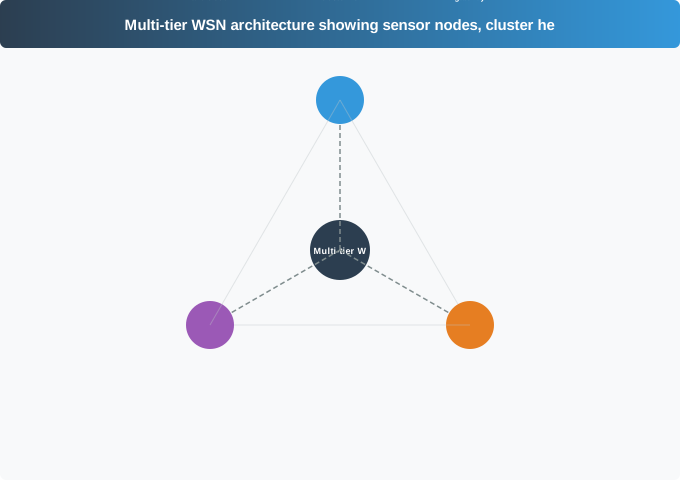
A complete WSN implementation consists of multiple tiers working together:
Alternative View: Energy Cost per Tier
This variant shows the same architecture with energy consumption profiles at each tier, helping engineers understand where optimization has the greatest impact.
Optimization Priority: Tier 1 (sensor nodes) has the most units and strictest battery constraints. A 10% improvement at Tier 1 has 100× more impact than at Tier 3.
25.3.2 Node Types and Roles
| Node Type | Role | Power Budget | Communication |
|---|---|---|---|
| Sensor Node | Data collection | Ultra-low (battery) | Single-hop to CH |
| Cluster Head | Data aggregation | Medium (larger battery) | Multi-hop capable |
| Relay Node | Message forwarding | Low (battery) | Multi-hop |
| Gateway | Network bridge | High (mains power) | Internet connected |
25.3.3 Hardware Component Selection
Choosing the right components impacts network lifetime significantly:
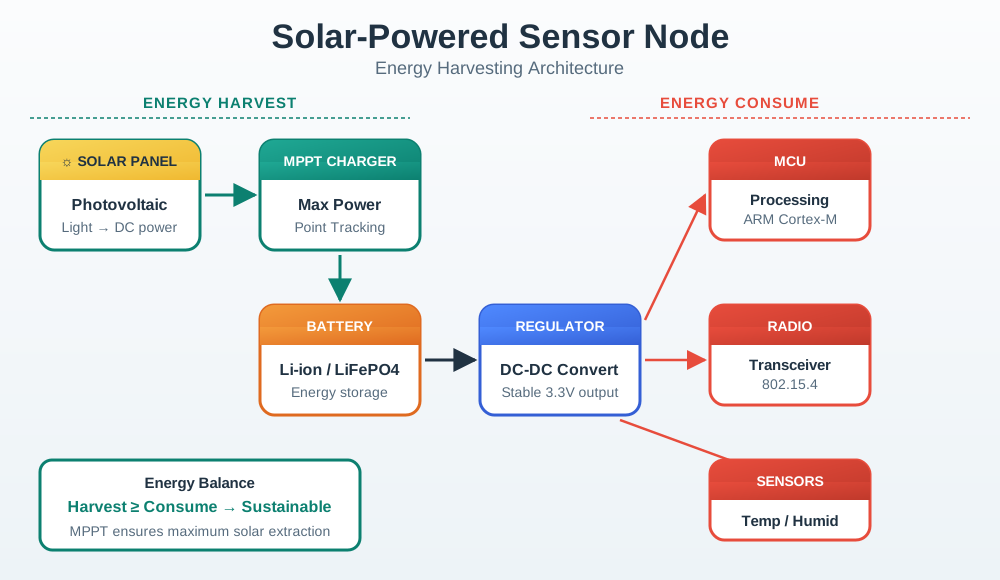
Processor Selection Criteria:
| Parameter | Low-End | Mid-Range | High-End |
|---|---|---|---|
| MCU | ATmega328 | STM32L0 | ESP32 |
| RAM | 2 KB | 8 KB | 512 KB |
| Flash | 32 KB | 64 KB | 4 MB |
| Sleep Current | 1 µA | 0.5 µA | 10 µA |
| Active Current | 5 mA | 10 mA | 80 mA |
| Best For | Simple sensing | Edge processing | Complex analytics |
Radio Selection Criteria:
| Standard | Range | Data Rate | Power | Best For |
|---|---|---|---|---|
| 802.15.4 | 100m | 250 kbps | Low | Indoor WSN |
| LoRa | 15 km | 50 kbps | Very Low | Rural monitoring |
| BLE | 50m | 1 Mbps | Ultra Low | Wearables |
| Wi-Fi | 100m | 54 Mbps | High | Gateway only |
25.4 Network Topology Implementation
25.4.1 Hierarchical Cluster Topology
The most common WSN topology uses clusters to reduce communication overhead:
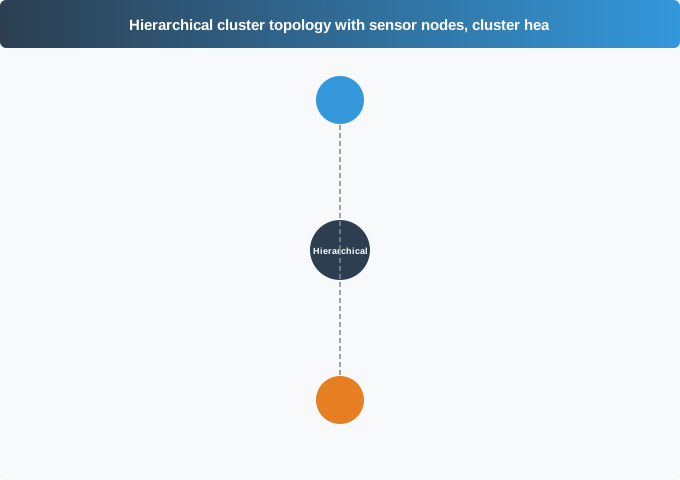
Cluster Formation Algorithm:
CLUSTER FORMATION PROCESS
═══════════════════════════════════════

Phase 1: Setup (performed periodically)
─────────────────────────────────────
1. Each node calculates threshold T(n):

   T(n) = p / (1 - p × (r mod 1/p))

   where: p = desired percentage of CHs
          r = current round number

2. Node generates random number [0,1]
3. If random < T(n), become Cluster Head
4. CH broadcasts advertisement message

Phase 2: Cluster Formation
─────────────────────────────────────
1. Non-CH nodes receive all advertisements
2. Join cluster with strongest signal (nearest CH)
3. Send join message to chosen CH
4. CH creates TDMA schedule for members

Phase 3: Steady State (data transmission)
─────────────────────────────────────
1. Sensor nodes collect data
2. Transmit in assigned TDMA slot
3. CH aggregates all member data
4. CH transmits aggregated data to BS

Repeat from Phase 1 after timer expires
Putting Numbers to It: LEACH Threshold
The LEACH threshold function ensures each node becomes cluster head exactly once per 1/p rounds:
\[T(n) = \frac{p}{1 - p \times (r \bmod \frac{1}{p})}\]
Worked example: With \(p = 0.05\) (5% cluster heads) in round \(r = 3\): \[T(n) = \frac{0.05}{1 - 0.05 \times (3 \bmod 20)} = \frac{0.05}{1 - 0.05 \times 3} = \frac{0.05}{0.85} = 0.0588\]
Each node generates random \(r \in [0,1]\). If \(r < 0.0588\), it becomes a cluster head. Expected cluster heads: \(100 \times 0.0588 \approx 6\) nodes (close to target of 5).
25.4.2 Energy-Efficient Data Aggregation
Cluster heads aggregate data to reduce transmissions:
| Aggregation Method | Compression | Energy Savings | Use Case |
|---|---|---|---|
| Average | 10:1 | 90% | Temperature monitoring |
| Min/Max | 10:1 | 90% | Threshold detection |
| Median | 10:1 | 90% | Outlier resistance |
| Delta encoding | 3:1 | 67% | Slowly changing data |
| Compression | 2:1 | 50% | Complex data |
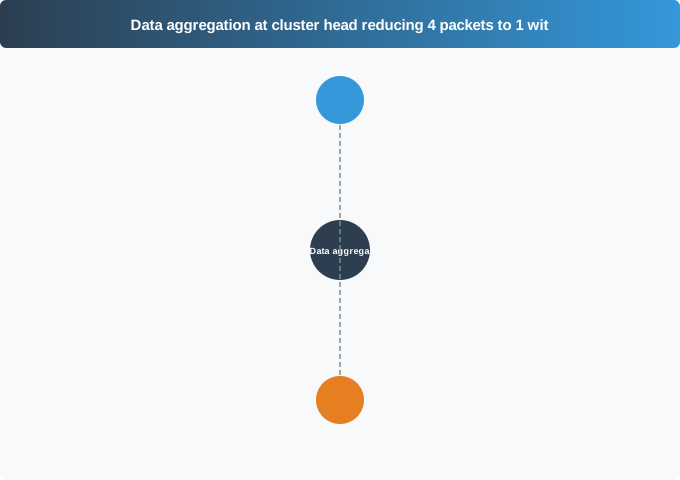
Data Aggregation at Cluster Head:
25.5 Worked Example: Forest Fire Detection Network
Scenario: Design a WSN for early fire detection in a 10 km x 10 km (10,000 hectare) national forest. The system must detect temperature anomalies above 60C within 30 seconds and report to a central fire station.
Step 1: Coverage and Node Density
Each temperature sensor has a detection radius of 50 meters. For complete coverage:
Forest area: 10,000 hectares = 100 km2
Node sensing radius: 50 m
Node coverage area: pi x 50^2 = 7,854 m2 ≈ 0.79 hectares
Nodes for full coverage: 10,000 / 0.79 = 12,658 nodes (hexagonal grid)
With overlap factor 1.2: ~15,190 nodes
At $12 per node (ATmega328P + 802.15.4 radio + thermistor + battery), hardware cost = $182,280.
Step 2: Cluster Architecture
| Tier | Count | Role | Hardware | Power |
|---|---|---|---|---|
| Sensor nodes | 15,000 | Temperature sensing | ATmega328P + MRF24J40 | 2x AA (5 years) |
| Cluster heads | 150 (1 per 100 nodes) | Aggregation, relay | STM32L4 + SX1276 LoRa | Solar + 18650 LiPo |
| Gateways | 5 | Internet bridge | RPi 4 + cellular modem | Solar + deep cycle battery |
| Base station | 1 | Central monitoring | Server at fire station | Mains |
Step 3: Communication Timing
Normal mode (no fire detected):
  Sensor → CH: 1 report every 5 minutes via 802.15.4
  CH aggregates 100 nodes: sends 1 packet every 5 min via LoRa
  End-to-end latency: ~30 seconds

Alert mode (temperature > 60C):
  Sensor → CH: immediate interrupt transmission
  CH → Gateway: priority LoRa packet (bypasses TDMA schedule)
  Gateway → Base station: cellular alert
  End-to-end latency: < 5 seconds
Step 4: Energy Budget
Sensor node in normal mode:
  Active (sensing + TX): 25 mA x 0.5s
  Sleep: 1 uA x 299.5s
  Avg current = (25mA x 0.5s + 0.001mA x 299.5s) / 300s = 0.042 mA
  Battery life: 3000 mAh / 0.042 mA = 71,428 hours = 8.15 years
  With 50% derating for cold weather (-40°C): ~4 years
Total System Cost:
| Component | Cost |
|---|---|
| 15,000 sensor nodes x $12 | $180,000 |
| 150 cluster heads x $45 | $6,750 |
| 5 gateways x $350 | $1,750 |
| Base station software | $5,000 |
| Installation labor | $50,000 |
| Year 1 total | $243,500 |
| Annual battery replacement (25% per year) | $11,250 |
Comparison: A single helicopter-based fire patrol costs $2,000-4,000 per hour. The WSN provides 24/7 monitoring at the cost of 61-122 helicopter flight hours per year.
25.6 Knowledge Check
Question 1: Cluster Head Selection
Question 2: Data Aggregation Benefits
Worked Example: Industrial Monitoring Hardware Selection
Scenario: Select node hardware for a 200-node factory floor monitoring system. Sensors measure temperature, vibration, and humidity every 10 seconds for predictive maintenance.
Requirements:
- Area: 10,000 m² factory floor
- Sensors: 200 nodes with temperature, accelerometer, humidity
- Sampling: Every 10 seconds
- Network lifetime target: 2 years on batteries
- Data: 16 bytes per reading (3 sensors × 4 bytes + timestamp)
- Communication: Multi-hop to 4 gateways
Hardware Options:
| Component | Option A (Low-End) | Option B (Mid-Range) | Option C (High-End) |
|---|---|---|---|
| MCU | ATmega328P (8-bit) | STM32L4 (32-bit ARM) | ESP32 (32-bit dual-core) |
| Clock | 8 MHz | 80 MHz | 240 MHz |
| RAM | 2 KB | 128 KB | 520 KB |
| Flash | 32 KB | 512 KB | 4 MB |
| Sleep current | 1 µA | 0.4 µA | 10 µA |
| Active current | 5 mA | 12 mA | 80 mA |
| Radio | MRF24J40 (802.15.4) | SX1276 (LoRa) | Built-in Wi-Fi |
| Radio TX | 23 mA @ 0 dBm | 28 mA @ 14 dBm | 120 mA @ 20 dBm |
| Radio RX | 19 mA | 11 mA | 95 mA |
| Cost per node | $12 | $28 | $45 |
Energy Budget Calculation (Option B - STM32L4 + LoRa):
Active time per cycle (10 seconds):
- Sensor read: 50 ms @ 12 mA
- Processing: 20 ms @ 12 mA
- TX (on 1/10 cycles, relay other 9/10): 50 ms @ 28 mA
- Total active: ~120 ms
Average current: \[I_{avg} = \frac{120ms \times 15mA + 9,880ms \times 0.4µA}{10,000ms} = 0.18 + 0.0004 = 0.18 \text{ mA}\]
Battery lifetime:
- Battery: 2× AA (3,000 mAh @ 3V)
- Lifetime: 3,000 mAh / 0.18 mA = 16,667 hours = 694 days (1.9 years)
Cost analysis:
- Hardware: 200 nodes × $28 = $5,600
- Batteries (2-year cycle): 200 × $3 × 1 replacement = $600
- Total 2-year TCO: $6,200
Decision: Select Option B (STM32L4 + LoRa)
- Meets 2-year lifetime target (1.9 years ≈ target)
- Sufficient RAM for edge processing (FFT on vibration data)
- LoRa provides reliable long-range communication across factory
- Mid-range cost balances features vs. budget
Decision Framework: Node Hardware and Topology Selection
Step 1: MCU Selection
| Requirement | Choose Low-End (8-bit) | Choose Mid-Range (32-bit ARM) | Choose High-End (ESP32/Dual-core) |
|---|---|---|---|
| Processing | Simple sensing (temp, humidity) | Edge analytics (FFT, filtering) | ML inference, computer vision |
| Memory | <10 KB data | 10-100 KB buffers | >100 KB (image processing) |
| Lifetime | >5 years | 2-5 years | <2 years (high sleep current) |
| Cost target | <$15/node | $15-30/node | >$30/node |
Step 2: Radio Selection
| Requirement | 802.15.4 (Zigbee) | LoRa | BLE | Wi-Fi |
|---|---|---|---|---|
| Range | 10-100m indoor | 2-15 km outdoor | 10-50m | 50-100m |
| Data rate | 250 kbps | 0.3-50 kbps | 1-2 Mbps | 54+ Mbps |
| Power (TX) | 15-25 mA | 20-120 mA (range-dependent) | 8-15 mA | 80-200 mA |
| Best for | Mesh networks, moderate data | Rural, low data rate | Wearables, smartphones | Gateways only |
Step 3: Topology Selection
| Network Size | Topology | Cluster Size | Gateway Count | Reasoning |
|---|---|---|---|---|
| <30 nodes | Star | N/A | 1 gateway | Simple, all in range |
| 30-100 nodes | Cluster (LEACH) | 10-15 per cluster | 1-2 gateways | Balance energy, scalability |
| 100-500 nodes | Hierarchical | 20-30 per cluster | 3-5 gateways | Distribute hotspot load |
| >500 nodes | Multi-tier mesh | 30-50 per cluster | 5-10 gateways | Enterprise-scale |
Cost-Performance Matrix:
| Configuration | Nodes | Hardware | 2-Year Battery | Installation | Total |
|---|---|---|---|---|---|
| Budget (ATmega328) | 200 | $2,400 | $1,800 (3 replacements) | $3,000 | $7,200 |
| Recommended (STM32L4) | 200 | $5,600 | $600 (1 replacement) | $3,000 | $9,200 |
| Premium (ESP32) | 200 | $9,000 | $2,400 (4 replacements) | $3,000 | $14,400 |
Rule of thumb: Mid-range ARM MCUs (STM32L4, nRF52) offer best lifetime/feature balance for most IoT deployments. Reserve high-end (ESP32) for gateways or ML-heavy nodes.
Common Mistake: Underestimating Sleep Current Impact
Misconception: “A node spending 99% of time in sleep mode will last 100× longer than always-on.”
Reality: Sleep current is often 1-10 µA, NOT zero. This “leakage” significantly erodes lifetime for ultra-low duty cycle applications.
Calculation example:
- Active: 20 mA for 1% of time
- Sleep: 5 µA for 99% of time
Average current: 0.01 × 20 mA + 0.99 × 0.005 mA = 0.2 + 0.005 = 0.205 mA
Sleep contributes 0.005 mA (2.4% of total). Seems tiny? Over 2 years: - Total consumed: 0.205 mA × 17,520 hours = 3,592 mAh - Sleep portion: 0.005 mA × 17,520 hours = 88 mAh - Sleep “wastes” 88 mAh – enough to power 44 additional transmissions!
Worse case (10 µA sleep, 0.1% duty cycle):
- Active: 0.001 × 20 mA = 0.02 mA
- Sleep: 0.999 × 0.01 mA = 0.01 mA
- Sleep current dominates: 0.01 / 0.03 = 33% of total energy
Solutions:
- Choose MCUs with <1 µA sleep (STM32L0: 0.4 µA, nRF52: 0.3 µA)
- Use power gating to fully disconnect peripherals
- For ultra-low duty cycle (<0.1%), use wake-up timers that consume nanoamps
- Consider energy harvesting (solar) for sub-µA average draw applications
Takeaway: Below 1% duty cycle, sleep current becomes the dominant energy consumer. Never ignore it in lifetime calculations.
25.7 Concept Relationships
Understanding how architecture and hardware concepts interconnect:
| Concept | Builds On | Enables | Conflicts With | Complements |
|---|---|---|---|---|
| Multi-Tier Architecture | Network topology theory | Scalable system design | Flat network approaches | Hierarchical protocols |
| Cluster Heads | Multi-hop routing capability | Data aggregation points | Star-only topologies | LEACH rotation algorithm |
| LEACH Protocol | Randomized selection, clustering | Fair energy distribution | Deterministic routing | TDMA scheduling |
| MCU Selection | Power budget, processing needs | Node capabilities, lifetime | Cost constraints | Sleep mode optimization |
| Radio Selection | Range, data rate requirements | Communication architecture | Power budget limits | Modulation schemes |
| Data Aggregation | Cluster topology | 10:1 transmission reduction | Raw data requirements | In-network processing |
| TDMA Scheduling | Cluster membership | Collision-free transmission | Asynchronous protocols | Duty cycling strategies |
25.8 How It Works: LEACH Cluster Formation and Rotation
LEACH (Low-Energy Adaptive Clustering Hierarchy) achieves balanced energy consumption through randomized cluster head rotation. Here’s the complete mechanism:
Round Structure (Setup + Steady-State):
Setup Phase (Brief - 1% of round duration):
Step 1: Cluster Head Self-Election
- Each node n generates random number r ∈ [0, 1]
- Calculates threshold: T(n) = p / (1 - p × (round mod (1/p)))
- p = desired cluster head percentage (e.g., 0.05 = 5% CHs)
- round = current round number
- If r < T(n), node becomes cluster head for this round
- Expected result: ~5% of nodes become CHs each round
Step 2: Cluster Head Advertisement
- Newly elected CHs broadcast ADV message: “I am cluster head [ID]”
- Uses CSMA MAC to avoid collisions
- Non-CH nodes listen for all advertisements
- ADV contains: CH_ID, RSSI (signal strength)
Step 3: Member Node Join Decision
- Each non-CH node receives multiple advertisements
- Selects cluster based on strongest RSSI (nearest CH)
- Sends JOIN message to chosen CH
- Message format: [Node_ID, CH_ID]
Step 4: TDMA Schedule Creation
- CH receives all JOIN messages (knows cluster membership)
- Creates TDMA schedule: Time_slot assignments for each member
- Broadcasts schedule to cluster members
- Schedule format: [Node_1: slot_0, Node_2: slot_1, …, Node_N: slot_N]
Steady-State Phase (Data Collection - 99% of round duration):
Step 5: TDMA-Based Data Transmission
- Each member node waits for assigned time slot
- Transmits sensor reading during slot (100ms)
- Sleeps during other slots (99% of time)
- Example: 10-node cluster, 1-second frame → each node transmits 100ms, sleeps 900ms
Step 6: Data Aggregation at Cluster Head
- CH remains awake full cycle to receive from all members
- Receives N readings (one per member)
- Performs aggregation: AVG, MIN, MAX, or compression
- Reduces N packets to 1 aggregated packet
Step 7: Inter-Cluster Communication
- After collecting all member data, CH transmits to base station
- Uses higher transmission power for long-range link
- Aggregated data: [CH_ID, Timestamp, AVG_value, MIN, MAX, N_samples]
Round Completion:
- After steady-state duration (e.g., 20 seconds), round ends
- Return to Step 1 with incremented round number
- New random CH election ensures different nodes become CH
- Average: Each node becomes CH once every 20 rounds (1/p)
Energy Balance:
- CH nodes: Higher energy (long TX to BS, aggregation, always awake)
- Member nodes: Lower energy (short TX to CH, sleep 90%+)
- Rotation: Each node experiences both roles equally over time
- Result: Energy consumption balanced across all nodes
Why It Works:
- Randomization prevents hotspots (no permanent CH)
- Rotation ensures fairness (everyone takes turns as CH)
- Aggregation minimizes total transmissions
- TDMA eliminates collisions and idle listening
25.9 Try It Yourself: Cluster Head Selection Simulation
Objective: Simulate LEACH cluster head election and calculate energy distribution.
Scenario:
- 100 sensor nodes uniformly distributed
- Target: 5 cluster heads per round (p = 0.05)
- Battery: 7,400 mJ (2,000 mAh × 3.7V)
- Round duration: 20 seconds
- CH energy per round: 15 mJ (aggregation + long TX)
- Member energy per round: 2 mJ (short TX to CH)
Tasks:
- Calculate Threshold for Round 1:
- p = 0.05
- round = 1
- T(n) = p / (1 - p × (round mod (1/p)))
- Compute T(n) = ?
- What percentage of nodes should become CH?
- Simulate Election:
- Generate 100 random numbers r_i ∈ [0, 1]
- Count how many r_i < T(n)
- Is the count close to 5? (Expected: 5, but random variation)
- Calculate Energy Consumption:
- Assume election yields 5 CHs
- CHs: 5 nodes × 15 mJ = ? mJ total
- Members: 95 nodes × 2 mJ = ? mJ total
- Total network energy = ? mJ per round
- Rotation Fairness Check:
- Each node becomes CH once every (1/p) = 20 rounds
- Energy over 20 rounds: 1 CH round + 19 member rounds
- Node energy = (1 × 15) + (19 × 2) = ? mJ
- Is this balanced across all nodes?
- Network Lifetime:
- Battery capacity: 7,400 mJ
- Energy per 20-round cycle: [Answer from Task 4]
- Cycles until battery depleted: 7,400 / [Answer] = ? cycles
- Lifetime in rounds: ? cycles × 20 = ? rounds
- Lifetime in time: ? rounds × 20 seconds = ? hours
What to Observe:
- Does the random election produce exactly p × N cluster heads each round?
- How does varying p (e.g., 0.03, 0.05, 0.1) affect cluster sizes and energy?
- What happens if one node has lower battery (modify threshold)?
Extension Challenge: Implement energy-aware threshold modification: - Standard: T(n) = p / (1 - p × (r mod 1/p)) - Energy-aware: T(n) = T_std × (E_current / E_avg) - Nodes with low battery get lower T (less likely to become CH) - Nodes with high battery get higher T (more likely to become CH)
Simulate 100 rounds with this modification. Do low-battery nodes last longer?
25.10 See Also
WSN Implementation Series:
- WSN Implementation: Deployment and Energy - Coverage planning and power management
- WSN Implementation: Routing and Monitoring - Protocol selection and network health
- WSN Fundamentals: Energy Management - Duty cycling and energy harvesting
Architecture Foundations:
- WSN Overview: Fundamentals - Core sensor network concepts
- Wireless Sensor Networks - WSN architecture principles
Hardware Selection:
- Microcontroller Selection{target=“_blank”} - MCU comparison and power modes
- Radio Technologies{target=“_blank”} - RF transceiver selection
Protocols:
- RPL Routing - IoT routing protocol
- 6LoWPAN - IPv6 over low-power networks
Common Pitfalls
1. Prioritizing Theory Over Measurement in WSN Architecture Design
Relying on theoretical models without profiling actual behavior leads to designs that miss performance targets by 2-10×. Always measure the dominant bottleneck in your specific deployment environment — hardware variability, interference, and load patterns routinely differ from textbook assumptions.
2. Ignoring System-Level Trade-offs
Optimizing one parameter in isolation (latency, throughput, energy) without considering impact on others creates systems that excel on benchmarks but fail in production. Document the top three trade-offs before finalizing any design decision and verify with realistic workloads.
3. Skipping Failure Mode Analysis
Most field failures come from edge cases that work in the lab: intermittent connectivity, partial node failure, clock drift, and buffer overflow under peak load. Explicitly design and test failure handling before deployment — retrofitting error recovery after deployment costs 5-10× more than building it in.
25.11 Summary
This chapter covered WSN architecture and topology design fundamentals:
- Multi-Tier Architecture: WSN implementations use layered design with sensor nodes, cluster heads, gateways, and cloud platforms, each with distinct power profiles and responsibilities
- Hardware Selection: Component choices (MCU, radio, sensors) directly impact network lifetime - low-power MCUs with 1µA sleep current enable multi-year battery life
- Cluster Topology: Hierarchical clustering with rotating cluster heads distributes energy load and reduces communication overhead through data aggregation
- Data Aggregation: Techniques like averaging, min/max, and delta encoding achieve 67-90% energy savings by reducing packet count at cluster heads
25.12 What’s Next
| Topic | Chapter | Description |
|---|---|---|
| Deployment and Energy | WSN Implementation: Deployment and Energy | Sensor placement strategies, coverage analysis, duty cycling, and power harvesting |
| Routing and Monitoring | WSN Implementation: Routing and Monitoring | Protocol selection, multi-hop routing, and network health monitoring |
| WSN Fundamentals | WSN Overview: Fundamentals | Core sensor network concepts and design constraints |