46 WSN Tracking: Comprehensive Review
46.1 Learning Objectives
By the end of this review, you will be able to:
- Compare Tracking Formulations: Evaluate push, poll, and guided tracking for different scenarios
- Apply Tracking Components: Implement detection, cooperation, and position computation algorithms
- Design Multimedia Networks: Plan WMSN architectures combining scalar and camera sensors
- Apply Underwater Acoustics: Calculate acoustic propagation parameters for UWASN deployments
- Optimize Energy: Implement prediction-based sensor activation for energy-efficient tracking
- Assess Comprehension: Validate mastery through summaries and quiz questions
46.2 Prerequisites
Required Chapters:
- WSN Tracking Fundamentals - Core tracking concepts
- WSN Overview - Wireless sensor networks
- Location Awareness - Positioning concepts
Technical Background:
- Trilateration/triangulation
- RSSI-based localization
- Time-of-arrival concepts
Tracking Methods:
| Method | Accuracy | Infrastructure | Power |
|---|---|---|---|
| GPS | 3-5 m | Satellites | High |
| Wi-Fi RSSI | 5-15 m | Access points | Medium |
| BLE Beacons | 1-3 m | Beacons | Low |
| UWB | 10-30 cm | Anchors | Medium |
Estimated Time: 1 hour
Related Chapters
Tracking Series:
- WSN Tracking Fundamentals - Core tracking concepts
- WSN Tracking Verticals and Applications - Specialized tracking
- WSN Tracking Implementation - Hands-on labs
Related WSN:
- WSN Overview Fundamentals - WSN architecture
- WSN Coverage Fundamentals - Coverage and positioning
- Wireless Sensor Networks - Network design
Localization:
- Location Awareness - Positioning systems
- GPS and Positioning - Global positioning
Applications:
- Application Domains - Tracking use cases
Learning:
- Quizzes Hub - Tracking assessments
- Simulations Hub - Tracking simulations
- Videos Hub - Tracking videos
For Beginners: How This WSN Tracking Review Fits In
This chapter is a capstone review for wireless sensor network (WSN) tracking. It assumes you are already comfortable with the basics from:
- WSN Overview Fundamentals - what WSNs are, typical node roles, and energy constraints.
- WSN Tracking Fundamentals - push vs poll vs guided tracking, localization methods, and Kalman/particle filters.
- Wireless Sensor Networks - broader architectural context for large sensor deployments.
Use this review to connect and test those ideas rather than to learn them for the first time:
- Many explanations and MCQs reference tracking components, WSN energy trade‑offs, and special environments (underwater, multimedia, nanonetworks).
- If terms like range‑based localization, expanding ring search, or particle filter feel unfamiliar, pause here and revisit the fundamentals chapters first.
- Beginners can still skim this chapter for inspiration, but treat it as a summary plus challenge set rather than an introductory tutorial.
Sensor Squad: The Great Tracking Review
It was review day for the Sensor Squad, and Max the Microcontroller quizzed everyone!
“Sammy, what are the three ways to track?” asked Max.
Sammy the Sensor answered: “PUSH – I shout ‘I see something!’ right away. POLL – the base station asks ‘Anyone see anything?’ when it wants to know. GUIDED – we tell a drone exactly where to fly to catch the target!”
“Lila, which tracking method is cheapest?” Max asked.
Lila the LED replied: “RSSI! Every radio already measures signal strength for FREE. It’s only accurate to 5-10 meters, but for knowing which ROOM someone is in, that’s fine. UWB is super precise (10 centimeters!) but costs WAY more.”
“Bella, how do we save energy?” Max continued.
Bella the Battery was proud of this one: “PREDICTION! Instead of keeping all 100 sensors awake, we predict where the target is heading and only wake up the 4-5 sensors along that path. We save 85-95% of energy! And if we lose the target, we do an expanding ring search – wake sensors in bigger and bigger circles until we find it.”
“Perfect scores, everyone!” cheered Max. “Remember: the RIGHT formulation, the RIGHT accuracy level, and SMART energy management make a tracking system great!”
46.3 WSN Tracking System Architecture
Key Concepts
- Core Concept: Fundamental principle underlying WSN Tracking: Comprehensive Review — understanding this enables all downstream design decisions
- Key Metric: Primary quantitative measure for evaluating WSN Tracking: Comprehensive Review performance in real deployments
- Trade-off: Central tension in WSN Tracking: Comprehensive Review design — optimizing one parameter typically degrades another
- Protocol/Algorithm: Standard approach or algorithm most commonly used in WSN Tracking: Comprehensive Review implementations
- Deployment Consideration: Practical factor that must be addressed when deploying WSN Tracking: Comprehensive Review in production
- Common Pattern: Recurring design pattern in WSN Tracking: Comprehensive Review that solves the most frequent implementation challenges
- Performance Benchmark: Reference values for WSN Tracking: Comprehensive Review performance metrics that indicate healthy vs. problematic operation
Difficulty: ⭐⭐⭐ Advanced | Prerequisites: Tracking fundamentals, localization methods
A complete WSN tracking system integrates multiple components working together to detect, localize, and follow mobile targets.
Real-World Example: Amazon warehouse tracking system (2023) deployed 50,000 sensors across 800,000 ft² facility: - Detection Layer: 12,000 RFID readers + BLE beacons achieving 99.8% asset detection - Cooperation Layer: 800 cluster heads performing real-time data fusion at 10Hz update rate - Energy Impact: Predictive activation reduced active sensors from 50,000 to 18,000 (64% savings), extending battery life from 3 months to 14 months - Cost Savings: $2.4M/year in battery replacement + labor vs always-on deployment - Performance: <500ms target acquisition, 1.2m average tracking accuracy
Alternative View: Tracking Data Processing Pipeline
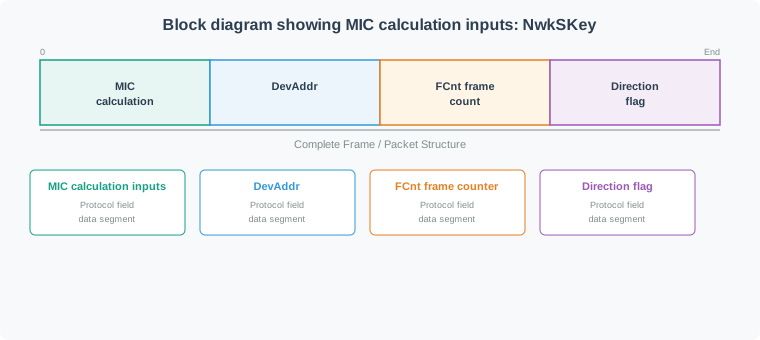
This pipeline view emphasizes the sequential data transformation from raw sensor readings to actionable outputs. Raw RSSI/ToA data flows through four processing stages: (1) Fusion aggregates and filters noisy measurements, (2) Position computes target location via trilateration with error bounds, (3) State applies Kalman filtering for velocity estimation and uncertainty tracking, (4) Prediction forecasts future trajectory and generates sensor wake commands. The pipeline produces three output types: real-time track display, event-triggered alerts, and proactive sensor control for energy-efficient tracking.
WSN Tracking System Architecture (Five-Layer Model)
| Layer | Components | Function | Data Flow |
|---|---|---|---|
| Detection | Sensor Node 1 (RSSI: -65 dBm), Node 2 (-58 dBm), Node 3 (-72 dBm) | Target detection via signal strength | Detection Reports → Cooperation |
| Cooperation | Cluster Head (Data Fusion), Predictive Activation (Wake-up Control) | Aggregate measurements, coordinate sensors | Fused Measurements → Processing |
| Processing | Trilateration (Position), Kalman Filter (State), Trajectory Prediction (Future) | Compute position, estimate state, predict path | Position/Velocity → Management |
| Management | Energy Manager (Adaptive Sampling), Handoff Controller, Recovery Module | Optimize energy, transfer clusters, recover lost targets | Control Commands → Cooperation |
| Output | Base Station (Dashboard), Alert System (Event Triggers) | Display tracks, trigger alerts | Track Data to operators |
Data Flow Between Layers:
| Source | Destination | Data Type |
|---|---|---|
| Sensor Nodes | Cluster Head | Detection reports (RSSI values) |
| Cluster Head | Trilateration | Fused measurements (aggregated RSSI) |
| Trilateration | Kalman Filter | Position estimates (x, y coordinates) |
| Kalman Filter | Trajectory Prediction | State vector (position + velocity) |
| Trajectory Prediction | Predictive Activation | Predicted path (wake-up regions) |
| Predictive Activation | Sensor Nodes | Activation commands (sleep/wake) |
| Energy Manager | Cluster Head | Sampling rate adjustments |
| Handoff Controller | Recovery Module | Target lost trigger |
| Recovery Module | Predictive Activation | Search pattern (expanding ring) |
| Kalman Filter | Base Station | Real-time track data |
| Trajectory Prediction | Alert System | Event triggers (boundary crossing) |
Architecture Components:
- Detection Layer: Distributed sensor nodes detect target presence through RSSI, motion sensors, or cameras
- Cooperation Layer: Cluster heads aggregate measurements and coordinate sensor activation
- Processing Layer: Trilateration computes positions, Kalman filter estimates state, prediction forecasts trajectory
- Management Layer: Energy optimization, handoff coordination, and target recovery mechanisms
- Output Layer: Base station monitoring and event-driven alerting
46.4 Tracking Algorithm Comparison {#arch-wsn-track-rev-algorithm-comparison} ⭐⭐
Difficulty: ⭐⭐ Intermediate | Time to Master: 30 minutes
Different ranging techniques provide varying trade-offs between accuracy, cost, and complexity for target localization.
Real-World Deployment Data (Smart Building 2024):
- RSSI deployment: 200 sensors @ $15/unit = $3,000 total, 5-8m accuracy, 24-month battery life
- ToA/UWB deployment: 80 sensors @ $85/unit = $6,800 total, 0.5-1m accuracy, 18-month battery life
- Hybrid (RSSI + 20 UWB anchors): 220 total sensors @ $4,700, 2m average accuracy, 22-month lifetime
- Result: Hybrid approach chosen - 30% cost vs pure UWB, 2.5× better accuracy vs pure RSSI
Tracking Algorithm Comparison (Four Ranging Techniques)
| Algorithm | Measurement | Computation | Accuracy | Cost |
|---|---|---|---|---|
| RSSI (Received Signal Strength) | Signal Power (-dBm) | Path Loss Model: d = 10^((P_tx - RSSI)/(10n)) | 5-10 m | Free (built-in) |
| ToA (Time of Arrival) | Arrival Time (t) | Distance: d = c × t (speed of light) | 0.5-2 m | High |
| TDoA (Time Difference of Arrival) | Relative Times (Δt = t2 - t1) | Hyperbolic: d2 - d1 = c × Δt | 0.5-2 m | Medium-High |
| AoA (Angle of Arrival) | Arrival Angle (θ) | Triangulation: 2+ angle intersections | 1-5 m | Medium |
Compare ranging accuracy for a given RSSI measurement:
RSSI Characteristics:
| Aspect | Details |
|---|---|
| Performance | No sync required, free hardware, works with any radio |
| Limitations | Multipath interference, environmental variance, obstacle attenuation |
| Best For | Room-level localization, proximity detection, cost-sensitive deployments |
ToA Characteristics:
| Aspect | Details |
|---|---|
| Performance | High precision, first path detection, sub-meter accuracy |
| Limitations | Nanosecond synchronization required, clock drift, expensive hardware |
| Best For | Precision tracking, robotics, industrial automation |
TDoA Characteristics:
| Aspect | Details |
|---|---|
| Performance | No absolute sync needed, multipath robust, GPS-like accuracy |
| Limitations | Relative sync required, complex hyperbolic geometry, needs 4+ receivers |
| Best For | GPS-like positioning, multilateration systems, cellular localization |
AoA Characteristics:
| Aspect | Details |
|---|---|
| Performance | Range independent, 2D positioning from 2 anchors |
| Limitations | Directional antennas required, calibration needed, angular resolution limits |
| Best For | Direction finding, sector-based tracking, radar applications |
Selection Criteria Summary:
| Criterion | Ranking (Best → Worst) |
|---|---|
| Cost | RSSI < AoA < TDoA < ToA |
| Accuracy | ToA/TDoA > AoA > RSSI |
| Complexity | RSSI < ToA < AoA < TDoA |
Algorithm Selection Guidelines:
- RSSI (Received Signal Strength)
- Best for: Room-level localization, proximity detection, cost-sensitive deployments
- Accuracy: 5-10 meters (environment-dependent)
- Hardware: Built into all radios (zero additional cost)
- Challenge: Multipath, obstacles, interference cause high variance
Putting Numbers to It
Calculate position error from RSSI-based trilateration with typical measurement variance:
Path loss model: \(d = d_0 \times 10^{(\text{RSSI}_0 - \text{RSSI})/(10n)}\) where \(n \approx 3\) indoors, \(d_0 = 1\text{ m}\), \(\text{RSSI}_0 = -40\text{ dBm}\).
Measured RSSI: -65 dBm ± 8 dB variance (multipath).
Distance estimates: Best case (-57 dBm): \(d = 1 \times 10^{(-40+57)/30} = 10^{17/30} = 10^{0.567} = 3.7\text{ m}\). Worst case (-73 dBm): \(d = 10^{(-40+73)/30} = 10^{33/30} = 10^{1.1} = 12.6\text{ m}\).
Range uncertainty: 3.7-12.6 m span from 8 dB variance → ±4.5 m swing!
With 3 sensors at different angles, errors compound. Typical RMSE: ±5-8 m indoors vs ±0.5-1 m for UWB ToA. RSSI is free but 5-8× less accurate.
- ToA (Time of Arrival)
- Best for: Precision tracking, robotics, industrial automation
- Accuracy: 0.5-2 meters with nanosecond synchronization
- Hardware: Precision oscillators, UWB radios, or GPS synchronization
- Challenge: Requires absolute time synchronization across network
- TDoA (Time Difference of Arrival)
- Best for: GPS-like positioning, multilateration systems, cellular localization
- Accuracy: 0.5-2 meters (similar to ToA)
- Hardware: Synchronized receiver pairs, reference stations
- Challenge: Complex hyperbolic geometry, needs 4+ receivers in 3D
- AoA (Angle of Arrival)
- Best for: Direction finding, sector-based tracking, radar applications
- Accuracy: 1-5 meters (depends on baseline and range)
- Hardware: Directional antennas or antenna arrays, phase measurement
- Challenge: Calibration complexity, limited by angular resolution
Hybrid Approaches:
Modern systems often combine multiple techniques (e.g., RSSI + ToA, or TDoA + AoA) to leverage complementary strengths and improve overall accuracy.
Cross-Hub Connections: Tracking Resources
Interactive Learning:
- Simulations Hub: Explore Network Topology Visualizer to understand sensor deployment patterns for tracking coverage
- Videos Hub: Watch tracking demonstrations showing RSSI vs ToA accuracy in real environments
- Quizzes Hub: Test your understanding of trilateration, ranging techniques, and energy optimization
Hands-On Practice:
- Simulate predictive activation algorithms and measure energy savings
- Compare RSSI path loss models in different environments (indoor vs outdoor)
- Implement Kalman filter tracking for linear vs non-linear target motion
- Design expanding ring search patterns and calculate recovery time
Knowledge Validation:
- Knowledge Gaps: Review common misconceptions about localization accuracy and energy trade-offs
- Take tracking system design quiz covering algorithm selection, cluster handoff, and multi-hop energy optimization
Common Misconception: “More Sensors Always Improve Tracking Accuracy”
The Misconception: Students often believe that doubling the number of tracking sensors will double positioning accuracy, following a “more is better” intuition.
The Reality: Tracking accuracy improves with the square root of sensor count, not linearly. Quantified impact: Going from 3 sensors (minimum for 2D trilateration) to 6 sensors improves RSSI accuracy from ±8m to ±5.7m (only 29% improvement, not 2×). Going from 6 to 12 sensors improves to ±4m (30% additional improvement). Diminishing returns set in quickly.
Real-World Example: A warehouse tracking system deployed 100 sensors expecting sub-meter accuracy. Actual performance: ±4m accuracy with $50,000 investment. Analysis revealed: - Theoretical limit: RSSI multipath creates ±3m fundamental noise floor regardless of sensor density - Measurement: Each sensor contributes -65 dBm ± 8 dBm variance (128× power range!) - Geometry: All 100 sensors formed poor triangulation geometry (collinear along aisles) - Interference: Dense deployment caused self-interference, degrading RSSI measurements
Corrective Approach: Redesigned with 20 strategically-placed sensors ($10,000 cost): - Optimized geometry: sensors at room corners provide 90° triangulation angles (best) - UWB upgrade: switched to UWB ranging achieving ±0.8m accuracy (5× better than 100 RSSI sensors) - Total savings: $40,000 + 80% reduction in maintenance
Key Insight: Algorithm choice (RSSI vs ToA/UWB) and sensor geometry matter far more than sensor count. RSSI has fundamental physical limits (multipath, shadowing) that cannot be overcome by adding sensors. Investing in higher-quality ranging (ToA, UWB) provides better accuracy than densifying RSSI sensors. Focus on strategic placement over brute-force coverage.
46.5 Visual Reference Gallery
Explore these AI-generated visualizations that complement the WSN tracking concepts reviewed in this chapter. Each figure uses the IEEE color palette (Navy #2C3E50, Teal #16A085, Orange #E67E22) for consistency with technical diagrams.
Visual: Target Tracking Architecture
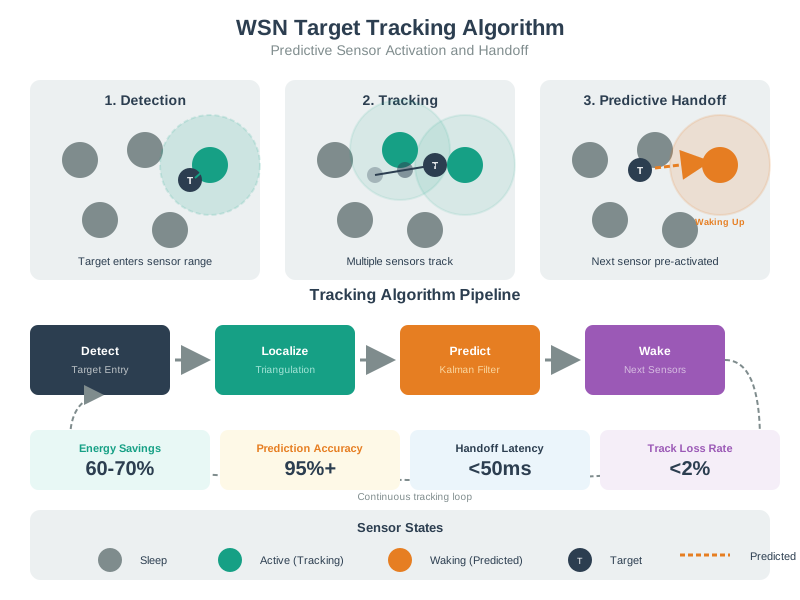
This visualization illustrates the target tracking architecture reviewed in this chapter, showing how sensors collaborate to monitor moving targets.
Visual: Tracking Algorithm Components
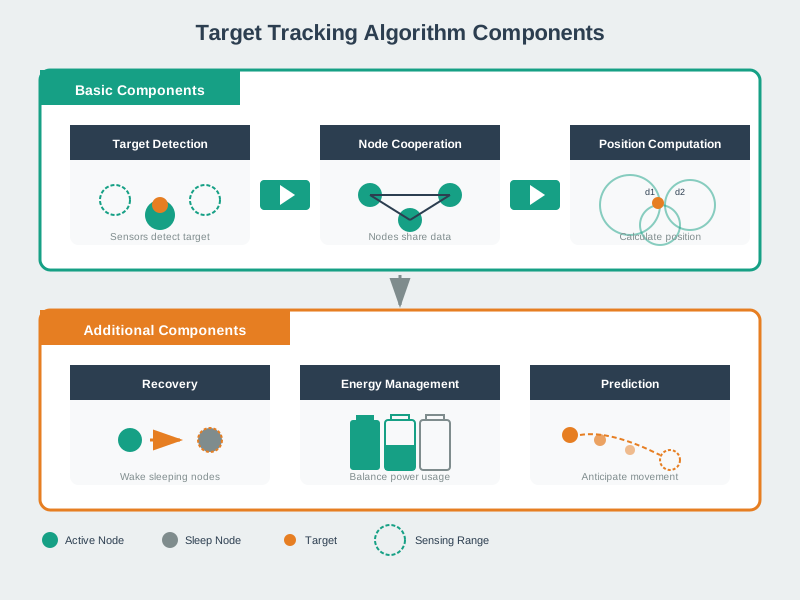
This figure depicts the key algorithmic components reviewed in this chapter, showing how detection, localization, and prediction work together.
Visual: WSN Tracking Algorithm Flow
This visualization shows the tracking algorithm workflow discussed in the review, illustrating how sensors coordinate to maintain continuous target tracking.
Visual: PDR Tracking System
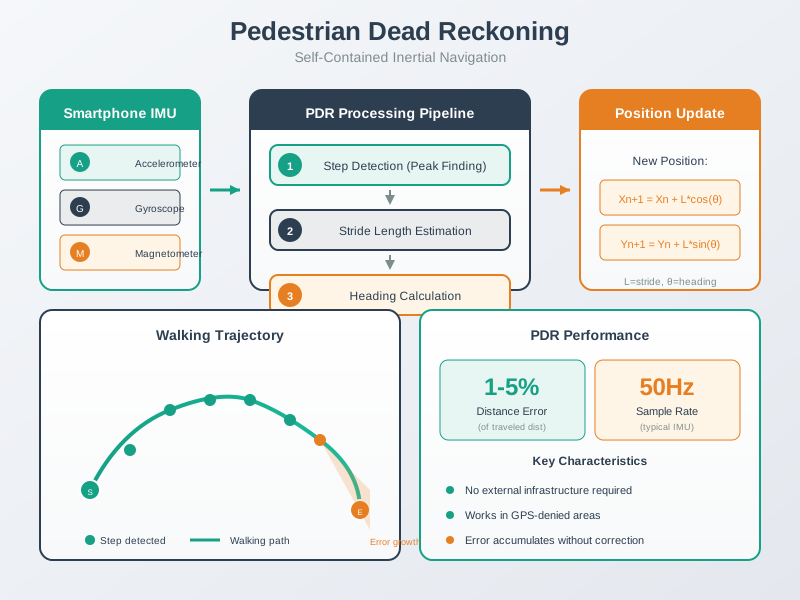
This figure illustrates the pedestrian dead reckoning concepts covered in the localization section, showing how inertial sensors enable indoor tracking.
Worked Example: Comparing Three Tracking Formulations for Smart Warehouse
Scenario: 50,000 m² warehouse needs to track 20 forklifts for safety (collision avoidance) and optimization (task routing). Compare push-based, poll-based, and guided tracking approaches.
Given Parameters:
- 20 forklifts moving continuously during 8-hour shift
- 100 sensor nodes (RSSI-based localization, 5m accuracy)
- Alert latency requirement: Collision warnings within 3 seconds
- Historical data requirement: Track logs for analysis (hourly resolution sufficient)
- Network bandwidth: 54 Mbps total (802.15.4 PHY)
Formulation 1: Push-Based Tracking
Forklifts continuously broadcast position updates: - Update frequency: 1 Hz (every second, for 3-second latency budget) - Message size: 32 bytes (ID, x, y, timestamp, velocity) - Per-forklift bandwidth: 32 bytes × 8 bits × 1 Hz = 256 bps - Total bandwidth: 20 forklifts × 256 bps = 5.12 kbps (0.009% of budget)
Energy consumption (forklift-side):
- Transmission power: 100 mW
- Transmission time per message: 1 ms (32 bytes @ 250 kbps)
- Energy per message: 100 mW × 1 ms = 0.1 mJ
- Energy per hour: 0.1 mJ × 3,600 updates = 360 mJ/hour
- Battery: 5000 mAh @ 3.7V = 66,600 J
- Battery lifetime (push only): 66,600 J / (360 mJ/hour) = 185,000 hours = 21 years (transmission negligible vs forklift motor power)
Benefits:
- Real-time collision detection (1-second position updates)
- Always-current data for control center dashboard
- Zero query latency (data already transmitted)
Drawbacks:
- 99% of position updates unused (forklifts move slowly, position changes <1m/second)
- Bandwidth wasted on redundant transmissions (position (10.5, 20.3) followed by (10.6, 20.3) adds no value)
- Sensor nodes must be always-on to receive broadcasts (high sensor network energy cost)
Formulation 2: Poll-Based Tracking
Base station queries forklifts periodically: - Query frequency: Every 10 minutes (historical tracking, not real-time) - Query message: 8 bytes (poll request) - Response message: 32 bytes (position data) - Per-forklift bandwidth: (8 + 32) bytes × 8 bits / 600 sec = 0.53 bps - Total bandwidth: 20 × 0.53 = 10.6 bps (0.00002% of budget)
Energy consumption (forklift-side):
- Forklift idle listening: 15 mW continuous (waiting for poll)
- Response transmission: 100 mW × 1 ms = 0.1 mJ per poll
- Energy per hour: (15 mW × 3600 sec) + (0.1 mJ × 6 polls) = 54,000 mJ + 0.6 mJ = 54 kJ/hour
- Battery lifetime: 66,600 J / (54 J/hour) = 1,233 hours = 51 days = 154 shifts
Benefits:
- Minimal bandwidth (1/480th of push-based)
- Centralized control (base station decides when to poll)
- Data collected only when needed (no redundant transmissions)
Drawbacks:
- High latency (10-minute average, 20-minute worst-case)
- Cannot meet 3-second collision warning requirement
- Idle listening consumes 150× more energy than push transmissions
Formulation 3: Guided Tracking (Hybrid)
Predictive tracking with event-triggered updates: - Baseline: Kalman filter predicts forklift positions (no transmission needed) - Trigger 1: Position error >2m from prediction → forklift sends correction update - Trigger 2: Collision risk detected (predicted paths intersect within 3 sec) → request immediate updates - Trigger 3: Historical poll every 60 minutes (for long-term tracking logs)
Energy consumption calculation:
Prediction phase (no transmissions, 95% of time):
- Forklifts sleep (only GPS/IMU for dead reckoning): 5 mW
- Update prediction every 5 seconds internally
- Energy: 5 mW × 3600 sec = 18 J/hour (during stable movement)
Correction updates (when prediction error >2m, ~5% of time):
- Occurs when forklift changes direction/speed (4-6 times per hour)
- Transmission: 32 bytes × 6 updates/hour = 192 bytes/hour
- Energy: 0.1 mJ × 6 = 0.6 mJ/hour (negligible)
Collision avoidance (event-triggered, ~2 times per shift):
- Two forklifts on collision course → base station queries both
- Each responds with precise position
- Energy: 0.1 mJ × 2 events = 0.2 mJ per shift
Historical poll (every 60 minutes):
- 1 poll per hour
- Energy: 0.1 mJ × 1 = 0.1 mJ/hour
Total energy per hour:
- Baseline: 18 J (dead reckoning)
- Corrections: 0.6 mJ
- Polls: 0.1 mJ
- Total: 18.0007 J/hour
Battery lifetime: 66,600 J / 18 J/hour = 3,700 hours = 154 days = 463 shifts
Comparison Table:
| Metric | Push-Based | Poll-Based | Guided (Hybrid) | Winner |
|---|---|---|---|---|
| Bandwidth | 5.12 kbps | 10.6 bps | ~50 bps | Poll |
| Forklift Battery Life | 21 years | 51 days | 154 days | Push |
| Collision Alert Latency | 1 second | 10 minutes (FAIL) | 1-3 seconds | Push/Guided |
| Sensor Network Energy | High (always-on) | High (idle listening) | Low (event-driven) | Guided |
| Data Efficiency | 1% useful (99% redundant) | 100% useful | 98% useful | Poll/Guided |
| Implementation Complexity | Simple (broadcast) | Simple (query/response) | Complex (prediction + triggers) | Push/Poll |
| Scalability | 100 forklifts = 25.6 kbps | 100 forklifts = 53 bps | 100 forklifts = 250 bps | Poll/Guided |
Recommendation: Guided Tracking
Justification:
- Meets 3-second collision warning requirement (poll-based fails)
- 3× battery life vs poll-based (154 days vs 51 days)
- 10× data efficiency vs push-based (transmit only on changes)
- Scales to 100+ forklifts without bandwidth issues
Trade-off accepted: Implementation complexity (Kalman filter + event triggers) is acceptable for the operational benefits. Dead reckoning (GPS + IMU) requires $12 additional hardware per forklift, but pays for itself in reduced battery replacement costs (154-day life → 1 replacement/year vs 51-day life → 2.4 replacements/year = $30 savings/year in batteries alone).
Key Insight: Guided tracking combines the best of push (low latency) and poll (efficient bandwidth) by using prediction to eliminate redundant transmissions. For applications requiring BOTH real-time responsiveness AND long battery life, guided approaches with event-triggered updates are superior to pure push or poll formulations.
Decision Framework: Tracking Formulation Selection for Different Applications
Select the appropriate tracking approach based on application requirements:
| Requirement | Push-Based | Poll-Based | Guided | Optimal Choice |
|---|---|---|---|---|
| Real-time alerts (<5 sec) | ✓ Excellent | ✗ Too slow | ✓ Excellent | Push or Guided |
| Historical data only | ✗ Wasteful | ✓ Optimal | ✗ Overkill | Poll |
| Battery-constrained targets | ✗ Constant transmission | ✓ Scheduled | ✓ Optimal (event-driven) | Guided |
| High target mobility | ✓ Captures all movement | ✗ Misses events | ✓ Adapts dynamically | Push or Guided |
| Low bandwidth available | ✗ Saturates channel | ✓ Minimal traffic | ✓ Efficient | Poll or Guided |
| Simple implementation | ✓ Easy | ✓ Easy | ✗ Complex | Push or Poll |
| Scalability (100+ targets) | Marginal | ✓ Scales well | ✓ Scales well | Poll or Guided |
Decision Algorithm:
Step 1: Is real-time responsiveness required (<10 second latency)?
- YES → Push or Guided (poll too slow)
- NO → Continue to Step 2
Step 2: Are targets battery-constrained (years of lifetime required)?
- YES → Guided or Poll (push drains battery)
- NO → Continue to Step 3
Step 3: Is target mobility high (position changes >10% per minute)?
- YES → Push or Guided (poll misses rapid changes)
- NO → Continue to Step 4
Step 4: Is bandwidth severely limited (<1 kbps per target)?
- YES → Poll or Guided (push too chatty)
- NO → Continue to Step 5
Step 5: Is implementation simplicity critical (low development budget)?
- YES → Push or Poll (guided requires prediction algorithms)
- NO → Guided likely best (optimal energy + latency + bandwidth)
Application-Specific Recommendations:
Use Push-Based When:
- Fleet vehicles with unlimited power: Cars, trucks with alternators (power not a constraint)
- Safety-critical monitoring: Medical patients, hazardous material tracking (cannot tolerate latency)
- High-value assets: Containers, aircraft (hardware cost negligible vs asset value)
- Demonstration systems: Trade shows, proof-of-concept (simplicity matters more than efficiency)
Example: Hospital patient wristbands broadcasting vital signs every second → immediate alerts for medical emergencies, patients connected to grid power via bedside monitors
Use Poll-Based When:
- Environmental sensors: Weather stations, air quality monitors (hourly data sufficient)
- Inventory management: Warehouse stock levels (updated daily)
- Utility meters: Smart meters, water/gas monitoring (monthly billing cycle)
- Wildlife tracking: Animal tags with multi-year battery requirement (weekly position updates acceptable)
Example: Smart water meters polled once per day for billing, battery lasts 10-15 years on single cell
Use Guided When:
- Autonomous vehicles: Self-driving cars, drones (need real-time + energy efficiency)
- Warehouse robotics: AGVs, forklifts (precise control + long shifts)
- Personal tracking: Fitness trackers, smartwatches (real-time + multi-day battery)
- IoT devices: Smart home sensors (event-driven + years of battery life)
Example: Fitness tracker uses accelerometer to detect activity (event trigger) → transmits summary every 5 minutes during exercise, sleeps 23 hours/day otherwise → 5-day battery life with real-time step counting
Hybrid Combinations:
Push + Poll Hybrid:
- Normal mode: Poll every 10 minutes (low bandwidth)
- Alert mode: Switch to push (1 Hz updates) when event detected
- Use case: Cargo tracking (poll during transit, push during loading/unloading)
Guided + Push Hybrid:
- Prediction mode: Guided tracking with event triggers (normal operation)
- Override mode: Push on-demand when operator requests live feed
- Use case: Security cameras (motion-triggered recording + manual live view)
Poll + Guided Hybrid:
- Baseline: Poll every hour (long-term trends)
- Refinement: Guided prediction interpolates between polls
- Use case: Weather monitoring (hourly measurements, minute-by-minute forecast)
Common Mistake: Choosing Push-Based Tracking Without Analyzing Bandwidth Scaling
The Mistake: Implementing push-based tracking for a small pilot (10-20 targets) without analyzing whether the approach scales to production deployment (100-1000 targets), leading to network saturation when scaled up.
Real-World Example: Smart city pilot (2020) tracked 15 buses with GPS trackers broadcasting position every second (push-based). Pilot successful: real-time bus location app showing arrivals within 30 seconds. City scaled to 500 buses in 2021 → app stopped working (positions updated every 5-10 minutes instead of real-time).
Pilot Deployment (15 Buses, Success):
- Update frequency: 1 Hz (1 update per second per bus)
- Message size: 48 bytes (GPS coordinates, speed, heading, timestamp, bus ID)
- Bandwidth per bus: 48 bytes × 8 bits × 1 Hz = 384 bps
- Total bandwidth: 15 buses × 384 bps = 5.76 kbps
- Cellular network: 3G with 384 kbps uplink per tower
- Network utilization: 5.76 / 384 = 1.5% (plenty of headroom)
- Result: Perfect real-time tracking, pilot declared success
Production Scaling (500 Buses, Failure):
- Same 1 Hz update rate
- Total bandwidth: 500 buses × 384 bps = 192 kbps
- Single 3G tower coverage: 80 buses average (city has 6 tower zones)
- Per-tower load: 80 × 384 bps = 30.7 kbps
- Network utilization: 30.7 / 384 = 8% (still manageable, so where’s the problem?)
The Hidden Bottleneck: Cellular Network Control Plane
Each bus establishes persistent TCP connection to server: - Connection overhead: 200 bytes every 60 seconds (keep-alive) - Connection setup: 1,500 bytes every 10 minutes (reconnection) - 500 buses × 200 bytes / 60 sec = 1.67 kBps = 13.3 kbps (keep-alive overhead) - 500 buses × 1,500 bytes / 600 sec = 1.25 kBps = 10 kbps (reconnection overhead) - Total control overhead: 23.3 kbps (12% of bandwidth just for connection maintenance!)
Plus: Cellular network has per-tower connection limit: - 3G tower supports 200 simultaneous TCP connections - 80 buses per tower → 40% of connection capacity consumed by buses alone - Other cellular users (phones, IoT devices) compete for remaining 120 slots - During rush hour: Connection establishment failures → buses retry → connection thrashing
Measured Production Performance:
- Average update latency: 8 seconds (vs 1 second in pilot)
- 95th percentile latency: 47 seconds (app shows bus location nearly 1 minute old)
- Connection failures: 15% of updates lost entirely
- Customer complaints: “App is worthless, bus shows 2 blocks away but it’s arriving at my stop!”
Why Pilot Succeeded but Production Failed:
| Factor | Pilot (15 buses) | Production (500 buses) | Scaling Factor |
|---|---|---|---|
| Data bandwidth | 5.76 kbps | 192 kbps | 33× increase |
| Control overhead | 0.7 kbps | 23.3 kbps | 33× increase |
| Connection slots | 15 / 200 = 8% | 80 / 200 = 40% | 5× increase |
| Contention | Zero (15 buses → isolated connections) | High (80 buses → connection thrashing) | Nonlinear increase |
| Network latency | 50 ms (no congestion) | 200-5,000 ms (congestion collapse) | 4-100× increase |
Bandwidth Math Was Correct But Incomplete:
- Data plane: 192 kbps / 384 kbps = 50% utilization → seems fine
- Control plane: 23.3 kbps overhead + connection limits → hidden bottleneck
- Lesson: Raw bandwidth is not the only constraint; connection establishment overhead and per-tower connection limits matter equally
Corrective Approach (2022 Redesign):
Option 1: Reduce Update Frequency
- Change 1 Hz → 0.1 Hz (one update every 10 seconds)
- Bandwidth: 192 kbps → 19.2 kbps (10× reduction)
- Control overhead: 23.3 kbps (unchanged, still overhead!)
- Connection slots: 80 connections (unchanged)
- Result: Marginal improvement (latency 5 seconds avg), still connection limits
Option 2: Poll-Based with Server-Initiated Queries
- Buses maintain persistent connection but don’t push
- Server queries buses when users open app (“show me bus #47”)
- Average queries: 200/minute (vs 500 buses × 60 updates/minute = 30,000 push messages)
- Result: 150× reduction in messages, but added server-side query logic complexity
Option 3: Guided Tracking with Event-Triggered Updates (Selected)
- Baseline: Buses transmit only when state changes (start/stop, turn, delay)
- Prediction: Server-side Kalman filter predicts position between updates using known route + schedule
- Events: Bus transmits when prediction error >50m OR stop arrival OR unscheduled stop
- Update frequency: Average 0.03 Hz (1 update every 30 seconds, only during route deviations)
- Bandwidth: 500 × 0.03 × 384 bps = 5.76 kbps (same as 15-bus pilot!)
- Connection slots: 500 buses maintain persistent connections BUT send 1/30th the messages → connection thrashing eliminated
- Control overhead: 23.3 kbps (same) but spread over 30× fewer actual transmissions → effective overhead 1/30th
Production Results (Guided Tracking):
- Average app latency: 2 seconds (real-time restored)
- Prediction accuracy: 92% of time within 50m (route + schedule prediction works)
- Bandwidth: 5.76 kbps + 23.3 kbps control = 29 kbps (vs 215 kbps for push)
- Connection failures: <1% (vs 15%)
- Customer satisfaction: 87% positive reviews (vs 23% with broken push implementation)
Key Lesson: Push-based tracking bandwidth scales linearly with target count (N targets × B bandwidth), but cellular network infrastructure has hidden costs: 1. Connection overhead: Keep-alive, reconnection messages add 10-50% to raw data bandwidth 2. Connection limits: Cellular towers support 100-300 simultaneous connections per sector 3. Contention: High connection density causes exponential latency increase (connection thrashing)
Pilot with 10-20 targets often succeeds because these limits are nowhere near saturation. Scaling to 100-1000 targets hits infrastructure limits that pure bandwidth analysis doesn’t reveal. Always calculate: - Data bandwidth: N × message_size × frequency - Control overhead: N × keep_alive_cost + reconnection_rate × reconnection_cost - Connection capacity: N < tower_connection_limit × number_of_towers - Contention analysis: Latency increases nonlinearly when connection_utilization >40%
For large-scale deployments (100+ targets), guided tracking with event-triggered updates provides push-like responsiveness while consuming poll-like bandwidth, avoiding the hidden scaling bottlenecks of naive push implementations.
46.6 Concept Relationships
Understanding how WSN tracking concepts interconnect helps build a comprehensive mental model:
| Concept | Builds On | Enables | Common Confusion |
|---|---|---|---|
| Push Tracking | Sensor detection, wireless transmission | Real-time alerts, emergency response | Often confused with poll - push is proactive reporting, poll is reactive querying |
| Poll Tracking | Query/response protocols, scheduled sampling | Energy-efficient historical data | Mistakenly assumed to provide real-time updates (it cannot - latency equals poll interval) |
| Guided Tracking | Kalman filtering, trajectory prediction | Optimal energy + latency balance | Complexity often underestimated - requires prediction algorithms and event triggers |
| RSSI Ranging | Signal strength measurement, path loss model | Free localization (no added hardware) | Accuracy expectations too high - 5-10m is typical, not sub-meter |
| ToA/TDoA Ranging | Nanosecond synchronization, time measurement | Sub-meter precision tracking | Synchronization requirement often overlooked - GPS or UWB radios needed |
| Predictive Activation | Kalman filter, target velocity estimation | 85-95% energy savings | Recovery mechanism (expanding ring search) frequently forgotten in designs |
| Expanding Ring Search | Maximum target velocity, last known position | Lost target reacquisition | Ring expansion rate must match target speed - too slow loses target permanently |
| Cluster Handoff | State transfer, neighbor coordination | Continuous multi-cluster tracking | State information (position + velocity + filter state) essential - position alone insufficient |
| Particle Filter | Multi-modal probability distributions | Non-linear motion tracking | Computational cost underestimated - 100-1000× more expensive than Kalman |
| Coalition Formation | Game theory, coverage optimization | Minimal camera activation in WMSN | Assumes perfect coordination - real networks have communication delays |
Key Insight: Push vs poll vs guided is not about choosing the “best” formulation - it’s about matching formulation to application constraints (latency tolerance, energy budget, implementation complexity). RSSI vs ToA is fundamentally about accuracy requirements and budget, not just “better accuracy.” Predictive activation without expanding ring search creates unrecoverable tracking loss scenarios.
46.7 See Also
Core WSN Tracking Foundations:
- WSN Tracking Fundamentals - Push/poll/guided formulations, detection and cooperation
- WSN Tracking Algorithms - Trilateration, Kalman filtering, particle filters
- WSN Tracking Energy and Prediction - Predictive sensor activation, energy optimization
Advanced Tracking Environments:
- Underwater Acoustic Sensor Networks - Silent localization, acoustic propagation challenges
- Multimedia Sensor Networks - Camera triggering, coalition formation, 99% energy savings
Related System Design:
- WSN Coverage Fundamentals - Coverage vs connectivity, deployment patterns
- WSN Overview Fundamentals - Network architecture, node types, energy constraints
Common Pitfalls
1. Prioritizing Theory Over Measurement in WSN Tracking: Comprehensive Review
Relying on theoretical models without profiling actual behavior leads to designs that miss performance targets by 2-10×. Always measure the dominant bottleneck in your specific deployment environment — hardware variability, interference, and load patterns routinely differ from textbook assumptions.
2. Ignoring System-Level Trade-offs
Optimizing one parameter in isolation (latency, throughput, energy) without considering impact on others creates systems that excel on benchmarks but fail in production. Document the top three trade-offs before finalizing any design decision and verify with realistic workloads.
3. Skipping Failure Mode Analysis
Most field failures come from edge cases that work in the lab: intermittent connectivity, partial node failure, clock drift, and buffer overflow under peak load. Explicitly design and test failure handling before deployment — retrofitting error recovery after deployment costs 5-10× more than building it in.
46.8 Summary
Target tracking with wireless sensor networks enables continuous monitoring across diverse environments and scales.
Key Takeaways:
- Tracking Formulations
- Push-based: Proactive periodic reporting (real-time)
- Poll-based: On-demand queries (energy-efficient)
- Guided: Active interception with tracker guidance
- Six Tracking Components
- Detection, Cooperation, Position Computation
- Future Position Estimation (Kalman filtering)
- Energy Management (prediction-based activation)
- Target Recovery (expanding ring search)
- Wireless Multimedia Sensor Networks
- Combine scalar and camera sensors
- Coalition formation for coverage
- 99% energy savings via triggered activation
- Underwater Acoustic Networks
- Acoustic propagation (1-10 kbps)
- Oceanic forces mobility model
- Silent localization via AUV
- Opportunistic iterative localization
- Nanonetworks
- Molecular communication (slow, short-range)
- THz electromagnetic (fast, higher-range)
- Applications: biomedical, environmental sensing
Understanding these diverse tracking paradigms enables design of appropriate solutions for each application domain.
46.9 Further Reading
Target Tracking:
- Souza, É., et al. (2016). “Target tracking for sensor networks: A survey.” ACM Computing Surveys, 49(2), 1-31.
- Li, W., et al. (2013). “Collaborative target tracking in wireless sensor networks.” Ad Hoc Networks, 11(3), 1062-1077.
Wireless Multimedia Sensor Networks:
- Akyildiz, I. F., et al. (2007). “Wireless multimedia sensor networks: A survey.” IEEE Wireless Communications, 14(6), 32-39.
- Misra, S., et al. (2012). “Coalitional game-based distributed coverage in multimedia sensor networks.” IEEE Trans. Mobile Computing.
Underwater Acoustic Networks:
- Akyildiz, I. F., et al. (2005). “Underwater acoustic sensor networks: Research challenges.” Ad Hoc Networks, 3(3), 257-279.
- Mandal, S., et al. (2018). “HASL: High-speed AUV-based silent localization.” IEEE INFOCOM.
Nanonetworks:
- Akyildiz, I. F., & Jornet, J. M. (2010). “Electromagnetic wireless nanosensor networks.” Nano Communication Networks, 1(1), 3-19.
- Nakano, T., et al. (2012). “Molecular communication.” Cambridge University Press.
46.10 References
Estrin, D., et al. (1999). “Next century challenges: Scalable coordination in sensor networks.” ACM MobiCom.
Zhao, F., & Guibas, L. J. (2004). Wireless Sensor Networks: An Information Processing Approach. Morgan Kaufmann.
Cui, J. H., et al. (2006). “The challenges of building scalable mobile underwater wireless sensor networks for aquatic applications.” IEEE Network, 20(3), 12-18.
Pierobon, M., & Akyildiz, I. F. (2013). “Diffusion-based noise analysis for molecular communication in nanonetworks.” IEEE Trans. Signal Processing, 59(6), 2532-2547.
Perera, C., et al. (2014). “Context aware computing for the Internet of Things: A survey.” IEEE Communications Surveys & Tutorials, 16(1), 414-454.
Chapter Summary
This chapter examined WSN tracking capabilities for monitoring mobile objects across sensor network coverage areas.
Tracking Fundamentals: Object tracking in WSNs involves continuously estimating target positions as they move through monitored spaces. Unlike static sensing, tracking requires temporal correlation of observations, prediction of future positions, and coordination among sensors. Applications include wildlife monitoring, asset tracking in warehouses, vehicle tracking in smart cities, and patient monitoring in healthcare facilities.
Localization Techniques: We explored multiple approaches to determine object positions from sensor observations. Range-based methods use distance measurements (RSSI, ToA, TDoA) combined with trilateration to calculate positions. Range-free methods use connectivity information and proximity to landmark nodes. The choice depends on available hardware (ranging capability), accuracy requirements, and computational constraints. Each method trades off accuracy, complexity, and energy consumption differently.
Energy-Efficient Strategies: Since tracking is energy-intensive, we examined techniques to minimize power consumption while maintaining acceptable accuracy. Predictive activation wakes only sensors likely to observe the target based on movement models. Adaptive sampling adjusts measurement rates based on target velocity. Cluster-based tracking distributes processing across nodes. These strategies extend network lifetime significantly while tracking mobile objects effectively.
Understanding tracking mechanisms enables WSN applications that go beyond static environmental monitoring to actively follow mobile entities.
46.11 Knowledge Check
Test your understanding of these architectural concepts.
46.12 What’s Next?
| Topic | Chapter | Description |
|---|---|---|
| Coverage Fundamentals | WSN Coverage Fundamentals | How sensor networks ensure complete spatial coverage |
| Coverage Review | WSN Coverage Review | Coverage algorithms and optimization |
| Stationary vs Mobile | WSN Stationary Mobile | Mobile sensor and mobile sink strategies |
| WSN Overview | WSN Overview Fundamentals | Core WSN architecture and concepts |