11 Emergent Swarm Behavior in WSNs

More
Depth: Practitioner
Progress saves as you read. Mark sections complete as you go; your progress appears in the sidebar.
11.1 In 60 Seconds
This section: In 60 Seconds — Picture many small sensors spreading through a damaged building.
Picture many small sensors spreading through a damaged building. No single sensor can see the whole area. Each one can still follow a local rule, such as moving away from crowded neighbors. Swarm behavior is the larger pattern created by many such local choices.
Start with the result the group should produce. Then state what each node can sense and the rule it follows. Watch whether the group settles, keeps changing, or forms empty areas. Test a failed node, delayed information, and a misleading local reading. A useful rule needs a stop condition and a safe response when the pattern does not appear.
Use a small swarm record. Give every node the same local facts. Give every node one clear rule. Set the update time. State the group result you expect. Choose a measure for that result. Set a time by which the group should settle. Mark any area that must stay safe. Add a rule for stopping or returning to a safe state.
Try uneven starting positions. Remove a node. Delay a message. Add a bad reading. Run the case several times. Report spread as well as the best result. A pattern that appears once is not yet a reliable swarm behavior.
The simple example does not prove the best global result. Local rules can create surprise and instability. The Practitioner section builds reviewable swarm evidence. Under the Hood examines convergence, limits, and failure cases.
Emergent swarm behavior in a WSN happens when many nodes follow local rules and the network-level behavior appears without a central controller writing every action. A reviewer should treat the swarm claim as an evidence claim, not as a magic property. The claim must say what local information each node can observe, what rule it applies, what global behavior should emerge, how convergence is detected, and what failure or instability reopens the decision.
Swarm ideas are useful when WSN nodes need local adaptation: balancing neighbor density, adjusting duty schedules, repairing coverage gaps, spreading mobile sensors, or shifting forwarding load away from weak areas. They are risky when the design promises global optimality, guaranteed safety, or long-term energy savings without field evidence.
11.2 Learning Objectives
This section: Learning Objectives
By the end of this chapter, you will be able to:
- Explain how local WSN rules can create network-level behavior without central command.
- Separate a swarm claim from the neighbor evidence and limits needed to approve it.
- Review common local-rule families such as separation, alignment, cohesion, gradient response, and load response.
- Identify convergence, oscillation, partition, fairness, and energy risks in swarm-style WSN behavior.
- Build a swarm-behavior evidence record with failure response, owner, and retest triggers.
11.3 Emergent Swarm Behavior
This section: Emergent Swarm Behavior
11.4 Start With the Swarm Claim
This section: Start With the Swarm Claim — A swarm behavior review begins with the behavior the network is expected to produce.
A swarm behavior review begins with the behavior the network is expected to produce. Do not start with an algorithm name. Start with the local rule, the local evidence, and the accepted global outcome.
A design that says “the network self-organizes” is incomplete. A reviewable claim says what each node can know, what it changes, what outcome should be visible, and what evidence would reject the claim.
11.5 Swarm Behavior Review Route
This section: Swarm Behavior Review Route — The next Swarm Behavior Review Route step depends on WSN swarm behavior evidence route.
The next Swarm Behavior Review Route step depends on WSN swarm behavior evidence route. Read Figure 11.1 first, focusing on Evidence route for emergent WSN behavior and Behavior.
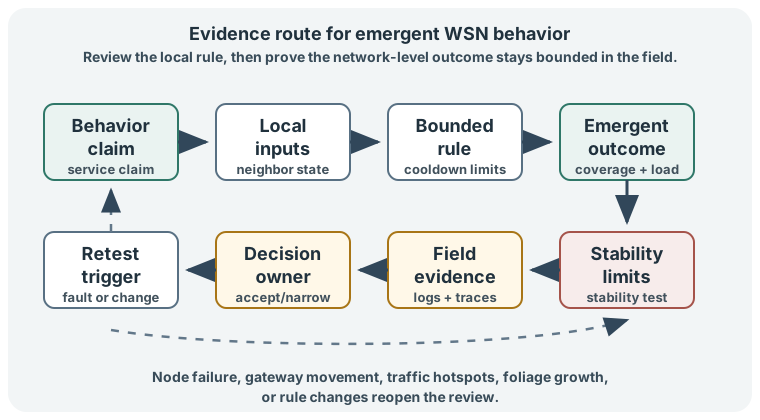
Figure Figure 11.1 begins with a behavior claim and the local inputs a node can see. A bounded rule, including cooldown limits, changes those inputs into an outcome in coverage or load. Stability checks ask whether the outcome settles or stays within accepted limits. Field logs and route traces then support an accept or narrow decision with an owner. Node failure, gateway movement, traffic hotspots, foliage growth, and rule changes reopen that decision. This route makes a self-organizing claim testable: the team can point to the rule, the network effect, and the evidence that would reject it.
The route is a loop because emergent behavior can change when nodes fail, wake schedules change, foliage grows, a gateway moves, or a traffic hotspot appears. A local rule that was stable in one operating state can oscillate or partition the network in another.
11.6 Local Rules That Matter in WSNs
This section: Local Rules That Matter in WSNs — Swarm behavior is not limited to moving robots.
Swarm behavior is not limited to moving robots. In a WSN, local rules may change sampling, radio power, duty cycle, relay choice, cluster membership, or repair state.
These rules are useful because they do not require every node to know the whole network. They also create review risk because local evidence can be stale, partial, or misleading.
11.6.1 Stigmergic Routing Pattern
One concrete WSN swarm pattern is stigmergy: nodes coordinate indirectly by updating local traces that other nodes later read. Ant-colony routing uses this idea with virtual pheromone rather than a biological trail.
- Small control packets explore candidate paths toward a sink or gateway.
- A node increases the local preference for links that recently delivered traffic with acceptable delay, energy cost, queue state, or link quality.
- Forwarding remains probabilistic, so the network can use a strong path without completely hiding alternatives.
- Pheromone values decay, so stale paths fade when a relay fails, a link degrades, or a better path appears.
The review should translate the biology into measurable node state. A pheromone value might mean recent delivery success, link margin, queue delay, remaining energy, or a weighted score. The record should say where the value is stored, how old it may be, how quickly it decays, and how a sleeping or rebooted node recreates enough state to behave safely.
11.7 What Each Node Must Know
This section: What Each Node Must Know — A swarm rule is only as good as the signals that drive it.
A swarm rule is only as good as the signals that drive it. The reviewer should inspect whether each node can actually observe the conditions used by the rule.
If the local signal is weak, the swarm outcome is weak. A node cannot safely infer coverage, connectivity, or event severity from a single noisy signal unless the review record states the uncertainty and fallback.
11.8 Emergence Needs Boundaries
This section: Emergence Needs Boundaries — Emergent behavior should be reviewed as bounded adaptation.
Emergent behavior should be reviewed as bounded adaptation. The local rule should say what a node may change and what it may not change.
Boundaries keep a useful swarm rule from becoming uncontrolled behavior. A node should not save energy by silently dropping an alarm path, hiding repeated queue loss, or disconnecting a required coverage region.
11.9 IoT Boundary and Gateway Evidence
This section: IoT Boundary and Gateway Evidence — Swarm-style WSN behavior often sits inside a broader IoT system.
Swarm-style WSN behavior often sits inside a broader IoT system. The review should separate local autonomy from gateway custody, cloud oversight, and command authority.
The boundary keeps swarm coordination reviewable after it becomes part of an IoT platform workflow.
Use the visual in Figure 11.2 to test IoT Boundary and Gateway Evidence. Its Field nodes and state labels anchor the evidence behind IoT Boundary and Gateway Evidence in named system parts.
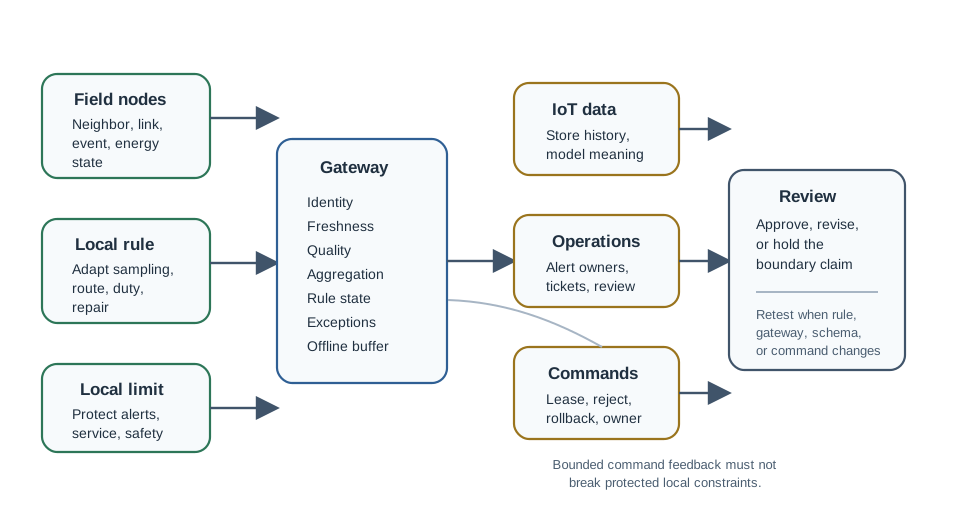
Figure Figure 11.2 follows a greenhouse node that may lower duplicate trend sampling when nearby readings agree. The node checks freshness, calibration, and neighbor connection before acting. The gateway keeps the rule version, node state, degraded labels, missing-neighbor signals, and reason for the local change. Cloud review can audit trends and tune approved limits, but the figure protects alarm sampling and minimum reporting freshness. Command ownership covers who may change a rule, when it expires, and how rollback works. This path lets operators review a local action without losing the safety and coverage limits that bound it.
11.10 Convergence and Stability Checks
This section: Convergence and Stability Checks — A swarm-style design should not be accepted only because a simulation looks organized.
A swarm-style design should not be accepted only because a simulation looks organized. The reviewer needs evidence that the rule settles into an acceptable operating state or remains bounded while conditions change.
Ask these checks during review:
Does the behavior converge, or does it keep changing without improving the claim? Does one node’s response trigger repeated opposite responses from neighbors? Does the rule create unfair work for relays, cluster heads, edge nodes, or nodes near a gateway? Does the network remain connected while local adjustments happen? Does the coverage claim remain true in the active duty state, not only in an all-awake diagram? Does the rule expose a degraded state when it cannot repair the condition? Does the record say which change requires retesting?
Convergence does not need to mean every value is fixed forever. It can mean the behavior stays inside accepted bounds and reports when it leaves those bounds.
11.10.1 Pheromone Evaporation and Tuning
Evaporation is the part of ant-colony routing that makes old evidence fade. Without it, the first good path can accumulate preference forever, even after a node dies, a gateway moves, or a better route appears. With decay, a path must keep being reinforced by successful traffic to stay attractive.
This creates the central tuning trade-off: exploitation follows strong evidence, while exploration tries weaker alternatives often enough to discover repairs. Too much exploitation locks the network onto stale paths. Too much exploration wastes energy and prevents routes from settling.
| Tuning choice | Review question | Failure if wrong |
|---|---|---|
| Evaporation or decay rate | How quickly does stale route evidence lose influence? | Too slow locks in broken routes; too fast forgets useful paths. |
| Reinforcement amount | What evidence is allowed to raise preference? | A poor metric rewards noisy, congested, or energy-expensive paths. |
| Exploration probability | How often may nodes try a weaker path? | Too high causes churn; too low hides repair options. |
| Damping, cooldown, maximum change | Can one local response trigger repeated opposite responses? | Missing bounds turn local correction into network oscillation. |
The implementation record should include the update interval, decay rule, maximum action per interval, fallback for missing neighbor state, and protected constraints checked before a local action is accepted.
11.11 Knowledge Check: Pheromone Evaporation
This section: Knowledge Check: Pheromone Evaporation
11.12 Swarm Behavior Evidence Record
This section: Swarm Behavior Evidence Record — What must survive the move from expected outcome to Local Inputs?
What must survive the move from expected outcome to Local Inputs? The visual at Figure 11.3 poses that question for the current swarm behavior evidence record decision.
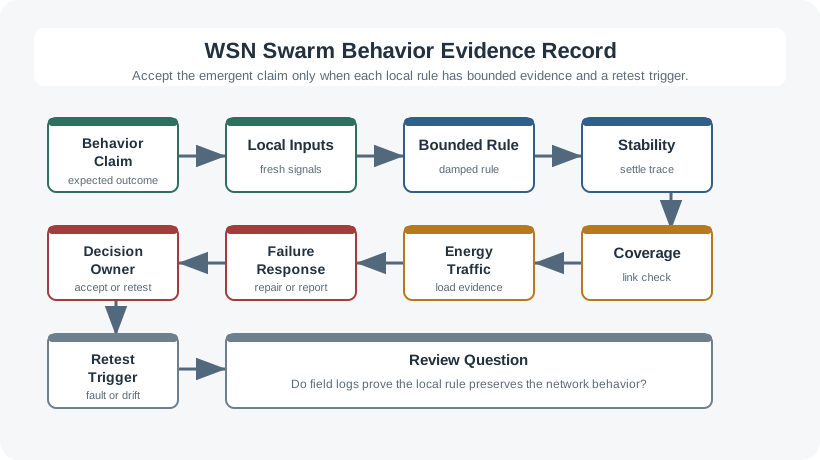
Begin with the Local Inputs label in Figure 11.3, noting that it establishes the starting condition. Look backward to expected outcome, which adds a distinct review condition, and forward to fresh signals, which sets the timing constraint. This reveals why wSN swarm behavior evidence record from behavior claim through local inputs, bounded rule, evidence checks, decision owner, failure response, and retest trigger. The visual therefore advances swarm behavior evidence record, rather than interrupting it.
Claim: State the network behavior that should emerge and the reason it matters.
Inputs: List the local signals each node uses and how stale, noisy, missing, or conflicting signals are handled.
Rule: Describe the action, bounds, damping, cooldown, and protected constraints.
Evidence: Attach field or test logs for convergence, coverage, connectivity, energy, traffic, and failure response.
Decision: Accept, narrow, reject, or retest the swarm claim with an owner and trigger.
The record should be readable by deployment and operations teams. If a later fault occurs, they should know whether the swarm rule was expected to repair it, report it, or leave it to maintenance.
11.13 Dense Greenhouse Monitoring
This section: Dense Greenhouse Monitoring — A greenhouse team wants nodes to reduce duplicate temperature sampling in dense areas.
A greenhouse team wants nodes to reduce duplicate temperature sampling in dense areas. The proposed rule says each node lowers its sampling rate when it hears many nearby nodes reporting similar values.
Review the claim:
Finding: the rule is acceptable only if alarm sampling is excluded from the reduction rule and stale neighbor data does not suppress a local reading. The evidence record should include the minimum active reporting path and the retest trigger after node relocation or seasonal layout changes.
11.14 Worked Review: Relay Hotspot Relief
This section: Worked Review: Relay Hotspot Relief — A bridge monitoring WSN shows a relay near the gateway forwarding too much traffic.
A bridge monitoring WSN shows a relay near the gateway forwarding too much traffic. The team proposes a local load-response rule: a relay that sees sustained queue pressure advertises a weaker preference so nearby nodes choose alternate parents when available.
Review the claim:
Finding: the swarm-style response is useful, but it does not replace capacity planning. If all alternate relays are weak, the correct outcome is a degraded-service signal and maintenance action, not hidden route churn.
11.15 Common Swarm Review Mistakes
This section: Common Swarm Review Mistakes
11.16 Review Checklist
This section: Review Checklist — Use this checklist before accepting a WSN swarm behavior claim.
Use this checklist before accepting a WSN swarm behavior claim.
11.17 Knowledge Check: Swarm Claim Evidence
This section: Knowledge Check: Swarm Claim Evidence
11.18 Knowledge Check: Instability Risk
This section: Knowledge Check: Instability Risk
11.19 Matching: Swarm Review Evidence
This section: Matching: Swarm Review Evidence
11.20 Ordering: Swarm Behavior Review
This section: Ordering: Swarm Behavior Review
11.21 Summary
This section: Summary — Emergent swarm behavior in WSNs is useful when local rules produce a reviewable network behavior: balanced density, protected connectivity, adaptive sampling, hotspot relief, gap response, or recovery signaling.
Emergent swarm behavior in WSNs is useful when local rules produce a reviewable network behavior: balanced density, protected connectivity, adaptive sampling, hotspot relief, gap response, or recovery signaling. The key review question is not whether the behavior is inspired by a swarm model. The question is whether the local rule has trustworthy inputs, bounded actions, protected constraints, stability evidence, and an operational response when the rule cannot preserve the claim.
Good swarm reviews avoid overclaiming. They do not promise universal optimality, guaranteed energy savings, or automatic self-healing. They record what the rule is allowed to change, what it must not break, what evidence proves success, and what condition requires retesting.
11.22 Key Takeaway
This section: Key Takeaway — Emergent Swarm Behavior in WSNs should evaluate swarm behavior through local rules, emergent effects, stability, failure response, observability, and deployment evidence.
Emergent Swarm Behavior in WSNs should evaluate swarm behavior through local rules, emergent effects, stability, failure response, observability, and deployment evidence.
11.23 Concept Relationships
This section: Concept Relationships — Swarm behavior depends on Sensor Node Characteristics because each node must observe, compute, store, and report the local evidence used by the rule.
Swarm behavior depends on Sensor Node Characteristics because each node must observe, compute, store, and report the local evidence used by the rule. Swarm behavior affects Communication Paradigms because local forwarding, aggregation, and downlink choices can change traffic shape. Swarm behavior connects to Coverage Fundamentals because local adaptation must preserve the accepted sensing and delivery claim. Swarm behavior can support Mobile Coverage Optimization, but mobility needs route, recharge, safety, localization, and maintenance evidence.
11.24 What’s Next
This section: What’s Next — Sensor Node Characteristics for the local node evidence that swarm rules depend on.
Continue with these chapters when you need deeper context:
Sensor Node Characteristics for the local node evidence that swarm rules depend on. Communication Paradigms for traffic flows affected by local adaptation. WSN Coverage Fundamentals for checking whether adaptation preserves the coverage claim. Human-Centric Sensing for the next WSN tracker chapter and mobility-driven sensing context.
Find help
3 reviewed answers.
Where should I start in a module?
Open the module page from the sidebar to see its chapters in order. Use the module map to return to a topic you need.
Modules and pathsReviewed
What can I try when a project does not work?
Check the symptom, then work through the diagnostic steps. Keep the error message and the smallest example that reproduces it.
When you are stuckReviewed
How do interactive examples work?
Use the interactive guide to check how examples and simulations work before changing your project.
Interactive examples guideReviewed