49 WSN Trickle Dissemination

More
Depth: Practitioner
Progress saves as you read. Mark sections complete as you go; your progress appears in the sidebar.
49.1 Start With the Field Story
This section: Start With the Field Story — Picture a set of small nodes that all hear the same update.
Picture a set of small nodes that all hear the same update. If each one speaks at once, the shared radio fills with copies.
First, record the time span, what counted as the same news, and why a node spoke or stayed quiet. A silent node may be saving work, not missing data.
Fast repeats can spread change, yet they spend power and airtime. Slow repeats save both, yet they can leave old state in place for longer.
That is the simple story, but it does not prove every timer or reset. The later timelines and limits show when the rule holds.
Use the Practitioner sections to review a real update trace.
Plain check
- Name the shared news. Mark its version. Mark the first time. Mark the last time.
- Count what each node heard. Count what each node sent. Note each quiet choice. Note each reset.
- Test a calm period. Test a new update. Test one lost copy. Test one late node.
- Watch radio use. Watch battery use. Watch old state. Keep those costs together.
- Save the timer bounds. Save the quiet rule. Name the test owner. Set the next test.
- Use Practitioner to review. Use deeper timer checks. Test the limit case. Keep claims small.
Trickle saves transmissions by listening for consistency, but consistency must mean the right thing. Start with the state being disseminated, then check suppression, reset triggers, interval growth, version evidence, and operations limits.
49.2 In 60 Seconds
This section: In 60 Seconds — Trickle is a controlled dissemination pattern for low-power wireless networks.
Trickle is a controlled dissemination pattern for low-power wireless networks. A node announces a compact version or route-state summary only when that announcement is likely to add useful information. When nearby nodes already agree, it can stay quiet. When it hears a different version, route state, or repair signal, it returns to a short interval so the new information can spread.
This chapter reviews Trickle as an evidence process, not as a magic low-overhead feature. The review asks what state is being compared, what counts as consistent, what causes a reset, how suppression is bounded, whether stale or partitioned nodes can recover, and what monitoring proves that dissemination or route maintenance is still healthy.
Trickle exists because a long-lived deployment needs retasking — a parameter change, a new binary, a route-maintenance signal — and pushing that update to every node one at a time is rarely practical. That retasking need pulls in two directions at once: while nothing has changed, the maintenance chatter should cost close to nothing, but the moment something does change, the update should still reach every node quickly. A fixed periodic broadcast cannot satisfy both goals with one interval, which is the design pressure the rest of this chapter’s suppression and reset evidence exists to review.
49.3 Learning Objectives
This section: Learning Objectives
By the end of this chapter, you will be able to:
- explain Trickle’s consistency, suppression, interval growth, and reset behavior in WSN terms
- review whether Trickle evidence supports a dissemination or route-maintenance claim
- distinguish version metadata, route-control metadata, payload delivery, and security validation
- identify parameter and topology conditions that make suppression unsafe or noisy
- build a Trickle review record with accepted limits, owner, fallback action, and retest trigger
49.4 WSN Trickle Dissemination
This section: WSN Trickle Dissemination
49.5 Prerequisites
This section: Prerequisites
This chapter builds on WSN Routing Fundamentals Review, WSN Routing Introduction Review, WSN Routing Challenge Review, WSN Routing Protocol Classification Review, WSN Routing Data Aggregation Review, WSN Routing Labs and Exercises Review, and WSN Routing Link Quality Review.
If a learner cannot describe route state, neighbor hearing, acknowledgments, freshness, parent changes, repair behavior, and link-quality evidence, review those chapters before using Trickle to explain dissemination or RPL maintenance behavior.
49.6 Trickle Review Scope
This section: Trickle Review Scope — Trickle review starts with the state being disseminated and the decision that depends on that state.
Trickle review starts with the state being disseminated and the decision that depends on that state.
49.7 Evidence Map
This section: Evidence Map — A useful Trickle evidence review starts with the state key — version, config, or route marker — because suppression only means something when neighbors are comparing the intended metadata.
A useful Trickle evidence review starts with the state key — version, config, or route marker — because suppression only means something when neighbors are comparing the intended metadata. The visual in Figure 49.1 turns that evidence path into the chapter’s worked k = 1 trace.
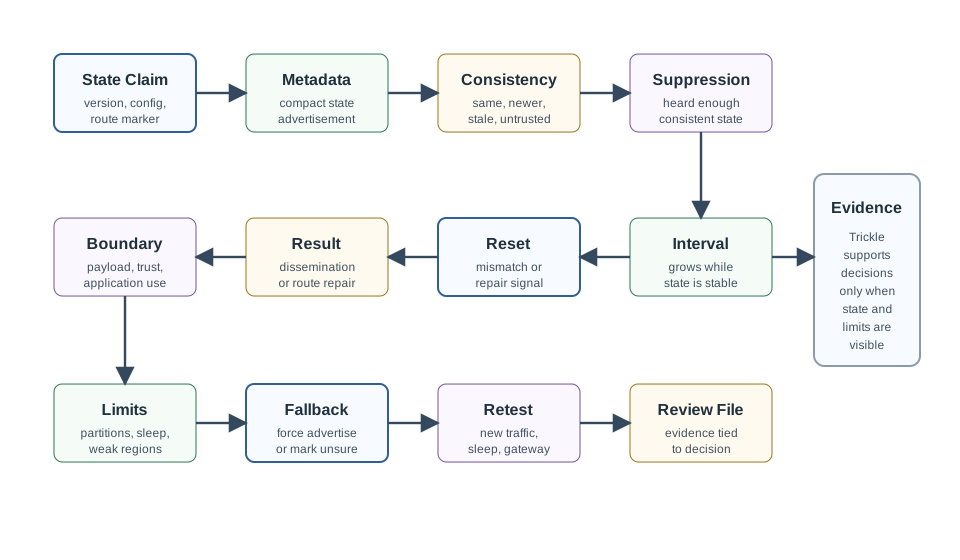
Read Figure 49.1 from the state-key examples into the interval trace. In the worked k = 1 case, hearing one consistent message gives c = 1, so a node suppresses at its own turn. When consistency holds through the interval, the next shown interval grows from I to 2I; a mismatch, repair event, policy change, or operator action returns the node to a short interval. This is timer and suppression evidence, not proof that the heavier payload or route repair completed.
The map prevents a common mistake: treating Trickle as proof that an update, configuration, or route repair succeeded. Trickle can help distribute compact evidence that something changed. The reviewer still needs delivery evidence, validation evidence, and a recovery path for nodes that missed the change.
49.8 What Trickle Can and Cannot Prove
This section: What Trickle Can and Cannot Prove
49.9 Evidence Record
This section: Evidence Record — Before treating the evidence record as settled, inspect one concrete Trickle timer trace.
Before treating the evidence record as settled, inspect one concrete Trickle timer trace. The worked example at Figure 49.2 keeps the timer bounds beside the k = 1 suppression rule, then shows one consistent interval doubling to twice its previous length while redundant transmissions are suppressed.
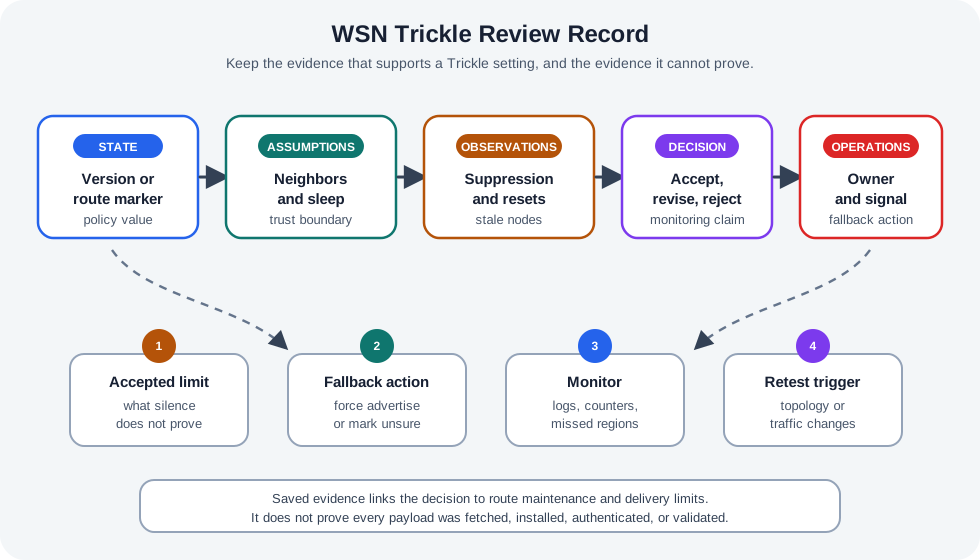
The trace at Figure 49.2 supplies the concrete observations that belong in the record: the interval bounds, the suppression threshold, which node transmitted, which nodes suppressed after hearing consistent evidence, and the mismatch that returns the timer to a short interval. The deployment assumptions and operations limits below still matter; this timer trace does not by itself prove payload delivery, route repair, or global consistency.
State: Record the version, configuration marker, route metadata, or policy value being disseminated.
Assumptions: Record neighbor density, sleep behavior, link evidence, security boundary, payload fetch path, and reset rules.
Observations: Record consistent messages, suppressed sends, reset events, stale nodes, parent changes, and missed regions.
Decision: Accept, revise, or reject the Trickle setting for the monitoring claim and route-maintenance need.
Operations: Name owner, monitoring signal, fallback action, accepted limit, and retest trigger.
49.10 Reviewing Consistency and Suppression
This section: Reviewing Consistency and Suppression — Suppression is useful only when silence still leaves the network observable.
Suppression is useful only when silence still leaves the network observable.
Use this review question: Could a suppressed node be the only useful speaker for part of the deployment? If yes, the review needs topology, link-quality, and missed-region evidence before accepting the suppression behavior.
49.10.1 Worked Timeline: Three Neighbors, Threshold k = 1
A short timeline makes the counter-and-threshold mechanics concrete before the parameter table below turns them into review fields. Take three mutually-neighboring nodes — 1, 2, and 3 — all holding the same consistent state, with suppression threshold k = 1: a node that hears at least one consistent transmission during its interval stays quiet.
First interval. Node 1 transmits early in the interval. Nodes 2 and 3 both hear it, so each has heard one consistent message before its own turn would come up — with k = 1 that is enough evidence to suppress, so neither 2 nor 3 transmits during this interval.
Second interval. The interval doubles in length (no inconsistency reset the timer, so the interval grows), and this time node 2 transmits. Nodes 1 and 3 hear it and, having each heard one consistent message, suppress their own scheduled transmission in turn.
The pattern is suppression: the first node to reach its scheduled transmit time can speak, and neighbors that heard it stay quiet when k = 1. Each node resets its counter and chooses a fresh random transmit time in each interval, so the same node may speak again; Trickle does not enforce turn-taking. This is “polite gossip”: broadcast only when too few consistent messages have already been heard.
The next Worked Timeline: Three Neighbors, Threshold k = 1 step depends on the relationship behind Worked Timeline: Three Neighbors, Threshold k = 1. Read Figure 49.3 first, focusing on Trickle suppression, three mutual neighbors and Node 1.

Figure Figure 49.3 follows three mutual neighbors with threshold k = 1. In the first interval node 1 transmits; nodes 2 and 3 hear one consistent message and suppress their own turns. The next interval doubles, and node 2 speaks while the others suppress. The change in speaker is possible because each node resets its counter and selects a new transmit time; it is not enforced turn-taking. The result depends on mutual hearing. If node 3 misses node 1, its count may stay zero and it may transmit, so the deployment needs reception evidence rather than assuming the drawing’s topology.
This is also where the review question above earns its keep. The timeline above only works because all three nodes are mutual neighbors — each one’s transmission is heard by both others. If node 3 cannot hear node 1, its counter may remain zero and it can transmit at its own scheduled time. The review must then check whether the nodes that depend on node 3 actually hear it; silence or a transmission alone does not prove delivery to a weak area.
Trickle parameters are review promises. Keep them beside the state claim and deployment limits, not as isolated constants.
| Review field | Evidence to capture | Failure it prevents |
|---|---|---|
| State key | Version, DODAG marker, rank summary, configuration marker, or repair flag being compared | Counting agreement about the wrong thing |
| Interval bounds | Minimum and maximum interval, plus why those bounds fit traffic, density, and sleep behavior | Reset bursts that overload the channel or quiet periods that hide stale nodes |
| Threshold k | How many consistent messages justify suppression in this topology and link-quality region | Loud neighbors silencing the only useful speaker for a weak area |
| Counter c | Which messages counted as consistent, with freshness, trust, and direction noted | False agreement from stale, untrusted, or irrelevant metadata |
| Reset cause | The mismatch, repair event, policy change, or operator action that returned the interval to fast announcements | Assuming a reset means the actual payload or route repair succeeded |
49.11 Interval Growth and Resets
This section: Interval Growth and Resets — Trickle tuning is a risk decision.
Trickle tuning is a risk decision. Short intervals make changes more visible but add channel pressure. Long intervals reduce routine announcements but can leave stale or partitioned state visible later.
The reason to inspect Figure 49.4 is Interval Growth and Resets. Its Set I and Listen elements locate the relationship behind Interval Growth and Resets precisely.
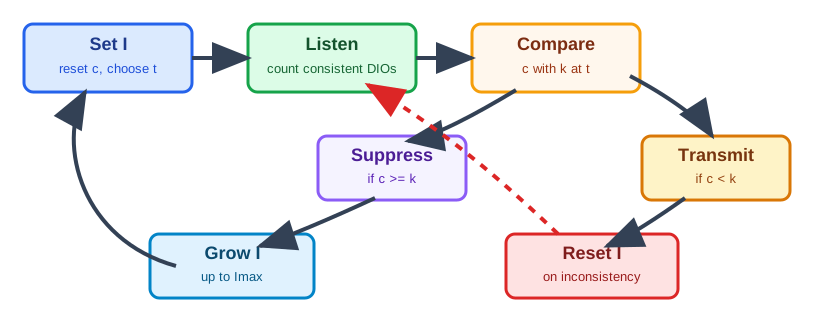
Figure Figure 49.4 shows how Trickle limits routine announcements while remaining ready for change. The node sets interval I, resets its consistency count, and chooses a transmit time. As it listens, consistent DIOs raise the count. At the chosen time it transmits when the count is below k and suppresses when it reaches k. Consistency lets the interval grow; inconsistency resets it. Those steps make minimum and maximum intervals review promises: a short reset can add channel load, while a long quiet interval can delay visible state. The section asks for trace evidence under burst, failure, and recovery conditions.
The reviewer should reject settings that are justified only by formula examples. The accepted record must show the monitored workload, topology, link quality, reset cause, and fallback behavior.
49.12 Payload, Security, Route Limits
This section: Payload, Security, Route Limits — Trickle often advertises metadata.
Trickle often advertises metadata. The expensive or high-risk operation usually happens after the metadata exchange.
49.13 Building Configuration Update
This section: Building Configuration Update — Scenario: A building WSN needs to distribute a new sampling policy for room sensors while keeping alarm reporting reliable.
Scenario: A building WSN needs to distribute a new sampling policy for room sensors while keeping alarm reporting reliable.
State: Sampling-policy version and effective time, not the sensor readings themselves.
Assumptions: Nodes can hear local neighbors, border routers can detect stale policy markers, and alarm traffic has priority over maintenance chatter.
Evidence: Version advertisements, suppression counters, reset events after policy mismatch, nodes that fetched and applied the policy, stale-node list, and alarm-path health during rollout.
Decision: Accept Trickle settings only if suppressed messages do not hide rooms, alarm reporting remains healthy, and stale policy markers are visible to operations.
Fallback: Pause rollout, force a controlled maintenance advertisement, or mark rooms uncertain until their applied policy is confirmed.
Route-maintenance messages are only useful when the selected path has credible bidirectional delivery, which Figure 49.5 makes calculable.

Read Figure 49.5 from DIRECTER · 2 HOPS to RELIABLE · 3 HOPS. The change from PATH = 4.58 to PATH = 3.36 explains why Trickle suppression and reset evidence cannot rely on hop count alone: the DIO path also needs current forward and reverse delivery evidence.
49.14 Worked Review: RPL Route Maintenance
This section: Worked Review: RPL Route Maintenance — Scenario: A low-power mesh uses RPL, and DIO advertisements are paced by Trickle while nodes occasionally change parents after link degradation.
Scenario: A low-power mesh uses RPL, and DIO advertisements are paced by Trickle while nodes occasionally change parents after link degradation.
State: RPL instance, DODAG version or repair state, rank, parent evidence, and freshness marker.
Assumptions: Parent changes and local repairs create visible inconsistency, but routine stable periods should not flood the channel.
Evidence: DIO interval state, reset events after repair, parent-change logs, route traces before and after repair, link-quality evidence, and missed-child visibility.
Decision: Accept the behavior only if route repairs are visible, loops are not suggested by traces, and quiet periods do not mask stale parent state.
Fallback: Investigate weak links, adjust repair visibility, isolate noisy reset causes, or retest parent selection under the same workload.
The timer loop can show that compact metadata was paced efficiently. It does not prove that a firmware image was fetched, a configuration was applied, a route repair converged, or stale children recovered. Those outcomes need their own delivery, validation, route, and operations evidence.
49.15 Common Mistakes
This section: Common Mistakes
49.16 Review Checklist
This section: Review Checklist — state being disseminated and the decision that depends on it.
Before accepting Trickle behavior, verify that the record includes:
state being disseminated and the decision that depends on it. consistency rule, freshness rule, trust boundary, and version handling. suppression threshold evidence under expected neighbor density and link quality. interval growth and reset evidence under stable and changing conditions. payload, route, security, and application boundaries. stale-node, missed-region, partition, and sleepy-node visibility. accepted limits, owner, fallback action, monitoring signal, and retest trigger.
49.17 Knowledge Check: Trickle Evidence
This section: Knowledge Check: Trickle Evidence
49.18 Knowledge Check: Reset Risk
This section: Knowledge Check: Reset Risk
49.19 Knowledge Check: Suppression Coverage
This section: Knowledge Check: Suppression Coverage
49.20 Match Trickle Evidence to Review Meaning
This section: Match Trickle Evidence to Review Meaning
49.21 Order a Trickle Review
This section: Order a Trickle Review
49.22 Summary
This section: Summary — Trickle is a disciplined way to reduce redundant WSN control chatter while still reacting to state changes.
Trickle is a disciplined way to reduce redundant WSN control chatter while still reacting to state changes. It is best reviewed as a local evidence loop: nodes compare compact metadata, suppress redundant announcements when enough neighbors agree, grow intervals during stable periods, and reset when inconsistency appears.
The quality of a Trickle decision depends on what the review can prove. Strong review connects version or route metadata to consistency rules, suppression evidence, interval behavior, reset triggers, stale-node visibility, payload or route boundaries, operations ownership, and retest conditions.
49.23 Key Takeaway
This section: Key Takeaway — WSN Trickle Dissemination Review should balance path reliability, link quality, energy cost, latency, aggregation, topology change, control overhead, and deployment evidence.
WSN Trickle Dissemination Review should balance path reliability, link quality, energy cost, latency, aggregation, topology change, control overhead, and deployment evidence.
49.24 Concept Relationships
This section: Concept Relationships
49.25 What’s Next?
This section: What’s Next?
Continue with WSN Routing Introduction Review to connect Trickle with the wider routing chapter family, then revisit WSN Routing Link Quality Review, WSN Routing Labs and Exercises Review, and Trickle: Timing RPL Messages when route-maintenance behavior needs protocol-specific review.
Find help
3 reviewed answers.
Where should I start in a module?
Open the module page from the sidebar to see its chapters in order. Use the module map to return to a topic you need.
Modules and pathsReviewed
What can I try when a project does not work?
Check the symptom, then work through the diagnostic steps. Keep the error message and the smallest example that reproduces it.
When you are stuckReviewed
How do interactive examples work?
Use the interactive guide to check how examples and simulations work before changing your project.
Interactive examples guideReviewed