23 Wireless Multimedia WSN Tracking

More
Depth: Practitioner
Progress saves as you read. Mark sections complete as you go; your progress appears in the sidebar.
23.1 Start With the Field Story
This section: Start With the Field Story — Bandwidth is how much data a link can carry in a set time.
Bandwidth is how much data a link can carry in a set time. A camera clip needs far more of it than one temperature reading. That is why a rich view can help a track while also raising power, privacy, and storage costs.
Picture a quiet store room with many simple motion sensors and a few cameras. A motion sensor sees a small change and wakes the nearest camera. The camera records a short clip. The system then decides whether the clip supports an alert.
Keep each step distinct. A trigger says that something may have happened. A capture is the image, sound, or clip that was saved. A detection is a model’s claim about that media. A track links signs thought to come from the same target over time.
The record must keep the trigger time, capture time, source, media quality, model result, and handoff path. It must also show what was blurred, cut, delayed, or dropped. A user should be able to tell live proof from old or uncertain proof.
Event-driven capture can save power and link use, but only when missed triggers and false triggers are measured. A camera that wakes late may miss the target. A camera that wakes too often may drain its battery or collect more private data than planned.
This Overview uses a simple trigger-then-capture path. Real sites may use many views, sound, edge models, or handoffs between cameras. The Practitioner section maps those cases. Under the Hood keeps track of direction, time, custody, privacy, and doubt.
Run a simple field check. Walk through the watched area in light and dark. Approach from more than one side. Move fast and slow. Save when the first sensor fired, when the camera woke, and what part of the event was caught.
Now cause harmless false triggers. Move a curtain. Change the light. Play a loud sound if sound is in scope. Record which signs wake the rich sensor and how the system stops a false alert.
Cut the link after capture. The source copy, sent copy, and stored copy should have clear times and owners. A user should not see an old clip marked as live. A private clip should not move beyond the stated path.
End with the known gap. Name the place, target, weather, light, lens, model, and staff cover that were tested. Do not claim the same result for a case the test did not include.
Set a clear rule for keeping media. Save only what the job needs. State who may see it and when it must be removed. Keep a log when a clip is viewed, changed, sent, or cut.
Give staff a way to challenge a bad alert. Let them mark a false match, missed target, late clip, or poor view. Keep the note with the model and site facts so the next test can use it.
Plan the no-media case. If the camera is blocked or off, the system may still have a simple trigger. Mark that result as weak. Do not show it as if a clear image or sound had been checked.
Multimedia tracking raises the cost of being wrong. A camera, microphone, or image node may collect richer evidence, but it also creates bandwidth, power, privacy, and custody obligations that a simple scalar sensor does not.
That extra cost is architectural, not incidental. A WMSN deployment is rarely built entirely from camera-class nodes. It typically mixes a small number of expensive, power-hungry, directional camera-sensor (CS) nodes with a much larger number of cheap, omnidirectional scalar-sensor (SS) nodes that report ordinary readings such as temperature, light, or vibration. The scalar nodes cannot resolve fine-grained detail on their own, so a common pattern wakes a nearby camera node only when a scalar trigger suggests it is worth paying the camera’s bandwidth and power cost — which is exactly the trigger-then-capture evidence chain this chapter reviews below. Because camera coverage is directional and expensive to keep active, placement and wake decisions for CS nodes are often treated as their own coordination problem, separate from the SS layer’s coverage, so that the few camera nodes actually watch the region a scalar trigger just flagged instead of an arbitrary fixed direction.
Wireless multimedia tracking is a specialized WSN vertical where a tracking claim depends on both sensor events and media evidence. The review question is not whether cameras or microphones add useful context. It is whether trigger evidence, capture conditions, media custody, processing rules, bandwidth limits, and privacy boundaries remain visible when a multimedia record becomes a track, alert, or historical event.
This chapter treats WMSN tracking as an evidence review problem. It avoids universal claims about power savings, bandwidth reduction, recognition accuracy, field cost, or camera performance. Those results depend on scene design, lighting, lens placement, target behavior, trigger tuning, processing model, storage policy, gateway path, and operations staffing.
23.2 In 60 Seconds
This section: In 60 Seconds — Multimedia tracking should name the evidence type: scalar trigger, image, clip, audio segment, detection metadata, track estimate, or gateway summary.
Multimedia tracking should name the evidence type: scalar trigger, image, clip, audio segment, detection metadata, track estimate, or gateway summary. A camera or microphone observation is not automatically a current track. Trigger timing, capture window, media quality, and custody must survive handoff. Event-driven activation helps only when false triggers, missed triggers, wake latency, coverage gaps, and fallback behavior are reviewed. Media processing must label what was directly captured, what was inferred, what was discarded, and what requires human or secondary confirmation. Release readiness needs visible labels for current, delayed, ambiguous, degraded, privacy-limited, historical, and retired records.
23.3 Learning Objectives
This section: Learning Objectives
By the end of this chapter, you will be able to:
- Review multimedia tracking claims without turning camera presence into proof.
- Identify trigger, capture, media-quality, processing, custody, bandwidth, and retention evidence.
- Separate event detection, media capture, classification, track association, and operations labels.
- Evaluate multimedia tracking scenarios for false triggers, missed capture, stale uploads, privacy limits, and degraded state.
- Build a release gate checklist for WMSN tracking chapters, labs, and prototypes.
23.4 Multimedia WSN Tracking Review
This section: Multimedia WSN Tracking Review
23.5 Multimedia Tracking Claim
This section: Multimedia Tracking Claim
Start with a claim that states what the media evidence can prove:
Multimedia tracking claim: The system can detect and report a specified target, event, asset, or scene state for a stated decision while preserving trigger evidence, capture conditions, media custody, processing assumptions, bandwidth limits, privacy boundaries, and operating labels.
That claim is intentionally narrower than “video confirms the target.” A media frame, clip, or audio segment can support a tracking record only when the system shows how it was triggered, captured, processed, stored, and handed to the decision layer.
23.6 Multimedia Evidence Map
This section: Multimedia Evidence Map — A useful review of multimedia evidence map needs both trigger and motion, sound, in view.
A useful review of multimedia evidence map needs both trigger and motion, sound, in view. The visual in Figure 23.1 places them on one evidence path so an attractive partial result is not mistaken for acceptance.
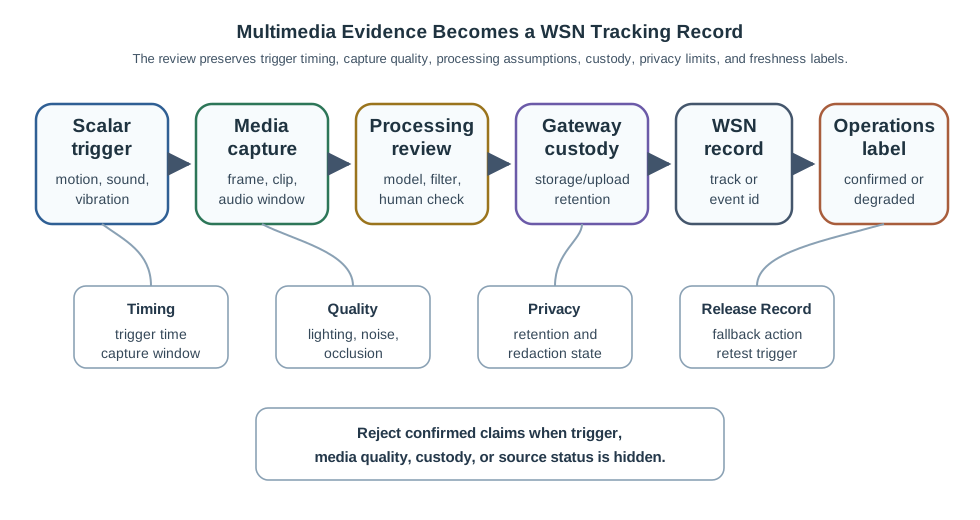
Start the figure at Figure 23.1 with trigger and ask how it establishes the starting condition. Against it, motion, sound, adds a distinct review condition; the later vibration adds a distinct review condition. The ordering is consequential: Wireless multimedia tracking evidence map showing scalar trigger, media capture, processing review, gateway custody, WSN tracking record, and operations label with timing, quality, privacy, fallback, and retest evidence. Carry that ordering into the next multimedia evidence map review.
The map separates the trigger from the captured media and from later processing. This prevents a dashboard marker from hiding whether the system saw the target, inferred the target, or merely received a low-confidence event.
23.7 Trigger and Capture Review
This section: Trigger and Capture Review — WMSN tracking often uses a low-cost trigger to decide when to wake a camera or microphone.
WMSN tracking often uses a low-cost trigger to decide when to wake a camera or microphone. A review should focus on the evidence consequences of that activation policy.
The review should reject any design that says “camera confirms” without showing trigger timing, capture quality, and coverage evidence.
23.8 Media Quality and Custody
This section: Media Quality and Custody — Media evidence has a chain of custody.
Media evidence has a chain of custody. It may be captured locally, compressed, summarized at the edge, redacted, uploaded later, or discarded by retention policy.
If source media is unavailable, the record can still be useful, but it should be labeled as summarized, historical, privacy-limited, or non-auditable.
23.9 Bandwidth and Processing Boundaries
This section: Bandwidth and Processing Boundaries — Multimedia evidence can overwhelm low-power links and gateways.
Multimedia evidence can overwhelm low-power links and gateways. A good chapter reviews what was filtered before transmission and what that filtering means for tracking.
The safest multimedia record says what was captured and what was intentionally not captured.
23.10 Topology Management by Coalition Formation
This section: Topology Management by Coalition Formation — The coalition objective becomes concrete on a field map.
The coalition objective becomes concrete on a field map. Figure 23.2 places scalar triggers, directional cameras, alternative relay paths, and the control centre around one wildlife event.

In Figure 23.2, C1 offers 92% FOV but depends on relay R2 at 24% energy. C2 offers 78% FOV, a 1.1 Mbit/s stream, and the healthier R3–R5 route. The scored choice therefore selects C2 only after coverage and connectivity both pass; the lost field of view is 92% - 78% = 14 percentage points. The record then bounds that trade with bitrate, expiry, queue, quality, and rotation thresholds so the temporary coalition cannot silently become a permanent drain on the same relays.
A multimedia WSN cannot keep every camera awake and streaming merely because an event exists. Camera-sensor (CS) nodes have directional fields of view and expensive video payloads; scalar-sensor (SS) nodes are cheaper, often omnidirectional, and can provide early event evidence or low-cost relaying. Topology management selects a temporary coalition of both types that covers the event and preserves a path to the control centre without consuming the whole network.
Represent candidate node with sensing coverage , communication neighbors , residual energy , and expected task cost if coalition is formed. A reviewable coalition must satisfy two hard constraints:
Let be the set of camera-sensor nodes.
Coverage alone can select a camera whose video has no route. Connectivity alone can select relays that never observe the event. The selection therefore optimizes only among coalitions that satisfy both. One useful objective is
where coverage and media quality provide benefit, the normalized energy term penalizes draining weak nodes, and penalizes predicted queue or link pressure from large media payloads. The weights express an application decision; they are not universal protocol constants.
Build the coalition step by step:
- Trigger locally. SS detections create an event location, time window, and confidence rather than waking every camera.
- Discover candidates. Nearby CS nodes advertise field of view, orientation, media capability, residual energy, and route evidence; possible SS relays advertise reach and load.
- Seed coverage. Select a camera or camera set that observes the event with the required angle, overlap, and quality.
- Close connectivity. Add relay nodes until every selected media source has a current path to the gateway.
- Test deviations. A node joins or leaves only when the new coalition improves its utility while hard coverage and connectivity constraints remain true. Distributed merge-and-split or best-response updates can implement this test without a central solver.
- Schedule and bound. Assign capture windows, bitrate or feature-extraction limits, relay duty, buffer limits, and a coalition expiry time.
- Rotate or dissolve. Re-form the coalition when the event moves, a route breaks, quality falls, or an energy threshold is crossed; dissolve it when the evidence window closes.
The game is useful only if its result is observable. Record which nodes proposed and joined, why alternatives were rejected, the coverage and path proof, video bitrate, queue state, energy before and after, membership changes, and the fallback when no feasible coalition exists. A failed formation should narrow the label to trigger-only, partial coverage, or delayed media—not silently claim a connected video track.
23.11 Gateway Handoff Review
This section: Gateway Handoff Review — The gateway is where trigger evidence, media evidence, processing output, and operations labels become one WSN record.
The gateway is where trigger evidence, media evidence, processing output, and operations labels become one WSN record.
Gateway input: Trigger id, media node id, capture window, quality flags, processing state, privacy state, and local buffer state.
Translation rule: Association rule, confidence threshold, compression or summary rule, discarded evidence, and retention rule.
Output record: Track id or event id, lifecycle label, freshness, confidence, source-media status, privacy boundary, and operator-facing limit.
Fallback state: Request confirmation, mark ambiguous, keep local media, widen sensor activation, hold decision, redact, or retire the track.
Gateway handoff is incomplete if the output only says “visual confirmation.” It must also say what was captured, what was inferred, what is auditable, and when the record stops supporting the claim.
23.12 Multimedia Evidence Timelines
This section: Multimedia Evidence Timelines — A multimedia track is assembled across several timelines that can drift apart.
A multimedia track is assembled across several timelines that can drift apart. A scalar trigger can occur before the camera wakes. Capture can begin after the important scene moment. Processing can finish after the operator decision window. Upload can arrive long after the event.
| Timeline | Evidence that must survive | Honest label when weak |
|---|---|---|
| Trigger timeline | Trigger source, threshold, debounce rule, timestamp, confidence, and false-trigger context | Possible event or trigger-only |
| Capture timeline | Wake time, field of view, pre-event buffer, capture window, media quality, and missed-start risk | Missed capture or degraded media |
| Processing timeline | Compression, inference, human review, discarded media, confidence, and inferred labels | Model-inferred or review-required |
| Custody timeline | Local storage, upload time, redaction, retention, source-media availability, privacy boundary, and auditability | Summary-only, privacy-limited, delayed, or historical |
This separation matters because each timeline can make a different release label honest. A trigger without capture is a possible event, not a media-confirmed track. A capture without source custody is summarized or non-auditable. A detection without review can be model-inferred, not confirmed.
23.13 Handoff Audit Classes
This section: Handoff Audit Classes — A WMSN record changes evidence type several times: scalar event to media capture, media capture to processed result, processed result to gateway record, and gateway record to operations label.
A WMSN record changes evidence type several times: scalar event to media capture, media capture to processed result, processed result to gateway record, and gateway record to operations label. Most review mistakes happen at those changes.
| Handoff | Evidence that must survive | Failure label |
|---|---|---|
| Trigger to capture | Trigger source, threshold, timestamp, wake latency, field of view, and missed-start risk | trigger-only |
| Capture to process | Capture window, quality flags, occlusion, compression, discarded frames, and source-media status | degraded media |
| Process to gateway | Model or human-review state, confidence, category limits, retained evidence, and upload time | model-inferred |
| Gateway to operations | Retention rule, redaction state, privacy boundary, auditability, owner, and decision scope | privacy-limited or historical |
Confirmed should not be the default label. Confirmed means the handoff chain supports the decision at the required quality and time. If one handoff is weak, choose the narrower label that tells the truth.
23.14 Try It: Sensor Handoff Timing
This section: Try It: Sensor Handoff Timing — Sensor-to-sensor handoff is one place where the audit language becomes concrete.
Sensor-to-sensor handoff is one place where the audit language becomes concrete. A tracking record can lose evidence when the next sensor wakes late, coverage overlap is too short, or the target moves through a gap before context is transferred.
Audit class is also the bridge between engineering and privacy. Redaction or retention may be mandatory, and the chapter should not imply that keeping every clip forever is the quality answer. The quality answer is to make the retained evidence class explicit so operations can still make a bounded decision without pretending the missing media is available.
23.15 Knowledge Check: Audit Class
This section: Knowledge Check: Audit Class
23.16 Release Gates
This section: Release Gates — To challenge Release Gates, examine the visual at Figure 23.3.
To challenge Release Gates, examine the visual at Figure 23.3. Its Wireless Multimedia WSN Tracking Release Gates and Claim Fit labels reveal Release gates for wireless multimedia WSN tracking.
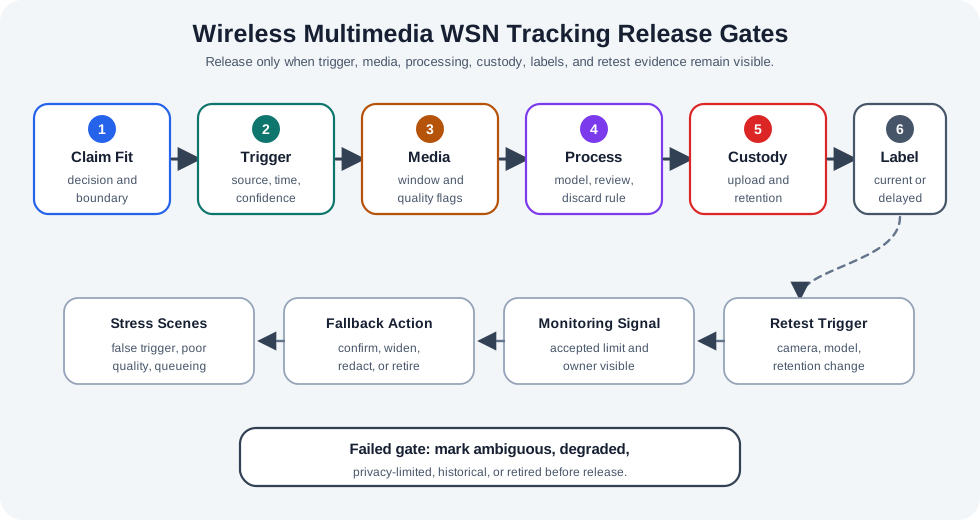
Figure Figure 23.3 separates a feasible camera route from a confirmed animal track. Its field map selects a camera after coverage and link checks. Yet the release case still fails: one trigger has no frame of the target. Another upload arrives after the event. Neither should appear as a current confirmed track. The record must keep capture window, field of view, lighting, source status, classification confidence, and retention rule. A revised release can label missed capture, delayed upload, and low-confidence results separately. This keeps network feasibility from upgrading weak media evidence into a stronger claim.
Release gates should test the full route from trigger to media evidence to system-level decision.
23.17 Worked Review: Wildlife Camera Corridor
This section: Worked Review: Wildlife Camera Corridor — A remote corridor uses motion and acoustic triggers to wake nearby cameras and record possible wildlife movement.
A remote corridor uses motion and acoustic triggers to wake nearby cameras and record possible wildlife movement.
23.18 Worked Review: Facility Perimeter Video
This section: Worked Review: Facility Perimeter Video — A facility perimeter uses scalar sensors to wake cameras and sends edge summaries to a monitoring console.
A facility perimeter uses scalar sensors to wake cameras and sends edge summaries to a monitoring console.
23.19 Structural Inspection Snapshot
This section: Structural Inspection Snapshot — A bridge or tunnel sensor detects vibration change and requests a snapshot from a nearby camera.
A bridge or tunnel sensor detects vibration change and requests a snapshot from a nearby camera.
23.20 Common Multimedia Tracking Mistakes
This section: Common Multimedia Tracking Mistakes
23.21 Readiness Checklist
This section: Readiness Checklist — Before approving a multimedia tracking chapter, lab, or prototype review, verify these items.
Before approving a multimedia tracking chapter, lab, or prototype review, verify these items.
23.22 Knowledge Check: Trigger Evidence
This section: Knowledge Check: Trigger Evidence
23.23 Knowledge Check: Media Custody
This section: Knowledge Check: Media Custody
23.24 Match Multimedia Evidence
This section: Match Multimedia Evidence
23.25 Order Multimedia Evidence
This section: Order Multimedia Evidence
23.26 Summary
This section: Summary — Wireless multimedia tracking is a WSN vertical where trigger evidence, media capture, processing, custody, and operations labels are central to the tracking claim.
Wireless multimedia tracking is a WSN vertical where trigger evidence, media capture, processing, custody, and operations labels are central to the tracking claim. A motion event, image, clip, or audio segment is not automatically a confirmed current track. It becomes useful only when trigger timing, capture quality, processing assumptions, source-media status, gateway custody, privacy limits, and uncertainty survive into the system-level record.
The right review posture is conservative. Treat multimedia tracking concepts as bounded evidence systems. Preserve what triggered capture, what was captured, what was inferred, what was discarded, what decision it supports, and where the claim stops.
23.27 Key Takeaway
This section: Key Takeaway — Wireless Multimedia WSN Tracking Review should adapt tracking assumptions to the vertical’s sensing physics, communication limits, localization uncertainty, energy budget, and deployment evidence.
Wireless Multimedia WSN Tracking Review should adapt tracking assumptions to the vertical’s sensing physics, communication limits, localization uncertainty, energy budget, and deployment evidence.
23.28 Concept Relationships
This section: Concept Relationships
23.29 What’s Next
This section: What’s Next
Find help
3 reviewed answers.
Where should I start in a module?
Open the module page from the sidebar to see its chapters in order. Use the module map to return to a topic you need.
Modules and pathsReviewed
What can I try when a project does not work?
Check the symptom, then work through the diagnostic steps. Keep the error message and the smallest example that reproduces it.
When you are stuckReviewed
How do interactive examples work?
Use the interactive guide to check how examples and simulations work before changing your project.
Interactive examples guideReviewed