24 Underwater Acoustic WSN Tracking
More
Depth: Practitioner
Progress saves as you read. Mark sections complete as you go; your progress appears in the sidebar.
24.1 Bound the Underwater Fix
This section: Bound the Underwater Fix — Imagine a buoy waits for a slow sound pulse from a tag below rough water.
Imagine a buoy waits for a slow sound pulse from a tag below rough water. The team must decide whether the late signal can support a safe location claim. Bandwidth means how much data a link can carry in a set time. A gateway is a device that links one network or system to another.
The buoy hears an underwater tag through sound, not a land radio path. Sound travel, water conditions, clock error, noise, and movement all affect when the message arrives and where the target may be. Publish a location only with an error bound and a time that the operator can use.
24.1.1 Check Acoustic Time and Position
- Where were the tag and listening points when the signal was sent?
- How were the clocks and sound travel time checked?
- What noise or movement could shift the estimated position?
- Is the fix recent and bounded enough for the intended action?
Keep known positions, clock checks, arrival time, acoustic conditions, error bound, and surface handoff with each fix. If one of these is missing, mark the location uncertain rather than drawing a precise point.
24.1.2 When Radio Assumptions Fail
An underwater acoustic fix needs evidence specific to sound propagation in water. Radio timing and path-loss assumptions cannot establish its arrival time, link quality, or location uncertainty. Absorption, sound-speed assumptions, water conditions, noise, reflections, clock error, and movement must be reviewed with the observation. A link calculation can support reachability without establishing a precise position.
At Practitioner depth, check absorption, propagation delay, and observed acoustic contact alongside localization geometry and position age. Preserve observation, send, receive, and upload times so delayed evidence retains its historical meaning. Gateway handoff must carry path quality, custody, and uncertainty into the tracking record. If environmental or position evidence is stale, widen the uncertainty or hold the precise location claim until additional observations support the intended action.
24.1.3 Before Steering to the Tag
Before steering toward the tag, compare the fix time with the buoy’s receipt time and the target’s possible movement. A delayed pulse can support a past position while leaving the current one uncertain. Show the bound and wait for another observation when the action needs more certainty.
24.2 Start With the Field Story
This section: Start With the Field Story — Underwater tracking starts with a difficult medium.
Underwater tracking starts with a difficult medium. Acoustic links are slow, variable, and energy-constrained, so every claim about localization, node drift, gateway contact, and data freshness needs stronger evidence than it would on land.
Underwater acoustic tracking is a specialized WSN vertical where the network cannot assume ordinary radio behavior, stable node placement, or immediate gateway contact. The review question is not whether acoustic networks are possible. It is whether a tracking claim remains explainable when observations are delayed, localization depends on environmental assumptions, and data may be collected through sparse buoys, mobile vehicles, or later uploads.
This chapter treats underwater tracking as an evidence review problem. It avoids universal range, speed, bandwidth, battery, and deployment-cost promises. Those values depend on water depth, salinity, temperature, sea state, hardware, mission profile, and operations constraints. A learner should instead ask which assumptions were measured, which were inferred, and how stale or uncertain evidence is labeled.
24.3 In 60 Seconds
This section: In 60 Seconds — Underwater WSN tracking usually relies on acoustic, optical, tethered, physical-collection, or hybrid paths rather than ordinary radio links.
Underwater WSN tracking usually relies on acoustic, optical, tethered, physical-collection, or hybrid paths rather than ordinary radio links. Acoustic evidence needs timing, sound-speed, multipath, Doppler, depth, clock, and path-quality context before it can support a track. Node position is part of the evidence. Anchors, buoys, AUVs, drifting sensors, and moored sensors can all move or become uncertain. Gateway custody matters because an underwater observation may be summarized by a buoy, carried by a vehicle, or uploaded after the tracked state has changed. Release readiness requires visible labels for current, delayed, ambiguous, degraded, historical, experimental, and retired tracking records.

24.4 Learning Objectives
This section: Learning Objectives
By the end of this chapter, you will be able to:
- Review underwater acoustic WSN tracking claims without turning channel assumptions into proof.
- Identify the evidence needed for acoustic path, localization, timing, drift, and gateway custody.
- Separate local detections, acoustic ranges, track estimates, and operations labels.
- Evaluate underwater worked scenarios for stale evidence, ambiguous localization, degraded gateways, and fallback behavior.
- Build a release gate checklist for underwater tracking chapters, labs, and prototypes.
24.5 Underwater Acoustic WSN Tracking
This section: Underwater Acoustic WSN Tracking
24.6 Underwater Tracking Claim
This section: Underwater Tracking Claim
Start with a claim that can be tested in the stated water environment:
Underwater tracking claim: The system can detect and report a specified underwater target, asset, node, or environmental state for a stated decision while preserving acoustic path evidence, localization uncertainty, observation time, gateway custody, stale-state labels, and operating limits.
That claim is intentionally narrower than “the network tracks everything underwater.” A hydrophone event, acoustic range, AUV contact, or buoy upload can be useful, but it becomes a tracking record only when the evidence path and its limits are visible.
24.7 Underwater Evidence Map
This section: Underwater Evidence Map — The practical question in underwater evidence map is where observation hands responsibility to event or range.
The practical question in underwater evidence map is where observation hands responsibility to event or range. Use Figure 24.1 to inspect that hand-off before carrying the design forward.
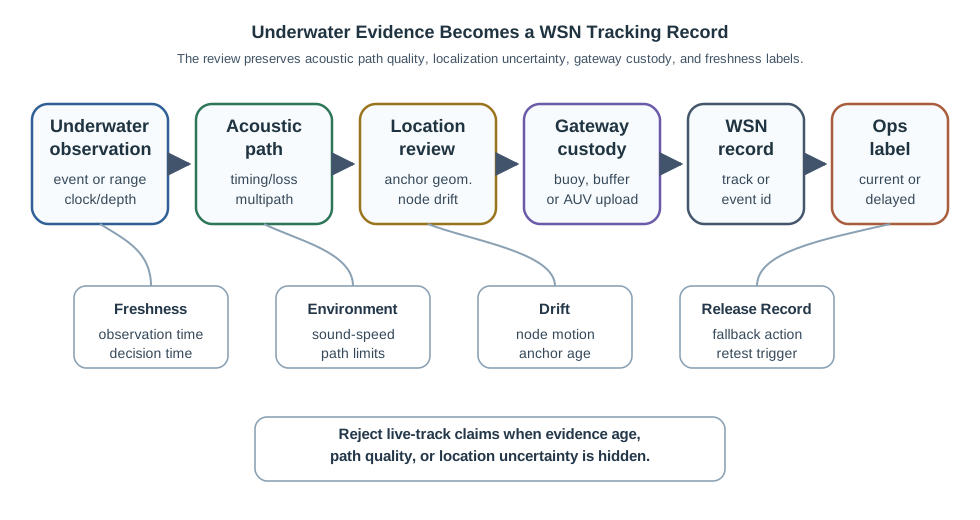
The visual path in Figure 24.1 moves from observation (identifies the field observation) through event or range (adds a distinct review condition) to clock and depth (adds a distinct review condition). Reading those labels as one chain clarifies that underwater acoustic tracking evidence map showing local observation, acoustic path, localization review, gateway custody, WSN tracking record, and operations label with timing, drift, sound-speed, fallback, and retest evidence. It therefore connects this diagram directly to the chapter’s treatment of underwater evidence map.
The map separates observation, acoustic path, localization, gateway custody, and operations label. A tracking dashboard that only shows a final point can hide the assumptions that make that point useful or unsafe.
24.8 Acoustic Path Review
This section: Acoustic Path Review — Underwater tracking often starts with acoustic communication or acoustic ranging.
Underwater tracking often starts with acoustic communication or acoustic ranging. A review should focus on what the acoustic path preserves and what it can distort.
No acoustic path is automatically release-ready. The path is reviewable only when its timing and environmental assumptions are shown with the track.
24.9 Timing and Freshness
This section: Timing and Freshness — Underwater evidence can be valuable even when it is not live.
Underwater evidence can be valuable even when it is not live. The problem is presenting old evidence as current.
The review should reject any design that updates a live track with delayed underwater evidence without showing freshness and uncertainty.
24.10 Localization and Drift
This section: Localization and Drift — Underwater tracking depends on knowing both the target evidence and the observing node positions.
Underwater tracking depends on knowing both the target evidence and the observing node positions. Node position may be a measured state, a model output, or an assumption.
If the observing node location is uncertain, the target track should inherit that uncertainty instead of hiding it.
24.11 Localization Pattern Examples
This section: Localization Pattern Examples — The practical review question is whether the localization record still explains its uncertainty after the water state, anchor state, vehicle path, or virtual topology changes.
Underwater localization schemes often appear under names such as 3-D anchor localization, AUV-assisted silent localization, HASL-style high-speed AUV localization, opportunistic localization, or self-organizing virtual architectures. Treat those names as examples of evidence patterns, not as release approval.
The practical review question is whether the localization record still explains its uncertainty after the water state, anchor state, vehicle path, or virtual topology changes.
24.11.1 Internal Solitons and Three-Dimensional Motion
An internal soliton is a nonlinear wave travelling along a density interface inside the water column. Its steep temperature and salinity gradient changes sound speed and can refract, focus, defocus, or scatter an acoustic path. The effect is not equivalent to adding a constant range error: a link can change as the soliton crosses the path even when transmitter and receiver have not moved. Localization records should therefore bind ranges to a sound-speed profile and observation time, and should widen uncertainty or reject a range when the profile is stale.
Node motion must also be modelled in three dimensions. A useful oceanic-forces model updates position and velocity from the dominant current, buoyancy, drag, wave, and tether forces:
The point is not that every node needs a full fluid-dynamics solver. The point is that a shallow-water random walk cannot stand in for vertical drift, depth-dependent currents, or a mooring constraint. The chosen model should expose the force terms it omits and be checked against position or current observations.
24.11.2 Three-Anchor Iterative Silent Localization
Three surface anchors can provide horizontal geometry while a pressure sensor supplies depth. Let unknown node position be , anchor be , and corrected acoustic range be . The range equations are
Pressure fixes or tightly constrains , reducing the unknown horizontal coordinates to and . Subtracting the first squared-range equation from the other two cancels and produces two linear equations. Solve that initial estimate, predict anchor and node positions to the common observation time, recompute sound-speed-corrected ranges, and iterate until the position update or residual stops improving. Three anchors are enough only when geometry is not nearly collinear and the depth and timing errors are bounded.
24.11.3 HASL Cycle: AUV-Assisted Without Node Transmissions
High-speed AUV-based silent localization moves the active cost to the vehicle. Follow the cycle from the vehicle’s navigation evidence: the AUV first obtains a surface GPS fix, then tracks its submerged path with dead reckoning or inertial/navigation sensors. At constant intervals it broadcasts a beacon containing vehicle position and transmit time. Silent sensor nodes collect several of those beacons without answering, which avoids acoustic contention and reveals less about their presence.
The sensor then turns arrival timing into range-like constraints and uses its pressure-derived depth as the vertical coordinate. Once it has observations from enough geometrically diverse AUV positions, it solves its position by trilateration or nonlinear least squares. The result is not just a coordinate: the node retains residuals, AUV position age, the sound-speed assumption, and geometry quality alongside the estimate so a reviewer can judge whether the route supplied enough evidence.
“Silent” means the node does not transmit during localization; it does not mean the estimate is evidence-free. A constant beacon interval helps associate observations and predict vehicle position, but clock offset, AUV dead-reckoning drift, sound-speed variation, and a nearly straight pass can still dominate the solution.
24.11.4 Opportunistic Localization Policy
Opportunistic localization gives the two node states different objectives. An unlocalized node chooses which localized neighbors or beacon opportunities will minimize expected time to obtain sufficient geometry:
A localized node chooses transmit power to maximize localization benefit per joule, not raw reach:
At each opportunity the node discovers state, scores candidates, selects a power or neighbor, emits or listens once, updates which peers became localized, and backs off when marginal benefit falls. The algorithm needs limits for repeated failures and for overlapping helpers that would spend energy localizing the same peer.
24.11.5 Tic-Tac-Toe Virtual Architecture
A moving underwater network should not treat a momentary neighbor graph as permanent. For currently connected nodes and with nonzero relative velocity , relative position , and usable acoustic radius , the constant-velocity time until they leave range is the positive root of
Expanding gives a quadratic in ; the first future boundary crossing estimates how long the pair can remain connected. The Tic-tac-toe pattern uses these predicted durations to form a layered virtual topology: relatively stable nodes become higher-layer coordinators or junctions, shorter-lived neighbors attach below them, and the layers are rebuilt as predicted lifetimes or measured links expire.
Formation proceeds by exchanging motion and link state, predicting pair lifetimes, selecting stable parents, checking that the layered structure reaches a gateway or collection point, and scheduling repair before the weakest required edge expires. The record should retain the prediction horizon, parent lifetime, layer changes, broken-edge behavior, and actual-versus-predicted contact duration. Otherwise “self-organizing” hides topology churn instead of managing it.
24.12 Gateway Custody Review
This section: Gateway Custody Review — The underwater gateway path may be live, intermittent, mobile, or delayed.
The underwater gateway path may be live, intermittent, mobile, or delayed. The custody record should explain what happened to the evidence after it was observed.
Gateway input: Observation id, node id, timing source, acoustic path quality, localization state, and buffer state.
Translation rule: Range conversion, track association, aggregation window, discarded evidence, and uncertainty conversion.
Output record: Track id or event id, lifecycle label, freshness, confidence, custody, environment limits, and operator-facing warning.
Fallback state: Request confirmation, mark delayed, widen the search area, hold the decision, schedule a collection pass, or retire the track.
Gateway custody is incomplete if it only says “target detected.” It must also show when evidence was observed, how it moved, what was summarized, and where the claim stops.
24.13 Error Budget and State Labels
This section: Error Budget and State Labels — The underwater error budget belongs inside the tracking record, not in background notes.
The underwater error budget belongs inside the tracking record, not in background notes. A point estimate is a claim about observation time, acoustic path quality, sound-speed assumptions, observing-node position, and gateway custody. If any field is stale or weak, the operations label should inherit that weakness.
| Evidence condition | Record label | Review action |
|---|---|---|
| Detection exists, but acoustic path quality is not reviewed | acoustic-unverified | Hold precise location and show only bounded event evidence |
| Sound-speed profile, noise, or multipath evidence is stale | environment-limited | Widen uncertainty and require a profile or path-quality refresh |
| Anchor, buoy, or AUV position age controls the estimate | geometry-limited | Expose anchor age, drift source, and range diversity before release |
| Evidence is buffered or carried before upload | historical or delayed | Keep observation time separate from upload and decision time |
| Several plausible locations or classes remain | ambiguous | Request confirmation, collect more ranges, or widen the search area |
The record should also keep a time-stamped ledger: observation time, send or receive time, upload time, sound-speed profile id or age, path-quality state, anchor or vehicle position age, uncertainty state, custody path, discarded-evidence note, and label-transition owner. That ledger prevents a late high-quality packet, a fresh low-quality buoy relay, or an anchor-position update from silently overwriting the supported label.
24.14 Knowledge Check: Error Ledger
This section: Knowledge Check: Error Ledger
24.15 Release Gates
This section: Release Gates — Evidence for Release Gates starts in Figure 24.2.
Evidence for Release Gates starts in Figure 24.2. Look at 1. Claim beside decision stated before accepting Release gates for underwater acoustic WSN tracking.
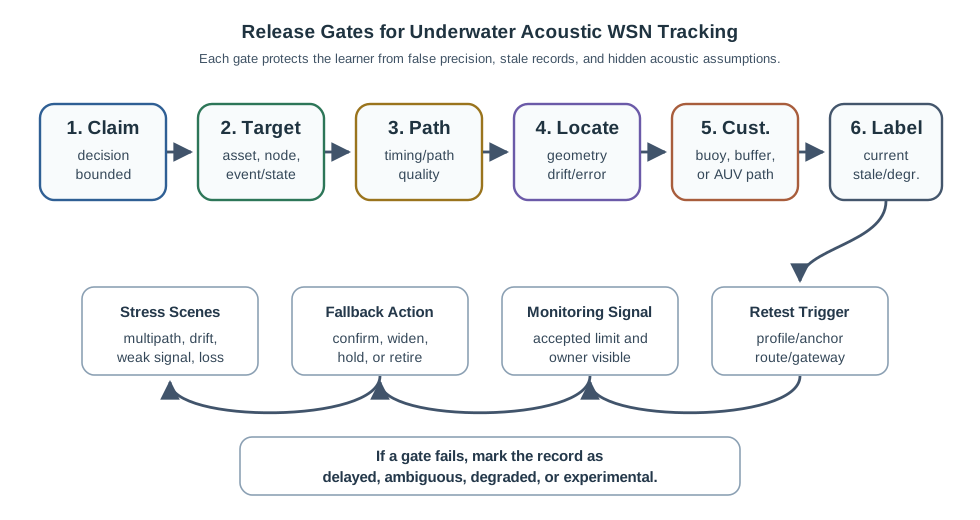
Figure Figure 24.2 tests a location claim against acoustic evidence before release. Its worked case gives a 2.00 km path and 1.33 s travel time, but it does not quantify multipath or the location error bound. The gateway must keep timing, path quality, and uncertainty through handoff. Without that review, the operations label is acoustic-unverified and the system holds a precise location claim, while bounded event evidence may remain useful. The route ends with an owner and retest after a changed water profile, anchor position, or gateway. Link calculations alone cannot justify a precise fix.
Release gates should test the full route from underwater observation to system-level decision.
24.16 Mooring Field Asset Tracking
This section: Mooring Field Asset Tracking — A mooring field uses acoustic pings from fixed sensors to report the position of an underwater asset moving near several anchors.
A mooring field uses acoustic pings from fixed sensors to report the position of an underwater asset moving near several anchors.
24.17 Worked Review: AUV Data Collection
This section: Worked Review: AUV Data Collection — An AUV collects buffered detections from underwater nodes and uploads them after surfacing.
An AUV collects buffered detections from underwater nodes and uploads them after surfacing.
24.18 Worked Review: Coastal Event Detection
This section: Worked Review: Coastal Event Detection — A coastal sensor line reports acoustic events that may indicate vessel activity, equipment movement, or environmental noise.
A coastal sensor line reports acoustic events that may indicate vessel activity, equipment movement, or environmental noise.
24.19 Common Underwater Tracking Mistakes
This section: Common Underwater Tracking Mistakes
24.20 Readiness Checklist
This section: Readiness Checklist — Before approving an underwater acoustic tracking chapter, lab, or prototype review, verify these items.
Before approving an underwater acoustic tracking chapter, lab, or prototype review, verify these items.
24.21 Knowledge Check: Acoustic Evidence
This section: Knowledge Check: Acoustic Evidence
24.22 Knowledge Check: Gateway Custody
This section: Knowledge Check: Gateway Custody
24.23 Match Underwater Evidence
This section: Match Underwater Evidence
24.24 Order Underwater Evidence
This section: Order Underwater Evidence
24.25 Figure Review: Localization Under Motion
This section: Figure Review: Localization Under Motion — A silent node can localize without transmitting when the moving AUV leaves a sufficiently diverse, time-aligned trail of position evidence.
A silent node can localize without transmitting when the moving AUV leaves a sufficiently diverse, time-aligned trail of position evidence.

Read Figure 24.3 across the AUV row first: a surface fix is followed by dead-reckoned, timed beacons and a known pose interval. Then follow the silent-node row: it listens, adds depth from pressure, solves its horizontal position from the received ranges, and labels the result with motion and acoustic doubt. The dashed loop asks whether geometry and uncertainty meet the acceptance rule before the node uses that estimate. The AUV carries the active position work; the underwater node spends receive energy.
When several assets are already moving through the water column, localization can be opportunistic rather than organized around a dedicated anchor pass.

Read Figure 24.4 as two different choices. On the left, unlocalized node u ranks A, B, and C by expected time to a fix and chooses A for the shortest delay. On the right, already localized node A compares candidate peers by new fixes per joule and chooses P2. The same neighbourhood can favour a different peer when the objective changes. Neither panel shows an observation pool or a sound-speed gate; those checks belong to the broader localization review, not to this drawing.
Long-lived underwater forwarding also needs a topology that can reform as predicted contact duration changes.

In Figure 24.5, VIRTUAL LAYER 1 offers a 28-to-22-to-18-second route that passes the CUSTODY TEST, whereas the dashed 7-to-5-second branch triggers REFORM and reassignment to the 14-second path.
24.26 Summary
This section: Summary — Underwater acoustic tracking is a WSN vertical where acoustic path evidence, localization uncertainty, gateway custody, and operations labels are central to the tracking claim.
Underwater acoustic tracking is a WSN vertical where acoustic path evidence, localization uncertainty, gateway custody, and operations labels are central to the tracking claim. A hydrophone event, acoustic range, or delayed AUV upload is not automatically a current track. It becomes useful only when timing, path quality, drift, localization state, custody, and uncertainty survive into the system-level record.
The right review posture is conservative. Treat underwater tracking concepts as bounded evidence systems. Preserve what was observed, how it moved through the acoustic and gateway path, how it was localized, what decision it supports, and where the claim stops.
24.27 Key Takeaway
This section: Key Takeaway — Underwater Acoustic WSN Tracking Review should adapt tracking assumptions to the vertical’s sensing physics, communication limits, localization uncertainty, energy budget, and deployment evidence.
Underwater Acoustic WSN Tracking Review should adapt tracking assumptions to the vertical’s sensing physics, communication limits, localization uncertainty, energy budget, and deployment evidence.
24.28 Concept Relationships
This section: Concept Relationships
24.29 What’s Next
This section: What’s Next
Find help
3 reviewed answers.
Where should I start in a module?
Open the module page from the sidebar to see its chapters in order. Use the module map to return to a topic you need.
Modules and pathsReviewed
What can I try when a project does not work?
Check the symptom, then work through the diagnostic steps. Keep the error message and the smallest example that reproduces it.
When you are stuckReviewed
How do interactive examples work?
Use the interactive guide to check how examples and simulations work before changing your project.
Interactive examples guideReviewed