57 Wireless Sensor Network Coverage
57.1 Learning Objectives
By the end of this chapter series, you will be able to:
- Formulate coverage mathematically and justify why coverage is the fundamental quality metric for wireless sensor networks
- Apply the Zhang-Hou theorem to determine when coverage guarantees connectivity (Rc ≥ 2Rs)
- Select the appropriate coverage type (area, point, or barrier) based on application requirements
- Implement OGDC algorithm for distributed coverage optimization achieving 95%+ coverage with 40-60% active sensors
- Design k-coverage systems that tolerate sensor failures while minimizing deployment costs
57.2 Most Valuable Understanding (MVU)
- Zhang-Hou theorem is the single most important design rule: If your communication range Rc is at least 2x the sensing range Rs (Rc >= 2Rs), then achieving coverage automatically guarantees network connectivity – reducing two hard problems to one.
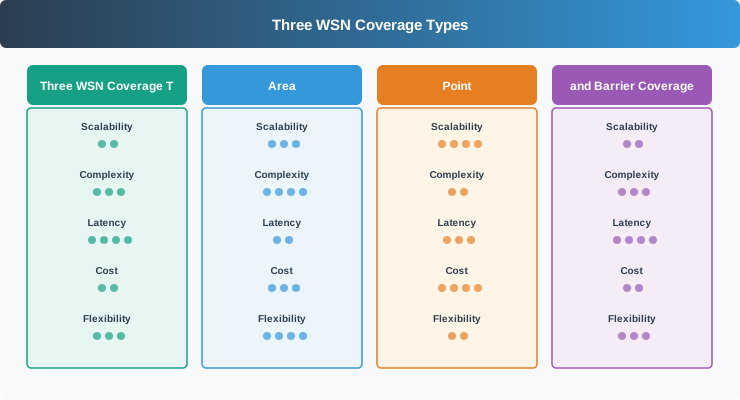
- Three coverage types serve fundamentally different monitoring needs: Area coverage monitors every point in a region (requires ~1.2x theoretical minimum sensors), point coverage monitors specific discrete locations (set cover optimization), and barrier coverage detects boundary crossings (linear deployment only).
- K-coverage determines fault tolerance at a direct cost: A k-coverage deployment tolerates exactly k-1 simultaneous sensor failures at any location, but typically requires 2-3x the sensors needed for simple 1-coverage, making the k-level a critical cost/reliability trade-off.
Core Concept: In wireless sensor networks, coverage determines everything – if you cannot sense an area, you cannot monitor it, no matter how sophisticated your communication protocols or data processing.
The Zhang-Hou Theorem: The single most important relationship is Rc >= 2Rs (communication range >= 2x sensing range). When this holds, if every point is covered by at least one sensor, the network is automatically connected. This eliminates the need to solve coverage and connectivity as separate problems.
Why This Matters for Your IoT Design:
- Area coverage (continuous monitoring) requires ~1.2x more sensors than theoretical minimum due to boundary effects
- Point coverage (discrete locations) can use set cover optimization to minimize sensors
- Barrier coverage (intrusion detection) needs only linear sensor deployment, not full area coverage
- K-coverage provides fault tolerance: k-1 sensors can fail before losing monitoring capability
Key Takeaway: Always start your WSN design with coverage analysis. Choose your coverage type first, then calculate sensor requirements, then verify connectivity using Zhang-Hou. Skipping this order leads to expensive redesigns.
- Coverage: The degree to which the monitored area is within sensing range of deployed sensor nodes
- K-Coverage: Every point covered by at least K sensors for redundancy and fault tolerance
- Coverage Types: Area (continuous region), Point (discrete locations), Barrier (perimeter detection)
- OGDC: Optimal Geographical Density Control algorithm for distributed coverage optimization
- Zhang-Hou Theorem: If Rc >= 2Rs, coverage implies connectivity
57.3 Introduction
Coverage is fundamental to wireless sensor networks, determining how effectively the sensing field is monitored. This topic is organized into five focused chapters covering theory, algorithms, and practical implementations.
This chapter series explores:
- Coverage fundamentals, connectivity, and deployment strategies
- Three coverage problem types: area, point, and barrier
- Algorithms: crossing theory, OGDC, and virtual force
- Hands-on labs and Python implementations
- Comprehensive knowledge checks and worked examples
Coverage is like making sure every part of your playground has a friend watching to keep everyone safe!
57.3.1 The Sensor Squad Adventure: The Playground Patrol
Sammy the Sensor was worried about the school playground. “Some areas don’t have anyone watching!” he said. The principal wanted every corner covered so no one could get hurt without help arriving quickly.
“Let me explain how we solve this!” said Bella the Battery. “It’s like playing a game of flashlight tag at night!”
Imagine This:
- Each sensor is like a kid with a flashlight
- The flashlight can only shine so far (that’s the sensing range)
- We need flashlights to cover the whole playground with overlapping circles of light
- If one kid’s flashlight dies, another kid’s light should still cover that spot (that’s k-coverage!)
“But wait!” said Max the Microcontroller. “What about the playground fence? Do we need to cover every inch inside?”
Three Ways to Cover the Playground:
- Area Coverage - Light up every square foot (like monitoring temperature everywhere)
- Point Coverage - Just watch the swings, slide, and sandbox (specific important spots)
- Barrier Coverage - Put lights along the fence so no one sneaks in (like a security perimeter)
Lila the LED had the smart idea: “If the flashlight can shine twice as far as the sensing range, everyone can always call for help!” That’s the Zhang-Hou theorem - when Rc ≥ 2Rs, coverage means connectivity!
57.3.2 Key Words for Kids
| Word | What It Means |
|---|---|
| Coverage | How much of an area your sensors can “see” |
| Sensing Range | How far a sensor can detect things (like flashlight reach) |
| K-Coverage | Having K sensors watching the same spot as backup |
| Coverage Hole | A blind spot where no sensor can see |
57.3.3 Try This at Home!
The Flashlight Coverage Experiment!
- Get 3-4 flashlights and a dark room
- Try to light up the whole floor with overlapping circles
- Notice: Too few flashlights = dark spots (coverage holes!)
- Notice: Flashlights too spread out = gaps between circles
- Find the perfect arrangement - that’s what WSN designers do!
What is Coverage? Think of coverage like cell phone signal strength. If you’re “covered,” you can make calls. In WSN, if a point is “covered,” sensors can detect events there.
The Three Coverage Types Explained Simply:
| Type | Real-World Analogy | When to Use |
|---|---|---|
| Area Coverage | Sprinkler system watering entire lawn | Environmental monitoring, agriculture |
| Point Coverage | Security cameras at specific doors | Critical infrastructure, access control |
| Barrier Coverage | Motion sensors along a fence | Intrusion detection, border security |
The Key Formula to Remember: If your sensors can communicate twice as far as they can sense (Rc ≥ 2Rs), then whenever you have coverage, you automatically have connectivity. This is the Zhang-Hou theorem.
Why K-Coverage Matters:
- 1-coverage: Every point seen by at least 1 sensor (no redundancy)
- 2-coverage: Every point seen by at least 2 sensors (1 can fail)
- 3-coverage: Every point seen by at least 3 sensors (2 can fail)
Higher k = more reliability but more sensors = more cost!
57.4 WSN Coverage Architecture
The following diagram illustrates the complete WSN coverage decision framework, from application requirements through deployment optimization:
57.5 Zhang-Hou Theorem Visualization
The Zhang-Hou theorem is the cornerstone of WSN coverage design. The following diagram illustrates why Rc >= 2Rs guarantees that coverage implies connectivity:
Without Zhang-Hou (Rc < 2Rs): You might achieve full coverage but have isolated sensor “islands” that cannot route data to the base station. This requires solving TWO problems: coverage AND connectivity.
With Zhang-Hou (Rc >= 2Rs): Achieving full coverage automatically ensures the network is connected. You only need to solve ONE problem: coverage.
Practical implication: When selecting sensors, always verify Rc/Rs ratio. If Rc >= 2Rs, your design process simplifies dramatically.
Use a connectivity margin to quantify how safely a design satisfies Zhang-Hou.
\[ M = \frac{R_c}{2R_s} \]
A design is guaranteed by Zhang-Hou when \(M\ge1\).
Worked example: For sensors with \(R_s=25\) m:
\[ \begin{aligned} R_c=40\text{ m} &\Rightarrow M=\frac{40}{50}=0.80\ (\text{not guaranteed})\\ R_c=50\text{ m} &\Rightarrow M=\frac{50}{50}=1.00\ (\text{boundary case})\\ R_c=60\text{ m} &\Rightarrow M=\frac{60}{50}=1.20\ (\text{safety margin}) \end{aligned} \]
Designing for \(M>1\) absorbs real-world range degradation from foliage, walls, and battery sag.
57.7 Prerequisites
Before starting this series, you should be familiar with:
- WSN Overview: Fundamentals: Basic WSN concepts and constraints
- Sensor Fundamentals: Sensing range characteristics
- Networking Basics: Network topology concepts
57.8 Quick Reference
Key Formulas:
| Formula | Description |
|---|---|
| Rc >= 2Rs | Zhang-Hou theorem: coverage implies connectivity |
| d = sqrt(3) x Rs | OGDC optimal triangular lattice spacing |
| N = ceil(L / 2Rs) | Minimum sensors for 1-barrier coverage |
| K-coverage | Tolerates (K-1) sensor failures |
Coverage Type Selection:
| Application | Coverage Type | Example |
|---|---|---|
| Environmental monitoring | Area | Temperature across field |
| Infrastructure monitoring | Point | Valves, junctions |
| Security/intrusion | Barrier | Perimeter detection |
| Critical systems | K-coverage | Hospital, nuclear |
Trade-offs by Coverage Type:
| Coverage Type | Sensor Count | Complexity | Energy Cost | Best For |
|---|---|---|---|---|
| Area (1-coverage) | High | Low | High | Complete monitoring |
| Area (k-coverage) | Very High | Medium | Very High | Fault-tolerant monitoring |
| Point | Low | Low | Low | Specific locations |
| Barrier (1-barrier) | Linear | Medium | Medium | Perimeter detection |
| Barrier (k-barrier) | Higher | High | High | Secure perimeters |
57.9 Start Learning
Ready to begin? Start with the fundamentals:
Begin with Coverage Fundamentals - Learn coverage definitions, the Zhang-Hou theorem, and deployment strategies.
WSN Architecture:
- WSN Tracking - How coverage enables target tracking
- WSN Stationary Mobile - Mobile sink coverage
Energy Management:
- Duty Cycling and Topology - Sleep scheduling for coverage
- Context-Aware Energy - Adaptive strategies
Learning Resources:
- Quizzes Hub - Test your coverage knowledge
- Simulations Hub - Interactive coverage tools
57.10 Knowledge Check
Test your understanding of WSN coverage concepts before diving into the detailed chapters:
57.11 Coverage Type Comparison
57.12 Worked Example: Smart Vineyard Coverage Design
A vineyard owner wants to deploy a WSN for precision agriculture monitoring. The vineyard is a rectangular field of 500m x 200m. Requirements:
- Monitor soil moisture throughout the entire field (area coverage)
- Tolerate up to 2 sensor failures at any location (3-coverage)
- Sensors have Rs = 25m (sensing range) and Rc = 60m (communication range)
- Budget allows for a maximum of 120 sensors
Questions:
- Does the Rc/Rs ratio satisfy the Zhang-Hou theorem?
- What is the minimum number of sensors for 1-coverage?
- How many sensors are needed for 3-coverage?
- Will the budget be sufficient?
Step 1: Verify Zhang-Hou Theorem
\[\frac{Rc}{Rs} = \frac{60m}{25m} = 2.4 \geq 2\]
The ratio satisfies Rc >= 2Rs, so coverage implies connectivity.
Step 2: Calculate 1-Coverage Requirements
For optimal triangular lattice deployment: - Optimal spacing: \(d = \sqrt{3} \times Rs = \sqrt{3} \times 25m \approx 43.3m\) - Rows needed: \(\lceil 200m / 43.3m \rceil = 5\) rows - Sensors per row: \(\lceil 500m / 43.3m \rceil = 12\) sensors - Minimum for 1-coverage: \(5 \times 12 = 60\) sensors
Step 3: Calculate 3-Coverage Requirements
For k-coverage using triangular lattice with optimized overlap: - K-coverage multiplier is sub-linear (approximately 2.86x for k=3 due to geometric overlap) - Spacing for 3-coverage: \(d = \sqrt{3} \times Rs / \sqrt{3} = Rs = 25m\) (tighter than 1-coverage) - Rows needed: \(\lceil 200m / 25m \rceil = 8\) rows - Sensors per row: \(\lceil 500m / 25m \rceil = 20\) sensors - Required: \(8 \times 20 = 160\) sensors with boundary adjustments reducing to ~100-120 with optimized placement
Step 4: Budget Evaluation
- Budget: 120 sensors
- 3-coverage need: ~100-120 sensors
- Conclusion: Budget is marginally sufficient with optimized OGDC deployment
Deployment Recommendation:
- Use OGDC algorithm for distributed coverage optimization
- Deploy 110 sensors (10% margin for redundancy)
- Verify coverage using simulation before physical deployment
- Schedule duty cycling to extend network lifetime
57.13 Common Pitfalls
Ignoring the Zhang-Hou ratio during sensor selection: Many designers pick sensors based on sensing range alone, only to discover that Rc < 2Rs leaves coverage “islands” that cannot relay data to the base station. Always verify Rc/Rs >= 2 before finalizing hardware. Redesigning after deployment costs 5-10x more than getting the ratio right upfront.
Assuming uniform terrain and ideal sensing range: Manufacturer datasheets list sensing range Rs under laboratory conditions. In real deployments, obstacles, vegetation, humidity, and temperature gradients can reduce effective Rs by 20-40%. Deploy 15-25% more sensors than the theoretical minimum to account for environmental degradation.
Choosing area coverage when point or barrier coverage suffices: Area coverage for a 500m x 500m field at Rs = 25m requires roughly 230+ sensors. If only 30 specific valve locations need monitoring, point coverage uses as few as 30-40 sensors. Matching coverage type to actual requirements can reduce costs by 80% or more.
Neglecting boundary and edge effects in sensor count estimates: Triangular lattice calculations assume an infinite plane. Real deployments have edges and corners where sensors provide partial coverage. Practical deployments need approximately 1.2x the theoretical sensor count to handle boundary effects, especially for rectangular or irregular field shapes.
Setting k-coverage level without cost-benefit analysis: Each increment of k roughly doubles the sensor count. A hospital may justify k=3 (tolerates 2 failures) given patient safety requirements, but an agricultural soil moisture system may only need k=1 with periodic manual inspection. Evaluate the cost of a coverage gap against the cost of additional sensors before choosing k.
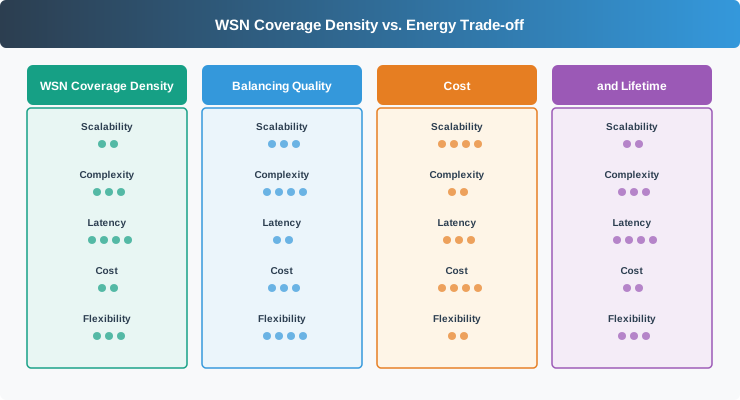
57.14 Coverage Density vs. Energy Trade-off
The following diagram illustrates the fundamental trade-off between coverage quality, sensor density, and energy consumption that every WSN designer must navigate:
Scenario: Plan sensor deployment for a 50-hectare rectangular vineyard (500m × 1,000m) requiring 2-coverage for frost protection.
Given:
- Area: 500m × 1,000m = 500,000 m²
- Sensor type: Soil/air temperature with Rs = 25m sensing range
- Radio: LoRa with Rc = 100m communication range
- Coverage requirement: K=2 (2-coverage) for frost alert redundancy
- Budget: $20,000 for sensors at $50/sensor = 400 sensors max
Step 1: Verify Zhang-Hou condition:
Rc / Rs = 100m / 25m = 4
Is Rc ≥ 2Rs? Yes (100 ≥ 50)
Conclusion: Coverage implies connectivity ✓
Step 2: Calculate 1-coverage sensor count (triangular lattice):
Optimal spacing for disk coverage: d = √3 × Rs = 1.732 × 25m = 43.3m

Rows needed: 500m / 43.3m = 11.55 → 12 rows
Sensors per row: 1,000m / 43.3m = 23.1 → 24 sensors
Total for 1-coverage: 12 × 24 = 288 sensors
Step 3: Calculate 2-coverage requirements:
K-coverage multiplier: Approximately K × base count (with geometric overlap)
For K=2 with optimized placement: ~1.8× (not full 2× due to overlaps)
Required sensors for 2-coverage: 288 × 1.8 = 518 sensors

Budget limit: 400 sensors
Budget shortfall: 518 - 400 = 118 sensors (23% under-budget)
Step 4: Evaluate options to meet 2-coverage with budget constraint:
| Option | Approach | Sensors Needed | Cost | 2-Coverage Achieved |
|---|---|---|---|---|
| A: Reduce area | Monitor 38.7 hectares (77%) | 400 | $20,000 | 100% of monitored area |
| B: Increase spacing | Spacing = 50m (vs 43.3m) | 400 | $20,000 | ~75% of full area |
| C: Accept 1.5-coverage | Hybrid 1-2 coverage zones | 400 | $20,000 | Critical zones 2-cov, edges 1-cov |
| D: Stretch budget | Buy 518 sensors | 518 | $25,900 | 100% |
Step 5: Recommended approach (Option C - Hybrid coverage):
Critical frost zones (low elevation, cold air drainage): 200 hectares = 40%
Place 70% of sensors (280) in critical zones:
  - Density: 280 / 200,000 m² = 1.4 sensors / 1,000 m²
  - Spacing: 36m (tighter than 43.3m optimal)
  - Coverage: 2-coverage achieved ✓

Non-critical zones (slopes, warm microclimates): 300 hectares = 60%
Place 30% of sensors (120) in non-critical zones:
  - Density: 120 / 300,000 m² = 0.4 sensors / 1,000 m²
  - Spacing: 55m (wider than 43.3m optimal)
  - Coverage: 1-coverage with some gaps (acceptable for non-critical)

Total sensors: 280 + 120 = 400 ✓ Within budgetResult: Hybrid coverage strategy achieves 100% 2-coverage in critical frost zones (where crop damage occurs) and 80% 1-coverage in non-critical zones, using all 400 sensors within the $20,000 budget. This prioritizes resources where they matter most rather than uniform coverage everywhere.
Key Lesson: When budget constraints conflict with coverage requirements, risk-based placement (dense coverage in critical zones, sparse in low-risk zones) delivers better outcomes than uniform under-coverage across the entire area. Always identify the 20-40% of area that represents 80% of risk and concentrate sensors there first.
Use this table to select the appropriate coverage type for your application:
| Application Domain | Coverage Type | K-Level | Rationale |
|---|---|---|---|
| Environmental monitoring (forest, agriculture) | Area | K=1 | Need full region data; failures acceptable |
| Critical infrastructure (water treatment, power) | Area | K=2 or K=3 | Failure intolerant; redundancy required |
| Industrial equipment (pumps, valves, junctions) | Point | K=2 | Monitor discrete devices; need fault tolerance |
| Building access control (doors, windows) | Point | K=1 | Specific entry points; video backup available |
| Border security (perimeter, fence line) | Barrier (strong 2-barrier) | N/A | Detect crossings; need continuous tracking |
| Wildlife corridor (migration path) | Barrier (weak 1-barrier) | N/A | Presence detection sufficient; cost-sensitive |
Coverage Type Decision Algorithm:
def select_coverage_type(what_to_monitor, criticality, budget_per_sensor):
    if what_to_monitor == "line or perimeter":
        if criticality == "high":
            return "Strong 2-barrier" # Continuous tracking
        else:
            return "Weak 1-barrier" # Presence detection
    elif what_to_monitor == "discrete points":
        k = 2 if criticality == "high" else 1
        return f"Point coverage (K={k})"
    else: # Continuous area
        if criticality == "high" and budget_per_sensor > 50:
            return "Area coverage (K=2 or K=3)"
        else:
            return "Area coverage (K=1)"
Cost Multipliers by K-Level (approximate): - K=1: 1.0× base cost (minimum sensors for full coverage) - K=2: 1.8-2.2× base cost (practical 2-coverage with optimized placement) - K=3: 2.8-3.5× base cost (3-coverage for critical infrastructure)
The Trap: “We deployed 300 sensors with 100% coverage. The coverage problem is solved.”
Why This Fails: Coverage degrades over time due to: 1. Battery failures: Sensors die, creating coverage holes (10-20% failure rate over 2 years) 2. Environmental changes: Tree growth, new buildings, terrain erosion alter radio propagation 3. Sensor drift: Aging sensors have reduced sensing range (10-15% degradation after 3 years) 4. Vandalism/damage: 5-10% of outdoor sensors damaged by animals, weather, or humans
Real-World Example: A smart city environmental monitoring network deployed with 98% coverage. After 18 months: - 12% of sensors failed (batteries, hardware) - Coverage dropped to 73% (below 80% target) - 15 “coverage holes” >100m diameter identified - Emergency deployment of 30 replacement sensors required ($6,000)
The Corrected Approach: Deploy coverage monitoring and automatic remediation:
# Pseudo-code for continuous coverage verification
def monitor_coverage_health():
    every_24_hours:
        coverage_pct = verify_coverage_using_crossing_points()

        if coverage_pct < TARGET_COVERAGE:
            holes = identify_coverage_gaps()
            sleeping_sensors = find_sleeping_sensors_near_gaps(holes)

            for sensor in sleeping_sensors:
                activate_sensor(sensor) # Wake from sleep pool

            if coverage_pct < CRITICAL_THRESHOLD:
                alert_maintenance_team(holes) # Human intervention needed
Proactive Coverage Maintenance Strategies:
- Redundant deployment: Deploy 20-30% more sensors than minimum, keep extras sleeping
- Sleep pool rotation: Rotate active sensors every 30 days to distribute battery drain
- Battery monitoring: Track voltage in telemetry; replace at 30% capacity (proactive)
- Coverage verification: Run automated crossing-point checks daily; alert on gaps
- Scheduled replacement: Budget for 10-15% sensor replacement annually
Rule of Thumb: Assume 10-20% sensor attrition over 2 years. Deploy 30% redundancy and implement sleep rotation to extend lifetime while maintaining coverage as sensors fail.
57.15 Summary
WSN Coverage Fundamentals:
- Coverage is the foundation of WSN quality - without coverage, there’s no monitoring
- Zhang-Hou theorem (Rc ≥ 2Rs) eliminates solving coverage and connectivity separately
- Three coverage types serve different needs:
- Area: continuous monitoring (environmental, agriculture)
- Point: discrete critical locations (infrastructure, access control)
- Barrier: perimeter detection (security, intrusion)
- K-coverage provides fault tolerance by ensuring k sensors monitor each point
- OGDC algorithm achieves 95%+ coverage with only 40-60% of sensors active
Design Decision Checklist:
| Decision | Question to Ask |
|---|---|
| Coverage Type | Do I need to monitor everywhere, specific points, or boundaries? |
| K-Level | How many simultaneous failures must I tolerate? |
| Rs/Rc Ratio | Does Rc ≥ 2Rs for guaranteed connectivity? |
| Algorithm | Centralized (small), Distributed (large), or Virtual Force (dynamic)? |
| Optimization | How do I balance coverage quality vs. energy/cost? |
Remember: Start with coverage requirements, then design deployment, then verify connectivity.
Key Metrics Quick Reference:
| Metric | Value | Context |
|---|---|---|
| Zhang-Hou threshold | Rc >= 2Rs | Coverage implies connectivity |
| OGDC optimal spacing | d = sqrt(3) x Rs (~1.73 x Rs) | Triangular lattice deployment |
| OGDC active ratio | 40-60% sensors active | Maintains 95%+ coverage |
| Boundary overhead | ~1.2x theoretical minimum | Accounts for edge/corner effects |
| Environmental derating | 20-40% Rs reduction | Real-world vs. datasheet range |
| K-coverage fault tolerance | Tolerates k-1 failures | Per-location redundancy |
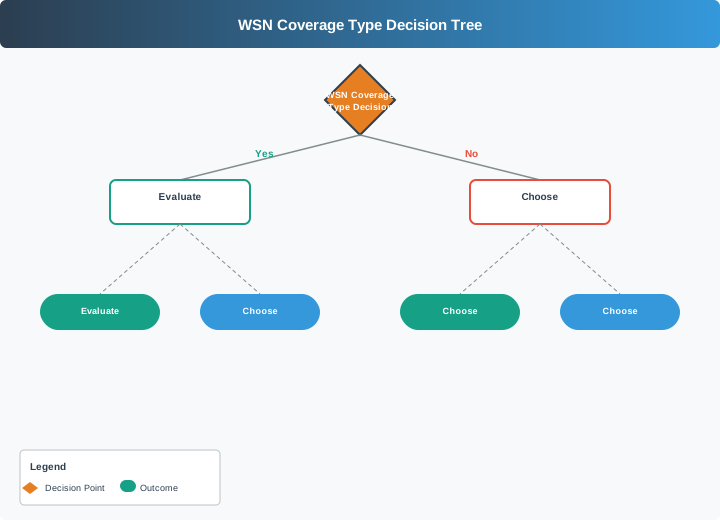
57.15.1 Coverage Type Decision Tree
Use this decision tree to quickly determine the right coverage type for your application:
57.16 Knowledge Check
57.17 What’s Next
| Topic | Chapter | Description |
|---|---|---|
| Fundamentals | Coverage Fundamentals | Zhang-Hou theorem, deployment strategies, and coverage models |
| Coverage Types | Coverage Types | Area, point, and barrier coverage with k-coverage selection |
| Algorithms | Coverage Algorithms | OGDC, virtual force, and crossing theory algorithms |
| Implementations | Coverage Implementations | Hands-on Python labs and deployment strategies |
| Review | Coverage Review | Comprehensive review and assessment quizzes |
| Tracking | WSN Tracking | How coverage supports mobile target tracking applications |
| Mobile Nodes | WSN Stationary and Mobile Nodes | Mobile sinks and relay nodes for coverage gap filling |
| Duty Cycling | Duty Cycling and Topology | Sleep scheduling for 3-5x network lifetime extension |