46 WSN Directed Diffusion Routing

More
Depth: Practitioner
Progress saves as you read. Mark sections complete as you go; your progress appears in the sidebar.
46.1 Start With the Field Story
This section: Start With the Field Story — Trace one complete request.
Trace one complete request. Write the wanted event. Add its place and time. Watch the request spread. Mark each return direction. Start one matching source. Compare the paths. Strengthen the useful one. Let old state expire.
Then disturb the field. Break the chosen path. Add a second source. Send a second interest. Watch message cost and repair. Keep duplicate data visible. Approve only the tested load. Recheck when nodes move or energy falls.
Picture a forest with many heat sensors. A base station wants reports only from an area where smoke may be rising. It does not begin by naming one sensor. It describes the data it wants. Nearby nodes then help find useful sources and paths.
An interest is a request for named data from a place and time. The request spreads through the sensor field. Each node remembers where it came from. That memory gives possible directions back. These directions are called gradients. A source that matches the interest can send data along them.
At first, several paths may carry reports. The base station can strengthen the path that works well. This step is reinforcement. Other paths may remain as choices or fade away. Interests and path state must expire so old requests do not live forever.
Review the whole cycle. State the interest. Watch it spread. Find the matching sources. Compare the returning paths. Strengthen one with evidence. Then remove stale state. Count the messages and the work placed on busy nodes.
This first view assumes one clear interest and steady nodes. Real fields can move, fail, and hold several interests at once. The Practitioner layer builds the trace and test record. Under the Hood examines gradient state, reinforcement, duplicate data, and the costs hidden by the simple request-and-return story.
Directed Diffusion begins with an interest, not a fixed address. The review story is how interests spread, gradients form, sources match data, reinforcement selects useful paths, and expiry prevents stale routes from looking valid.
46.2 In 60 Seconds
This section: In 60 Seconds — Directed Diffusion is a data-centric WSN routing pattern.
Directed Diffusion is a data-centric WSN routing pattern. A sink expresses an interest, nodes record gradients back toward the interest source, matching sensors send data along those gradients, and the sink can reinforce the path or paths that best satisfy the application evidence. The important review question is not whether Directed Diffusion sounds efficient. The question is whether the interest, gradient state, matching rule, reinforcement rule, aggregation boundary, expiry, duplicate handling, and monitoring evidence are explicit.
Use this chapter after routing classification and data aggregation. A good Directed Diffusion record states what the sink asks for, which sources match, how gradients form and expire, what exploratory data proves, how reinforcement is chosen, how stale interests are removed, how duplicate or aggregated data is handled, and what retest trigger can invalidate the design.
46.3 Learning Objectives
This section: Learning Objectives
By the end of this chapter, you will be able to:
- explain Directed Diffusion using interests, gradients, matching sources, exploratory data, and reinforcement
- identify the evidence needed before accepting a data-centric routing design
- review interest scope, gradient state, expiry, duplicate handling, and aggregation boundaries
- distinguish valid Directed Diffusion fit from protocol-name overuse
- build a Directed Diffusion review record with owner, fallback action, and retest triggers
46.4 Directed Diffusion Routing Review
This section: Directed Diffusion Routing Review
46.5 Prerequisites
This section: Prerequisites — This chapter builds on WSN Routing Protocol Classification Review, WSN Routing Introduction Review, and WSN Routing Data Aggregation Review.
This chapter builds on WSN Routing Protocol Classification Review, WSN Routing Introduction Review, and WSN Routing Data Aggregation Review. If the learner cannot describe data-centric routing, route state, or aggregation risk, review those chapters first.
46.6 What Directed Diffusion Means
This section: What Directed Diffusion Means — Directed Diffusion routes by the requested data attributes rather than by a permanent destination address for each sensor.
Directed Diffusion routes by the requested data attributes rather than by a permanent destination address for each sensor. The sink asks a question, the network sets up reverse direction state, and matching data flows back.
46.7 Directed Diffusion Review Scope
This section: Directed Diffusion Review Scope — Directed Diffusion is useful vocabulary only when the review ties it to evidence.
Directed Diffusion is useful vocabulary only when the review ties it to evidence.
46.8 Interest and Gradient Flow
This section: Interest and Gradient Flow — Make Interest and Gradient Flow testable with the visual in Figure 46.1.
Make Interest and Gradient Flow testable with the visual in Figure 46.1. The Directed Diffusion: Two-Phase Pull Protocol and Phase 1: Interest Propagation checkpoints frame the sequence behind Interest and Gradient Flow.
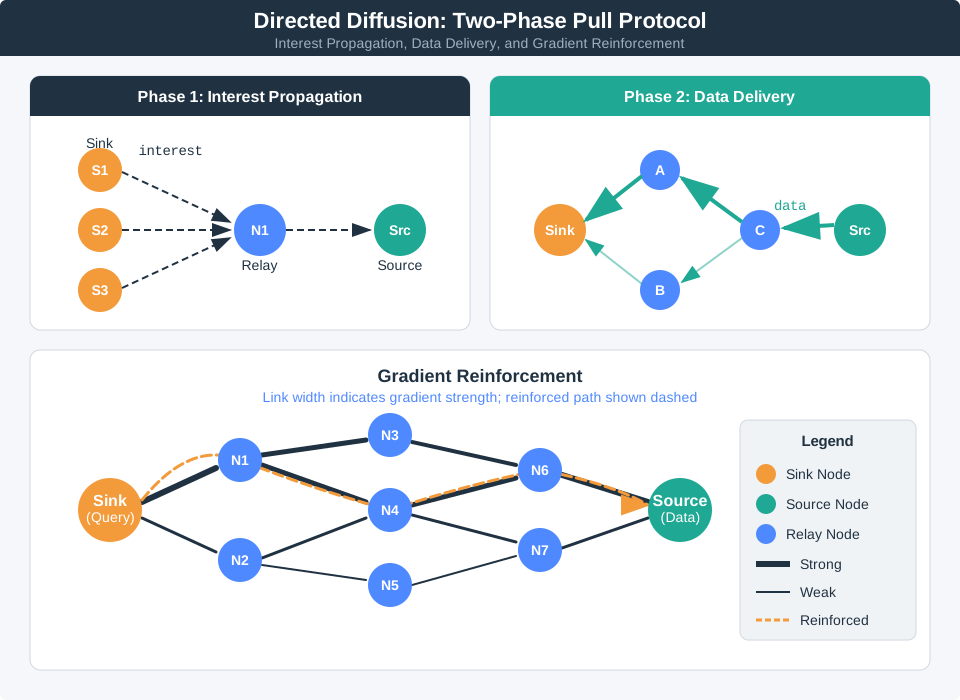
Figure Figure 46.1 follows a request from sink to source and data back again. In phase one, an interest names the data and spreads outward while relays store gradient directions toward the sink. Matching sources then return exploratory reports along those gradients. After comparing path evidence, the sink may reinforce a useful path, rate, or source; other paths may remain or fade. The example interest includes a type, interval, duration, and field, showing why scope and expiry matter. The diagram is a routing pattern, so the team must still measure freshness, relay pressure, duplicate behavior, and recovery before promising performance.
The diagram shows a review pattern, not a performance promise. The sink’s interest creates local reverse-path state. Matching sources respond. The sink compares the evidence and may reinforce one path, multiple paths, a rate, or an expiry rule.
46.9 Interest Evidence
This section: Interest Evidence — An interest should be specific enough to route useful data and bounded enough to avoid stale or excessive route state.
An interest should be specific enough to route useful data and bounded enough to avoid stale or excessive route state.
Treat an interest as a small executable contract, not a loose request. It should name the data attribute or event, region or source class, reporting interval, allowed answer age, collection duration, quality condition, and expiry rule. Those fields decide which nodes may match, which relays may forward, and when stale route state must disappear.
Read Figure 46.2 to see how an interest becomes a bounded request that can establish gradients and expire safely.
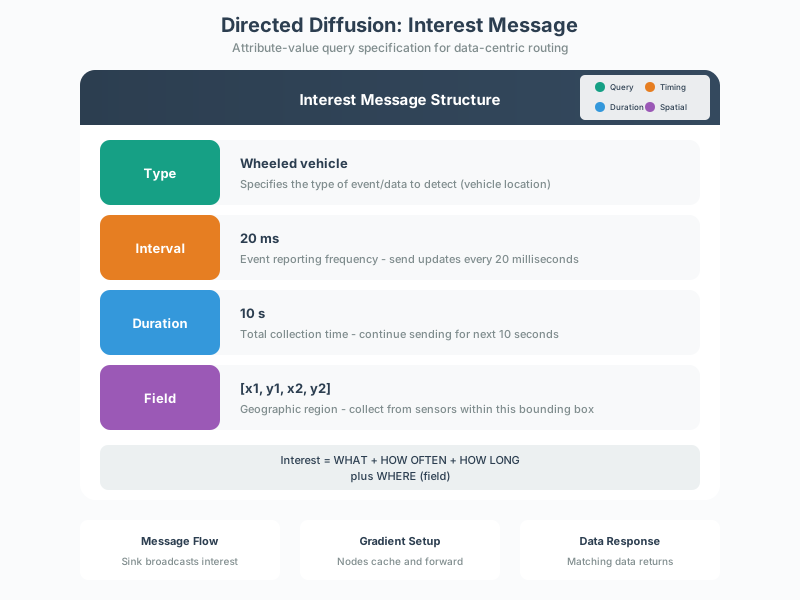
Start with the interest fields: the requested type and wheeled-vehicle value narrow which observations may match. The interval and duration then define reporting pace and lifetime, preventing a request from becoming permanent route state. Follow the interest as it spreads toward possible sources; each receiver establishes a gradient back toward the requester. Matching data travels along those gradients, where useful paths can be reinforced. This order matters because routing is created by the request itself, so an incomplete field or missing expiry changes both the answer and the network cost.
Avoid interests that are so broad they act like a permanent flood. Also avoid interests that are so narrow that matching sources cannot be diagnosed when expected data does not arrive.
A well-written interest also defines the silence case. If no node responds, the record should distinguish “no matching phenomenon,” “interest did not reach the region,” “matching source was stale,” and “data returned but was suppressed.” Routing by content is powerful only when the content name still matches the decision being made.
46.10 Scope, Push Variants, and Limits
This section: Scope, Push Variants, and Limits — The first cost to control is interest flooding.
The first cost to control is interest flooding. Geographic scope, source class, event type, duration, and refresh rate should narrow which nodes carry the request. A vehicle-location interest such as type=vehicle, interval=20 ms, duration=10 s, and field=[x1,y1,x2,y2] is stronger than a permanent global request because relays can tell when the question is outside their region or already expired.
Push diffusion turns the same naming idea around for cases with few senders and many possible receivers. Instead of flooding interests first, sources or local relays flood a small amount of event data or metadata, and interested sinks reinforce the gradients that prove useful. Treat this as a different routing contract, not as permission to flood every reading: the review still needs duplicate control, source visibility, expiry, and reinforcement evidence.
Directed Diffusion examples are often taught as clean protocol sketches. A deployable review must add the field evidence those sketches can hide: link stability, link load, parent changes, duty-cycle rendezvous, and whether forwarding nodes are actually awake when the interest or data arrives. If MAC behavior, receiver sleep, or relay load can change the route, reinforcement should consider that link evidence before the path is accepted.
46.11 Gradient State Evidence
This section: Gradient State Evidence — Gradient state is the local memory that makes Directed Diffusion work.
Gradient state is the local memory that makes Directed Diffusion work. It must be bounded, inspectable, and repairable.
Gradient state is not free. If the review cannot explain how it expires, repairs, and avoids duplicates, the design is not ready for acceptance.
Keep a gradient ledger per interest and per neighbor. A node may hear the same interest from several neighbors and keep candidate gradients while exploratory data proves which route should be reinforced.
| Ledger field | What it proves | Failure if missing |
|---|---|---|
| Interest key | Which selector, scope, interval, duration, and expiry this gradient belongs to. | Old or different interests can be mixed with current data. |
| Neighbor direction | Which neighbor supplied the interest and can receive matching data back toward the sink. | The node cannot explain why data flowed to that relay. |
| Requested rate or quality | Whether this is exploratory, reinforced, downgraded, or expired behavior. | Traffic can rise without a recorded reinforcement decision. |
| Evidence counters | Freshness, duplicate count, delivery, source visibility, and relay pressure used for reinforcement. | The sink may reinforce the first packet rather than the best-supported path. |
| Expiry and repair | When stale gradients are removed and what event triggers a refresh or fallback. | Data can follow obsolete state after the sink, source, or condition changes. |
The ledger gives support staff a debug handle. When a report is late, they can ask whether the interest reached the region, whether the matching source created data, whether the relay suppressed a duplicate, whether the reinforced rate changed, or whether the gradient expired as designed.
A concrete case makes the “requested rate or quality” field less abstract. Suppose a gradient records an interest rate of one event per second, but during a one-second window a relay actually hears two qualifying reports arriving from different sources. The gradient’s rate does not mean “reject the second report” — it means the relay must make an explicit choice and the record must say which one it made: forward only the first report and drop the second, or combine the two into one aggregated report for that interval. Neither choice is automatically correct. Forwarding only the first can silently discard a second source’s evidence; aggregating can hide which sources actually reported and by how much they disagreed. The review failure is not picking one option, it is leaving the choice unrecorded, because a sink that later asks “why did I only see one reading for that second” needs the ledger to say whether a report was dropped or folded into a summary.
46.12 Exploratory Data and Reinforcement
This section: Exploratory Data and Reinforcement — Exploratory data helps the sink compare paths before selecting reinforced behavior.
Exploratory data helps the sink compare paths before selecting reinforced behavior. Reinforcement should be based on measured evidence, not on the first packet that arrives.
The reinforcement record should say what was measured and why one path, rate, or source was accepted. Without that evidence, reinforcement becomes a hidden preference.
Reinforcement should be recorded as a state transition. A gradient begins as exploratory, becomes reinforced only after evidence is compared, may be downgraded by negative reinforcement, and eventually expires. That transition is safer than a hidden “best path” label because it names the evidence that justified the higher rate or preferred relay.
| State | Allowed behavior | Evidence to retain |
|---|---|---|
| Exploratory | Forward low-rate matching data over candidate gradients. | Arrival time, freshness, duplicate count, source identity, relay pressure, and link warnings. |
| Reinforced | Increase rate or priority for the selected gradient while limits remain true. | Why this path beat alternatives and which metric would invalidate it. |
| Downgraded | Reduce rate, avoid a relay, or prune a gradient whose evidence degrades. | Stale data, missing sources, duplicate growth, relay overload, or weak-link evidence. |
| Expired | Remove state when interest lifetime, source condition, or monitoring evidence is no longer current. | Expiry trigger, owner, fallback, and whether a new interest must be issued. |
If the reinforced path stops meeting the interest contract, the sink should compare remaining exploratory or fallback evidence, reinforce a better gradient if one exists, or mark the interest unresolved. “Less traffic” is not automatically better; the reduced path set must still preserve the answer the interest asked for.
46.13 Data, Aggregation, Duplicates
This section: Data, Aggregation, Duplicates — Directed Diffusion often works well with in-network aggregation, but aggregation must not hide the evidence that the interest asked for.
Directed Diffusion often works well with in-network aggregation, but aggregation must not hide the evidence that the interest asked for.
If the interest asks for “any source above threshold,” an average response may be wrong. If it asks for “regional trend,” a bounded aggregate with member evidence may be acceptable. The review must tie the data behavior to the interest.
46.14 Directed Diffusion Evidence Record
This section: Directed Diffusion Evidence Record — For Directed Diffusion Evidence Record, inspect Figure 46.3 before deciding how Interest constrains freshness expiry.
For Directed Diffusion Evidence Record, inspect Figure 46.3 before deciding how Interest constrains freshness expiry. That labelled relationship grounds the evidence behind Directed Diffusion Evidence Record.
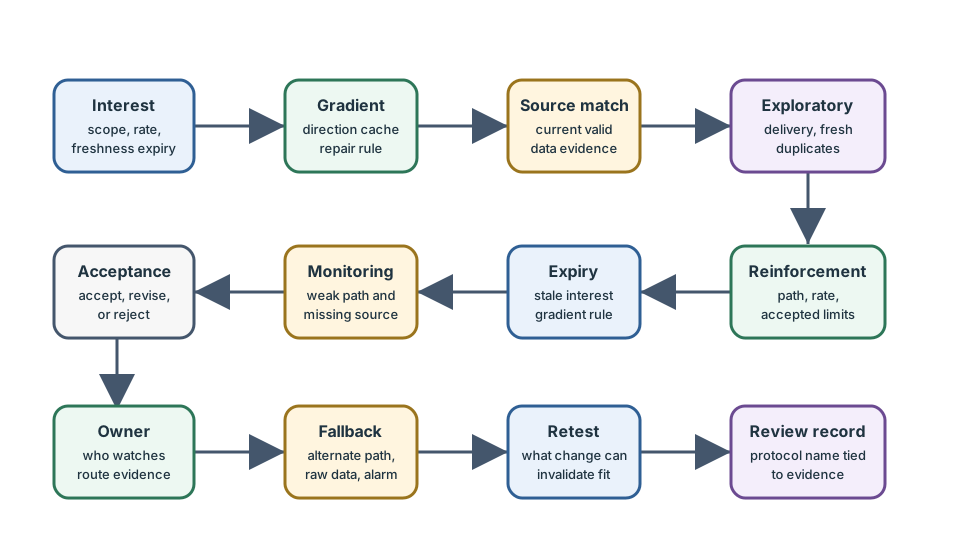
Figure Figure 46.3 records each decision made during directed diffusion. The interest specifies attributes, scope, freshness, rate, duration, quality, and expiry. Gradient state keeps direction, cache, duplicate policy, and repair behavior. Source match shows which nodes qualify. It also checks whether their data is current. Early reports show delivery, freshness, duplicate traffic, relay pressure, and source visibility. Only then can the sink select a path or rate. The operations side names an owner, monitoring signal, fallback, and retest trigger. This record makes the reinforced route reviewable and shows which later change could invalidate it.
Interest: Record attributes, scope, freshness, rate, duration, quality need, and expiry.
Gradient state: Record direction, rate, expiry, cache, duplicate policy, and repair behavior.
Source match: Record which nodes or regions match and what evidence proves the data is current and valid.
Exploratory data: Record path delivery, freshness, duplicate behavior, relay pressure, and source visibility.
Reinforcement: Record the accepted path, rate, or source choice and why close alternatives were rejected.
Operations: Record owner, monitoring signal, fallback action, and retest trigger.
46.15 When Directed Diffusion Fits
This section: When Directed Diffusion Fits — Directed Diffusion fits data-centric workloads best when the sink asks for data attributes or conditions rather than a fixed node address.
Directed Diffusion fits data-centric workloads best when the sink asks for data attributes or conditions rather than a fixed node address.
Do not accept Directed Diffusion just because the chapter names it. Accept it only when the workload is data-centric and the review record proves the assumptions.
46.16 Worked Review: Field Threshold Query
This section: Worked Review: Field Threshold Query — Scenario: A field gateway asks whether any monitored zone has soil moisture below an accepted threshold.
Scenario: A field gateway asks whether any monitored zone has soil moisture below an accepted threshold. The answer is useful only if matching regions, freshness, and missing members are visible.
Interest: Region and threshold query with freshness limit, duration, and explicit stale-data handling.
Gradient evidence: Nodes record reverse direction, expiry, and duplicate suppression for the active interest.
Data evidence: Matching sources preserve zone identity, reading age, quality flag, and missing-zone evidence.
Decision: Accept only if reinforcement is based on delivery, freshness, source visibility, and gateway monitoring rather than one early packet.
46.17 Worked Review: Equipment Event Watch
This section: Worked Review: Equipment Event Watch — Scenario: A building gateway asks for equipment heat or vibration events.
Scenario: A building gateway asks for equipment heat or vibration events. A single valid outlier can matter even if surrounding sensors look normal.
Interest: Condition-based event query with alarm priority and source identity requirement.
Gradient evidence: Exploratory reports compare alternate paths, but gradients must expire if the query or equipment state changes.
Data evidence: Duplicate alarms are controlled, but source identity, event time, and quality evidence remain visible.
Decision: Reject any aggregation or suppression rule that can hide the single event the interest was created to find.
46.18 Common Mistakes
This section: Common Mistakes
46.19 Review Checklist
This section: Review Checklist — interest attributes, scope, freshness, rate, duration, and expiry.
Before accepting Directed Diffusion, verify that the record includes:
interest attributes, scope, freshness, rate, duration, and expiry. gradient direction, rate or quality, cache, duplicate policy, and expiry. source match rule and evidence for current, valid data. exploratory data evidence for path comparison. reinforcement rule and rejected alternatives. aggregation boundary, duplicate handling, and exception path. monitoring signals for stale interests, stale gradients, weak paths, missing sources, and duplicate storms. accepted limits, owner, fallback action, and retest trigger.
46.20 Knowledge Check: Interest and Gradient
This section: Knowledge Check: Interest and Gradient
46.21 Knowledge Check: Reinforcement Evidence
This section: Knowledge Check: Reinforcement Evidence
46.22 Knowledge Check: Reinforcement State
This section: Knowledge Check: Reinforcement State
46.23 Directed Diffusion Terms
This section: Directed Diffusion Terms
46.24 Order the Directed Diffusion Review
This section: Order the Directed Diffusion Review
46.25 Summary
This section: Summary — Directed Diffusion is a data-centric routing pattern that uses interests, gradients, matching sources, exploratory data, and reinforcement.
Directed Diffusion is a data-centric routing pattern that uses interests, gradients, matching sources, exploratory data, and reinforcement. It is useful when the workload is driven by data attributes or conditions, but it must be reviewed like any other routing choice. The accepted record should make interest scope, gradient state, source matching, duplicate handling, aggregation boundaries, reinforcement evidence, expiry, monitoring, owner, fallback action, and retest triggers visible.
46.26 Key Takeaway
This section: Key Takeaway — WSN Directed Diffusion Routing Review should balance path reliability, link quality, energy cost, latency, aggregation, topology change, control overhead, and deployment evidence.
WSN Directed Diffusion Routing Review should balance path reliability, link quality, energy cost, latency, aggregation, topology change, control overhead, and deployment evidence.
46.27 Concept Relationships
This section: Concept Relationships
46.28 What’s Next
This section: What’s Next — Continue with WSN Routing Data Aggregation Review to revisit aggregation boundaries, then use WSN Routing Link Quality to test whether the reinforced path is supported by measured delivery and repair evidence.
Continue with WSN Routing Data Aggregation Review to revisit aggregation boundaries, then use WSN Routing Link Quality to test whether the reinforced path is supported by measured delivery and repair evidence. For broader family fit, return to WSN Routing Protocol Classification Review.
Find help
3 reviewed answers.
Where should I start in a module?
Open the module page from the sidebar to see its chapters in order. Use the module map to return to a topic you need.
Modules and pathsReviewed
What can I try when a project does not work?
Check the symptom, then work through the diagnostic steps. Keep the error message and the smallest example that reproduces it.
When you are stuckReviewed
How do interactive examples work?
Use the interactive guide to check how examples and simulations work before changing your project.
Interactive examples guideReviewed