38 MWSN Environments and Carriers

More
Depth: Practitioner
Progress saves as you read. Mark sections complete as you go; your progress appears in the sidebar.
38.1 Match the Carrier to Its Claim
This section: Match the Carrier to Its Claim — Imagine a sensor rides on a bus while another drifts below the sea.
Imagine a sensor rides on a bus while another drifts below the sea. The team must decide whether each moving carrier can support the same kind of claim. A bus sensor follows a schedule, while an underwater carrier may drift or need a planned mission. Both move, yet their route, contact, power, position, and recovery evidence support different promises. Describe the carrier before claiming field coverage.
38.1.1 Check the Movement Pattern
- Who or what moves the sensor, and can its route be controlled?
- Where and when can it measure or upload?
- What position and clock evidence accompanies the reading?
- Who can recover the carrier or data after a missed contact?
Record the movement pattern, position, observation time, contact window, custody, and recovery owner. For a person or animal carrying a device, include the relevant permission and handling boundary.
38.1.2 When Carriers Are Not Comparable
The same sensor value can support different claims depending on where and when its carrier traveled. A scheduled bus provides an expected route and service window, while a drifting carrier requires evidence of its observed movement and position uncertainty. Neither movement pattern establishes area coverage without connecting observations to the actual path, measurement time, and sensing boundary.
At Practitioner depth, compare controlled, scheduled, and opportunistic movement through their contact and recovery evidence. Controlled movement can support planned rendezvous; scheduled movement needs visible timetable variation and skipped service; opportunistic movement needs observed contacts and explicit uncertainty. Preserve position, clock state, buffer age, custody, and upload timing when comparing readings. A sound sensor value may still describe an uncertain place or arrive too late for the intended decision.
38.1.3 Before Mapping a Moving Reading
Place each observation on the carrier’s actual path before using it as evidence of an area. A gap in position or time can make the sampled place uncertain even if the sensor value itself is sound. State that limit when comparing carriers.
38.2 Start With the Field Story
This section: Start With the Field Story — Mobile WSN environments are not interchangeable.
Mobile WSN environments are not interchangeable. A person, vehicle, animal, robot, or drifting object creates different motion evidence, power assumptions, contact patterns, consent issues, and recovery plans. Name the carrier before trusting the data trail.
38.3 In 60 Seconds
This section: In 60 Seconds — Mobile wireless sensor networks use moving platforms to sense, carry data, relay traffic, or collect readings from fixed nodes.
Mobile wireless sensor networks use moving platforms to sense, carry data, relay traffic, or collect readings from fixed nodes. The platform can be underwater, terrestrial, aerial, vehicle-mounted, robot-mounted, animal-borne, or human-carried, but the review question is the same: does this moving entity produce trustworthy sensing evidence for the decision the system must support?
Mobile-entity review should not start with a favorite platform. It starts with the sensing claim, environment, movement pattern, role, contact opportunity, data custody, freshness limit, safety constraint, privacy boundary, maintenance route, fallback action, and retest trigger. A platform is a good fit only when those items are visible in the evidence record.
38.4 Learning Objectives
This section: Learning Objectives
By the end of this chapter, you will be able to:
- distinguish underwater, terrestrial, aerial, human-carried, vehicle-based, robot-based, and animal-borne mobile sensing contexts
- separate mobile sensor, mobile sink, mobile relay, and Data MULE roles before choosing a platform
- review platform fit using contact evidence, buffer evidence, freshness limits, sensing meaning, operations limits, and maintenance ownership
- identify when uncontrolled mobility, controllable mobility, or scheduled mobility is appropriate
- connect mobile-entity selection to mobile WSN fundamentals, component roles, DTN behavior, mobile sinks, and production deployment
38.5 MWSN Types and Mobile Entities
This section: MWSN Types and Mobile Entities
38.6 Prerequisites
This section: Prerequisites
This chapter builds on Mobile WSN Fundamentals Review, MWSN Nodes, Sinks, and Data MULEs Review, Stationary WSN Fundamentals Review, WSN Human-Centric Sensing, Delay-Tolerant Networks for IoT, and WSN Production Deployment.
If a learner cannot describe sensing claims, mobile roles, contact windows, buffers, freshness, data custody, route evidence, privacy boundaries, and maintenance ownership, review those chapters before accepting a mobile-entity design.
38.7 Review Scope
This section: Review Scope — Mobile WSN type review classifies a moving entity by the evidence it can provide, not by how impressive the platform appears.
Mobile WSN type review classifies a moving entity by the evidence it can provide, not by how impressive the platform appears.
38.8 Mobile Entity Evidence Map
This section: Mobile Entity Evidence Map — Why place decision, place beside freshness here?
Why place decision, place beside freshness here? The figure at Figure 38.1 answers that question and prepares the evidence needed for mobile entity evidence map.
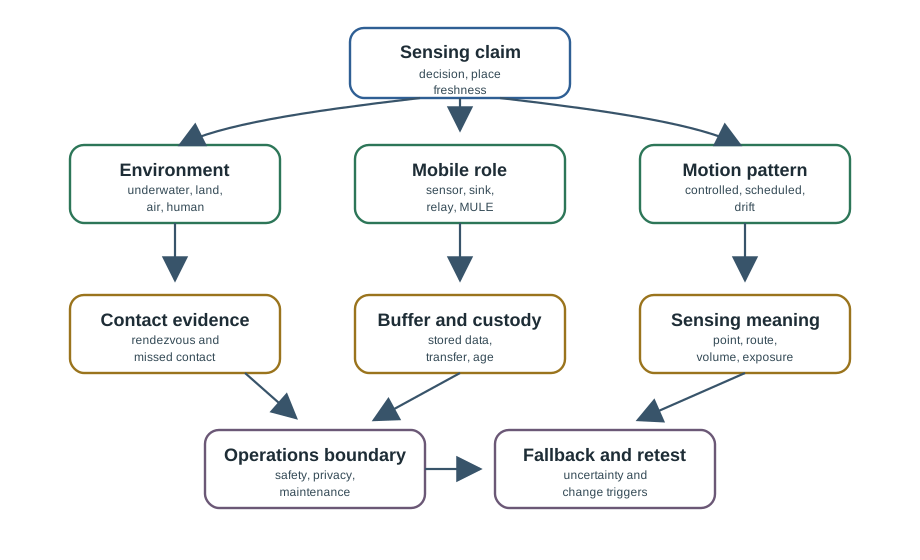
The diagram in Figure 38.1 opens with decision, place, which records the bounded outcome. Its freshness checkpoint sets the timing constraint, before Environment adds a distinct review condition. That sequence gives the visual its meaning: Mobile WSN entity evidence map connecting sensing claim, environment, mobile role, motion pattern, contact evidence, buffer evidence, data custody, freshness limit, operations boundary, fallback, and retest trigger. The same boundary now governs mobile entity evidence map.
The map prevents platform-first drift. A drone, bus, phone, robot, animal tag, or underwater vehicle can be useful only when its movement produces the right evidence at the right time. If contact, buffer, ownership, safety, privacy, or fallback behavior is missing, the platform choice is still unreviewed.
38.9 Mobile WSN Types
This section: Mobile WSN Types — The same mobile role can appear in several environments, but each environment changes the evidence burden.
The same mobile role can appear in several environments, but each environment changes the evidence burden.
38.10 Entity Roles Before Platforms
This section: Entity Roles Before Platforms — An entity type is not enough.
An entity type is not enough. A bus carrying an air sensor is a mobile sensor; a bus collecting packets from roadside nodes is a Data MULE; a drone bridging a disconnected area is a mobile relay. Review the role before reviewing the platform.
38.11 Movement Patterns
This section: Movement Patterns — Movement pattern determines coverage, repeatability, delay, and bias.
Movement pattern determines coverage, repeatability, delay, and bias.
38.12 Carrier Control and Stack Evidence
This section: Carrier Control and Stack Evidence — Carrier control changes the wireless stack because it changes the probability of contact.
Carrier control changes the wireless stack because it changes the probability of contact. A controlled robot, UAV, or AUV can be sent toward a rendezvous area, so sources can use planned wake windows, bounded buffers, missed-visit alarms, and explicit recovery rules. A scheduled bus or inspection round may be predictable enough for guard windows, but the WSN does not own the route, so skipped service and route changes must stay visible. Opportunistic, drifting, and animal-driven carriers need discovery, buffering, custody transfer, duplicate handling, stale-data marking, and a clear uncertainty boundary.
The reason to inspect Figure 38.2 is Carrier Control and Stack Evidence. Its Underwater Mobile Wireless Sensor Network and Satellite elements locate the sequence behind Carrier Control and Stack Evidence precisely.
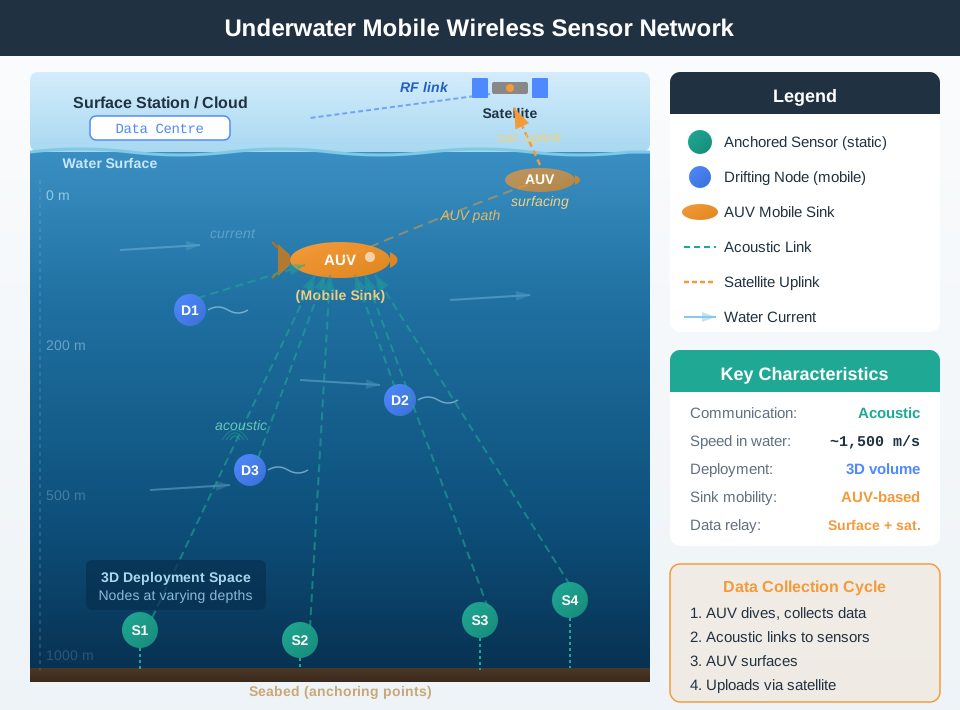
Figure Figure 38.2 follows stored underwater readings through an AUV mobile sink to a surface or cloud path. Anchored and drifting nodes sense below the surface; acoustic contact lets the controlled collector take custody. The AUV’s mission path then leads to surfacing and delayed upload through a surface station or satellite. Each handoff needs proof. Contact can fail, stored readings can age, and a missed visit needs a recovery rule. The section’s carrier table explains why controlled movement can support planned wake windows while drift requires stronger discovery, custody, and uncertainty evidence.
| Control class | MAC and discovery implication | Routing and custody implication | Review proof |
|---|---|---|---|
| Controlled | Sleep until planned rendezvous; use short discovery windows | Collector route and missed-visit alarms can be explicit | Mission log, contact log, buffer margin, abort rule, and recovery owner |
| Scheduled | Wake around service windows with guard time | Timetable defines expected delivery, but skipped service must be handled | Schedule variance, skipped-window rate, stale-data rule, and route-change retest |
| Opportunistic | Use periodic discovery or contact-triggered exchange | Store-carry-forward, duplicate handling, and probabilistic gateway reach dominate | Observed contacts, bias report, buffer pressure, expiry rule, and uncertainty boundary |
| Drifting or animal-driven | Discovery must tolerate long silence and changing neighborhoods | Custody and position uncertainty can dominate routing value | Movement trace, welfare or retrieval rule, clock state, custody, and missing-data meaning |
Environment modifies every row. Underwater systems add acoustic delay, low bandwidth, depth, surfacing upload, recovery, and stale-data marking. Aerial systems add weather, payload, permission, and landing constraints. Human-carried systems add consent, privacy, phone-model variation, and behavior bias. Vehicle systems add route ownership, mounting, power, calibration access, and depot upload. These are not side notes; they decide whether the carrier’s data can support the decision.
38.13 Knowledge Check: Carrier Control
This section: Knowledge Check: Carrier Control
38.14 Platform Fit Evidence Record
This section: Platform Fit Evidence Record — Use Figure 38.3 to test whether a mobile sensing entity can meet the required claim and freshness bound.
Use Figure 38.3 to test whether a mobile sensing entity can meet the required claim and freshness bound.
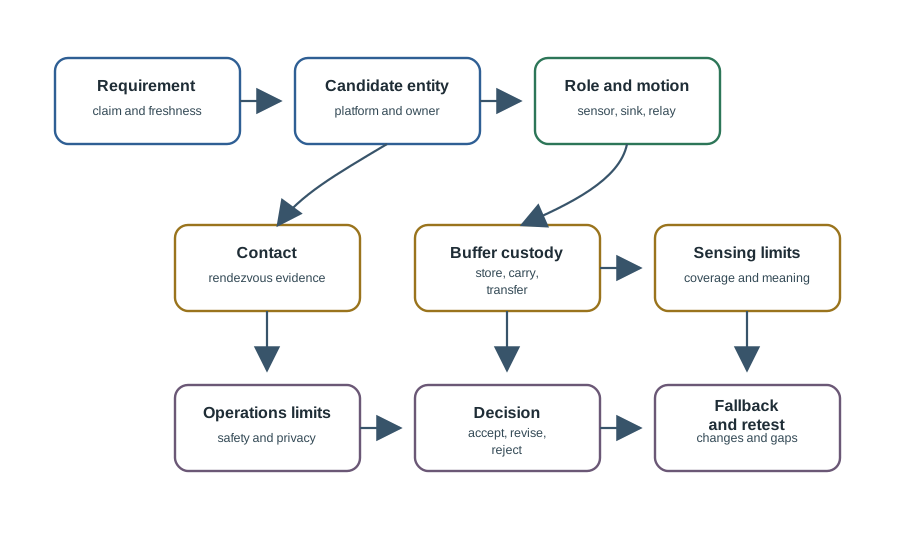
Begin with the required claim and freshness, then name the candidate entity and the role it is expected to perform. Its mobility and contact pattern determine when data can move; buffer evidence shows whether it survives the gaps. Sensing limits and operational limits come next because a feasible route can still fail the measurement or maintenance need. The decision must preserve a fallback for missed contact, overflow, or loss of the mobile entity. Finally, the retest trigger states which change in route, workload, or service bound invalidates the fit decision.
Requirement: Record the sensed condition, decision, location meaning, freshness need, privacy or safety boundary, and tolerated gaps.
Candidate entity: Record platform, environment, role, motion pattern, route or mission plan, sensors, power source, upload path, and maintenance owner.
Evidence: Record contact observations, buffer behavior, data custody, calibration state, mounting effects, coverage gaps, missed-contact handling, and operating limits.
Decision: Accept, revise, or reject the entity for this sensing claim and name the fallback if the entity is unavailable.
Retest trigger: Retest when routes, schedules, payloads, carriers, firmware, gateways, weather exposure, privacy rules, or maintenance ownership changes.
38.15 Reviewing Underwater Entities
This section: Reviewing Underwater Entities — Underwater mobile WSNs often depend on acoustic contact, stored readings, mission plans, and delayed upload.
Underwater mobile WSNs often depend on acoustic contact, stored readings, mission plans, and delayed upload. The review should avoid pretending that underwater mobility behaves like ordinary land radio.
38.16 Reviewing Terrestrial Entities
This section: Reviewing Terrestrial Entities — Terrestrial entities are easier to connect than underwater entities, but mobility still changes data meaning.
Terrestrial entities are easier to connect than underwater entities, but mobility still changes data meaning.
38.17 Reviewing Aerial Entities
This section: Reviewing Aerial Entities — Aerial entities are useful when vertical perspective, rapid reach, or temporary relay position matters.
Aerial entities are useful when vertical perspective, rapid reach, or temporary relay position matters. They are weak when the claim requires continuous presence without a support plan.
38.18 Reviewing Human-Carried Entities
This section: Reviewing Human-Carried Entities — Human-carried sensing can provide rich observations, but the evidence must respect people and interpret mobility honestly.
Human-carried sensing can provide rich observations, but the evidence must respect people and interpret mobility honestly.
38.19 Transit Air-Quality Entity
This section: Transit Air-Quality Entity — Scenario: A city wants corridor-level air-quality trend evidence using sensors mounted on scheduled transit vehicles.
Scenario: A city wants corridor-level air-quality trend evidence using sensors mounted on scheduled transit vehicles.
Requirement: Corridor trend evidence with route meaning, accepted gaps, and a rule for marking streets outside the transit network as unobserved.
Candidate entity: Scheduled transit vehicles acting as mobile sensors and occasional data upload carriers.
Evidence to collect: Route coverage, skipped-route frequency, mounting location, sensor calibration, depot maintenance, upload path, timestamps, and how road work or route changes affect comparability.
Decision logic: Accept the transit fleet for repeated corridor evidence, not for every residential street or continuous point monitoring unless additional evidence supports that claim.
Fallback: Use fixed nodes, service vehicles, manual spot checks, or targeted mobile campaigns for gaps outside the transit route.
38.20 AUV Data Collection Entity
This section: AUV Data Collection Entity — Scenario: Seabed sensors store readings until an autonomous underwater vehicle passes through a planned collection route.
Scenario: Seabed sensors store readings until an autonomous underwater vehicle passes through a planned collection route.
Requirement: Delayed but recoverable underwater readings with known data age, custody, and missed-contact handling.
Candidate entity: AUV acting as a Data MULE and mobile sink for stationary underwater sensors.
Evidence to collect: Mission path, contact depth, acoustic contact log, buffer state, duplicate handling, time stamps, surfacing upload, recovery plan, and stale-data rule.
Decision logic: Accept the AUV if data age and missed-contact behavior fit the decision. Reject it for decisions requiring immediate continuous visibility unless another path provides that evidence.
Fallback: Repeat the mission, use a surface gateway, deploy additional collectors, or mark missing stations uncertain until recovered.
38.21 Worked Review: UAV Temporary Relay
This section: Worked Review: UAV Temporary Relay — Scenario: A field WSN loses gateway reachability in one area, and a UAV is proposed as a temporary relay during inspection periods.
Scenario: A field WSN loses gateway reachability in one area, and a UAV is proposed as a temporary relay during inspection periods.
Requirement: Temporary data recovery for a known partition, with clear limits on when the relay is present and what data can wait.
Candidate entity: UAV acting as a mobile relay and optional mobile sink.
Evidence to collect: Flight path, relay altitude, link evidence to both sides, route recovery, landing state, weather rule, operator ownership, and fallback if flight is unavailable.
Decision logic: Accept only as a scheduled or event-driven recovery path. Do not claim continuous connectivity unless the operation actually provides continuous presence.
Fallback: Add a fixed relay, move a gateway, collect manually, or mark the partition as delayed data.
38.22 Common Mistakes
This section: Common Mistakes
38.23 Review Checklist
This section: Review Checklist — sensing claim, location meaning, freshness limit, tolerated gaps, and decision owner.
Before accepting a mobile WSN type or entity, verify that the record includes:
sensing claim, location meaning, freshness limit, tolerated gaps, and decision owner. environment, mobile role, movement pattern, platform owner, route or mission plan, and sensing payload. contact evidence, buffer evidence, upload path, data custody, duplicate handling, and missed-contact rule. calibration, mounting, exposure, positioning, timestamp, and coverage-boundary evidence. safety, privacy, permission, recovery, maintenance, power, and replacement boundaries. fallback action, accepted limits, uncertainty rule, monitoring owner, and retest trigger.
38.24 Knowledge Check: Entity Role
This section: Knowledge Check: Entity Role
38.25 Knowledge Check: Opportunistic Mobility
This section: Knowledge Check: Opportunistic Mobility
38.26 Match Entities to Review Evidence
This section: Match Entities to Review Evidence
38.27 Order a Mobile Entity Review
This section: Order a Mobile Entity Review
38.28 Summary
This section: Summary — Mobile WSN types and entities are best reviewed as evidence choices.
Mobile WSN types and entities are best reviewed as evidence choices. Underwater, terrestrial, aerial, human-carried, vehicle-based, robot-based, and animal-borne platforms each bring different movement patterns, contact opportunities, sensing meanings, and operations limits.
The strongest review separates environment, entity role, movement pattern, contact evidence, buffer evidence, data custody, freshness, safety, privacy, maintenance, fallback, and retest trigger. A platform is a good fit only when its movement supports the sensing claim without hiding gaps or changing what the data means.
38.29 Key Takeaway
This section: Key Takeaway — MWSN Types and Mobile Entities Review should compare stationary nodes, mobile nodes, sinks, and data MULEs using coverage, latency, buffer pressure, routing cost, energy, and deployment evidence.
MWSN Types and Mobile Entities Review should compare stationary nodes, mobile nodes, sinks, and data MULEs using coverage, latency, buffer pressure, routing cost, energy, and deployment evidence.
38.30 Concept Relationships
This section: Concept Relationships — Mobile WSN Fundamentals Review explains why mobility is used and how freshness, custody, and contact shape the design.
Mobile WSN Fundamentals Review explains why mobility is used and how freshness, custody, and contact shape the design. MWSN Nodes, Sinks, and Data MULEs Review defines the component roles used in this chapter. Stationary WSN Fundamentals Review provides the fixed-placement baseline for comparing mobile alternatives. WSN Human-Centric Sensing and Delay-Tolerant Networks for IoT extend the human-carried and delay-tolerant parts of the review. Mobile Sink Production Deployment applies the same evidence record to production mobile sinks.
38.31 What’s Next
This section: What’s Next — Continue with WSN Production Deployment to review how mobile-entity selection becomes a production deployment process.
Continue with WSN Production Deployment to review how mobile-entity selection becomes a production deployment process.
Find help
3 reviewed answers.
Where should I start in a module?
Open the module page from the sidebar to see its chapters in order. Use the module map to return to a topic you need.
Modules and pathsReviewed
What can I try when a project does not work?
Check the symptom, then work through the diagnostic steps. Keep the error message and the smallest example that reproduces it.
When you are stuckReviewed
How do interactive examples work?
Use the interactive guide to check how examples and simulations work before changing your project.
Interactive examples guideReviewed