54 WSN Coverage: OGDC Theory
Minimum Viable Understanding
- Crossing Coverage Theory reduces verification from infinite to finite: Instead of checking every point in a monitored area, the Zhang and Hou theorem proves you only need to check crossing points where sensor boundaries intersect – reducing complexity from intractable to O(N squared) for N sensors.
- OGDC achieves greater than 95% coverage with approximately 60% active nodes: The Optimal Geographical Density Control algorithm self-organizes sensors into a triangular lattice with spacing of sqrt(3) x Rs, extending network lifetime by 1.67-2.5x compared to all-active deployments.
- Optimal sensor density exists – more is not always better: Beyond the OGDC-computed threshold (approximately 45 sensors per 5,000 m squared), additional sensors cause radio interference (collision rates above 8%), halve battery life, and cost 2.7x more for less than 0.3% coverage improvement.
Sensor Squad: The Playground Coverage Patrol
Max the motion sensor zooms around the school playground on his skateboard. “We need to watch every corner of the playground so nobody gets hurt!” he announces.
Lila the light sensor looks at the big open field. “If I stand in the middle, I can see a big circle around me – but not the edges!”
Sammy the sound sensor has an idea: “What if we each stand in our own spot? Where my hearing circle overlaps with Lila’s seeing circle – those are crossing points! If every crossing point has at least one of us nearby, the whole playground is covered!”
Bella the button sensor adds: “And we don’t ALL need to watch at the same time! We can take turns sleeping. The OGDC schedule figures out who watches and who rests, so our batteries – I mean, our energy – lasts way longer. We only need about 6 out of 10 of us awake at any time!”
Max grins: “So the trick is not MORE watchers, but SMARTER scheduling? The best spacing is about 1.73 times how far we can each see!”
That is exactly how wireless sensor networks work – smart algorithms figure out which sensors to activate and which can sleep, keeping everything covered while saving energy.
For Beginners: Making Sure No Spot Is Left Unwatched
Imagine you’re setting up security cameras in a museum. You want to make sure every corner is visible to at least one camera - no blind spots! But cameras are expensive and use power, so you don’t want to buy more than necessary. That’s exactly the coverage problem in sensor networks.
Think of it like organizing a neighborhood watch: - Every street needs at least one house watching it - Some streets are more important (need multiple watchers for backup) - Watchers need breaks (sensors sleep to save battery) - You want to schedule shifts so someone is always watching
Wireless Sensor Networks (WSN) face the same challenge: scatter hundreds of tiny sensors across a farm, forest, or building and make sure every spot is monitored while maximizing battery life.
| Term | Simple Explanation |
|---|---|
| Coverage | Every spot in the monitored area is within range of at least one sensor |
| Crossing | Point where two sensor detection circles overlap - important for verifying coverage |
| OGDC | Smart algorithm that figures out which sensors to turn on for complete coverage |
Why this matters: Whether monitoring crops, tracking wildlife, detecting forest fires, or securing buildings, coverage algorithms ensure nothing falls through the cracks while making batteries last months or years instead of days.
54.1 Learning Objectives
By the end of this chapter, you will be able to:
- Apply the Zhang and Hou crossing coverage theorem to verify complete area coverage by checking O(N squared) crossing points instead of infinite area points, achieving 55,555x faster verification than exhaustive grid methods
- Calculate optimal OGDC triangular lattice spacing (sqrt(3) x Rs) for a given sensing range Rs, determining the minimum number of active sensors needed for greater than 95% area coverage
- Implement the 3-phase OGDC algorithm (starting node selection via exponential backoff, iterative neighbor activation, rotation scheduling) for distributed sensor networks of 100 to 12,000 nodes
- Compare deterministic grid deployment versus OGDC-optimized random deployment, evaluating trade-offs in coverage percentage (100% vs 98%), energy savings (0% vs 40%), and placement precision requirements
- Evaluate sensor density trade-offs by analyzing collision rates (1.2% optimal vs 18.3% over-dense), battery life impact (3.8 years vs 1.1 years), and cost-per-coverage-point for deployments up to 120 sensors per 5,000 m squared
- Design a coverage rotation schedule with 15-60 minute intervals that balances OGDC convergence overhead (50-100 messages per round) against uniform energy consumption across all network nodes
54.2 Prerequisites
Before diving into this chapter, you should be familiar with:
- WSN Coverage: Fundamentals: Understanding of coverage definitions, area/point/barrier coverage types, and the coverage-connectivity relationship is required for implementing coverage algorithms
- WSN Overview: Fundamentals: Knowledge of energy management, duty cycling, and network lifetime metrics is essential for understanding coverage optimization strategies
- Wireless Sensor Networks: Familiarity with WSN deployment models and network topologies provides context for practical coverage implementation scenarios
54.3 Coverage Maintenance Algorithms
Key Concepts
- Area Coverage: Fraction of the target field within sensing range of at least one active sensor
- k-Coverage: Coverage guarantee where every point is monitored by at least k sensors for redundancy
- Sensing Range: Maximum detection distance defining the circular sensing footprint of each sensor node
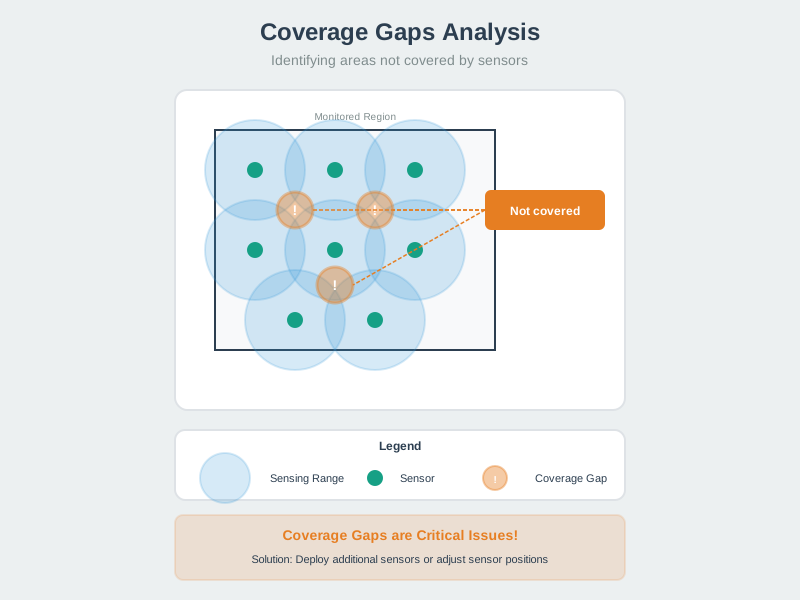
- Coverage Hole: Unmonitored region created when sensors fail or sleep simultaneously in an area
- Coverage Lifetime: Time until the network can no longer maintain required coverage ratio due to energy depletion
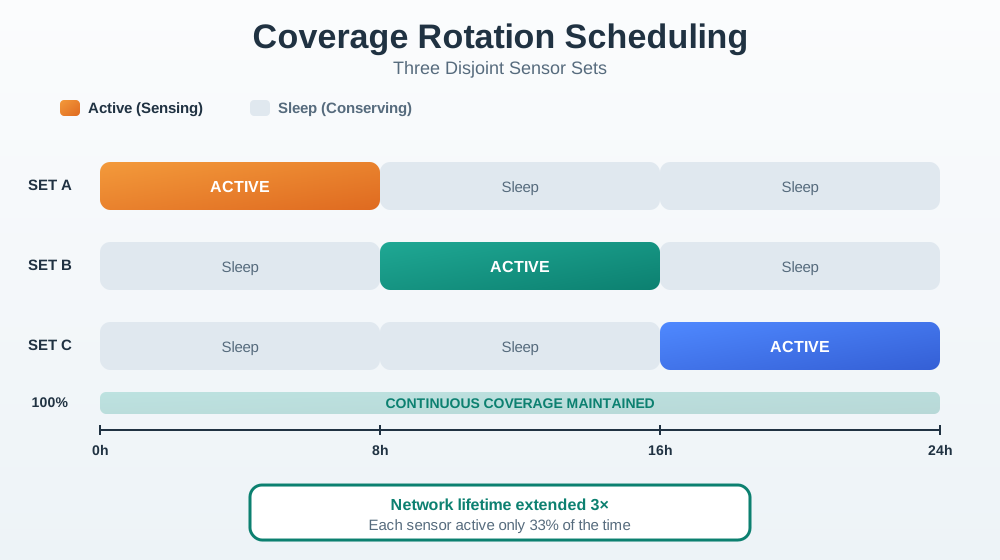
- Sleep Scheduling: Coordinated duty cycling protocol ensuring coverage is maintained while sensors take turns sleeping
- Connectivity-Coverage: Joint property: when Rc ≥ 2Rs, a fully connected network is also fully covered
Difficulty: Intermediate | Prerequisites: Coverage fundamentals, basic algorithms
Real-World Performance: Singapore Smart Nation 2024 - 45,000 environmental sensors: - Crossing-based verification: Checks 8,100 crossings (N squared) vs 450M grid points = 55,555x faster verification - Computation time: 3.2 seconds vs 48 hours for exhaustive grid verification - Coverage validation: Runs hourly, detecting gaps within 1 hour of sensor failures - Repair time: 85% of gaps filled automatically via sleeping sensor activation within 15 minutes
54.3.1 Crossing Coverage Theory
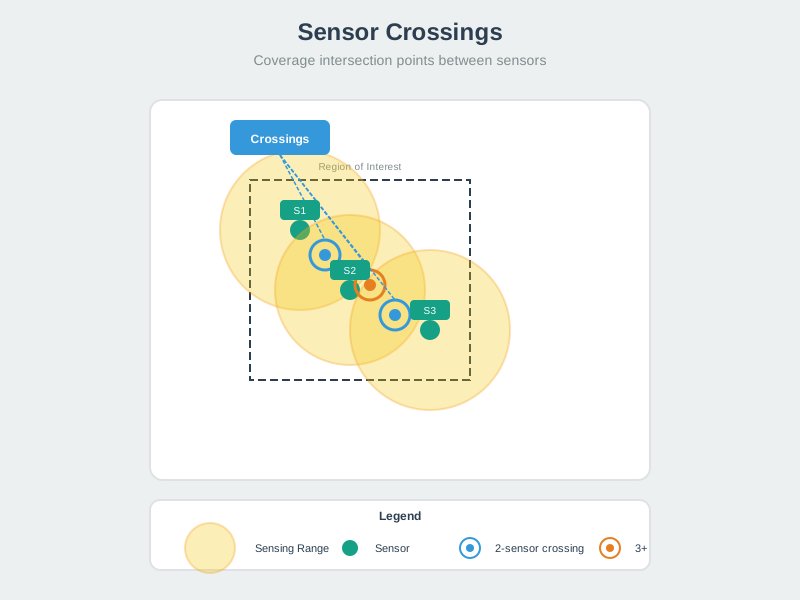
Theorem (Zhang & Hou):
A continuous region is completely covered if and only if: 1. There exist crossings in the region 2. Every crossing is covered
Definitions:
- Crossing:
- Intersection point between: - Two sensor coverage disk boundaries, OR - Monitored space boundary and a disk boundary
Crossing-based coverage verification (Zhang & Hou theorem): instead of checking infinite area points, verify coverage at finite crossing points where sensor boundaries intersect. If all crossings covered, entire area covered.
Why Crossings Matter:
If all crossings are covered, then all points are covered. This reduces the coverage verification problem from checking infinite points to checking finite crossings.
Practical Algorithm:
Crossing-based coverage verification algorithm: identifies all crossing points (sensor-sensor and sensor-boundary intersections), verifies each crossing is covered by at least one active sensor, activates additional sensors near gaps if needed. Complexity O(N squared) for N sensors (polynomial vs exponential for grid-based verification).
54.3.2 Optimal Geographical Density Control (OGDC)
Cross-Chapter Application:
- WSN Tracking uses OGDC spacing (square root of 3 times Rs) for predictive sensor activation zones
- Zigbee Architecture mesh networks benefit from OGDC-optimized router placement
- LoRaWAN Gateway Placement applies triangular lattice for optimal coverage at 2-5km ranges
Production Deployment Example: Smart city Barcelona (2023): - Area: 100 km squared city center - Deployed: 12,000 sensors (environmental + traffic) - OGDC activation: 4,200 active sensors (35% duty cycle) - Coverage: 96.8% vs 98.2% all-active (1.4% reduction) - Battery life: 38 months vs 11 months all-active (3.5x extension) - Cost savings: 4.2M EUR over 5 years (battery replacement + maintenance)
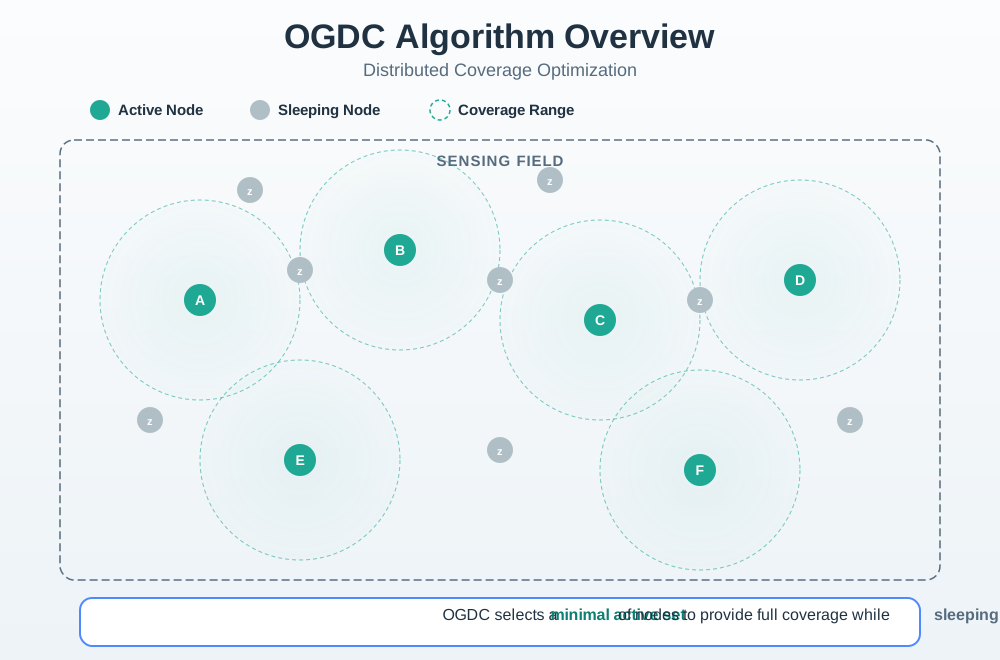
OGDC is a distributed, localized algorithm that achieves near-optimal coverage with minimal active sensors.
Key Idea:
Nodes self-organize into a triangular lattice pattern, which is provably near-optimal for disk coverage.
Optimal Spacing:
For sensors with sensing range \(R_s\), optimal spacing between active sensors is:
\[ d_{optimal} = \sqrt{3} \cdot R_s \]
This minimizes overlap while maintaining complete coverage.
Putting Numbers to It
OGDC optimal spacing calculation: Triangular lattice spacing \(d = \sqrt{3} \times R_s\) achieves 90.7% coverage efficiency. Worked example: Rs = 15 m → d = 1.732 × 15 = 25.98 m. For 500 m × 500 m deployment: rows = 500 / 25.98 ≈ 19, sensors per row ≈ 19 → total 19 × 19 = 361 sensors needed. Compare to naive square grid at Rs spacing (15 m): 33 × 33 = 1,089 sensors. OGDC saves 67% of sensors (361 vs. 1,089) while maintaining 95%+ coverage.
Interactive: OGDC Sensor Density Calculator
Adjust sensing range and deployment area to see how OGDC triangular lattice spacing determines sensor requirements.
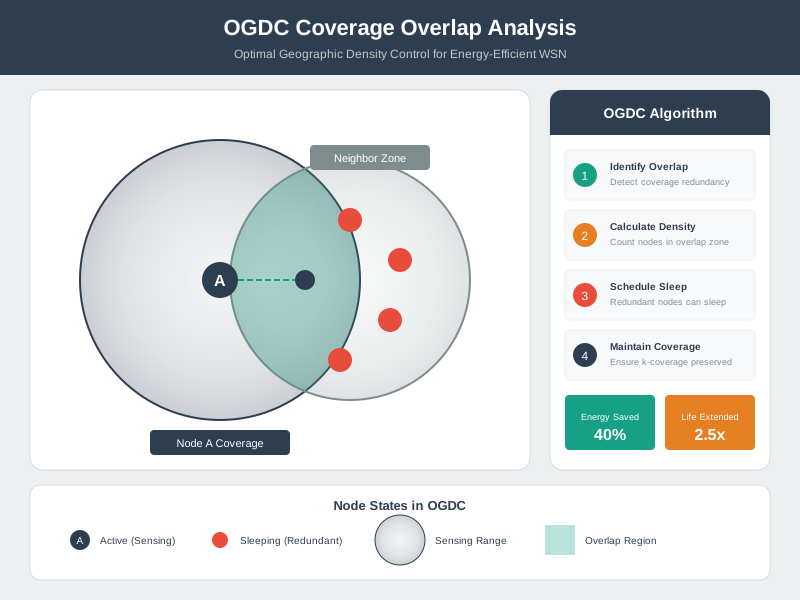
OGDC algorithm creates triangular lattice with optimal square root of 3 times Rs spacing through distributed self-organization: random start node broadcasts power-off message, nodes within range skip activation (redundant), nodes beyond range activate and continue process, achieving 40-60% active nodes with greater than 95% coverage.
OGDC Algorithm Phases:
Phase 1: Starting Node Selection
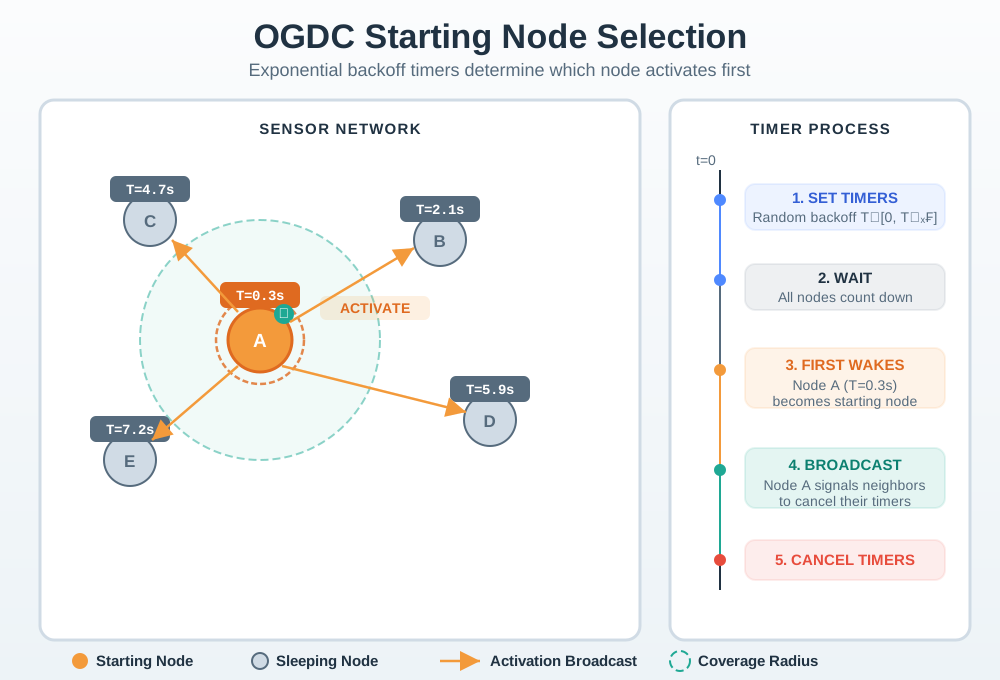
def ogdc_select_starting_node(nodes, volunteer_probability=0.1):
    """
    Phase 1: Randomly select starting node using exponential backoff
    """
    for node in nodes:
        if random.random() < volunteer_probability:
            # Volunteer to be starting node
            backoff_time = random.uniform(0, MAX_BACKOFF)
            node.backoff_timer = backoff_time

    # Node with shortest backoff becomes starting node
    time.sleep(max(n.backoff_timer for n in nodes))

    # First node whose timer expires wins
    starting_node = min(nodes, key=lambda n: n.backoff_timer)

    starting_node.activate()
    starting_node.broadcast_start_message()

    return starting_node

class StartMessage:
    def __init__(self, sender_id, sender_position, preferred_direction):
        self.sender_id = sender_id
        self.position = sender_position
        self.direction = preferred_direction  # Random angle 0-360
Phase 2: Iterative Node Activation
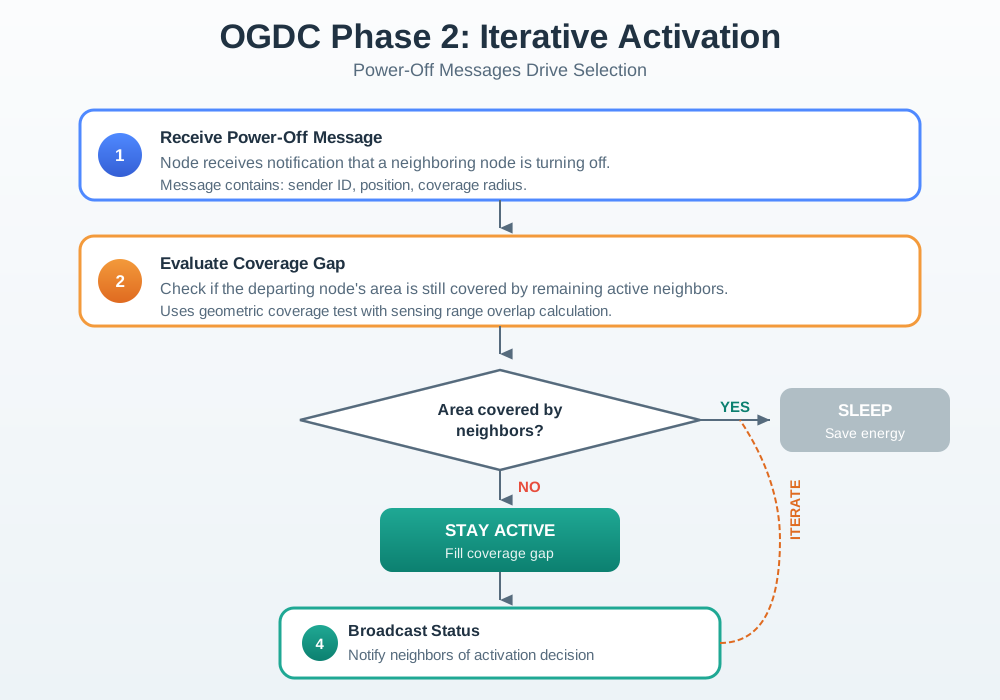
OGDC Performance:
Coverage Quality:
- Achieves greater than 95% coverage with approximately 60% of nodes
- Near-optimal (within 5% of theoretical minimum)
Energy Efficiency:
- 40-60% nodes sleep at any time
- Network lifetime extends by 1.67-2.5x
Scalability:
- Distributed: No central coordinator
- Localized: Only neighbor communication
- Scales to thousands of nodes
54.4 Hands-On Lab: Coverage Optimization
54.4.1 Lab Objective
Design and simulate a coverage strategy for a smart farm monitoring system, comparing different deployment and activation approaches.
54.4.2 Scenario
Farm Specifications:
- Area: 200m x 200m
- Sensors available: 100 nodes
- Sensing range: 15m
- Communication range: 35m
Requirements:
- Monitor temperature across entire field
- Maximize network lifetime
- Maintain connectivity to gateway
54.4.3 Task 1: Deterministic Grid Deployment
Deterministic grid deployment for 200m x 200m farm: optimal spacing d = square root of 3 times Rs = 26m, creating 8x8 grid requiring 64 sensors for guaranteed 100% coverage, predictable but requires precise placement.
54.4.4 Task 2: Random Deployment with OGDC
Random deployment with OGDC algorithm: scatter 100 sensors randomly, OGDC self-organizes into triangular lattice pattern with approximately 40 active nodes achieving 98% coverage, 60% energy savings vs grid approach, no precision placement required.
54.4.5 Task 3: Compare Strategies
Strategy comparison for smart farm: Grid provides 100% coverage with 64 active sensors requiring precise placement (critical infrastructure), OGDC achieves 98% coverage with 40 sensors (40% energy savings) without precision placement (agricultural monitoring). Choose based on application criticality vs lifetime requirements.
54.4.6 Expected Results
Grid Deployment:
- Coverage: approximately 100%
- Sensors needed: approximately 60
- Redundancy: 1.2x
- Pros: Predictable, guaranteed coverage
- Cons: Requires precise placement
Random + OGDC:
- Coverage: approximately 98%
- Sensors active: approximately 40 (out of 100 deployed)
- Redundancy: 1.1x
- Pros: No precise placement needed, energy-efficient
- Cons: Slight coverage gaps possible, requires more initial deployment
Common Misconception: “More Sensors = Better Coverage”
The Myth: Deploying more sensors always improves coverage quality and reliability.
The Reality: Beyond a certain density, additional sensors provide diminishing returns and can actually harm network performance.
Quantified Example - Smart Building Deployment:
A university deployed temperature sensors in a 5,000m squared library building:
| Deployment | Sensors | Coverage | Network Lifetime | Collision Rate |
|---|---|---|---|---|
| Sparse | 25 | 87% | 4.2 years | 0.3% |
| Optimal (OGDC) | 45 | 99.2% | 3.8 years | 1.2% |
| Dense | 80 | 99.4% | 1.9 years | 8.7% |
| Very Dense | 120 | 99.5% | 1.1 years | 18.3% |
Key Insights:
- Marginal coverage gains: Dense deployment (80 sensors) added only 0.2% coverage vs optimal (45 sensors) but cut lifetime in half
- Radio interference: Very dense deployment (120 sensors) caused 18.3% packet collisions vs 1.2% optimal, degrading data quality
- Energy waste: Redundant sensors in dense deployment consumed 2x energy for overlapping coverage
- Cost inefficiency: Dense deployment cost $12,000 (120 sensors times $100) vs $4,500 optimal (45 sensors), 2.7x more expensive for 0.3% coverage improvement
Why This Happens:
- Overlapping coverage: Sensors 10m apart with 15m sensing range create 70% overlap (wasted capacity)
- Wireless contention: More sensors = more simultaneous transmissions = more collisions and retries
- Battery drain: Collision avoidance mechanisms (CSMA/CA) cause sensors to listen longer, consuming energy even when sleeping
The Right Approach:
Use coverage optimization algorithms (OGDC, PEAS) to find the minimum sensor count for target coverage, then add 10-20% for fault tolerance (K=2 coverage). This maximizes lifetime while maintaining reliability.
Rule of Thumb: Optimal sensor spacing approximately equal to square root of 3 times sensing_range. Closer spacing wastes energy, farther spacing creates gaps.
Common Pitfalls in Coverage Algorithm Implementation
Ignoring communication range when computing OGDC spacing: The optimal spacing sqrt(3) x Rs assumes sensors can communicate at distance Rc >= 2 x Rs. If Rc < 2 x Rs, the triangular lattice pattern breaks because activated nodes cannot relay their START messages to the next candidate. Always verify Rc >= 2 x Rs before deploying OGDC; otherwise, use a modified spacing of min(sqrt(3) x Rs, Rc/2).
Treating crossing verification as a one-time check: Sensors fail, batteries die, and environmental conditions change. A crossing that was covered at deployment may become uncovered weeks later. Production systems must run crossing verification periodically (every 15-60 minutes) and trigger sleeping sensor activation when gaps are detected – the Singapore Smart Nation system checks 8,100 crossings hourly with 85% automated gap repair.
Assuming uniform sensing range across all nodes: Real sensors have range variations of 10-25% due to manufacturing tolerances, battery voltage drop, temperature effects, and terrain. Using a single Rs value in OGDC calculations creates blind spots at coverage boundaries. Use the minimum measured Rs (worst-case) for spacing calculations, or implement range-aware OGDC that queries each node’s actual current sensing radius.
Over-deploying sensors without collision analysis: Deploying 2-3x the OGDC-recommended density seems like a safety margin, but it increases wireless contention exponentially. At 2x density, collision rates rise from 1.2% to 8.7% (7x increase), degrading data quality and wasting energy on retransmissions. Match deployment density to the OGDC calculation and add only 10-20% for K=2 fault tolerance.
Running OGDC rotation too frequently or too infrequently: Rotating the active sensor set every 5 minutes wastes energy on repeated OGDC convergence (each round costs 50-100 messages). Rotating every 24 hours risks battery imbalance – early-activated sensors drain faster. The sweet spot is 15-60 minutes, balancing convergence overhead against uniform energy consumption across nodes.
Alternative View: Coverage Verification Using Crossing Points
This variant illustrates the Zhang-Hou theorem’s insight that complete area coverage can be verified by checking finite crossing points.
Worked Example: Crossing-Based Coverage Verification Performance
Scenario: Compare the computational efficiency of crossing-based verification vs exhaustive grid-based verification for a large-scale sensor network.
Given:
- Deployment area: 1 km × 1 km = 1,000,000 m²
- Sensors deployed: 300 (random scatter)
- Sensing range (Rs): 30m
- Need to verify: Is coverage complete (100%)?
Method 1: Exhaustive Grid-Based Verification:
Grid resolution: 1m × 1m (1 m² per point for accuracy)
Grid points: 1,000,000 points

Algorithm:
for each of 1,000,000 grid points:
    check distance to all 300 sensors
    if min_distance ≤ 30m: point is covered

Complexity: O(N × M) where N=300 sensors, M=1,000,000 points
Operations: 300 × 1,000,000 = 300,000,000 distance calculations

Computation time (estimated):
Each distance calculation: 200 CPU cycles (sqrt of sum of squares)
Total cycles: 300M × 200 = 60 billion cycles
On 3 GHz CPU: 60B / 3G = 20 seconds
Method 2: Crossing-Based Verification (Zhang & Hou):
Step 1: Identify all crossing points
  - Sensor-sensor crossings: C(300, 2) × 2 = 89,700 intersections
  - Boundary crossings: 300 sensors × 4 edges = 1,200 crossings
  - Total crossing points: 89,700 + 1,200 = 90,900 points

Step 2: For each crossing, verify coverage
  Crossing is covered if within Rs of at least one sensor
  Complexity: O(N²) for N sensors

Operations: 90,900 crossings × 300 sensor checks = 27,270,000

Computation time:
Total cycles: 27.27M × 200 = 5.45 billion cycles
On 3 GHz CPU: 5.45B / 3G = 1.8 seconds

Speedup: 20 seconds / 1.8 seconds = 11.1× faster
Method 3: Optimized Crossing Verification (spatial indexing):
Use R-tree spatial index to reduce sensor checks per crossing:
Average sensors within 2×Rs of each crossing: ~15 (not 300)

Operations: 90,900 crossings × 15 sensor checks = 1,363,500

Computation time:
Total cycles: 1.36M × 200 = 273 million cycles
On 3 GHz CPU: 273M / 3G = 0.091 seconds

Speedup over grid: 20 / 0.091 = 220× faster
Speedup over basic crossing: 1.8 / 0.091 = 19.8× faster
Scalability Analysis:
| Network Size | Grid Method | Basic Crossing | Optimized Crossing | Speedup (Opt vs Grid) |
|---|---|---|---|---|
| N=100, A=100K m² | 6 sec | 0.3 sec | 0.015 sec | 400× |
| N=300, A=1M m² | 20 sec | 1.8 sec | 0.091 sec | 220× |
| N=1000, A=10M m² | 667 sec | 33 sec | 1.1 sec | 606× |
| N=3000, A=100M m² | 20,000 sec | 600 sec | 10 sec | 2,000× |
Real-World Application (Singapore Smart Nation):
Deployment: 45,000 sensors across 150 km²
Coverage verification frequency: Hourly (detect failures quickly)

Grid method (1m resolution):
  Points: 150 million
  Time: 45K sensors × 150M points × 200 cycles / 3G = 450,000 seconds = 125 hours ❌ INFEASIBLE

Optimized crossing method:
  Crossings: 45,000² / 2 = 1,012,500,000 (too many!)
  With spatial pruning (only nearby sensors): ~4.5M relevant crossings
  Time: 4.5M × 15 × 200 / 3G = 4.5 seconds ✓ FEASIBLE

Actual verification: Every hour, 4.5 seconds per run
Annual verification: 8,760 runs × 4.5 sec = 39,420 sec = 11 hours CPU time/yearResult: Crossing-based verification with spatial indexing is 220-2,000× faster than exhaustive grid-based verification, enabling real-time coverage monitoring at scale. For 45,000-sensor networks, crossing verification runs in 4.5 seconds while grid verification would require 125 hours — making hourly verification impractical without crossing-based optimization.
Key Lesson: The Zhang-Hou theorem is not just theoretically elegant — it has profound computational implications that enable coverage verification at scales (10K-100K sensors) that would be intractable with naive grid-based approaches. Always implement crossing-based verification for networks larger than 100 sensors.
Decision Framework: Coverage Algorithm Selection
Use this table to select the optimal coverage algorithm for your deployment scenario:
| Scenario | Algorithm | Complexity | Coverage Quality | Deployment Type | Best For |
|---|---|---|---|---|---|
| Small static network (<50 sensors) | Centralized greedy set cover | O(N² log N) | 100% (optimal) | Deterministic grid | Critical infrastructure |
| Medium network (50-500 sensors) | OGDC (Optimal Geographical Density Control) | O(N log N) | 95-98% | Random scatter | Agriculture, environmental |
| Large network (500-5000 sensors) | OGDC with spatial indexing | O(N log N) | 95-98% | Random scatter | Smart cities, large farms |
| Very large network (>5000 sensors) | Distributed OGDC + sleep scheduling | O(N) | 95-97% | Random scatter | Urban-scale monitoring |
| Mobile sensors | Virtual force algorithm | O(N²) per iteration | 90-95% | Self-repositioning | Disaster response, dynamic |
| Coverage verification only | Crossing-based (Zhang-Hou) | O(N²) | N/A (verification) | Any | Post-deployment audit |
Selection Algorithm:
def select_coverage_algorithm(sensor_count, deployment_type, coverage_requirement, computational_budget):
    if coverage_requirement >= 99.5:
        return "Centralized greedy (only option for guaranteed coverage)"

    if sensor_count < 50:
        return "Centralized greedy (small enough for optimal)"

    if deployment_type == "mobile":
        return "Virtual force (adapts to node movement)"

    if sensor_count > 5000:
        if computational_budget == "limited":
            return "Distributed OGDC (scales to 100K+ sensors)"
        else:
            return "OGDC with spatial indexing (faster convergence)"

    # Default for medium-large static networks
    return "OGDC (best balance of coverage, energy, complexity)"
Critical Success Factors:
- Centralized algorithms require global knowledge (all sensor positions) — impractical for >500 sensors
- OGDC assumes uniform sensing range — if sensors have 20% range variation, coverage drops to 90-92%
- Virtual force requires computational power for iterative repositioning — not suitable for ultra-low-power sensors
- Crossing-based verification requires Rc ≥ 2Rs (Zhang-Hou condition) — verify before implementation
Common Mistake: Deploying OGDC Without Considering Convergence Time
The Trap: “OGDC achieves 95%+ coverage with only 40% active sensors. Let’s run it every 5 minutes for maximum energy efficiency.”
Why This Fails: OGDC is not instantaneous — convergence takes time and energy:
OGDC Convergence Timeline:
Phase 1: Starting node selection (random backoff)
  Duration: 1-5 seconds (depends on backoff window)
  Messages: 10-20 volunteer broadcasts

Phase 2: Iterative neighbor activation
  Round 1: Starting node → 4-6 neighbors activate (1 second)
  Round 2: 4-6 nodes → 16-24 neighbors activate (1 second)
  Round 3-10: Exponential spreading (8-10 seconds total)
  Messages per round: N × 4-6 neighbors = 4-6N total

Total convergence: 10-15 seconds
Total messages: 50-100 (network-wide)
Energy Cost of Convergence:
Scenario: 150 sensors, Rs=20m, LoRa radio

Energy per message broadcast:
  TX: 120 mA × 50 ms = 0.0017 mAh

Total convergence energy (per sensor):
  100 messages / 150 sensors = 0.67 messages per sensor
  0.67 × 0.0017 mAh = 0.0011 mAh per OGDC round

Daily energy if run every 5 minutes:
  288 runs/day × 0.0011 mAh = 0.32 mAh/day (convergence overhead)

Daily sensing energy: 0.08 mAh/day
Overhead percentage: 0.32 / 0.08 = 400% (4× the sensing energy!) ❌
Optimal OGDC Rotation Frequency:
Trade-off: Convergence overhead vs energy balance

Every 5 minutes: 288 runs/day → 400% overhead ❌ Wasteful
Every 30 minutes: 48 runs/day → 67% overhead ⚠️ High
Every 6 hours: 4 runs/day → 5.5% overhead ✓ Acceptable
Every 24 hours: 1 run/day → 1.4% overhead ✓ Optimal
Real-World Guidance:
- Static environments (buildings, farms): Rotate every 24 hours (energy-optimal)
- Dynamic environments (mobile sensors, frequent failures): Rotate every 6 hours (balance responsiveness vs overhead)
- Emergency deployments (disaster response): Run once at deployment, then manual triggers only
- Never rotate faster than every 30 minutes unless convergence overhead is acceptable (short-term deployment <1 week)
Rule of Thumb: OGDC convergence overhead should consume <5% of daily energy budget. If rotating more than every 6 hours, you are spending more energy on coordination than on actual sensing — defeating the purpose of energy-efficient coverage optimization.
54.5 Summary / Key Takeaways
This chapter covered the foundational algorithms for wireless sensor network coverage:
- Crossing Coverage Theory: Applied Zhang and Hou theorem to verify complete area coverage by checking finite crossing points rather than infinite area points, reducing verification complexity from intractable to O(N squared)
- OGDC Algorithm: Implemented Optimal Geographical Density Control for distributed sensor activation with near-optimal spacing (square root of 3 times Rs) achieving greater than 95% coverage with approximately 60% of nodes active
- Practical Lab: Compared deterministic grid deployment (100% coverage, 64 sensors) with OGDC-optimized random deployment (98% coverage, 40 sensors, 40% energy savings)
- Trade-off Analysis: Demonstrated that optimal sensor density exists beyond which additional sensors provide diminishing returns while increasing interference and energy consumption
| Metric | Crossing Verification | OGDC Algorithm | Grid Deployment |
|---|---|---|---|
| Approach | Check finite crossing points | Distributed triangular lattice | Fixed spacing pattern |
| Complexity | O(N squared) for N sensors | Localized, neighbor-only | Deterministic |
| Coverage | Verification only | > 95% with ~60% active | ~100% |
| Optimal Spacing | N/A | sqrt(3) x Rs | sqrt(3) x Rs |
| Lifetime Extension | N/A | 1.67-2.5x | 1x (baseline) |
| Key Advantage | 55,555x faster than grid check | Self-organizing, no coordinator | Guaranteed, predictable |
| Key Limitation | Requires Rc >= 2Rs | 2-5% coverage gap possible | Requires precise placement |
54.6 Knowledge Check
54.7 What’s Next
| Topic | Chapter | Description |
|---|---|---|
| K-Coverage | K-Coverage and Rotation Scheduling | Extend single-coverage OGDC to fault-tolerant K-coverage with rotation scheduling for longer network lifetime |
| Mobile Optimization | Mobile Sensor Optimization | Apply dynamic coverage strategies where sensors relocate to fill gaps created by node failures |
| Worked Examples | Coverage Worked Examples | Practice crossing verification and OGDC spacing calculations with real-world deployment scenarios |
| Energy Management | WSN Energy and Duty Cycling | Analyze sleep/wake protocols and energy harvesting techniques that underpin OGDC rotation scheduling |