28 WSN Coverage: Problem Types

More
Depth: Practitioner
Progress saves as you read. Mark sections complete as you go; your progress appears in the sidebar.
28.1 Start With the Field Story
This section: Start With the Field Story — Do not treat coverage as one shape.
Do not treat coverage as one shape. Area, point, barrier, path, and hybrid problems each tell a different field story, so the review begins by naming the objective before choosing formulas or algorithms.
28.2 In 60 Seconds
This section: In 60 Seconds — WSN coverage problem types describe what must be sensed.
WSN coverage problem types describe what must be sensed. Area coverage asks whether a continuous region is monitored. Point coverage asks whether named targets are monitored. Barrier coverage asks whether a boundary crossing will be detected. Path coverage asks whether a route or corridor is monitored. Hybrid coverage combines types when one formulation cannot express the real requirement.
Choosing the wrong type causes quality drift. A perimeter problem can become an expensive area problem. A few valve targets can become a vague facility-wide claim. A route-monitoring problem can be mistaken for full-area coverage. Start with the monitoring objective, then select the coverage type that matches the evidence you can actually collect.
28.3 Learning Objectives
This section: Learning Objectives
By the end of this chapter, you will be able to:
- Distinguish area, point, barrier, path, and hybrid WSN coverage problems.
- Translate a monitoring objective into the right coverage formulation.
- Explain how redundancy and active operating state change the meaning of a coverage claim.
- Identify evidence needed to accept each coverage type in a deployed WSN.
- Avoid common problem-type mistakes that waste sensors or overstate protection.
28.4 Quick Check: WSN Coverage: Problem Types
This section: Quick Check: WSN Coverage: Problem Types
28.5 Coverage Type Starts With the Objective
This section: Coverage Type Starts With the Objective — Do not begin with a sensor count.
Do not begin with a sensor count. Begin by asking what missed event would matter.
28.6 Selection Route
This section: Selection Route — Evidence for Selection Route starts in Figure 28.1.
Evidence for Selection Route starts in Figure 28.1. Look at Monitoring objective beside Area before accepting WSN coverage problem type selection route.
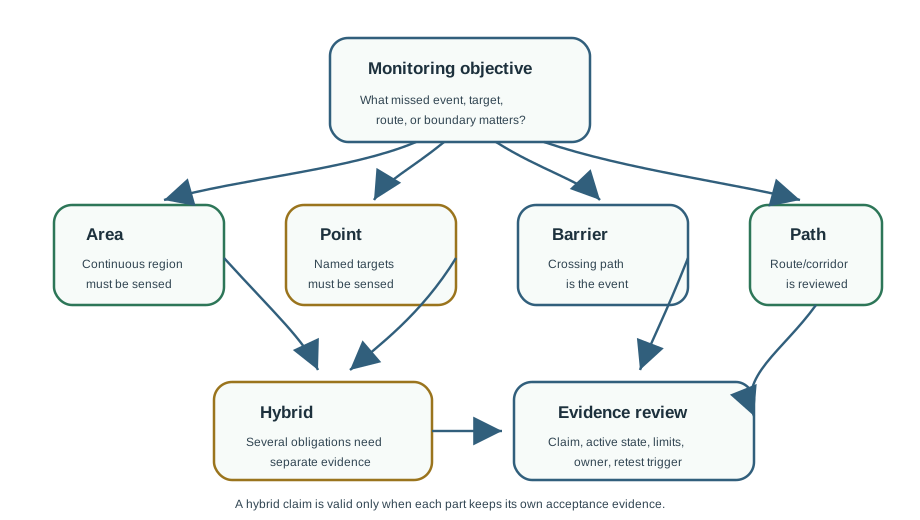
Figure Figure 28.1 starts with the monitoring objective: what event, target, route, or boundary must be observed? A continuous region needs area coverage. Named targets need point coverage. A crossing needs barrier coverage. A route or corridor needs path coverage. A hybrid case carries several obligations, each with its own acceptance evidence. The final review records the claim, active state, known limits, owner, and retest trigger. This route helps the team select the right kind of proof before choosing sensors or algorithms; it does not rank one coverage type above another.
The route is not a ranking. Area coverage is not automatically better than point or barrier coverage. The best type is the one that states the required protection without pretending to monitor things the design cannot prove.
28.7 Area Coverage
This section: Area Coverage — Area coverage is used when the event can occur anywhere in a continuous region.
Area coverage is used when the event can occur anywhere in a continuous region.
Area coverage is often the broadest and most demanding type. It should be chosen because the whole region matters, not because it sounds more complete.
28.8 Point Coverage
This section: Point Coverage — Point coverage is used when the requirement names discrete targets.
Point coverage is used when the requirement names discrete targets.
Point coverage can be efficient and accurate when the important locations are known. It becomes weak when the target list is incomplete or when the chapter silently implies area protection.
28.9 Barrier Coverage
This section: Barrier Coverage — Barrier coverage is used when crossing a boundary is the event of interest.
Barrier coverage is used when crossing a boundary is the event of interest.
Barrier coverage should say what type of crossing it is meant to detect. A design that only checks the obvious straight crossing can miss corners, service gates, and paths around obstructions.
28.10 Path Coverage
This section: Path Coverage — Path coverage is used when sensing quality matters along a route rather than across an entire area.
Path coverage is used when sensing quality matters along a route rather than across an entire area.
Path coverage is useful when a learner needs to reason about movement, inspection, or monitoring continuity along a route. It should state whether missed events between route points are acceptable.
28.11 Hybrid Coverage
This section: Hybrid Coverage — Hybrid coverage is used when one coverage type cannot express the requirement.
Hybrid coverage is used when one coverage type cannot express the requirement.
Example: A storage site may need point coverage at tanks, barrier coverage at the fence, and path coverage along loading aisles.
Review rule: Each coverage type should keep its own claim and evidence. Do not hide several different obligations behind one broad phrase such as "full coverage."
Risk: Hybrid designs drift when a reviewer approves the strongest-looking diagram but does not check whether every part of the hybrid claim has its own validation evidence.
28.12 Evidence Record
This section: Evidence Record — Before applying Evidence Record, view Figure 28.2 and compare WSN Coverage Problem Type Evidence Record with Objective.
Before applying Evidence Record, view Figure 28.2 and compare WSN Coverage Problem Type Evidence Record with Objective. Their relationship makes WSN coverage problem type evidence record reviewable.
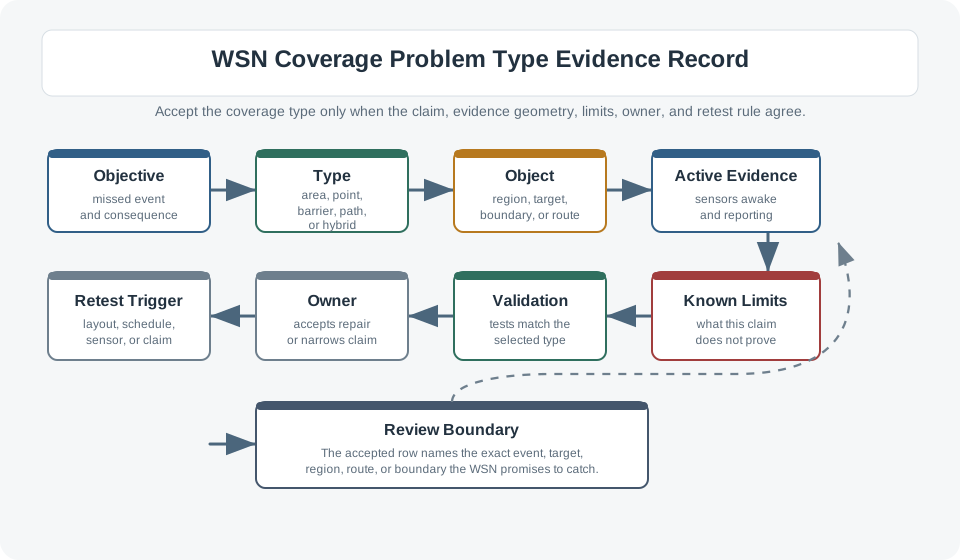
Figure Figure 28.2 turns the selected type into an auditable claim. The objective names the missed event and its consequence. Type and object then state whether the promise concerns a region, target, boundary, or route. Active evidence counts sensors that are awake and reporting, while validation tests must match that selected type. Known limits say what the result does not prove. The owner can accept repair work or narrow the claim, and the retest trigger catches changes in layout, schedule, sensor, or requirement. The accepted row should name exactly what the network promises to catch.
This record also helps later chapters. Algorithms, implementation plans, and worked examples can only be meaningful after the problem type is clear.
28.13 Redundancy and Active State
This section: Redundancy and Active State — Coverage type answers what must be sensed.
Coverage type answers what must be sensed. Redundancy answers how many independent sensing opportunities are required. Active state answers which sensors count during the reviewed operating condition.
Redundancy should be written as a requirement, not implied by a dense drawing. If a sleeping schedule removes the backup sensor, the accepted redundancy may not exist during operation.
28.14 Worked Review: Storage Yard
This section: Worked Review: Storage Yard — A site manager says, “We need coverage for the storage yard.” That phrase is too broad to approve.
A site manager says, “We need coverage for the storage yard.” That phrase is too broad to approve.
Area interpretation: Detect abnormal conditions anywhere inside the yard. This requires evidence across the whole region.
Point interpretation: Detect abnormal conditions at named tanks and valve groups. This requires a complete target list and sensor-to-target mapping.
Barrier interpretation: Detect gas or motion crossing the perimeter. This protects the boundary but does not prove internal source detection.
Hybrid interpretation: Monitor tanks as points, fence crossings as a barrier, and loading lanes as paths. This may be the best fit, but each part needs its own evidence.
The review should ask the manager which missed event matters. The answer determines the problem type.
28.15 Worked Review: Building Access
This section: Worked Review: Building Access — A building team places sensors near several doors and then labels the design “floor coverage.” That wording overclaims the design.
A building team places sensors near several doors and then labels the design “floor coverage.” That wording overclaims the design.
Better claim: The design provides point coverage for named access points.
Evidence needed: Door list, sensor placement, detection test at each door, active state during occupied and unoccupied periods, and gateway reachability.
Known limit: The design does not monitor open office space, corridors away from doors, or movement after entry unless additional area or path coverage is added.
Changing the claim from “floor coverage” to “access-point coverage” improves quality because it matches the evidence.
28.16 Common Problem-Type Mistakes
This section: Common Problem-Type Mistakes
28.17 Review Checklist
This section: Review Checklist — What event, target, route, region, or boundary must be sensed?
Before approving a WSN coverage problem type, verify that the record answers these questions:
What event, target, route, region, or boundary must be sensed? Which coverage type matches that objective? What evidence would prove that the selected type is satisfied? Which sensors count in the active operating state? Is redundancy required, and is it present while the network is operating? What parts of the site are explicitly outside the claim? Does the selected type need to be combined with another type? What condition forces the problem type or claim to be reviewed again?
28.18 Knowledge Check: Type Selection
This section: Knowledge Check: Type Selection
28.19 Knowledge Check: Avoiding Overclaim
This section: Knowledge Check: Avoiding Overclaim
28.20 Matching: Coverage Problem Types
This section: Matching: Coverage Problem Types
28.21 Ordering: Coverage Type Review
This section: Ordering: Coverage Type Review
28.22 Problem-Type Contract
This section: Problem-Type Contract — The body chapter names area, point, barrier, path, and hybrid coverage.
The body chapter names area, point, barrier, path, and hybrid coverage. The deeper review is to treat each type as a contract about the missed event that would make the deployment fail. Area coverage fails when an accepted part of the region is outside the sensing condition. Point coverage fails when a named target lacks accepted sensing evidence. Barrier coverage fails when a crossing path can evade the belt. Path coverage fails when the route segment or movement window is not supported. Hybrid coverage fails when one of its separate subclaims is hidden inside a broad label.
Do not reduce problem-type contract to a single headline metric. The visual in Figure 28.3 brings What missed event matters? and Area into the same frame, ready for the evidence comparison that follows.
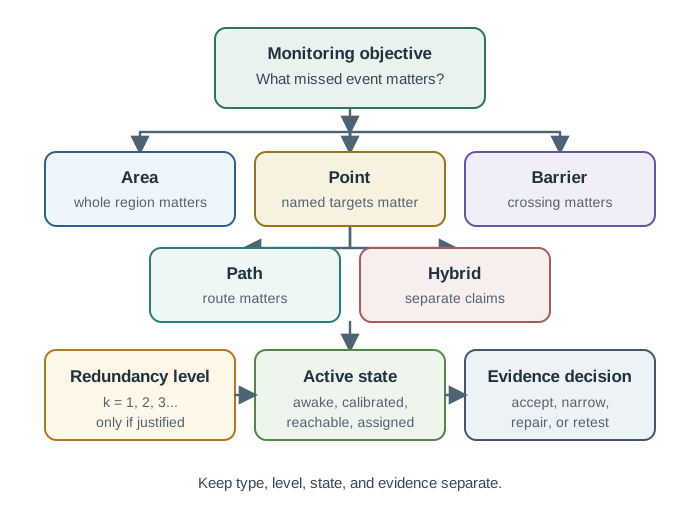
On the figure at Figure 28.3, read What missed event matters? as the point that adds a distinct review condition; Area then fixes the spatial boundary. The separate whole region matters label fixes the spatial boundary, preventing the first two stages from being accepted on their own. The complete reading is that wireless sensor network coverage type decision map linking monitoring objective to area, point, barrier, path, hybrid, redundancy level, active state, and evidence decision. This distinction carries forward into problem-type contract.
Use the decision map as a contract check: the selected type controls the redundancy level, active state, and evidence decision that can be accepted.
This is why the selected type must appear before node counts or algorithms. A dense point design still does not prove interior area coverage. A clean barrier chain still does not prove what happens after entry. A route plan still does not cover storage racks away from the path. The problem type is the smallest honest sentence that names what the network promises to catch and what it explicitly leaves outside the claim.
The contract should also name the review boundary. A claim can be valid for the north fence, the loading aisle, or the twelve valves while being silent about the rest of the site. That silence is not a defect if it is visible. It becomes a defect only when the chapter lets a narrow claim sound like a broad one.
28.23 Split Hybrid Coverage Claims
This section: Split Hybrid Coverage Claims — Most field requests arrive as informal language: “cover the yard,” “watch the line,” “protect access,” or “monitor the route.” The reviewer should not translate that phrase into one large drawing.
Most field requests arrive as informal language: “cover the yard,” “watch the line,” “protect access,” or “monitor the route.” The reviewer should not translate that phrase into one large drawing. First split it into claim units, then decide whether each unit is area, point, barrier, or path coverage. Only after that split should the team count sensors, choose redundancy, or pick an algorithm.
| Field phrase | Likely hidden claims | Review action |
|---|---|---|
| “Cover the yard.” | Temperature region, named tanks, fence crossing, loading-lane path. | Split into area, point, barrier, and path rows; accept or reject each row separately. |
| “Watch the pipeline.” | Named valves, corrosion-prone joints, service road, right-of-way boundary. | Keep point targets separate from path and barrier obligations. |
| “Protect the building.” | Door points, restricted-zone barrier, occupied-area environmental region. | Prevent door sensors from being described as full floor coverage. |
| “Monitor robot movement.” | Route handoff, charging point, exclusion boundary, weak wireless segment. | Define path coverage first, then add point or barrier claims only when evidence supports them. |
The practical mistake is letting the strongest-looking subclaim lend credibility to the others. A clear fence test does not validate tank monitoring. A full target list does not validate route timing. A route pass during the day does not validate a night rotation. For a hybrid claim, each subclaim needs its own monitored object, active state, validation evidence, known limit, owner, and retest trigger. The result may look less impressive than one large map, but it is much easier to repair because each failing obligation is visible.
After the split, use separate acceptance verbs. Accept a tank target list, narrow a fence claim to the tested gates, repair an aisle handoff, and retest a region after layout change. Separate verbs keep the review operational.
If a phrase cannot be split into claim units, it is not ready for placement or algorithm work. Ask which missed event matters, then choose the narrowest type that proves that event.
28.24 Problem Types Change Geometry
This section: Problem Types Change Geometry — Problem type changes the geometry of proof.
Problem type changes the geometry of proof. Area coverage samples or bounds a two-dimensional region. Point coverage evaluates a finite target set. Barrier coverage evaluates crossing paths through a boundary or belt. Path coverage evaluates route segments over time. Hybrid coverage combines several geometries that must remain separate. This is why the same physical sensors can be overbuilt for one problem and under-proven for another.
The difference is not only cost; it is also evidence shape. For area coverage, the evidence should expose holes, edge cases, obstructions, and active-state gaps in the region. For point coverage, the evidence should prove the target list is complete and each target has accepted sensing. For barrier coverage, the evidence should include likely crossings, gates, corners, and bypass paths. For path coverage, the evidence should include direction, speed, dwell time, handoff, and the operating window. If the evidence shape does not match the type, the acceptance record is not reliable.
A useful way to audit the geometry is to ask what must be enumerated. Area coverage enumerates samples or cells in a region. Point coverage enumerates named targets. Barrier coverage enumerates representative crossing paths and weak segments. Path coverage enumerates route segments and time windows. Hybrid coverage enumerates the subclaims and keeps their evidence separate. The enumeration tells the reviewer what can be counted, what can be missed, and which algorithm family is appropriate later. That is where problem type becomes an audit tool, not a label.
28.24.1 Knowledge Check: Evidence Geometry
28.25 Summary
This section: Summary — Coverage problem types keep WSN design honest.
Coverage problem types keep WSN design honest. Area coverage is for continuous regions, point coverage is for named targets, barrier coverage is for crossings, path coverage is for routes, and hybrid coverage is for requirements that need more than one type.
The quality rule is to match the claim to the evidence. If the evidence only proves points, do not call it area coverage. If it proves a boundary crossing, do not call it interior monitoring. If it combines several obligations, keep each one visible.
28.26 Key Takeaway
This section: Key Takeaway — WSN Coverage: Problem Types should connect coverage goals to sensing model, placement density, redundancy, obstacles, energy use, mobility, and deployment evidence.
WSN Coverage: Problem Types should connect coverage goals to sensing model, placement density, redundancy, obstacles, energy use, mobility, and deployment evidence.
28.27 Concept Relationships
This section: Concept Relationships — WSN Coverage: Fundamentals explains how coverage claims begin.
WSN Coverage: Fundamentals explains how coverage claims begin. WSN Coverage Algorithms explains how selection and maintenance algorithms support accepted claims. WSN Coverage Worked Examples applies coverage-type selection to concrete scenarios. WSN Coverage Implementations turns the selected type into placement, active-set, validation, and retest decisions.
28.28 What’s Next
This section: What’s Next — WSN Coverage Algorithms for verification, active-set, rotation, and gap-repair algorithm families.
WSN Coverage Algorithms for verification, active-set, rotation, and gap-repair algorithm families. WSN Coverage Worked Examples for applying problem-type selection to concrete scenarios. WSN Coverage Implementations for implementation patterns after the type is clear.
Find help
3 reviewed answers.
Where should I start in a module?
Open the module page from the sidebar to see its chapters in order. Use the module map to return to a topic you need.
Modules and pathsReviewed
What can I try when a project does not work?
Check the symptom, then work through the diagnostic steps. Keep the error message and the smallest example that reproduces it.
When you are stuckReviewed
How do interactive examples work?
Use the interactive guide to check how examples and simulations work before changing your project.
Interactive examples guideReviewed