41 Delay-Tolerant Networks for IoT

More
Depth: Practitioner
Progress saves as you read. Mark sections complete as you go; your progress appears in the sidebar.
41.1 In 60 Seconds
This section: In 60 Seconds
41.1.1 Let Data Wait Without Losing Its Story
A park ranger walks past remote river monitors once each week. There is no continuous path from the valley to the office. Each monitor can store a reading, the ranger’s device can carry it, and the office can receive it later. The useful question is whether that delay still supports the environmental decision.
Name the claim before choosing this pattern. State the oldest acceptable reading, which events may expire, how much can be stored, who carries custody, and how copies are recognized. Keep source, event time, unit, quality, and expiry with every reading. Urgent danger that cannot wait needs another local or immediate path.
Then disturb the contact plan. Miss one ranger visit. Fill a monitor’s storage. Repeat a transfer. Change the carrying device’s clock. Deliver an older copy after a newer one. Check loss, order, duplicates, energy, and the visible age at the office. Record who follows up when an expected contact does not occur.
Carry-later delivery cannot promise a live path or a fixed arrival time without measured contact evidence. It is honest when the decision can wait and the record preserves meaning. The deeper sections compare direct, limited-copy, flooding, and history-based forwarding, plus custody, storage, safety, and security limits.
The field record should answer: What can wait? How long can it wait? What must never wait? Who carries the data? When is contact expected? How much can each device hold? Which copy is the first useful copy? When does a record expire? Who investigates a missed visit? What safe action stays at the source?
Use a calendar as part of the test. Miss one planned contact. Arrive early. Arrive late. Use a different ranger. Lose one carrying device. Fill one store. Restore an old copy. Check whether the office sees source time rather than carry time. Check whether a duplicate changes a report. Keep the missed-contact alert separate from the delayed science record.
The strongest design admits where waiting is safe and where it is not. A weekly water trend may survive. A fire warning may not. Put urgent action near the event or provide another path. Use carry-later delivery for evidence whose value remains after the measured delay, and test that claim again when routes or seasons change.
A delay-tolerant network lets a WSN or IoT system move data even when no end-to-end path exists at the moment the data is created. A node stores the message, a person, vehicle, animal, robot, buoy, or mobile sink carries it through the environment, and the message is forwarded when a useful contact occurs.
Good DTN review starts with the monitoring claim. The claim should say what delay is acceptable, what data can expire, which contacts are expected, how buffers are protected, which routing rule controls copies, who owns missed contacts, and what evidence proves the system is not silently losing stale or duplicated readings.
41.2 Learning Objectives
This section: Learning Objectives
By the end of this chapter, you will be able to:
- Explain store-carry-forward as a WSN evidence claim rather than a slogan.
- Decide when a DTN pattern fits better than continuous multi-hop routing or always-on backhaul.
- Compare direct delivery, limited-copy forwarding, flooding, and history-informed forwarding without overclaiming their results.
- Review contact, buffer, custody, freshness, duplicate, energy, and security evidence for a DTN deployment.
- Build a DTN evidence record with an owner, accepted delay, known limits, and retest triggers.
41.3 Delay-Tolerant IoT Networks
This section: Delay-Tolerant IoT Networks
41.4 Start With the Delay Claim
This section: Start With the Delay Claim — The first review question is not “which DTN protocol?” It is “what delay can the sensing decision tolerate?” DTN is useful only when the decision can wait for intermittent contact.
The first review question is not “which DTN protocol?” It is “what delay can the sensing decision tolerate?” DTN is useful only when the decision can wait for intermittent contact. A soil trend, wildlife track, maintenance log, or remote clinic batch can often wait. A fire alarm, hazardous gas alert, active safety interlock, or emergency shutdown usually cannot.
If the system cannot state those boundaries, it is not ready for a DTN claim. It may still be a useful experiment, but the learner should not accept it as a reliable production design.
41.5 DTN Review Route
This section: DTN Review Route — To challenge DTN Review Route, examine the visual at Figure 41.1.
To challenge DTN Review Route, examine the visual at Figure 41.1. Its Data and Claim labels reveal WSN delay-tolerant network review route.
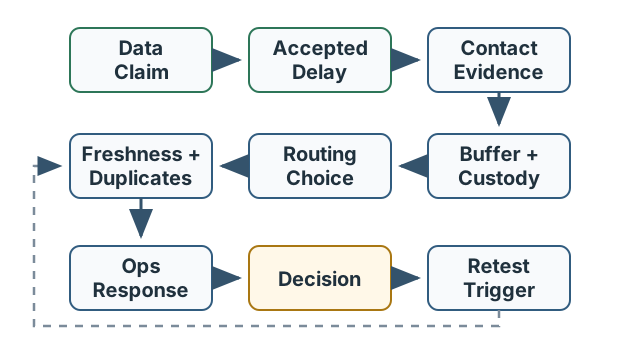
Figure Figure 41.1 follows a river reading that waits for a ranger’s weekly visit. The data keeps source time, unit, quality, and expiry while the buffer preserves a retryable copy until custody is confirmed. A missed visit can turn a one-week wait into two weeks, so freshness must use the measurement time rather than the carry time. Contact duration and usable bytes test whether a transfer can finish. The office may accept delayed water trends, but an urgent fire warning needs another path. A named owner handles missed contacts, and route or payload changes trigger a new review.
The route is a loop. A changed route schedule, new carrier behavior, firmware update, gateway move, larger payload, shorter reporting deadline, new data sensitivity, or missed-contact incident can reopen the decision.
41.6 Store-Carry-Forward Evidence
This section: Store-Carry-Forward Evidence — The next Store-Carry-Forward Evidence step depends on DTN store-carry-forward sequence.
The next Store-Carry-Forward Evidence step depends on DTN store-carry-forward sequence. Read Figure 41.2 first, focusing on Store-Carry-Forward in a DTN and Store.
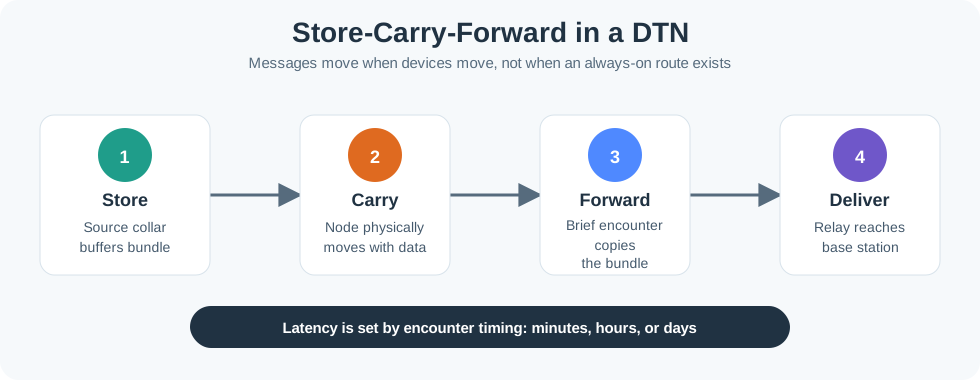
Figure Figure 41.2 separates four events that a continuous link would hide. The source collar stores a bundle until a mobile node arrives. That node carries the data as it moves, then copies it during a brief encounter. A relay later delivers it to the base station. Encounter timing can stretch latency from minutes to days, so delivery alone does not prove the reading is fresh enough for the decision. The section’s review must also check buffer capacity, custody receipt, and age from the original measurement, since each stage can fail independently.
The budget starts at sampling time, not upload time. A record can spend time waiting in the source buffer, waiting for a carrier contact, transferring during a short encounter, waiting in the carrier buffer, waiting for gateway contact, and waiting for backend processing. A successful transfer can still fail the sensing claim if the record is too old for the decision.
Keep three ages separate during review. Measurement age is the time since the sensor observed the condition. Custody age is the time since the current holder accepted responsibility for the message. Dashboard age is the time since the backend last received or displayed the record. A wildlife-movement study may tolerate large measurement age for historical analysis, while a trail safety dashboard may tolerate old custody age only for archive review. Each claim needs a named age limit.
Store-carry-forward has three evidence points. Each point can fail independently.
A DTN design can look good on paper while failing because contact time is too short, the carrier bypasses a stop, a buffer fills before the next visit, the gateway clock drifts, or a node deletes data after an unverified handoff. The review should make those failure modes visible.
41.7 Intermittent Contact Routing
This section: Intermittent Contact Routing — DTN forwarding rules trade delivery confidence against storage, airtime, energy, duplicate work, and privacy exposure.
DTN forwarding rules trade delivery confidence against storage, airtime, energy, duplicate work, and privacy exposure. Avoid treating one rule as universally best.
The accepted rule should follow the data claim. Trend data can usually tolerate tighter copy limits. Rare safety-relevant messages may justify more aggressive forwarding only if the system also reviews energy, congestion, and privacy consequences.
Before accepting a routing rule, review copy count, time-to-live, payload size, and queue policy as one shared resource budget.
| Design dial | What it improves | What it risks | Evidence needed |
|---|---|---|---|
| More copies | Higher chance that one carrier reaches a gateway | More buffer pressure, duplicate work, energy use, and exposure | Copy count, duplicate merge rule, and delivery gain versus overhead |
| Longer TTL | More time for rare contacts to occur | Stale records can crowd buffers or be mistaken for current data | Accepted delay, expiration label, and stale-dashboard behavior |
| Larger payload | More detail per encounter | Transfer may not complete in the contact window | Payload-size test with discovery, security, retry, and confirmation overhead |
| History-informed forwarding | Copies move toward carriers with better encounter history | History can become stale after route or season changes | Recent contact ledger and retest trigger for mobility changes |
41.8 Contact and Buffer Evidence
This section: Contact and Buffer Evidence — A DTN is only as strong as its contact evidence and buffer discipline.
A DTN is only as strong as its contact evidence and buffer discipline. Review should include observed or tested contacts, not just assumed movement.
Ask these questions:
Which node, carrier, or gateway is expected to meet which other component? How long does a useful contact last, and how much payload can be transferred in that window? What happens when a carrier misses a planned route or arrives with a full buffer? Can a node prove that custody transferred before deleting its local copy? Are old readings expired or marked stale before a dashboard treats them as current? Are duplicates, repeated reports, and partial transfers visible to the backend? Are identifiers, locations, and payloads protected while data is carried?
For expected encounters, record a contact-and-custody ledger with enough detail to expose missed, partial, stale, or unsafe transfer claims.
| Review field | Evidence to collect | Failure it exposes |
|---|---|---|
| Contact window | Observed duration, discovery time, association time, handshake overhead, and usable payload bytes | The carrier passes close enough to detect but not long enough to finish transfer |
| Buffer margin | Queued messages, maximum age, free storage, dropped-message counter, and power-loss behavior | Old or large batches silently evict newer or more important data |
| Custody receipt | Message id, source copy state, carrier acceptance, gateway confirmation, and retry rule | A source deletes after an interrupted or unconfirmed handoff |
| Freshness label | Measurement time, transfer time, gateway time, expiration rule, and dashboard age label | Delayed readings are displayed as current evidence |
| Route owner | Expected visit pattern, missed-contact alert, maintenance response, and retest trigger | No one notices when route behavior, payload size, or gateway health changes |
Contact evidence should be checked after route changes, seasonal access changes, different participant behavior, gateway relocation, antenna changes, larger payloads, or firmware updates.
41.9 DTN Evidence Record
This section: DTN Evidence Record — Figure Figure 41.3 shows the contacts and records behind a delayed reading.
Figure Figure 41.3 shows the contacts and records behind a delayed reading.
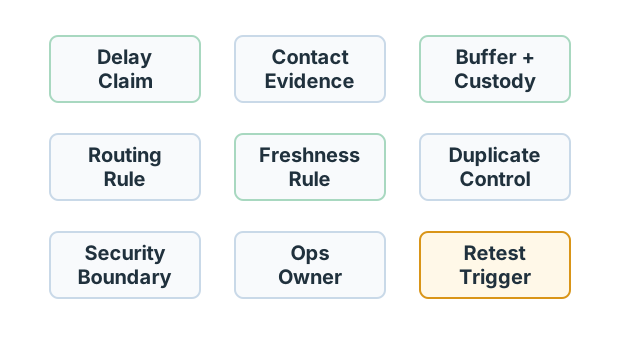
In Figure 41.3, the river monitor stores a reading before the ranger’s visit, the ranger carries it, and the office receives it at a later contact. The trace asks for contact duration, discovery and handshake time, and usable payload bytes to show that a handoff can finish. Buffer margin tracks queued messages, age, free space, and drops. Custody evidence keeps the source copy until receipt is proved, while measurement, transfer, and gateway times distinguish a delayed reading from a current one. Testing a missed visit or full buffer exposes where the claim can fail before the dashboard presents the data.
Claim: State the data age and decision the DTN path is allowed to support.
Evidence: Attach contact observations, buffer limits, transfer tests, custody behavior, freshness rules, duplicate handling, and security boundaries.
Decision: Accept, narrow, reject, or retest the DTN claim with an owner and response plan.
Retest: Name the route, payload, policy, firmware, gateway, carrier, or incident change that reopens review.
The record should be understandable by networking, operations, and data users. A dashboard user must know when data is delayed, stale, missing, duplicated, or outside the accepted claim.
41.10 Worked Review: Wildlife Collar Uploads
This section: Worked Review: Wildlife Collar Uploads — A wildlife study uses collars that store location summaries and upload when an animal passes near a water-station gateway.
A wildlife study uses collars that store location summaries and upload when an animal passes near a water-station gateway. The team wants to use the data for movement-pattern research, not live animal rescue.
Review the claim:
Finding: accept the DTN path for delayed movement research if the record includes contact observations, buffer capacity, receipt confirmation, data-age labeling, and a field response when expected gateways stop seeing uploads. Reject any live-response claim unless another path is reviewed.
41.11 Worked Review: Clinic Data Mule Route
This section: Worked Review: Clinic Data Mule Route — A rural clinic network stores daily sensor and inventory records on local kiosks.
A rural clinic network stores daily sensor and inventory records on local kiosks. A scheduled vehicle passes clinics and uploads batches to a district gateway when it returns.
Review the claim:
Finding: accept for non-urgent batch reporting with clear missing-data status, custody receipts, retries, and an operations owner. Narrow the claim if the team wants real-time surveillance or emergency response.
41.12 Common DTN Review Mistakes
This section: Common DTN Review Mistakes
41.13 Review Checklist
This section: Review Checklist — Use this checklist before accepting a DTN path in a WSN or IoT deployment.
Use this checklist before accepting a DTN path in a WSN or IoT deployment.
41.14 Knowledge Check: Delay Fit
This section: Knowledge Check: Delay Fit
41.15 Knowledge Check: Custody Boundary
This section: Knowledge Check: Custody Boundary
41.16 Copy and Freshness Budget
This section: Copy and Freshness Budget
41.17 Matching: DTN Review Evidence
This section: Matching: DTN Review Evidence
41.18 Ordering: DTN Review Route
This section: Ordering: DTN Review Route
41.19 Summary
This section: Summary — Delay-tolerant networking is a useful WSN and IoT pattern when useful data can wait for intermittent contacts.
Delay-tolerant networking is a useful WSN and IoT pattern when useful data can wait for intermittent contacts. The review should not stop at naming store-carry-forward. It should prove that storage, mobility, forwarding, custody, freshness, copy limits, security, and operations ownership fit the decision being made.
Use DTN for delayed evidence such as trend summaries, field logs, batch uploads, and mobility-assisted collection. Narrow or reject DTN claims when the data must support live alarms, immediate control, or decisions that cannot tolerate stale or missing readings.
41.20 Key Takeaway
This section: Key Takeaway — Delay-Tolerant Networks for IoT should treat people, delay, consent, data quality, custody, privacy, intermittent connectivity, and deployment evidence as part of the sensing architecture.
Delay-Tolerant Networks for IoT should treat people, delay, consent, data quality, custody, privacy, intermittent connectivity, and deployment evidence as part of the sensing architecture.
41.21 Concept Relationships
This section: Concept Relationships — DTN extends Human-Centric Sensing when people, vehicles, animals, or carried devices act as mobile carriers.
DTN extends Human-Centric Sensing when people, vehicles, animals, or carried devices act as mobile carriers. DTN can support MWSN Types and Mobile Entities when static nodes rely on mobile sinks or data mules. DTN review complements WSN Mobile Coverage Optimization because mobility can improve collection while introducing route and contact bias. DTN forwarding must still respect WSN Communication evidence: radio range, traffic load, acknowledgments, and gateway behavior.
41.22 What’s Next
This section: What’s Next — Human-Centric Sensing and Participatory Sensing connect DTN with human-carried and participatory sensing patterns.
Human-Centric Sensing and Participatory Sensing connect DTN with human-carried and participatory sensing patterns. Participatory Sensing examines intentional human data contribution and platform evidence. WSN Mobile Sinks reviews production mobile collection paths and operations handoff.
Find help
3 reviewed answers.
Where should I start in a module?
Open the module page from the sidebar to see its chapters in order. Use the module map to return to a topic you need.
Modules and pathsReviewed
What can I try when a project does not work?
Check the symptom, then work through the diagnostic steps. Keep the error message and the smallest example that reproduces it.
When you are stuckReviewed
How do interactive examples work?
Use the interactive guide to check how examples and simulations work before changing your project.
Interactive examples guideReviewed