20 Push, Poll, and Guided Tracking

More
Depth: Practitioner
Progress saves as you read. Mark sections complete as you go; your progress appears in the sidebar.
20.1 Begin With Who Needs the Next Position
This section: Begin With Who Needs the Next Position — A gateway is a node that joins one network to another.
A gateway is a node that joins one network to another. Latency means the time from a field event to the useful result. Picture a tagged tool moving through a yard. The system can push each change, wait for a person to ask, or guide a search toward likely nodes. Start with who needs the position, how fresh it must be, and what a wrong label could cause.
Choose one mode for the first trial. Mark who starts the exchange and who owns the last known state. Then test a move, a lost report, a late reply, and a mode switch. Record time, energy, path, state age, owner, and recovery. Show the user when the result is current, old, sought, or unknown.
Push can be fast, but it may drain nodes. Poll can save reports, but it may answer late. A guided search can focus work, but it needs sound prior state. A mix can adapt, but switching adds state and proof duties. For a tracking mode, review each mode and its release record; check custody, state change, energy, delay, and recovery before accepting the result.
Use the same short route for each mode. Move the tag past three known points. Save the true pass time. Save the first report time. Save who asked, who replied, and who held the last state. Mark each gap and repeat. This makes speed and energy trade-offs easy to compare.
Show state age to the user. “Last seen” is not “here now.” A search in progress is not a fix. A guided guess is not a sighting. Use plain labels and keep the time beside them. If the mode changes, mark the change and its cause.
Set a stop rule. If state is too old or key nodes are lost, the system should say unknown and use the safe field process. A tracking screen must not look more certain than its evidence.
20.2 Start With the Field Story
This section: Start With the Field Story — Start by asking who drives the tracking conversation.
Start by asking who drives the tracking conversation. Push, poll, guided, and hybrid tracking each spend energy and latency differently, so the right formulation is the one whose evidence matches the target motion, response time, and custody requirement.
A WSN tracking formulation defines how target evidence moves through the network. It answers a practical question: does the network report observations as soon as they happen, wait until someone asks, guide a mobile actor toward a target, or combine those behaviors?
The formulation is not a brand name and not a universal winner. Push, poll, guided, and hybrid tracking each change latency, energy, custody, recovery, and operator meaning. A high-quality chapter explains why the chosen formulation fits the tracking decision and how weak, stale, predicted, or missing evidence is labeled.
20.3 In 60 Seconds
This section: In 60 Seconds — Push tracking reports observations proactively.
Push tracking reports observations proactively. It fits urgent decisions only when false triggers, traffic load, energy cost, and gateway handoff are visible. Poll tracking stores observations until a query asks for them. It fits delayed decisions only when stale data, query scope, and missing responses are labeled. Guided tracking uses network evidence to steer a mobile actor, inspector, robot, or collector. It needs route, safety, prediction, and handoff evidence. Hybrid tracking is common. Critical events may push, routine history may be polled, and a mobile actor may be guided only after escalation. A formulation review should end with a release label: current, delayed, predicted, ambiguous, lost, recovered, or historical.
20.4 Learning Objectives
This section: Learning Objectives
By the end of this chapter, you will be able to:
- Compare push, poll, guided, and hybrid WSN tracking formulations without treating any one as universally best.
- Identify the evidence each formulation must preserve before a target state can be displayed.
- Explain how formulation choice changes latency, energy, custody, recovery, and state labels.
- Review worked tracking scenarios and select an honest formulation label.
- Apply release gates before approving a formulation chapter, lab, simulation, or prototype.
20.5 WSN Tracking Formulations
This section: WSN Tracking Formulations — A hidden assumption between cluster and SINK could overturn wsn tracking formulations.
A hidden assumption between cluster and SINK could overturn wsn tracking formulations. The chart in Figure 20.1 brings that assumption into the review.

Use SINK as the pivot in the diagram at Figure 20.1. Before it, cluster adds a distinct review condition; after it, Nodes near the target defines what the design promises, while the pivot itself adds a distinct review condition. The resulting structure is not decorative: Three node-graph panels comparing target-tracking formulations: push tracking clusters nearby nodes around a moving target and reports to a sink, poll tracking spreads a query tree from the sink outward, and guided tracking builds a routing corridor that steers a mobile actor toward the target. It sets the usable limit for wsn tracking formulations.
This stage of wsn tracking formulations calls for evidence at both PUSH and POLL. In the visual at Figure 20.2, the two labels make the required comparison explicit.

Three labels carry the instructional work in the chart at Figure 20.2. PUSH adds a distinct review condition; POLL adds a distinct review condition; query adds a distinct review condition. Read together, they establish this specific relationship: Three timelines comparing when each tracking formulation sends messages: push reports on a fixed periodic schedule regardless of demand, poll stays silent until a query arrives and then sends one response, and guided sends a steady stream of beacon updates that steers a mobile actor along a corridor toward the target. The ongoing wsn tracking formulations analysis should preserve all three.
20.6 Formulation Claim
This section: Formulation Claim
Start with a claim that can be reviewed:
Tracking formulation review claim: The system can produce a target record for a stated decision while preserving how evidence is reported, queried, guided, delayed, summarized, recovered, and handed off to an operator or gateway.
This claim prevents shortcut language such as “push is fastest,” “poll saves energy,” or “guided catches the target.” Those may be true in a specific deployment, but a chapter must show the evidence boundary before those statements become release-ready.
20.7 Formulation Review Map
This section: Formulation Review Map — Evidence for Formulation Review Map starts in Figure 20.3.
Evidence for Formulation Review Map starts in Figure 20.3. Look at WSN Tracking Formulations Evidence Map beside Push before accepting WSN tracking formulations evidence map for push, poll, guided, and hybrid choices.
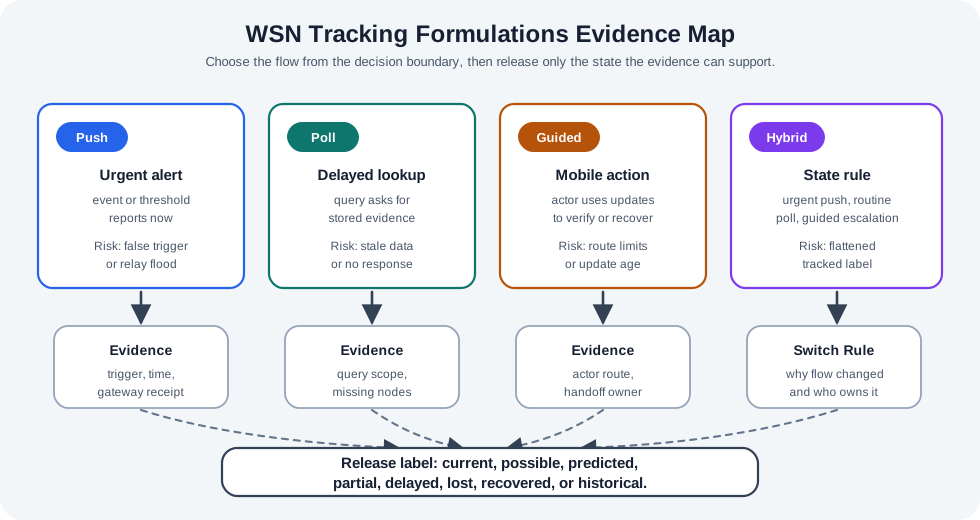
Figure Figure 20.3 chooses evidence flow from the decision need. Push sends urgent event or threshold reports, with false-trigger and relay-flood risks. Poll asks for stored evidence later, so the reviewer must handle stale data and missing replies. Guided tracking uses an actor’s route and update age to verify or recover a target. Hybrid flow needs a state rule for switching among them and an owner for that change. Trigger time, query scope, missing nodes, handoff, and gateway receipt support different release labels. The output may be current, possible, delayed, partial, predicted, or lost only as its evidence permits.
20.8 Push Tracking Review
This section: Push Tracking Review — Push tracking reports target evidence proactively.
Push tracking reports target evidence proactively. A sensor, cluster head, relay, or gateway sends a report because a local event, threshold, schedule, or policy says the state is important now.
Push tracking should not be approved because it feels real-time. It should be approved when the page shows why immediate reporting is necessary and what happens when reports conflict, repeat, or fail to reach the gateway.
20.9 Poll Tracking Review
This section: Poll Tracking Review — Poll tracking answers questions on demand.
Poll tracking answers questions on demand. Sensors may detect and store evidence locally, but the system does not publish every observation immediately. A query asks for a target, region, time range, cluster, or condition.
Poll tracking is not automatically energy-efficient. A short query interval, broad query scope, repeated retries, or many responding nodes can make polling expensive. The chapter should show the measurement scope before making an energy claim.
20.10 Guided Tracking Review
This section: Guided Tracking Review — Guided tracking uses WSN evidence to guide an actor: a mobile collector, inspector, robot, drone, field team, or another control system.
Guided tracking uses WSN evidence to guide an actor: a mobile collector, inspector, robot, drone, field team, or another control system. The actor is not just viewing the track. It changes position, sampling plan, route, or attention based on the network evidence.
Guided tracking is not only about interception. In many WSN systems the mobile actor is a technician, vehicle, mobile sink, or inspection device. The formulation is guided when the target evidence changes what the actor does next.
20.11 Hybrid Formulations
This section: Hybrid Formulations — Real systems often mix formulations.
Real systems often mix formulations. A hybrid design is acceptable when each state has a clear rule.
Hybrid tracking needs extra care because labels can flatten during handoff. A pushed alert, polled summary, guided update, and mobile-sink upload should not all appear as the same “tracked” state.
20.12 Latency, Energy, and Custody
This section: Latency, Energy, and Custody — Formulation review is a three-way evidence problem.
Formulation review is a three-way evidence problem. A chapter that only discusses latency or only discusses energy is incomplete.
The same target record can mean very different things under different formulations. A pushed alert may be recent but noisy. A polled record may be accurate but old. A guided update may be useful for action but uncertain. A hybrid summary may preserve the best view only if custody survives handoff.
20.13 State and Switch Records
This section: State and Switch Records — Under the hood, a tracking formulation is a state record for evidence.
Under the hood, a tracking formulation is a state record for evidence. Push begins with a local event, poll begins with a query, guided tracking adds an actor state, and hybrid tracking adds switch rules between flows. The release layer should be able to see each state without guessing.
| Record field | What it preserves | Why it matters |
|---|---|---|
| Owner | Node, cluster, sink, mobile actor, gateway, service, or operator that changed the state | Prevents a gateway summary from looking like raw sensor confirmation |
| Timer | Event time, processing time, query time, relay delay, contact time, and display time | Separates fresh alerts from stale or delayed records |
| Missing evidence | Missed report, no query response, sleeping node, lost handoff, or unavailable actor | Stops “no response” from becoming “no target” |
| Switch rule | Why the record moved from push to poll, poll to guided, or guided to historical | Keeps hybrid tracking from flattening different evidence flows |
| Release label | Current, possible, partial, predicted, delayed, lost, recovered, or historical | Makes the dashboard show only what the formulation can prove |
This state view also keeps cost claims honest. Latency includes sensing, local processing, queueing, query wait, relay delay, mobile contact, gateway upload, and operator display time. Energy includes listening, waking, storing, retries, relays, mobile collection, and recovery. A formulation is technically sound when its state record carries enough information for the release layer to choose a label without hiding uncertainty.
20.14 Formulation State Machine
This section: Formulation State Machine
20.15 Release Gates
This section: Release Gates — To challenge Release Gates, examine the visual at Figure 20.4.
To challenge Release Gates, examine the visual at Figure 20.4. Its WSN Tracking Formulations Release Gates and Claim labels reveal the sequence behind Release Gates.
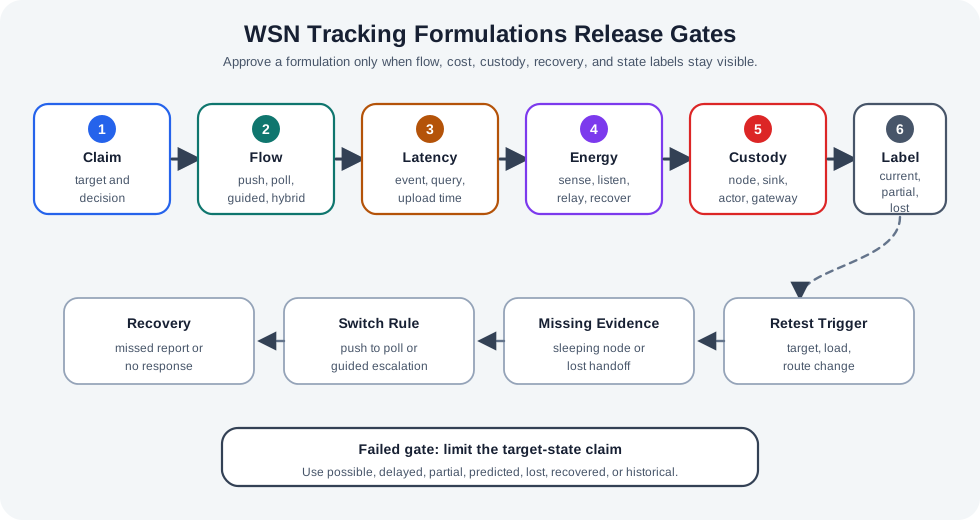
Figure Figure 20.4 checks a formulation from claim to release label. It names the target and decision, then records push, poll, guided, or hybrid flow. Latency includes event, query, and upload time; energy includes sensing, listening, relay, and recovery. Custody tracks node, sink, actor, and gateway. A switch rule explains when flow changes, while recovery covers missed reports and missing replies. Sleeping nodes and lost handoffs remain visible as missing evidence. If a gate fails, the target-state claim must narrow to a label such as possible, delayed, partial, predicted, lost, or historical until retest supports more.
If any gate fails, the formulation can still be taught, but the chapter should use a bounded label such as “possible target,” “last seen,” “predicted path,” “partial query,” or “historical reconstruction” rather than “confirmed current track.”
20.16 Worked Review: Boundary Alert
This section: Worked Review: Boundary Alert — A perimeter WSN must alert operators when motion crosses a restricted boundary.
A perimeter WSN must alert operators when motion crosses a restricted boundary. Sensors near the boundary detect events and report through local relays.
20.17 Worked Review: Asset Lookup
This section: Worked Review: Asset Lookup — A facility wants to locate equipment tags only when a user searches for an item.
A facility wants to locate equipment tags only when a user searches for an item. Fixed nodes keep local observations and a gateway queries likely regions.
20.18 Worked Review: Mobile Verification
This section: Worked Review: Mobile Verification — A mobile sink or inspection robot receives WSN updates and moves toward a target region to confirm an uncertain event.
A mobile sink or inspection robot receives WSN updates and moves toward a target region to confirm an uncertain event.
20.19 Common Formulation Mistakes
This section: Common Formulation Mistakes
20.20 Readiness Checklist
This section: Readiness Checklist — The target, decision boundary, and formulation choice.
Before approving a WSN tracking formulation page, verify that it shows:
The target, decision boundary, and formulation choice. Whether the target state is observed, queried, predicted, summarized, guided, delayed, or historical. The latency path from event time to displayed state. The energy scope for sensing, listening, transmitting, receiving, storing, waking, querying, relaying, and recovery. The custody path across sensor, cluster, sink, mobile actor, gateway, cloud service, and operator. The recovery behavior for missed reports, no query response, stale updates, and lost guidance. The release label for current, possible, predicted, delayed, ambiguous, lost, recovered, partial, or historical records. The retest trigger when target behavior, network load, gateway path, or operator decision changes.
20.21 Knowledge Check: Formulation Fit
This section: Knowledge Check: Formulation Fit
20.22 Knowledge Check: Poll Results
This section: Knowledge Check: Poll Results
20.23 Matching: Formulation Evidence
This section: Matching: Formulation Evidence
20.24 Ordering: Formulation Review Flow
This section: Ordering: Formulation Review Flow
20.25 Summary
This section: Summary — WSN tracking formulations describe how evidence flows.
WSN tracking formulations describe how evidence flows. Push reports proactively, poll answers queries, guided tracking steers a mobile actor, and hybrid tracking combines those behaviors under explicit rules. The formulation is high quality only when it preserves the target decision, evidence age, latency path, energy scope, custody path, recovery behavior, and release label.
Avoid universal formulation claims. A tracking state should be released as current, delayed, predicted, ambiguous, lost, recovered, partial, or historical based on the evidence that survived the selected formulation.
20.26 Key Takeaway
This section: Key Takeaway — WSN Tracking Formulations Review should connect tracking models, prediction, localization, handoff, sampling rate, energy cost, uncertainty, and deployment evidence before accepting a design.
WSN Tracking Formulations Review should connect tracking models, prediction, localization, handoff, sampling rate, energy cost, uncertainty, and deployment evidence before accepting a design.
20.27 Concept Relationships
This section: Concept Relationships
20.28 What’s Next
This section: What’s Next — Use WSN Tracking Fundamentals to check the target-state vocabulary behind the formulation.
Previous: WSN Tracking Fundamentals
Next: WSN Tracking Algorithm Components Review
Use WSN Tracking Fundamentals to check the target-state vocabulary behind the formulation. Continue to WSN Tracking Algorithm Components Review for detection, cooperation, localization, prediction, and recovery evidence.
Find help
3 reviewed answers.
Where should I start in a module?
Open the module page from the sidebar to see its chapters in order. Use the module map to return to a topic you need.
Modules and pathsReviewed
What can I try when a project does not work?
Check the symptom, then work through the diagnostic steps. Keep the error message and the smallest example that reproduces it.
When you are stuckReviewed
How do interactive examples work?
Use the interactive guide to check how examples and simulations work before changing your project.
Interactive examples guideReviewed