12 WSN and IoT Integration

More
Depth: Practitioner
Progress saves as you read. Mark sections complete as you go; your progress appears in the sidebar.
12.1 Start With the Field Story
This section: Start With the Field Story — Picture twenty small weather units spread across a farm.
Carry Meaning Beyond the Field
Picture twenty small weather units spread across a farm. Each unit measures soil or air and passes the reading through nearby units. The farmer does not need raw radio messages. The farmer needs to know which field is dry and whether the reading is recent enough to guide watering.
A wireless sensor network, or WSN, is this local group of measuring units and radio links. The Internet of Things, or IoT, adds the wider service that stores, shows, and acts on their facts. A gateway is the bridge between the two.
Start with one reading. Keep its source, time, unit, and quality as it crosses the bridge. Name who acts when it is late or missing. Then send a safe command back and prove that the right field unit received it.
Draw the boundary as two boxes and one arrow. On the field side, list the small units and their local radio jobs. On the service side, list storage, displays, alerts, and people. On the arrow, write the facts that must survive the crossing.
Use a known reading to test that drawing. Delay it, combine it with another, and remove the field link. The service should mark each change and gap. A person should be able to trace the final display back to the right field place.
The simple picture has limits when units combine readings or links change. Practitioner compares connection patterns. Under the Hood follows addresses, packet detail, and command safety.
A WSN becomes part of IoT when sensor readings cross a gateway boundary and become useful data for a service, operator, or automation rule. Keep that boundary visible: the network may gather evidence, but the IoT system must preserve meaning, ownership, and safe action.
12.2 In 60 Seconds
This section: In 60 Seconds — A WSN is often the sensing subsystem inside a larger IoT system.
A WSN is often the sensing subsystem inside a larger IoT system. The WSN handles constrained field sensing, local radio behavior, aggregation, and gateway reachability. IoT adds broader integration: identity, storage, dashboards, analytics, alerts, remote operations, application workflows, and sometimes downlink commands.
The integration boundary is usually the gateway. That boundary must preserve data meaning, node identity, freshness, quality, security, command safety, and operations ownership. A gateway that only forwards packets is not enough if the IoT platform cannot tell which sensor produced the reading, whether it is stale, whether it was aggregated, or who should act when it disappears.
12.3 Learning Objectives
This section: Learning Objectives
By the end of this chapter, you will be able to:
- Explain how a WSN can act as the sensing layer inside a broader IoT system.
- Identify the gateway responsibilities that connect constrained sensor networks to IP, cloud, dashboards, and applications.
- Compare direct replacement, gateway bridge, edge processing, and hybrid integration patterns.
- Review WSN-to-IoT data meaning, identity, freshness, aggregation, command paths, and security boundaries.
- Build an integration evidence record with acceptance limits, owners, and retest triggers.
12.4 Quick Check: WSN and IoT Integration
This section: Quick Check: WSN and IoT Integration
12.5 Prerequisites
This section: Prerequisites — This chapter assumes you understand the WSN roles introduced in WSN Introduction and History and the broader system view from Wireless Sensor Networks.
This chapter assumes you understand the WSN roles introduced in WSN Introduction and History and the broader system view from Wireless Sensor Networks. For communication patterns and routing evidence, review WSN Communication Patterns and WSN Routing Introduction Review.
12.6 Relationship Scope
This section: Relationship Scope — WSN and IoT overlap, but they are not the same design problem.
WSN and IoT overlap, but they are not the same design problem.
Treating WSN as “just IoT with small devices” hides important constraints. Treating IoT as “just WSN with a cloud dashboard” hides gateway, identity, data governance, and operations responsibilities. The review should preserve both views.
A compact side-by-side comparison makes the same boundary concrete rather than only conceptual. Treat each row as a tendency to verify for the deployment in front of you, not a rule that always holds.
| Dimension | Classic WSN tendency | IoT-facing tendency |
|---|---|---|
| Node population | Largely homogeneous, pre-provisioned nodes | Heterogeneous, individually configurable devices |
| Hop model | Multi-hop relay toward a sink or gateway | Often single-hop to a gateway or access point |
| Addressing | Non-IP, local node and cluster identifiers | IP-based or platform identity, individually reachable |
| Node function | Sensing only | Sensing and actuation |
| Traffic direction | Mostly one-way, uplink to the sink | Two-way, including downlink commands |
| Edge processing | Limited local processing | More processing pushed to the edge |
| Configuration | Fairly static once deployed | Highly dynamic, remotely reconfigurable |
Read the table as a starting hypothesis, not a certificate. A deployment can be “WSN-shaped” on some rows (multi-hop, non-IP, sensing-only) and still need the IoT-shaped review from the rest of this chapter, because a sensor network is often only a portion of a larger IoT system rather than a separate category from it.
12.7 Boundary Map
This section: Boundary Map — At this point, boundary map needs an inspectable chain rather than another rule of thumb.
At this point, boundary map needs an inspectable chain rather than another rule of thumb. The figure at Figure 12.1 supplies it by linking WSN Field to Gateway Boundary.
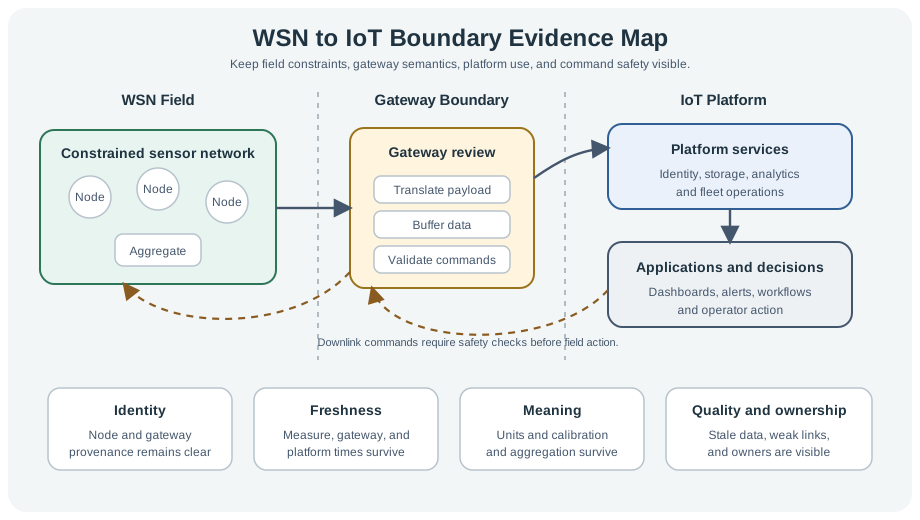
Treat WSN Field, Gateway Boundary, and IoT Platform in the diagram at Figure 12.1 as three separate gates. The first adds a distinct review condition, the second tests whether evidence can travel, and the third adds a distinct review condition. Their combined message is specific: WSN to IoT boundary evidence map showing constrained sensor nodes, local aggregation, gateway translation and buffering, platform services, applications, controlled command checks, and evidence records for identity, freshness, meaning, quality, and ownership. Use that message, with its limits, in the ensuing boundary map decision.
12.8 What The Gateway Must Preserve
This section: What The Gateway Must Preserve — The gateway should be reviewed as an evidence-preserving component, not just a protocol adapter.
The gateway should be reviewed as an evidence-preserving component, not just a protocol adapter.
12.9 Integration Patterns
This section: Integration Patterns — Different integration patterns fit different evidence and operating constraints.
Different integration patterns fit different evidence and operating constraints.
The best pattern is the one that preserves useful field evidence while adding the IoT capability the application actually needs. Cloud connectivity is a means, not the design goal.
12.10 Virtualized WSN Provisioning
This section: Virtualized WSN Provisioning — Some deployments expose a virtual wireless sensor network (VWSN) rather than a fixed one-to-one application network.
Some deployments expose a virtual wireless sensor network (VWSN) rather than a fixed one-to-one application network. Infrastructure providers contribute physical nodes, a VWSN provider aggregates those resources, then assigns a logical sensor network to a user request. The application receives a VWSN, deploys code or a workflow against it, and runs without owning every underlying sensor. The review record should still name the physical node pool, allocation rule, tenant boundary, resource lifetime, identity mapping, missing-node behavior, and who can revoke or reassign a shared node. Virtualization is useful only if it preserves the same gateway evidence this chapter requires: provenance, freshness, quality, security scope, and command safety.
12.11 Addressability And Header Fit
This section: Addressability And Header Fit — Making a WSN part of IoT does not mean every constrained node should behave like a cloud server.
Making a WSN part of IoT does not mean every constrained node should behave like a cloud server. It means the integration gives field evidence a usable identity, data contract, and command boundary.
| Aspect | Classic WSN | IoT-facing node or gateway model |
|---|---|---|
| Addressing | Local node IDs and cluster IDs, usually not Internet-reachable. | Platform identities, topics, resources, or constrained IP endpoints mapped to field provenance. |
| Traffic shape | Convergecast toward a sink or gateway. | Platform queries, event streams, alerts, buffered uploads, and carefully bounded downlink commands. |
| Protocol fit | Application-specific frames and short local messages. | Gateway translation, constrained IP, or 6LoWPAN when end-to-end IP is justified. |
| Review question | Did the WSN preserve the sensing claim? | Did the integration preserve identity, time, units, quality, ownership, and command safety? |
6LoWPAN is one way to make small radio nodes IP-reachable without pretending the link is large. The constraint is frame size: an IEEE 802.15.4 frame is about 127 bytes, while an IPv6 header is 40 bytes and a UDP header adds 8 more before the payload. 6LoWPAN compresses headers when fields can be derived from link-layer context, and fragments larger IPv6 packets across several small frames when needed.
That adaptation buys interoperability and individual reachability, but it is not free. The review should ask where state is reconstructed, which identities are stable, how fragments are handled, how stale buffered data is labeled, and which cloud requests stop at the gateway instead of reaching sleeping field nodes. Passing a telemetry upload test is not enough if the integration cannot prove meaning, freshness, and safe command behavior.
6LoWPAN is a network-layer answer to reachability. An older, service-layer answer to the same “make sensor data usable outside the WSN” problem is the OGC Sensor Web Enablement family: a Sensor Observation Service (SOS) exposes stored and near-real-time readings behind a query interface, a Sensor Planning Service (SPS) lets a client request or schedule a sensing task, a Sensor Alert Service (SAS) and Web Notification Service (WNS) push threshold-triggered notices to registered clients, and SensorML or Observations & Measurements (O&M) describe the sensor and encode the readings in a self-describing format. The evidence question is identical to the gateway questions above, just moved up a layer: does the service description still carry calibration state, measurement time, and missing-data status, or does the query interface make the data reachable while quietly discarding the meaning the rest of this chapter insists on preserving?
12.12 Knowledge Check: Header Fit
This section: Knowledge Check: Header Fit
12.13 Review Route
This section: Review Route — The risk in review route lies between Decision and field role and WSN.
The risk in review route lies between Decision and field role and WSN. The map at Figure 12.2 exposes that gap so the next design step can use a bounded conclusion rather than a slogan.
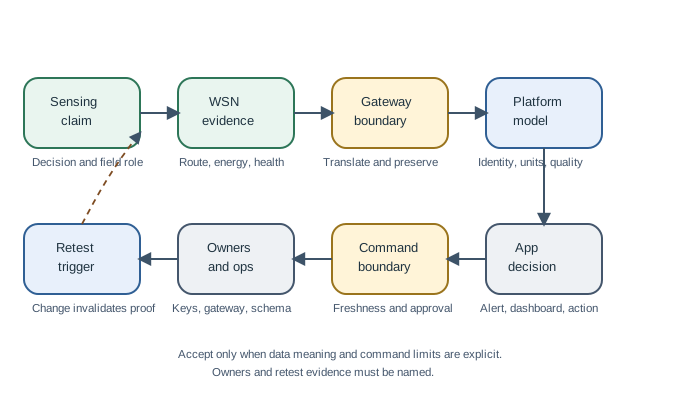
The first concrete marker in Figure 12.2 is Decision and field role: it records the bounded outcome. WSN changes the question by adds a distinct review condition, and Route, energy, health completes it by tests whether evidence can travel. The figure therefore demonstrates that wSN to IoT integration review route moving from sensing claim to field evidence, gateway translation, platform data model, application decision, command boundary, operations ownership, and retest trigger. That conclusion rejoins the chapter’s review route thread.
The route separates data forwarding from data acceptance. A payload can arrive in the cloud and still be unusable if units, timestamps, aggregation rules, device identity, or missing-node evidence were lost at the boundary.
12.14 Data Meaning Across The Boundary
This section: Data Meaning Across The Boundary — WSN packets are often optimized for local constraints.
WSN packets are often optimized for local constraints. IoT platforms usually need richer context. The gateway or edge service must decide how much context to attach without pretending the sensor node measured more than it did.
Review the following questions:
Does the platform know whether the value is raw, filtered, aggregated, inferred, or a status signal? Does the timestamp represent measurement time, gateway receipt time, or platform ingestion time? Does the platform know the node role, sensor location, calibration state, firmware version, and gateway path? Does an aggregate include member count, missing members, time window, and aggregation rule? Does the application distinguish “no event” from “node silent” and “gateway offline”?
If the answer is unclear, the integration is not ready for application decisions.
12.15 Downlink And Automation Boundaries
This section: Downlink And Automation Boundaries — IoT platforms often add remote dashboards, alerts, rules, and automation.
IoT platforms often add remote dashboards, alerts, rules, and automation. Those features can create downlink commands that return to the WSN. Downlink is usually more fragile than uplink because constrained nodes may sleep, move, lose parent routes, or lack enough power to listen continuously.
Review downlink separately:
- which commands are allowed from the platform
- which commands require operator approval
- how stale state blocks unsafe commands
- how the gateway validates node reachability and role
- what happens if a command is delayed, duplicated, reordered, or partially applied
- how the system records command outcome and recovery action
Automation is safe only when the command boundary is as explicit as the data boundary.
12.16 Greenhouse WSN to Dashboard
This section: Greenhouse WSN to Dashboard — A greenhouse already has a local WSN that reports temperature and humidity to a gateway.
A greenhouse already has a local WSN that reports temperature and humidity to a gateway. The operator wants a cloud dashboard, mobile alerts, and remote setpoint recommendations.
Review:
- Keep the existing WSN if field readings, battery behavior, and gateway reachability are already reliable.
- Add gateway translation that preserves node identity, zone, unit, measurement time, calibration state, and missing-node evidence.
- Keep local alerts for urgent conditions if cloud backhaul is not guaranteed.
- Treat cloud recommendations as advisory until the command path, operator approval, and rollback behavior are tested.
- Retest when node placement, gateway firmware, platform schema, alert thresholds, or control policy changes.
Better record:
Claim: The existing greenhouse WSN can act as the sensing layer for a cloud dashboard and alert workflow.
Evidence needed: node-to-zone mapping, measurement timestamps, unit and calibration metadata, gateway outage buffer behavior, missing-node alert, and local alert fallback.
Command boundary: remote recommendations are allowed; automatic actuator commands require a separate safety review.
Retest trigger: gateway change, schema change, alert-rule change, sensor relocation, or new downlink automation.
12.17 Brownfield Irrigation Network
This section: Brownfield Irrigation Network — A farm has a working WSN with soil sensors and cluster heads.
A farm has a working WSN with soil sensors and cluster heads. The team wants to add cloud analytics and mobile notifications instead of replacing the field devices.
Review:
- Preserve the field network if it already meets sensing coverage and maintenance requirements.
- Add a gateway bridge that publishes normalized sensor events to the platform.
- Include cluster membership, aggregation windows, missing-member counts, and gateway health in the platform model.
- Avoid direct cloud connections from every constrained node unless power, security, firmware, and connectivity evidence justify it.
- Keep irrigation decisions tied to local field evidence, weather context, operator policy, and command confirmation.
Better record:
Claim: A gateway bridge can add IoT analytics without replacing the existing soil-sensing WSN.
Evidence needed: field-network health, gateway identity map, data model, backhaul reliability, buffer and replay rules, alert owner, and command confirmation path.
Acceptance limit: analytics can use buffered data only when the platform displays measurement time and missing-data status.
Retest trigger: new crop zone, new sensor model, changed aggregation rule, gateway replacement, or automated irrigation command.
12.18 Integration Evidence Record
This section: Integration Evidence Record — Use this record before approving WSN-to-IoT integration.
Use this record before approving WSN-to-IoT integration.
Sensing claim: what field condition is measured, where, how often, and for which application decision?
WSN claim: what topology, aggregation, route, battery, and missing-node evidence supports the field network?
Gateway claim: what translation, buffering, identity mapping, validation, and security work happens at the boundary?
Platform claim: what schema, topics, storage, analytics, dashboards, alerts, and retention rules use the readings?
Command claim: which commands can return to the field, who approves them, and how stale state blocks unsafe action?
Operations claim: who owns gateway health, credentials, firmware, schema changes, alert thresholds, and retest?
12.19 Common Mistakes
This section: Common Mistakes
12.20 Review Checklist
This section: Review Checklist — The sensing claim is still clear after data leaves the WSN.
Before accepting a WSN-to-IoT integration, confirm:
The sensing claim is still clear after data leaves the WSN. The gateway preserves node identity, units, timestamps, location, role, and quality status. Aggregates include membership, time window, method, and missing-data evidence. The platform distinguishes quiet, stale, failed, and gateway-offline states. Credentials and keys are scoped so a field-node issue does not become a platform-wide issue. Downlink commands are bounded by local safety, freshness, ownership, and confirmation rules. Gateway health, schema changes, firmware updates, alerts, and retest triggers have named owners.
12.21 Knowledge Check: Boundary Evidence
This section: Knowledge Check: Boundary Evidence
12.22 Knowledge Check: Migration Pattern
This section: Knowledge Check: Migration Pattern
12.23 Match: WSN-IoT Boundary Terms
This section: Match: WSN-IoT Boundary Terms
12.24 Order: WSN-To-IoT Integration Review
This section: Order: WSN-To-IoT Integration Review
12.25 Summary
This section: Summary — WSNs and IoT are related but not identical.
WSNs and IoT are related but not identical. A WSN is often the constrained sensing layer that observes a physical environment. IoT extends that layer into identity, storage, dashboards, analytics, alerts, automation, fleet operations, and application workflows. The gateway is the usual boundary, and it must preserve evidence rather than merely forward packets.
Strong integration records show the sensing claim, field-network evidence, gateway translation, platform data model, command limits, owners, and retest triggers. Weak integration records celebrate cloud arrival while losing the meaning needed for decisions.
12.26 Key Takeaway
This section: Key Takeaway — WSN and IoT Integration should clarify where WSN sensing, gateways, IoT services, data ownership, operations, and deployment evidence meet.
WSN and IoT Integration should clarify where WSN sensing, gateways, IoT services, data ownership, operations, and deployment evidence meet.
12.27 Concept Relationships
This section: Concept Relationships
12.28 What’s Next
This section: What’s Next — WSN Sensor Node Characteristics for constrained device roles and node evidence.
Continue with the chapters that deepen each side of the integration boundary:
WSN Sensor Node Characteristics for constrained device roles and node evidence. WSN Communication Patterns for uplink, downlink, aggregation, and relay behavior. WSN Energy Management for power constraints that shape reporting and commands. WSN Deployment Sizing for field planning and gateway placement. WSN Routing Introduction Review for route-health evidence that should survive IoT integration. WSN Common Mistakes and Pitfalls for common review failures across the sensing and operations boundary.
Find help
3 reviewed answers.
Where should I start in a module?
Open the module page from the sidebar to see its chapters in order. Use the module map to return to a topic you need.
Modules and pathsReviewed
What can I try when a project does not work?
Check the symptom, then work through the diagnostic steps. Keep the error message and the smallest example that reproduces it.
When you are stuckReviewed
How do interactive examples work?
Use the interactive guide to check how examples and simulations work before changing your project.
Interactive examples guideReviewed