26 WSN Tracking Implementation

More
Depth: Practitioner
Progress saves as you read. Mark sections complete as you go; your progress appears in the sidebar.
26.1 Start With the Field Story
This section: Start With the Field Story — Picture a cart that carries medicine through a hospital.
Picture a cart that carries medicine through a hospital. Small sensors see it pass. The screen must show where it is now. It must also admit when the trail is weak. That honest gap matters more than a smooth dot on a map.
A gateway is the device or service that carries sensor records into the wider system. Telemetry means time-stamped reports about what the tracker saw and how it behaved. Start with one trip. Give each sighting a time, source, owner, and confidence note. Keep a guessed position marked as a guess. Mark an old position as old. If two carts pass close together, do not merge them just to keep the display neat. Record the doubt and ask for more evidence.
Use this plain review route:
- What did a sensor see?
- When did it see it?
- Which track received that sighting?
- Who owns the track now?
- How old is the shown state?
- What doubt travels with it?
- What happens when a node sleeps?
- What happens when a handoff fails?
- Can the operator see a lost track?
- Can a later sighting restore it safely?
This Overview gives the release story, not the full tracking model. Practitioner shows the lifecycle records, handoff tests, and field review. Under the Hood covers association, prediction, route cost, and conflict rules. Those deeper rules may refine the simple trip, but they must never turn an uncertain sighting into a certain claim.
Retell the trip before moving on. A sensor makes a sighting. The record keeps its time. The record keeps its source. A rule links it to a track. Doubt stays on that track. One owner holds it at a time. A handoff names the next owner. Old state stays marked old. Predicted state stays marked predicted. A lost track stays visible. A new sighting may restore it. A conflict asks for more proof. Sleeping nodes leave a known gap. Failed uploads remain in custody. The screen shows the limit. Release waits for the hard test.
Implementation is where tracking promises become release gates. A framework must show which nodes observe, how estimates are labelled, where uncertainty is stored, who owns handoff, and what telemetry proves the tracker is ready.
A WSN tracking implementation framework turns tracking ideas into a releaseable system. It defines how observations enter the system, how target states are created, how sensors are coordinated, how tracks are handed off or retired, and how operators can tell whether a displayed target state is current, predicted, delayed, ambiguous, lost, recovered, partial, or historical.
This page is not a code listing and not a performance benchmark. It is a review layer for implementation quality. A tracking framework is ready only when its architecture, evidence records, lifecycle rules, telemetry, and validation gates make target claims auditable.
26.2 In 60 Seconds
This section: In 60 Seconds — A tracking framework needs contracts between sensing, estimation, association, prediction, coordination, gateway, and application layers.
A tracking framework needs contracts between sensing, estimation, association, prediction, coordination, gateway, and application layers. Implementation quality depends on records, not only algorithms: source observation, state estimate, owner, age, uncertainty, custody, and release label must travel together. Multi-target behavior needs explicit association rules and conflict labels before a system can display separate target tracks. Energy behavior needs sleeping, waking, sampling, relaying, gateway handoff, and recovery costs in the same review record. A release gate should reject frameworks that hide stale predictions, missing nodes, handoff gaps, or dashboard-only claims.
26.3 Learning Objectives
This section: Learning Objectives
By the end of this chapter, you will be able to:
- Review a WSN tracking implementation framework as a set of contracts and evidence records.
- Identify the lifecycle labels needed for tentative, current, predicted, ambiguous, lost, recovered, partial, and historical tracks.
- Explain how sensor coordination, data association, energy state, and gateway custody affect implementation quality.
- Evaluate worked implementation scenarios without relying on brittle numeric claims or vendor-style promises.
- Apply validation and release gates before approving a tracking framework page, lab, simulation, or prototype.
26.4 WSN Tracking Framework Review
This section: WSN Tracking Framework Review
26.5 Framework Claim
This section: Framework Claim — This claim keeps the implementation grounded.
Start with a claim that can be reviewed:
Implementation framework review claim: The system can move a target record from observation to released state while preserving module contract, source evidence, localization method, association decision, lifecycle label, energy state, handoff owner, gateway custody, recovery action, and validation result.
This claim keeps the implementation grounded. A page may discuss filters, clustering, data association, mobile collectors, or dashboards, but each component must say what evidence it consumes, what state it emits, and what label it applies when evidence is incomplete.
26.6 Implementation Architecture Map
This section: Implementation Architecture Map — Do not reduce implementation architecture map to a single headline metric.
Do not reduce implementation architecture map to a single headline metric. The visual in Figure 26.1 brings SENSE and Sensing into the same frame, ready for the evidence comparison that follows.
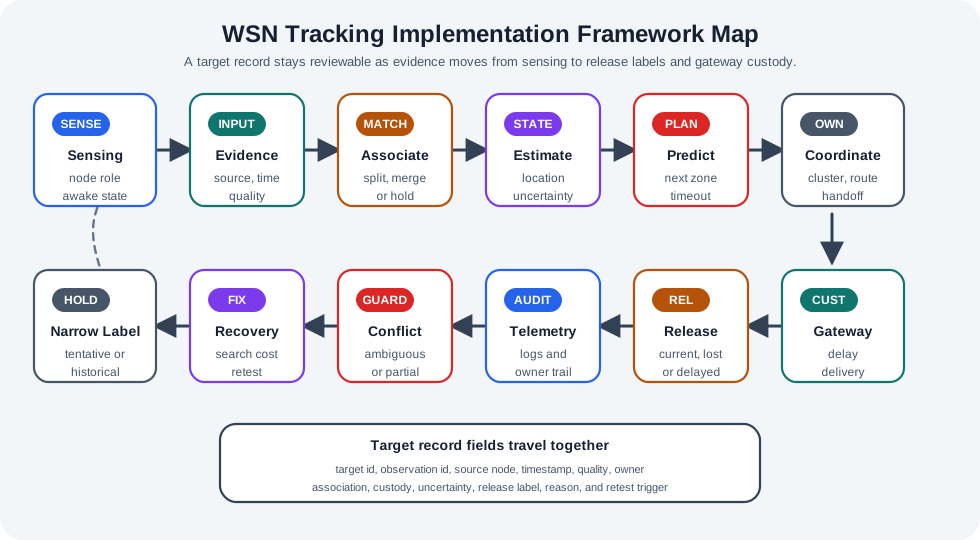
On the figure at Figure 26.1, read SENSE as the point that identifies the field observation; Sensing then adds a distinct review condition. The separate node role label adds a distinct review condition, preventing the first two stages from being accepted on their own. The complete reading is that wSN tracking implementation framework architecture map showing sensing, evidence intake, association, estimation, prediction, coordination, gateway custody, release labels, telemetry, recovery, and retest fields. This distinction carries forward into implementation architecture map.
The map shows the path from sensed evidence to released target state. A framework review should verify each module boundary. If a module drops evidence age, measurement quality, owner, or uncertainty, the final target label becomes weaker even when the algorithm itself is reasonable.
Treat the implementation map as a state machine, not a set of headings. A tracking record should not move from tentative to current, predicted, ambiguous, lost, recovered, or historical because a dashboard component prefers a clean marker. It should move only when stored evidence satisfies the guard condition for that transition.
| Contract state | Evidence that must travel with the record | Review risk when missing |
|---|---|---|
| Input state | Observation source, timestamp, node mode, quality, gateway delay, and missing coverage | A later module cannot tell whether the track is fresh or partial |
| Decision state | Association, estimation, prediction, split, merge, hold, and reject reasons | A conflict is hidden behind one smooth path |
| Owner state | Cluster, collector, gateway, or application owner plus handoff status | A handoff gap masquerades as current tracking |
| Release state | Evidence age, uncertainty, conflict status, custody, recovery status, and retest trigger | The learner-facing label is stronger than the evidence supports |
A minimal contract-state record should include target id, observation id, source node or collector, sensing mode, timestamp source, measurement quality, association status, owner, gateway custody, uncertainty, release label, and reason for the last transition. Keeping those fields together prevents a common implementation failure: the association service knows a record is weak, but the release service receives only a cleaned coordinate and displays it as current.
26.7 Lifecycle Labels
This section: Lifecycle Labels — An implementation framework needs lifecycle labels because target state changes over time.
An implementation framework needs lifecycle labels because target state changes over time. A target can be newly observed, confirmed, predicted, temporarily missing, recovered, split into two possible tracks, merged after duplicate reports, or retired as historical.
Lifecycle labels need guard conditions. A transition guard is the rule that must be true before a record can move to a stronger label. For example, tentative to current requires fresh evidence, accepted association, active owner, bounded uncertainty, and gateway custody inside the decision window. Weakening transitions are just as important: current to predicted happens when evidence is old but a bounded motion model still applies, and predicted to lost happens when the timeout expires without confirmation.
The guard also needs a denial reason. If a record fails the current-state guard because gateway delay is too high, the stored reason should say delayed custody, not just “not current.” If it fails because association is unresolved, the reason should point to conflict status and candidate ids. If it fails because owner handoff is incomplete, the reason should name the previous owner, next owner, and recovery action. These denial reasons become the hooks for telemetry, retest, and later correction.
26.7.1 Knowledge Check: Release State Guards
26.8 Data Association and Conflict Handling
This section: Data Association and Conflict Handling — Multi-target implementation is not just more detections.
Multi-target implementation is not just more detections. It is the problem of deciding which observation belongs to which target record. When targets cross, sensors overlap, or reports arrive late, the framework needs conflict behavior.
26.9 Energy and Coordination
This section: Energy and Coordination — An implementation framework should coordinate sensors without turning sleeping zones into false certainty.
An implementation framework should coordinate sensors without turning sleeping zones into false certainty. Energy optimization is part of the framework contract only when the evidence record explains what was awake, what was asleep, and how recovery is triggered.
26.10 Validation Gate Map
This section: Validation Gate Map — Before applying Validation Gate Map, view Figure 26.2 and compare Contract with assumptions.
Before applying Validation Gate Map, view Figure 26.2 and compare Contract with assumptions. Their relationship makes the structure behind Validation Gate Map reviewable.
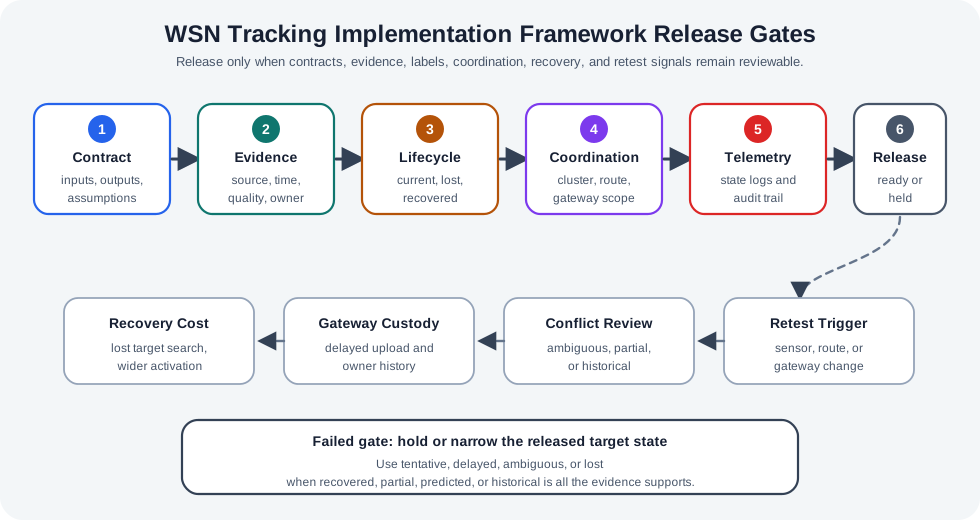
Figure Figure 26.2 checks a tracking implementation before it releases a target state. The module contract states inputs, outputs, and assumptions; the evidence record keeps source, time, quality, and owner. Lifecycle labels separate current, lost, and recovered states. The next gate names cluster, route, and gateway scope. Telemetry preserves state logs and an audit trail. Recovery cost includes wider activation and lost-target search, and gateway custody covers delayed upload. Conflict review keeps ambiguous, partial, or historical evidence visible. A changed sensor, route, or gateway starts retest. The released label stays narrow until the evidence supports it again.
The validation gates force a page to prove the implementation behavior it claims. The gates should be applied to code examples, simulations, labs, and narrative chapters.
Use the gates on failure scenes, not only on the successful path. A framework looks reviewable only after the same target record survives stale delivery, identity conflict, owner handoff, and missing coverage without losing the reason for its released label.
| Failure scene | Fields that must survive | Allowed label when weak |
|---|---|---|
| Delayed gateway batch | Observation time, delivery time, custody, queue delay, dropped summaries | Delayed or historical |
| Crossing targets | Candidate observations, rejected matches, conflict reason, identity owner | Ambiguous, split, or held |
| Cluster handoff gap | Previous owner, next owner, wake status, recovery action, timeout | Lost, recovered, or partial |
| Missing coverage | Awake nodes, asleep nodes, unavailable zones, fallback route, retest trigger | Degraded or retest-required |
The useful output of this rehearsal is not a bigger dashboard. It is a smaller set of release rules that the dashboard must obey. A current label needs a fresh observation, supported association, active owner, and bounded gateway delay. A predicted label needs a timeout and contradiction rule. An ambiguous label needs candidate evidence kept for review, not deleted for visual neatness.
26.11 System, Vertical, and Release Boundaries
This section: System, Vertical, and Release Boundaries — Implementation frameworks should carry system-pattern and application-vertical evidence without turning every vertical into a separate unchecked promise.
Implementation frameworks should carry system-pattern and application-vertical evidence without turning every vertical into a separate unchecked promise.
This boundary lets a framework absorb richer system and application examples while keeping the release claim conservative.
26.12 Telemetry and Observability
This section: Telemetry and Observability — Tracking frameworks need telemetry that supports review, not only dashboards.
Tracking frameworks need telemetry that supports review, not only dashboards. A useful dashboard shows what the framework knows and what it does not know.
26.13 Worked Review: Facility Asset Tracking
This section: Worked Review: Facility Asset Tracking — Scenario: a facility tracking framework displays last-known locations for moving tools and carts.
Scenario: a facility tracking framework displays last-known locations for moving tools and carts.
26.14 Perimeter Multi-Target Tracking
This section: Perimeter Multi-Target Tracking — Scenario: a perimeter deployment reports two moving targets crossing adjacent sectors.
Scenario: a perimeter deployment reports two moving targets crossing adjacent sectors.
26.15 Worked Review: Sparse Field Collector
This section: Worked Review: Sparse Field Collector — Scenario: a mobile collector receives summaries from sparse WSN zones and uploads them after passing a gateway.
Scenario: a mobile collector receives summaries from sparse WSN zones and uploads them after passing a gateway.
26.16 Common Framework Mistakes
This section: Common Framework Mistakes
26.17 Readiness Checklist
This section: Readiness Checklist
26.18 Knowledge Check: Framework Contract
This section: Knowledge Check: Framework Contract
26.19 Knowledge Check: Multi-Target Conflict
This section: Knowledge Check: Multi-Target Conflict
26.20 Matching: Framework Evidence
This section: Matching: Framework Evidence
26.21 Ordering: Framework Review Flow
This section: Ordering: Framework Review Flow
26.22 Summary
This section: Summary — A WSN tracking implementation framework is ready when target records are auditable across the whole path from sensor observation to released state.
A WSN tracking implementation framework is ready when target records are auditable across the whole path from sensor observation to released state. The important question is not whether a page names a sophisticated algorithm. The important question is whether a reviewer can see how evidence, uncertainty, ownership, energy state, conflict handling, gateway custody, recovery, and release labels were preserved.
The deeper implementation chapters can then discuss algorithm components, system patterns, and production framework details without drifting into unverified performance claims.
26.23 Key Takeaway
This section: Key Takeaway — WSN Tracking Implementation Framework Review should connect tracking models, prediction, localization, handoff, sampling rate, energy cost, uncertainty, and deployment evidence before accepting a design.
WSN Tracking Implementation Framework Review should connect tracking models, prediction, localization, handoff, sampling rate, energy cost, uncertainty, and deployment evidence before accepting a design.
26.24 Concept Relationships
This section: Concept Relationships
26.25 What’s Next
This section: What’s Next
Find help
3 reviewed answers.
Where should I start in a module?
Open the module page from the sidebar to see its chapters in order. Use the module map to return to a topic you need.
Modules and pathsReviewed
What can I try when a project does not work?
Check the symptom, then work through the diagnostic steps. Keep the error message and the smallest example that reproduces it.
When you are stuckReviewed
How do interactive examples work?
Use the interactive guide to check how examples and simulations work before changing your project.
Interactive examples guideReviewed