25 Nanoscale WSN Tracking

More
Depth: Practitioner
Progress saves as you read. Mark sections complete as you go; your progress appears in the sidebar.
25.1 Start With the Field Story
This section: Start With the Field Story — A gateway is a device that joins one kind of network to another.
A gateway is a device that joins one kind of network to another. In a nanoscale tracking idea, it may turn tiny local signs into a record that normal computers can store and show.
Start with the claim, not the scale. Name what is being tracked. It may be a small particle, a cell event, a chemical change, or a group of tiny devices. Then say which part is real, which part is a lab test, and which part is only a model.
There are several possible message paths. A chemical signal may spread through a fluid. A very small radio may send an electric wave. A larger device may carry or relay the sign. Each path changes the time, range, and doubt in the final record.
The record should keep five plain facts: what was seen, where it was seen, when it was seen, how it moved, and who or what changed it. It should also state the safe limit and the amount of doubt. If the gateway turns many small signs into one total, keep the rule used to make that total.
Do not turn a concept or simulation into a health or factory promise. Test the full path before making a claim about use in the field. A safe review marks stale data, lost links, bad timing, and missing source details.
This Overview treats each sign as a bounded observation. Real nano links may fade, drift, react, or arrive in groups. The Practitioner section compares the paths. Under the Hood records timing, calibration, custody, and uncertainty at each handoff.
Use one test record for each claim. Name the target. Name the local sign. State how the sign moved. Give the time range. Show how the gateway changed it. Mark the amount of doubt. State which result would prove the claim wrong.
Keep a lab result in its own box. A model can show that an idea may work. A lab can show that a part worked in set conditions. Only a field test can show how the full path acts in its real setting. Do not merge those three kinds of proof.
Ask a final set of plain questions. Could another sign look the same? Could the link change the time? Could the gateway lose the source? Could a late sign be shown as new? Could the test harm the thing being watched? Record each answer or gap.
Stop when the proof ends. Mark an unknown result as unknown. That honest limit is more useful than a strong claim built from a weak sign.
Nanoscale tracking is easiest to overstate because the scale is unfamiliar. Start by separating concept, simulation, and deployable proof, then ask what communication, timing, safety, and gateway evidence would make a tracking claim credible.
Nanoscale tracking is a specialized WSN vertical where the target, sensor, message, and gateway may sit at very different scales. The review question is not whether nanoscale communication is exciting. It is whether a tracking claim remains explainable when observations are local, messages are delayed or degraded, and a nano-micro gateway translates evidence into ordinary WSN records.
This chapter treats nanoscale tracking as a review problem. It does not promise clinical, industrial, or environmental outcomes. It shows what evidence a learner should ask for before a nanoscale tracking concept is treated as operationally meaningful.
25.2 In 60 Seconds
This section: In 60 Seconds — Nanoscale tracking must name what is being tracked: a molecule, particle, cell-scale event, nano-device cluster, local chemical state, or gateway-level aggregate.
Nanoscale tracking must name what is being tracked: a molecule, particle, cell-scale event, nano-device cluster, local chemical state, or gateway-level aggregate. Communication evidence matters because molecular, electromagnetic, and hybrid nano-micro paths preserve different timing, range, custody, and uncertainty information. Local detection should not automatically become a system-level track. The gateway must label freshness, sampling bias, aggregation, and translation limits. Safety, containment, calibration, and retrieval boundaries are part of the tracking claim, especially when sensing occurs in biological, chemical, or hard-to-access environments. Release readiness needs a record of assumptions, evidence path, gateway handoff, degraded labels, fallback behavior, owners, and retest triggers.
25.3 Learning Objectives
This section: Learning Objectives
By the end of this chapter, you will be able to:
- Review nanoscale tracking claims without overextending laboratory or theoretical assumptions.
- Distinguish molecular, electromagnetic, and hybrid nano-micro evidence paths.
- Identify which timing, custody, aggregation, and safety labels must survive gateway handoff.
- Evaluate worked nanoscale tracking scenarios for current, delayed, ambiguous, degraded, and historical state.
- Build a release gate checklist for nanoscale tracking concepts.
25.4 Nanoscale WSN Tracking Review
This section: Nanoscale WSN Tracking Review
25.5 Nanoscale Tracking Claim
This section: Nanoscale Tracking Claim
Start with a claim that is narrow enough to prove:
Nanoscale tracking claim: The system can detect and report a specified nanoscale target or state for a stated decision while preserving observation evidence, communication path, timing uncertainty, gateway translation, safety boundary, and operational limits.
That claim is intentionally more modest than “nanonetworks will track everything.” A nanoscale sensor may detect a local marker, but the platform still has to prove how that local evidence becomes a track, event, alert, or historical record.
25.6 Nanoscale Evidence Map
This section: Nanoscale Evidence Map — Evidence for Nanoscale Evidence Map starts in Figure 25.1.
Evidence for Nanoscale Evidence Map starts in Figure 25.1. Look at Nanoscale WSN Tracking Evidence Map beside Local before accepting Nanoscale WSN tracking evidence map.
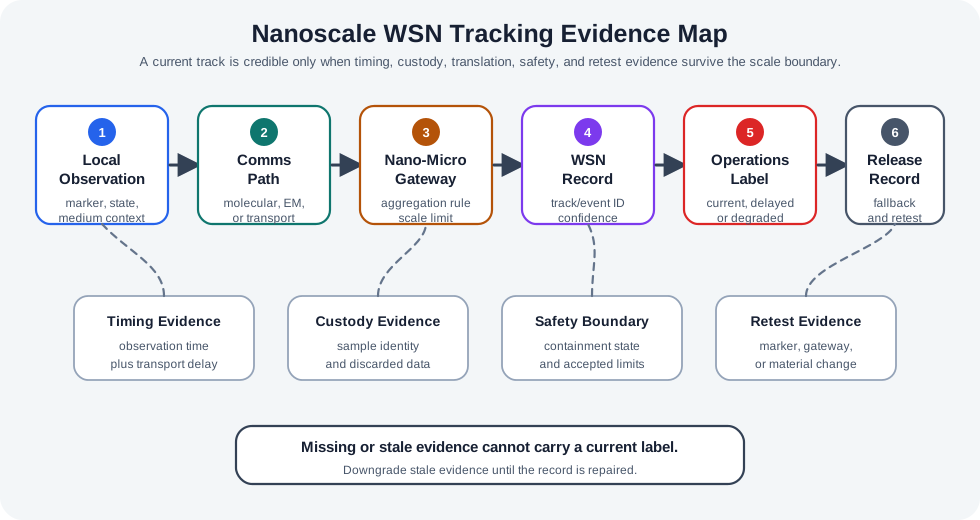
Figure Figure 25.1 starts with a local observation and follows it through a communication path, nano-micro gateway, WSN record, operations label, and release record. The observation needs marker, state, and medium context. The gateway may alter what reaches the WSN record. Timing, sample identity, discarded data, and custody must survive that handoff. The operations label distinguishes current from delayed or degraded evidence. Safety limits, fallback, and retest fields guard the final decision. A stale or missing link in this chain cannot support a current track label.
The map separates local sensing from system-level tracking. The gateway is not just a relay; it is the point where scale, timing, aggregation, and custody become visible or get lost.
25.7 Communication Path Review
This section: Communication Path Review — Nanoscale systems often discuss molecular communication and terahertz-style electromagnetic communication.
Nanoscale systems often discuss molecular communication and terahertz-style electromagnetic communication. A review should focus less on buzzwords and more on evidence consequences.
No communication path is automatically best. The right path is the one whose limits are visible enough for the supported decision.
25.8 Timing and Freshness
This section: Timing and Freshness — Nanoscale evidence often changes meaning with time.
Nanoscale evidence often changes meaning with time. A local molecular observation, a delayed gateway upload, or an aggregated signal may be useful for history but unsafe as a current track.
The review should reject any design that presents delayed nanoscale evidence as current without a freshness label.
25.9 Scale and Safety Boundaries
This section: Scale and Safety Boundaries — Nanoscale tracking concepts can cross into biological, chemical, medical, environmental, or regulated domains.
Nanoscale tracking concepts can cross into biological, chemical, medical, environmental, or regulated domains. The chapter does not provide safety approval. It identifies what a technical review must not hide.
If safety or containment assumptions are missing, the track should be labeled experimental, not production-ready.
25.10 Gateway Handoff Review
This section: Gateway Handoff Review — The nano-micro gateway is where a nanoscale observation becomes a WSN record.
The nano-micro gateway is where a nanoscale observation becomes a WSN record. It must preserve enough evidence for later review.
Gateway input: Local observation type, sensor or batch identity, medium state, timing source, and quality flags.
Translation rule: Aggregation window, threshold, consensus rule, discarded evidence, and uncertainty conversion.
Output record: Track id or event id, lifecycle label, freshness, custody, confidence, safety boundary, and operator-facing limit.
Fallback state: Request confirmation, widen sampling, hold decision, mark degraded, quarantine evidence, or retire the track.
The gateway handoff is not complete if the output only says “target detected.” It must also say what was observed, how it was translated, and when the evidence stops supporting the claim.
25.11 Gateway Ledger Fields
This section: Gateway Ledger Fields — The gateway ledger keeps scale honest.
The gateway ledger keeps scale honest. It separates the local observation, communication path, translation rule, safety state, and dashboard label so a clean WSN record does not hide the evidence that produced it.
The useful minimum is a row a reviewer can audit later:
| Ledger field | What it preserves | Review question |
|---|---|---|
| Local state | Target or state, source identity, local medium, calibration state, marker confidence, and discarded or contaminated evidence | Was the record a direct observation, a proxy marker, or a filtered event? |
| Communication state | Molecular signaling, electromagnetic link, physical transport, or hybrid relay plus timing limits | How much delay, ordering uncertainty, or path loss changed the evidence? |
| Translation state | Aggregation window, threshold, consensus rule, timestamp source, and uncertainty conversion | What did the gateway summarize, infer, convert, or discard? |
| Safety state | Containment, retrieval, neutralization, disposal, exposure boundary, owner, and retest trigger | Where does the tracking claim stop until the safety boundary is reviewed again? |
This ledger protects the learner from a common scale error: reading a polished gateway output as if it were the raw nanoscale event. If the gap cannot be explained, the label should move down to delayed, aggregated, ambiguous, degraded, experimental, or historical until the missing evidence is repaired.
25.12 Operational Labels From Evidence
This section: Operational Labels From Evidence — A useful dashboard can show a simple label, but the review record underneath should keep the reason for that label.
A useful dashboard can show a simple label, but the review record underneath should keep the reason for that label. The same marker event can support different operational states depending on freshness, aggregation, containment, and calibration.
| Evidence condition | Allowed label | Review action |
|---|---|---|
| Local-only marker with no gateway custody | Ambiguous or experimental | Require observation time, sensor identity, medium state, and confirmation rule. |
| Windowed batch uploaded after the target moved | Delayed or aggregated | Show observation window, upload time, and the reason it cannot be live state. |
| Calibrated gateway output with discarded evidence kept | Current only within a stated boundary | Keep calibration, aggregation rule, rejected samples, and accepted limits visible. |
| Containment, material, or medium changed after validation | Degraded or retest-required | Trigger review before reusing the label for operational decisions. |
The practical anti-pattern is a gateway that compresses all of this into one friendly word: “detected.” That word hides whether the sensor saw a target, a proxy marker, an aggregate, a delayed batch, or an uncertain background signal.
25.13 Knowledge Check: Gateway Ledger Labels
This section: Knowledge Check: Gateway Ledger Labels
25.14 Release Gates
This section: Release Gates — The reason to inspect Figure 25.2 is Release Gates.
The reason to inspect Figure 25.2 is Release Gates. Its Nanoscale WSN Tracking Release Gates and Claim elements locate Nanoscale WSN tracking release gates precisely.
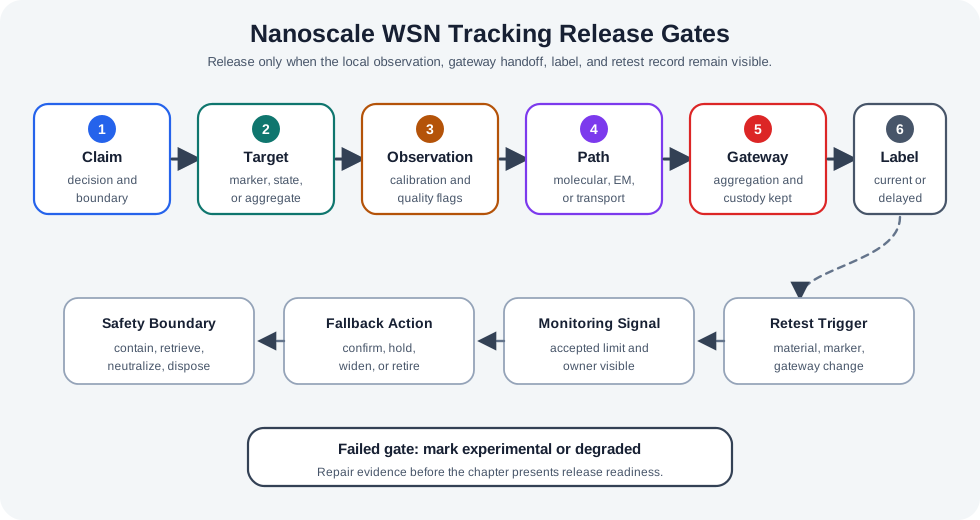
Figure Figure 25.2 makes release conditional on a bounded claim. It names the target marker or group. It checks local data quality, then follows the signal or transport path. The gateway must keep the source and custody record. The output label must say whether the track is current or delayed. Safety boundaries include containment, retrieval, neutralization, and disposal, while fallback can confirm, hold, widen, or retire the claim. Monitoring names the owner. A retest trigger names changes that reopen review. If any gate lacks evidence, the result stays experimental or degraded until the record is repaired.
Release gates should test the full evidence path from local observation to system-level decision.
25.15 Lab-on-Chip Marker Tracking
This section: Lab-on-Chip Marker Tracking — A lab-on-chip prototype tracks a chemical marker moving through microchannels.
A lab-on-chip prototype tracks a chemical marker moving through microchannels. Local nanoscale receptors report binding events to a microcontroller gateway.
25.16 Worked Review: Material Defect Sensing
This section: Worked Review: Material Defect Sensing — A material-monitoring concept embeds nanoscale sensing sites in a composite panel and reports possible defect growth through a micro gateway.
A material-monitoring concept embeds nanoscale sensing sites in a composite panel and reports possible defect growth through a micro gateway.
25.17 Worked Review: In-Body Concept Boundary
This section: Worked Review: In-Body Concept Boundary — A research concept uses local marker detection and gateway reporting to describe a possible in-body tracking workflow.
A research concept uses local marker detection and gateway reporting to describe a possible in-body tracking workflow. The review stays technical and does not treat the concept as clinical approval.
25.18 Common Nanoscale Tracking Mistakes
This section: Common Nanoscale Tracking Mistakes
25.19 Readiness Checklist
This section: Readiness Checklist — Before approving a nanoscale tracking concept for a learning module, lab workflow, or prototype review, verify these items.
Before approving a nanoscale tracking concept for a learning module, lab workflow, or prototype review, verify these items.
25.20 Knowledge Check: Nanoscale Claim
This section: Knowledge Check: Nanoscale Claim
25.21 Knowledge Check: Communication Path
This section: Knowledge Check: Communication Path
25.22 Match Nanoscale Evidence
This section: Match Nanoscale Evidence
25.23 Order Nanoscale Evidence
This section: Order Nanoscale Evidence
25.24 Summary
This section: Summary — Nanoscale tracking is a WSN vertical where local observation, communication path, gateway translation, and operations labels matter as much as the target itself.
Nanoscale tracking is a WSN vertical where local observation, communication path, gateway translation, and operations labels matter as much as the target itself. A nanoscale marker, particle, or device signal is not automatically a current track. It becomes useful only when timing, calibration, custody, aggregation, safety boundary, and uncertainty survive into the system-level record.
The right review posture is conservative. Treat nanoscale tracking concepts as bounded evidence systems. Preserve what was observed, how it moved, how it was translated, what decision it supports, and where the claim stops.
25.25 Key Takeaway
This section: Key Takeaway — Nanoscale WSN Tracking Review should adapt tracking assumptions to the vertical’s sensing physics, communication limits, localization uncertainty, energy budget, and deployment evidence.
Nanoscale WSN Tracking Review should adapt tracking assumptions to the vertical’s sensing physics, communication limits, localization uncertainty, energy budget, and deployment evidence.
25.26 Concept Relationships
This section: Concept Relationships
25.27 What’s Next
This section: What’s Next
Find help
3 reviewed answers.
Where should I start in a module?
Open the module page from the sidebar to see its chapters in order. Use the module map to return to a topic you need.
Modules and pathsReviewed
What can I try when a project does not work?
Check the symptom, then work through the diagnostic steps. Keep the error message and the smallest example that reproduces it.
When you are stuckReviewed
How do interactive examples work?
Use the interactive guide to check how examples and simulations work before changing your project.
Interactive examples guideReviewed