44 WSN Routing Fundamentals
More
Depth: Practitioner
Progress saves as you read. Mark sections complete as you go; your progress appears in the sidebar.
44.1 Start With the Field Story
This section: Start With the Field Story — Picture soil sensors spread across a farm.
Follow One Reading Through Every Relay
Picture soil sensors spread across a farm. A reading from the far row must cross three battery nodes before it reaches the sink. The network planner must deliver useful data without making the same relays carry every packet until their batteries fail.
-
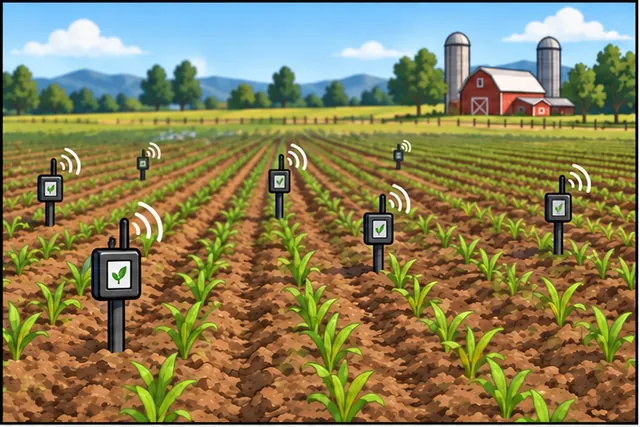
A far farm sensor sends one reading through three battery relays.
-
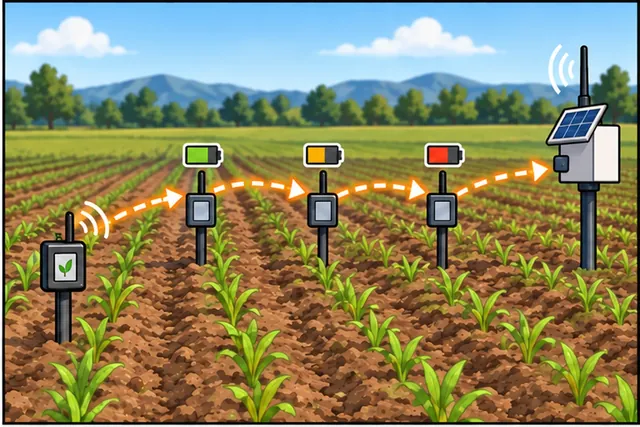
The busiest relay can die if every packet follows the same path.
-
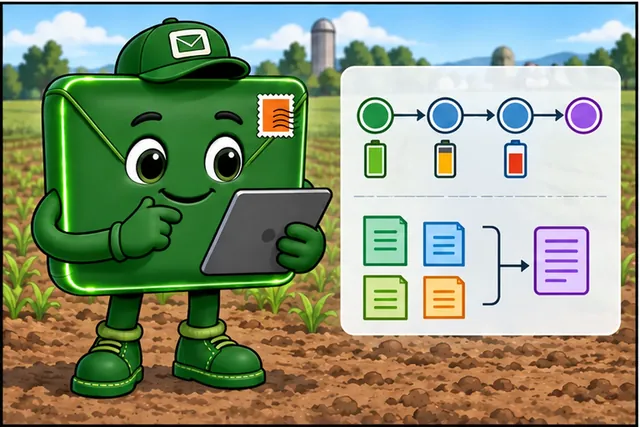
Test normal, burst, alarm, broken-link, and weak-battery routes.
-
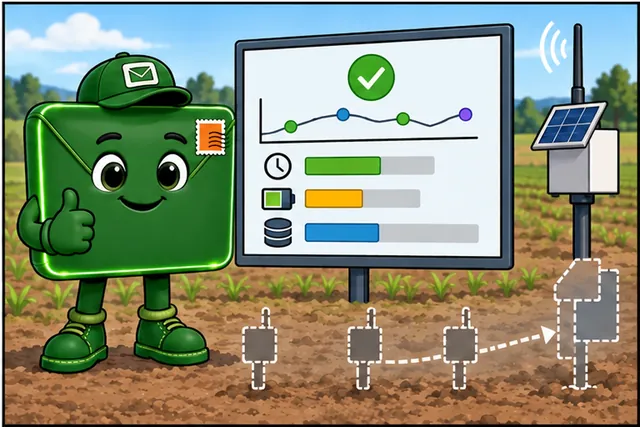
Choose a route that meets delay needs without hiding energy costs.
Write the route claim for one reading. Name the source, sink, traffic direction, allowed delay, relay choices, link evidence, stored route state, and repair owner. Mark where readings may be combined and which identity, event time, unit, and quality must survive that step.
Send normal, burst, alarm, and command traffic. Weaken one link, remove a relay, drain a busy node, move the sink, restart route state, and repeat an old packet. Check delivery, delay, energy, duplicates, loops, repair time, and whether combined data can still be explained.
Keep urgent field protection local when a multi-hop path can miss the safe deadline. A short route is not always the best route, and a formed route does not prove trusted or fresh data. Keep a fallback for loss and expose stale state to the operator.
This opening does not pick one routing family. Practitioner builds the path, load, and repair record. Under the Hood examines route state, link cost, energy balance, aggregation, many-to-one pressure, mobility, and recovery.
Use this route check:
- Trace one full path.
- Lose one relay once.
- Time the route repair.
- Check the source facts.
- Reopen when load shifts.
Routing starts with a reading that must reach a sink without exhausting the nodes that help it. Follow one packet through source, relay, aggregation, link choice, repair, and monitoring before choosing a protocol family.
44.2 In 60 Seconds
This section: In 60 Seconds — WSN routing is the evidence-backed process of moving sensor readings, alerts, queries, and control traffic between source nodes and a sink or gateway.
WSN routing is the evidence-backed process of moving sensor readings, alerts, queries, and control traffic between source nodes and a sink or gateway. It is not only a shortest-path problem. A useful WSN route must match the traffic direction, node roles, relay pressure, link quality, route state, aggregation boundary, and monitoring evidence that the application depends on.
Use this chapter as the entry point for the routing sequence. The goal is to learn the routing vocabulary and review record before choosing a protocol family. A good routing introduction answer should explain what moves, where it moves, which nodes relay it, what state is stored, what can fail, and what evidence proves the path is still acceptable.

44.3 Learning Objectives
This section: Learning Objectives
By the end of this chapter, you will be able to:
- define WSN routing in terms of sources, relays, sinks, gateways, paths, and route state
- explain why WSN routing review starts with traffic direction and monitoring evidence
- separate path reachability from link quality, relay pressure, route repair, and aggregation meaning
- describe the evidence a beginner should collect before naming a routing protocol family
- build a routing introduction record with assumptions, accepted limits, owner, and retest triggers
44.4 WSN Routing Introduction
This section: WSN Routing Introduction
44.5 Prerequisites
This section: Prerequisites — This chapter builds on Wireless Sensor Networks Overview and prepares learners for WSN Routing Protocol Classification Review.
This chapter builds on Wireless Sensor Networks Overview and prepares learners for WSN Routing Protocol Classification Review. If the learner cannot identify sensor nodes, relay nodes, sinks, gateways, and many-to-one reporting, review the overview chapter first.
44.6 What Routing Means in a WSN
This section: What Routing Means in a WSN — Routing describes how data and control messages move across the sensor network.
Routing describes how data and control messages move across the sensor network. In many WSN deployments, several source nodes report toward one sink, and some nodes forward data for others.
The routing review begins by naming these pieces. Without them, a route diagram is just a picture of connectivity, not evidence that the monitoring application will work.
44.7 Routing Introduction Scope
This section: Routing Introduction Scope — An introductory routing review should answer six questions before protocol names appear.
An introductory routing review should answer six questions before protocol names appear.
44.8 Route Anatomy
This section: Route Anatomy — Use the visual in Figure 44.1 to test Route Anatomy.
Use the visual in Figure 44.1 to test Route Anatomy. Its Multi-Hop Relay Architecture and Source labels anchor the sequence behind Route Anatomy in named system parts.
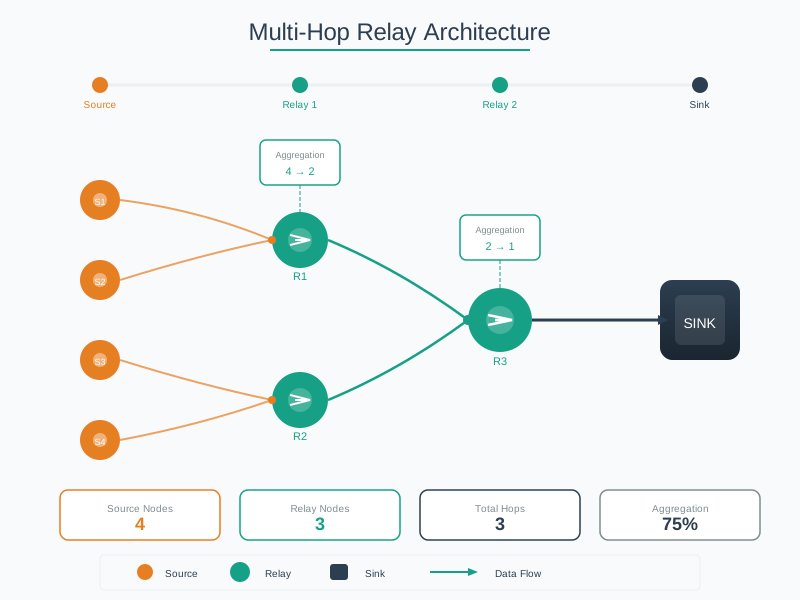
Figure Figure 44.1 shows source nodes sending readings through relays to a sink. The drawing marks four source flows becoming two and then one after aggregation, so the relay role does more than repeat packets. A route review still needs to ask whether those relays can carry their load, whether link quality and freshness survive, and what happens during repair. The same source-relay-sink pattern can support several routing families; the figure does not choose a protocol. It gives the learner a path to inspect before later sections compare metrics, failures, and evidence for each route.
The diagram separates roles from protocol names. The same source, relay, and sink pattern can later be implemented by tree, data-centric, hierarchical, geographic, reactive, or quality-aware behavior. The introductory review only asks whether the route evidence is complete enough to support a later classification.
44.9 Why WSN Routing Is Different
This section: Why WSN Routing Is Different — WSN routing differs from ordinary network routing because the application decision often depends on data meaning, not just destination reachability.
WSN routing differs from ordinary network routing because the application decision often depends on data meaning, not just destination reachability.
44.10 Scalability and QoS Bounds
This section: Scalability and QoS Bounds — Adding nodes expands sensing coverage, but it does not create radio capacity.
Adding nodes expands sensing coverage, but it does not create radio capacity. In a shared multihop channel, more sources also create more contenders, relay work, interference, route state, and traffic near the sink. A useful first-order scaling model is
where is the sustainable throughput available to one node and is the node population. This is a planning law, not a guarantee for every topology. Its value is the warning it provides: if the population grows by a factor of four, the per-node share is expected to fall to roughly one half unless the design adds spatial reuse, channels, sinks, aggregation, scheduling, or another capacity change.
Walk that implication through a concrete deployment. Suppose 100 nodes each have a defensible budget of 8 kbit/s. Growing to 400 nodes without changing the radio plan gives the estimate
The result does not say every node will measure exactly 4 kbit/s. It says a design review cannot multiply the original per-node rate by 400 and call the network scalable. The new population must be tested under the new contention, relay, and interference pattern.
Throughput is only one quality-of-service dimension. Review the four dimensions together:
| QoS dimension | What to measure | Why an average can mislead |
|---|---|---|
| Bandwidth | useful application bits delivered per second, per flow and at the sink | Aggregate capacity can look healthy while edge nodes are starved. |
| Delay | time from sensing or enqueue to accepted delivery | A packet can arrive successfully but too late for the decision. |
| Jitter | variation in delay between successive packets | Mean delay can pass while bursty arrival breaks sampling, playback, or control timing. |
| Packet-loss probability | missing packets divided by attempted packets for the stated traffic and time window | A quiet-period result hides loss during alarms, interference, or route repair. |
| : QoS evidence required when a WSN population or RF environment changes. |
Changing RF conditions couple these quantities. A fade raises retransmissions; retransmissions consume bandwidth and energy; queueing raises delay and jitter; exhausted retry limits raise loss. Therefore a QoS claim needs a workload, percentile, observation window, topology, channel, and failure condition. For example, “95th-percentile alarm delay below 2 s with packet-loss probability below during the interference test” is reviewable. “Good QoS” is not.
Scale tests should increase offered load and node count separately, then together. Record where queue depth, retry rate, duty-cycle limit, or sink-adjacent relay load becomes the first bottleneck. That breakpoint tells the team whether to aggregate, add another sink, split channels, schedule critical traffic, narrow the reporting rate, or revise the service claim.
44.11 Evidence Record
This section: Evidence Record — Before the evidence record argument advances, use Figure 44.2 to reconcile Traffic Use with Reading, alert, query,.
Before the evidence record argument advances, use Figure 44.2 to reconcile Traffic Use with Reading, alert, query,. The diagram turns that reconciliation into something the team can inspect.
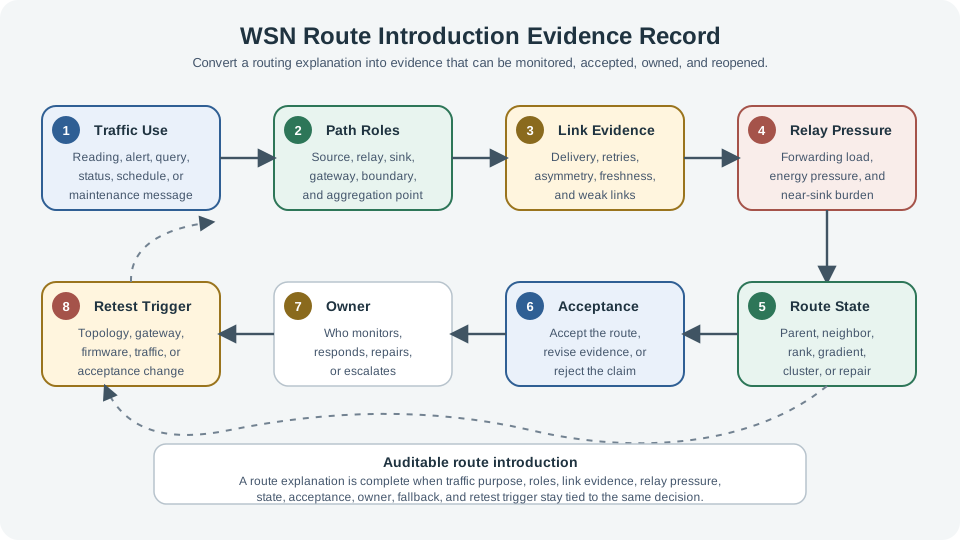
At Traffic Use, Figure 44.2 adds a distinct review condition. The visual next names Reading, alert, query, to show where the review identifies the field observation; maintenance message finally assigns operational responsibility. Those concrete stages express the following claim: WSN route introduction evidence record linking traffic purpose, path roles, link evidence, relay pressure, route state, acceptance, owner, and retest trigger. They keep evidence record tied to observable evidence.
Traffic claim: State the reading, alarm, query, command, or update the route must carry.
Path evidence: Record source, relay, sink, direction, alternate path, and gateway boundary.
Link evidence: Record delivery, retries, asymmetry, parent changes, and measurement age.
Relay evidence: Record which nodes forward other nodes' traffic and what monitoring shows about their health.
State evidence: Record the route state each node stores and how stale state is detected or repaired.
Decision: Accept, revise, or reject the route; name the owner, fallback action, and retest trigger.
44.12 Path and Role Evidence
This section: Path and Role Evidence — Route evidence is strongest when every important role is visible.
Route evidence is strongest when every important role is visible.
An introductory routing answer should avoid saying “the network is connected” as the final claim. It should say which traffic was tested, which roles carried it, and which failures remain visible.
44.13 Link Quality and Relay Pressure
This section: Link Quality and Relay Pressure — The first route a packet uses may not be the route the system should keep using.
The first route a packet uses may not be the route the system should keep using. A short path with weak links can create repeated retries and repairs. A longer path through stable links may be easier to operate. A relay close to the sink may also carry a much heavier workload than edge nodes.
The beginner-level habit is simple: a route is not only a line on a diagram. It is a set of measured behaviors that must stay within accepted limits.
44.14 Route State and Repair
This section: Route State and Repair — Every routing method stores or infers some state.
Every routing method stores or infers some state. The introductory review should ask what state exists, where it is stored, and what happens when it becomes wrong.
Repair is part of routing, not an afterthought. A route design that works only until the first weak link, dead relay, moved gateway, or stale parent is not ready for acceptance.
44.15 Aggregation Boundaries
This section: Aggregation Boundaries — WSNs often reduce traffic by filtering, suppressing duplicates, or combining readings.
WSNs often reduce traffic by filtering, suppressing duplicates, or combining readings. That can be useful, but it changes the evidence that reaches the sink.
This chapter does not require learners to choose a data aggregation protocol. It only prepares them to ask whether the route preserves enough evidence for the later data-aggregation chapter.
44.16 Routing Monitoring and Family Fit
This section: Routing Monitoring and Family Fit — Protocol-family names are useful vocabulary only after the route evidence is visible.
Protocol-family names are useful vocabulary only after the route evidence is visible. A beginner review can compare tree or proactive collection, data-centric queries, reactive repair, geographic hints, hierarchical clusters, and dissemination behavior without treating any label as automatic approval.
The routing introduction should leave learners with an operations habit: choose routing behavior from the evidence record, monitor the evidence after deployment, and reopen the route decision when the signals drift.
A routing metric is a contract about what the route may optimize and what it may sacrifice. A hop-count metric sacrifices link quality and relay balance for short paths. A link-quality metric may spend more energy to avoid lossy hops. An energy-aware metric may accept delay or longer paths to protect a critical relay.
Compare the three routes in Figure 44.3 to see how changing the metric can change the chosen path on the same graph.
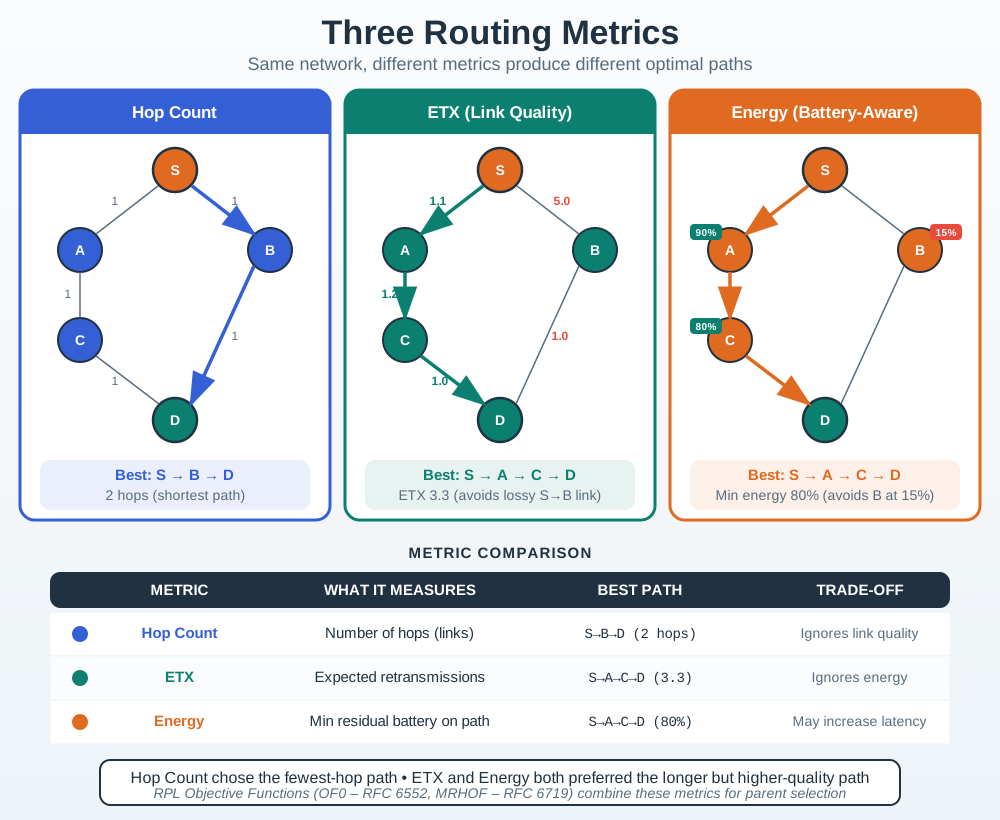
Read the hop-count result first: it rewards the fewest relays, even when one of those links is weak or one relay is nearly depleted. The ETX result uses expected transmissions, so a longer-looking route can win by avoiding retries. The energy-aware result protects constrained relays and may accept more hops or delay. The graph has not changed; only the definition of “best” has. That is why a routing record must name the metric, its current inputs, and the application cost it is allowed to trade away.
A parent-choice ledger is the practical record behind that claim:
| Ledger field | What to record | Failure it exposes |
|---|---|---|
| Candidate next hops | Visible neighbors, gateway reachability, role, parent history, rejected candidates, and alternate path. | The route looks deterministic even though the node had no acceptable backup. |
| Link evidence | Delivery ratio, retries, ETX, asymmetry check, sample age, parent changes, and repair events. | A strong-looking parent was selected from stale or one-way link evidence. |
| Relay cost | Forwarded packet share, queue pressure, battery trend, duty-cycle pressure, and downstream dependency. | The selected relay becomes the hidden bottleneck for many sources. |
| Data meaning | Freshness need, alarm priority, aggregation boundary, missing-member visibility, and fallback data path. | A route preserves packets but loses the evidence needed for the decision. |
| Expiry and owner | Metric lifetime, retest trigger, alert threshold, route owner, and manual recovery action. | The path remains accepted after the conditions that justified it have changed. |
Separate path existence, path quality, and path meaning. Path existence means a packet can traverse the hops. Path quality means delivery, retries, repair, and relay load are within accepted limits. Path meaning means the delivered data is still fresh, attributable, complete enough, and visible to the decision owner. A route can pass the first test and fail the other two.
Most practical WSN routing decisions combine imperfect signals: ETX, remaining energy, queue pressure, measurement freshness, recent repairs, and traffic priority. Those signals age while routes continue to use them. A parent that was good during commissioning can become weak after moisture, interference, enclosure changes, gateway movement, battery decline, or a traffic burst.
Two companion rules keep the route from drifting. Expiry says how long each measurement can justify a route. Hysteresis says how much better a candidate must be before a node changes parent. Without expiry, stale routes persist. Without hysteresis, tiny measurement noise can cause parent churn, duplicate traffic, routing loops, or repeated repair overhead.
| Signal | Expiry question | Repair risk |
|---|---|---|
| Link quality | How recent are delivery, retry, asymmetry, and parent-change measurements? | Stale ETX keeps a weak parent or triggers needless churn. |
| Relay load | How current are queue, forwarded-share, duty-cycle, and battery observations? | A relay is accepted after it has become the bottleneck. |
| Data freshness | How old can a reading be before the route no longer supports the claim? | Packets arrive, but too late for the monitoring decision. |
| Aggregation state | How long can a summary hide missing members, outliers, or stale inputs? | The sink receives a clean aggregate that no longer proves coverage. |
The introductory standard is not a full routing equation. It is a route decision that says which measurements drove the path, when those measurements expire, what threshold prevents noise-driven churn, and what fallback protects the monitoring claim when no candidate remains acceptable.
44.17 Knowledge Check: Route Metric Aging
This section: Knowledge Check: Route Metric Aging
44.18 Worked Review: Building Monitoring
This section: Worked Review: Building Monitoring — Scenario: Battery sensors report room temperature and door-state changes to a building gateway.
Scenario: Battery sensors report room temperature and door-state changes to a building gateway. Most readings are routine, but missing rooms must be visible because they affect maintenance decisions.
Traffic claim: Routine readings and occasional door-state events move toward one building gateway.
Route roles: Some hallway nodes may relay room-node traffic, so their health must be compared with non-relay nodes.
Evidence needed: Parent changes, retry counts, missing-room visibility, gateway maintenance behavior, and whether local summaries preserve room identity.
Decision: Accept the introduction record only if route-health monitoring can distinguish a quiet room from a failed node or stale route.
44.19 Worked Review: Remote Field Gateway
This section: Worked Review: Remote Field Gateway — Scenario: Field sensors report soil and equipment status to a gateway at the edge of the deployment.
Scenario: Field sensors report soil and equipment status to a gateway at the edge of the deployment. The site has changing moisture, seasonal plant growth, and limited maintenance visits.
Traffic claim: Periodic status readings and rare alerts move across multiple hops to an edge gateway.
Route roles: Nodes between the field and gateway may become long-term relays, so relay pressure and link quality must be reviewed separately.
Evidence needed: Link measurements across site conditions, alternate path behavior, stale-neighbor detection, repair events, and gateway outage handling.
Decision: Revise the route if evidence depends on a single season, a single gateway placement, or a single successful test pass.
44.20 Common Mistakes
This section: Common Mistakes
44.21 Review Checklist
This section: Review Checklist — traffic type, direction, urgency, and decision use.
Before accepting an introductory WSN routing explanation, verify that it records:
traffic type, direction, urgency, and decision use. source, relay, sink, gateway, and boundary roles. link-quality evidence beyond one signal or one packet. relay-pressure evidence near sinks, bridges, cluster heads, or corridors. route-state evidence and repair behavior. aggregation boundaries and missing-data visibility. accepted limits, owner, fallback action, and retest trigger.
44.22 Knowledge Check: Route Evidence
This section: Knowledge Check: Route Evidence
44.23 Knowledge Check: Relay Pressure
This section: Knowledge Check: Relay Pressure
44.24 Match Routing Terms to Evidence
This section: Match Routing Terms to Evidence
44.25 Order the Introductory Routing Review
This section: Order the Introductory Routing Review
44.26 Summary
This section: Summary — WSN routing introduction is about evidence, not memorizing a protocol.
WSN routing introduction is about evidence, not memorizing a protocol. A useful routing explanation names the traffic, source nodes, relay nodes, sink or gateway, route state, link evidence, relay pressure, aggregation boundary, monitoring signals, and retest triggers. Once those pieces are visible, later chapters can review routing challenges, protocol classification, data aggregation, link quality, Directed Diffusion, and related WSN routing families without drifting into unsupported claims.
44.27 Key Takeaway
This section: Key Takeaway — WSN Routing Introduction Review should balance path reliability, link quality, energy cost, latency, aggregation, topology change, control overhead, and deployment evidence.
WSN Routing Introduction Review should balance path reliability, link quality, energy cost, latency, aggregation, topology change, control overhead, and deployment evidence.
44.28 Concept Relationships
This section: Concept Relationships
44.29 What’s Next
This section: What’s Next — Continue with WSN Routing Protocol Classification Review to map evidence to routing families.
Continue with WSN Routing Protocol Classification Review to map evidence to routing families. After that, review WSN Routing Data Aggregation, WSN Routing Directed Diffusion, and WSN Routing Link Quality for deeper route-design patterns.
Find help
3 reviewed answers.
Where should I start in a module?
Open the module page from the sidebar to see its chapters in order. Use the module map to return to a topic you need.
Modules and pathsReviewed
What can I try when a project does not work?
Check the symptom, then work through the diagnostic steps. Keep the error message and the smallest example that reproduces it.
When you are stuckReviewed
How do interactive examples work?
Use the interactive guide to check how examples and simulations work before changing your project.
Interactive examples guideReviewed