43 Mobile Sink Production Deployment

More
Depth: Practitioner
Progress saves as you read. Mark sections complete as you go; your progress appears in the sidebar.
43.1 Release a Tested Collection Route
This section: Release a Tested Collection Route — Imagine a service vehicle gathers stored readings from remote nodes on a fixed route.
Imagine a service vehicle gathers stored readings from remote nodes on a fixed route. The operator must decide whether each visit keeps the data fresh enough for the real task. A gateway is a device that links one network or system to another.
A service vehicle becomes a useful mobile sink only when its route reaches the remote nodes often enough for their readings to remain fresh. Test the planned stops against actual contact, storage, power, and later upload, including a missed visit.
43.1.1 Check Contacts and Uploads
- Which source nodes are reachable on this route?
- Does each stop leave enough time to collect buffered readings?
- When do collected readings reach the upload point?
- What covers a missed stop or a failing collector?
Keep route logs, node contact receipts, buffer levels, health, measurement age, and upload receipts. Mark nodes outside the tested route as outside the service claim.
43.1.2 When a Drive-By Misses Data
A vehicle passing near a source does not establish that its buffered readings reached the decision owner. The contact must last long enough to transfer the waiting data and confirm custody, and later upload must keep the measurement within the accepted freshness limit. A missed node or data that expires before upload breaks the collection claim for that source.
At Practitioner depth, check reachability against observed route and contact logs, then rehearse fallback under missed passes, partial transfers, collector failure, and blocked upload. These failures need distinct recovery actions because data may remain at the source, be partly transferred, or wait on the collector. Keep buffer age, contact receipts, collector health, and upload receipts visible. Limit release to sources with tested contact and upload evidence.
43.1.3 Before Approving a Mobile Sink
Compare the oldest reading in each node’s buffer with the task’s freshness limit. If the vehicle misses a stop, expose the gap and choose the rehearsed return visit or alternate collector. Release the route only for nodes with observed contact and upload evidence.
43.2 Start With the Field Story
This section: Start With the Field Story — A mobile sink is useful only if its route and custody promises are real.
A mobile sink is useful only if its route and custody promises are real. Start with when it meets nodes, how long data waits, what happens when a visit is missed, and who owns the collector, buffer, and retry evidence.
43.3 In 60 Seconds
This section: In 60 Seconds — A mobile sink is not just a moving gateway.
A mobile sink is not just a moving gateway. In production it is a data-collection service with a route owner, contact windows, buffer rules, custody evidence, collector health, upload path, fallback action, and retest trigger. A good plan proves that delayed collection still supports the monitoring decision and that missed contact becomes visible uncertainty instead of silent data loss.
Mobile sinks are valuable when movement is already available, when fixed relays create unacceptable burden, when disconnected sources must be collected, or when field access makes manual collection expensive or unsafe. They create risk when movement is assumed to be free, always available, always safe, or always able to meet data-age requirements.
43.4 Learning Objectives
This section: Learning Objectives
By the end of this chapter, you will be able to:
- review mobile sink and Data MULE deployment as an operating system rather than a path-planning puzzle
- define route, contact, buffer, custody, data-age, upload, fallback, and retest evidence for mobile collection
- compare fixed-route, adaptive-route, opportunistic, partitioned, and coordinated mobile-collector strategies without overclaiming their fit
- identify production drift caused by missed contacts, route changes, stale buffers, collector faults, upload failures, and ownership gaps
- connect mobile sink deployment to production deployment gates, mobile entities, routing, energy, and coverage chapters
43.5 Mobile Sink Deployment Review
This section: Mobile Sink Deployment Review
43.6 Prerequisites
This section: Prerequisites
This chapter builds on WSN Production Deployment Review, MWSN Types and Mobile Entities Review, Mobile WSN Fundamentals Review, Stationary WSN Fundamentals Review, WSN Routing Introduction Review, WSN Energy Management, and WSN Coverage Fundamentals.
If a learner cannot describe contact windows, data custody, buffer age, route ownership, relay burden, gateway ingestion, uncertainty labels, and fallback actions, review those chapters before approving a mobile-sink deployment.
43.7 Mobile Sink Review Scope
This section: Mobile Sink Review Scope — Production review asks whether mobile collection can support the monitoring claim after field conditions and operating schedules change.
Production review asks whether mobile collection can support the monitoring claim after field conditions and operating schedules change.
43.8 Mobile Sink Evidence Map
This section: Mobile Sink Evidence Map — Evidence for Mobile Sink Evidence Map starts in Figure 43.1.
Evidence for Mobile Sink Evidence Map starts in Figure 43.1. Look at Monitoring claim beside what the collected data before accepting the sequence behind Mobile Sink Evidence Map.
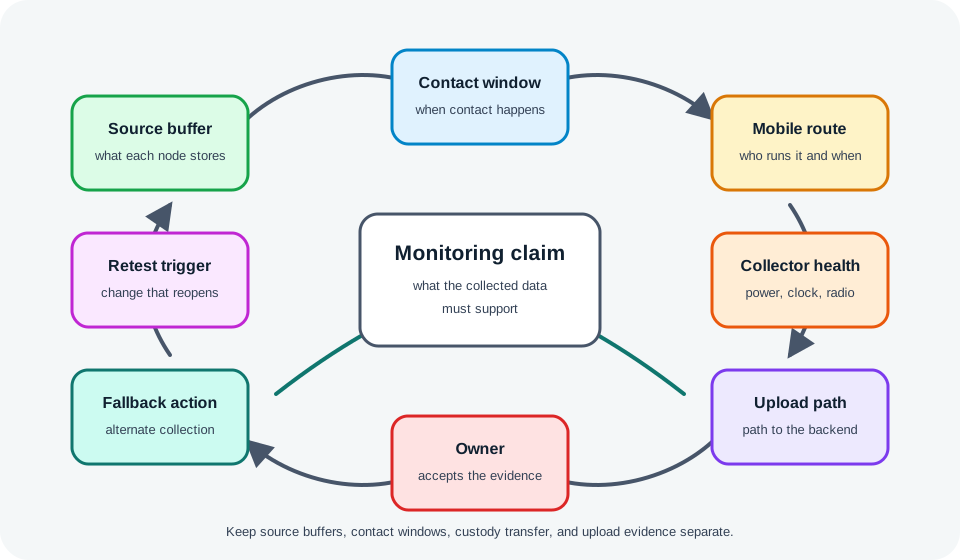
Figure Figure 43.1 follows a buffered reading through route, contact, custody, and backend upload. In the worked ledger, a source has an eight-hour buffer limit and the worst next pass occurs after six hours, leaving two hours at contact. A further four-hour upload delay makes the route and upload subtotal ten hours before other processing. The contact must prove what was offered, accepted, or left partial; the backend must confirm arrival. Missed contact, incomplete handoff, and late upload call for different owner actions. The release decision must stay within the proven freshness limit and show fallback when that limit fails.
The map prevents a common error: proving that a collector can move through a site while failing to prove that the collected data remains meaningful. A route is production-ready only when source buffers, contact windows, data age, custody transfer, upload, ownership, fallback, and retest triggers all support the monitoring claim.
43.9 Strategy Selection
This section: Strategy Selection — Mobile-sink strategies should be chosen for the operating claim, not because one routing algorithm sounds more advanced.
Mobile-sink strategies should be chosen for the operating claim, not because one routing algorithm sounds more advanced.
Use Figure 43.2 to choose a mobile-sink route only after its delay, custody, and missed-pass behavior are explicit.

Begin with the fixed route. It gives a known visit plan, but needs a repair rule when a pass is missed. The next route changes in response to fresh facts. That may help reach more nodes, though new plans cost time and make delay less clear. The third choice reuses trips that already take place, so reach and data age may vary. A group of collectors can split the field, but each handoff needs a clear owner. For all four, test reach, age of queued data, sensor power, and repair. A route name alone does not prove a sound service.
A fixed route contract says when each source is visited and what delay is acceptable. An adaptive route contract says which priority rule may skip a source and how that skipped source is reported. An opportunistic route contract says how variable trips are bounded and when coverage is too uncertain. A multi-collector contract says which collector owns each source, how handoff works near boundaries, and how duplicate or partial custody records are reconciled.
The contract becomes auditable when each promise has a visible test. Reachability is tested with source lists and route logs. Freshness is tested with oldest accepted data and dashboard age labels. Custody is tested with source-side and collector-side receipts. Recovery is tested by forcing a missed pass, a partial transfer, and a delayed upload. Those tests make the mobile-sink claim specific enough to release, limit, or reject.
The contract should also state what the route is not allowed to prove. A collector that passes near a field once per day may support trend review but not safety alarms. A robot that visits most rooms may support routine maintenance but not complete building coverage. A vehicle route that depends on staff schedule may support delayed planning but not urgent intervention. The production claim is valid only inside the route’s proven service envelope.
43.10 Route and Contact Evidence
This section: Route and Contact Evidence — Route planning should show what is reachable and what remains at risk.
Route planning should show what is reachable and what remains at risk.
43.11 Buffer and Custody Review
This section: Buffer and Custody Review — Mobile-sink systems often fail quietly when source buffers are treated as unlimited or when custody transfer is not visible.
Mobile-sink systems often fail quietly when source buffers are treated as unlimited or when custody transfer is not visible.
Source buffer: Record what is stored, what can be overwritten, what expires, and which conditions put data at risk.
Timestamp: Record measurement time, collection time, upload time, processing time, and display time separately.
Custody transfer: Record source identity, collector identity, transfer completion, duplicate handling, and retry behavior.
Uncertainty: Mark missing, stale, inferred, duplicated, delayed, or partially collected data before it reaches the decision owner.
Closure: Close a collection incident only after the owner can see whether the monitoring claim is restored, limited, or suspended.
A contact is successful only when the source and collector can prove what happened. Discovery alone is not enough. The record should say when the source woke, when the collector entered useful range, how long the link stayed usable, which records were offered, which records were accepted, whether the source may delete or retain a retry copy, and whether the collector later uploaded the batch.
| Contact ledger field | What to record | Failure it exposes |
|---|---|---|
| Encounter window | Expected pass time, actual pass time, wake schedule, range, speed, obstruction, and link duration | The collector passes close enough to detect but not long enough to finish transfer |
| Source buffer | Oldest record age, free storage, overwrite rule, expiry rule, and records waiting before contact | Data is silently overwritten before the next collection opportunity |
| Custody receipt | Batch id, source state, accepted records, partial records, duplicate rule, retry rule, and delete permission | The source deletes after an incomplete or unconfirmed handoff |
| Collector state | Battery, storage, clock, firmware, route completion, upload queue, and recovery after interruption | The collector becomes the weak point after successfully meeting the source |
| Owner action | Missed-contact alert, fallback, uncertainty label, manual service, and retest trigger | Missed collection remains hidden while dashboards show old confidence |
Separate missed contact, partial contact, and late upload. Missed contact means the source and collector never exchanged enough evidence for the batch. Partial contact means some evidence moved but custody is not complete. Late upload means the collector has custody but the backend or decision owner does not. Treating all three as “no new data yet” hides the cause and delays the right recovery.
Test the ledger with the real payload class. A ten-second contact may be enough for scalar readings but not for image batches, firmware logs, or encrypted audit bundles. A route that succeeds with empty buffers may fail after a rainy week of missed passes. A collector that works at the start of a route may run out of storage or power before the high-priority sources.
43.12 Multi-Collector Coordination
This section: Multi-Collector Coordination — To challenge Multi-Collector Coordination, examine the visual at Figure 43.3.
To challenge Multi-Collector Coordination, examine the visual at Figure 43.3. Its Mobile Sink Coordination Review and Partitioned zones labels reveal the sequence behind Multi-Collector Coordination.
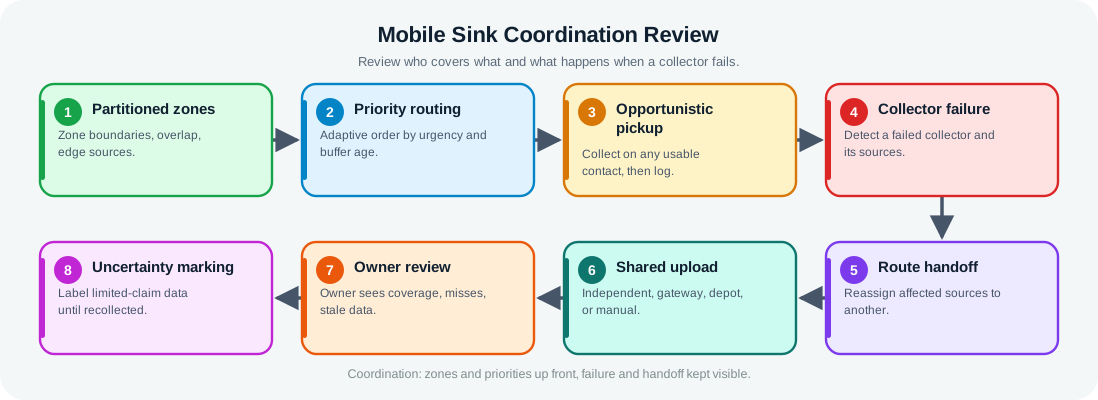
Figure Figure 43.3 shows two partitioned collection zones and the sources near their boundary. Each collector owns assigned sources, while a handoff rule decides who handles edge sources. The timeline keeps the source buffer limit, route interval, contact, and possible upload delay visible. Its failure drill disables one collector, reassigns the route, and asks an owner to review missed or stale data. The two-hour arithmetic margin between the eight-hour buffer limit and six-hour interval is only a simplified bound; transfer and upload add time. Coordination needs current route, custody, and freshness evidence before either zone’s claim is released.
43.13 Movement Cost and Feasibility
This section: Movement Cost and Feasibility — Movement cost should be reviewed as an operating constraint rather than as a generic claim about robots, vehicles, or aircraft.
Movement cost should be reviewed as an operating constraint rather than as a generic claim about robots, vehicles, or aircraft.
The hidden coupling in mobile-sink production is time. The route interval says how often collection is expected. The source buffer TTL says how long records can wait without overwrite or expiry. The freshness budget says how old a measurement may be before it no longer supports the claim. The upload SLA says how quickly the collector must move accepted records into backend custody.
For a source to support the claim, the worst-case time from measurement to backend availability must be less than the accepted evidence age. That worst case includes time until the next route pass, wake alignment, contact transfer, route interruption, collector storage delay, upload delay, backend processing, and dashboard refresh. Buffer TTL must exceed the pre-contact waiting time plus retry margin. Collector storage must exceed the route’s expected accepted load plus missed-upload margin.
| Clock | Review question | Failure signal |
|---|---|---|
| Route interval | How long can a source wait for the next real contact under normal and disrupted operation? | Expected collection date passes without contact or route owner acknowledgement |
| Buffer TTL | How long before stored records expire, overwrite, or stop matching the decision? | Oldest buffered record approaches expiry before the collector arrives |
| Contact duration | Can the source transfer the worst-case batch with handshake, retries, and custody receipt? | Partial transfer, duplicate burst, or source retains retry copy after contact |
| Upload SLA | How soon after custody must the collector upload and confirm backend acceptance? | Collector holds accepted records while dashboard still shows stale data |
This shared-clock model explains why mobile collection needs explicit fallback. A missed pass is not just one late visit; it consumes buffer TTL, narrows the freshness budget, and may fill collector storage on the next successful route. A fallback route, manual service visit, temporary relay, or limited dashboard claim should trigger before the timing inequality is broken.
43.13.1 Knowledge Check: Timing Budget
43.14 Commissioning a Mobile Sink
This section: Commissioning a Mobile Sink — Commissioning should prove both the source layer and the moving collection layer.
Commissioning should prove both the source layer and the moving collection layer.
43.15 Failure Drills
This section: Failure Drills — Failure drills show whether mobile collection degrades honestly.
Failure drills show whether mobile collection degrades honestly.
43.16 Worked Review: Service Vehicle Collector
This section: Worked Review: Service Vehicle Collector — Scenario: Stationary field sensors buffer readings until an existing service vehicle passes through the site.
Scenario: Stationary field sensors buffer readings until an existing service vehicle passes through the site.
Claim: Field-level trends can support review when data age and missed collection are visible to the decision owner.
Route evidence: Validate the service route, schedule control, vehicle availability, contact windows, and field areas that are outside the route.
Custody evidence: Record source buffer behavior, collector identity, transfer completion, upload path, duplicate handling, and stale-data labeling.
Fallback: Use manual collection, alternate route, temporary relay, delayed decision, or uncertainty marking when contact is missed.
Retest trigger: Retest after route, schedule, vehicle, crop height, collector firmware, gateway upload, or ownership changes.
43.17 Aerial Inspection Collector
This section: Aerial Inspection Collector — Scenario: A mobile collector gathers data from remote sources where fixed relays are not practical.
Scenario: A mobile collector gathers data from remote sources where fixed relays are not practical.
Claim: Remote source data can support inspection review only when collection route, reserve, upload, and data age are proven.
Route evidence: Validate access, safety, weather constraints, contact windows, reserve behavior, and what locations are outside the claim.
Custody evidence: Record source identity, transfer completion, collector storage, upload completion, and stale or incomplete data labels.
Fallback: Use alternate collection, manual inspection, temporary relay, delayed decision, or limited claim when route completion is uncertain.
Retest trigger: Retest after flight path, route owner, weather policy, collector maintenance, firmware, upload, or safety-rule changes.
43.18 Worked Review: Facility Robot Collector
This section: Worked Review: Facility Robot Collector — Scenario: A facility robot collects data from fixed sensor groups during scheduled rounds.
Scenario: A facility robot collects data from fixed sensor groups during scheduled rounds.
Claim: Facility condition data can support maintenance review when each group is visited, uploaded, and labeled with current source state.
Route evidence: Validate route blockage, doors, people, equipment movement, charging, local wireless coverage, and shift schedule changes.
Custody evidence: Record collection order, missed groups, partial transfers, upload state, duplicate handling, and dashboard freshness.
Fallback: Use manual collection, reroute, fixed relay, local gateway, or uncertainty marking when scheduled collection fails.
Retest trigger: Retest after layout, access, robot maintenance, gateway, firmware, alert threshold, or maintenance-owner changes.
43.19 Common Mistakes
This section: Common Mistakes
43.20 Mobile Sink Readiness Checklist
This section: Mobile Sink Readiness Checklist — monitoring claim, decision owner, freshness need, data-age limit, tolerated uncertainty, and safety or privacy boundary.
Before accepting a mobile-sink production deployment, verify that the record includes:
monitoring claim, decision owner, freshness need, data-age limit, tolerated uncertainty, and safety or privacy boundary. route owner, route-change rule, route completion evidence, contact windows, missed-contact detection, and fallback action. source buffer rule, timestamp model, duplicate handling, custody transfer, upload path, and stale-data labeling. collector identity, power state, storage, clock sync, firmware, maintenance owner, recovery plan, and upload verification. coordination rules for partitions, priority changes, collector failure, duplicate collection, and shared upload when more than one collector is used. failure drills for missed route, partial contact, collector failure, upload failure, and stale or bad data. release decision, open exceptions, accepted limits, fallback actions, incident closure evidence, and retest triggers.
43.21 Knowledge Check: Route Evidence
This section: Knowledge Check: Route Evidence
43.22 Knowledge Check: Missed Contact
This section: Knowledge Check: Missed Contact
43.23 Match Mobile Sink Evidence
This section: Match Mobile Sink Evidence
43.24 Order a Mobile Sink Production Review
This section: Order a Mobile Sink Production Review
43.25 Summary
This section: Summary — Mobile sink production deployment is an evidence problem.
Mobile sink production deployment is an evidence problem. A moving collector is useful only when route ownership, contact windows, buffer custody, data age, collector reliability, upload proof, fallback behavior, and retest triggers support the monitoring claim.
The production record should make uncertainty visible. Missed contacts, stale buffers, partial transfers, duplicate uploads, failed collectors, route changes, and delayed uploads should change the dashboard state and trigger owned action rather than silently preserving old confidence.
43.26 Key Takeaway
This section: Key Takeaway — Mobile Sink Production Deployment Review should validate stationary or mobile sink plans with visit schedules, buffer limits, route reliability, energy impact, maintenance ownership, and deployment evidence.
Mobile Sink Production Deployment Review should validate stationary or mobile sink plans with visit schedules, buffer limits, route reliability, energy impact, maintenance ownership, and deployment evidence.
43.27 Concept Relationships
This section: Concept Relationships — WSN Production Deployment Review provides the rollout gate framework that mobile sink deployment must pass.
WSN Production Deployment Review provides the rollout gate framework that mobile sink deployment must pass. Production deployment gate practice provides evidence gates, owners, fallback actions, and retest triggers for mobile-sink operation. MWSN Types and Mobile Entities Review helps select the mobile entity and movement pattern used by the collector. Mobile WSN Fundamentals Review explains contact windows, buffers, data age, custody, and disconnected collection. Stationary WSN Fundamentals Review supports the fixed source layer used by many mobile-sink systems. WSN Routing Introduction Review supports route repair, relay burden, link evidence, and gateway behavior when mobile collection is not enough. WSN Energy Management supports collector power, source sleep, wake schedules, and maintenance planning. WSN Coverage Fundamentals supports source coverage evidence and uncertainty labeling.
43.28 What’s Next
This section: What’s Next — Continue with WSN Routing Introduction Review to review how route evidence, relay burden, and gateway behavior interact with mobile collection choices.
Continue with WSN Routing Introduction Review to review how route evidence, relay burden, and gateway behavior interact with mobile collection choices.
Find help
3 reviewed answers.
Where should I start in a module?
Open the module page from the sidebar to see its chapters in order. Use the module map to return to a topic you need.
Modules and pathsReviewed
What can I try when a project does not work?
Check the symptom, then work through the diagnostic steps. Keep the error message and the smallest example that reproduces it.
When you are stuckReviewed
How do interactive examples work?
Use the interactive guide to check how examples and simulations work before changing your project.
Interactive examples guideReviewed