51 WSN Coverage Types
Key Concepts
- Area Coverage: Monitoring every point in a continuous 2D region with sensor coverage
- Point Coverage: Monitoring discrete critical locations (doors, valves, junctions)
- Barrier Coverage: Detecting intruders crossing a border or perimeter
- K-Coverage: Redundancy where every point is covered by at least k sensors
- Weak vs Strong Barrier: Path-intersection detection vs continuous path monitoring
51.1 Learning Objectives
By the end of this chapter, you will be able to:
- Differentiate Coverage Types: Distinguish area, point, and barrier coverage applications
- Calculate Sensor Requirements: Compute minimum sensors for each coverage type
- Design K-Coverage Systems: Select appropriate redundancy levels for fault tolerance
- Choose Barrier Strategies: Decide between weak and strong barrier coverage based on requirements
MVU: Minimum Viable Understanding
Core concept: Coverage problems fall into three categories: area (monitor continuous region), point (monitor discrete locations), and barrier (detect crossings). Why it matters: Choosing the wrong coverage type wastes sensors - area coverage for sparse valve monitoring costs 5-10x more than point coverage. Key takeaway: Match coverage type to application: area for environmental monitoring, point for infrastructure, barrier for security.
For Kids: Meet the Sensor Squad!
Coverage types are like different ways to protect a park – you can watch EVERYTHING, guard just the important spots, or set up a fence so nobody sneaks in!
51.1.1 The Sensor Squad Adventure: Three Ways to Protect the Park
The Sensor Squad was called in to protect the city park, but they could not agree on the best plan!
Lila the Light Sensor wanted to cover EVERY SINGLE SPOT. “We should spread out so no matter where you step, at least one of us can see you. That is area coverage – like having streetlights everywhere so nowhere is dark!”
Max the Motion Detector disagreed. “That is way too many sensors! The park has exactly 5 important things to watch: the fountain, the playground, the bench area, the gate, and the garden shed. Let us just put sensors near THOSE spots. That is point coverage – guard the treasures, not every blade of grass!”
Bella the Button Sensor had a third idea. “What if we just line up along the park fence? Then no one can sneak in or out without us noticing! That is barrier coverage – like a laser tripwire around a museum!”
Sammy the Temperature Sensor settled the debate. “You are all right! Different parks need different plans. A nature reserve needs area coverage to track animals everywhere. A museum needs point coverage on each exhibit. And a border needs barrier coverage to catch anyone crossing. The trick is picking the RIGHT type for YOUR job!”
51.1.2 Key Words for Kids
| Word | What It Means |
|---|---|
| Area Coverage | Watching every single spot in a space – no blind spots anywhere |
| Point Coverage | Guarding only the important spots (doors, valuables, machines) |
| Barrier Coverage | Making a sensor fence so nothing can cross without being detected |
| K-Coverage | Having K sensors watching the same spot – backup in case one falls asleep! |
For Beginners: Understanding Coverage Types
What is this chapter about? When you deploy sensors, you must decide WHAT to monitor. This chapter explains three fundamentally different approaches:
| Coverage Type | Think of it as… | When to use |
|---|---|---|
| Area Coverage | Painting a wall – no spot left unpainted | Environmental monitoring, agriculture |
| Point Coverage | Security cameras aimed at specific doors | Building access, pipeline valves |
| Barrier Coverage | A laser tripwire around a perimeter | Border security, wildlife corridors |
The most common mistake: Using area coverage when point coverage would suffice. If you only need to monitor 20 valves in a pipeline, deploying enough sensors to cover the entire pipeline corridor wastes 3-5x the budget compared to placing sensors directly at each valve location.
K-coverage adds backup: Whatever type you choose, k-coverage means each spot is watched by k sensors. If k=2 and one sensor fails, the backup sensor keeps monitoring. Higher k = more reliability but more cost.
51.2 Prerequisites
Before diving into this chapter, you should be familiar with:
- WSN Coverage Fundamentals: Understanding of coverage definitions, connectivity, and deployment strategies
- Sensor Fundamentals and Types: Knowledge of sensing range characteristics
Related Chapters
Fundamentals:
- WSN Coverage Fundamentals - Coverage basics and connectivity
Algorithms:
- WSN Coverage Algorithms - OGDC and coverage maintenance
Implementations:
- WSN Coverage Implementations - Hands-on labs and Python code
Review:
- WSN Coverage Review - Comprehensive coverage quiz and summary
51.3 Coverage Problem Types
51.3.1 Area Coverage
Objective: Monitor every point in a continuous 2D region.
Applications:
- Environmental monitoring (temperature, humidity)
- Precision agriculture (soil conditions)
- Indoor climate control
- Pollution tracking
Challenge: Minimize number of active sensors while ensuring complete coverage.
Mathematical Formulation:
Let A be the region to monitor, and Ci be the coverage disk of sensor i with radius Rs:
\[ A \subseteq \bigcup_{i \in \text{Active}} C_i \]
Energy-Efficient Approach:
Deploy redundant sensors (many more than needed), then use duty cycling.
Rotation Schedule:
To maximize lifetime, rotate active sensors:
Round 1: Sensors {1, 3, 5, 7} active (cover 100%)
Round 2: Sensors {2, 4, 6, 8} active (cover 100%)
Round 3: Back to {1, 3, 5, 7}
...
Lifetime Improvement: If 50% of sensors needed for coverage, lifetime doubles through rotation.
51.3.2 Point Coverage
Objective: Monitor a discrete set of critical points (not continuous area).
Applications:
- Building access monitoring (doors, windows)
- Pipeline monitoring (junctions, valves)
- Bridge structural health monitoring (stress points)
- Smart grid (critical substations)
Mathematical Formulation:
Let P = {p1, p2, …, pn} be points to cover:
\[ \forall p_i \in P, \exists s_j \in \text{Active} : d(p_i, s_j) \leq R_s \]
Minimum Sensor Placement:
This is the classic set cover problem (NP-hard).
51.3.3 K-Coverage and Redundancy
Critical applications require k-coverage: every point covered by at least k sensors (fault tolerance).
K-Coverage Levels:
1-coverage: Each point monitored by >= 1 sensor
2-coverage: Each point monitored by >= 2 sensors (tolerates 1 failure)
k-coverage: Each point monitored by >= k sensors (tolerates k-1 failures)
Putting Numbers to It
K-coverage sensor requirement: For k-coverage, sensor count scales approximately as \(N_k \approx k \times N_1\) where \(N_1\) is the sensor count for 1-coverage, but geometric optimization reduces this. See the full Worked Example below for a detailed hospital deployment calculation showing how K=3 requires only ~2.86x sensors rather than the naive 3x estimate.
51.3.4 Barrier Coverage
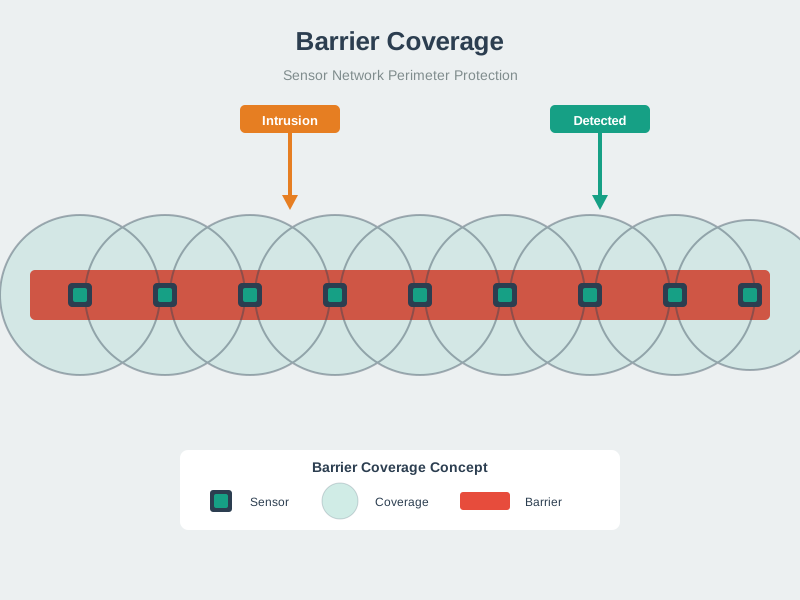
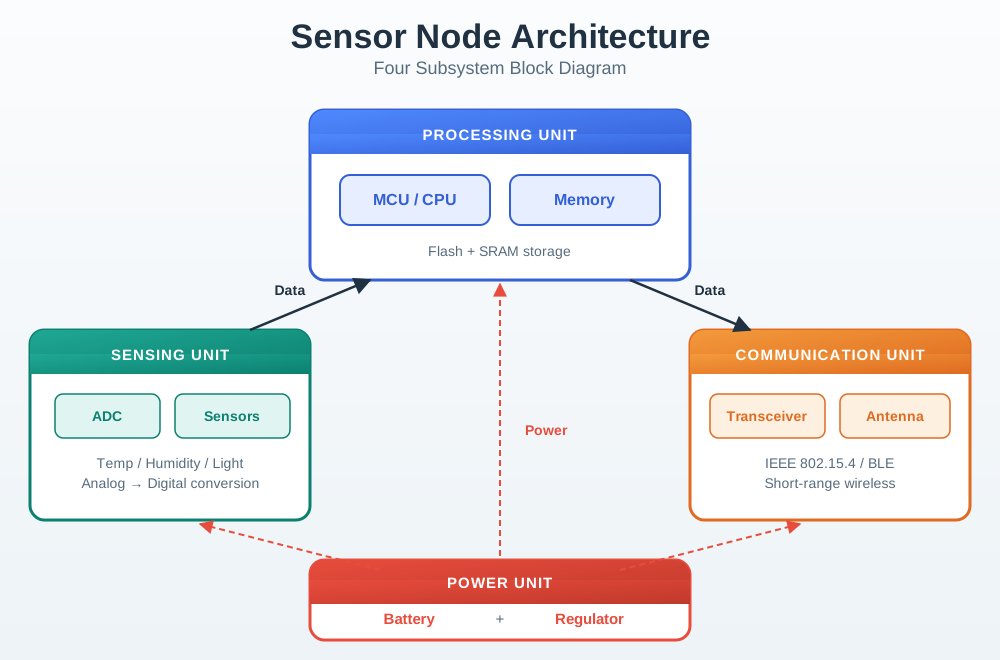
Objective: Detect intruders crossing a barrier (line or belt).
Applications:
- Border surveillance
- Perimeter security (military bases, critical infrastructure)
- Wildlife corridor monitoring
- Pipeline intrusion detection
51.3.5 K-Barrier Coverage Levels
51.3.6 Weak vs. Strong Barrier
Weak k-Barrier:
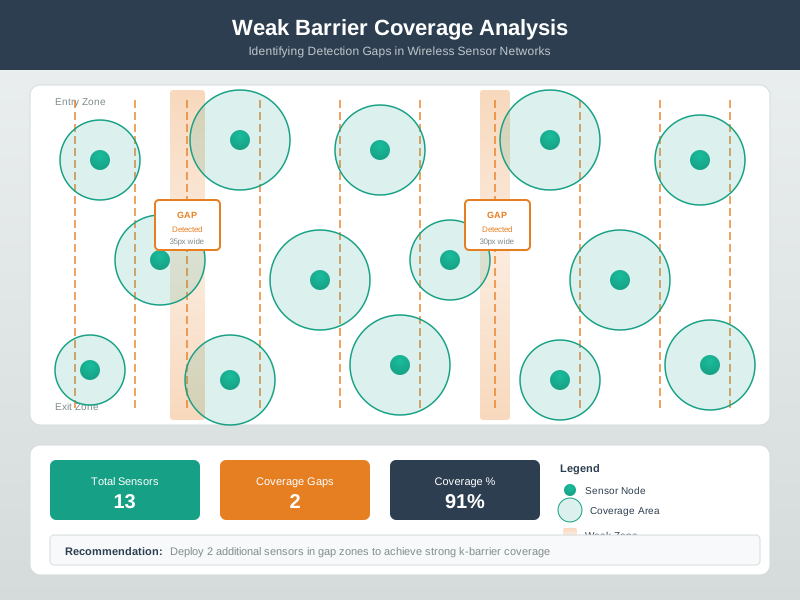
Every path crossing the barrier intersects sensing ranges of at least k sensors.
Strong k-Barrier:
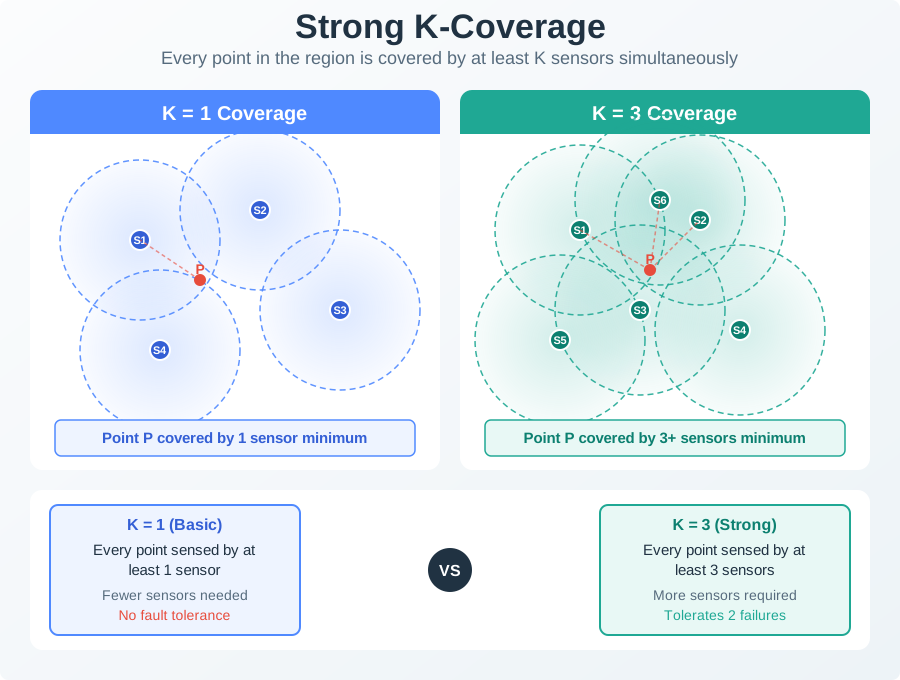
Every point on every path crossing the barrier is within sensing range of at least k sensors simultaneously.
Deployment Strategy:
For a barrier of length L with sensors of range Rs:
Minimum sensors for 1-barrier: ceil(L / (2 x Rs))
Minimum sensors for k-barrier: Approximately k x ceil(L / (2 x Rs))
51.3.7 Interactive: K-Coverage Sensor Estimator
51.4 Coverage Type Comparison
| Coverage Type | Goal | Sensors Needed | Applications |
|---|---|---|---|
| Area | Monitor every point in 2D region | High (full coverage) | Environmental, agriculture |
| Point | Monitor discrete critical locations | Low (targeted) | Infrastructure, access control |
| Barrier | Detect border crossings | Medium (linear) | Security, wildlife |
| K-Coverage | Redundancy for fault tolerance | K x base sensors | Critical systems |
Worked Example: K-Coverage Sensor Count Calculation
Scenario: A hospital deploys patient monitoring sensors with K=3 coverage requirement (tolerates 2 failures per location). Calculate required sensor count.
Given:
- Hospital floor: 60m × 40m = 2,400 m²
- Sensing range (Rs): 8m (patient vital signs monitoring)
- Communication range (Rc): 20m
- Coverage requirement: K=3 (every point monitored by ≥3 sensors)
Step 1: Verify Zhang-Hou condition:
Rc / Rs = 20m / 8m = 2.5
Is Rc ≥ 2Rs? Yes (20 ≥ 16)
Conclusion: Coverage implies connectivity ✓
Step 2: Calculate 1-coverage sensor requirement:
Sensor coverage area: π × 8² = 201 m²
Theoretical minimum: 2,400 / 201 = 11.9 → 12 sensors

With triangular lattice (90.7% efficiency):
Practical 1-coverage: 12 / 0.907 = 13.2 → 14 sensors
Step 3: Calculate 3-coverage requirement (naive approach):
Naive assumption: K=3 requires 3× sensors
Naive estimate: 14 × 3 = 42 sensors
Step 4: Calculate 3-coverage requirement (geometric optimization):
K-coverage with optimized overlap:
- Sensors placed at √3 × Rs / √K spacing
- For K=3: d = (√3 × 8m) / √3 = 8m
  (tighter than 1-coverage spacing of 13.9m)

Rows: 60m / 8m = 7.5 → 8 rows
Sensors per row: 40m / 8m = 5 sensors
Grid total: 8 × 5 = 40 sensors

Multiplier: 40 / 14 = 2.86× (not full 3×)
Step 5: Boundary adjustment for real floor plan:
Hospital floor has:
- 4 patient rooms (15m × 10m each)
- 1 corridor (60m × 10m)
- 2 nurse stations (10m × 10m each)

Critical zones (patient rooms): Require full K=3
  4 rooms × 150 m² = 600 m²
  Sensors: 600 / (201 / 3) = 9 sensors per room × 4 = 36 sensors

Non-critical zones (corridor, nurse stations): K=2 acceptable
  1,800 m² remaining
  Sensors: 1,800 / (201 / 2) = 18 sensors

Total optimized deployment: 36 + 18 = 54 sensors
Step 6: Compare cost of different K-levels:
| K-Level | Sensors Required | Hardware Cost (@$80/sensor) | Fault Tolerance | Annual Maintenance |
|---|---|---|---|---|
| K=1 | 14 | $1,120 | 0 failures (no redundancy) | $280 (20% fail/year) |
| K=2 | 25 | $2,000 | 1 failure per point | $500 (20% fail/year) |
| K=3 | 40 | $3,200 | 2 failures per point | $800 (20% fail/year) |
| K=3 optimized | 54* | $4,320 | 2 failures (critical zones) | $1,080 (20% fail/year) |
*K=3 in patient rooms, K=2 in corridors
Result: Optimized K=3/K=2 hybrid deployment requires 54 sensors ($4,320 hardware) to achieve fault-tolerant monitoring where it matters most (patient rooms), while accepting slightly lower redundancy in non-critical zones (corridors).
Key Lesson: K-coverage cost scales sub-linearly with K when using geometric optimization (2.86× for K=3, not 3×). Further, hybrid K-coverage (different K in different zones) reduces total sensor count by 25-35% compared to uniform K across entire area — critical for cost-sensitive deployments where criticality varies spatially.
Decision Framework: Choosing the Right K-Level
Use this table to select appropriate K-coverage level based on application criticality and failure tolerance:
| Application Type | Recommended K | Failure Tolerance | Cost Multiplier | Justification |
|---|---|---|---|---|
| Non-critical environmental (parks, forests) | K=1 | Gaps acceptable | 1.0× | Periodic coverage gaps OK; repair on next visit |
| Agricultural monitoring (soil, weather) | K=1 or K=2 | Tolerate brief outages | 1.0-1.8× | Daily decisions; single sensor sufficient |
| Building automation (HVAC, lighting) | K=2 | < 1 hour gap tolerance | 1.8-2.2× | Comfort priority; 1-2 sensor failures acceptable |
| Industrial process (manufacturing QC) | K=2 or K=3 | < 10 min gap tolerance | 2.2-2.9× | Quality critical; cost of defects > sensor cost |
| Healthcare (patient monitoring) | K=3 or K=4 | Zero gap tolerance | 2.9-4.0× | Life-safety; regulatory compliance required |
| Nuclear/military (security, safety) | K=4+ | Zero gap tolerance | 4.0-5.5× | Life-safety + security; no compromise |
K-Coverage Decision Algorithm:
def select_k_coverage(criticality, gap_tolerance_minutes, cost_per_failure_dollars):
    if criticality == "life_safety":
        return 3 if gap_tolerance_minutes > 5 else 4

    # Cost-benefit analysis
    sensor_cost = 80 # dollars per sensor
    annual_failure_prob = 0.20 # 20% sensors fail per year

    k = 1
    while True:
        expected_gap_hours = annual_failure_prob ** k * 8760 # hours/year
        expected_gap_cost = (expected_gap_hours / 60) * cost_per_failure_dollars
        extra_sensor_cost = sensor_cost * (k - 1) * 1.8 # ~1.8x per K-level

        if expected_gap_cost < extra_sensor_cost:
            return k # Not worth adding more sensors
        k += 1
        if k > 5:
            return 5 # Practical upper limit
Critical Insight: For non-life-safety applications, K=2 is the sweet spot — tolerates 1 failure per location with only 1.8-2.2× sensor cost, while K=3 jumps to 2.9× for marginal additional reliability. Reserve K≥3 for applications where sensor failure causes measurable harm (patient injury, production defects, security breaches).
Common Mistake: Uniform K-Coverage Across Heterogeneous Space
The Trap: “Our hospital has a K=3 requirement for patient monitoring, so we deploy K=3 coverage across the entire facility — patient rooms, corridors, storage, bathrooms, all at K=3.”
Why This Fails: Not all spaces have equal criticality:
Hospital 10,000 m² facility:
- Patient rooms (critical): 3,000 m² (30%)
- Corridors (moderate): 4,000 m² (40%)
- Storage/utility (low): 2,000 m² (20%)
- Bathrooms (low): 1,000 m² (10%)

Uniform K=3 deployment:
Total sensors: 10,000 m² × (3 sensors / 201 m²) = 149 sensors
Cost: 149 × $80 = $11,920
Hybrid K-Coverage Strategy:
Patient rooms (K=3): 3,000 m² × (3 / 201) = 45 sensors
Corridors (K=2): 4,000 m² × (2 / 201) = 40 sensors
Storage/utility (K=1): 2,000 m² × (1 / 201) = 10 sensors
Bathrooms (K=0): 0 sensors (no monitoring needed)

Total sensors: 45 + 40 + 10 = 95 sensors
Cost: 95 × $80 = $7,600
Savings: $11,920 - $7,600 = $4,320 (36% cost reduction)
Regulatory Compliance Check: Most healthcare monitoring regulations specify K-coverage requirements per patient, not per square meter: - Patient rooms: K=3 required (monitors patient location, not entire room) - Corridors: K=1 sufficient (detect patient movement for fall alerts) - Bathrooms: Often excluded or K=1 (privacy concerns)
Real-World Example: A 200-bed hospital deployed uniform K=3 across 50,000 m² ($60,000 in sensors). Regulatory audit found: - Only 15,000 m² (patient rooms) required K=3 - 20,000 m² (corridors) required K=1 - 15,000 m² (storage, utility) required K=0 - Actual requirement: 225 sensors vs 750 deployed (66% over-deployment = $42,000 wasted)
The Corrected Approach: Map K-coverage requirements to functional zones, not uniform area coverage. Critical zones get K=3+, semi-critical get K=2, non-critical get K=1 or K=0. This optimization typically reduces total sensor count by 30-50% while maintaining all regulatory and safety requirements.
51.5 How It Works: K-Coverage Fault Tolerance Mechanism
K-coverage provides fault tolerance by ensuring every critical point is monitored by at least k independent sensors simultaneously. This section explains the underlying mechanism that makes this redundancy effective.
Geometric Overlap Requirement: K-coverage requires k sensor coverage circles to all intersect at the monitored point. This means sensors must be placed closer together than in 1-coverage deployments. For triangular lattice deployments, the optimal spacing is approximately \(\sqrt{3} \times R_s / \sqrt{k}\), where \(R_s\) is the sensing range.
Energy-Coverage Trade-off: Higher k values consume more energy because more sensors are active simultaneously. Rotation scheduling mitigates this: with k=3 coverage, you can keep only 2 sensors active per point while the third sleeps, providing k=2 coverage with 33% energy savings. When a sensor fails, its backup wakes up automatically.
Failure Probability Math: For k-coverage with sensor annual failure rate p, the probability that a point loses all coverage in one year is \(p^k\). With a 20% annual failure rate (p=0.2), k=3 coverage yields \(0.2^3 = 0.008\) or 0.8% chance of total coverage loss at any point, compared to 20% for k=1. This 25x reliability improvement justifies the ~2.9x cost increase for critical applications. See the Decision Framework above for guidance on choosing the right k-level for your application.
51.6 Try It Yourself: K-Coverage Sensor Placement
Objective: Calculate optimal sensor spacing for different k-coverage levels and visualize the redundancy.
Setup:
import numpy as np
import matplotlib.pyplot as plt

# Parameters
AREA_SIZE = 60  # 60m x 60m area
SENSING_RANGE = 10  # Rs = 10m
K_LEVELS = [1, 2, 3]  # Test k=1, k=2, k=3 coverage

def calculate_grid_spacing(Rs, k):
    """Optimal grid spacing for k-coverage"""
    return Rs * np.sqrt(2 / k)  # Approximation for square grid

def deploy_grid(area_size, spacing):
    """Deploy sensors on square grid with given spacing"""
    coords_1d = np.arange(spacing/2, area_size, spacing)
    sensors_x, sensors_y = np.meshgrid(coords_1d, coords_1d)
    return sensors_x.flatten(), sensors_y.flatten()

def count_coverage(sensors_x, sensors_y, point_x, point_y, sensing_range):
    """Count how many sensors cover a given point"""
    distances = np.sqrt((sensors_x - point_x)**2 + (sensors_y - point_y)**2)
    return np.sum(distances <= sensing_range)

# Simulate for each k-level
fig, axes = plt.subplots(1, 3, figsize=(18, 6))

for idx, k in enumerate(K_LEVELS):
    # Calculate spacing and deploy sensors
    spacing = calculate_grid_spacing(SENSING_RANGE, k)
    sensors_x, sensors_y = deploy_grid(AREA_SIZE, spacing)

    # Visualize on subplot
    ax = axes[idx]

    # Draw sensor coverage circles
    for sx, sy in zip(sensors_x, sensors_y):
        circle = plt.Circle((sx, sy), SENSING_RANGE, color='blue', alpha=0.15)
        ax.add_patch(circle)
        ax.plot(sx, sy, 'bo', markersize=6)

    # Sample coverage at grid points
    sample_spacing = 2  # Check every 2m
    sample_x = np.arange(0, AREA_SIZE, sample_spacing)
    sample_y = np.arange(0, AREA_SIZE, sample_spacing)

    coverage_counts = []
    for gx in sample_x:
        for gy in sample_y:
            coverage = count_coverage(sensors_x, sensors_y, gx, gy, SENSING_RANGE)
            coverage_counts.append(coverage)
            if coverage < k:
                ax.plot(gx, gy, 'rx', markersize=8)  # Mark under-covered points

    ax.set_xlim(0, AREA_SIZE)
    ax.set_ylim(0, AREA_SIZE)
    ax.set_title(f'K={k} Coverage\n{len(sensors_x)} sensors, spacing={spacing:.1f}m')
    ax.set_xlabel('X Position (m)')
    ax.set_ylabel('Y Position (m)')
    ax.grid(True, alpha=0.3)

    # Print statistics
    avg_coverage = np.mean(coverage_counts)
    min_coverage = np.min(coverage_counts)
    points_with_k_coverage = np.sum(np.array(coverage_counts) >= k)
    total_points = len(coverage_counts)

    print(f"\n=== K={k} Coverage Statistics ===")
    print(f"Sensors deployed: {len(sensors_x)}")
    print(f"Grid spacing: {spacing:.2f}m")
    print(f"Average coverage per point: {avg_coverage:.2f} sensors")
    print(f"Minimum coverage per point: {min_coverage} sensors")
    print(f"Points with >= k coverage: {100*points_with_k_coverage/total_points:.1f}%")

plt.tight_layout()
plt.savefig('k_coverage_comparison.png', dpi=150)
plt.show()
What to Observe:
- How does sensor count scale with k? (Roughly k× for k-coverage vs 1-coverage)
- What’s the optimal spacing for k=2 vs k=1? (Tighter for higher k - approximately Rs/sqrt(k))
- Are there coverage gaps (red X marks)? (Should be minimal for proper grid deployment)
- What happens to average coverage in the center vs edges? (Higher in center due to boundary effects)
Extension Challenge: Modify the code to simulate sensor failures: Randomly remove 20% of sensors and recalculate coverage. How does k=3 maintain coverage while k=1 develops holes?
51.7 Concept Relationships
| Concept | Builds On | Enables | Conflicts With |
|---|---|---|---|
| Area Coverage | Continuous 2D monitoring, Geometric disk model | Environmental monitoring, Rotation scheduling for lifetime | Point coverage sparse deployments, Cost minimization |
| Point Coverage | Discrete critical locations, Set cover optimization | Infrastructure monitoring, Minimal sensor count | Full area monitoring, Continuous coverage guarantees |
| Barrier Coverage (Weak vs Strong) | Linear perimeter monitoring, Crossing detection | Security applications, Wildlife corridors | Area coverage budgets, Point coverage for sparse targets |
| K-Coverage Redundancy | Multiple overlapping sensors, Failure tolerance goal | (k-1) fault tolerance, Rotation sets for energy | Single-sensor economics, Minimal deployment budgets |
| Hybrid K-Coverage Zones | Differentiated criticality levels, Zone-based planning | 30-50% cost reduction, Regulatory compliance | Uniform coverage assumptions, One-size-fits-all K levels |
51.8 See Also
- WSN Coverage Fundamentals - Zhang-Hou theorem and coverage-connectivity relationship foundational to all coverage types
- WSN Coverage Algorithms - OGDC and virtual force algorithms that implement area coverage optimization
- WSN Coverage Optimization - Advanced techniques for minimizing sensor count while meeting k-coverage requirements
- WSN Common Mistakes - Pitfall #3 (underestimating density) shows coverage vs connectivity trade-offs
- Set Cover Problem - Classical computer science problem underlying point coverage optimization
Common Pitfalls
1. Ignoring the Boundary Effect in Coverage Calculations
Sensors at deployment edges cover half-circles instead of full disks, reducing effective coverage by up to 50% near boundaries. Theoretical coverage formulas assume infinite deployment — always add a buffer zone of at least Rs around the target area, or deploy extra nodes at boundaries.
2. Treating Coverage and Connectivity as Independent Problems
Coverage (sensing range Rs) and connectivity (communication range Rc) are coupled — designing them independently often results in a connected network with coverage holes or vice versa. Use the Rc ≥ 2Rs rule as a design guideline ensuring coverage implies connectivity.
3. Measuring Coverage at Deployment Time Only
Coverage degrades as nodes fail — a 99% coverage rate at deployment can drop below 80% within 6 months as batteries deplete. Build coverage monitoring into the system (periodic self-assessment using crossing theory) and define a minimum acceptable threshold that triggers maintenance.
51.9 Summary
This chapter covered the three main types of WSN coverage problems:
Key Takeaways:
Area Coverage - Monitor continuous 2D regions using rotation scheduling to maximize lifetime. Best for environmental monitoring where events can occur anywhere.
Point Coverage - Monitor discrete critical locations using set cover algorithms. Dramatically reduces sensor count compared to area coverage for sparse infrastructure.
Barrier Coverage - Detect crossings using weak (path-intersection) or strong (continuous monitoring) strategies. Choose based on detection vs tracking requirements.
K-Coverage - Provides (k-1) failure tolerance. Match k to reliability requirements: k=1 for basic, k=2 for fault tolerance, k=3+ for critical systems.
51.10 Knowledge Check
51.11 What’s Next?
| Topic | Chapter | Description |
|---|---|---|
| Coverage Algorithms | WSN Coverage Algorithms | Crossing theory, OGDC, and virtual force algorithms for coverage optimization |
| Core Concepts | WSN Coverage Core Concepts | Boolean disk, probabilistic models, and Zhang-Hou theorem foundations |
| Worked Examples | WSN Coverage Worked Examples | Hands-on k-coverage analysis, energy budgets, and TCO comparisons |
| Coverage Implementations | WSN Coverage Implementations | Practical OGDC deployment, K-coverage rotation, and mobile optimization |