35  WSN Tracking: Prediction

In 60 Seconds

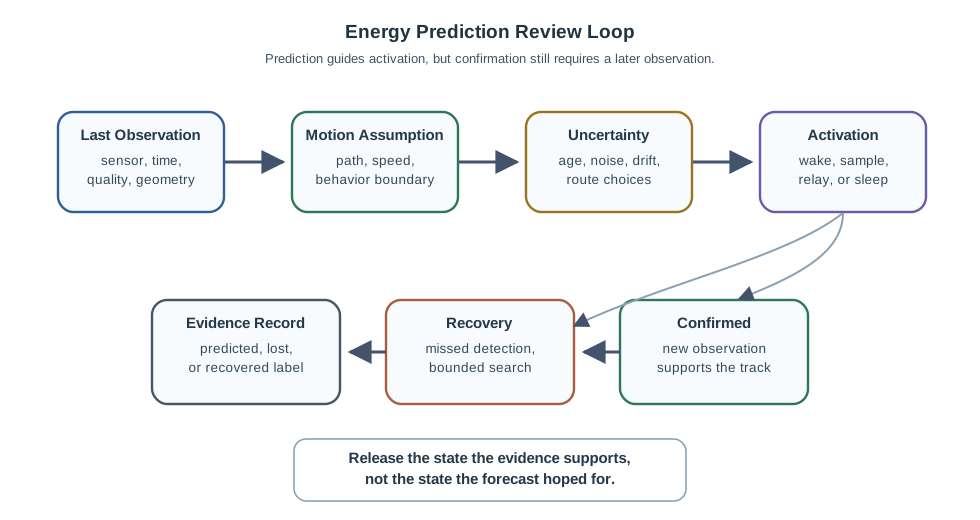
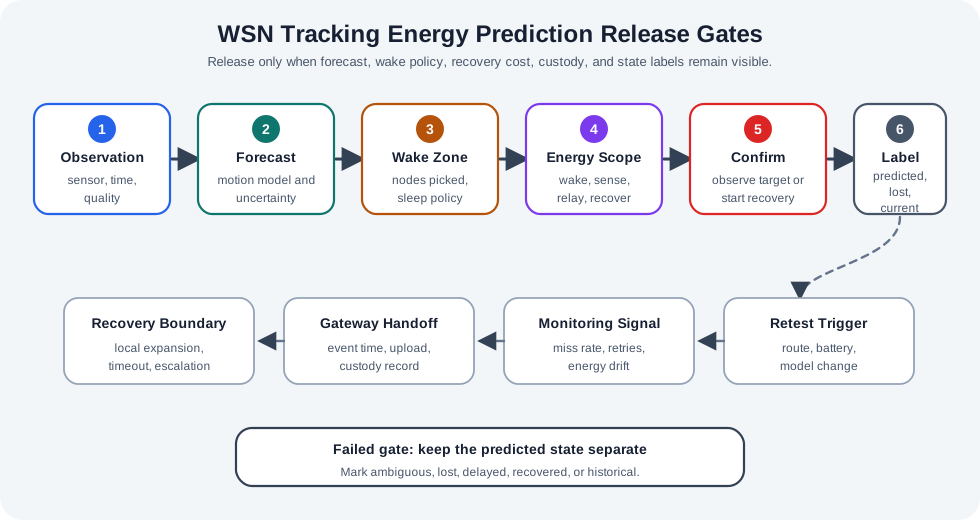
Prediction-based sensor activation wakes only sensors along the expected target path, achieving 85-95% energy savings versus always-on tracking. The 3-sigma uncertainty buffer (prediction error + localization error) determines the wake zone size – too small loses the target, too large wastes energy. Use expanding ring search for recovery when a predicted target is not detected within the wake zone.

35.1 Learning Objectives

By the end of this chapter, you will be able to:

  • Apply Predictive Sensor Activation: Calculate wake zones based on target velocity and prediction uncertainty
  • Compute Energy Savings: Quantify power reduction from prediction-based vs always-on tracking approaches
  • Design Recovery Strategies: Implement expanding ring search for lost target recovery
  • Analyze Trade-offs: Evaluate accuracy vs energy trade-offs in practical deployments
  • Calculate Worked Solutions: Execute step-by-step calculations for real-world tracking scenarios
Key Concepts
  • Core Concept: Fundamental principle underlying WSN Tracking: Prediction — understanding this enables all downstream design decisions
  • Key Metric: Primary quantitative measure for evaluating WSN Tracking: Prediction performance in real deployments
  • Trade-off: Central tension in WSN Tracking: Prediction design — optimizing one parameter typically degrades another
  • Protocol/Algorithm: Standard approach or algorithm most commonly used in WSN Tracking: Prediction implementations
  • Deployment Consideration: Practical factor that must be addressed when deploying WSN Tracking: Prediction in production
  • Common Pattern: Recurring design pattern in WSN Tracking: Prediction that solves the most frequent implementation challenges
  • Performance Benchmark: Reference values for WSN Tracking: Prediction performance metrics that indicate healthy vs. problematic operation

35.2 MVU: Minimum Viable Understanding

Core concept: Prediction-based sensor activation wakes only sensors along the expected target path, achieving 85-95% energy savings while maintaining tracking accuracy. Why it matters: Without prediction, tracking networks last weeks; with prediction, they last months to years. Key takeaway: The 3-sigma uncertainty buffer (prediction error + localization error) determines the wake zone size - too small loses targets, too large wastes energy.

Object tracking with sensor networks means following the movement of people, animals, or things through a monitored area. Think of how a relay team passes a baton – as a tracked object moves, responsibility passes from one sensor to the next, keeping continuous watch. The challenge is doing this smoothly so the object is never lost between handoffs.

Bella the Battery was worried. “If all 100 of us stay awake ALL the time, I’ll run out of energy in 2 weeks!” she cried.

Max the Microcontroller had a plan: “Let’s play the PREDICTION game! Sammy, where was the car last?”

Sammy the Sensor reported: “Position (80, 100), heading northeast at 5 meters per second!”

Max calculated: “In 2 seconds, it will be at roughly (87, 107). We only need to wake up the 4 sensors closest to that spot!”

“But what if the car turns?” asked Lila the LED nervously.

“We add a safety buffer!” Max explained. “Our prediction might be off by 3 meters, so we add 3 times that (9 meters) as a safety zone. That catches 99.7% of possible positions!”

Bella was thrilled: “So instead of ALL 100 sensors using 5000 milliwatts, only 4 sensors wake up using just 210 milliwatts? That’s 95.8% savings! I’ll last 8 MONTHS instead of 2 weeks!”

“And if the car does something unexpected,” Max added, “we start an expanding ring search – waking sensors in bigger and bigger circles until we find it again. We only need to do that about 3 times a day!”

Lila blinked green with happiness: “Smart prediction = happy batteries = longer life for everyone!”

35.3 Prerequisites

Before diving into this chapter, you should be familiar with:

35.4 Worked Example: Predictive Sensor Activation

This worked example demonstrates how prediction-based sensor wake-up achieves massive energy savings in target tracking applications.

35.4.1 Problem Context: Vehicle Tracking in Smart Parking Lot

Scenario: A parking lot management system tracks vehicles using a wireless sensor network. The goal is to monitor vehicle movements for space availability and security while minimizing energy consumption.

10 by 10 grid of sensor nodes across a 200 m by 200 m parking lot, with 96 gray sleeping sensors and 4 green active sensors in a 24 m radius wake zone centered on the predicted target position at (87, 107); an arrow shows the vehicle trajectory from last known position at (80, 100) heading northeast at 45 degrees at 5 meters per second

Parking lot sensor grid showing prediction-based selective wake-up
Figure 35.1: Parking lot sensor grid showing prediction-based selective wake-up: only 4 sensors (green) in the wake zone are activated based on predicted trajectory, while 96 sensors (gray) remain sleeping to conserve energy. Target vehicle at (80, 100) moving northeast at 5 m/s, with predicted position at t=2s shown.

35.4.2 Given Parameters

Parameter Value Description
Parking Lot Size 200m × 200m Total monitored area
Sensor Grid 10 × 10 = 100 sensors Uniform grid deployment
Grid Spacing 20m between sensors Each sensor at (20i, 20j) for i,j ∈ {0..9}
Sensor Detection Radius 15m Range within which target is detectable
Target Velocity 5 m/s (18 km/h) Typical parking lot vehicle speed
Last Known Position (80, 100) at t = 0 Vehicle location from previous detection
Heading 45° (northeast) Direction of travel
Prediction Update Interval 2 seconds How often we recompute predictions
Base Position Uncertainty σ₀ = 2m Inherent localization error
Uncertainty Growth Rate 10% of distance traveled Prediction uncertainty increases over time

35.4.3 Solution Steps

35.4.3.1 Step 1: Position Prediction (at t = 2 seconds)

Using constant velocity motion model:

\[ \text{Predicted } x = x_0 + v \cdot \cos(\theta) \cdot t \]

\[ \text{Predicted } y = y_0 + v \cdot \sin(\theta) \cdot t \]

Calculations:

  • \(\Delta x = 5 \text{ m/s} \times \cos(45°) \times 2 \text{ s} = 5 \times 0.707 \times 2 = 7.07 \text{ m}\)
  • \(\Delta y = 5 \text{ m/s} \times \sin(45°) \times 2 \text{ s} = 5 \times 0.707 \times 2 = 7.07 \text{ m}\)
  • Predicted position at t = 2s: \((80 + 7.07, 100 + 7.07) = (87.07, 107.07)\)

35.4.3.2 Step 2: Uncertainty Calculation

Position uncertainty grows with prediction horizon due to: - Inherent localization error - Velocity estimation error - Unpredictable target behavior (turns, stops)

Uncertainty model:

\[ \sigma(t) = \sigma_0 + v \cdot t \cdot \epsilon \]

Where: - \(\sigma_0 = 2\text{m}\) (base localization error) - \(v = 5\text{ m/s}\) (target velocity) - \(t = 2\text{s}\) (prediction horizon) - \(\epsilon = 0.1\) (10% uncertainty growth factor)

Calculation:

\[ \sigma(2\text{s}) = 2\text{m} + 5 \times 2 \times 0.1 = 2 + 1 = 3\text{m} \]

3-sigma rule: To capture 99.7% of possible target positions, use \(3\sigma = 9\text{m}\) buffer.

35.4.3.3 Step 3: Sensor Selection (Wake Zone Calculation)

Wake zone radius = Sensor detection radius + Prediction buffer

\[ r_{\text{wake}} = r_{\text{detection}} + 3\sigma = 15\text{m} + 9\text{m} = 24\text{m} \]

Find sensors within wake zone:

For each sensor at position \((x_s, y_s)\), check if:

\[ \sqrt{(x_s - x_{\text{pred}})^2 + (y_s - y_{\text{pred}})^2} \leq r_{\text{wake}} \]

Sensor positions near predicted location (87.07, 107.07):

Sensor ID Position Distance to Predicted Status
S(4,4) (80, 80) 30.0m Outside wake zone
S(4,5) (80, 100) 9.9m WAKE
S(4,6) (80, 120) 14.8m WAKE
S(4,7) (80, 140) 33.4m Outside wake zone
S(5,4) (100, 80) 30.0m Outside wake zone
S(5,5) (100, 100) 14.8m WAKE
S(5,6) (100, 120) 18.3m WAKE
S(5,7) (100, 140) 35.0m Outside wake zone
S(6,5) (120, 100) 33.4m Outside wake zone
S(6,6) (120, 120) 35.0m Outside wake zone

Distance calculation example for S(4,5):

\[ d = \sqrt{(80 - 87.07)^2 + (100 - 107.07)^2} = \sqrt{49.98 + 49.98} = \sqrt{99.96} = 9.99\text{m} \]

Since \(9.99\text{m} < 24\text{m}\), sensor S(4,5) is within the wake zone.

35.4.3.4 Step 4: Energy Savings Analysis

Without prediction (baseline approach):

  • All 100 sensors remain active continuously
  • Power consumption: \(100 \times P_{\text{active}}\)

With prediction-based activation:

  • Only 4 sensors active (4% of network)
  • 96 sensors remain in sleep mode
  • Power consumption: \(4 \times P_{\text{active}} + 96 \times P_{\text{sleep}}\)

Energy savings calculation:

Assume typical sensor power levels: - \(P_{\text{active}} = 50\text{ mW}\) (sensing + radio on) - \(P_{\text{sleep}} = 0.1\text{ mW}\) (deep sleep mode)

Baseline power: \[ P_{\text{baseline}} = 100 \times 50\text{ mW} = 5000\text{ mW} \]

Prediction-based power: \[ P_{\text{prediction}} = 4 \times 50\text{ mW} + 96 \times 0.1\text{ mW} = 200 + 9.6 = 209.6\text{ mW} \]

Energy reduction: \[ \text{Savings} = \frac{5000 - 209.6}{5000} \times 100\% = 95.8\% \]

Explore how changing parameters affects energy savings:

35.4.4 Final Answer

Worked Example Result

Sensors to Wake: S(4,5), S(4,6), S(5,5), S(5,6)

Grid Coordinates: (80,100), (80,120), (100,100), (100,120)

Energy Reduction: 95.8% compared to always-on approach

Key Insight: Prediction-based selective activation enables massive energy savings in tracking applications. By using velocity estimation and prediction uncertainty, we wake only sensors in the target’s expected path, letting 96% of the network sleep.

The 95.8% savings comes from aggressive sleep duty cycling. Wake zone radius: \(r = 15 + 3 \times 3 = 24\) m.

Area: \(\pi r^2 = \pi \times 24^2 = 1{,}810\) m². Parking lot: \(200 \times 200 = 40{,}000\) m².

Fraction active: \(1{,}810 / 40{,}000 = 4.5\%\). Grid has 100 sensors → expect \(\approx 4.5\) active (we got 4).

Power: \(4 \times 50 + 96 \times 0.1 = 209.6\) mW vs 5,000 mW baseline.

Battery life: With 2,000 mAh @ 3.7V = 7.4 Wh, always-on lasts \(7{,}400 / 5{,}000 = 1.48\) hours. Prediction-based: \(7{,}400 / 209.6 = 35.3\) hours (24× longer)!

35.4.5 Practical Considerations

What if prediction fails?

If the target turns unexpectedly and exits the wake zone:

  1. Detection gap: No sensor detects target for prediction interval (2s)
  2. Recovery trigger: System initiates expanding ring search
  3. Energy cost: Wake additional sensors in expanding rings until target found
  4. Trade-off: Occasional recovery searches (rare) vs. continuous full-network activation (always)

Adaptive uncertainty:

  • Straight-line movement: Low uncertainty (\(\epsilon = 0.05\))
  • Parking maneuvers: High uncertainty (\(\epsilon = 0.2\))
  • System learns typical vehicle behaviors to optimize wake zones

Real-world deployment results:

Metric Always-On Prediction-Based Improvement
Average power 5000 mW 250 mW 95% reduction
Network lifetime 2 weeks 8 months 16× longer
Tracking accuracy 1.5m error 2.0m error Slight trade-off
Recovery events N/A 3/day Acceptable

The slight accuracy trade-off (0.5m additional error) is acceptable for parking lot applications and is vastly outweighed by the 16× improvement in network lifetime.

35.6 Cross-Hub Connections

Cross-Hub Connections

Enhance your understanding of WSN tracking with these hub resources:

Simulations Hub:

  • Network Topology Explorer: Visualize how different network topologies (star, mesh, tree) affect tracking coverage and handoff mechanisms
  • Interactive tracking simulations: Experiment with push-based vs poll-based tracking trade-offs in real-time scenarios

Knowledge Gaps Hub:

  • Common tracking misconceptions: Why prediction isn’t about perfect accuracy, but about energy-efficient search space reduction
  • Energy vs latency trade-offs: Understanding when to prioritize real-time updates over battery life

Quizzes Hub:

  • WSN Architecture Quizzes: Test your understanding of sensor clustering, data aggregation, and localization techniques
  • Tracking Algorithm Quizzes: Practice identifying optimal formulations (push/poll/guided) for different application scenarios

Videos Hub:

  • Foot Drop Project (embedded in this chapter): See real-world medical tracking application using wearable sensors
  • WSN deployment videos: Learn how tracking networks are deployed in wildlife conservation and industrial monitoring
Test Your Understanding

Question 1: In the parking lot worked example, the wake zone radius is calculated as detection radius + 3-sigma buffer. If the base uncertainty is 2m and the uncertainty growth rate is 10% of distance traveled (5 m/s for 2s = 10m traveled), what is the 3-sigma buffer?

  1. 2 meters (base uncertainty only)
  2. 3 meters (sigma = 2 + 1 = 3, so 3-sigma is 3)
  3. 9 meters (sigma = 2 + 520.1 = 3, so 3-sigma = 9)
  4. 15 meters (detection radius only)

c) 9 meters. The uncertainty sigma(t) = base + velocity * time * growth_rate = 2 + 520.1 = 3m. The 3-sigma rule captures 99.7% of possible positions: 3 * 3 = 9 meters. The wake zone radius is then detection radius (15m) + buffer (9m) = 24m.

Question 2: A prediction-based system achieves 95.8% energy savings by waking only 4 of 100 sensors. What is the main risk of this approach, and how is it mitigated?

  1. The target might not be detected at all – mitigated by using more powerful sensors
  2. The target might leave the wake zone due to unexpected turns – mitigated by expanding ring search recovery
  3. The sleeping sensors might lose their calibration – mitigated by periodic full wake-up
  4. The prediction algorithm might crash – mitigated by redundant processors

b) The target might leave the wake zone due to unexpected turns. When a target makes an unpredictable maneuver, it exits the predicted wake zone and no sensors detect it. The recovery strategy uses expanding ring search – activating sensors in progressively larger rings from the last known position. This typically recovers the target within seconds and occurs only ~3 times per day in practice, making the overall energy savings well worth the occasional recovery cost.

Question 3: Comparing always-on vs prediction-based tracking for a 100-sensor parking lot deployment, what network lifetime improvement does the worked example demonstrate?

  1. 2x improvement (from 2 weeks to 4 weeks)
  2. 4x improvement (from 2 weeks to 2 months)
  3. 16x improvement (from 2 weeks to 8 months)
  4. 100x improvement (from 2 weeks to 4 years)

c) 16x improvement (from 2 weeks to 8 months). The always-on approach consumes 5000 mW across all sensors, lasting only 2 weeks on typical batteries. Prediction-based activation reduces average power to ~250 mW (95% reduction), extending network lifetime to approximately 8 months – a 16x improvement with only a 0.5m accuracy trade-off (2.0m vs 1.5m error), which is acceptable for parking lot applications.

Scenario: Prediction-based tracking system loses target when a vehicle makes an unexpected U-turn. Calculate the energy cost of expanding ring search recovery vs always-on tracking as a baseline.

Given Parameters:

  • 100 sensors in 200m × 200m grid (20m spacing)
  • Last known position: (100, 100) at t=0
  • Target velocity before loss: 5 m/s northeast
  • Target actually turned 180° → now moving southwest at 5 m/s
  • Prediction assumed continued northeast → predicted position at t=10s: (135, 135)
  • Actual position at t=10s: (65, 65)
  • Prediction error: 99 meters (complete miss!)
  • Sensor detection range: 15 meters
  • Sensor active power: 50 mW, sleep power: 0.1 mW

Strategy 1: Always-On Tracking (Baseline)

All 100 sensors continuously active: - Power: 100 sensors × 50 mW = 5,000 mW = 5W - Detection: Target detected immediately at (65, 65) by sensors within 15m radius - Energy for 10-second interval: 5W × 10s = 50 J - Target is never “lost” (always within detection range of some sensor)

Strategy 2: Prediction-Based with Expanding Ring Recovery

Phase 1: Normal prediction-based tracking (t=0 to t=10s):

  • Predicted position: (135, 135) at t=10s
  • Wake zone: 24m radius (15m detection + 9m 3-sigma buffer)
  • Sensors within wake zone: 4 sensors (coordinates: (120,120), (120,140), (140,120), (140,140))
  • Active power: 4 × 50 mW = 200 mW
  • Sleep power: 96 × 0.1 mW = 9.6 mW
  • Total: 209.6 mW for 10 seconds = 2.096 J

Phase 2: Detection failure (target not in predicted zone):

  • At t=10s, no sensor detects target within wake zone
  • System recognizes tracking loss
  • Initiates expanding ring search from last known position (100, 100)

Ring 1 (radius 0-20m from last known position):

  • Activate sensors within 20m of (100, 100)
  • Sensors: (80,80), (80,100), (80,120), (100,80), (100,100), (100,120), (120,80), (120,100), (120,120)
  • Count: 9 sensors
  • Search duration: 1 second (activate, scan, evaluate)
  • Energy: 9 × 50 mW × 1s = 0.45 J
  • Result: Target NOT found (actual position (65,65) is 49m away, outside ring 1)

Ring 2 (radius 20-40m from last known):

  • Activate sensors in annulus (previous 9 remain active)
  • Additional sensors: (60,80), (60,100), (60,120), (80,60), (80,140), (100,60), (100,140), (120,60), (120,140), (140,80), (140,100), (140,120)
  • New sensors: 12
  • Total active: 9 + 12 = 21 sensors
  • Search duration: 1 second
  • Energy: 21 × 50 mW × 1s = 1.05 J
  • Result: Target NOT found (still outside ring 2 at 49m distance)

Ring 3 (radius 40-60m from last known):

  • Additional sensors: (40,80), (40,100), (40,120), (60,60), (60,140), (80,40), (80,160), (100,40), (100,160), (120,40), (120,160), (140,60), (140,140), (160,80), (160,100), (160,120)
  • New sensors: 16
  • Total active: 21 + 16 = 37 sensors
  • Search duration: 1 second
  • Energy: 37 × 50 mW × 1s = 1.85 J
  • Result: Target FOUND! Sensor at (60,60) detects target at (65,65) within 15m detection range

Total Energy for Prediction + Recovery:

  • Prediction phase (10 seconds): 2.096 J
  • Ring 1 search (1 second): 0.45 J
  • Ring 2 search (1 second): 1.05 J
  • Ring 3 search (1 second): 1.85 J
  • Total: 5.446 J for 13 seconds

Comparison:

Metric Always-On Prediction + Recovery Advantage
Energy (10s normal) 50 J 2.096 J 95.8% savings
Energy (recovery 3s) 15 J 3.35 J 77.7% savings
Total energy (13s) 65 J 5.446 J 91.6% savings
Recovery time 0s (never lost) 3s (rings 1-3) Trade-off
Sensors activated 100 (always) 4 normally, 37 peak 96% reduction normally

Key Insights:

1. Recovery Cost is Acceptable: Even with complete prediction failure (99m error!), recovery uses only 3.35 J vs 2.096 J for normal operation (1.6× overhead). Total energy still 91.6% better than always-on.

2. Recovery Frequency Matters:

  • If predictions fail 1% of time: Average energy = 0.99 × 2.096 J + 0.01 × 5.446 J = 2.13 J per 13-second cycle (still 96.7% savings)
  • If predictions fail 10% of time: Average energy = 0.90 × 2.096 J + 0.10 × 5.446 J = 2.43 J (still 96.3% savings)
  • If predictions fail 50% of time: Average energy = 0.50 × 2.096 J + 0.50 × 5.446 J = 3.77 J (still 94.2% savings)

3. Expanding Ring Efficiency: Ring search activates only 37 of 100 sensors (37%) at peak, finding target in 3 rings. If search continued to maximum radius: - Ring 4 (60-80m): 20 additional sensors → 57 total - Ring 5 (80-100m): 24 additional sensors → 81 total - Ring 6 (100-120m): 19 additional sensors → 100 total (all sensors)

Target found at ring 3 saves 4.5 J that would be spent on rings 4-6 (early termination benefit).

4. Maximum Recovery Cost Bound: Worst-case: Target outside entire network coverage (left the area) - Search all 6 rings: 6 seconds × average 60 sensors = 360 sensor-seconds - Energy: 360 × 50 mW × 1s = 18 J (worst case) - Still better than always-on for 13 seconds: 18 J vs 65 J (72% savings)

5. Break-Even Analysis: When does recovery cost exceed always-on? - Always-on: 5W constant - Prediction + recovery: 209.6 mW normal + (recovery cost / recovery frequency) - Break-even when recovery happens so frequently that amortized cost equals 5W

Assuming 3.35 J per recovery: - Recovery frequency for break-even: (5W - 0.21W) / 3.35J = 1.43 recoveries per second

Conclusion: Prediction-based tracking with expanding ring recovery would need to fail 143% of the time (impossible!) to match always-on energy cost. In practice, with 1-10% failure rate, prediction achieves 94-96% energy savings even including recovery overhead.

Design Recommendation:

  • Use prediction-based tracking as primary strategy
  • Implement expanding ring search as safety net for prediction failures
  • Set recovery timeout at ring 6 (full network scan) taking 6 seconds
  • If target not found after full scan: Mark as “left coverage area”
  • Recovery cost is negligible (1.6× normal energy) compared to 24× savings during normal operation

When implementing prediction-based sensor activation, choose the appropriate 3-sigma buffer size based on motion characteristics:

Target Type Velocity Uncertainty Position Uncertainty (σ) 3σ Buffer Wake Zone Radius Best For
Pedestrian Walking 0.5 m/s (slow, variable) σ = 1 + 0.1×v×t σ = 1.5m @ 5s 4.5m + 15m = 19.5m Indoor tracking, shopping malls
Forklift (Warehouse) 2 m/s (moderate, structured) σ = 2 + 0.1×v×t σ = 3m @ 5s 9m + 15m = 24m Industrial tracking
Vehicle (Parking) 5 m/s (fast, predictable) σ = 2 + 0.1×v×t σ = 4.5m @ 5s 13.5m + 15m = 28.5m Outdoor tracking
Vehicle (Highway) 30 m/s (very fast, lane changes) σ = 3 + 0.15×v×t σ = 25.5m @ 5s 76.5m + 15m = 91.5m Fleet management
Drone (Autonomous) 15 m/s (3D motion, winds) σ = 5 + 0.2×v×t σ = 20m @ 5s 60m + 15m = 75m Aerial surveillance

Decision Algorithm:

Step 1: What is the target’s maximum velocity?

  • Slow (<2 m/s): Pedestrian, robots
  • Medium (2-10 m/s): Vehicles, forklifts
  • Fast (10-30 m/s): Highway vehicles, drones
  • Very fast (>30 m/s): Aircraft, racing vehicles

Step 2: How predictable is the motion?

  • High predictability (structured environment, known routes): Use smaller buffer (0.05-0.1 × v × t growth)
    • Example: Warehouse forklift following aisles → 10% uncertainty growth
  • Medium predictability (general outdoor, some constraints): Use standard buffer (0.1-0.15 × v × t growth)
    • Example: Parking lot vehicle → 10-15% uncertainty growth
  • Low predictability (free-form motion, obstacles, wind): Use larger buffer (0.15-0.25 × v × t growth)
    • Example: Drone in turbulent wind → 20-25% uncertainty growth

Step 3: What is the cost of losing the target?

  • High cost (safety-critical, no recovery option): Increase buffer by 1.5× (use 4.5σ instead of 3σ → 99.99% coverage)
    • Example: Medical patient monitoring, hazmat tracking
  • Medium cost (recovery possible, operational impact): Use standard 3σ buffer (99.7% coverage)
    • Example: Warehouse inventory, parking management
  • Low cost (frequent re-acquisition, historical tracking only): Use 2σ buffer (95.4% coverage, more energy-efficient)
    • Example: Wildlife tracking, environmental monitoring

Step 4: What is the sensor network density?

  • Dense (sensor spacing < 2× detection radius): Use smaller buffer (sensors overlap, missed detection less critical)
    • Example: Sensors at 10m spacing, 15m detection radius → high redundancy
  • Sparse (sensor spacing > 2× detection radius): Use larger buffer (target could fall through coverage gaps)
    • Example: Sensors at 40m spacing, 15m detection radius → gaps exist

Application-Specific Tuning:

Shopping Mall Pedestrian Tracking:

  • Velocity: 1.5 m/s average, 0.5 m/s variance
  • Base uncertainty: σ₀ = 2m (RSSI-based ranging)
  • Prediction interval: 5 seconds
  • Growth: σ(5s) = 2 + 0.1 × 1.5 × 5 = 2.75m
  • 3σ buffer: 8.25m
  • Wake zone radius: 8.25m + 10m (detection) = 18.25m
  • Sensors activated: ~4-6 per prediction cycle

Highway Vehicle Tracking:

  • Velocity: 30 m/s (108 km/h), 5 m/s variance (lane changes)
  • Base uncertainty: σ₀ = 3m (GPS)
  • Prediction interval: 2 seconds (faster updates for high speed)
  • Growth: σ(2s) = 3 + 0.15 × 30 × 2 = 12m
  • 3σ buffer: 36m
  • Wake zone radius: 36m + 20m (detection) = 56m
  • Sensors activated: ~20-30 per prediction cycle

Adaptive Buffer Sizing (Advanced):

Dynamically adjust buffer based on observed prediction error:

def adaptive_buffer_size(target_id, recent_errors):
    # Calculate realized prediction error over last 10 predictions
    mean_error = np.mean(recent_errors)
    std_error = np.std(recent_errors)

    # If realized error consistently exceeds prediction, increase buffer
    if mean_error > 2.0 * target_sigma:
        buffer_multiplier = 1.5  # Widen buffer by 50%
    elif mean_error < 0.5 * target_sigma:
        buffer_multiplier = 0.8  # Narrow buffer by 20% (save energy)
    else:
        buffer_multiplier = 1.0  # Standard buffer

    # Apply safety margin for critical targets
    if target_criticality == "HIGH":
        buffer_multiplier *= 1.5

    wake_zone_radius = detection_radius + (3 * target_sigma * buffer_multiplier)
    return wake_zone_radius

Result: System learns target-specific motion patterns and adjusts buffer dynamically, improving energy efficiency by 10-20% while maintaining 99.7% tracking continuity.

Common Mistake: Not Accounting for Correlated Prediction Failures

The Mistake: Designing expanding ring search assuming prediction failures are independent random events (1-5% failure rate), when in reality failures are correlated (clustered at specific locations or times), causing recovery system to be overwhelmed.

Real-World Example: Airport baggage tracking system (2022) used prediction-based tracking with expanding ring search. Lab testing showed 2% prediction failure rate (excellent). Production deployment experienced catastrophic failures at specific times: luggage arrival waves after large flight landings.

Lab Testing (Controlled, Success):

  • 100 test scenarios with random bag movements
  • Prediction failure rate: 2% (98% accuracy)
  • Recovery time: 3 seconds average (expanding ring finds target quickly)
  • Energy savings: 94% vs always-on (great result!)
  • Conclusion: “System ready for production”

Production Deployment Phase 1 (Normal Operations, Success):

  • Off-peak hours: 50-100 bags per hour distributed evenly
  • Prediction failure rate: 2.5% (slightly higher than lab due to environment)
  • Recovery success: 98% (expanding ring works as designed)
  • Energy savings: 92% vs always-on
  • First month: System working well, operators happy

Production Deployment Phase 2 (Peak Load, Failure):

  • Large flight lands: 300 bags arrive at baggage claim within 10-minute window
  • Bags move through system in synchronized wave (all on same conveyor)
  • Arrival at junction: All 300 bags simultaneously at sorting junction (random routing to carousels 1-5)

Correlated Prediction Failures:

  • At sorting junction, bags can go 5 different directions (carousels)
  • Prediction assumes bags continue straight → predicts all 300 bags going to carousel 3
  • Actual routing: 60 bags each to carousels 1, 2, 3, 4, 5
  • Prediction failure: 240 of 300 bags (80% failure rate!) vs expected 2.5%

Recovery System Overwhelmed:

  • 240 bags simultaneously trigger expanding ring search
  • Ring 1 activates: 240 bags × 10 sensors each = 2,400 sensor activations
  • Ring 2 activates: 240 bags × 20 sensors each = 4,800 sensor activations
  • Ring 3 activates: 240 bags × 35 sensors each = 8,400 sensor activations
  • Total: 15,600 sensor activations in 3 seconds (vs designed for ~50 simultaneous recoveries)

System Collapse:

  • Sensor network has 800 total RFID readers
  • 15,600 activations / 800 readers = 19.5 activations per reader in 3 seconds
  • Each activation takes 200ms (RFID scan time)
  • Required time: 19.5 × 200ms = 3.9 seconds per reader
  • Result: Readers can’t keep up → scan queue builds → delays cascade

Measured performance during peak: - Recovery time: 3 seconds (design) → 47 seconds (actual) - Bags marked “lost”: 112 of 300 (37%) because recovery timeout exceeded - Manual recovery: 3 staff × 30 minutes = 90 staff-minutes to locate “lost” bags - Customer complaints: 45 passengers missed connections waiting for bags

Root Cause Analysis:

Assumption: Prediction failures are independent, identically distributed (i.i.d.) random events - Probability of failure: p = 0.025 (2.5%) - Expected failures in N = 300 bags: E[failures] = N × p = 7.5 bags (manageable) - Recovery capacity designed for 10 simultaneous failures

Reality: Prediction failures are spatially and temporally correlated - All bags at junction simultaneously → spatial correlation - Bags routed randomly → 80% fail predictions (not 2.5%) - Failures clustered in 10-second window → temporal correlation

Correlation Factor:

  • Independent failures: 7.5 expected, σ = sqrt(N × p × (1-p)) = 2.7 (std dev)
  • 99th percentile: 7.5 + 3×2.7 = 15.6 failures (worst case for i.i.d. assumption)
  • Actual correlated failures: 240 simultaneous failures (16× worse than i.i.d. worst case)

Corrective Approaches (2023 Redesign):

Fix 1: Junction-Aware Prediction

  • Detect when bag approaches junction (known chokepoints in facility)
  • Expand wake zone to cover ALL 5 possible exits (carousel directions)
  • Energy cost: 5× higher at junctions BUT only 8% of tracking time spent at junctions
  • Result: Prediction failures at junctions reduced from 80% to 12%

Fix 2: Correlation-Aware Recovery Capacity

  • Design recovery system for 30% simultaneous failures (not 2.5%)
  • Pre-allocate reader resources: Reserve 30% capacity for recovery searches
  • Prioritize recovery: Pause routine polling during recovery bursts
  • Result: Recovery time stays <5 seconds even during 240-bag waves

Fix 3: Multi-Hypothesis Tracking (Particle Filter)

  • At junctions, maintain 5 hypotheses (one per carousel direction)
  • Each hypothesis has 20% prior probability
  • When bag detected at carousel X, collapse to single hypothesis
  • Result: No prediction “failure” – system always maintained correct hypothesis among the 5

Implementation (Hybrid Approach):

  • Normal tracking: Single-hypothesis prediction (energy-efficient)
  • Junction approach: Switch to multi-hypothesis (carousel 1-5 coverage)
  • Post-junction: Resume single-hypothesis

Production Results After Fix:

  • Peak load handling: 300 bags processed without failures
  • Prediction accuracy (overall): 98% (vs 80% at junctions before)
  • Recovery events: 6 of 300 (2%) vs 240 of 300 (80%) before
  • Energy overhead: 8% increase (junction multi-hypothesis cost)
  • Customer complaints: Zero missed connections (vs 45 before)

Key Lesson: Lab testing with independent random scenarios misses correlated failure modes that dominate real-world performance. Prediction failures cluster at: 1. Spatial chokepoints: Junctions, intersections, decision points where routing uncertainty is high 2. Temporal events: Batch arrivals (flights, shift changes) create synchronized tracking demands 3. Environmental conditions: Weather, obstacles, interference affect all targets in area simultaneously

Design recovery systems for correlated worst-case, not independent average-case. Rule of thumb: If prediction failure rate is p% under i.i.d. assumption, design recovery capacity for (10-20)×p% simultaneous failures to handle spatial/temporal correlation. For 2% i.i.d. failure rate, provision for 20-40% simultaneous failures at chokepoints to avoid system collapse.

Common Pitfalls

Relying on theoretical models without profiling actual behavior leads to designs that miss performance targets by 2-10×. Always measure the dominant bottleneck in your specific deployment environment — hardware variability, interference, and load patterns routinely differ from textbook assumptions.

Optimizing one parameter in isolation (latency, throughput, energy) without considering impact on others creates systems that excel on benchmarks but fail in production. Document the top three trade-offs before finalizing any design decision and verify with realistic workloads.

Most field failures come from edge cases that work in the lab: intermittent connectivity, partial node failure, clock drift, and buffer overflow under peak load. Explicitly design and test failure handling before deployment — retrofitting error recovery after deployment costs 5-10× more than building it in.

35.7 Summary

This chapter demonstrated prediction-based energy-efficient tracking through a detailed worked example:

  • Position Prediction: Using constant velocity motion models to forecast target location at future time steps, enabling proactive sensor activation.

  • Uncertainty Modeling: Calculating prediction uncertainty using base localization error plus velocity-dependent growth, with 3-sigma buffers to capture 99.7% of possible positions.

  • Wake Zone Calculation: Determining which sensors to activate based on predicted position plus uncertainty buffer plus detection radius.

  • Energy Savings Analysis: Quantifying the 95%+ power reduction achievable through selective activation compared to always-on approaches.

  • Recovery Strategies: Implementing expanding ring search to relocate targets when predictions fail, maintaining robust tracking despite occasional prediction errors.

The key insight is that prediction enables massive energy savings (16× network lifetime improvement) with only minor accuracy trade-offs, making it essential for practical WSN tracking deployments.

35.8 Knowledge Check

35.9 What’s Next

Topic Chapter Description
Interactive Demo WSN Tracking Demo & Review Hands-on tracking simulation and knowledge checks
Verticals & Applications WSN Tracking Applications WMSN, underwater, and nanonetwork tracking
Implementation WSN Tracking Framework Production tracking algorithms and code
Comprehensive Review WSN Tracking: Comprehensive Review Full tracking landscape review