3 Sensor Node Behaviors: Taxonomy
3.1 Learning Objectives
By the end of this chapter series, you will be able to:
- Classify node behaviors: Categorize sensor nodes into six distinct classes – normal, failed, badly failed, selfish, malicious, and dumb – using observable diagnostic criteria
- Diagnose misbehavior: Apply the detection decision tree to systematically identify and isolate misbehaving nodes based on heartbeat, data validation, and cooperation metrics
- Distinguish failure modes: Differentiate between permanent hardware failures, temporary environmental interference, and intentional misbehavior using contextual evidence
- Design duty cycling schedules: Create energy-efficient sleep/wake configurations that account for dumb and failed node patterns in the network
- Preserve connectivity: Apply topology management strategies to maintain network operation despite node failures and environmental disruptions
- Leverage social sensing: Integrate crowdsourced data signals for proactive rare event detection in WSN deployments
3.2 Prerequisites
Before diving into this chapter, you should be familiar with:
- Wireless Sensor Networks: Understanding WSN fundamentals, network topologies, and energy constraints is essential for analyzing node behavior patterns
- Multi-Hop Ad Hoc: Fundamentals: Knowledge of multi-hop routing and dynamic topologies helps contextualize how node misbehavior affects network connectivity
- M2M Communication: Fundamentals: Familiarity with M2M node types and duty cycling provides background for understanding energy-driven selfish behavior
- Networking Basics for IoT: Understanding MAC protocols, collision avoidance, and routing is necessary for detecting malicious attacks like black holes and wormholes
If you are short on time, focus on these three essentials:
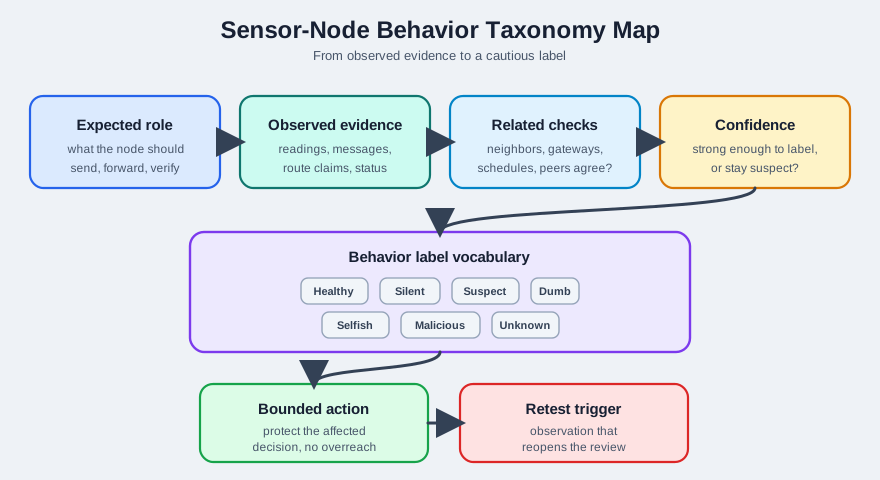
- Six behavior categories: Normal (works correctly), Failed (stops entirely), Badly Failed (sends wrong data), Selfish (refuses to cooperate), Malicious (actively attacks), and Dumb (temporarily unable to communicate due to environment)
- The most dangerous node is not the dead one – failed nodes are easy to detect by their silence, but badly failed and malicious nodes actively corrupt data or attack the network while appearing operational
- Use the detection decision tree: Check heartbeat first (failed?), then validate data (badly failed?), then check cooperation (selfish?), then look for attack patterns (malicious?), and finally correlate with weather (dumb?)
Everything else in this chapter series deepens these core concepts with detection algorithms, reputation formulas, and recovery mechanisms.
3.3 Overview: Sensor Node Behaviors in Wireless Sensor Networks
- Duty Cycling: Alternating between active sensing/communication and low-power sleep states to conserve energy in battery-powered sensor nodes
- Sleep Scheduling: Coordinating sleep/wake cycles across sensor nodes to maintain coverage and connectivity while minimizing energy consumption
- Event-Driven Behavior: Sensors remaining in low-power state until triggered by external events, conserving energy compared to continuous monitoring
- Adaptive Sensing: Dynamically adjusting sampling rates, sensing range, or active sensors based on observed conditions or remaining energy
- MAC Protocols: Medium Access Control schemes coordinating when sensors transmit to avoid collisions while enabling sleep periods
- Synchronization: Maintaining time coordination among distributed sensors for scheduled operations despite clock drift and network delays
Imagine you deploy 500 sensors across a farm to monitor soil moisture, temperature, and humidity. After a few months in the real world, things go wrong:
- Some sensors run out of battery and go silent
- A sensor’s thermometer breaks but it keeps sending garbage readings
- One sensor decides to save its own battery by refusing to relay messages for neighbors
- A hacker reprograms a sensor to sabotage the network
- Heavy rain temporarily blocks radio signals from several sensors
The key challenge: Each of these problems looks different and requires a different response. You cannot treat a dead sensor the same way you treat a hacked sensor. This taxonomy gives you a systematic framework for classifying, detecting, and responding to every type of misbehavior.
| Term | Simple Explanation |
|---|---|
| Node Behavior | How a sensor acts – is it working, broken, or misbehaving? |
| Taxonomy | A classification system that groups similar behaviors together |
| Misbehavior Detection | Techniques for figuring out which sensors are not acting correctly |
| Reputation System | A trust score that tracks how cooperative each sensor has been |
| Mobile Relay | A ground robot or drone that visits isolated sensors to collect their data |
| Byzantine Failure | A sensor that sometimes works and sometimes gives wrong data – the hardest type to catch |
In real-world wireless sensor network deployments, nodes exhibit diverse behaviors ranging from perfect operation to complete failure, and from cooperative to adversarial conduct. Understanding these behavioral patterns is essential for designing robust IoT systems that can detect, isolate, and compensate for misbehaving nodes.
3.3.1 Why a Taxonomy Matters
Without a structured classification, network operators face several problems:
- Misdiagnosis: Treating a selfish node as a failed node wastes resources on unnecessary replacement when route adjustment would suffice
- Delayed Response: Without predefined detection methods for each category, misbehavior may go unnoticed for weeks, corrupting months of data
- Over-reaction: Immediately isolating a “dumb” node that is only temporarily affected by rain removes a healthy sensor from the network unnecessarily
- Under-reaction: Failing to quickly isolate a malicious node allows attacks to propagate and compromise the entire network
The taxonomy presented here organizes node behaviors into six distinct categories, each with specific detection methods and appropriate responses. This systematic approach enables automated monitoring systems that can diagnose problems in real-time and trigger the correct remediation action.
This topic is covered in three focused chapters:
3.4 Chapter Overview
3.4.1 1. Node Behavior Classification
Sensor Node Behaviors: Classification
This chapter covers the foundational categories of node operational status:
- Normal Nodes: Fully functional sensors performing accurate sensing and reliable packet forwarding
- Failed Nodes: Nodes that have stopped operating due to battery depletion, hardware failure, or firmware crashes
- Badly Failed Nodes: Dangerous nodes that continue transmitting corrupted or erroneous data
- Recovery Mechanisms: Watchdog timers and redundancy strategies for automatic recovery
Key Topics: Sensing accuracy, packet delivery rates, battery depletion lifecycle, firmware crash recovery, outlier detection for corrupted data
3.4.2 2. Selfish and Malicious Behavior
Sensor Node Behaviors: Selfish and Malicious Nodes
This chapter covers intentional misbehavior and security threats:
- Selfish Nodes: Energy-conserving behavior that prioritizes self-interest over network cooperation
- Reputation Systems: EWMA-based tracking of node cooperation with gradual exclusion
- Malicious Attacks: Black hole, sinkhole, wormhole, and Sybil attacks with detection strategies
- Defense Mechanisms: Multi-path routing, authenticated updates, and cryptographic verification
Key Topics: Reputation calculation formulas, tragedy of the commons, incentive mechanisms, attack taxonomy, layered security defenses
3.4.3 3. Dumb Nodes and Connectivity Recovery
Sensor Node Behaviors: Dumb Nodes and Connectivity Recovery
This chapter covers environmental communication failures and recovery strategies:
- Dumb Nodes: Functional sensors temporarily unable to communicate due to rain, fog, or interference
- Detection Methods: Environmental correlation and neighbor monitoring to distinguish dumb from failed
- CoRD Scheme: Ground-based mobile relays for all-weather data recovery
- CoRAD Scheme: Aerial drones for faster coverage in clear weather conditions
Key Topics: Rain attenuation, data buffering, mobile relay algorithms, drone flight planning, recovery prioritization
3.5 How It Works
3.5.1 Behavior Detection Decision Tree
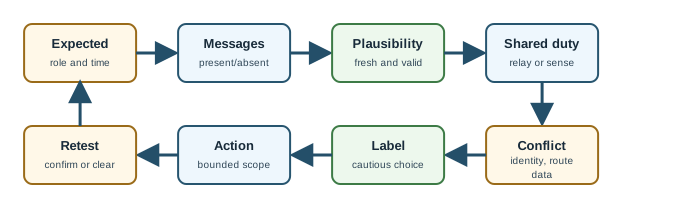
A critical practical skill is determining which behavior category a suspect node falls into. The following decision tree provides a systematic diagnostic process that network management systems can automate:
How to use this decision tree:
- Heartbeat check is always the first step – if the node is not sending periodic beacons, it is either failed or environmentally blocked (dumb)
- Weather correlation distinguishes dumb from failed: if multiple nodes in the same geographic area go silent during rain, they are likely dumb, not failed
- Data validation catches badly failed nodes by applying range checks, rate-of-change limits, and neighbor correlation
- Cooperation monitoring detects selfish nodes by tracking their packet forwarding ratio over time
- Attack pattern analysis identifies malicious nodes through anomalies such as route advertisement manipulation, selective forwarding, or traffic injection
3.5.2 Automated Classification System
In production networks, this decision tree translates into an automated classification pipeline:
def classify_node_behavior(node_id, observation_window):
# Step 1: Check heartbeat
if not receives_heartbeat(node_id, timeout=60):
# No heartbeat - failed or dumb?
if correlates_with_weather_event(node_id):
return "DUMB" # Environmental interference
else:
return "FAILED" # Hardware failure
# Step 2: Validate data quality
if not data_is_valid(node_id, observation_window):
return "BADLY_FAILED" # Corrupt sensor/firmware
# Step 3: Check cooperation
forwarding_ratio = calculate_forwarding_ratio(node_id, observation_window)
if forwarding_ratio < 0.5:
# Low cooperation - selfish or malicious?
if detects_attack_patterns(node_id):
return "MALICIOUS" # Active attack
else:
return "SELFISH" # Energy conservation
# All checks passed
return "NORMAL"This automated approach enables real-time monitoring of thousands of nodes without manual intervention.
3.6 Real-World Deployment Scenarios
Understanding how these categories manifest in practice helps translate theory into operational decisions:
3.6.1 Scenario 1: Agricultural Monitoring Network
A vineyard deploys 200 soil moisture sensors across 50 hectares. After the first growing season:
- 12 nodes failed (6% failure rate) – all due to battery depletion in sun-exposed positions where higher temperatures accelerated discharge
- 3 nodes badly failed – damaged moisture probes reporting constant 100% saturation, which triggered unnecessary irrigation costing approximately $2,000 in wasted water
- 0 selfish/malicious nodes – no incentive for selfish behavior in a single-owner deployment with no multi-hop forwarding
- 15-40 nodes periodically dumb during heavy rain events (twice per month), recovering automatically within 2-4 hours
Lesson: In agricultural deployments, badly failed nodes cause the most economic damage because they silently trigger wrong automated actions. Invest in data validation over security.
Economic impact of badly failed nodes in vineyards:
A single badly failed moisture sensor reports constant 100% saturation (damaged probe) for 2 weeks. The irrigation controller responds by shutting off water to that zone (50 vines). Actual moisture drops from 60% to 20%, killing vines. Economic calculation:
\[ \text{Loss per vine} = \$150 \text{ (replacement)} + \$80 \text{ (lost harvest)} \]
Total damage from one badly failed node:
\[ \text{Total loss} = 50 \text{ vines} \times (\$150 + \$80) = 50 \times \$230 = \$11{,}500 \]
Compare to 3 truly failed nodes (silent):
\[ \text{Failed node impact} = 3 \times \$40 \text{ (battery replacement)} = \$120 \]
The badly failed node caused 96× more economic damage than failed nodes ($11,500 vs $120) despite being only 25% as common (3 failed vs 1 badly failed in typical deployment).
3.6.2 Scenario 2: Urban Air Quality Network
A city deploys 500 air quality sensors on lampposts, with data shared across multiple agencies:
- 8 nodes failed per month (1.6% monthly rate) – primarily power supply issues and vandalism
- 5 nodes badly failed – calibration drift caused PM2.5 sensors to over-report by 300%, triggering unnecessary health advisories
- 22 nodes selfish – nodes managed by one agency began dropping forwarding requests from another agency’s nodes during budget disputes
- 2 nodes malicious – compromised by activists to inject false pollution data to influence policy decisions
- 30+ nodes dumb during fog events in winter months
Lesson: Multi-stakeholder deployments introduce selfish and malicious behavior that single-owner deployments rarely see. Reputation systems and access control become essential.
3.7 Quick Reference: Node Behavior Summary
| Behavior | Can Sense? | Can Transmit? | Helps Others? | Detection Method | Response | Threat Level |
|---|---|---|---|---|---|---|
| Normal | Yes | Yes | Yes | Routine heartbeat | Continue operation | None |
| Failed | No | No | No | Missing beacons | Route recalculation | Low |
| Badly Failed | Partial | Yes | Yes (bad data) | Data validation | Isolation | High |
| Selfish | Yes | Yes | Sometimes | Reputation below 0.5 | Gradual exclusion | Medium |
| Malicious | Yes | Yes | Attacks | Anomaly detection | Immediate isolation | Critical |
| Dumb | Yes | No (temporary) | Cannot | Weather correlation | Mobile relay | Low |
3.8 Common Misconceptions
Misconception 1: “A silent node is always a failed node.” Not true. Dumb nodes also go silent – but they are healthy and will resume communication once environmental conditions improve. Prematurely marking a dumb node as failed leads to unnecessary route changes and replacement costs. Always check environmental conditions before classifying a silent node.
Misconception 2: “Selfish and malicious nodes are the same.” Selfish nodes conserve their own resources at the network’s expense but do not actively attack. Malicious nodes deliberately sabotage the network. The distinction matters because selfish nodes can be incentivized to cooperate (e.g., through payment or reciprocity), while malicious nodes must be isolated.
Misconception 3: “Data validation alone catches all badly failed nodes.” Simple range checks catch obvious failures (e.g., temperature of 500 degrees C), but subtle calibration drift or intermittent hardware faults produce plausible-looking data that passes basic validation. Multi-layer validation including neighbor correlation and rate-of-change checks is required.
Misconception 4: “More redundant nodes always solve misbehavior problems.” Redundancy helps with failed and badly failed nodes but does nothing against malicious nodes that can compromise additional nodes. Redundancy without proper authentication can actually increase the attack surface.
3.9 Knowledge Check
A) Failed node – the battery was depleted
B) Malicious node – an attacker is jamming the signals
C) Dumb node – environmental conditions are temporarily blocking communication
D) Selfish node – the node is conserving energy during the storm
Correct Answer: C
Multiple nodes going silent simultaneously during a storm strongly suggests environmental interference (rain attenuation). A failed node would lose contact permanently and independently, not simultaneously with neighbors during weather events. The key diagnostic clue is the correlation between weather and the outage affecting multiple nodes in the same area.
A) Failed nodes – because they produce no data at all
B) Badly failed nodes – because they produce plausible but incorrect data
C) Selfish nodes – because they reduce network throughput
D) Dumb nodes – because they create data gaps during weather events
Correct Answer: B
Badly failed nodes are the most dangerous because they continue transmitting data that appears valid but is actually corrupted. Analytics systems process this data as truth, leading to wrong conclusions and potentially costly automated actions (e.g., triggering irrigation based on false soil moisture readings). Failed nodes are easy to detect by their silence, and their absence can be accounted for in analytics through interpolation.
A) Normal node with poor connectivity
B) Badly failed node with a damaged radio
C) Selfish node conserving its forwarding energy
D) Malicious node performing a black hole attack
Correct Answer: C
The key indicator is that the node forwards its own data successfully (proving its radio works) but selectively drops transit traffic. This selective behavior – prioritizing own data while refusing to cooperate – is characteristic of a selfish node. A badly failed node would have problems with all transmissions, and a black hole attack would typically drop all forwarded packets (100%), not just 80%. A malicious node might also advertise false routes, whereas a selfish node simply refuses to forward.
A) Heartbeats are cheaper to monitor than data validation
B) A node that is not transmitting cannot have its data validated – the checks must follow a logical dependency order
C) Data validation is only needed for malicious nodes
D) Heartbeat checks are more accurate than data validation
Correct Answer: B
The decision tree follows a logical dependency order. A node that is not transmitting any signals (no heartbeat) cannot have its data quality assessed – there is no data to validate. Therefore, the heartbeat check must come first to determine whether the node is communicating at all (failed vs. dumb) before evaluating the quality of any data it sends (badly failed) or its cooperation behavior (selfish vs. malicious).
A) Agricultural sensors are more reliable hardware
B) City sensors are exposed to more environmental interference
C) Multi-stakeholder deployments create incentives for selfish behavior and increase attack surface
D) Smart city networks use weaker encryption
Correct Answer: C
The critical difference is ownership and governance. In a single-owner agricultural deployment, there is no incentive for nodes to behave selfishly because all nodes serve the same owner. In multi-agency city deployments, nodes owned by one agency may deprioritize forwarding for another agency (selfish behavior), and the larger, more visible network presents a more attractive target for attackers (malicious behavior). Hardware reliability and environmental factors do not explain the presence or absence of intentional misbehavior.
Meet the Sensor Squad:
- Sammy (Temperature Sensor) - Measures how hot or cold things are
- Lila (Light Sensor) - Detects brightness levels
- Max (Motion Sensor) - Spots when things move
- Bella (Smart Gateway) - The team’s coordinator and detective
The Mission: Finding the Troublemakers
The Sensor Squad works in a big farm, monitoring the greenhouse. But Bella noticed something strange - some sensors are not acting right! Let us investigate the different types of misbehaving sensors.
Case 1: Barry the Battery-Dead Sensor (Failed Node)
Barry was a great temperature sensor, but one day he just… stopped talking.
“Barry? Barry, are you there?” Bella called.
Silence.
What happened: Barry’s battery died after 2 years of hard work. He is completely offline - cannot sense, cannot transmit, cannot do anything.
Bella’s Response: “Mark Barry as FAILED. We need to replace his battery or get a new sensor for that tomato plant corner.”
Case 2: Selfish Sally the Energy Hoarder (Selfish Node)
Sally still works perfectly, but Bella noticed something sneaky: Sally refuses to help other sensors!
Sally sends her own temperature readings perfectly fine. But when neighbor sensors ask her to forward their messages? Sally ignores them to save her battery!
Bella’s Response: “Sally is being SELFISH. I will route messages around her. If she does not improve, we will exclude her from the network entirely!”
Case 3: Malicious Mike the Network Bully (Malicious Node)
Mike is the worst! He pretends to help but actually sabotages the network.
Mike advertises: “Hey everyone, I have the best route to the gateway! Send your data through me!”
Then Mike drops ALL the packets into a black hole - the data disappears!
Bella’s Response: “Mike is MALICIOUS! Immediate exclusion! Broadcast warning to all sensors: DO NOT route through Mike!”
Case 4: Dumb Danny the Weather Victim (Dumb Node)
Danny is perfectly healthy, but during heavy rainstorms, he goes silent.
On a sunny day, Danny’s radio range is 100 meters. During a monsoon rainstorm, the rain absorbs radio signals - Danny’s range drops to only 5 meters!
Bella’s Solution: “Send the drone! Fly close to Danny (within 5 meters), download his buffered data, and bring it back!”
Case 5: Badly Failed Benny the Trickster (Badly Failed Node)
Benny is the sneakiest problem of all. He still talks to Bella regularly, but his temperature sensor is broken. The real temperature is 25 degrees C, but Benny keeps saying “It is 85 degrees C! Emergency!”
Bella almost turned on the emergency cooling system, which would have frozen the tomatoes!
Bella’s Response: “Check what Benny’s neighbors say. Sammy next to Benny says it is 24 degrees C. Benny is lying! Mark Benny as BADLY FAILED and ignore his readings until we replace his sensor.”
The Sensor Squad’s Behavior Chart:
| Sensor Type | Can Sense? | Can Transmit? | Helps Others? | Bella’s Action |
|---|---|---|---|---|
| Normal (Sammy) | Yes | Yes | Yes | Trust fully |
| Failed (Barry) | No | No | No | Replace battery |
| Badly Failed (Benny) | Wrong data! | Yes | Yes (bad data) | Check neighbors, isolate |
| Selfish (Sally) | Yes | Yes | NO! | Reduce trust, route around |
| Malicious (Mike) | Yes | Yes | Attacks! | Immediate exclusion |
| Dumb (Danny) | Yes | No (rain) | Cannot (temporary) | Send drone when weather clears |
Bella’s Detective Rule: “Always check what the neighbors say before blaming a sensor! And always check the weather before declaring a sensor dead!”
Deep Dives:
- Wireless Sensor Networks - WSN deployment fundamentals
- Multi-Hop Fundamentals - Routing in dynamic networks
- WSN Coverage - Maintaining coverage with failures
Comparisons:
- M2M Fundamentals - Duty cycling strategies
- Security Methods - Detecting malicious nodes
- RPL Operation - Routing around failures
Products:
- Application Domains - Agriculture sensor deployments
- Energy-Aware Design - Power management
Learning:
- Simulations Hub - Node behavior simulators
- Quizzes Hub - Test your WSN knowledge
Scenario: A municipal water utility operates a 150-node WSN monitoring pressure, flow rate, and water quality across the pipe network. On a Monday morning, the network management system flags 18 nodes as “non-responsive.” The operations team must classify each node’s behaviour to determine the correct response.
Given:
- 150 nodes deployed across 120 km of pipe network, 3 years in operation
- 18 nodes flagged as non-responsive over the weekend
- Weather: Heavy freezing rain Saturday night (ice accumulation 15 mm)
- Node battery life: rated 5 years, oldest nodes are 3 years old
- Previous month: 2 nodes replaced (battery depletion)
- One node (Node 47) was recently serviced by a third-party contractor
Step 1 – Apply heartbeat check (failed vs dumb?): Of 18 non-responsive nodes, check geographic clustering and weather correlation:
- 11 nodes are clustered in the elevated northern district (hilltop, exposed to icing)
- 4 nodes are scattered across the network (no geographic pattern)
- 3 nodes are in the same underground valve chamber
Decision: The 11 clustered hilltop nodes went silent during the ice storm – classify as Dumb (ice on antennas attenuating radio signals). The 4 scattered nodes with no weather correlation – classify as Failed candidates. The 3 underground nodes – investigate further.
Step 2 – Validate the “dumb” classification: Wait 24 hours for ice to melt. Result: 9 of 11 hilltop nodes resume transmission automatically. The remaining 2 stay silent – reclassify from Dumb to Failed (the ice storm likely caused physical damage to already-weakened hardware). Total dumb: 9. Total failed candidates: 4 + 2 = 6.
Step 3 – Diagnose the 6 failed nodes:
| Node | Age | Last reading | Diagnosis |
|---|---|---|---|
| N12 | 3.0 yr | Battery: 2% | Failed – battery depletion |
| N34 | 2.8 yr | Battery: 3% | Failed – battery depletion |
| N89 | 1.5 yr | Battery: 78% then silence | Failed – hardware fault (young battery) |
| N102 | 2.9 yr | Battery: 5% | Failed – battery depletion |
| N55 | 0.8 yr | Normal then sudden silence | Failed – probable flood damage (underground) |
| N61 | 0.8 yr | Normal then sudden silence | Failed – probable flood damage (underground) |
Step 4 – Investigate the 3 underground nodes (including N47): Node 47 (recently serviced by contractor) is transmitting but reporting pipe pressure of -2 bar (physically impossible). Neighbours N48 and N49 report normal 3.5 bar. Classify N47 as Badly Failed – the contractor likely damaged the pressure transducer during servicing. This is the most dangerous node because the automated leak-detection algorithm nearly triggered an emergency shutdown based on the false negative-pressure reading.
Step 5 – Response plan with cost estimates:
| Category | Count | Action | Cost |
|---|---|---|---|
| Dumb (ice) | 9 | No action, auto-recovered | $0 |
| Failed (battery) | 3 | Replace batteries, schedule for spring | $450 |
| Failed (hardware) | 2 | Replace nodes | $1,200 |
| Failed (flood) | 1 | Replace node, add waterproof enclosure | $800 |
| Badly Failed | 1 | Recalibrate sensor, retrain contractor | $200 + $500 training |
Total cost: $3,150. Without the taxonomy, the utility would have dispatched emergency crews to all 18 nodes at $400/visit = $7,200 – the systematic diagnosis saved 56%.
Key Insight: The decision tree’s first step (weather correlation) immediately classified 9 of 18 nodes correctly with zero cost. The most expensive mistake would have been missing the badly failed node (N47) – its physically impossible readings were about to trigger a $50,000 emergency pipe shutdown. Badly failed nodes that generate plausible-looking but wrong data are always the highest-priority diagnosis target.
3.10 Concept Check
Scenario: In a smart city deployment, 15 sensors in a tunnel simultaneously report “gateway unreachable” during a thunderstorm. After 20 minutes, when the storm passes, all 15 nodes automatically reconnect and upload buffered data. What behavior type?
A) Failed nodes B) Malicious nodes coordinating an attack C) Dumb nodes experiencing environmental interference D) Selfish nodes refusing to cooperate
Answer: C - Dumb nodes. The key indicators are: (1) multiple nodes affected simultaneously (environmental pattern), (2) automatic recovery when conditions improve (temporary failure), (3) sensing and buffering still functional (not hardware failed). Rain attenuation on radio signals is a classic dumb node scenario.
3.11 Concept Relationships
Understanding node behavior taxonomy connects to several key WSN concepts:
To Energy Management (Energy-Aware Design): Selfish behavior arises from nodes prioritizing their own energy conservation. Understanding the incentives helps design better duty-cycling strategies and reputation-based cooperation mechanisms.
To Security (IoT Security): Malicious node behavior is fundamentally a security concern. The detection methods (watchdog monitoring, reputation scoring) bridge the gap between network protocols and security mechanisms.
To Routing Protocols (RPL Operation): Failed, badly failed, and selfish nodes all affect routing table validity. RPL’s parent selection and route repair mechanisms must account for these behavior patterns.
To Fault Tolerance (Network Design): The distinction between failed (permanent) and dumb (temporary) nodes informs redundancy strategies. Dumb nodes return to service automatically; failed nodes require physical replacement.
3.12 See Also
For deeper understanding of detection mechanisms:
- Node Behavior Classification - Detailed algorithms for identifying normal, failed, and badly failed nodes with mathematical formulations
- Node Behavior Selfish Malicious - Reputation systems, watchdog protocols, and attack taxonomy with defense mechanisms
For practical deployment scenarios:
- Sensor Behaviors: Mine Safety - Real-world application showing multi-sensor fusion for fire detection in harsh underground environments
- Trust Management Implementation - Complete Python code implementing EMA reputation scoring and trust-based routing
For system-level integration:
- WSN Coverage Fundamentals - How node failures affect coverage guarantees and network lifetime
- Duty Cycling and Topology - Energy-aware sleep scheduling that must account for dumb and failed node patterns
Common Pitfalls
Real WSN node behavior exists on a spectrum from fully cooperative through self-interested to actively malicious. A node that prioritizes its own data delivery over routing for neighbors is not malicious – it is selfish. A node that randomly drops half of its forwarded packets is not selfish – it may be faulty. Using only binary cooperative/malicious classification leads to over-response (expelling selfish nodes that could be corrected) or under-response (tolerating malicious behavior as ‘just misbehaving’).
Network conditions (interference, distance, power) cause nodes to exhibit behavior patterns that mimic misbehavior in taxonomy frameworks. A node sending corrupted data may have a damaged sensor (hardware fault), not be maliciously injecting false data. Taxonomy frameworks must separate environmental context from behavioral intent. Use statistical baselines (normal performance under similar conditions) to distinguish environmental effects from intentional behavior.
Black hole attacks (dropping all packets), gray hole attacks (selective dropping), wormhole attacks (tunneling), and Sybil attacks require different detection approaches. One-size-fits-all anomaly detection tuned for the most common attack may miss sophisticated attacks from other categories. Map each behavior category in the taxonomy to its specific detection signature and design separate detection modules per category.
3.13 Summary
This chapter series provides comprehensive coverage of sensor node behaviors in wireless sensor networks:
- Six behavior categories form the taxonomy: Normal, Failed, Badly Failed, Selfish, Malicious, and Dumb – each with distinct detection methods and response strategies
- The detection decision tree provides a systematic diagnostic process: heartbeat check, weather correlation, data validation, cooperation monitoring, and attack pattern analysis
- Context determines prevalence: Single-owner deployments primarily face failed, badly failed, and dumb nodes; multi-stakeholder deployments additionally encounter selfish and malicious behavior
- Badly failed nodes are the most operationally dangerous because they silently corrupt data and trigger wrong automated decisions
Detailed coverage in sub-chapters:
- Classification: Normal, failed, and badly failed nodes with detection and recovery mechanisms
- Selfish and Malicious: Intentional misbehavior, reputation systems, and security attacks with defenses
- Dumb Nodes and Recovery: Environmental communication failures and CoRD/CoRAD mobile relay schemes
3.14 Knowledge Check
3.16 What’s Next
| If you want to… | Read this |
|---|---|
| Understand how taxonomy maps to practical classification methods | Node Behavior Classification |
| Study selfish and malicious behaviors in detail | Selfish and Malicious Node Behaviors |
| Implement trust-based countermeasures for misbehaving nodes | Sensor Behaviors Trust Implementation |
| Apply node behavior analysis in safety-critical mine environments | Sensor Behaviors Mine Safety |
| Understand recovery strategies for identified problem nodes | Dumb Recovery Strategies |