15 Sensor Behaviors Review
15.1 Learning Objectives
By the end of this chapter series, you will be able to:
- Diagnose sensor node behaviors across the 6-type spectrum (normal, degraded, failed, dumb, selfish, malicious) using observable metrics such as forwarding ratio, battery level, and data quality scores
- Architect reputation-based trust management systems that assign nodes to 5 trust levels (Trusted through Blacklisted) with configurable watchdog thresholds and hysteresis to prevent oscillation
- Differentiate among 9 failure modes, distinguishing transient environmental faults (dumb nodes recovering in 3-10 minutes) from permanent hardware failures requiring physical replacement
- Derive energy savings from adaptive duty cycling strategies, comparing S-MAC synchronization overhead against B-MAC preamble sampling across 1%-100% duty cycle ranges
- Synthesize event-aware topology adaptation with social sensing integration, achieving 95% energy savings during normal periods while maintaining sub-60-second detection during rare events
- Node behavior classification: Sensor nodes exhibit 6 distinct behavior types – normal, degraded, failed, dumb (environment-caused), selfish (resource-hoarding), and malicious (attack-driven) – each requiring different detection and response strategies
- Trust management threshold: Reputation scores below 0.3 (on a 0-1 scale) trigger node blacklisting; watchdog mechanisms monitor packet forwarding with typical timeout windows of 2-5 seconds
- Energy-behavior tradeoff: Adaptive duty cycling saves 50-99% energy compared to continuous operation, but introduces detection latency ranging from milliseconds (event-driven) to minutes (deep-sleep periodic)
Sammy the Sound Sensor, Lila the Light Sensor, Max the Motion Sensor, and Bella the Button Sensor were all working together in a park to keep things safe. One morning, Sammy noticed something strange.
“Hey team, I keep trying to talk to Lila, but she never answers!” said Sammy.
Max checked the situation. “Lila is still blinking her little light – she is sensing just fine. But there is a big fog rolling in, and her radio signal cannot get through the thick air!”
“Oh!” said Bella. “So Lila is not broken – she is just a dumb node right now. The fog is blocking her messages, not her sensing!”
Sammy felt better. “That is different from when old Sensor Gary stopped working completely – he was a failed node because his battery died.”
“And remember sneaky Sensor Steve?” Max added. “He would only forward his own data and drop everyone else’s messages. That made him a selfish node!”
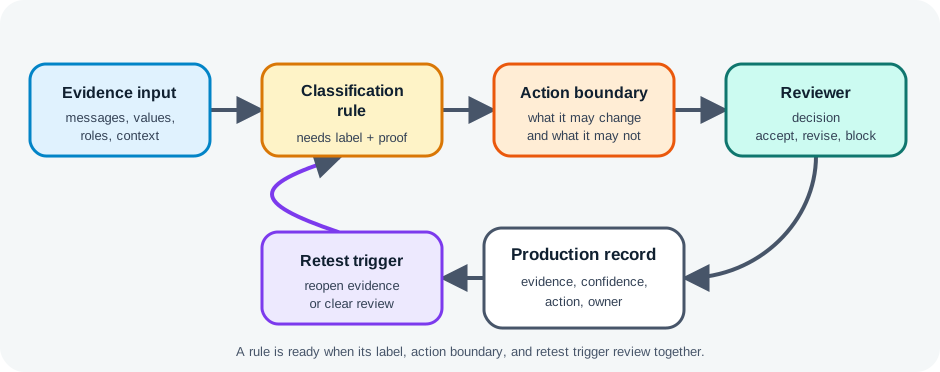
Bella summarized it for the team: “So we have different kinds of problems: broken nodes, temporarily stuck nodes, and nodes that misbehave on purpose. We need to watch everyone’s behavior and keep a reputation score – like a trustworthiness grade!”
The Sensor Squad learned that keeping track of who behaves well and who does not is the key to a healthy sensor network – just like keeping track of who plays fair in a team game!
Think of a wireless sensor network like a team of coworkers in an office. Each person (sensor node) has a job to do: collect information and pass messages along.
Why do nodes misbehave? Just like coworkers, sensor nodes can have problems:
- Hardware failure: The sensor physically breaks – like a coworker calling in sick permanently
- Environmental interference: Rain, fog, or obstacles block the radio signal temporarily – like a coworker whose phone drops calls in a bad-signal area
- Selfish behavior: A node saves its own battery by refusing to relay others’ messages – like a coworker who does their own work but never helps teammates
- Malicious attack: A compromised node deliberately sends wrong data or disrupts the network – like a saboteur pretending to be a team member
How do we handle this? The network uses a reputation system, similar to reviews on a shopping website. Every node gets a trust score:
- Nodes that reliably forward messages and report accurate data earn high scores
- Nodes that drop messages or report suspicious data lose points
- When a node’s score drops too low, it gets cut off from the network
The energy challenge: Sensors run on tiny batteries, so they cannot stay awake all the time. Duty cycling means the sensor sleeps most of the time and only wakes up periodically to check for events. The tricky part is deciding how often to wake up – too often wastes energy, too rarely might miss important events.
15.2 Prerequisites
Required Chapters:
- Sensor Behaviors Fundamentals - Core concepts
- Sensor Fundamentals - Sensor basics
- Energy Considerations - Power management
Technical Background:
- Sensor state machines
- Event-driven vs polling
- Duty cycling concepts
Sensor Behavior Patterns:
| Pattern | Power | Latency | Use Case |
|---|---|---|---|
| Continuous | High | Low | Critical monitoring |
| Periodic | Medium | Medium | Environmental |
| Event-driven | Low | Variable | Motion detection |
| Adaptive | Variable | Variable | Smart systems |
Estimated Time: 1 hour (total for both chapters)
15.3 Chapter Overview
This section has been organized into focused chapters for optimal learning:
15.3.1 1. Sensor Production Framework
Time: 45 minutes | Level: Advanced
Complete production-ready Python framework for managing sensor node behaviors: - Behavior classification (6 types) - Failure detection with 9 modes - Reputation-based trust management - Adaptive duty cycling (1%-100% range) - Event-aware topology adaptation - 6 comprehensive code examples with output
15.3.2 2. Sensor Production Quiz
Time: 30 minutes | Level: Advanced
Test your understanding with real-world scenarios: - Dumb node behavior in agricultural WSN (rain attenuation diagnosis) - Safety-critical mine monitoring architecture (5-nines reliability) - Duty cycling protocol tradeoffs (S-MAC vs B-MAC) - Energy consumption analysis (radio dominance) - Social sensing effectiveness patterns
15.4 Quick Reference
Behavior Classification (6 types):
- Normal, Degraded, Failed, Dumb, Selfish, Malicious
Failure Detection:
- 9 failure modes with automatic diagnosis
- Predictive maintenance with early warning
- Dead node detection with timeout monitoring
Security and Trust:
- Reputation-based trust management
- Watchdog monitoring for packet forwarding
- Blacklisting of misbehaving nodes
- 5 trust levels from Trusted to Blacklisted
Energy Optimization:
- Adaptive duty cycling (1%-100% range)
- Social sensing integration
- Battery-aware power management
- Event-driven activation
15.5 Key Concepts Summary
Node Behavior Spectrum (6 types):
- Normal: Perfect operation under good conditions
- Degraded: Reduced performance due to resource constraints (low battery, high temperature)
- Failed: Complete inability to operate
- Dumb: Temporary communication failure due to environmental interference
- Selfish: Prioritizing self-interest over cooperation
- Malicious: Deliberately attacking network
Dumb Nodes (detail):
- Temporary communication failure due to environment
- Sensing functional, transmission impaired
- Recovers when conditions improve
- Requires CoRD/CoRAD for connectivity restoration
Event-Aware Management:
- Adapt topology for event detection
- High density during events, sparse otherwise
- Balance energy vs detection requirements
Information-Theoretic Self-Management (InTSeM):
- Transmit only high-information readings
- 50-90% transmission reduction in stable environments
- Automatic anomaly detection
Social Sensing:
- Leverage social media for rare event prediction
- Adjust duty cycle proactively
- 90-99% energy savings for rare event monitoring
Assuming all silent nodes are failed: A node that stops responding may be a “dumb node” experiencing temporary environmental interference (rain attenuation, physical obstruction) rather than a hardware failure. Immediately removing such nodes wastes deployment resources – always implement a recovery timeout window (typically 3-10 minutes) before declaring a node permanently failed.
Using a single trust threshold for all environments: A fixed reputation threshold (e.g., 0.5) that works in a stable indoor deployment will generate excessive false positives in harsh outdoor environments where legitimate signal degradation is common. Calibrate trust thresholds per deployment context, and consider using separate thresholds for data quality vs. forwarding behavior.
Equating low duty cycle with energy efficiency: Reducing duty cycle from 10% to 1% does not guarantee 10x battery life improvement. Radio startup energy costs (turning the transceiver on/off) can dominate at very low duty cycles, and missed events may require costly retransmissions. The optimal duty cycle depends on event frequency, radio startup cost, and latency requirements.
Ignoring collusion attacks in trust management: Simple watchdog-based reputation systems assume nodes act independently. A group of malicious nodes can collude to vouch for each other while attacking the network, maintaining artificially high trust scores. Production systems need cross-validation from multiple independent observers and anomaly detection on trust score patterns.
Treating selfish and malicious nodes identically: Selfish nodes conserve their own resources but do not actively attack – they may still provide valid sensor readings. Malicious nodes deliberately inject false data or disrupt routing. The response strategies differ: selfish nodes can be incentivized to cooperate through payment or reciprocity mechanisms, while malicious nodes must be isolated immediately.
Scenario: A 500-node soil moisture monitoring network in California experiences sudden connectivity loss during heavy rain. 38 out of 50 sensors report “gateway unreachable” but continue collecting data locally.
Investigation Process:
- Characterize the failure pattern:
- Affected nodes: 76% (38/50) during rain
- Communication range: Dropped from 100m to 3-8m
- Sensor function: All sensors still collecting valid moisture readings
- Recovery: All nodes reconnected within 30 minutes of rain stopping
- Calculate rain attenuation:
- Rain rate: 20mm/hour (heavy rain)
- 2.4 GHz attenuation: ~0.02-0.05 dB/m
- Path loss increase at 100m: 2-5 dB
- Result: Marginal links (95-100m) fail completely
- Classify behavior: Dumb nodes (temporary environmental impairment)
- Sensing still works ✓
- Processing still works ✓
- Communication temporarily fails due to weather ✓
- Automatic recovery when conditions improve ✓
Solution Decision: Deploy UAV-based mobile data collection (CoRAD) triggered by weather alerts. Cost: $1,500 UAV + automation vs. $2,500-4,000 to replace all 50 nodes with 915 MHz radios.
Key Insight: Replacing hardware for dumb node behavior wastes money. The environment caused the problem, not the sensors.
UAV-based data collection cost-benefit for dumb nodes:
During heavy rain (20mm/hr), 2.4 GHz attenuation causes 38 out of 50 sensors to become dumb nodes. Rain lasts 2 hours per event, occurring twice per month. Two solutions:
Option 1: Replace all 50 nodes with 915 MHz radios (better rain penetration)
\[ \text{Cost} = 50 \text{ nodes} \times \$80/\text{node} = \$4{,}000 \]
Option 2: Deploy UAV with 915 MHz downlink for emergency data collection
\[ \text{UAV cost} = \$1{,}500 + (\$50/\text{flight} \times 24 \text{ flights/year}) = \$1{,}500 + \$1{,}200 = \$2{,}700 \text{ (first year)} \]
Amortized over 5 years:
\[ \text{Annual cost}_{\text{UAV}} = \frac{\$1{,}500}{5} + \$1{,}200 = \$300 + \$1{,}200 = \$1{,}500/\text{year} \]
Savings: UAV solution saves $4,000 - $2,700 = $1,300 upfront, and ongoing costs are $1,500/year vs $0 for replacement. Break-even occurs at year 2. The UAV approach is 62.5% cheaper over 5 years when dumb node behavior is predictable and weather-correlated.
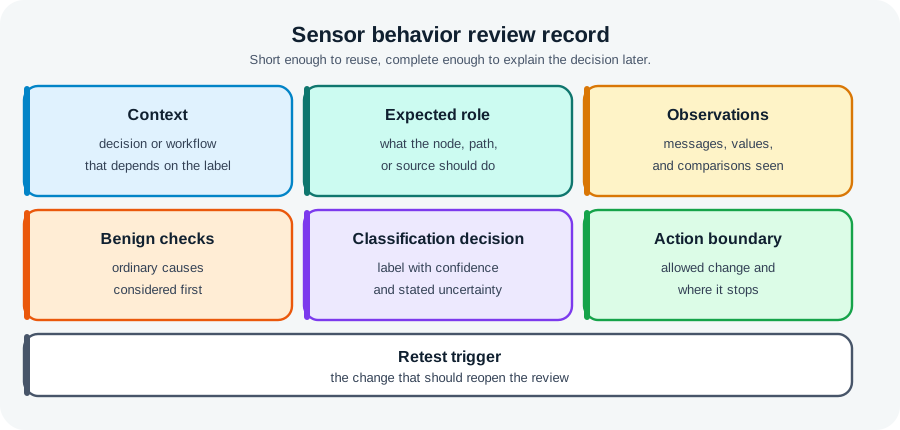
Use this table to classify observed node behaviors based on diagnostic evidence:
| Observation | Normal | Degraded | Dumb | Failed | Selfish | Malicious |
|---|---|---|---|---|---|---|
| Sensing works | ✓ | ✓ | ✓ | ✗ | ✓ | ✓ |
| Processing works | ✓ | ✓ | ✓ | ✗ | ✓ | ✓ |
| Communication works | ✓ | Intermittent | ✗ | ✗ | Partial | ✓ |
| Affects multiple nodes | N/A | Maybe | ✓ | ✗ | ✗ | ✗ |
| Recovers automatically | N/A | ✓ | ✓ | ✗ | ✗ | ✗ |
| Forwarding ratio | >95% | 80-95% | N/A | 0% | <30% | <10% |
| Battery level | >30% | 10-30% | Any | 0% | Any | Any |
| Data quality | High | Medium | High | N/A | High | Low/False |
How to use: Check each diagnostic criterion against the table. The column with the most ✓ marks indicates the behavior type.
Example: Node shows sensing ✓, processing ✓, communication ✗, affects 38 nodes ✓, recovers automatically ✓ = Dumb node behavior.
The Error: A node with battery at 22% starts dropping 40% of forwarding requests. Network administrator flags it as “selfish” and reduces its trust score below 0.3, triggering blacklisting.
Why This Is Wrong: Low battery (below 30% threshold) legitimately causes reduced forwarding to conserve remaining energy for critical operations. The node is degraded, not selfish.
Correct Response:
- Check battery level: 22% < 30% → Degraded behavior likely
- Check temperature: 58°C approaching 60°C threshold → Additional stress
- Reclassify as Degraded instead of Selfish
- Adjust expectations: Reduced duty cycle is appropriate for resource conservation
- Schedule maintenance: Replace battery rather than punishing the node
Calculation:
- Selfish node: Forwarding drops with NO resource constraints (battery >50%, temperature normal)
- Degraded node: Forwarding drops WITH resource constraints (battery <30%, temperature >55°C)
Key Insight: Context matters. Always check system resources before classifying behavior as malicious or selfish.
15.6 Concept Relationships
This review chapter synthesizes concepts across node behavior management, energy optimization, and fault detection:
To Trust Management (Trust Implementation): The reputation-based system with five trust levels (Trusted >0.8 to Blacklisted <0.3) implements game-theoretic incentives - nodes must cooperate to maintain network access for their own traffic.
To Failure Prediction (Testing and Validation): Predictive maintenance thresholds (battery <30%, temperature >60C, memory >90%) enable proactive node replacement before catastrophic failure, reducing network partitions.
To Adaptive Duty Cycling (Duty Cycling): The 1%-100% duty cycle range demonstrates how baseline energy efficiency (98% sleep) can coexist with event responsiveness (50-100% alert mode) when events occupy <0.1% of operational time.
To Topology Management (Topology Management): Event-aware activation (100m radius, 50-73% duty cycle) shows how network density dynamically adapts to detected anomalies while maintaining energy budgets.
15.7 See Also
For foundational taxonomy:
- Node Behavior Taxonomy - Six behavior classes (normal, degraded, failed, dumb, selfish, malicious) with decision tree diagnostics
- Node Behavior Classification - Detection algorithms for normal, failed, and badly failed nodes with watchdog monitoring
For implementation details:
- Production Framework - Complete Python system with behavior classification, failure detection (9 modes), reputation scoring, adaptive duty cycling
- Trust Management Implementation - EMA-based reputation with watchdog monitoring achieving >90% detection accuracy
For application scenarios:
- Mine Safety Monitoring - Multi-sensor fusion (temperature + CO + smoke) reducing false alarms by 80-85%
- WSN Coverage - Coverage guarantees with failures, redundancy ratios, network lifetime calculations
For assessment:
- Production Quiz - Scenario-based questions on dumb node diagnosis, safety-critical architecture (five-nines reliability), duty cycling protocols (S-MAC vs B-MAC)
15.8 Summary and Key Takeaways
This chapter provides a production-ready overview of sensor node behavior management in wireless sensor networks:
- Behavior classification matters: The 6-type behavior taxonomy (normal, degraded, failed, dumb, selfish, malicious) enables targeted response strategies rather than one-size-fits-all fault handling
- Trust is quantifiable: Reputation-based systems with 5 trust levels (Trusted, Probationary, Suspicious, Untrusted, Blacklisted) provide automated, scalable misbehavior management
- Failure detection requires nuance: Distinguishing 9 failure modes prevents costly misdiagnosis – a dumb node (environmental interference) should not be treated like a malicious node (deliberate attack)
- Duty cycling is a spectrum: Adaptive duty cycling across 1%-100% saves 50-99% energy, but optimal settings depend on event frequency, detection latency requirements, and radio hardware characteristics
- Production readiness demands integration: Event-aware topology adaptation, social sensing for rare events, and InTSeM (Information-Theoretic Self-Management) must work together for real-world deployments achieving 5-nines reliability in safety-critical scenarios
15.9 Further Reading
Node Behavior and Security:
- Karlof, C., & Wagner, D. (2003). “Secure routing in wireless sensor networks: Attacks and countermeasures.” Ad Hoc Networks, 1(2-3), 293-315.
- Stajano, F., & Anderson, R. (1999). “The resurrecting duckling: Security issues for ad-hoc wireless networks.” Security Protocols Workshop.
Duty Cycle and Energy Management:
- Ye, W., Heidemann, J., & Estrin, D. (2002). “An energy-efficient MAC protocol for wireless sensor networks.” IEEE INFOCOM.
- Tang, L., et al. (2011). “PW-MAC: An energy-efficient predictive-wakeup MAC protocol for wireless sensor networks.” IEEE INFOCOM.
Social Sensing:
- Sakaki, T., et al. (2010). “Earthquake shakes Twitter users: Real-time event detection by social sensors.” WWW Conference.
- Aggarwal, C. C., & Abdelzaher, T. (2013). “Social sensing.” Managing and Mining Sensor Data, Springer.
Mine Safety Applications:
- Moridi, M. A., et al. (2015). “Development of underground mine monitoring and communication system integrated Zigbee and GIS.” International Journal of Mining Science and Technology, 25(5), 811-818.
15.10 References
Akyildiz, I. F., et al. (2002). “Wireless sensor networks: A survey.” Computer Networks, 38(4), 393-422.
Dressler, F., & Fischer, S. (2009). “Connecting wireless sensor networks with TCP/IP networks.” Autonomic Communication, Springer.
Wang, Q., et al. (2013). “A realistic power consumption model for wireless sensor network devices.” IEEE SECON.
Buchegger, S., & Le Boudec, J. Y. (2002). “Performance analysis of the CONFIDANT protocol.” ACM MobiHoc.
Perera, C., et al. (2015). “Sensing as a service model for smart cities supported by Internet of Things.” Transactions on Emerging Telecommunications Technologies, 25(1), 81-93.
Deep Dives:
- Sensor Behaviors Fundamentals - Behavior taxonomy
- Sensor Behaviors Quiz - Assessment and applications
Comparisons:
- WSN Overview - Network-wide behavior management
- Energy-Aware Design - Power optimization
Applications:
- Sensor Fundamentals - Hardware characteristics
- Mine Safety IoT - Safety-critical systems
Design:
- Network Traffic Analysis - Behavior monitoring
- Network Design - Fault tolerance
Learning:
- Quizzes Hub - Node behavior scenarios
- Knowledge Gaps Hub - Failure detection review
15.11 Knowledge Check
15.12 What’s Next
| If you want to… | Read this |
|---|---|
| Review the core sensor production framework | Sensor Production Framework |
| Complete knowledge checks for sensor production concepts | Sensor Production Quiz |
| Study trust implementation in sensor behavior systems | Sensor Behaviors Trust Implementation |
| Review mine safety application of sensor behaviors | Sensor Behaviors Mine Safety |
| Return to the main node behavior taxonomy | Node Behavior Taxonomy |