43 What Is Sensing-as-a-Service?
More
Depth: Practitioner
Progress saves as you read. Mark sections complete as you go; your progress appears in the sidebar.
43.1 Start Simple
This section: Start Simple — Picture a bus team offering cabin heat readings to a city health study.
Treat a Shared Reading as a Service Promise
Picture a bus team offering cabin heat readings to a city health study. The buyer does not own the devices, routes, or repairs, yet still needs to know what each value means and when it can be trusted. The sensing owner must make that promise clear before reuse begins.
Describe one offered stream in plain words. Name the source, place, unit, sample pace, age limit, quality mark, allowed use, support owner, and end rule. Say what happens when a device moves, misses a check, or changes its scale. Keep the buyer able to trace each value to the promise in force at that time.
Test a silent source, a late value, a changed route, a new buyer, a full store, and an owner who ends access. Check how weak quality and planned gaps are shown. A stream can be easy to buy and still be unfit for a decision.
Keep urgent action with the team that sees the real place. Shared readings can support study and planning, but reuse does not grant control of the bus.
This opening does not settle every market or legal term. Practitioner shapes the offer and user check. Under the Hood examines discovery, terms, isolation, scale, payment, and how changes travel to every user.
Use a short release check. Can a buyer find the owner? Is the unit plain? Is age shown? Does weak data carry a mark? Can use end when promised? If any answer is no, the reading is not ready to be sold or shared.
Start with one sensor stream that another team wants to reuse. In What Is Sensing-as-a-Service?, the practical question is who owns the sensing resource, what quality is promised, and what policy keeps the service safe to consume.
43.2 Learning Objectives
This section: Learning Objectives
By the end of this chapter, you will be able to:
- Explain the difference between dedicated sensing and S2aaS.
- Identify the three S2aaS roles: sensor owner, platform operator, and data consumer.
- Distinguish IaaS, PaaS, and SaaS-style sensing services.
- Explain how sensor virtualization enables discovery, sharing, and multi-tenancy.
- Evaluate whether a sensing use case is a good fit for S2aaS.
- State the quality, privacy, and governance checks required before sensor data can be sold or reused.
43.3 Sensors as Service Promise
This section: Sensors as Service Promise — If you only need the intuition, this layer is enough: S2aaS does not remove sensors.
If you only need the intuition, this layer is enough: S2aaS does not remove sensors. It changes who owns the sensors, who consumes the results, and what evidence proves that the sensing service can be trusted.
Figure 43.3 shows S2aaS layers connect sensing, communication, cloud data, service management, and applications.
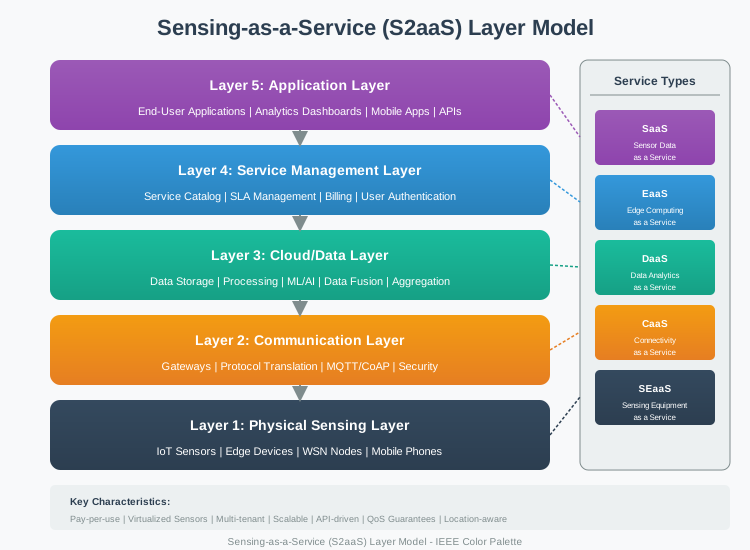
Mobile summary: Dedicated sensing makes each consumer own a separate sensor stack; S2aaS lets multiple consumers subscribe through a platform that handles discovery, access, quality, and billing over a shared sensor pool.
Physical sensing
Devices still need placement, power, calibration, connectivity, maintenance, and replacement.
Virtual service
The platform exposes a capability such as zone air quality, occupancy, vibration, or traffic flow.
Trust contract
The consumer needs metadata, quality limits, latency, access rules, and audit evidence before reuse is safe.
43.4 Practitioner: Write the Fit Record
This section: Practitioner: Write the Fit Record — A practical S2aaS decision starts with one consumer job and one service promise.
A practical S2aaS decision starts with one consumer job and one service promise. For example, a city logistics team might subscribe to loading-zone air-quality measurements rather than installing its own sensor network.
Record the consumer need
Name the decision that depends on the data, the required location, freshness, resolution, and allowed use.
Record the service boundary
Name the sensor owner, platform operator, data consumer, API or dashboard, metering rule, and support owner.
Record trust evidence
Include calibration status, completeness, latency, privacy basis, tenant isolation, audit trail, and quality flags.
Record rejection rules
State when the consumer must reject the service, request a dedicated sensor, or pause downstream automation.
43.5 Why Shared Sensing Can Fail
This section: Why Shared Sensing Can Fail — The difficult part is not publishing an API.
The difficult part is not publishing an API. The difficult part is preserving meaning when the same sensing infrastructure serves multiple consumers with different quality, privacy, billing, and operational expectations.
Treat why Shared Sensing Can Fail as one connected review. Begin with virtualization mismatch: the advertised capability can hide sensor placement, coverage gaps, or substitute devices. With that boundary fixed, examine quality drift: calibration age, missing samples, delayed uploads, and changed aggregation windows can alter consumer decisions. Then connect it to tenant leakage: shared infrastructure needs access control, purpose limits, retention limits, and audit trails. Close the review by checking service confusion: raw readings, processed streams, and finished reports carry different responsibilities and failure meanings. The order matters: each later judgment depends on the owner, state, constraint, or failure evidence retained by the preceding step, so the resulting record can support the next chapter decision.
This section:
This section:
43.6 Why S2aaS Exists
This section: Why S2aaS Exists
Traditional IoT deployments often build a dedicated sensing network for one application: one agency deploys air-quality sensors, one building owner deploys occupancy sensors, one fleet operator deploys temperature probes, and each system is integrated separately. That model gives control, but it also creates duplicated hardware, underused coverage, separate maintenance programs, and slow access for secondary users who only need the data.
S2aaS changes the question from “Which sensors should this application buy?” to “Which sensing capability can this application subscribe to, under what quality and usage terms?”
43.6.1 Dedicated Sensing
The application team owns the device selection, installation, calibration, connectivity, storage, access control, and replacement cycle.
43.6.3 Fit Question
Does the consumer need physical control of the device, or is trustworthy access to the sensing result enough?
43.7 The S2aaS Roles
This section: The S2aaS Roles — S2aaS is easiest to reason about as a three-role system.
S2aaS is easiest to reason about as a three-role system.
43.7.1 Sensor Owner
Deploys or controls physical sensors. The owner is responsible for maintenance, calibration records, connectivity, and the rules under which data can be shared.
43.7.2 Platform Operator
Provides registration, discovery, tenant isolation, quality checks, API access, metering, billing, consent records, and audit logs.
43.7.3 Data Consumer
Uses the service for a task such as research, compliance, routing, building optimization, asset monitoring, or analytics.
These roles can be held by separate organizations, or one organization can hold more than one role. The model still needs to name the roles because responsibility is different from ownership. A platform can operate the marketplace without owning every sensor, and a data consumer can use a dashboard without being allowed to redistribute raw readings.
43.8 Service Stack
This section: Service Stack — The service stack separates physical sensing from the interfaces consumers use.
The service stack separates physical sensing from the interfaces consumers use. This separation is what makes shared infrastructure practical.
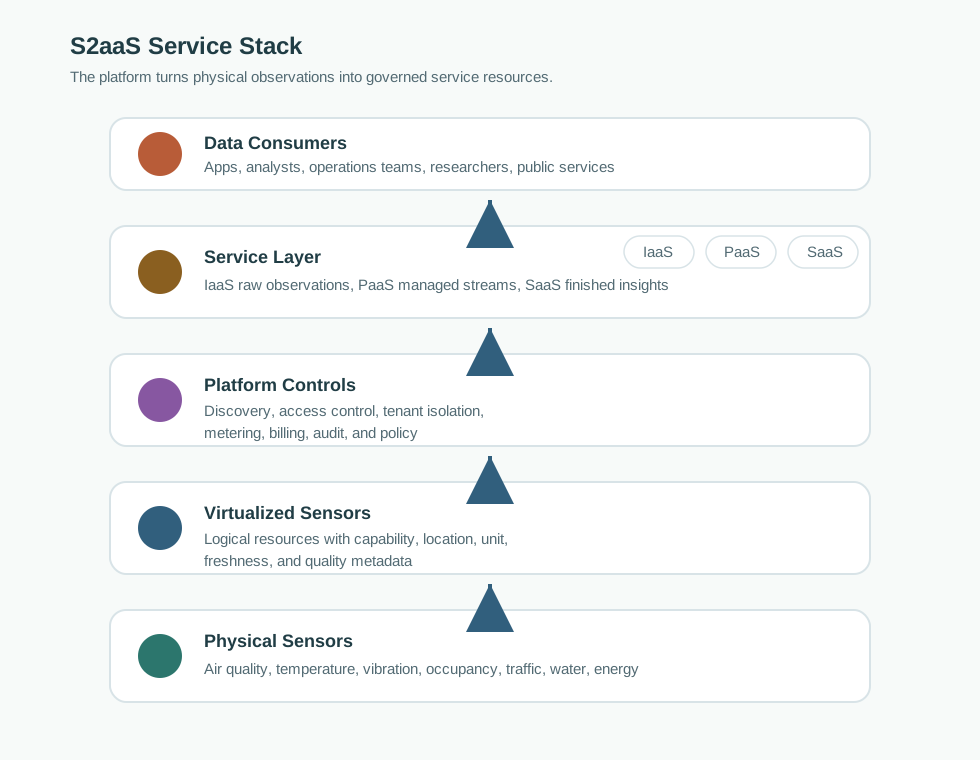
43.8.1 IaaS-Style Sensing
Provides raw or near-raw sensor observations through an API or stream. Choose this when the consumer has its own analytics pipeline and needs maximum control over processing.
43.8.2 PaaS-Style Sensing
Provides normalized feeds, aggregation, filtering, event detection, storage, and query services. Choose this when teams need data services but still build their own application logic.
43.8.3 SaaS-Style Sensing
Provides finished dashboards, alerts, compliance reports, or recommendations. Choose this when the consumer wants outcomes rather than raw sensor integration.
43.9 Sensor Virtualization
This section: Sensor Virtualization — Sensor virtualization means the consumer works with a logical resource instead of a specific physical sensor.
Sensor virtualization means the consumer works with a logical resource instead of a specific physical sensor. A request might ask for “outdoor PM2.5 readings in zone A every five minutes with recent calibration records.” The platform then maps that request to one or more physical devices, quality rules, fallback sources, and delivery channels.
Virtualization supports four important capabilities:
- Discovery: consumers can search by capability, location, time range, data quality, price, or policy.
- Substitution: the platform can replace a failed sensor with an equivalent source when quality rules allow it.
- Multi-tenancy: multiple consumers can use the same physical stream while receiving isolated access, usage records, and service terms.
- Portability: applications can move between providers or regions if the service interface and metadata model are stable.
43.10 What Must Be in the Metadata
This section: What Must Be in the Metadata — The metadata is not decoration.
The metadata is not decoration. It is what lets a consumer decide whether a sensing product is usable.
43.10.1 Capability Metadata
- Measured phenomenon and unit — make the capability understandable so consumers can judge whether it matches their task.
- Sensor type and model class when relevant — describe the physical source while keeping the requested sensing capability clear.
- Spatial coverage and coordinate reference — provide location context so consumers can assess whether observations are spatially relevant.
- Sampling interval and delivery latency — make timing visible alongside quality status; reachable data may still be too late for a decision.
- Observation history and retention window — describe the available record and its limits so consumers can compare their data needs with the service terms.
43.10.2 Trust Metadata
- Calibration date or quality status — makes the sensor’s calibration state visible so consumers can assess whether readings meet their quality needs.
- Completeness and missing-data behavior — explains gaps and how weak or unavailable data is shown before reuse.
- Allowed use and redistribution terms — distinguishes permission to consume a service from permission to share its readings onward.
- Tenant visibility and privacy restrictions — connects shared access with tenant isolation, consent, and limits on sensitive data.
- Support or remedy for quality failures — names the support owner and explains what happens when the promised quality is not met.
43.11 Fit Decision
This section: Fit Decision — S2aaS is useful when the consumer values access more than device ownership.
S2aaS is useful when the consumer values access more than device ownership. It is weaker when the consumer needs physical control, private placement, unusual sampling hardware, or exclusive use of the data source.
43.11.1 Good Fit
- Data is useful to multiple consumers.
- Physical placement can be shared or standardized.
- Quality can be described with clear service terms.
- Consumers can tolerate an API contract instead of direct device control.
- Privacy and ownership rules can be enforced by policy and platform controls.
43.11.2 Weak Fit
- The sensor must be placed inside a private process or secure facility.
- The consumer needs exclusive use or custom hardware behavior.
- Data rights are unclear or consent cannot be obtained.
- Quality cannot be measured or audited.
- A failed reading could trigger unsafe action without independent verification.
43.12 Quality and Governance
This section: Quality and Governance — S2aaS consumers do not maintain the physical sensors themselves, so trust has to move into the service contract and the platform controls.
S2aaS consumers do not maintain the physical sensors themselves, so trust has to move into the service contract and the platform controls.
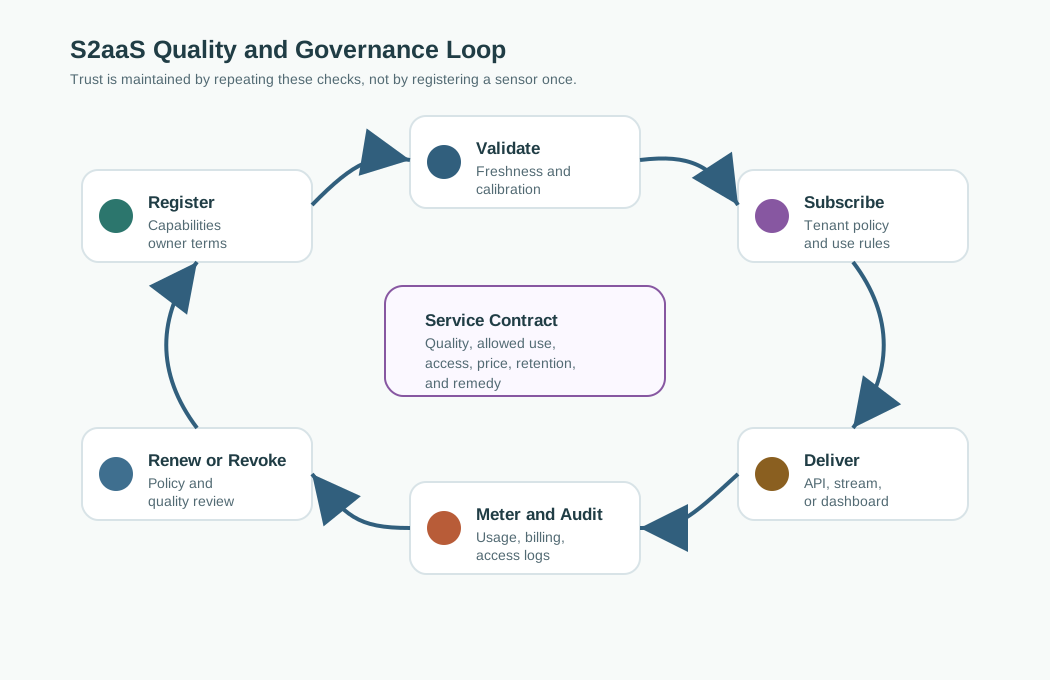
The minimum readiness check asks:
- Can the consumer discover the right capability? The registry should expose location, measurement type, unit, sampling interval, and quality status.
- Can the platform enforce the agreement? Access control, rate limits, tenant isolation, and allowed-use terms must be technical controls, not only prose.
- Can data quality be trusted? Calibration, freshness, completeness, and latency must be measured and visible.
- Can sensitive data be protected? Location, movement, occupancy, health, and camera-derived signals may require aggregation, minimization, consent, or rejection.
- Can use be audited? The platform should record who accessed which resource, when, under which policy, and at what service tier.
43.13 Economics Without Drift
This section: Economics Without Drift — S2aaS economics depend on the gap between the cost of operating trustworthy sensing infrastructure and the revenue or value created by reuse.
S2aaS economics depend on the gap between the cost of operating trustworthy sensing infrastructure and the revenue or value created by reuse. More tenants do not automatically make the model viable. The platform still pays for calibration, connectivity, replacement, security, support, billing, privacy controls, and data-quality operations.
Use a simple break-even check before making projections:
Let be recurring subscription revenue, be the value of avoided duplicate sensing cost, be annual operating cost, and be the initial deployment and integration cost.
If annual net value is zero or negative, sharing does not pay back the deployment. If the payback period is longer than the planning horizon, the project needs a different business model, lower operating cost, stronger anchor consumers, or a narrower deployment scope.
A small number of serious consumers with clear recurring needs often matters more than a large list of casual users. Before deployment, identify who needs the data, what quality level they require, what they are allowed to do with it, and whether the platform can deliver that service repeatedly.
43.14 Worked Example: Choosing a Service Layer
This section: Worked Example: Choosing a Service Layer — Scenario: A city has roadside air-quality sensors.
Scenario: A city has roadside air-quality sensors. Three consumers ask for access:
- A university research group wants raw observations for a pollution model.
- A public health team wants hourly aggregates and alerts when thresholds are exceeded.
- A citizen information portal wants a simple daily air-quality status per district.
Decision:
- The research group fits IaaS-style sensing because it needs raw or near-raw observations and will do its own analysis.
- The public health team fits PaaS-style sensing because it needs normalized data, aggregation, threshold detection, and reliable delivery.
- The citizen portal fits SaaS-style sensing because it needs a finished result, not direct sensor integration.
Reuse condition: all three consumers can use the same physical sensing network only if tenant isolation, rate limits, data-quality metadata, and allowed-use policies are enforced.
43.15 Knowledge Check
This section: Knowledge Check
43.16 Concept Relationships
This section: Concept Relationships
- Physical sensors produce observations that have location, unit, time, and quality context.
- Sensor virtualization turns those observations into logical sensing resources.
- Service layers package resources as raw data, managed streams, or finished insights.
- Marketplace roles define who owns sensors, who operates the platform, and who consumes data.
- Governance controls make sharing safe enough to reuse across tenants.
43.17 Common Pitfalls
This section: Common Pitfalls
43.17.1 Calling Any Sensor API S2aaS
A simple API is not enough. S2aaS requires discovery, virtualization, access control, quality metadata, metering, and reuse across consumers.
43.17.2 Selling Data Without Rights
Sensor data may reveal location, occupancy, movement, behavior, or operational state. Confirm ownership, consent, allowed use, and retention before reuse.
43.17.3 Hiding Quality Problems
Consumers need to know whether readings are fresh, calibrated, complete, and spatially relevant. Missing quality metadata makes the service hard to trust.
43.17.4 Assuming Sharing Always Pays Back
Multi-tenancy helps only when revenue or avoided cost exceeds operation, privacy, platform, support, and quality-management costs.
43.18 References and Further Reading
This section: References and Further Reading
- OGC SensorThings API, for modeling sensor observations and exposing queryable sensing resources.
- W3C SOSA/SSN ontologies, for describing sensors, observations, procedures, features of interest, and observed properties.
- oneM2M functional architecture, for service-layer concepts that also appear in shared sensing platforms.
43.19 Summary
This section: Summary — S2aaS turns sensing capability into a managed service.
S2aaS turns sensing capability into a managed service. The core shift is not that sensors disappear; it is that applications can discover and consume virtualized sensing resources without owning every device. A good S2aaS design names the roles, chooses the right service layer, publishes useful metadata, enforces tenant boundaries, and makes quality and allowed use visible enough for consumers to trust.
43.20 What’s Next
This section: What’s Next
- Study the detailed service models in S2aaS Concepts and Models.
- Explore stakeholder value and adoption challenges in S2aaS Value Creation and Challenges.
- Check ownership, consent, and privacy in S2aaS Data Ownership.
- Move into implementation guidance with S2aaS Implementations.
- Use S2aaS Readiness Check after completing the S2aaS section.
43.21 Key Takeaway
This section: Key Takeaway — Sensing as a Service turns measurements into a managed service.
Sensing as a Service turns measurements into a managed service. Define the customer, data product, quality expectations, access interface, billing model, and operational obligations together.
Find help
3 reviewed answers.
Where should I start in a module?
Open the module page from the sidebar to see its chapters in order. Use the module map to return to a topic you need.
Modules and pathsReviewed
What can I try when a project does not work?
Check the symptom, then work through the diagnostic steps. Keep the error message and the smallest example that reproduces it.
When you are stuckReviewed
How do interactive examples work?
Use the interactive guide to check how examples and simulations work before changing your project.
Interactive examples guideReviewed