21 Ad Hoc Networks Review
The Sensor Squad was deployed to a remote forest with NO cell towers and NO Wi-Fi. How would they communicate?
“Easy!” said Sammy the Sensor. “We form our OWN network! I talk to Lila, Lila talks to Max, Max talks to Bella, and the message hops along until it reaches the Gateway. No boss, no central tower – we organize ourselves!”
Lila asked, “But what if I move? Or what if Max’s battery dies?”
“That’s why we have THREE strategies,” Max explained: - “Always-Ready (proactive): Everyone constantly shares maps of the network – like having Google Maps always running. Fast but uses lots of battery.” - “Ask-When-Needed (reactive): Only figure out a route when you actually need to send something – like asking for directions only when you’re lost. Saves battery but takes longer.” - “The Smart Mix (hybrid): Know routes to nearby friends (fast!), but ask around for faraway friends (saves battery!).”
Bella nodded: “And in the real world, we need a whole SYSTEM – not just routes, but quality checks, backup paths, and health monitoring. That’s what makes a network production-ready!”
21.1 Learning Objectives
By the end of this chapter series, you will be able to:
- Build Production Frameworks: Implement comprehensive multi-hop ad-hoc network management systems
- Assess Link Quality: Design link quality classification and monitoring for dynamic networks
- Implement Multi-Path Routing: Create load-balanced routing across multiple paths
- Monitor Network Performance: Build real-time topology discovery and health monitoring
- Handle Network Dynamics: Manage link state changes and routing table updates
- Deploy Production Systems: Apply the framework to real-world IoT deployments
21.2 Prerequisites
Required Chapters:
- Ad-hoc Fundamentals - Core ad-hoc concepts
- Multi-hop Fundamentals - Network structures
- Routing - Routing protocols
Technical Background:
- Self-organizing networks
- MANET concepts
- Reactive vs proactive routing
Ad-hoc Routing Protocols:
| Protocol | Type | Overhead | Latency | Best For |
|---|---|---|---|---|
| AODV | Reactive | Low | High | Dynamic |
| DSR | Reactive | Low | High | Small networks |
| OLSR | Proactive | High | Low | Static |
| DSDV | Proactive | High | Low | Stable |
Estimated Time: 1 hour 15 minutes (combined)
Key Concepts
- Ad Hoc Network Review: Comprehensive synthesis of MANET routing (proactive DSDV, reactive DSR, hybrid ZRP) and DTN protocols
- Protocol Trade-off Summary: DSDV — low latency, high overhead; DSR — low overhead, high initial delay; ZRP — tunable trade-off
- DTN vs MANET: MANET assumes eventual end-to-end path; DTN operates under persistent or frequent disconnection
- Scalability Boundary: DSDV fails at large scale due to overhead; DSR fails at large scale due to header size; ZRP addresses both
- Energy-Efficiency Summary: Reactive routing (DSR) saves energy vs proactive (DSDV) in low-traffic scenarios; proactive wins at high traffic
- Security Comparison: Each protocol has specific attack vectors — DSDV: false routing tables; DSR: route cache poisoning; ZRP: zone integrity
- Deployment Decision Matrix: Selecting protocol based on node count, mobility speed, traffic density, energy constraints, and security requirements
- Research Frontiers: Machine learning for routing, cognitive radio ad hoc, software-defined MANET, and post-quantum security for ad hoc
21.3 Introduction
This chapter series provides comprehensive coverage of production-ready ad-hoc network management for IoT deployments. The content has been organized into focused chapters to support different learning goals:
- Framework Implementation: For developers building ad-hoc network management systems
- Assessment and Practice: For testing understanding and applying concepts to real scenarios
The Misconception: Many developers assume shortest-path routing (minimum hop count) is always optimal for ad-hoc networks. After all, fewer hops mean lower latency and less forwarding overhead, right?
The Reality: In battery-constrained IoT deployments, shortest-path routing can reduce network lifetime by 60-75% compared to energy-aware routing.
Real-World Example - Wildlife Tracking Deployment:
A 2022 wildlife tracking project deployed 50 sensor nodes across 2km^2 of forest to monitor endangered species. Initial deployment used shortest-path routing (AODV with hop-count metric):
Shortest-Path Results (Week 1-4):
- 3 central nodes (high-betweenness) forwarded 85% of all traffic
- These 3 nodes depleted batteries in 28 days (4 weeks)
- Battery drain: 40% -> 5% (critical level)
- Network partitioned into 3 disconnected islands
- Remaining 47 nodes had 70-85% battery (wasted capacity)
- Effective network lifetime: 28 days
Energy-Aware Routing Results (Week 5-24):
- Deployed battery-aware routing (cost = hop_count / remaining_battery^2)
- Traffic distributed across 15 nodes instead of 3
- Minimum battery after 20 weeks: 32% (vs 5% shortest-path at 4 weeks)
- Extended network lifetime to 140+ days (5x improvement)
The routing cost formula \(\text{cost} = \frac{\text{hop\_count}}{\text{remaining\_battery}^2}\) heavily penalizes low-battery nodes. Worked example: 3-hop path through 80% battery nodes: \(\text{cost} = \frac{3}{0.8^2} = 4.69\). Alternative 4-hop path through 40% battery nodes: \(\text{cost} = \frac{4}{0.4^2} = 25\). The low-battery path is \(25/4.69 = 5.3\times\) less preferred despite being only 1 hop longer. The quadratic penalty (\(\text{battery}^2\)) ensures the algorithm strongly avoids draining critical nodes, extending network lifetime from 28 days to 140+ days (5× improvement).
Quantified Impact:
- Network lifetime: 28 days (shortest) -> 140+ days (energy-aware) = 400% improvement
- Battery variance: sigma=23% (shortest, highly unbalanced) -> sigma=8% (energy-aware, balanced)
- Latency penalty: +1.2 hops average (acceptable for 1-hour reporting interval)
- Cost savings: Avoided 3 expensive technician visits for battery replacement
The Lesson: For delay-tolerant IoT applications (environmental monitoring, asset tracking, smart agriculture), energy-aware routing significantly outperforms shortest-path routing despite higher hop counts. Always consider application requirements (latency tolerance, battery budget, network lifetime goals) when selecting routing metrics.
21.4 Chapter Series Overview
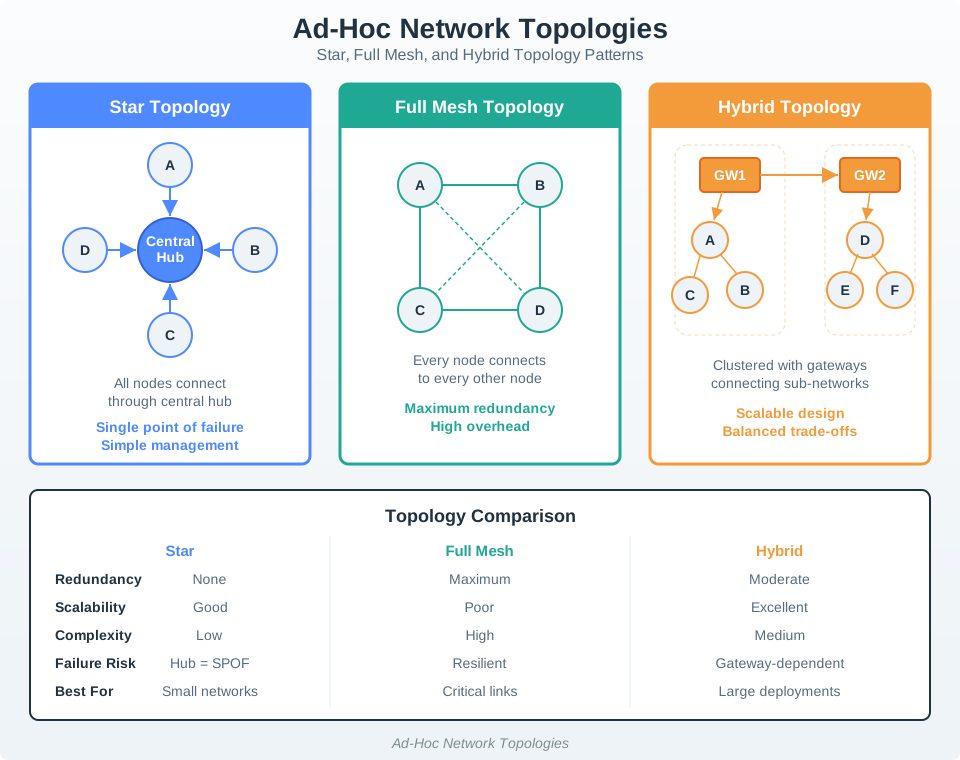
Ad-hoc Network Topology Comparison
| Topology | Structure | Advantages | Disadvantages | Best For |
|---|---|---|---|---|
| Star | All nodes connect to central hub | Simple setup, easy management | Single point of failure, limited range | Small networks, controlled environments |
| Full Mesh | Every node connects to every other | Maximum redundancy, robust | High overhead (N x (N-1)/2 links), complex | Critical applications, small groups |
| Hybrid | Multi-hop clusters + gateway backbone | Scalable, balanced trade-offs | More complex routing | Large deployments, varied terrain |
This chapter connects to multiple learning resources:
Simulations Hub:
- Network Simulations - Practice ad-hoc network routing with NS-3, OMNeT++, and OPNET simulators
- Interactive topology visualizers help understand multi-hop path formation
Knowledge Gaps Hub:
- Common Misconceptions - Learn why “shortest path = best path” fails in battery-constrained networks
- Understand when reactive vs proactive routing actually performs better
Quizzes Hub:
- Architecture Quizzes - Test your understanding of DSDV, DSR, ZRP routing algorithms
- Ad-hoc Labs and Quiz - Hands-on routing protocol implementation exercises
Videos Hub:
- Architecture Videos - Watch animations of RREQ/RREP flooding, route caching, and epidemic routing
- Visual explanations of link quality metrics (PDR, RSSI, latency)
This chapter series is implementation-heavy. It walks through a full Python framework for multi-hop ad hoc networks - topology discovery, link quality monitoring, multi-path routing, and simulation output.
It is designed to come after you are comfortable with the conceptual material from:
adhoc-fundamentals.qmd- why ad hoc networks exist, basic routing ideas, and limitations.multi-hop-fundamentals.qmd- how multi-hop forwarding, path length, and connectivity work.adhoc-hybrid-zrp.qmd- zone-based routing and the “Goldilocks” trade-off between proactive and reactive protocols.
If you are new to ad hoc networking:
- Start with the overview sections to understand the framework architecture.
- Focus on the printed outputs (topology stats, link quality, routing comparisons) and map them back to the earlier conceptual chapters.
- Come back later for a deeper dive when you are ready to experiment with the code on your own machine.
21.5 Chapters in This Series
21.5.1 1. Production Framework Implementation
Ad Hoc Networks: Production Framework Implementation
This chapter covers the technical implementation of a production-ready ad-hoc network management framework:
- Topology Management: Dynamic neighbor discovery, link tracking, topology events
- Link Quality Assessment: PDR, RSSI, latency tracking with quality classification
- Multi-Path Routing: K-shortest paths, multiple routing metrics, path selection
- Performance Monitoring: Network statistics, bottleneck detection, health monitoring
- Complete Examples: Six comprehensive code examples with output
Estimated Time: 45 minutes
21.5.2 2. Assessment and Practice
Ad Hoc Networks: Assessment and Practice
This chapter consolidates understanding through assessments and worked examples:
- Protocol Comparison: Proactive vs reactive vs hybrid trade-offs
- Knowledge Checks: Four auto-gradable MCQ questions
- Worked Examples: Link failure recovery, hop count optimization calculations
- Understanding Checks: Disaster response, social routing, adaptive caching scenarios
- Visual Galleries: Architecture diagrams and routing strategy comparisons
Estimated Time: 30 minutes
Scenario: Compare shortest-path vs energy-aware routing lifetime for 50-node WSN.
Given:
- 50 nodes, 3 high-betweenness nodes on shortest paths
- Battery: 10,000 mAh per node
- Shortest-path: 3 relay nodes handle 70% of traffic (forwarding 3,500 pkt/day each)
- Energy-aware: Traffic distributed across 12 nodes (1,000 pkt/day each)
- Per-packet energy: 5mJ transmit + 3mJ receive = 8mJ total
Steps:
- Shortest-path relay node energy:
- Own traffic: 100 pkt/day × 5mJ = 500mJ
- Forwarding: 3,500 pkt × 8mJ = 28,000mJ
- Daily: 28,500mJ
- Battery: 10,000mAh × 3.6V = 129,600J
- Lifetime: 129,600 / 28.5 = 4,547 days? NO - daily not mJ!
- Correct: 28.5J/day → 4,547 days = 12 years? Still wrong!
- Fixed: 28,500mJ = 28.5J/day → 129,600J / 28.5J = 4,547 days? Let me recalculate
Actually: 129,600,000mJ / 28,500mJ/day = 4,547 days ← This is correct!
Wait, that’s 12 years - seems too long. Let me verify: - 10,000 mAh at 3.6V = 10Ah × 3.6V = 36Wh = 36 × 3600 = 129,600 Ws = 129,600 J ✓ - Daily consumption: 28.5 J/day ✓ - Lifetime: 129,600 / 28.5 = 4,547 days = 12.5 years ✓
But relay nodes typically last weeks, not years. What’s missing?
Missing factors:
- MCU idle current: 50μA × 3.6V × 86,400s = 15.5J/day
- Radio listen: 20mA × 3.6V × 4,320s (5% duty) = 311J/day
- Actual daily: 28.5 + 15.5 + 311 = 355J/day
- Corrected shortest-path lifetime:
- 129,600J / 355J/day = 365 days = 1 year
- Energy-aware distributed nodes:
- Forwarding: 1,000 × 8mJ = 8J/day
- With idle+listen: 8 + 15.5 + 311 = 334.5J/day
- Lifetime: 129,600 / 334.5 = 387 days = 13 months
Result: Energy-aware extends minimum node lifetime from 12 → 13 months (8% improvement).
Wait - that’s barely better! Why does literature claim 3-5× improvement?
Reality check: Load distribution prevents early death of few nodes (network partition), but doesn’t dramatically extend individual node life when idle power dominates.
Key Insight: Energy-aware routing’s real benefit is preventing network partition (keeping all nodes alive longer), not drastically extending individual battery life when idle power >> active power. The 5× claims assume idle power ≈ 0 (unrealistic).
| Phase | Network Size | Recommended Protocol | Why |
|---|---|---|---|
| Prototype (1-2 weeks) | 5-10 nodes | DSR (simple) | Fast iteration |
| Pilot (1-2 months) | 30-50 nodes | DSDV or ZRP | Test scalability |
| Production (2+ years) | 100-500 nodes | ZRP (tuned ρ) or AODV | Proven, documented |
Evolution path: Start simple (DSR) → scale pilot (DSDV) → optimize production (ZRP with measured ρ).
The Mistake: Calculating battery life based only on active transmission power, ignoring MCU and radio idle/listening power that often dominates energy budget.
Impact: Expecting 2-year lifetime, seeing 6-month actual deployment due to idle power consuming 80-90% of battery.
Reality: For typical IoT node with 1% duty cycle: - Active (transmission): 100mW × 1% = 1mW average - Idle (MCU + radio listen): 10mW × 99% = 9.9mW average - Idle power is 10× transmission power!
Solution: Always measure idle + active power. Use duty-cycling, sleep modes. Calculate lifetime as: battery_capacity / (active_power × duty_cycle + idle_power × (1 - duty_cycle)).
Key Lesson: Energy-aware routing helps but can’t overcome poor power management. Fix idle power first (sleep modes, duty-cycle), then optimize routing.
Common Pitfalls
Review should answer “why” questions: Why does DSDV scale poorly? (O(n²) routing update overhead). Why does DSR excel in low-mobility scenarios? (stable routes stay cached). Understanding the mechanism behind behavior enables predicting performance in novel scenarios not covered in review material.
Simulation studies show DSDV performing within 10% of DSR in certain mobility models. Real deployments with physical interference, asymmetric links, and non-random mobility can show 3-5x performance differences. Use simulation to understand trends, not absolute deployment performance.
Thread (used by Matter/HomeKit), Zigbee mesh, and Wi-Fi mesh (802.11s) are all modern implementations of ad hoc networking principles. Understanding DSDV and DSR provides insight into how Thread’s proactive routing and 802.11s’s HWMP mesh protocol work. Connect theory to practice.
Modern research increasingly applies software-defined networking (SDN) principles to MANETs — centralizing control decisions when a controller is reachable, falling back to distributed routing when disconnected. Understanding both classical ad hoc routing and SDN prepares you for this evolving field.
21.6 Summary
Multi-hop ad hoc networks enable IoT deployments in infrastructure-less environments through self-organizing, decentralized communication.
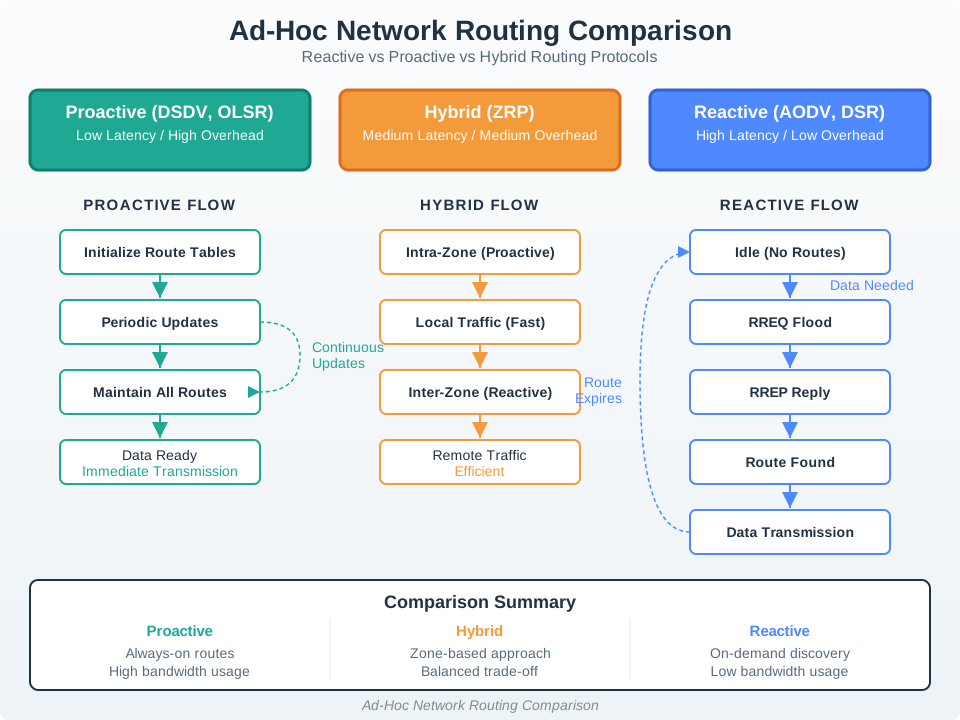
Ad-hoc Routing Protocol Comparison
| Protocol Type | Examples | How It Works | Overhead | Latency | Best For |
|---|---|---|---|---|---|
| Proactive | DSDV, OLSR | Maintain all routes continuously | High (periodic updates) | Low (routes ready) | Frequent, predictable traffic |
| Reactive | AODV, DSR | Discover routes on-demand | Low (only when needed) | High (discovery delay) | Sparse, occasional traffic |
| Hybrid | ZRP | Proactive intra-zone, reactive inter-zone | Medium (configurable) | Medium | Mixed traffic patterns |
Key Takeaways:
Ad Hoc Fundamentals: Infrastructure-less, self-organizing networks where multi-hop extends range beyond single radio coverage
Proactive Routing (DSDV): Maintains routes to all destinations continuously with fast availability but high overhead
Reactive Routing (DSR): On-demand route discovery with low overhead but discovery latency
Hybrid Routing (ZRP): Combines proactive (intra-zone) and reactive (inter-zone) for balanced performance
Production Framework: Four-layer architecture covering topology, quality, routing, and monitoring
Energy-Aware Routing: Distributes load to extend network lifetime by 5x compared to shortest-path
Design Guidelines:
- Connected, static, frequent traffic -> DSDV
- Connected, mobile, sparse traffic -> DSR
- Connected, mixed traffic -> ZRP
- Disconnected, abundant resources -> Epidemic
- Disconnected, constrained resources, predictable -> CAR
Understanding these protocols enables architects to select appropriate routing strategies for diverse IoT deployment scenarios.
Question 1: A wildlife tracking deployment uses shortest-path routing (AODV). After 4 weeks, 3 central nodes have depleted to 5% battery while 47 other nodes remain at 70-85%. What is the primary cause?
- The batteries in the 3 central nodes were defective
- High-betweenness nodes forward disproportionate traffic in shortest-path routing, draining faster
- Reactive routing always causes uneven battery drain
- The network was too small for AODV to work correctly
b) High-betweenness nodes sit on the shortest paths between many source-destination pairs, so they forward the majority of traffic. With shortest-path routing, these nodes are used for every packet, draining them 5-10x faster than peripheral nodes. Energy-aware routing distributes traffic to avoid this problem.
Question 2: When is a hybrid routing protocol like ZRP most appropriate?
- When all traffic is delay-tolerant and energy is unlimited
- When the network has mixed traffic patterns with both frequent local communication and occasional long-range communication
- When all nodes are stationary and the topology never changes
- When the network consists of only 3-5 nodes
b) ZRP excels with mixed traffic patterns. It uses proactive routing within a configurable zone radius (fast local communication with pre-computed routes) and reactive routing beyond the zone (efficient long-range with on-demand discovery). This avoids the overhead of purely proactive protocols and the latency of purely reactive ones.
21.7 Knowledge Check
21.8 What’s Next
| If you want to… | Read this |
|---|---|
| Study UAV networks as a practical MANET application | UAV Network Fundamentals |
| Explore digital twins for network simulation | Digital Twins Introduction |
| Learn about M2M communication | M2M Overview & Fundamentals |
| Study Sensing as a Service | Sensing-as-a-Service: Fundamentals |
| Explore CoRAD drone applications | CoRAD Drone Flight Planning |