3 Ad-Hoc Network Applications
More
Depth: Practitioner
Progress saves as you read. Mark sections complete as you go; your progress appears in the sidebar.
3.1 Start Simple
This section: Start Simple — Imagine a rescue team entering a valley after the fixed network has failed.
Imagine a rescue team entering a valley after the fixed network has failed. Their radios must share location and warning messages through nearby team members. The useful job is not “build an ad-hoc network.” It is “keep this field action working without fixed support.”
Start with that field job. Mark who moves, who sends, who must receive, how late a message may be, and how much battery each relay can spend. Then test a broken path, a moving group, a busy channel, and a member who leaves.
Record delivery, delay, route repair, and energy at the worst point. An ad-hoc path can work without fixed equipment, but it is not always connected. More relays can add reach while also adding delay, traffic, and battery cost.
Go deeper in two steps. The Practitioner section builds an Application-to-Routing Record. Under the Hood tests application fit against the actual failure model.
A protocol is a shared set of rules for sending and receiving data. Choose one only after the field job and its hard limits are clear.
Make a field card for the job. State the area, group size, move rate, message size, send rate, last useful time, and battery limit. Mark any fixed aid that may still exist. Mark the person who owns the result.
Test the card as a route changes. Walk one unit behind a hill. Split the group. Add a burst of warnings. Remove the best relay. Bring it back. Record how long the network takes to find a new path and which messages arrive too late.
Do not hide a split by reporting only the good side. Count each receiver. Keep the worst battery role. Recheck when group size, land shape, radio setting, or message need changes. The app is the judge of route success.
3.2 Start With the Job the Field Still Needs Done
This section: Start With the Job the Field Still Needs Done — An ad-hoc network is only useful if it keeps an application alive when infrastructure is missing or damaged.
An ad-hoc network is only useful if it keeps an application alive when infrastructure is missing or damaged. The application might need alerts, location updates, shared maps, sensor readings, or team coordination.
Start with that job, not with a protocol name. Decide how fresh the data must be, how many nodes may disappear, and what failure looks like to a user. The right ad-hoc design is the one that matches that application pressure.
3.3 Use Ad-Hoc Without Infrastructure
This section: Use Ad-Hoc Without Infrastructure — Ad-hoc networks are useful when devices must communicate without depending on fixed access points, cellular towers, or wired backhaul.
Ad-hoc networks are useful when devices must communicate without depending on fixed access points, cellular towers, or wired backhaul. The application fit usually comes from the operating environment: damaged infrastructure, moving teams, vehicles that meet briefly, remote sensors, drone swarms, temporary events, or communities that build their own mesh.
The first design question is not which protocol is fashionable. It is what the application must survive: mobility, partitions, sparse traffic, bursty alarms, energy limits, local latency, security, and support ownership.
A good application fit has two visible promises. First, the service can still do something useful when the network is incomplete: route a priority message, exchange local awareness, collect delayed readings, or keep a team coordinated inside a local region. Second, the operators can explain what will not be guaranteed: end-to-end latency, global reachability, duplicate-free delivery, battery life under relay load, or centralized access control.
This is why the same "ad-hoc" label covers different engineering choices. AODV or DSR-style on-demand discovery may fit sparse emergency or sensor traffic because routes are discovered only when needed. OLSR or DSDV-style maintained state may fit smaller dense meshes when local latency matters. GPSR-style position-aware forwarding may fit vehicles or drones when location is available and contact windows are short. The application pressure chooses the starting family.
Rejecting ad-hoc networking is also a valid design decision. If the site has reliable managed Wi-Fi, wired Ethernet, private LTE, or a dependable gateway backhaul, the managed network may give clearer ownership, monitoring, updates, and security controls. The application argument for ad-hoc networking should therefore name the unmanaged condition that the design is buying resilience against.
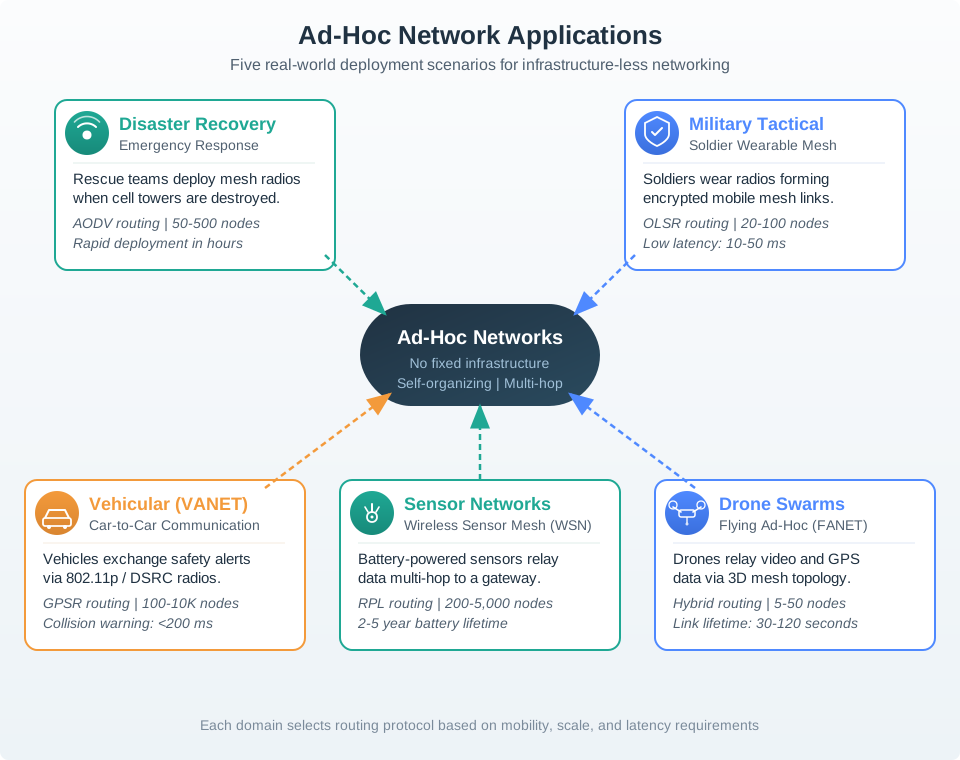
Disaster Response
Responder radios and portable relays form a temporary mesh when normal infrastructure is damaged, overloaded, or absent.
Vehicular Networks
Vehicles exchange local hazard or coordination messages with nearby peers whose contact time may be brief.
Sensor Meshes
Remote sensors relay compact readings through neighbors so the deployment can cover places where a single gateway cannot hear every node.
Drone and Tactical Meshes
Moving teams or aircraft need local coordination while topology changes and fixed infrastructure may not be trustworthy.
3.4 Application-to-Routing Record
This section: Application-to-Routing Record — A practical ad-hoc design records why the application needs a mesh and which routing behavior matches the dominant pressure.
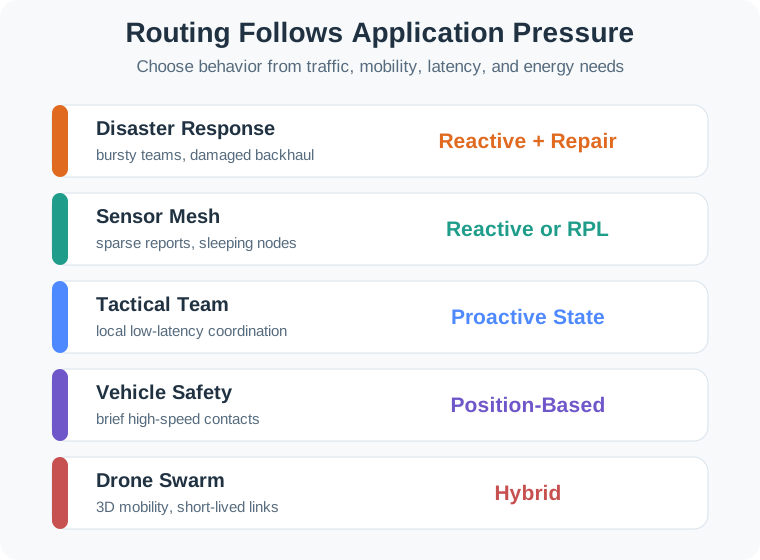
A practical ad-hoc design records why the application needs a mesh and which routing behavior matches the dominant pressure. Sparse periodic sensing often rewards on-demand route discovery and long sleep windows. Dense local coordination may need maintained state. Fast-moving vehicles often need position-aware forwarding. Mixed or large deployments may need a hybrid or hierarchical plan.
The selection record should name the application boundary, normal traffic, degraded traffic, expected mobility, partition behavior, energy ownership, and retest trigger. Without that record, the protocol label becomes a guess.
3.5 Application Fit by Failure Model
This section: Application Fit by Failure Model — Ad-hoc applications succeed when their failure model is explicit.
Ad-hoc applications succeed when their failure model is explicit. A disaster mesh assumes infrastructure loss and team movement. A sensor mesh assumes power scarcity and gateway reachability problems. A vehicular network assumes short contact windows and local freshness requirements. A drone mesh assumes rapid topology change and mission-specific command boundaries.
Those assumptions change what counts as proof. A single message crossing the mesh does not prove partition handling, relay exhaustion, safety freshness, command authorization, or recovery ownership. The proof should include normal operation and degraded operation.
The hidden boundary is between network behavior and application semantics. The routing layer may report a successful next-hop transfer while the application still fails because the message arrived too late, lacked the right authorization context, exhausted a critical relay, or reached only one side of a partition. Application approval therefore needs route evidence and service evidence, not only packet evidence.
Under the hood, the field pilot should deliberately separate topology failures from policy failures. Move nodes to create a partition, remove a relay, replay a burst of alarms, and then check whether priority, expiry, logging, and operator handoff still match the design record. If the remedy is "add more relays" every time, the architecture has not yet explained the failure model.
When Reactive Fits
Traffic is sparse, topology changes matter, and the application can tolerate route discovery before transfer.
When Proactive Fits
Local latency matters, traffic is frequent enough to justify route state, and the topology is small or stable enough to maintain.
When Hybrid Fits
Local traffic and distant traffic have different needs, or the network mixes node roles, movement patterns, and traffic classes.
When Ad-Hoc Does Not Fit
The application needs strict service guarantees that a managed infrastructure network can provide more simply and accountably.
3.6 Choose an Ad-Hoc Path After a Flood
This section: Choose an Ad-Hoc Path After a Flood — For this ad-hoc network application, a flood cuts power to roadside access points while rescue teams still need to exchange bridge and shelter reports.
For this ad-hoc network application, a flood cuts power to roadside access points while rescue teams still need to exchange bridge and shelter reports. In Figure 3.1, read the application settings beside their changing nodes and missing infrastructure. Figure 3.2 then ties mobility, delay tolerance, energy, and message urgency to a routing choice.
In the flood network, a medic’s “bridge closed” alert should favour rapid multi-hop delivery, even if it costs more radio energy. Under this routing protocol, a sensor archive that can wait until a vehicle passes may use store-carry-forward instead. Both are ad-hoc applications, but their contact pattern and consequence of delay lead to different protocols.
3.6.1 Predict the Field Route
For this ad-hoc network application, the flood map also changes as teams move. An ad-hoc route that worked beside the bridge may vanish behind a hill. The application should mark message age so an old “road open” report cannot look current after delayed delivery.
- Predict: Team vehicles separate for an hour but eventually meet at the shelter. Can a continuous end-to-end route be assumed? Check: No. A delay-tolerant ad-hoc path can store the report until contact returns.
- Predict: Every handset rebroadcasts the same urgent alert without a message identifier. What failure grows? Check: Duplicate traffic can consume the shared channel and battery during the emergency.
3.7 Summary
This section: Summary — Ad-hoc networks are useful when the application cannot assume fixed infrastructure: emergency response, tactical movement, vehicle encounters, remote sensing, drone coordination, temporary events, and community meshes.
Ad-hoc networks are useful when the application cannot assume fixed infrastructure: emergency response, tactical movement, vehicle encounters, remote sensing, drone coordination, temporary events, and community meshes. The right routing behavior depends on the application’s dominant pressure: mobility, sparse traffic, local latency, energy limits, partition tolerance, and support ownership.
3.8 Key Takeaway
This section: Key Takeaway
Use ad-hoc networking when the application needs local communication under weak infrastructure assumptions, and approve it only after normal and degraded-path evidence match the deployment’s failure model.
3.9 See Also
This section: See Also
Builds the core vocabulary for infrastructure-less, peer-to-peer, and multi-hop behavior.
Explains the routing behaviors that application selection records compare.
Shows why maintained route state can fit dense or low-latency local traffic.
Shows why on-demand discovery can fit sparse or energy-sensitive traffic.
Find help
3 reviewed answers.
Where should I start in a module?
Open the module page from the sidebar to see its chapters in order. Use the module map to return to a topic you need.
Modules and pathsReviewed
What can I try when a project does not work?
Check the symptom, then work through the diagnostic steps. Keep the error message and the smallest example that reproduces it.
When you are stuckReviewed
How do interactive examples work?
Use the interactive guide to check how examples and simulations work before changing your project.
Interactive examples guideReviewed