41 M2M Service Platforms
More
Depth: Practitioner
Progress saves as you read. Mark sections complete as you go; your progress appears in the sidebar.
41.1 Divide the M2M Platform Jobs
This section: Divide the M2M Platform Jobs — Imagine a building has lifts, meters, pumps, and alarms that must report through one service.
Imagine a building has lifts, meters, pumps, and alarms that must report through one service. The owner must decide which tasks stay local and which tasks the shared service will own. A gateway is a device or service that links one network or system to another.
The lifts, meters, pumps, and alarms may share a platform without sharing control authority. Decide which machine keeps local safety behaviour, which messages the platform may carry, and which user is allowed to issue a command to which device.
41.1.1 Trace an Alarm and a Command
- Which machine must keep working if the shared service is down?
- What does each device report, and what commands may return?
- How are device identity and user permission checked separately?
- What happens when a message is late, duplicated, or rejected?
Trace one alarm and one command through device identity, user access, queue, log, and local controller. Name the owner of each handoff so a shared dashboard cannot hide a failed boundary.
41.1.2 When Shared Service Hides a Boundary
A shared dashboard can present devices together while their control authority and permissions remain separate. Device authentication identifies the connected object; user authentication identifies the requester. Permission to read a device’s data does not imply permission to command it, and platform access does not replace local safety behavior.
The Practitioner depth makes these boundaries reviewable by separating device, user, application, and access responsibilities. Trace an alarm and a command through identity checks, policy, message handling, logs, and the local controller. Name the owner and evidence at each handoff. For a queued command, check its freshness and the controller’s acceptance, and keep rejection or timeout visible so the common screen does not hide the operational result.
41.1.3 Before a Remote Pump Command Acts
Before acting on a pump command, check who requested it, which pump was addressed, and whether the local controller accepted it. If the queue holds an old command, prevent it from becoming a fresh action. Keep the refusal and the local safe state visible to the operator.
41.2 Start Simple
This section: Start Simple — Start with two machines that need to coordinate a job without waiting for a person to interpret every message.
Start with two machines that need to coordinate a job without waiting for a person to interpret every message. In M2M Service Platforms, the practical question is what event, gateway boundary, fallback behavior, and evidence record make the exchange trustworthy.
41.3 Learning Objectives
This section: Learning Objectives
By the end of this chapter, you will be able to:
- Explain the core responsibilities of an M2M service platform without reducing it to a dashboard.
- Distinguish device registry, policy, service enablement, and application access responsibilities.
- Compare IP-based and non-IP M2M network boundaries and explain when a gateway is required.
- Select unicast, group delivery, service discovery, or broad notification patterns for different platform tasks.
- Identify platform design risks caused by identity sprawl, unscheduled reporting, and unclear command authority.
41.4 Platform Responsibilities
This section: Platform Responsibilities — A service platform should make M2M deployments repeatable.
A service platform should make M2M deployments repeatable. It keeps each new device class from requiring a custom integration project and gives operators one governed way to inspect the fleet.
Area
Platform responsibility
Design records
Device registry
Know each device or gateway identity, profile, owner, state, and lifecycle stage.
Registry fields, naming rule, decommission path, and credential rotation path.
Policy
Decide who or what may read, command, configure, or administer a device group.
Role rules, device scopes, time windows, and audit events.
Service enablement
Normalize messages, route events, buffer records, apply delivery rules, and expose health.
Message contract, queue behavior, freshness state, and diagnostic fields.
Application access
Expose platform data and commands through controlled interfaces for apps and workflows.
API contract, rate limits, command approval rules, and operator-facing states.
41.5 Make the Platform a Boundary Stack
This section: Make the Platform a Boundary Stack — “M2M platform” becomes testable when it is split into responsibility planes.
“M2M platform” becomes testable when it is split into responsibility planes. The names below come from an early service-platform decomposition; modern products may package them differently, but the hand-offs still have to exist.
| Plane | Records it owns | Decisions it makes | Must not silently absorb |
|---|---|---|---|
| Device platform | device profile, type, location, address, credentials/keys, area-network membership, status | registration, authentication, authorization, monitoring, and device-scoped control | human account charging or application-specific analytics |
| User platform | user/service-provider profile, account state, roles, charging or entitlement record, device scopes | registration/modification, inquiry, access restriction, and delegated administration | raw device trust keys or unrestricted device control |
| Application platform | normalized observations, heterogeneous-data mappings, service state, command and processing logs | data merging, derived services, connection/service coordination, and auditable command workflow | direct bypass of device authorization or undocumented schema conversion |
| Access platform | application registration, web/app entry point, app-to-device/service mapping, discovery result | which approved app is presented for a compatible device/service and where requests are routed | independent permission decisions that contradict user/device policy |
The split uses two identity domains deliberately. A device credential proves which physical or virtual object connected. A user credential proves who is asking. Authorization joins them with an action and scope:
Do not copy device keys into the user database to make that join convenient. Keep device authentication in the device plane, user/account lifecycle in the user plane, and let a policy decision issue a short-lived, scoped authorization result.
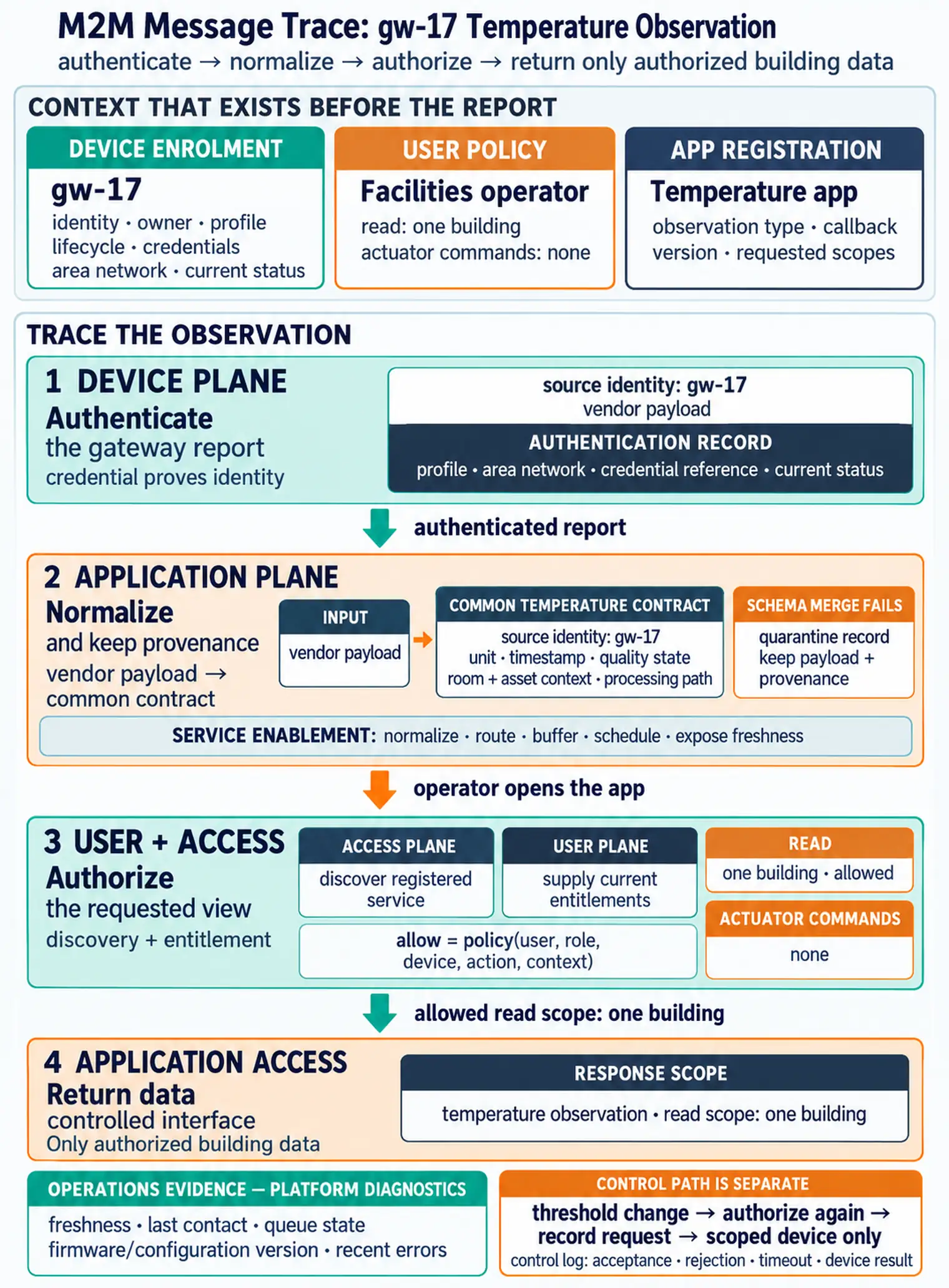
Follow one new temperature-monitor application through the stack, beginning with identity. A manager registers gateway gw-17, so the device plane stores its profile, area network, credential reference, and current status. A facilities operator enrols separately through the user plane. Their role permits reading one building and issuing no actuator commands, while an administrator retains control of that scope. A developer then registers the temperature app with the access plane, declaring its required observation type, callback, version, and requested scopes; the access plane maps it only to compatible registered devices and services.
Now trace an observation. When gw-17 reports, the device plane authenticates it. The application plane converts the vendor payload into the common temperature contract, retains source quality, merges room and asset context, and records the processing path. When the operator opens the app, the access plane discovers the registered service, the user plane supplies current entitlements, and the application plane returns only authorized building data.
Trace a command separately because read access does not imply control authority. If the app requests a threshold change, authorization is checked again, the application plane records the request, and the device plane delivers it only to the scoped device. Acceptance, rejection, timeout, and the device result remain in the control log. Charging or quota accounting can then use the user/service entitlement record and measured service usage, but it does not redefine whether the device credential was valid.
This flow also exposes failure boundaries. A stale device status should block or qualify a command. A disabled user should lose access without bricking the device. Removing an app mapping should stop discovery without deleting historical observations. A schema merge failure should quarantine the record with its original payload and provenance rather than invent a value. Those independent failure behaviors are the reason to preserve the four planes even when one vendor service implements all of them.
41.6 IP and Non-IP Network Boundaries
This section: IP and Non-IP Network Boundaries — M2M platforms usually meet both old and new networks.
M2M platforms usually meet both old and new networks. Non-IP field systems may still be correct for local equipment. IP-based devices may be correct for newer telemetry or cloud-facing services. The platform must make the boundary explicit.
Inspect Figure 41.1 and ask which gateway obligations appear only on the non-IP path.
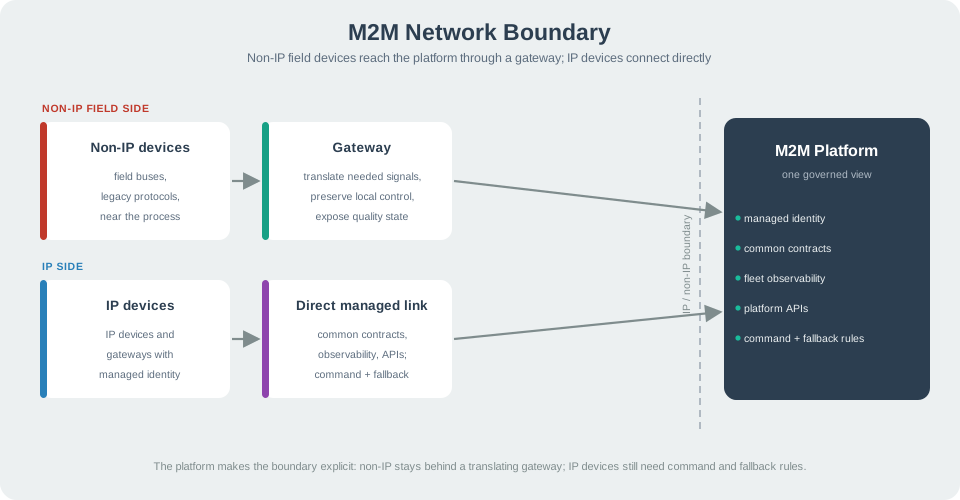
Trace both paths in Figure 41.1. A non-IP device needs a gateway to end its local bus or radio, map identity and messages, store data during loss, and limit return commands. An IP device can use a direct managed link, but it still needs proof of identity and a shared service contract. The dashed line changes address and protocol duties; it must not change the reading’s meaning. At the join, the platform supplies common identity, data rules, fleet views, APIs, and fallback rules. True interoperation needs a named boundary owner and governed meaning, not just an IP wrapper.
41.6.1 Non-IP Field Side
Field buses and legacy protocols can remain near the process. A gateway should translate only the signals needed by the platform, preserve local control ownership, and expose quality state.
41.6.2 IP Platform Side
IP-connected devices and gateways can use managed identity, common message contracts, fleet observability, and platform APIs. They still need explicit command and fallback rules.
41.7 Scheduling and Delivery
This section: Scheduling and Delivery — Scheduling is not only a network optimization.
Scheduling is not only a network optimization. It protects reliability, battery behavior, and platform operations. A platform should assign reporting windows or offsets rather than letting every device report at the same boundary.
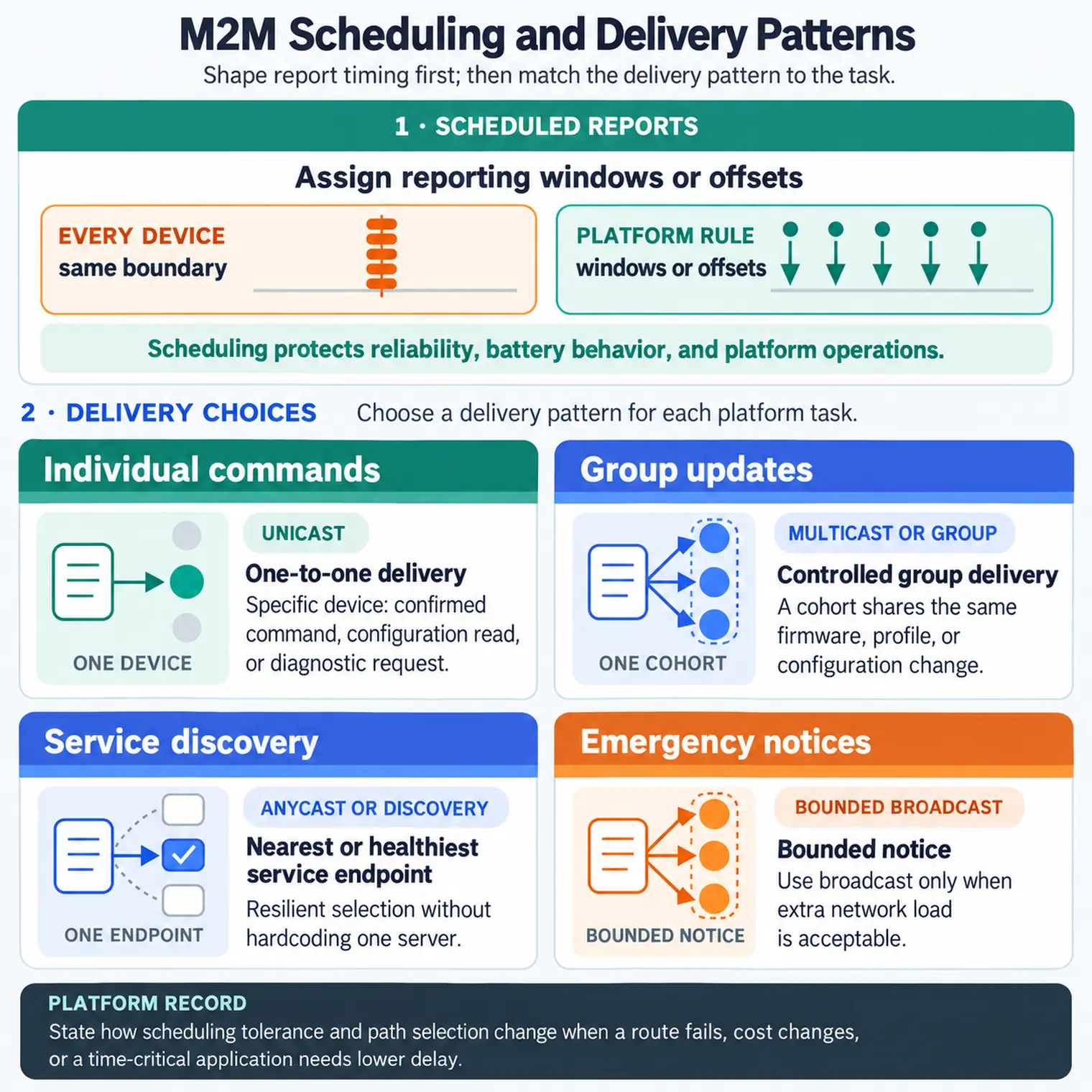
Classic delivery modes map to different platform promises: use unicast for a device-specific command, multicast or controlled group delivery for a cohort, anycast or service discovery for the nearest healthy service endpoint, and broadcast only for bounded notices where the extra network load is acceptable. The record should also state how scheduling tolerance and path selection change when a route fails, cost changes, or a time-critical application needs lower delay.
41.7.1 Individual Command
Use one-to-one delivery when a specific device needs a confirmed command, configuration read, or diagnostic request.
41.7.2 Group Update
Use controlled group delivery when a cohort shares the same firmware, profile, or configuration change.
41.7.3 Service Discovery
Use nearest or healthiest service selection when gateways need a resilient endpoint without hardcoding one server.
41.8 Building Operations Platform
This section: Building Operations Platform — A campus has working local controllers for ventilation and lighting.
A campus has working local controllers for ventilation and lighting. It also wants one operations view across buildings. The platform should not take over the physical loops; it should collect governed operational data and expose controlled actions.
41.8.1 Keep Local
Ventilation safety, lighting fallback, local alarms, and manual override stay inside the building control domain.
41.8.2 Platformize
Device registry, gateway health, energy trend records, alert routing, maintenance tickets, and access policy move into the service platform.
The platform design is acceptable only if it states which commands may cross the boundary, how stale data is marked, and how operators distinguish a local-control alarm from a platform analytics alert.
41.9 Checkpoint: Platform Boundary Checklist
This section: Checkpoint: Platform Boundary Checklist
Use this checklist before accepting a platform architecture:
- Every device and gateway has a stable identity, owner, lifecycle state, and decommission path.
- Device identity and user identity are separate.
- Gateway translation rules are documented with units, timestamps, quality flags, and rejected-message behavior.
- Reporting is scheduled or otherwise shaped to avoid synchronized traffic spikes.
- Command authority is explicit, including what is forbidden from remote services.
- Application access is through governed APIs or events, not direct database access.
- Diagnostics show last contact, data freshness, queue state, firmware or configuration version, and recent errors.
- Logs are useful for operations and security analysis without exposing unnecessary personal or sensitive data.
- ETSI-style service requirements are checked explicitly: scalability, identity hiding or pseudonymization when regulation requires it, audit logging for failed installation or service faults, scheduling tolerance, and policy-based path selection.

41.10 Practice Checks
This section: Practice Checks
This section:
This section:
41.11 Common Mistakes
This section: Common Mistakes
41.11.1 Mixing Identity Domains
Device identity, user identity, application identity, and gateway identity should be related by policy, not collapsed into one identifier.
41.11.2 Skipping Scheduling
Unscheduled reporting can create bursts that look like outages even when devices and links are healthy.
41.11.3 Direct Storage Access
Applications should use governed APIs or events. Direct storage access bypasses policy, audit, validation, and freshness semantics.
41.11.4 Treating Gateways as Invisible
Gateway health, translation version, queue depth, and last contact are part of the platform state.
41.13 Overview: Make The Platform A Boundary
This section: Overview: Make The Platform A Boundary — If you only need the operating rule, this layer is enough: an M2M service platform is valuable when it makes identity, policy, gateway translation, delivery, diagnostics, and application access explicit boundaries.
If you only need the operating rule, this layer is enough: an M2M service platform is valuable when it makes identity, policy, gateway translation, delivery, diagnostics, and application access explicit boundaries.
Figure 41.4 shows registry, policy, service enablement, applications, and operations form the M2M platform boundary stack.
Mobile summary: A durable M2M platform separates device identity, policy, service behavior, app access, and operational evidence instead of hiding them inside one dashboard.
Identity boundary
Devices, gateways, users, and applications need separate identities linked by policy, lifecycle state, owner, and credential rotation records.
Policy boundary
Read, command, configure, administer, group-update, and emergency-notice permissions should be scoped, audited, and retested when risk changes.
Service boundary
Message contracts, schedules, queues, freshness state, gateway health, and application APIs turn machine events into governed platform behavior.
41.14 Campus Platform Record
This section: Campus Platform Record — For the building-operations platform, the acceptance record should prove that the platform helps operators coordinate many systems without hiding gateway failure, policy drift, or synchronized traffic bursts.
For the building-operations platform, the acceptance record should prove that the platform helps operators coordinate many systems without hiding gateway failure, policy drift, or synchronized traffic bursts.
Registry proof
Record device and gateway ID, profile, building, owner, lifecycle state, credential age, decommission path, and last-contact expectation.
Gateway proof
Record source protocol, normalized fields, units, event time, receipt time, quality state, queue depth, translation version, and rejected-message reasons.
Scheduling proof
Assign reporting windows or deterministic offsets, define exception priority, and show how the platform detects missed reports without creating synchronized bursts.
Application proof
Expose governed APIs or events with rate limits, freshness state, command scope, expiry, audit records, and local rejection behavior for unsafe actions.
41.15 Why Platform Features Fail
This section: Why Platform Features Fail — A platform can have the right feature list and still fail if features are not connected to operational proof.
A platform can have the right feature list and still fail if features are not connected to operational proof. The failure usually appears as ambiguity, synchronized load, invisible gateway state, or command behavior that no team owns.
Treat why Platform Features Fail as one connected review. Begin with identity collapse: shared credentials make it hard to prove which device, gateway, user, or app performed an action. With that boundary fixed, examine burst scheduling: identical reporting times can overload the platform and make healthy fleets look offline. Then connect it to invisible gateway state: applications trust records without seeing translation version, queue depth, quality state, or last contact. Close the review by checking command ambiguity: group commands lack scope, expiry, audit, and local rejection rules, so one request can affect the wrong equipment. The order matters: each later judgment depends on the owner, state, constraint, or failure evidence retained by the preceding step, so the resulting record can support the next chapter decision.
41.16 Figure Review: Make Every Handoff Owned
This section: Figure Review: Make Every Handoff Owned — Inspect the service-platform diagram Figure 41.3 and ask which owner is accountable for evidence at each cross-domain handoff.
Inspect the service-platform diagram Figure 41.3 and ask which owner is accountable for evidence at each cross-domain handoff.

Read Figure 41.3 from device registration into user authorization and telemetry merging. Application discovery consumes that governed record rather than discovering anonymous device data. Charging then binds usage to the correct tenant, while administration closes the loop with policy and operational control. The numbered crossings show that the platform core transports and coordinates messages, but it does not erase lane ownership: device operations retain identity evidence, user services retain authorization, applications retain data-use context, and access services retain accounting and administration. This supports the chapter’s boundary rule because every handoff names both the operation and the evidence another team must be able to audit.
41.17 Summary
This section: Summary — M2M service platforms make connected-machine deployments repeatable by separating identity, policy, gateway translation, messaging, diagnostics, scheduling, and application access.
M2M service platforms make connected-machine deployments repeatable by separating identity, policy, gateway translation, messaging, diagnostics, scheduling, and application access. The strongest designs are explicit about boundaries: local control remains local, gateways translate and expose records, the platform shapes traffic and governs commands, and applications consume data through controlled contracts.
41.20 Key Takeaway
This section: Key Takeaway — A useful M2M platform handles onboarding, identity, messaging, data storage, command paths, rules, fleet management, security, and observability.
A useful M2M platform handles onboarding, identity, messaging, data storage, command paths, rules, fleet management, security, and observability. Platform fit is operational, not just feature-based.
Find help
3 reviewed answers.
Where should I start in a module?
Open the module page from the sidebar to see its chapters in order. Use the module map to return to a topic you need.
Modules and pathsReviewed
What can I try when a project does not work?
Check the symptom, then work through the diagnostic steps. Keep the error message and the smallest example that reproduces it.
When you are stuckReviewed
How do interactive examples work?
Use the interactive guide to check how examples and simulations work before changing your project.
Interactive examples guideReviewed