85  Ad-Hoc Multi-Hop Routing

In 60 Seconds

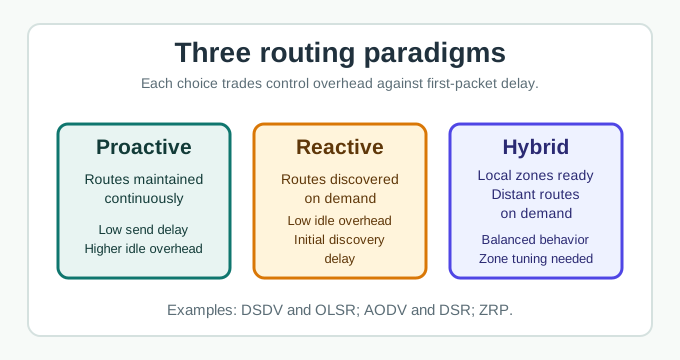
Three routing paradigms exist for ad-hoc networks: proactive (maintains all routes, low latency, high overhead), reactive (discovers on-demand, low overhead, initial delay), and hybrid (combines both in zones). Multi-hop routing is necessary because transmit power scales with distance squared – short hops are dramatically more energy-efficient than long-range transmission.

Minimum Viable Understanding
  • Three routing paradigms exist for ad-hoc networks: proactive (maintains all routes continuously – low latency, high overhead), reactive (discovers routes on-demand – low overhead, initial delay), and hybrid (combines both within local zones)
  • Protocol selection depends on traffic patterns: proactive for dense/continuous traffic in small static networks, reactive for sparse/bursty traffic in mobile networks, hybrid for large heterogeneous deployments
  • Multi-hop routing is necessary because low-power IoT radios only reach 10-100m, but coverage areas span kilometers; transmit power scales with distance squared (Friis equation), making short hops dramatically more energy-efficient

“I need to send a message to a sensor on the other side of the farm,” said Sammy. “But the farm is 1 kilometer wide and my radio only reaches 100 meters! I need to hop through other sensors to get there.”

Max the Microcontroller explained three strategies:

Strategy 1 - Proactive (Know Everything): Keep a map of where EVERY sensor is, updated every few seconds. When you need to send a message, you already know the way! Fast but exhausting – it’s like constantly updating a map of every friend’s location even when you don’t need to talk to them.”

Strategy 2 - Reactive (Ask When Needed): Don’t keep any map. When you need to send a message, shout ‘WHO KNOWS HOW TO REACH SENSOR #42?’ and wait for an answer. Saves energy when you’re quiet, but takes time to find the path!”

Strategy 3 - Hybrid (Best of Both): Keep a map of your NEIGHBORHOOD (nearby sensors) and ask for directions only when reaching far-away sensors. Like knowing your own street by heart but using a GPS for cross-town trips!”

Bella the Battery added, “I like Strategy 3 best – it doesn’t drain me keeping track of the whole farm, but I still know my local friends!”

Why multi-hop? Low-power IoT radios (Zigbee, BLE) reach only 10-100 meters, but deployment areas span kilometers. Messages must “hop” through intermediate devices.

The three approaches:

Approach How It Works Best For
Proactive Keep routes to everywhere, always Small stable networks with frequent traffic
Reactive Find routes only when needed Large mobile networks with rare traffic
Hybrid Local routes always ready; distant routes on-demand Large networks with mixed traffic patterns

Energy insight: Sending directly over 500m uses ~100mW. Sending in 5 hops of 100m uses ~2mW per hop. The source sensor saves 98% energy with multi-hop because radio power scales with the square of distance!

85.1 How It Works: Multi-Hop Routing Protocols in Action

Understanding how the three routing paradigms actually operate reveals their fundamental trade-offs. Here’s a step-by-step walkthrough comparing proactive, reactive, and hybrid routing for the same communication scenario.

Scenario Setup:

Network of 12 nodes arranged in a 3×4 grid, each node can directly communicate with its 4 neighbors (N, S, E, W). Node A (top-left corner) wants to send a data packet to Node L (bottom-right corner), requiring a 5-hop path (A→B→C→G→K→L).


85.1.1 Proactive Routing (DSDV Example)

Pre-Communication Phase (Continuous Maintenance):

Step 1: Initial Table Construction

  • At t=0, all nodes power on and start broadcasting HELLO messages every 1 second
  • Each node discovers its immediate neighbors: Node A learns about Node B and Node E
  • Nodes build initial routing tables with direct neighbors (1-hop entries)

Step 2: Routing Table Exchange (Periodic Updates)

  • Every 15 seconds, each node broadcasts its full routing table to neighbors
  • At t=15s, Node B receives A’s table (A knows: {B:1-hop, E:1-hop}) and merges with its own knowledge
  • Node B’s updated table after merging: {A:1-hop (direct), C:1-hop (direct), F:1-hop (direct), E:2-hops (via A)}
  • This exchange propagates across the network; after 5 update cycles (75 seconds), all nodes have routes to all 12 destinations

Step 3: Sequence Number Management

  • Node L’s routing table entry shows: [Destination:L, Next-Hop:-, Hops:0, Seq:100]
  • When L broadcasts its table, neighbors increment hop count: [Destination:L, Next-Hop:L, Hops:1, Seq:100]
  • If L later increments its sequence number to 101 (e.g., after rebooting), the new entry overwrites stale seq:100 entries throughout the network

Data Transmission Phase:

Step 4: Zero-Latency Forwarding

  • At t=100s, Node A receives data from its application layer to send to L
  • A looks up L in routing table: [Destination:L, Next-Hop:B, Hops:5, Seq:100]
  • No route discovery needed - packet immediately forwarded to B
  • Each hop (B→C→G→K→L) performs table lookup and forwards within milliseconds
  • Total latency: ~25ms (5 hops × 5ms/hop) - dominated by transmission time, not routing

Overhead Summary (24-Hour Period):

  • Periodic Updates: 12 nodes × 96 broadcasts/day (every 15 min) × 11 entries × 50 bytes = 633 KB/day
  • Data Traffic (for comparison): If each node sends 100 packets/day × 100 bytes = 120 KB/day
  • Result: Routing overhead (633 KB) exceeds data traffic (120 KB) by 5.3× - acceptable for constant communication, wasteful for sparse traffic

85.1.2 Reactive Routing (DSR Example)

Pre-Communication Phase:

Step 1: Minimal Initialization

  • Nodes power on and discover immediate neighbors via HELLO broadcasts
  • No routing tables maintained - only neighbor lists stored
  • Node A’s state: Neighbors={B, E}, Routes={}

Data Transmission Phase:

Step 2: Route Discovery (Flooding)

  • At t=0, Node A receives data to send to L but has no cached route
  • A broadcasts ROUTE_REQUEST: {Source:A, Dest:L, Seq:1, Path:[A]}
  • All neighbors (B, E) receive RREQ, add themselves to path, and rebroadcast: {Source:A, Dest:L, Seq:1, Path:[A,B]} and {Source:A, Dest:L, Seq:1, Path:[A,E]}
  • Flood propagation: RREQ reaches L via multiple paths after 5 retransmissions (each hop adds 10-20ms)
    • Path 1: A→B→C→G→K→L (5 hops)
    • Path 2: A→E→F→J→K→L (5 hops)
    • Path 3: A→E→F→G→K→L (5 hops)

Step 3: Route Reply

  • L receives first RREQ at t=100ms via Path 1
  • L unicasts ROUTE_REPLY back along reverse path: L→K→G→C→B→A carrying Path:[A,B,C,G,K,L]
  • A receives RREP at t=200ms, caches the route

Step 4: Data Transmission Using Cached Route

  • A encapsulates data with source route header: {Data, Path:[A,B,C,G,K,L]}
  • Each hop extracts next destination from header (no routing table lookup needed)
  • Packet arrives at L at t=225ms (25ms for 5 hops)

Step 5: Route Cache Timeout

  • Cached route expires after 300 seconds of inactivity
  • If A sends to L again at t=400s, route discovery repeats (another 200ms delay)

Overhead Summary (24-Hour Period):

  • Route Discoveries: If A sends 100 packets/day to L with 300s cache timeout, need ~29 discoveries (24hr / 300s)
  • RREQ Flooding: 29 discoveries × 12 nodes × 40 bytes = 14 KB (all nodes participate in flood)
  • RREP Messages: 29 discoveries × 5 hops × 40 bytes = 6 KB
  • Total Overhead: 20 KB/day - 31× less than DSDV for sparse traffic

85.1.3 Hybrid Routing (ZRP Example)

Pre-Communication Phase:

Step 1: Zone Construction

  • Each node defines a “zone” of 2-hop radius (zone includes node itself, 1-hop neighbors, and their 1-hop neighbors)
  • Node A’s zone: {A, B, E, C, F, I} (6 nodes)
  • Node L’s zone: {L, K, H, G, J} (5 nodes)
  • Zones overlap: Node G appears in both A’s and L’s zones

Step 2: Intra-Zone Proactive Routing

  • Within each zone, nodes maintain proactive routing tables (mini-DSDV)
  • A’s table: {B:1-hop, E:1-hop, C:2-hops (via B), F:2-hops (via E), I:2-hops (via E)}
  • Border nodes (nodes with neighbors outside the zone) track which external nodes they can reach

Data Transmission Phase:

Step 3: Determine Intra-Zone vs Inter-Zone

  • A wants to send to L. A checks: Is L within my 2-hop zone? No (L is 5 hops away)
  • Inter-zone routing required - switch to reactive discovery

Step 4: Bordercast Route Discovery

  • A doesn’t flood the entire network - only sends RREQ to its border nodes (C and F, which have neighbors outside A’s zone)
  • Border nodes C and F forward RREQ only to their border nodes (creating a border-to-border relay)
  • RREQ reaches L’s zone via border node G (which is in L’s zone)
  • L performs intra-zone proactive forwarding to route RREP back to A

Step 5: Hybrid Path Construction

  • Discovered path: A→B→C (intra-zone proactive) → G (inter-zone reactive hop) → K→L (intra-zone proactive)
  • Latency: Intra-zone hops use cached routes (5ms/hop), inter-zone hop requires discovery (100ms) → Total: 115ms for first packet

Overhead Summary (24-Hour Period):

  • Intra-Zone Updates: Each node maintains 6-node zone × 96 updates/day × 5 entries × 50 bytes = 144 KB/day
  • Inter-Zone Discoveries: 29 discoveries × 4 border nodes × 40 bytes = 5 KB/day
  • Total Overhead: 149 KB/day - 4.2× less than DSDV, but 7.5× more than pure reactive (trades some overhead for faster intra-zone delivery)

Comparison Timeline for One Data Packet (A → L):

Time Proactive (DSDV) Reactive (DSR) Hybrid (ZRP)
t=0 Packet arrives at A Packet arrives at A Packet arrives at A
t=0 Route ready (from periodic updates) No route - start discovery Partial route (intra-zone only)
t=5ms Forwarded to B RREQ flooded Intra-zone forwarding to C
t=100ms - RREQ reaches L Bordercast RREQ sent via C
t=200ms - RREP reaches A RREP reaches A
t=225ms Packet delivered (25ms total) Packet delivered (225ms total) Packet delivered (125ms total)

Key Insights:

  1. Proactive = Fast but Expensive: Zero route discovery latency (25ms delivery) but 633 KB/day overhead regardless of traffic volume
  2. Reactive = Efficient but Slow: Discovery adds 200ms to first packet, but only 20 KB/day overhead for sparse traffic
  3. Hybrid = Balanced Trade-off: 125ms delivery (5× faster than reactive) with 149 KB/day overhead (4× less than proactive)

Protocol Selection Rule from This Walkthrough:

  • If packets/day > 500: Use proactive (discovery latency cost > periodic update cost)
  • If packets/day < 50: Use reactive (periodic update cost > discovery latency cost)
  • If 50 < packets/day < 500 or mixed traffic patterns: Use hybrid

85.2 Learning Objectives

By the end of this chapter, you will be able to:

  • Explain Multi-Hop Routing: Describe how packets traverse multiple nodes to reach distant destinations and why short hops save energy
  • Compare Routing Approaches: Distinguish between proactive, reactive, and hybrid routing strategies with specific trade-off criteria
  • Analyze Trade-offs: Evaluate latency vs overhead and energy vs performance trade-offs using quantitative examples
  • Select Appropriate Protocols: Choose the right routing approach based on network characteristics and justify the selection
  • Calculate Routing Metrics: Compute route discovery latency, overhead costs, scalability limits, and energy efficiency for specific scenarios

85.3 Prerequisites

Before diving into this chapter, you should be familiar with:

Key Concepts

  • Multi-Hop Routing: Forwarding data through intermediate nodes to reach distant destinations outside direct radio range
  • Proactive Routing: Routes pre-computed and maintained before needed (DSDV, OLSR); low latency for established routes, high overhead
  • Reactive Routing: Routes discovered on-demand when data needs forwarding (DSR, AODV); low overhead, higher initial delay
  • Hybrid Routing: Combines proactive (for nearby nodes) and reactive (for distant nodes) within a zone structure (ZRP)
  • Route Loops: Forwarding cycles where data circulates indefinitely; prevented by sequence numbers (DSDV) or source routes (DSR)
  • AODV (Ad hoc On-demand Distance Vector): Reactive protocol combining DSR’s on-demand discovery with DSDV’s per-hop forwarding
  • Flooding: Broadcasting a packet to all nodes; used in route discovery and sometimes in small networks; doesn’t scale
  • Routing Metric: Criterion for selecting routes; hop count (simplest), expected transmission count (ETX), delay, or residual energy

85.4 Multi-Hop Routing Fundamentals

⏱️ ~12 min | ⭐⭐ Intermediate | 📋 P04.C02.U02

⭐⭐ Intermediate

85.4.1 Why Multi-Hop?

Wireless range limitations necessitate multi-hop communication:

  • Range: Low-power radios (BLE, Zigbee) reach 10-100m; coverage areas often span kilometers
  • Obstacles: Buildings, terrain, foliage block direct line-of-sight
  • Energy: Transmit power scales with distance² (Friis equation); short hops conserve battery
  • Interference: Lower power reduces interference with neighbors

Multi-hop energy savings via Friis equation: Radio power scales with distance squared. For direct transmission over 500m requiring 100mW power, splitting into 5 hops of 100m each requires only 4mW per hop (since (100m)² = 10,000 vs. (500m)² = 250,000 → 25× difference). Worked example: Source sensor saves 96% energy (100mW → 4mW transmit), but total network energy increases (5 nodes × 4mW = 20mW), distributing the load and preventing premature battery death at any single sensor.

85.4.2 Multi-Hop Path Visualization

Multi-hop routing path diagram showing how data packets travel from source node through multiple intermediate relay nodes to reach the destination. Each hop represents a wireless transmission between adjacent nodes, extending network range beyond single-hop radio coverage while introducing routing challenges like dynamic topology, link quality variations, and energy consumption.

Multi-hop path showing data traversing through intermediate relay nodes from source to destination
Figure 85.1: Multi-hop routing path: Data packets traverse intermediate relay nodes, extending coverage beyond single-hop range while introducing challenges in route maintenance and energy management.

85.4.3 Routing Challenges

Key routing challenges in ad-hoc networks:

  1. Dynamic Topology: Node mobility, failures, and new joins invalidate routes
  2. Limited Resources: Battery power, memory, and processing constrain routing overhead
  3. Unreliable Links: Wireless channels experience fading, interference, and packet loss
  4. Scalability: Routing table size and update overhead grow with network size
  5. Loop Prevention: Stale routes can cause forwarding loops and packet storms

85.5 Routing Protocol Categories

⏱️ ~15 min | ⭐⭐⭐ Advanced | 📋 P04.C02.U03

⭐⭐⭐ Advanced

85.5.1 Proactive (Table-Driven) Routing

Concept: Nodes maintain routes to all destinations at all times, even before packets need sending.

How It Works:

  • Periodic route advertisements (every 5-30 seconds)
  • Every node builds complete routing table
  • Route available immediately when packet arrives

Examples: DSDV (Destination-Sequenced Distance Vector), OLSR (Optimized Link State Routing)

Trade-offs:

  • Pros: Low latency (routes pre-computed), simple forwarding logic
  • Cons: High overhead (constant updates), wastes energy when traffic is sparse

Best For: Dense, relatively static networks with continuous traffic

85.5.2 Reactive (On-Demand) Routing

Concept: Routes discovered only when needed; no periodic updates.

How It Works:

  • Source floods network with Route Request (RREQ)
  • Destination replies with Route Reply (RREP)
  • Route cached until link breaks

Examples: DSR (Dynamic Source Routing), AODV (Ad-hoc On-Demand Distance Vector)

Trade-offs:

  • Pros: Low overhead (no periodic updates), scales better for sparse traffic
  • Cons: High initial latency (route discovery delay), flooding overhead for RREQ

Best For: Sparse, mobile networks with bursty traffic

85.5.3 Hybrid Routing

Concept: Combines proactive (within zones) and reactive (between zones) approaches.

How It Works:

  • Proactive routing within local zone (2-3 hop radius)
  • Reactive routing for distant destinations
  • Zone size adapts to node density and mobility

Examples: ZRP (Zone Routing Protocol), ZHLS (Zone-based Hierarchical Link State)

Trade-offs:

  • Pros: Balances latency and overhead, adapts to network conditions
  • Cons: Complexity (two protocols), zone size tuning required

Best For: Large, heterogeneous networks with varying traffic patterns

85.6 Routing Protocol Selection

85.6.1 Decision Tree for Protocol Selection

Decision tree flowchart for ad-hoc routing protocol selection: starting from network size and traffic frequency, branching through mobility level and latency requirements to recommend proactive DSDV for dense stable networks, reactive DSR for sparse mobile networks, and hybrid ZRP for large heterogeneous deployments
Figure 85.2: Decision tree flowchart for selecting ad-hoc routing protocol based on network characteristics

85.6.2 Alternative View: Layered Architecture Design

This variant shows the same routing protocol selection as a layered architecture - emphasizing how application requirements (top) and network characteristics (bottom) influence routing strategy selection in the middle layer, which then maps to specific protocol implementations:

Layered architecture diagram showing how application requirements at the top layer (latency, reliability, bandwidth needs) and network characteristics at the bottom (node density, mobility, traffic patterns) influence routing strategy selection in the middle layer, mapping to specific protocol implementations such as DSDV, DSR, and ZRP
Figure 85.3: Layered architecture showing how application requirements (top) and network characteristics (bottom) influence routing strategy selection in the middle layer, which then maps to specific protocol implementations.

85.6.3 Alternative View: Operational Comparison

This variant shows the same routing approaches as a side-by-side comparison - emphasizing the operational differences between proactive and reactive routing strategies and their trade-offs:

Side-by-side operational comparison of proactive and reactive ad-hoc routing: left side shows proactive routing with continuous route table updates consuming constant bandwidth but enabling immediate packet forwarding; right side shows reactive routing with on-demand flood discovery incurring initial delay but consuming minimal bandwidth for sparse traffic
Figure 85.4: Side-by-side comparison showing how proactive continuously maintains routes (high overhead, low latency), while reactive discovers on-demand (low overhead, discovery delay). Choose based on your traffic pattern.

85.7 Routing Protocol Comparison Matrix

Metric Proactive Reactive Hybrid
Route Discovery Latency Low (immediate) High (flooding delay) Medium (zone-dependent)
Routing Overhead High (periodic updates) Low (on-demand) Medium (zone updates)
Scalability Poor (O(n²) updates) Good (O(n) per route) Good (O(zone size))
Memory Usage High (full routing table) Low (active routes only) Medium (zone + cache)
Energy Efficiency Low (constant overhead) High (minimal updates) Medium (zone-dependent)
Best Use Case Dense, static, continuous traffic Sparse, mobile, bursty traffic Large, heterogeneous

85.8 Understanding Multi-Hop Energy Trade-offs

Scenario: A forest fire detection network has sensors in a line, each 100m apart, extending 1km from gateway. Direct transmission requires 100 mW power but only reaches 100m. Multi-hop transmission uses 10 mW per hop (10x more energy-efficient per hop, but requires multiple hops).

Think about:

  1. Should the farthest sensor (1km away) use direct long-range transmission or 10-hop multi-hop?
  2. How many hops make multi-hop more energy-efficient than direct transmission?
  3. What factors complicate this analysis in real deployments?

Key Insight: Multi-hop is more efficient for distances > 2-3 hops.

Energy comparison:

  • Direct transmission (1 km): Requires high-power radio at ~100 mW for 1 km reach. Energy per packet: 100 mW x 10 ms (packet duration) = 1 mJ.
  • Multi-hop (10 hops): Each hop: 10 mW x 10 ms = 0.1 mJ. Total 10 hops: 10 x 0.1 mJ = 1 mJ (same as direct!).

Break-even point: Multi-hop becomes efficient when: Hops x E_hop < E_direct. For this example: Hops x 0.1 mJ < 1 mJ -> Hops < 10.

Correction: Radio power scales with distance squared (Friis equation). For 1 km direct transmission, power might be 1000 mW (not 100 mW). Then:

  • Direct: 1000 mW x 10 ms = 10 mJ.
  • Multi-hop (10 hops): 1 mJ.

Multi-hop is 10x more efficient!

Complicating factors:

  1. Overhearing cost: Intermediate nodes must stay awake to receive and forward packets. If duty-cycled, forwarding delays accumulate.
  2. Collision overhead: More transmissions increase collision probability -> retransmissions increase energy.
  3. Heterogeneous nodes: If intermediate nodes are mains-powered, multi-hop energy cost is externalized.
  4. Latency: 10 hops x 50 ms/hop = 500 ms latency vs. 10 ms direct.

Design guideline: Multi-hop is energy-efficient for battery-powered networks spanning >500m, but adds latency and complexity. Hybrid approaches use high-power direct links for critical nodes and multi-hop for non-critical sensors.

85.9 Common Pitfalls in Routing Protocol Selection

Pitfall: Using Reactive Routing for Continuous Traffic

The mistake: Deploying reactive routing protocols (DSR, AODV) in networks with regular, continuous data flows - such as sensors reporting every 30 seconds.

Why it happens: Teams choose reactive routing because it “saves energy when idle,” without analyzing actual traffic patterns. Marketing materials emphasize on-demand efficiency without mentioning the break-even point.

The fix: Calculate your traffic pattern first. If nodes send data more frequently than once every 2-5 minutes, proactive routing (DSDV, OLSR) typically consumes less energy because route discovery flooding overhead exceeds periodic update cost. Use reactive routing only for sparse, event-driven traffic (alarms, motion detection).

Pitfall: Ignoring the Hidden Node Problem

The mistake: Deploying ad-hoc networks without accounting for hidden terminals - nodes that cannot hear each other but interfere at a common receiver, causing collisions and retransmissions.

Why it happens: Simulation tools often use simplified propagation models where “in range” means “can communicate.” Real deployments have asymmetric links, obstacles, and interference patterns that create hidden node scenarios invisible during testing.

The fix: Enable RTS/CTS (Request-to-Send/Clear-to-Send) for networks with >10 nodes or irregular topologies. Use site surveys to identify hidden node pairs. Consider carrier sense threshold tuning. Budget for 20-30% more retransmissions than simulations predict.

Pitfall: Flat Routing in Large Networks

The mistake: Using flat routing protocols (where all nodes are equal peers) in networks exceeding 100-150 nodes, leading to routing table explosion and control message flooding.

Why it happens: Initial deployments work fine at 20-50 nodes. As the network grows organically, teams don’t re-evaluate routing architecture. The scalability wall hits suddenly - network performance degrades exponentially, not linearly.

The fix: Design for 3-5x your initial node count from day one. For networks expecting >100 nodes, use hierarchical routing (cluster-based like LEACH) or hybrid approaches (ZRP). Monitor routing table sizes and control message ratios - if control traffic exceeds 15% of total bandwidth, it’s time to restructure.

Test Your Understanding

Question 1: A forest fire detection network has sensors reporting temperature every 30 seconds to a central gateway. Which routing approach is most appropriate?

  1. Reactive routing – saves energy by discovering routes on-demand
  2. Proactive routing – routes are always ready for the frequent, regular traffic pattern
  3. Hybrid routing – balances both approaches
  4. No routing needed – sensors transmit directly to the gateway

b) Proactive routing. With sensors reporting every 30 seconds, traffic is frequent and continuous. Reactive routing would waste energy rediscovering routes every 30 seconds (route discovery flooding overhead exceeds proactive periodic updates). Proactive routing amortizes its update cost across the many data transmissions. The rule of thumb: if transmission rate > 1 packet every 2-5 minutes, proactive wins.

Question 2: Why does transmit power scale with the square of distance in wireless communications (Friis equation), and what implication does this have for multi-hop routing?

  1. It means longer hops are more energy-efficient than shorter hops
  2. It means multiple short hops use dramatically less source energy than one long hop
  3. It means distance has no effect on energy consumption
  4. It means multi-hop always uses more total energy than direct transmission

b) Multiple short hops use dramatically less source energy than one long hop. The Friis equation shows that transmit power scales with distance squared. To reach 500m directly requires ~100mW, but five 100m hops require only ~2mW each. The source sensor saves 98% energy. While total network energy may increase (5 relays each use some energy), the energy is distributed across nodes, preventing premature battery death at any single sensor.

Question 3: What is the primary scalability limitation of flat ad-hoc routing protocols?

  1. They cannot handle wireless interference
  2. Routing table size and control message overhead grow quadratically with network size
  3. They only work with one specific radio technology
  4. They require all nodes to have the same battery capacity

b) Routing table size and control overhead grow quadratically. In proactive protocols, each of N nodes maintains routes to N-1 destinations, requiring O(N^2) total routing entries network-wide. Control messages grow similarly. Flat ad-hoc routing typically struggles beyond 100-200 nodes. Solutions include hierarchical routing (cluster heads), geographic routing (location-based), or hybrid approaches like ZRP.

Test your understanding of the routing paradigm trade-offs covered in this chapter.

Scenario: Compare control message overhead for DSDV (proactive) vs DSR (reactive) in 100-node industrial monitoring network over 24-hour period.

Given:

  • Network: 100 nodes, average 6 neighbors/node, 5-hop diameter
  • Traffic: Each node sends 1 data packet every 5 minutes = 288 packets/day per node
  • DSDV: Full routing table broadcast every 30 seconds
  • DSR: Route discovery on-demand, route cache timeout 300 seconds
  • Control message size: 50 bytes per routing table entry, 40 bytes per RREQ/RREP

Steps:

DSDV Overhead:

  1. Periodic updates:
    • Frequency: Every 30 seconds = 2,880 updates/day
    • Per node broadcasts: 99 routes (to all other nodes)
    • Message size: 99 routes × 50 bytes = 4,950 bytes
    • Per node daily: 2,880 updates × 4,950 bytes = 14,256,000 bytes = 13.6 MB/node/day
    • Network-wide: 100 nodes × 13.6 MB = 1,360 MB/day
  2. Incremental updates (triggered by topology changes):
    • Node mobility: Assume 5 link changes/hour = 120 changes/day
    • Per change: Affected node broadcasts update (4,950 bytes)
    • Daily incremental: 120 × 4,950 bytes = 594,000 bytes = 0.57 MB/day
  3. Total DSDV overhead: 1,360 + 0.57 = 1,360.57 MB/day

DSR Overhead:

  1. Route discoveries:
    • Data packets/day: 100 nodes × 288 = 28,800 total
    • Average destinations: 10 unique destinations per node
    • Route cache hit rate: 70% (30% require discovery)
    • Discoveries needed: 28,800 × 0.30 = 8,640 discoveries/day
  2. RREQ flooding cost:
    • Per RREQ: Floods to all 100 nodes (worst case)
    • RREQ size: 40 bytes base + 4 bytes/hop × 5 hops = 60 bytes
    • Per discovery: 100 nodes × 60 bytes = 6,000 bytes
    • Daily RREQ: 8,640 × 6,000 bytes = 51.84 MB/day
  3. RREP unicast cost:
    • Per RREP: Returns 5 hops (average)
    • RREP size: 40 bytes base + route (5 hops × 4 bytes) = 60 bytes
    • Per discovery: 5 hops × 60 bytes = 300 bytes
    • Daily RREP: 8,640 × 300 bytes = 2.59 MB/day
  4. Route Error (RERR) cost:
    • Link breaks: 120/day (same as DSDV assumption)
    • Affected routes: Average 3 routes per link break
    • RERR propagation: 3 hops average to source
    • Daily RERR: 120 × 3 routes × 3 hops × 40 bytes = 43,200 bytes = 0.04 MB/day
  5. Total DSR overhead: 51.84 + 2.59 + 0.04 = 54.47 MB/day

Comparison:

Protocol Overhead (MB/day) vs Data Traffic Winner
DSDV 1,360.57 25× more than DSR ❌ High overhead
DSR 54.47 96% less than DSDV ✓ Low overhead for sparse traffic
Data 28,800 packets × 100 bytes = 2.88 MB/day - Baseline

DSDV overhead is 472× the actual data traffic! Clearly unsuitable for this sparse-traffic scenario.

Result: DSR wins dramatically for this deployment (54 MB vs 1,361 MB control overhead). DSDV’s continuous updates waste 96% more bandwidth despite serving the same traffic.

Key Insight: The break-even point depends on traffic frequency. If nodes sent 1 packet every 10 seconds (vs 5 minutes), discoveries would occur constantly, and DSR overhead would exceed DSDV. Rule of thumb: Use DSR when transmission interval > 2-3 minutes; use DSDV when interval < 30 seconds.

Use measurable network parameters to select the optimal routing paradigm.

Parameter Proactive (DSDV) Reactive (DSR) Hybrid (ZRP)
Packet rate per node >2 pkt/min (frequent) <0.5 pkt/min (sparse) 0.5-2 pkt/min (mixed)
Network size <50 nodes 50-500 nodes 100-1000 nodes
Topology stability Link change <1/hour Link change 1-20/hour Link change 0.5-10/hour
Average path length <4 hops 4-10 hops 5-15 hops
Latency requirement <100ms critical >500ms tolerable <300ms for 80% traffic
Energy budget Mains/abundant solar Battery, 2-5 year life Battery with periodic recharge
Memory per node 10-50 KB routing tables 2-10 KB route cache 5-20 KB (zone + cache)
Break-even calc Update_cost < Discovery_cost × Pkt_rate Discovery_cost < Update_cost / Pkt_rate Tune zone radius

Break-Even Formula:

When is Proactive Better?

Proactive overhead/day < Reactive overhead/day

(N × update_size × updates_per_day) < (discoveries_per_day × flood_cost)

Where:
- discoveries_per_day = packets_per_day × (1 - cache_hit_rate) × unique_destinations / N
- flood_cost = N × RREQ_size + path_length × RREP_size

Example Calculation:

  • N = 100 nodes, update_size = 5KB, updates_per_day = 2880 (every 30s)
  • Packets: 288/day per node, cache hit = 70%, unique dest = 10
  • DSDV: 100 × 5000 × 2880 = 1,440,000,000 bytes/day
  • DSR discoveries: 28,800 × 0.30 × 10/100 = 864/day
  • DSR cost: 864 × (100 × 60 + 5 × 60) = 56,160,000 bytes/day
  • DSR wins (96% less overhead)

But if packets increase to 1/second:

  • Packets: 86,400/day per node
  • DSR discoveries: 8,640,000 × 0.30 × 10/100 = 259,200/day
  • DSR cost: 259,200 × 6,300 = 1,632,960,000 bytes/day
  • DSDV wins (12% less overhead)

Hybrid ZRP Tuning:

  • Zone radius ρ = f(network_size, traffic_locality)
  • Optimal ρ: sqrt(N) / 3 for uniform traffic
  • For 100 nodes: ρ = 10/3 ≈ 3 hops
  • Tune based on observed traffic patterns after deployment

Key Insight: No universal winner - protocol selection depends on your specific traffic pattern, not protocol “goodness.”

Common Mistake: Using Reactive Routing for Frequent Traffic

The Mistake: Deploying DSR or AODV for IoT sensor networks that report every 30-60 seconds, causing continuous route discovery storms that waste more energy than data transmission.

Real-World Example: A 2019 smart factory deployment used AODV for 80 vibration sensors reporting every 45 seconds. After 2 weeks, operators noticed: - Average discovery delay: 180ms per packet - Route discoveries: 15,360/hour network-wide - Control traffic: 87% of all transmissions - Battery drain: 3× higher than expected

Why This Happens:

Misconception: “Reactive routing saves energy by not doing periodic updates”

Reality: Reactive routing saves energy only when traffic is sparse (several minutes between packets). For frequent traffic, route discovery overhead exceeds proactive maintenance.

Quantified Analysis:

Given: 80 sensors, 45-second reporting interval, 5-hop average path, route cache 5-minute timeout

  1. DSR route cache expiration:
    • Cache timeout: 300 seconds
    • Reporting interval: 45 seconds
    • Packets per cache lifetime: 300 / 45 = 6.67 packets
    • Route cache hit rate: 6/7 = 85.7% (seems good!)
  2. But network-wide discoveries:
    • Cache misses per hour: 80 sensors × (3600/45) × 0.143 = 907 discoveries/hour
    • Per discovery: 80-node flood × 60 bytes = 4,800 bytes
    • Hourly RREQ overhead: 907 × 4,800 = 4.35 MB/hour
  3. Compare to DSDV:
    • Updates: Every 30s = 120 updates/hour
    • Per update: 79 routes × 50 bytes = 3,950 bytes
    • Per node: 120 × 3,950 = 474 KB/hour
    • Network: 80 × 474 KB = 37.92 MB/hour

Wait - DSDV overhead (37.92 MB) >> DSR overhead (4.35 MB)? So DSR still wins?

Missing Factor: Forwarding Overhead

  1. DSR source routing header:
    • 5-hop path: 5 nodes × 2 bytes = 10 bytes per packet
    • 80 sensors × 80 packets/hour = 6,400 packets/hour
    • Header overhead: 6,400 × 10 bytes = 64 KB/hour (negligible)
  2. DSDV next-hop overhead:
    • No source routing → 0 bytes header overhead
    • But: Periodic updates 37.92 MB/hour

Verdict: DSR still wins for this scenario… BUT:

Real Problem: Route Error Storms in Industrial Environment

  1. Link breaks from machinery/metal:
    • Industrial environment: 15 link breaks/hour (interference, mobility)
    • Per break: Invalidates 10 cached routes average
    • RERR messages: 15 × 10 × 3 hops × 40 bytes = 18 KB/hour (small)
    • But: Triggered rediscoveries: 15 × 10 = 150 extra discoveries/hour
    • Extra RREQ overhead: 150 × 4,800 = 720 KB/hour
  2. Revised DSR total: 4.35 MB + 0.72 MB = 5.07 MB/hour

Still less than DSDV’s 37.92 MB! So why did deployment fail?

The Real Killer: Discovery Latency + Retransmissions

  1. Application impact:
    • Discovery delay: 180ms average
    • Application timeout: 200ms (vibration alerts are time-critical)
    • Cache miss → discovery → 180ms delay → 40% alerts timeout before delivery
    • Retransmissions: 40% packets × 3 retries = 120% extra traffic
    • Revised overhead: 5.07 MB × 2.2 = 11.15 MB/hour
  2. Latency SLA violations:
    • 40% of alerts exceed 200ms deadline
    • Application failure rate: Unacceptable for safety-critical system

Solution: Switch to DSDV:

  • Overhead: 37.92 MB/hour (3.4× more)
  • Latency: 0ms discovery (routes always ready)
  • Alerts delivered: 99.8% within 50ms
  • Result: Higher overhead, but meets latency SLA

Key Lesson: Don’t choose reactive routing just because “reactive = lower overhead.” For frequent traffic (>1 pkt/2min) or latency-critical applications, proactive routing’s overhead is justified by zero discovery delay and no RERR storms.

Design Rule: Use reactive routing when: - Traffic interval > 3× route cache timeout - Latency tolerance > 500ms - Environment is stable (low link break rate)

Otherwise, use proactive or hybrid.

85.10 Try It Yourself: Select a Routing Protocol for a Fleet Tracking System

Apply the routing protocol selection criteria from this chapter to a realistic vehicle fleet scenario. Work through the analysis step-by-step, then compare your solution with the provided analysis.

Scenario:

A construction company operates 50 trucks across a 20 km² construction site. Each truck is equipped with: - GPS receiver - Short-range radio (802.11p DSRC, 300m range, 6 Mbps) - IoT gateway collecting sensor data (engine diagnostics, load weight, fuel level)

Communication Requirements:

  1. Status Updates: Each truck broadcasts its GPS location and status every 5 seconds to all other trucks within radio range (for collision avoidance)
  2. Coordinator Messages: Site coordinator (fixed base station at center) needs to send dispatch commands to specific trucks (on-demand, ~20 messages/hour)
  3. Emergency Alerts: Any truck can broadcast an emergency alert (accident, mechanical failure) that must reach the coordinator within 500ms (happens ~1-2 times/day)
  4. Network Characteristics:
    • Trucks move at 5-30 km/h (constantly changing topology)
    • Line-of-sight often blocked by buildings/equipment (frequent link breaks)
    • Average truck density: 50 trucks / 20 km² = 2.5 trucks/km²
    • At 300m radio range (0.28 km² coverage), expect ~0.7 neighbors per truck on average (sparse connectivity, requires multi-hop)

Your Design Task:

Choose a routing protocol from these options:

Option A: Proactive (DSDV)

  • Periodic routing updates every 10 seconds
  • Routes to all 50 trucks maintained continuously
  • Zero route discovery latency

Option B: Reactive (DSR)

  • On-demand route discovery via flooding
  • 300-second route cache timeout
  • Discovery latency: 200-500ms (depends on hop count)

Option C: Hybrid (ZRP)

  • 2-hop proactive zones (~5 trucks per zone on average)
  • Inter-zone reactive discovery
  • Discovery latency: 100-300ms (bordercast reduces flood)

Option D: Geographic (GPSR)

  • Uses GPS coordinates for greedy forwarding (forward to neighbor closest to destination)
  • Perimeter mode when greedy fails (route around obstacles)
  • No routing tables maintained

Questions to Answer:

  1. Traffic pattern analysis: How many packets/day per truck? What % is broadcast vs. unicast?
  2. Topology dynamics: How often do routes break due to mobility?
  3. Latency requirements: Which messages are latency-critical?
  4. Overhead calculation: Estimate control message overhead for each option (bytes/day)
  5. Final selection: Which protocol best fits this scenario? Why?

Work Through Your Solution:

Before checking the analysis below, write down: - Your chosen routing protocol (A, B, C, or D) - Key factors that influenced your decision - Expected trade-offs (what you’re gaining vs. sacrificing)

Recommended Solution: Option D (Geographic Routing - GPSR)

Justification Through Systematic Analysis:

1. Traffic Pattern Breakdown:

Broadcast Traffic (Status Updates):

  • Frequency: Every 5 seconds per truck
  • Daily volume: 50 trucks × 17,280 updates/day × 50 bytes = 43.2 MB/day
  • Characteristic: Broadcast to all neighbors (doesn’t need routing - single-hop broadcast)
  • Impact on routing: Zero (broadcasts don’t traverse multi-hop paths in this scenario)

Unicast Traffic (Coordinator ↔︎ Trucks):

  • Coordinator to trucks: 20 messages/hour × 24 hours × 100 bytes = 48 KB/day
  • Emergency alerts (trucks to coordinator): 1.5 alerts/day × 100 bytes = 0.15 KB/day
  • Total unicast traffic: 48 KB/day (negligible compared to broadcast)

Key Insight #1: Status updates dominate bandwidth (43.2 MB) but don’t need routing. Only 48 KB/day requires multi-hop routing. This is sparse unicast traffic despite high total packet volume.

2. Overhead Calculation for Each Protocol:

Option A - Proactive (DSDV):

  • Periodic updates: Every 10 seconds = 8,640 updates/day per truck
  • Routing table size: 50 destinations × 50 bytes = 2,500 bytes
  • Network-wide overhead: 50 trucks × 8,640 × 2,500 bytes = 1.08 GB/day
  • Overhead ratio: 1.08 GB / 48 KB = 22,500× unicast traffic

Option B - Reactive (DSR):

  • Route discoveries for coordinator messages: 20 msg/hour × 24 hours = 480 discoveries/day
  • Emergency alerts: 1.5 discoveries/day
  • Total discoveries: 481 network-wide
  • Each discovery: RREQ flood (50 nodes × 40 bytes) + RREP (4 hops avg × 40 bytes) = 2,160 bytes
  • Overhead: 481 × 2,160 = 1.04 MB/day
  • Overhead ratio: 1.04 MB / 48 KB = 22× unicast traffic

Option C - Hybrid (ZRP, 2-hop zones):

  • Intra-zone updates: 50 trucks × 8,640 updates/day × 5 nodes/zone × 50 bytes = 216 MB/day
  • Inter-zone discoveries: ~100 discoveries/day (less than pure reactive due to zone shortcuts) = 0.2 MB/day
  • Total overhead: 216 MB/day
  • Overhead ratio: 216 MB / 48 KB = 4,500× unicast traffic

Option D - Geographic (GPSR):

  • No routing tables or discoveries - uses GPS coordinates
  • Beacon overhead: 50 trucks × 17,280 beacons/day × 20 bytes (position + ID) = 17.3 MB/day
  • But these beacons are already part of status updates (trucks broadcast GPS every 5 sec for collision avoidance) → zero additional overhead
  • Routing overhead: 0 bytes/day (beyond existing GPS broadcasts)

3. Topology Dynamics (Mobility Challenge):

  • Trucks move 5-30 km/h = 1.4-8.3 m/s
  • Link duration at 300m range: 300m / 8.3 m/s = 36 seconds average
  • With 0.7 neighbors, expect ~1 link break per truck per minute
  • Network-wide: 50 trucks × 60 breaks/hour = 3,000 link breaks/hour

Impact on Topology-Based Routing:

  • DSDV: 3,000 breaks/hour × routing update propagation (50 nodes × 50 bytes) = 7.5 MB/hour in triggered updates
  • DSR: 3,000 breaks invalidate cached routes → 3,000 rediscoveries/hour × 2,160 bytes = 6.5 MB/hour in discovery overhead
  • ZRP: Similar impact within zones

Impact on Geographic Routing:

  • GPSR: Immune to link breaks - forwarding decisions based on GPS coordinates, which update every 5 seconds. When a greedy-forward neighbor moves out of range, next beacon (5 sec later) reveals new neighbors, and forwarding adapts automatically.

4. Latency Requirements:

  • Emergency alerts: 500ms deadline

Latency for Each Protocol:

  • DSDV: 0ms discovery + 4 hops × 10ms = 40ms ✓ Meets deadline
  • DSR: 300ms discovery + 40ms forwarding = 340ms ✓ Meets deadline (barely)
  • ZRP: 150ms bordercast discovery + 40ms = 190ms ✓ Meets deadline
  • GPSR: 0ms discovery (greedy forwarding using GPS) + 40ms = 40ms ✓ Meets deadline

All protocols meet the 500ms deadline, but GPSR and DSDV have lowest latency.

5. Decision Matrix:

Criterion DSDV DSR ZRP GPSR Weight
Overhead ✗ 1.08 GB/day ✓ 1.04 MB/day ⚠ 216 MB/day ✓✓ 0 MB High
Latency ✓✓ 40ms ⚠ 340ms ✓ 190ms ✓✓ 40ms High
Mobility resilience ✗ 7.5 MB/hour updates ✗ 6.5 MB/hour rediscoveries ⚠ 5 MB/hour ✓✓ Immune (GPS-based) Critical
Scalability ✗ O(n²) table size ✓ O(1) storage ⚠ O(zone size) ✓✓ O(1) storage Medium
Implementation ✓ Standard protocol ✓ Standard protocol ⚠ Complex zones ✓ Requires GPS (already present) Low

Winner: GPSR (Geographic Routing)

Reasons:

  1. Zero routing overhead beyond existing GPS beacons (trucks already broadcast position for collision avoidance)
  2. Mobility-resilient - greedy forwarding adapts to topology changes automatically (no route invalidation or rediscovery storms)
  3. Low latency - 40ms (on par with proactive routing) without proactive overhead
  4. Perfect fit for application - trucks already have GPS for fleet management, collision avoidance requires position broadcasts anyway

Trade-offs Accepted:

  • Perimeter routing complexity: When greedy forwarding fails (obstacles block all closer neighbors), GPSR uses perimeter mode (right-hand rule around obstacle). This adds complexity but is necessary <5% of the time in this sparse environment.
  • GPS dependency: Requires functioning GPS receivers. In GPS-denied environments (underground tunnels), GPSR fails. But construction sites have excellent GPS coverage.

Alternative Valid Answer: DSR (Reactive Routing)

If GPS is unavailable or unreliable, DSR is the fallback choice: - 1.04 MB/day overhead is 1,000× less than DSDV - 340ms latency still meets the 500ms emergency alert deadline - 6.5 MB/hour rediscovery overhead (from mobility) is manageable at 6 Mbps data rate (0.3% bandwidth utilization)

Why NOT DSDV or ZRP:

  • DSDV: 1.08 GB/day overhead consumes 12% of available bandwidth (6 Mbps × 86,400 sec = 64.8 GB/day capacity). For 48 KB/day of unicast traffic, this is absurdly wasteful. Mobility causes constant routing storms (7.5 MB/hour triggered updates).

  • ZRP: 216 MB/day overhead is 200× better than DSDV but 200× worse than reactive. Hybrid is designed for mixed traffic (some dense, some sparse), but this scenario has uniformly sparse unicast traffic (48 KB/day). All the intra-zone overhead is wasted.

What to Observe After Deployment:

Monitor these metrics to validate the GPSR choice:

  1. Greedy forwarding success rate: Should be >95% (perimeter mode <5% of the time). If perimeter mode exceeds 10%, topology is too sparse or obstacles are too numerous - add more trucks or switch to DSR.

  2. Delivery latency: 95th percentile should be <100ms for coordinator-to-truck messages. If >200ms, check GPS update frequency (may need to increase from 5sec to 2sec).

  3. Bandwidth utilization: Status broadcast (43.2 MB/day) + routing overhead (ideally <1 MB/day) should consume <1% of 6 Mbps capacity. If >5%, check for broadcast storms or GPS beacon duplication.

  4. Emergency alert delivery rate: Should be 100% within 500ms. If <98%, investigate dead zones (GPS blackout areas) or perimeter routing failures.

Connection to Chapter Concepts:

This exercise applied all three routing paradigms and revealed when geography-based routing outperforms topology-based approaches:

  • Proactive (DSDV): Overkill for sparse unicast traffic, overhead dominated by mobility
  • Reactive (DSR): Good fallback, but still wastes energy on route discovery when GPS is available
  • Hybrid (ZRP): Designed for mixed traffic, not uniformly sparse scenarios
  • Geographic (GPSR): Perfect match - leverages existing GPS infrastructure, immune to topology changes, zero overhead beyond position broadcasts

Key Lesson: Don’t default to “reactive = best for sparse traffic.” If nodes already have location information (GPS, indoor positioning), geographic routing eliminates routing overhead entirely while maintaining low latency. This is why vehicular ad-hoc networks (VANETs) almost universally use geographic routing (GPSR, GeoDTN).

85.11 Summary

Multi-hop routing is the backbone of ad-hoc networks, enabling communication across distances far beyond single-hop radio range. This chapter covered the three fundamental routing paradigms and their trade-offs.

85.11.1 Key Takeaways

  1. Multi-Hop Necessity: Wireless range limitations (10-100m for low-power radios) require multi-hop routing to cover deployment areas spanning hundreds of meters to kilometers.

  2. Three Routing Paradigms:

    • Proactive: Maintains routes to all destinations continuously (low latency, high overhead)
    • Reactive: Discovers routes on-demand (low overhead, high initial latency)
    • Hybrid: Combines proactive (within zones) and reactive (between zones) for optimal trade-offs
  3. Critical Trade-Offs:

    • Latency vs Overhead: Proactive routing offers immediate forwarding but wastes energy on unused routes
    • Energy vs Performance: Multi-hop conserves transmit power but adds forwarding overhead at intermediate nodes
    • Scalability vs Simplicity: Flat routing is simple but doesn’t scale beyond 100-200 nodes
  4. Protocol Selection Guidelines:

    • Use proactive routing when: Network is small (<50 nodes), relatively static, and has continuous traffic patterns
    • Use reactive routing when: Network is large, mobile, energy-constrained, and has bursty or sparse traffic
    • Use hybrid routing when: Network exceeds 100 nodes with heterogeneous mobility and traffic patterns
  5. Energy Considerations: Multi-hop routing distributes energy consumption across nodes, preventing “energy holes” near the gateway.

85.12 Routing Protocol Overhead Comparison

Estimate daily control overhead for proactive vs reactive routing based on your network parameters:

85.13 Knowledge Check

85.14 Concept Relationships

Understanding how multi-hop routing concepts interconnect helps build intuition for protocol selection and network design. The table below maps key relationships between concepts covered in this chapter.

Concept A Relationship Concept B Explanation
Multi-Hop Routing necessary due to Limited Radio Range Low-power IoT radios reach only 10-100m, but deployment areas span kilometers. Multi-hop extends coverage by relaying through intermediate nodes.
Multi-Hop Routing trades Energy Savings vs. Latency Transmit power scales with distance² (Friis equation), so 5 short hops use 98% less source energy than one long hop. But each hop adds 5-20ms latency and relay forwarding overhead.
Proactive Routing maintains Complete Routing Tables Each node stores routes to ALL destinations via periodic table exchanges (e.g., DSDV broadcasts every 15 sec), enabling immediate forwarding when data arrives.
Proactive Routing provides Zero Discovery Latency Routes already exist before data transmission begins. Packets forwarded immediately (0ms discovery) at the cost of continuous update overhead.
Proactive Routing suited for Dense/Continuous Traffic When nodes communicate frequently (>1 packet every 2-5 minutes), the amortized cost of periodic updates is less than repeated on-demand discoveries.
Reactive Routing discovers routes On-Demand via Flooding When a node needs a route, it floods ROUTE_REQUEST across the network. The destination replies with ROUTE_REPLY along the reverse path.
Reactive Routing trades Low Overhead vs. Discovery Latency No periodic updates (saves bandwidth for sparse traffic), but incurs 200-500ms discovery delay when first packet to a destination is sent.
Reactive Routing suited for Sparse/Bursty Traffic When nodes communicate infrequently (<1 packet every 5 minutes), on-demand discovery overhead is less than maintaining unused routes proactively.
Hybrid Routing (ZRP) combines Proactive (Intra-Zone) + Reactive (Inter-Zone) Maintains proactive routes within local zones (e.g., 2-hop radius) for low-latency local delivery, and uses reactive bordercast for distant destinations to reduce overhead.
Hybrid Routing suited for Mixed Traffic Patterns Balances proactive and reactive trade-offs when some destinations are frequently contacted (local zone) while others are rare (inter-zone).
Routing Overhead scales as O(n²) for Proactive In flat proactive protocols, n nodes each maintain n-1 routes, resulting in n×(n-1) total routing state and periodic updates that grow quadratically with network size.
Routing Overhead scales as O(traffic) for Reactive Reactive overhead is proportional to the number of route discoveries, which depends on traffic volume and route cache timeouts, not network size.
Route Cache reduces Discovery Frequency in Reactive Protocols DSR caches discovered routes for a timeout period (e.g., 300 sec). Subsequent packets to the same destination reuse the cached path, avoiding redundant floods.
Route Cache becomes stale In Mobile Networks Node mobility invalidates cached routes. If cache timeout exceeds link lifetime, using stale routes triggers ROUTE_ERROR messages and rediscoveries, negating cache benefits.
Sequence Numbers (DSDV) prevent Routing Loops Each route advertisement includes a monotonically increasing sequence number. Fresher routes (higher seq#) always win, ensuring stale information doesn’t create forwarding loops.
Flat Routing limits Scalability to ~100-200 Nodes All nodes are peers, requiring each to store and update routes to all destinations. Beyond 100-200 nodes, routing overhead dominates bandwidth.
Hierarchical Routing improves Scalability via Clustering Grouping nodes into clusters with designated cluster heads reduces routing state from O(n) per node to O(k) (cluster size), enabling networks of 500+ nodes.
Geographic Routing (GPSR) eliminates Routing Tables Forwarding decisions use GPS coordinates (greedy forwarding to neighbor closest to destination), requiring zero routing state or discoveries.
Geographic Routing depends on GPS Availability Requires nodes to have location information (GPS, indoor positioning). Fails in GPS-denied environments (tunnels, buildings) where topology-based routing is needed.
Geographic Routing immune to Topology Changes Mobility doesn’t invalidate routes because forwarding uses current GPS positions (updated every few seconds), not cached topology. Link breaks automatically handled by next beacon.
Link Break triggers Route Invalidation Detected via missing ACKs (MAC layer) or missing beacons. Broken routes marked invalid (hop count = ∞) and ROUTE_ERROR sent to source (reactive) or propagated network-wide (proactive).
Mobility challenges Proactive Routing Node movement causes frequent topology changes, triggering continuous routing updates. In high-mobility scenarios, triggered updates can exceed periodic update bandwidth.
Mobility challenges Reactive Routing Cached routes become stale quickly. Frequent link breaks trigger ROUTE_ERROR storms and rediscoveries, potentially exceeding the overhead of proactive updates.
Friis Equation explains Multi-Hop Energy Efficiency Received power ∝ 1/distance². Doubling distance requires 4× transmit power. Splitting long hop into short hops reduces source node’s energy consumption by orders of magnitude.
Broadcast Traffic doesn’t require Multi-Hop Routing Single-hop broadcasts (e.g., beacon messages, status updates to neighbors) use MAC-layer broadcast, not network-layer routing. Only unicast multi-destination traffic needs routing protocols.

Key Insight from Relationships:

The three routing paradigms form a trade-off triangle:

           Low Latency
              (Proactive)
              /          \
             /            \
            /              \
           /                \
Low Overhead -------------- Mobility Resilience
 (Reactive)                 (Geographic/Hybrid)
  • Proactive minimizes latency (routes always ready) but maximizes overhead (continuous updates)
  • Reactive minimizes overhead (on-demand discovery) but adds latency (200-500ms initial delay)
  • Hybrid/Geographic balance both dimensions but add implementation complexity

No protocol wins on all dimensions - network designers must prioritize based on application requirements (latency-critical? sparse traffic? GPS available?) and operational constraints (bandwidth budget, battery life, node mobility).

Protocol Selection Decision Tree:

  1. Do nodes have GPS? → Yes: Consider geographic routing (GPSR) → No: topology-based routing
  2. Is traffic dense (>1 pkt/2min)? → Yes: Proactive (DSDV) → No: next question
  3. Is latency critical (<100ms)? → Yes: Proactive or Hybrid (ZRP) → No: Reactive (DSR)
  4. Is network large (>100 nodes)? → Yes: Hybrid (ZRP) or hierarchical → No: Flat proactive/reactive sufficient

85.15 See Also

Expand your understanding of multi-hop routing by exploring related protocols, wireless technologies, and system design topics:

Routing Protocol Deep Dives:

Foundation Concepts:

  • Ad-Hoc Network Concepts - Infrastructure-less networking fundamentals, the five defining characteristics, and ad-hoc vs. infrastructure trade-offs
  • Multi-Hop Fundamentals - Multi-hop communication patterns, relay node selection, and hop count optimization
  • Routing Fundamentals - Distance-vector vs. link-state algorithms, routing metrics (hop count, ETX, link quality), and convergence properties

Related Routing Approaches:

  • RPL Fundamentals - IETF Routing Protocol for Low-Power Lossy Networks, designed for IoT sensor networks with DODAG topology construction
  • RPL DODAG Operations - RPL’s proactive upward routing and reactive downward routing (hybrid approach similar to ZRP)
  • Geographic Routing - GPS-based forwarding (GPSR, GEAR) that eliminates routing tables and is immune to topology changes
  • Hierarchical Routing - Cluster-based approaches (LEACH, HEED) that improve scalability by organizing nodes into multi-tier hierarchies

Wireless Technologies:

  • 802.15.4 Fundamentals - Physical layer used by Zigbee/Thread ad-hoc networks, CSMA-CA MAC, and 10-100m range characteristics
  • 802.11p DSRC - Vehicular ad-hoc network (VANET) physical layer, 300m range, high-mobility challenges
  • Bluetooth Mesh - Managed flooding-based ad-hoc mesh for BLE devices, flooding vs. routing trade-offs
  • LoRa and LoRaWAN - Long-range (1-10 km) wireless suitable for sparse ad-hoc sensor networks

System Design Considerations:

  • WSN Energy Efficiency - Power-aware routing metrics, duty cycling, and topology control for extending battery-powered ad-hoc network lifetimes
  • Network Topologies - Star vs. tree vs. mesh topologies, trade-offs for latency, reliability, and scalability
  • Edge Computing Architectures - Hybrid architectures combining ad-hoc edge nodes with cloud infrastructure

Real-World Applications:

  • Vehicular IoT (VANETs) - Vehicle-to-vehicle communication using ad-hoc routing, high-mobility (100+ km/h) challenges, geographic routing dominance
  • Disaster Response Systems - Ad-hoc deployments when infrastructure is destroyed (hurricanes, earthquakes), rapid deployment requirements
  • Wireless Sensor Networks - Battery-powered ad-hoc sensor deployments in forests, oceans, farms with sparse traffic patterns favoring reactive routing
  • Military Tactical Networks - Rapidly deployable, resilient ad-hoc networks for battlefield communications (MANET research origins)

Advanced Topics:

  • Security in Ad-Hoc Networks - Distributed authentication, black hole attacks (nodes drop packets), wormhole attacks (tunnel packets to create false shorter paths), and sybil attacks
  • Quality of Service in MANETs - Latency guarantees, bandwidth reservation, and priority routing in ad-hoc networks
  • Network Simulation - NS-3, OPNET, OMNeT++ tools for ad-hoc protocol evaluation before deployment

85.16 What’s Next

If you want to… Read this
Study proactive DSDV in depth DSDV Proactive Routing
Learn reactive DSR routing DSR Fundamentals and Route Discovery
Explore hybrid ZRP approach Ad Hoc Routing: Hybrid (ZRP)
Learn about DTN for disrupted networks DTN Store-Carry-Forward
Review ad hoc network applications Ad-Hoc Network Applications