28 UAV Capabilities and Constraints
More
Depth: Practitioner
Progress saves as you read. Mark sections complete as you go; your progress appears in the sidebar.
28.1 Start Simple
This section: Start Simple — Picture a survey aircraft leaving local radio range while a ground screen still shows its last position.
Follow One Flight Record Across a Moving Link
Picture a survey aircraft leaving local radio range while a ground screen still shows its last position. The system must preserve age and quality instead of turning an old point into a current flight claim.
An access point is the local radio station that devices join. A gateway is the device or service that joins two system paths. A payload is the useful content carried inside a message.
Record aircraft identity, source time, position unit, link path, and quality. Move beyond one radio cell, delay a record, repeat it, switch the joining point, and restart the ground receiver. Show stale, rejected, or missing state clearly.
This runway does not prove airworthiness, coverage, or command safety. The deeper sections compare moving links, hand-offs, path limits, routing choices, and the evidence required for a stated network feature.
Start with a mission that moves, loses energy, and changes its radio path while it works. In UAV Capabilities and Constraints, the practical question is what the aircraft must sense, relay, decide, and prove before the flight or network role is safe enough to trust.
28.2 Learning Objectives
This section: Learning Objectives
By the end of this chapter, you will be able to:
- Describe the main capabilities that make UAV networks useful in IoT systems.
- Explain the key challenge areas: mobility, energy, link quality, payload, environment, and operations.
- Distinguish advertised capability from mission-ready capability.
- Identify the records needed before trusting a UAV feature choice.
- Choose reasonable fallback behavior when a UAV link or role becomes unavailable.
28.3 Features as Readiness Claims
This section: Features as Readiness Claims — Figure 28.3 shows mobility, energy, link, payload, environment, and operations records constrain UAV capabilities.
If you only need the operating rule, this layer is enough: a UAV feature is mission-ready only while the role, route state, link freshness, energy reserve, payload status, gateway exit, and fallback action still support the service.
Figure 28.3 shows mobility, energy, link, payload, environment, and operations records constrain UAV capabilities.
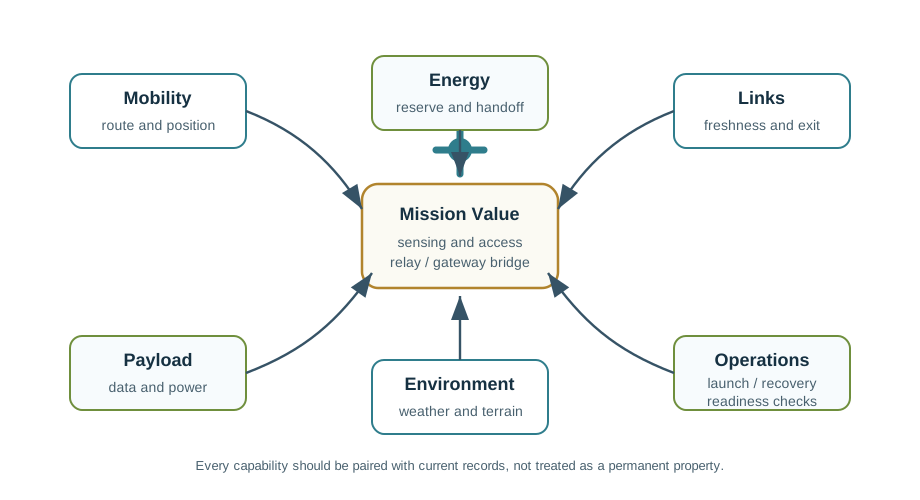
Mobile summary: Treat every UAV feature as a current readiness claim, not a permanent advantage; recheck the records before relying on the feature.
Feature
Name the capability being used: elevated view, mobile placement, temporary access, aerial relay, payload flexibility, or repositioning.
Record
Tie that feature to timestamped route, link, energy, payload, environment, and gateway evidence.
Fallback
State whether the system retries, buffers, reroutes, lands, replaces the UAV, or reduces service when the record goes stale.
28.4 Practitioner: Prove The Bridge Relay
This section: Practitioner: Prove The Bridge Relay — For the flood-damaged bridge example, the useful feature is mobile placement plus aerial relay.
For the flood-damaged bridge example, the useful feature is mobile placement plus aerial relay. The record should prove when that feature is current and when the team must change behavior.
28.5 Under the Hood: Why Capability Decays
This section: Under the Hood: Why Capability Decays — UAV capability decays faster than many fixed IoT capabilities because the node, link, payload, and operating limits keep moving.
UAV capability decays faster than many fixed IoT capabilities because the node, link, payload, and operating limits keep moving.
- Route decay: the useful relay position changes as the UAV moves around terrain or returns for reserve.
- Link decay: a good measurement can become irrelevant after a turn, altitude change, obstruction, or gateway movement.
- Payload decay: a richer sensor can create more data than the live link can move safely.
- Operations decay: battery handling, airspace limits, weather, and recovery windows can end a feature before the data task is complete.
This section:
This section:
This section:
- UAV features are trade-offs, not free advantages.
- Height improves visibility but can increase exposure, path length, and gateway planning needs.
- Mobility helps reach the mission area but makes links time-dependent.
- Payloads improve sensing or communication but consume power, weight, attention, and operating checks.
- Every UAV feature decision should include records about link freshness, route intent, energy reserve, gateway exit, and fallback behavior.
This section:
28.6 Prerequisites
This section: Prerequisites
Revisit these chapters if the terms are unfamiliar:
- UAV Networks Introduction: roles, FANET basics, mission fit, and first readiness checks.
- Networking Basics: links, routing, topology, and packet delivery.
- Multi-Hop Fundamentals: relays, path changes, and delayed delivery.
28.7 How This Chapter Fits
This section: How This Chapter Fits — The introduction chapter asked what role a UAV plays.
The introduction chapter asked what role a UAV plays. This chapter asks what that role costs. Later UAV chapters make detailed topology, routing, gateway, trajectory, and production decisions. The goal here is to build the feature-and-challenge checklist that keeps those later decisions honest.
The overview depth layer shows the feature pressure map that anchors mobility, energy, link, payload, environment, and operations records.
28.8 Core Capabilities
This section: Core Capabilities — UAV networks can add capabilities that are difficult or slow to achieve with fixed ground infrastructure.
UAV networks can add capabilities that are difficult or slow to achieve with fixed ground infrastructure. Each capability is useful only when the design also records its limits.
28.8.1 Elevated line of sight
Altitude can reduce local obstructions and make a ground area easier to observe or serve.
28.8.2 Mobile placement
The network node can move toward an incident, route, field area, or temporary user group.
28.8.3 Temporary access
A UAV can provide short-lived connectivity where a fixed access point is absent, damaged, or badly positioned.
28.8.4 Aerial relay
A UAV can bridge two nodes that cannot hold a direct ground-to-ground path.
28.8.5 Payload flexibility
The same airframe family can carry different sensors, radios, storage, compute modules, or inspection tools.
28.8.6 Rapid repositioning
The system can change the observation angle, handoff point, or relay location as the mission evolves.
These are feature families, not guarantees. A useful readiness check asks: what feature is being used, which traffic depends on it, how long it must remain available, and what records prove it is still available.
28.9 Challenge Areas
This section: Challenge Areas — Most UAV network failures come from treating a feature as permanent when it is actually temporary.
Most UAV network failures come from treating a feature as permanent when it is actually temporary. The following challenge areas should appear in every serious readiness check.
28.9.1 Mobility
UAVs change position, heading, altitude, and attitude. Link records must have a timestamp and route context.
28.9.2 Energy
Propulsion dominates the energy budget. Communication savings matter, but flight reserve and return planning matter more.
28.9.3 Links
Air-to-air and air-to-ground paths depend on distance, orientation, obstruction, interference, and gateway reachability.
28.9.4 Payload
Sensors and radios add weight, power draw, data volume, and integration risk. The payload should match the mission question.
28.9.5 Environment
Wind, precipitation, terrain, temperature, and visibility can change both flight behavior and radio behavior.
28.9.6 Operations
Launch, recovery, battery handling, pilot oversight, airspace constraints, and data handoff all affect whether the feature is usable.
28.10 Feature Trade-Off Loop
This section: Feature Trade-Off Loop — UAV feature choices interact.
-

Name the mission and the smallest flying role that serves it.
-

Check the link, reserve energy, payload, route, and gateway exit together.
-

Change the route or mission when a check fails, and keep a fallback.
UAV feature choices interact. Raising altitude can improve visibility, but it may change wind exposure, slant range, gateway reachability, and reserve energy. Adding a better sensor can improve mission value, but it may shorten flight time or produce more data than the link can move during flight.
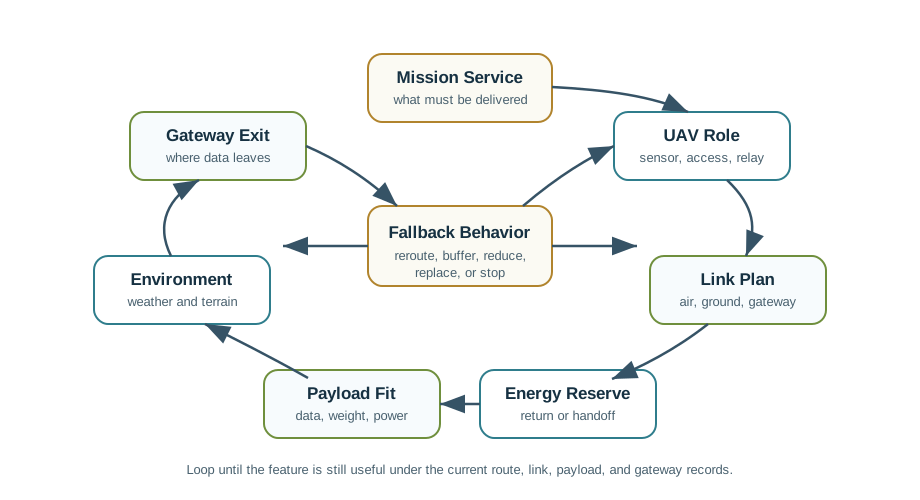
Use the loop as a readiness sequence:
- State the mission service: sensing, access, relay, or gateway bridge.
- Choose the minimum UAV role that can support that service.
- Sketch the current link plan and gateway exit.
- Check energy reserve and return or replacement behavior.
- Confirm payload fit and generated data volume.
- Check environment and route constraints.
- Define fallback behavior for stale links, unavailable gateways, and delayed data.
28.11 Feature Readiness Record
This section: Feature Readiness Record — The design should include a compact readiness record.
The design should include a compact readiness record. Inspect the diagram in Figure 28.2 before launch and at each material mission change, because it tests whether the chapter’s mobility, link, energy, payload, and gateway assumptions are still true together.
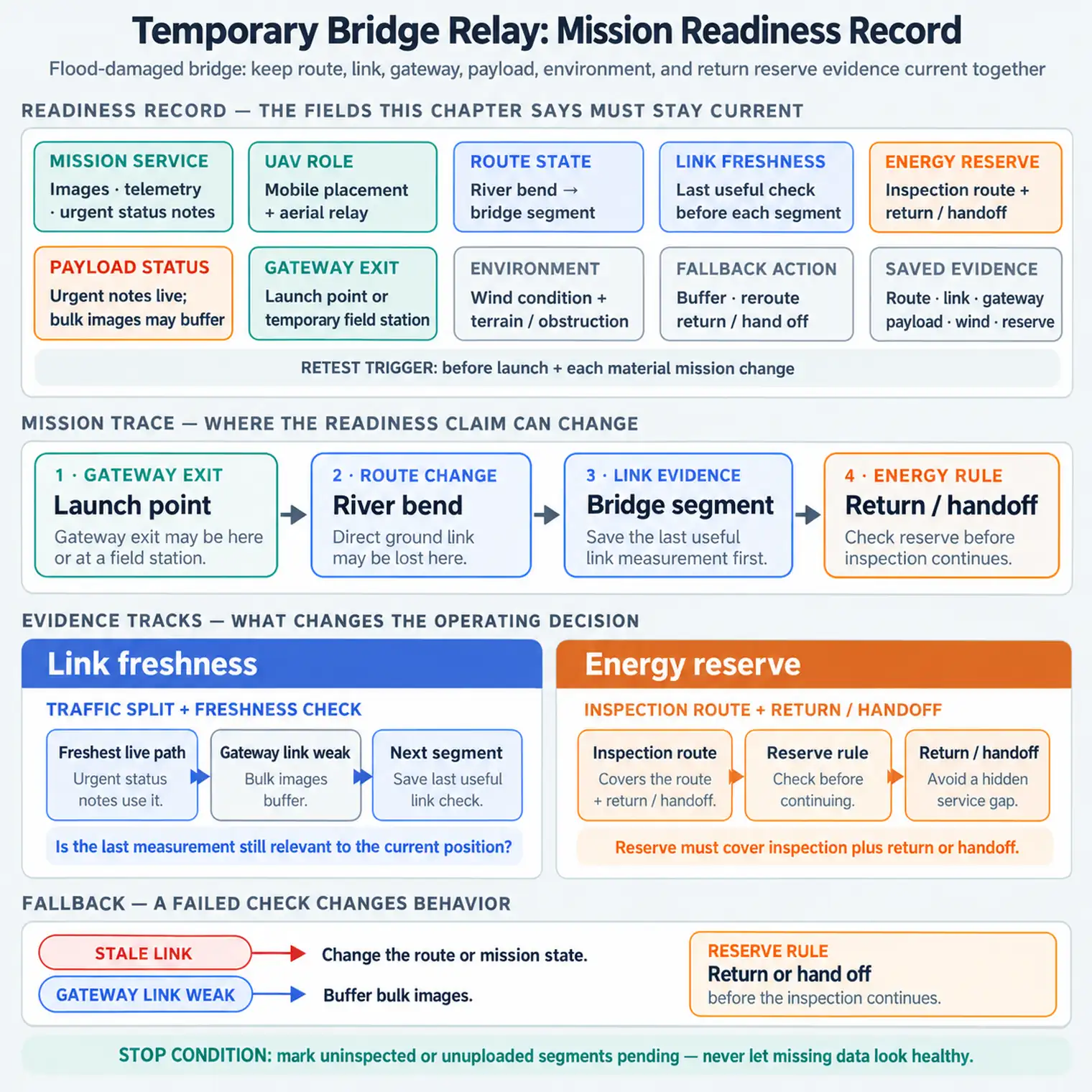
Read Figure 28.2 from mission service and UAV role into route state and link freshness. Continue through energy reserve, payload, gateway exit, and environment, then finish at fallback action, saved evidence, and retest trigger. That order turns a feature list into an operating decision: a stale link or inadequate reserve must change the route or mission state before it becomes a loss of control or data.
Role Which UAV role supports the traffic: sensor, access point, relay, gateway bridge, or coordinator?
Route state Where is the UAV now, where is it heading, and how long will it remain useful for this traffic?
Link freshness When was the link last measured, and is that measurement still relevant to the current position?
Energy reserve Can the UAV complete the role and still return, hand off, or be replaced without hiding a service gap?
Payload status Is the payload producing the right data at a volume the network can move or store?
Gateway exit Which path moves mission data out of the aerial network, and what fallback exists?
Environment Are weather, terrain, visibility, and obstruction assumptions still compatible with the plan?
Fallback action Does the system retry, buffer, reroute, land, replace the UAV, or reduce the service?
28.12 Temporary Inspection Relay
This section: Temporary Inspection Relay — Scenario: A maintenance team must inspect a remote bridge after a flood.
Scenario: A maintenance team must inspect a remote bridge after a flood. Ground access is slow. The team needs recent images, operator telemetry, and a way to send urgent status notes back to the command post.
Useful feature: Mobile placement. The UAV can move the sensing payload and relay path near the bridge before a ground team reaches it.
Main challenges:
- The UAV may lose direct ground link while following the river bend.
- The camera payload creates more data than the live link can always carry.
- Energy reserve must cover the inspection route and return or handoff plan.
- The gateway exit may be available only near the launch point or a temporary field station.
Feature decision:
- Send urgent status notes over the freshest live path.
- Buffer bulk images if the gateway link is weak.
- Record the last useful link measurement before each bridge segment.
- Keep a reserve rule for returning or handing off before the inspection continues.
- Mark any uninspected segment rather than letting missing data look like a healthy result.
The design does not need exact fleet-size math at this stage. It needs a clear statement of which feature is being used, what can fail, and how the records will show whether the feature remains available.
28.13 Feature Selection Guide
This section: Feature Selection Guide
| Mission pressure | Useful UAV feature | Readiness question |
|---|---|---|
| Need a better view over obstacles | Elevated line of sight | Does the higher path still have a reliable gateway exit? |
| Need data from an inaccessible area | Mobile placement | Can the UAV route support sensing and return or handoff? |
| Need temporary local connectivity | Temporary access | Which users or devices depend on the access point, and for how long? |
| Need to bridge a broken path | Aerial relay | What happens when the relay moves, lands, or loses its neighbor? |
| Need richer observations | Payload flexibility | Can the payload data be moved live, summarized, or safely buffered? |
| Need to follow a changing event | Rapid repositioning | How does the route update without making link records stale? |
28.14 Common Pitfalls
This section: Common Pitfalls
Specification sheets are useful starting points, but mission-ready capability depends on route, payload, weather, gateway placement, and reserve behavior. Check the mission records, not only the advertised range or endurance.
Ground IoT devices often spend most of their energy on communication. UAVs spend most mission energy staying airborne and moving. Radio choices still matter, but flight reserve and role handoff usually dominate reliability.
A link drawn on a plan is not proof that the link is useful now. Record when it was measured and whether the UAV has moved enough to make that measurement stale.
A better payload can create a worse network problem. Decide which observations need live delivery, which can be summarized, and which can be stored until a gateway is reachable.
If the design does not say what happens when a gateway is unavailable, the failure mode will appear during deployment. Fallback choices should be explicit: reroute, buffer, reduce service, replace the UAV, or stop the task.
28.15 Match Features to Readiness
This section: Match Features to Readiness
This section:
This section:
This section:
This section:
This section:
This section:
28.16 Summary
This section: Summary — UAV network features are powerful because they move sensing, access, relaying, and gateway support into the air.
UAV network features are powerful because they move sensing, access, relaying, and gateway support into the air. The same features create design pressure: mobility makes links stale, payloads change energy and data volume, environment changes the route, and gateway exits can disappear. A reliable UAV network check records the feature being used, the role it supports, the latest records for links and energy, the payload status, the gateway exit, and the fallback action.
28.17 Concept Relationships
This section: Concept Relationships
| Concept | Relationship |
|---|---|
| Elevated line of sight | Helps observation and connectivity, but still needs gateway and energy records |
| Mobile placement | Moves the network function near the mission, but makes route state important |
| Payload flexibility | Improves mission value while changing energy use and data volume |
| Link freshness | Connects a measured path to the UAV’s current position and route |
| Energy reserve | Protects return, handoff, replacement, and degraded-service behavior |
| Gateway exit | Turns local aerial connectivity into usable mission data |
28.18 What’s Next
This section: What’s Next
| If you want to… | Read this |
|---|---|
| Compare UAV topology patterns | UAV Network Topologies |
| Study FANET routing and sparse aerial links | FANET Fundamentals |
| Select and hand off aerial gateways | FANET Gateway Optimization |
| Connect UAV networks to ground and vehicle systems | UAV FANETs and Integration |
| Check production readiness for UAV networks | UAV Networks: Production Checks |
28.19 Key Takeaway
This section: Key Takeaway — UAV networks differ from static wireless networks because links move in 3D, energy is limited, gateways can disappear, and safety or regulatory constraints shape technical choices.
UAV networks differ from static wireless networks because links move in 3D, energy is limited, gateways can disappear, and safety or regulatory constraints shape technical choices.
Find help
3 reviewed answers.
Where should I start in a module?
Open the module page from the sidebar to see its chapters in order. Use the module map to return to a topic you need.
Modules and pathsReviewed
What can I try when a project does not work?
Check the symptom, then work through the diagnostic steps. Keep the error message and the smallest example that reproduces it.
When you are stuckReviewed
How do interactive examples work?
Use the interactive guide to check how examples and simulations work before changing your project.
Interactive examples guideReviewed