46 S2aaS Data Ownership and Privacy
More
Depth: Practitioner
Progress saves as you read. Mark sections complete as you go; your progress appears in the sidebar.
46.1 Start Simple
This section: Start Simple — Picture a council-owned air sensor beside a school.
Agree Who May Reuse One Sensor Stream
Picture a council-owned air sensor beside a school. A research team wants the readings, a parent wants alerts, and a supplier maintains the unit. Each group may value the same stream, but that does not give each group the same right to collect, change, share, or sell it.
Write an ownership record before reuse. Name the sensing asset, the measured place, the people or group affected, the source owner, the service operator, the approved users, and the promised use. Add time range, quality marks, price or duty, retention, exit, and the person who can answer a dispute.
Test a wrong user, a new purpose, a stale reading, a moved sensor, a changed unit, an outage, a revoked right, and the end of the service. Check that access stops when it should and that a later reviewer can tell what was shared, under which terms, and with what known limits.
Keep urgent local protection outside a reuse deal when loss of the service could cause harm. A buyer of the stream must not silently become the owner of the physical asset or the authority for local action. Keep identity, time, unit, quality, and version with every hand-off.
This opening does not settle every law or contract. Practitioner builds the service and exit record. Under the Hood examines rights, consent, quality, pricing, storage, enforcement, and disputes across several parties.
Use this reuse rights check:
- Name the sensing asset.
- Name the source owner.
- Name the service host.
- Name each approved user.
- State the allowed use.
- State the banned use.
- Set the right start.
- Set the right end.
- Set the keep time.
- Keep the source name.
- Keep the event time.
- Keep the stated unit.
- Keep the quality mark.
- Try the wrong user.
- Try a new use.
- Try an old right.
- Try the service end.
- Test the exit path.
- Reopen when use changes.
Start with one sensor stream that another team wants to reuse. In S2aaS Data Ownership and Privacy, the practical question is who owns the sensing resource, what quality is promised, and what policy keeps the service safe to consume.
46.2 Learning Objectives
This section: Learning Objectives
By the end of this chapter, you will be able to:
- Distinguish physical sensor ownership from data control, data stewardship, data-subject rights, and consumer licenses.
- Compare owner-retained, consumer-licensed, and shared-governance ownership models.
- Define a data rights contract for access, purpose, transformation, redistribution, retention, revocation, and audit.
- Choose privacy controls for personal, operational, public, and aggregated sensor data.
- Explain why anonymization alone is not enough for behavior-revealing sensor streams.
- Write a simple policy check that blocks reuse when purpose, retention, or redistribution rules are violated.
46.3 Prerequisites
This section: Prerequisites — This chapter builds on S2aaS Value Creation and Challenges.
This chapter builds on S2aaS Value Creation and Challenges. You should already understand S2aaS stakeholder value, trust gates, quality metadata, and governed reuse.
46.4 Concept Map
This section: Concept Map — Data ownership in S2aaS is best treated as a set of roles and rights, not a single label.
Data ownership in S2aaS is best treated as a set of roles and rights, not a single label.
46.4.1 Role
Who owns the device, controls the stream, represents the people or assets in the data, and operates the platform?
46.4.2 Right
What can each party access, use, transform, share, retain, revoke, or audit?
46.4.3 Control
Which technical and governance checks enforce those rights before and after data is shared?
46.5 Ownership Is Not One Question
This section: Ownership Is Not One Question — In ordinary conversation, “data ownership” sounds like one party owns the data and everyone else does not.
In ordinary conversation, “data ownership” sounds like one party owns the data and everyone else does not. S2aaS is more complicated. A building may own a sensor, a tenant may be represented by occupancy data, a platform may store the stream, and a consumer may license a derived feed for a narrow purpose.
46.5.1 Physical Owner
Owns or controls the deployed sensor, gateway, or site. This role usually controls maintenance, access to the device, and whether the stream may be published.
46.5.2 Platform Steward
Runs intake, storage, discovery, access control, retention, policy enforcement, and audit. This role may not own the data, but it must enforce the rules.
46.5.3 Data Subject
The person, household, worker, tenant, patient, student, driver, or community represented by the signal. Privacy interests can exist even when the data is indirect.
46.5.4 Data Consumer
Receives data or insights under a license or subscription. The consumer’s rights are limited by purpose, retention, redistribution, and quality constraints.
If a proposed S2aaS contract says “the data belongs to X” but does not say what X may do with it, the ownership model is incomplete.
46.6 Ownership Models
This section: Ownership Models — The ownership model should match the sensitivity of the stream, the number of stakeholders, and the purpose of reuse.
The ownership model should match the sensitivity of the stream, the number of stakeholders, and the purpose of reuse.
| Model | How it works | Fits best when | Main risk |
|---|---|---|---|
| Owner-retained control | The sensor or site owner keeps primary control and licenses limited access. | The stream is sensitive, operationally critical, or tied to a private site. | Useful reuse may be blocked by overly narrow access. |
| Consumer license | A consumer receives defined rights to use a stream or dataset for a purpose. | The use case is narrow, the consumer needs predictable terms, and the owner does not transfer broad control. | Consumers may assume they can reuse or resell derived data unless limits are explicit. |
| Shared governance | Several parties participate under a governance agreement. | Cities, campuses, research collaborations, and public-interest sensing need multiple access paths. | Decision making can become slow or vague without clear authority and escalation. |
| Public-interest release | Data is published openly or with low-friction access after safety screening. | The stream is low-sensitivity, aggregated, and useful for public service or research. | Open access can still create risk if location, time, or behavior patterns are too detailed. |
46.7 Rights Framework
This section: Rights Framework — A data rights framework converts broad ownership language into operational rules the platform can enforce.
A data rights framework converts broad ownership language into operational rules the platform can enforce.
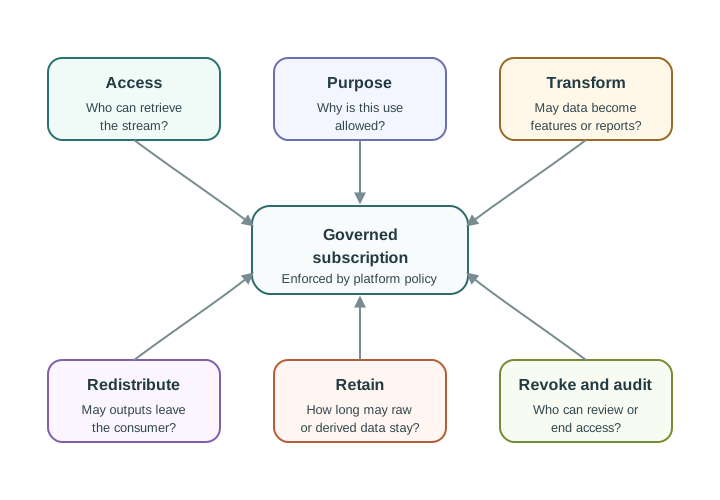
| Right | Contract question | Platform enforcement |
|---|---|---|
| Access | Who can retrieve this stream or dataset? | Identity, tenant membership, roles, scopes, and approval state. |
| Purpose | Why may the consumer use the data? | Purpose binding in subscriptions and API requests. |
| Transformation | May the consumer aggregate, enrich, train models, or create derivatives? | Allowed operation flags and derivative-use terms. |
| Redistribution | May outputs be shared with third parties? | Export controls, license flags, watermarking, and audit. |
| Retention | How long may raw data, derived data, and logs be kept? | Time-to-live rules, deletion jobs, and retention records. |
| Revocation | What happens when consent, authority, or quality changes? | Token revocation, subscription suspension, and renewal checks. |
| Audit | Who can inspect access and policy decisions? | Tamper-evident logs, reports, and incident workflow. |
46.7.1 Rights Cascade
Derived data can create new ownership questions. A consumer may combine occupancy counts with weather, energy, or sales data to build a new model. The original subscription should say whether derivative outputs inherit the original limits, need separate approval, or may be shared in aggregated form.
Do not define only raw-data rights. S2aaS reuse often creates aggregates, alerts, model features, dashboards, and reports. Each output type needs its own allowed-use and sharing rule.
46.8 Privacy Classification
This section: Privacy Classification — Privacy risk depends on what the stream can reveal, not only what the sensor is named.
Privacy risk depends on what the stream can reveal, not only what the sensor is named.
46.8.1 Low Personal Risk
Outdoor weather, aggregate environmental readings, public equipment status, or coarse infrastructure telemetry may be reusable with quality metadata, retention limits, and basic audit.
46.8.2 Behavior-Revealing Risk
Location, occupancy, door state, energy pattern, audio event, video-derived count, wearable, or vehicle movement data can reveal routines or identity and needs stronger controls.
46.8.3 Sensitive Context
Homes, health settings, schools, workplaces, care facilities, and law-enforcement contexts need additional governance because misuse can directly affect people.
46.8.4 Operational Sensitivity
Industrial process state, security systems, logistics routes, and facility occupancy may expose business operations even when they do not identify people.
46.9 Privacy Lifecycle
This section: Privacy Lifecycle — Privacy controls work best when they are built into the data path from collection to deletion.
Privacy controls work best when they are built into the data path from collection to deletion.
Use Figure 46.2 to follow one worked campus-occupancy export. Three concurrent room counts begin with room and sensor detail. The platform classifies the inference risk, removes sensor identifiers, coarsens room identity to a zone and timestamp to a 30-minute bucket, binds the research consumer to a purpose and retention rule, denies the raw-room endpoint, and delivers only the permitted zone-level result. The values are illustrative rather than measurements from a real campus deployment.
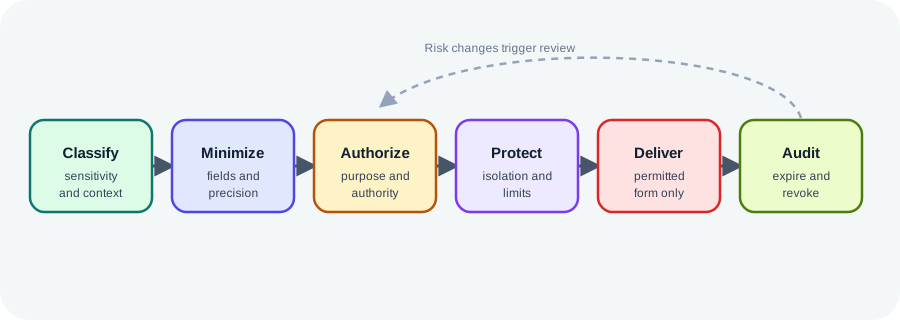
Read Figure 46.2 from stage 1 through stage 6. The teaching mechanism is the state change at each step: raw detail stays inside the governed platform, while the consumer receives only the form allowed by the recorded purpose and policy. A new consumer, new purpose, or request for finer room-level or one-minute detail reopens classification and authorization instead of silently broadening the existing subscription.
Lifecycle controls:
- Classify the stream by personal, operational, location, safety, and public-interest sensitivity.
- Minimize detail before sharing: reduce precision, frequency, retention, fields, or geographic resolution when possible.
- Authorize access with consent, ownership authority, policy approval, or another documented basis appropriate to the context.
- Protect data with encryption, tenant isolation, rate limits, and least-privilege credentials.
- Deliver only the permitted form: raw, aggregated, delayed, derived, or insight-only.
- Audit who accessed the stream, for what purpose, under which policy and quality state.
- Expire or revoke access when purpose ends, consent changes, contract expires, quality fails, or risk changes.
Privacy and data-protection rules vary by jurisdiction, sector, and data type. This chapter teaches design controls, not legal advice. Real deployments should map these controls to the applicable privacy, security, procurement, research, health, education, labor, and public-sector requirements.
46.10 Selection Workflow: Anonymization Limits
This section: Selection Workflow: Anonymization Limits — Removing direct identifiers is useful but not enough.
Removing direct identifiers is useful but not enough. Sensor data often contains patterns: repeated locations, time windows, movement paths, occupancy rhythms, device fingerprints, or operational cycles. Those patterns can make a stream linkable even when names and account numbers are absent.
Stronger privacy design combines multiple controls:
- Minimization: collect and share only fields needed for the stated purpose.
- Aggregation: publish group or zone summaries instead of individual traces.
- Coarsening: reduce location, time, or measurement precision when detail is unnecessary.
- Delay: publish data after the operational risk window has passed.
- Purpose limitation: bind data to a specific use and block unrelated reuse.
- Access tiers: provide raw data only to approved users and safer derivatives to broader audiences.
- Inspect and audit: log access and inspect unusual exports or high-risk requests.
46.10.1 Worked Example: Example: Building Occupancy Stream
Unsafe request: A consumer asks for room-level occupancy every few seconds from an office building and wants to retain raw history indefinitely.
Safer redesign:
- Provide floor-level or zone-level counts unless room-level detail is essential.
- Delay publication for non-operational analytics.
- Retain raw data briefly, then keep only aggregates.
- Prohibit employee monitoring, tenant profiling, or resale.
- Require approval before combining with badge, network, or camera-derived data.
- Record every export and provide an incident path for disputed use.
46.11 Governance Structure
This section: Governance Structure — A mature S2aaS platform turns policy into operational controls.
A mature S2aaS platform turns policy into operational controls.
46.11.1 Technical Controls
Identity, scopes, encryption, tenant isolation, rate limits, retention jobs, consent records, policy checks, and audit logs.
46.11.2 Contract Controls
Allowed purpose, quality terms, redistribution limits, derivative rules, liability boundaries, inspection rights, and termination.
46.11.3 Checkpoint: Oversight Controls
Risk assessment, stakeholder representation, transparency reports, incident process, appeals, and periodic reassessment.
Governance becomes weak when policy decisions live only in documents. The platform should be able to answer these questions from current records:
- Who approved this stream for sharing?
- Which purpose was approved?
- Which fields and precision levels were allowed?
- Which consumers accessed it?
- What data quality state existed at the time?
- When does the right expire?
- What must happen if consent, ownership, or risk changes?
46.12 Selection Workflow: Campus Environmental Sensing
This section: Selection Workflow: Campus Environmental Sensing — Scenario: A university operates outdoor temperature, humidity, noise, and pedestrian-flow sensors.
Scenario: A university operates outdoor temperature, humidity, noise, and pedestrian-flow sensors. Facilities wants operational dashboards, a city planning group wants heat-island research data, and a student team wants to build a campus comfort app.
Ownership and rights design:
- The university keeps physical control of devices and primary stream stewardship.
- Outdoor environmental readings are reusable after quality checks and retention limits.
- Pedestrian-flow data is shared only as aggregated zone counts, not individual traces.
- The city planning group receives research-use access with no redistribution of raw data.
- The student app receives comfort scores and coarse zone summaries, not detailed histories.
- A governance record defines purpose, field list, precision, retention, derivative use, and audit requirements for each consumer.
Decision: Use shared governance with consumer-specific licenses. This supports useful reuse while preventing the broad assumption that every consumer can access every stream at full detail.
46.13 Checkpoint: Ownership Readiness Checklist
This section: Checkpoint: Ownership Readiness Checklist
Before exposing a stream through S2aaS, check:
- The physical owner or steward has authority to publish the stream.
- The data-subject or affected-community risk has been classified.
- The approved purpose is specific enough to enforce.
- Raw fields, precision, frequency, and retention are minimized.
- Redistribution and derivative-use rules are explicit.
- Consumer access is scoped, logged, and revocable.
- Retention jobs and deletion records exist.
- Quality metadata travels with the stream.
- High-risk combinations require approval before export.
- The incident and dispute process is documented.
46.14 Knowledge Check
This section: Knowledge Check
46.16 Common Pitfalls
This section: Common Pitfalls
46.16.1 Device Ownership Is Not Data Rights
A site owner may control the device but still need privacy, labor, tenant, research, or community governance before sharing behavior-revealing data.
46.16.2 Ignoring Derived Data
Aggregates, alerts, features, scores, and model outputs can preserve sensitive patterns. Define derivative-use rules before data leaves the platform.
46.16.3 Keeping Raw Data Forever
Long retention increases breach, misuse, and re-identification risk. Retain the minimum detail for the minimum time needed.
46.16.4 Using Consent as a Checkbox
Consent or authority has to be specific, revocable where required, connected to a purpose, and enforceable in access decisions.
46.18 Enforceable Data Rights
This section: Enforceable Data Rights — If you only need the operating rule, this layer is enough: S2aaS ownership is not a label on a sensor.
If you only need the operating rule, this layer is enough: S2aaS ownership is not a label on a sensor. It is a current set of rights that the platform can enforce before, during, and after reuse.
Inspect Figure 46.3 and ask which role can authorize a new use of the reusable sensor stream.
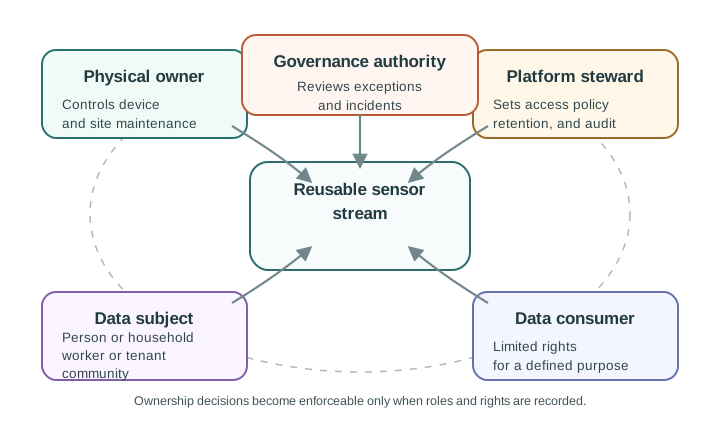
Read Figure 46.3 around the shared stream. Keep the person, device or site owner, platform worker, data steward, and buyer apart. A person's interest and consent remain even when another group owns the sensor. The platform may move and store data without owning the choice of purpose. The steward sets quality, access, data life, and allowed reuse. The buyer must follow those terms and report misuse or failure. Duties follow the data after collection. A reusable stream needs named owners for approval, correction, deletion, audit, safety, and fault response, backed by a rule the platform can enforce.
Mobile summary: A defensible S2aaS ownership record separates physical owner authority, platform stewardship, data-subject risk, consumer license terms, and governance oversight.
Authority
The physical owner or steward must be allowed to expose the stream, and that authority must be separate from the rights of people or sites represented by the data.
Use limit
Each consumer needs a permitted purpose, precision, delay, transformation rule, redistribution rule, retention window, and revocation path.
Proof
Identity checks, policy decisions, quality state, exports, deletions, exceptions, and incidents need logs that can be inspected later.
46.19 Occupancy Reuse Record
This section: Occupancy Reuse Record — For a campus occupancy stream, write one row per consumer instead of one broad "campus owns the data" statement.
For a campus occupancy stream, write one row per consumer instead of one broad "campus owns the data" statement.
Treat occupancy Reuse Record as one connected review. Begin with facilities operations: near-real-time zone counts, short raw retention, no employee monitoring, access tied to building operations roles, and incident review for unusual exports. With that boundary fixed, examine research group: delayed aggregates, approved research purpose, no raw trace redistribution, retention tied to the study window, and publication checks for small-cell disclosure. Then connect it to commercial vendor: comfort or utilization scores only unless a governance authority approves derivative products, resale terms, quality disclaimers, and deletion proof. Close the review by checking platform steward: policy rules, consent or authority records, quality metadata, export logs, retention jobs, revocation triggers, and a named owner for disputes. The order matters: each later judgment depends on the owner, state, constraint, or failure evidence retained by the preceding step, so the resulting record can support the next chapter decision.
Privacy reducer
Coarsen space and time until the data supports the approved purpose without exposing individual routines.
Reopen trigger
Recheck the record when a new consumer, new derivative, smaller zone, longer retention period, or new redistribution path appears.
46.20 Why Privacy Promises Fail Late
This section: Why Privacy Promises Fail Late — Late failures usually happen because the platform tracks access but not meaning.
Late failures usually happen because the platform tracks access but not meaning. A token can prove who downloaded a stream, but it cannot prove the download matched the approved purpose unless the request, policy, quality state, precision, retention, and derivative path are all bound together.
Treat why Privacy Promises Fail Late as one connected review. Begin with purpose drift: a consumer approved for research starts using the same export for ranking, enforcement, pricing, or advertising. With that boundary fixed, examine derivative escape: a score, model feature, or report carries sensitive patterns forward after the raw stream is deleted. Then connect it to small-cell exposure: aggregates become identifiable when a zone, time window, or event contains too few people or assets. Close the review by checking audit gap: revocation removes future API access but cannot explain old exports, third-party copies, or derived products. The order matters: each later judgment depends on the owner, state, constraint, or failure evidence retained by the preceding step, so the resulting record can support the next chapter decision.
46.21 Summary
This section: Summary — S2aaS data ownership is a governance design problem.
S2aaS data ownership is a governance design problem. Device owners, platform stewards, data subjects, consumers, and oversight bodies can all have legitimate roles. A strong platform makes rights explicit: who can access a stream, why, at what precision, for how long, with which derivative and redistribution limits, and under what audit and revocation rules. Privacy protection requires minimization, aggregation, purpose limitation, access tiers, retention controls, and operational audit, not just removal of direct identifiers.
46.23 Key Takeaway
This section: Key Takeaway — Data ownership determines who can collect, transform, share, sell, or delete sensed data.
Data ownership determines who can collect, transform, share, sell, or delete sensed data. Consent, rights, retention, privacy, and auditability must be designed before the service scales.
Find help
3 reviewed answers.
Where should I start in a module?
Open the module page from the sidebar to see its chapters in order. Use the module map to return to a topic you need.
Modules and pathsReviewed
What can I try when a project does not work?
Check the symptom, then work through the diagnostic steps. Keep the error message and the smallest example that reproduces it.
When you are stuckReviewed
How do interactive examples work?
Use the interactive guide to check how examples and simulations work before changing your project.
Interactive examples guideReviewed