2 Energy-Aware Design Basics
More
Depth: Practitioner
Progress saves as you read. Mark sections complete as you go; your progress appears in the sidebar.
2.1 Start With a Device That Must Outlast Its First Week
This section: Start With a Device That Must Outlast Its First Week — Picture a soil sensor that lasts months in a spreadsheet but dies after several wet, weak-signal nights.
Prove the Battery Promise With a Daily Cycle
Picture a soil sensor that lasts months in a spreadsheet but dies after several wet, weak-signal nights. The promise needs measured states and real event counts.
Watch the soil sensor move from a sunny day to a wet night. The battery indicator falls while the radio tries to reach a receiver. What did the spreadsheet leave out?
-
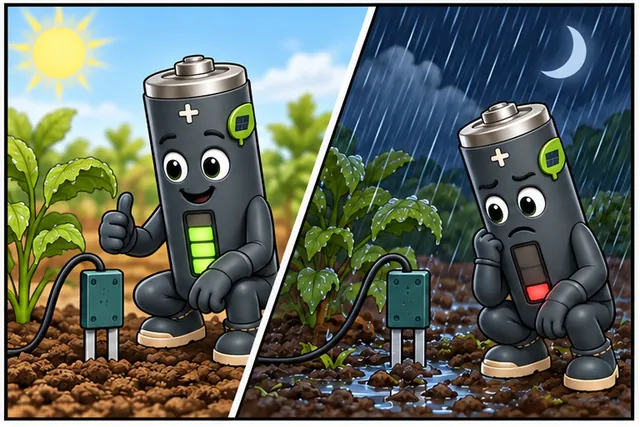
A soil sensor lasts months in a sheet but dies after wet, weak-signal nights.
-
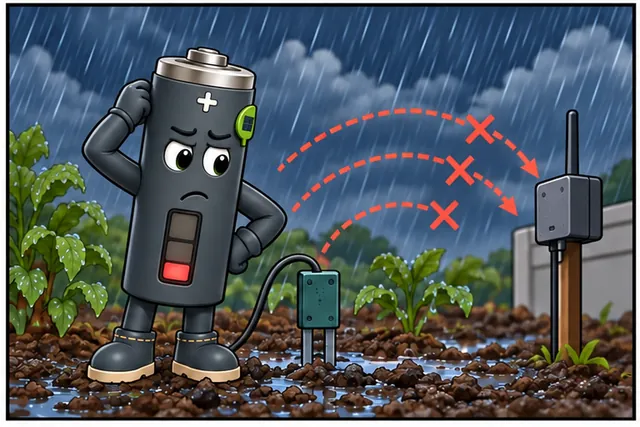
Retries and changing conditions break the paper battery promise.
-
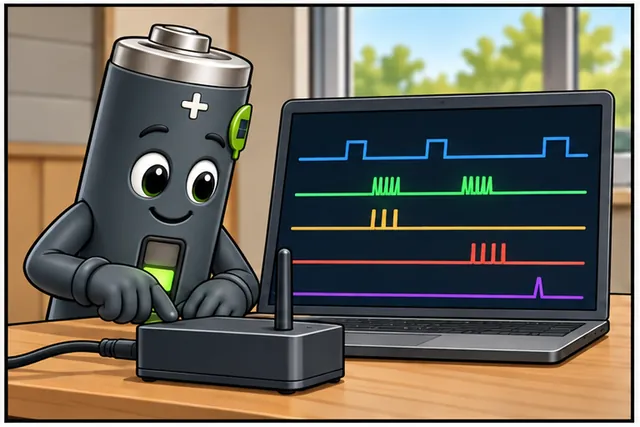
Measure sleep, sensing, sending, retry, and alarm cycles on the real device.
-
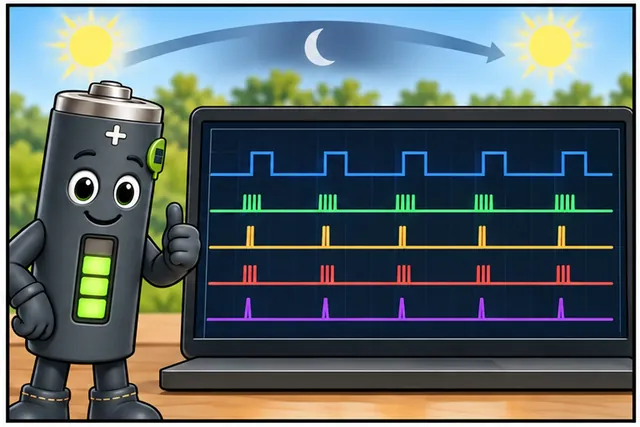
A repeatable daily trace now supports the battery estimate.
The second panel marks failed transmissions in the rain; the third shows separate bursts on a measured trace. By the final panel, the day-to-night trace repeats and can support a battery estimate. Count sleep, sensing, sending, retries, and alarms by current, duration, and frequency before making the lifetime promise.
Measure sleep, sensing, sending, retry, and alarm cycles. Keep the board, battery, temperature, current trace, event count, duty cycle, usable capacity, and estimate so another person can repeat the budget.
This check covers one device and workload, not every season or aging effect. The deeper sections add radio costs, harvesting, optimization, uncertainty, and field review.
Picture a soil sensor that looks fine on the bench but dies before the first weekend in the field. The design problem is not just choosing a bigger battery; it is deciding how often the device wakes, how long each radio burst lasts, and which service promise the battery must support.
This chapter turns that story into the first energy ledger. Start with average current, duty cycle, usable capacity, and measurement evidence before you argue about optimizations.
Battery Bruno
“Every milliamp is a day of battery — budget the sleep before you budget the features.”
Through this chapter, Bruno keeps one running ledger: what each state draws, how long the device sleeps, and what that means for life on one charge.
2.2 Energy Is A Design Budget
This section: Energy Is A Design Budget — Energy-aware IoT design starts with a service promise and turns it into a budget.
Energy-aware IoT design starts with a service promise and turns it into a budget. A device may need to sense every few seconds, report every few minutes, respond to alarms quickly, or survive for months without maintenance. Each promise consumes energy through sensors, processors, radios, storage, regulators, clocks, indicators, and sleep-state leakage.
The first useful question is not "which battery is largest?" It is "what average current can this service afford, and what evidence shows that the deployed device can stay inside that limit?" That answer depends on duty cycle, usable capacity, whole-device measurement, environmental margin, and the behavior of failures such as retries or missed wakeups.
Start by converting the promise into an allowance. If a 2400 mAh cell is derated to 70 percent usable capacity and the maintenance target is two years, the device can spend only 2400 x 0.70 / (2 x 365 x 24) = 0.096 mA, or about 96 uA on average. A board that sleeps at 80 uA and spends another 30 uA on wake, sensing, and radio work already misses the claim before any retry or cold-weather margin is added. That allowance makes the tradeoff visible before the team argues about battery brand.
What must survive the move from source to usable capacity? The visual at Figure 2.1 poses that question for the current energy is a design budget decision.
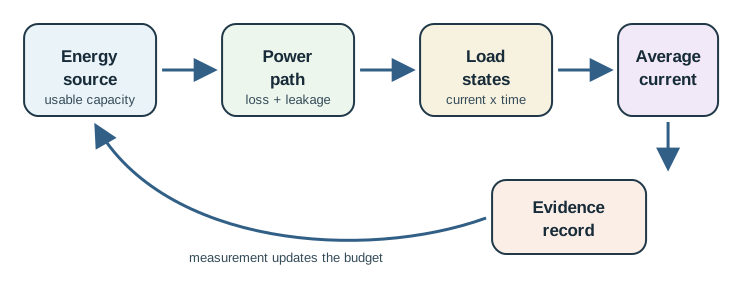
Begin with the usable capacity label in Figure 2.1, noting that it adds a distinct review condition. Look backward to source, which establishes the starting condition, and forward to Power, which exposes the energy consequence. This reveals why energy-aware system budget path linking usable capacity, power-path losses, load states, average current, and evidence record. The visual therefore advances energy is a design budget, rather than interrupting it.
The loop matters because every block can be wrong in a different way. A source may have less usable capacity than its label suggests, a regulator may leak more than the schematic budget allowed, a load state may last longer in firmware than in a datasheet example, and a field trace may expose retries the lab never saw. Energy-aware design keeps those corrections visible instead of burying them inside one optimistic lifetime number.
Bruno’s Power Budget
- Draw: 80 uA asleep plus 30 uA of wake, sense, and radio work — about 110 uA.
- Sleep: the sleep floor alone spends five-sixths of the allowance before any feature runs.
- Life: a two-year promise on 2400 mAh at 70 percent usable allows 96 uA — already missed.
If you only need the intuition, this layer is enough: define the service, compute the allowed average current, measure every important state, derate the source, and keep margin visible before making a lifetime claim.
2.3 The Four Budget Questions
This section: The Four Budget Questions
Service
What sensing, reporting, responsiveness, reliability, and maintenance interval must the device support?
States
How long does the device spend asleep, sensing, computing, storing, transmitting, receiving, retrying, and waiting?
Source
How much usable energy remains after voltage range, cutoff, temperature, pulse load, age, and reserve are considered?
Evidence
Which measured trace, firmware version, board configuration, and field record support the budget?
2.4 Beginner Vocabulary
This section: Beginner Vocabulary
- Power is the rate of energy use at one moment.
- Energy is power accumulated over time.
- Charge is current accumulated over time, often used with battery capacity.
- Average current is the equivalent steady current across a repeating workload.
- Duty cycle is the fraction of time spent in a state, such as radio transmit or sleep.
- Usable capacity is the part of the source that can actually be used under deployment conditions.
2.5 Overview Knowledge Check
This section: Overview Knowledge Check
2.6 Build The Energy Design Ledger
This section: Build The Energy Design Ledger — A practical energy review should produce a ledger that another engineer can inspect.
A practical energy review should produce a ledger that another engineer can inspect. The ledger connects the service promise to allowed average current, measured state behavior, source derating, and validation evidence. It should also make uncertainty visible instead of hiding it behind a single exact battery-life number.
For many battery-powered devices, the average-current budget is the central design number. It does not replace energy analysis for mixed voltages, regulator losses, pulse loads, or harvesting systems, but it gives the team a disciplined starting point for comparing workload choices and measurement evidence.
2.7 Budget Workflow
This section: Budget Workflow
- Define the service. State reporting interval, sensing quality, latency, reliability, storage behavior, and maintenance target.
- Set the allowance. Convert the lifetime target and usable capacity into a maximum average-current budget.
- Measure the workload. Capture whole-device current for sleep, wake, sense, compute, store, transmit, receive, retry, and idle states.
- Build the ledger. Multiply each state current by its duration, sum the cycle charge, and divide by cycle time.
- Review the margin. Compare expected, conservative, and worst-case assumptions before accepting the design.
- Retest after changes. Repeat the ledger when firmware, sensors, radio settings, power path, environment, or service targets change.
2.8 Review Ledger
This section: Review Ledger
2.9 Practitioner Knowledge Check
This section: Practitioner Knowledge Check
2.10 What The Numbers Mean
This section: What The Numbers Mean — The basic relationship is simple: power is voltage times current, energy is power over time, and average current is the state-weighted current over a cycle.
The basic relationship is simple: power is voltage times current, energy is power over time, and average current is the state-weighted current over a cycle. The difficulty is not the arithmetic. The difficulty is deciding which states are real, which measurements represent deployment behavior, and which source limits make the nominal capacity unusable.
A state ledger is a model. It should be useful enough to guide design decisions, but honest enough to show assumptions. Whole-device traces often reveal hidden loads: pull-ups, indicators, sensors left powered, regulator quiescent current, receive windows, join attempts, storage writes, retries, or firmware delays.
2.11 Worked Cycle Example
This section: Worked Cycle Example — Consider a sensor node that reports every 10 minutes, so one cycle is 600 seconds.
Consider a sensor node that reports every 10 minutes, so one cycle is 600 seconds. A measured trace shows sleep at 0.008 mA for 592 seconds, sensor warm-up at 2 mA for 3 seconds, compute at 6 mA for 1 second, radio transmit/receive at 42 mA for 3 seconds, and storage plus shutdown at 4 mA for 1 second. The cycle charge is (592 x 0.008) + (3 x 2) + (1 x 6) + (3 x 42) + (1 x 4) = 146.736 mA*s. Dividing by 600 seconds gives Iavg = 0.2446 mA, or about 245 uA.
Now connect that number to the source. A 2400 mAh cell derated to 70 percent has 1680 mAh usable capacity, so the first estimate is 1680 / 0.2446 = 6868 h, about 286 days. If weak signal adds two extra radio attempts and each adds 3 seconds at 42 mA, the cycle gains another 252 mA*s. The average becomes (146.736 + 252) / 600 = 0.6646 mA, cutting the estimate to about 105 days. The peak current did not change; the field state duration changed, which is why logs and retry behavior belong in the budget.
Bruno’s Power Budget
- Draw: one 600-second cycle costs 146.736 mA*s — the 3-second radio burst is 126 of it.
- Sleep: 592 of 600 seconds at 0.008 mA — the average is still about 245 uA.
- Life: 1680 mAh usable gives about 286 days; two retries per cycle cut it to about 105.
2.12 Equations To Use Carefully
This section: Equations To Use Carefully
Power
P = V x I. Use it when voltage and current are known for the state being reviewed.
Energy
E = P x t. Use energy units when voltages, converters, pulse loads, or harvesting paths differ.
Average current
Iavg = sum(Istate x tstate) / tcycle. Use measured state currents and measured durations.
Lifetime
life = usable capacity / Iavg. Use only after derating the source and stating assumptions.
2.13 Handoff Points That Break Budgets
This section: Handoff Points That Break Budgets
- Service to firmware: a faster reporting interval changes wake frequency and average current.
- Firmware to radio: retries, joins, acknowledgments, and receive windows can add more energy than the payload itself.
- Hardware to measurement: a board trace includes regulators, sensors, leakage, and standby loads that component tables may miss.
- Source to deployment: temperature, cutoff voltage, aging, pulse current, and reserve decide usable capacity.
- Prototype to field: weak signal, enclosure changes, dirty connectors, or firmware logs can invalidate a lab-only estimate.
2.14 Under-the-Hood Knowledge Check
This section: Under-the-Hood Knowledge Check
2.15 Summary
This section: Summary
- Energy-aware IoT design turns a service promise into an explicit energy budget.
- Average current is built from measured state currents and measured state durations, not from a single nominal number.
- Usable source capacity depends on cutoff, temperature, pulse load, age, converter behavior, and reserve.
- Duty cycle matters because sleep, receive windows, retries, and board leakage can dominate long-life devices.
- A lifetime claim needs a reproducible evidence record: service target, state trace, source derating, margin, firmware version, and retest triggers.
Do not promise battery life from a battery label. Start with the service, measure the whole-device workload, derate the source, and keep margin visible.
2.16 See Also
This section: See Also
Energy Sources for IoT Devices
Choose batteries, harvesters, buffers, and source assumptions after the service budget is visible.
Power Consumption Analysis
Turn measured state current and duration into average-current and lifetime evidence.
Low-Power Design Strategies
Reduce the budget with sleep policy, duty cycling, peripheral control, batching, and firmware timing.
Energy Measurement and Profiling
Collect whole-device traces that prove or correct the energy ledger.
Open printable teacher run sheet
Find help
3 reviewed answers.
Where should I start in a module?
Open the module page from the sidebar to see its chapters in order. Use the module map to return to a topic you need.
Modules and pathsReviewed
What can I try when a project does not work?
Check the symptom, then work through the diagnostic steps. Keep the error message and the smallest example that reproduces it.
When you are stuckReviewed
How do interactive examples work?
Use the interactive guide to check how examples and simulations work before changing your project.
Interactive examples guideReviewed