20 Energy-Aware Case Studies
More
Depth: Practitioner
Progress saves as you read. Mark sections complete as you go; your progress appears in the sidebar.
20.1 Start With the Evidence Record
This section: Start With the Evidence Record — Picture two field sensors with the same battery where one lasts twice as long.
Prove Why One Device Outlasts Another
Picture two field sensors with the same battery where one lasts twice as long. A product label cannot explain the difference; their measured daily work can.
Duty cycle means the share of time a device spends in an active state. Break each case into sleep, sensing, computing, sending, waiting, retry, and fault time before comparing it.
Replay the same quiet day, busy day, weak-link day, and alarm burst. Keep hardware, software version, current trace, event count, duty cycle, energy used, and service result so another person can compare the cases.
This check explains selected workloads and conditions, not every deployment. The deeper cases examine trade-offs, measurement limits, maintenance, and transferable lessons.
A case study is useful when it tells you what was measured, what was assumed, and what changed after deployment. Without that evidence record, a battery-life claim is only a story.
Read each case by following the load ledger, source limits, environmental conditions, and validation gaps. The reusable lesson is the pattern, not the headline number.
20.2 Energy-Aware Case Studies
This section: Energy-Aware Case Studies — This chapter uses anonymized field patterns rather than vendor stories.
This chapter uses anonymized field patterns rather than vendor stories. The goal is not to memorize product claims. The goal is to learn how to read an energy case study, identify the real cause of the improvement, and decide whether the lesson transfers to a new IoT design.
20.3 Learning Objectives
This section: Learning Objectives
By the end of this chapter, you will be able to:
- Read an energy case study as an evidence record rather than a success story.
- Identify the dominant current state that drove each design change.
- Separate measured improvement from battery-life estimates and deployment assumptions.
- Compare communication, sensing, sleep, and board-leakage interventions.
- Explain why a case-study lesson may not transfer to another deployment.
- Build a compact case-study review for a battery-powered IoT design.
20.4 How to Read an Energy Case Study
This section: How to Read an Energy Case Study — Every case study in this chapter follows the same review map.
Every case study in this chapter follows the same review map.
Ask five questions before accepting the lesson:
- What was measured? Current, voltage, time, radio retries, sensor warm-up, sleep leakage, and workload boundary.
- What dominated? Radio, sensing, compute, sleep leakage, regulator loss, or unexpected board current.
- What changed? Duty cycle, protocol, batching, sleep mode, sensor choice, power gating, or firmware state handling.
- What was re-measured? Same workload, same battery assumption, same service requirement.
- What transfers? The pattern that applies to another design, not the exact numbers.
20.5 Case Study 1: Field Soil Sensor
This section: Case Study 1: Field Soil Sensor — Initial symptom: A battery-powered soil sensor failed its seasonal-life target.
Initial symptom: A battery-powered soil sensor failed its seasonal-life target. The current trace showed that the radio connection sequence and idle loop dominated the daily budget.
Evidence
Baseline
After revision
Measurement interval
Sample and report every 15 minutes.
Sample every 15 minutes, report only when a threshold or scheduled batch required it.
Sleep state
MCU idle loop between readings; board current stayed high.
Deep sleep between readings, with sensor rail disabled.
Radio behavior
Full network reconnect for every report.
Shorter connection window and fewer reports.
Review lesson
The dominant cost was not the soil measurement.
Fix the idle and communication ledger before tuning the sensor.
Use the labelled map in Figure 20.1 to challenge case study 1: field soil sensor. If Baseline cannot be connected to After revision, the surrounding conclusion is premature.
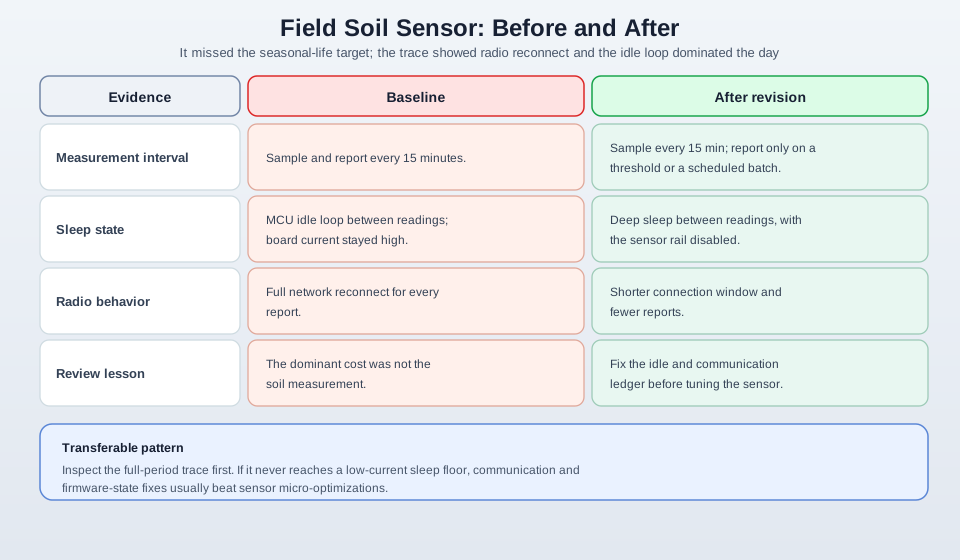
Rather than treating the labels as a list, relate Baseline to After revision in Figure 20.1. The former establishes the starting condition; the latter adds a distinct review condition. Measurement interval then states how the claim is checked, completing the visual statement: No-panel before-and-after field soil sensor ledger comparing baseline and revised rows for measurement interval, sleep state, radio behavior, and review lesson; idle current and radio reconnect dominance are replaced by deep sleep, a shorter active window, and batched reporting. That completed statement informs case study 1: field soil sensor.
Transferable pattern: When a field sensor fails a battery target, first inspect the full-period trace. If the trace never reaches a low-current sleep floor, communication and firmware-state fixes will usually beat sensor micro-optimizations.
20.6 Case Study 2: Asset Tracker
This section: Case Study 2: Asset Tracker — Initial symptom: An asset tracker met its average-current target in the lab but failed in field trials.
Initial symptom: An asset tracker met its average-current target in the lab but failed in field trials. The difference was poor coverage: retries and network attach time were longer than the design assumption.
20.7 Baseline assumption
Position report every fixed interval, with a short network attach and one successful upload.
20.8 Field evidence
Weak coverage created repeated attach attempts, longer transmit windows, and occasional queued reports.
20.9 Revision
Cache positions locally, reduce report frequency while stationary, and send batches when coverage is acceptable.
20.10 Service gate
The asset owner accepted delayed reports for stationary assets but required immediate escalation after movement.
Transferable pattern: Any tracker case study must include movement state, coverage state, retry behavior, and deadline class. A policy that works for stationary assets may be unacceptable for safety-critical moving assets.
20.11 Case Study 3: Industrial Vibration Monitor
This section: Case Study 3: Industrial Vibration Monitor — Initial symptom: A vibration monitor consumed too much energy when it streamed raw samples to a gateway.
Initial symptom: A vibration monitor consumed too much energy when it streamed raw samples to a gateway. The data movement cost exceeded the local computation cost.
Design choice
Why it helped
What had to be checked
Local feature extraction
Reduced upload size by sending compact spectral features instead of raw bursts.
The feature set still detected the target fault classes.
Adaptive interval
Measured slowly during stable operation, then increased frequency when vibration changed.
Escalation was fast enough for the maintenance use case.
Gateway batching
Reduced wireless overhead by grouping non-urgent summaries.
Buffered records survived resets and poor connectivity.
Transferable pattern: Do not assume local processing is worse for energy. When raw data is large and features are compact, local compute can reduce radio energy and improve battery life.
20.12 Case Study 4: Board Leakage Failure
This section: Case Study 4: Board Leakage Failure — Initial symptom: Firmware entered deep sleep correctly, but whole-board sleep current was far above the estimate.
Initial symptom: Firmware entered deep sleep correctly, but whole-board sleep current was far above the estimate. The MCU was not the problem; support circuitry stayed powered.
Regulator current The regulator quiescent current was larger than the MCU sleep current.
Debug bridge The USB or serial bridge remained powered in deployment builds.
Pullups and dividers Low-value resistors consumed continuous current across the battery.
Sensor standby The sensor looked asleep in firmware but its power rail remained enabled.
Indicator load Status LEDs and level shifters leaked through supposedly inactive paths.
Measurement fix The review switched from MCU-current estimates to whole-board current traces.
Transferable pattern: A low-power MCU does not make a low-power product. Sleep-state reviews must measure the whole board after the final hardware, firmware, and debug configuration are in place.
20.13 Pattern Map
This section: Pattern Map — The cases map to a small set of reusable energy lessons.
The cases map to a small set of reusable energy lessons.
The next pattern map claim rests on a relationship, not an isolated value. Inspect Case study and Reusable review lesson in Figure 20.2 before accepting it.
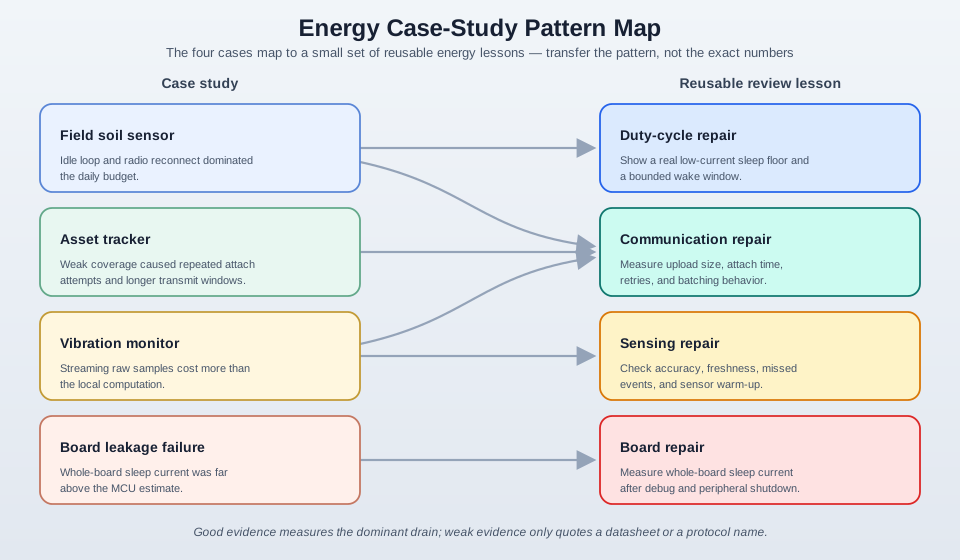
First isolate Case study on the figure at Figure 20.2; it adds a distinct review condition. Next pair Reusable review lesson (adds a distinct review condition) with Field soil sensor (adds a distinct review condition). Their pairing demonstrates that no-panel pattern map linking four cases (field soil sensor, asset tracker, vibration monitor, board leakage) to four reusable review lessons — duty-cycle repair, communication repair, sensing repair, and board repair. This is what the chapter needs before continuing pattern map.
Pattern
Good evidence
Weak evidence
Duty-cycle repair
Current trace shows a real low-current sleep floor and bounded wake window.
Only firmware settings or datasheet sleep numbers are shown.
Communication repair
Upload size, attach time, retries, signal quality, and batching behavior are measured.
Only protocol names are compared.
Sensing repair
Accuracy, freshness, missed events, and sensor warm-up are checked.
Only lower sample rate is reported.
Board repair
Whole-board sleep current is measured after debug and peripheral shutdown.
Only MCU datasheet current is quoted.
20.14 Best-Practice Checklist
This section: Best-Practice Checklist
20.15 Start with the trace
Capture enough time to include wake, sense, compute, transmit, receive, retry, and sleep states.
20.16 Rank before optimizing
Optimize the largest measured contributor first unless a service or safety requirement says otherwise.
20.17 Preserve service
Battery gains are not valid if they miss required events, stale the data, or remove necessary feedback.
20.18 Include overhead
Batching, compression, inference, and scheduling consume energy and memory. Include them in the revised ledger.
20.19 Derate estimates
Battery chemistry, temperature, aging, self-discharge, voltage cutoff, and field retries reduce ideal estimates.
20.20 Record transfer limits
Document where the lesson applies and where it does not: coverage, payload size, deadline, and maintenance model.
20.21 Common Pitfalls
This section: Common Pitfalls
20.22 Copying numbers
Case-study currents and lifetimes are not reusable design constants. Reuse the measurement method.
20.23 Ignoring field coverage
Lab radio energy can be much lower than field energy when retries and attach failures appear.
20.24 Hiding service loss
Longer sleep or batching is not a win if it violates freshness, safety, or user-feedback requirements.
20.25 Datasheet-only sleep
Whole-board leakage can dominate even when the MCU reaches its advertised sleep current.
20.26 Treating estimates as measurements
Battery-life spreadsheets are useful, but promotion requires traces from the real firmware and board.
20.27 No rollback path
Adaptive field policies need fallback behavior when context, coverage, or sensing quality degrades.
20.29 Knowledge Check
This section: Knowledge Check
20.30 Knowledge Check: Case-Study Evidence
This section: Knowledge Check: Case-Study Evidence
20.31 Knowledge Check: Transferable Lesson
This section: Knowledge Check: Transferable Lesson
20.32 Matching Quiz: Case Patterns
This section: Matching Quiz: Case Patterns
20.33 Ordering Quiz: Case-Study Review
This section: Ordering Quiz: Case-Study Review
20.34 Label the Diagram: Case-Study Evidence
This section: Label the Diagram: Case-Study Evidence
20.35 What’s Next
This section: What’s Next
Connect case-study evidence to battery, regulator, and deployment design assumptions.
Practice collecting and interpreting an energy trace.
Energy-Aware Low-Power Strategies
Choose practical sleep, wake, and low-power strategies after reading the case patterns.
Energy-Aware Interactive Tools
Use calculators and tools after the evidence pattern is clear.
20.36 The Cell Discharges Even When The Sensor Sleeps
This section: The Cell Discharges Even When The Sensor Sleeps — Across the case studies in this chapter, one factor separates the multi-year successes from the disappointments: battery chemistry.
Across the case studies in this chapter, one factor separates the multi-year successes from the disappointments: battery chemistry. A cell is not just a capacity number. Each chemistry has its own self-discharge rate, voltage, temperature range, and pulse-current behavior, and those properties decide whether a design that looks fine on the bench survives years in the field.
For a very low-power device, the surprising result is that the chemistry, not the workload, can set the lifetime. A cell that quietly loses 2% of its charge every month can empty itself faster than a microamp-scale sensor ever could, so choosing the wrong chemistry wastes most of the capacity before the load touches it.
Intuition only: self-discharge is a leak that runs in parallel with your load, all the time, whether or not the device is awake. Compare that leak against your average current before trusting a capacity figure.
Treat the map at Figure 20.3 as the evidence boundary for the cell discharges even when the sensor sleeps. Its Baseline and ledger labels identify the conditions that must be checked together.
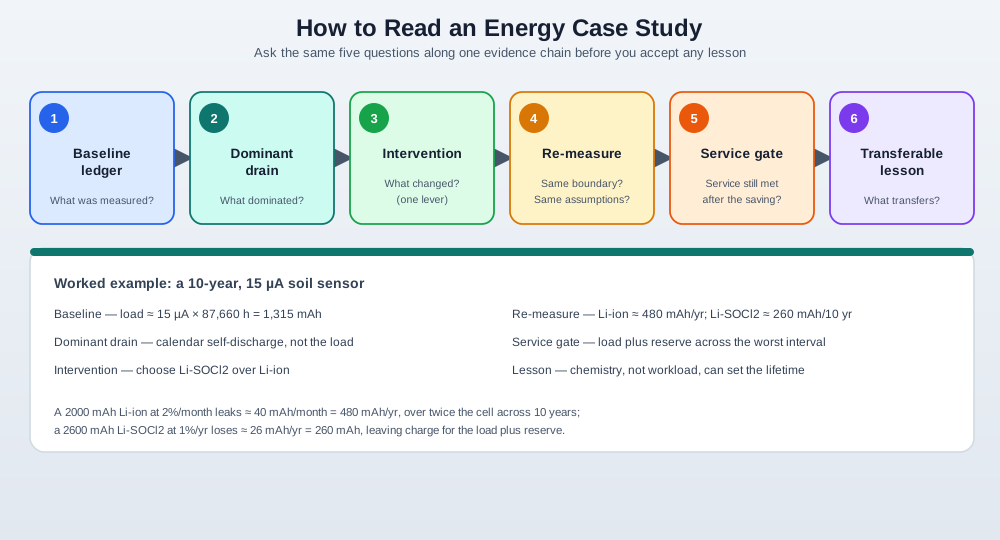
The evidence changes character across the diagram at Figure 20.3: Baseline establishes the starting condition, ledger adds a distinct review condition, then What was measured? states how the claim is checked. The transition explains the caption’s core point — energy case-study review chain with six stages — baseline ledger, dominant drain, intervention, re-measurement under the same boundary, service gate, and transferable lesson — worked through a ten-year fifteen-microamp soil sensor. That point is the next premise in the cell discharges even when the sensor sleeps.
For a 10-year, 15 uA soil sensor, the load itself needs about 15 uA x 87660 h = 1315 mAh before derating. In this constant-leak illustration, a 2,000 mAh Li-ion cell at 2% per month loses about 40 mAh per month, or 480 mAh in the first modelled year; ten years of that linear extrapolation exceeds twice its initial capacity, so the cell would empty first. A 2600 mAh Li-SOCl2 cell at about 1% per year loses about 26 mAh per year, or 260 mAh over the same period, leaving enough charge for the load plus reserve. The same average-current design therefore succeeds or fails before firmware changes, simply because the chemistry leak is different.
This is a deliberately conservative first-capacity model; a real lifetime estimate combines load current, state-dependent self-discharge, cutoff voltage, and usable capacity.
20.37 Chemistry At A Glance
This section: Chemistry At A Glance — The chemistry card’s long-life recommendation should be connected to parts a deployment team might actually encounter.
Li-SOCl2
3.6 V, very low self-discharge (about 1%/year), wide temperature, but limited continuous current. Tadiran Li-SOCl₂ example The default for multi-year unattended sensors.
Alkaline
1.5 V, cheap, moderate self-discharge (a few %/year), but weak in cold and under pulse loads, and prone to leakage over long deployments.
Li-ion / LiPo
3.7 V, rechargeable, energy-dense, but self-discharges roughly 2-3% per month and cannot be charged below 0 C. Battery self-discharge review Good only if recharged or serviced.
Coin cell (CR2032)
3 V, about 220 mAh, low self-discharge, but high internal resistance limits pulse current. Fine for tiny loads, risky for radio bursts.
The chemistry card’s long-life recommendation should be connected to parts a deployment team might actually encounter. Figure 20.4 shows several Li-SOCl2 formats so the case study can separate chemistry, voltage, package, and pulse delivery.

In Figure 20.4, compare the yellow cell marked ER6H(AA) 3.6V with the silver LITHIUM BATTERY 3.6V cylinder and the rectangular Lithium 6V pack. The labels show that “lithium” does not specify one voltage or package, and the visible tabs, wires, and terminals imply different integration choices. The chapter’s case-study lesson therefore returns to the exact cell datasheet, pulse capability, connector, and measured load rather than transferring one chemistry headline unchanged.
20.38 Overview Knowledge Check
This section: Overview Knowledge Check
20.39 Add Self-Discharge As A Parallel Current
This section: Add Self-Discharge As A Parallel Current — A useful first-order model treats average self-discharge as a constant current draining the cell alongside the load.
A useful first-order model treats average self-discharge as a constant current draining the cell alongside the load. Convert the rated percentage into an equivalent current: I_self = (rate x capacity) / period. Then lifetime becomes life = usable capacity / (I_load + I_self). When I_self approaches or exceeds I_load, the chemistry, not the workload, governs the outcome.
20.40 Worked Example: A 15 uA, 10-Year Sensor
This section: Worked Example: A 15 uA, 10-Year Sensor — Compare two chemistries for the same 15 uA average load and a 10-year target.
Compare two chemistries for the same 15 uA average load and a 10-year target.
- Li-SOCl2, 2600 mAh, about 1%/year: self-discharge = 26 mAh/year, and 26 mAh / 8766 h = about 3 uA equivalent. Total draw = 15 + 3 = 18 uA. With ~2340 mAh usable, life = 2340 / 0.018 = 130000 h, about 14.8 years. Meets the target with margin.
- Li-ion, 2000 mAh, about 2%/month: self-discharge = 40 mAh/month, and 40 mAh / 730 h = about 55 uA equivalent. Total draw = 15 + 55 = 70 uA. Even at a generous 2000 mAh usable, life = 2000 / 0.070 = 28600 h, about 3.3 years. Fails the target - dominated by self-discharge.
The Li-ion cell holds less than the Li-SOCl2 cell here, but that is not why it loses. It loses because its self-discharge current is nearly four times the load, so most of its charge never reaches the sensor.
Run the same calculation whenever a case study changes chemistry. First convert the chemistry leak into current, then add it to the measured workload current, then apply a usable-capacity derating. If the project requires 20% end-of-life reserve, the Li-SOCl2 example should use about 2080 mAh instead of 2600 mAh; at 18 uA total draw that still gives about 13.2 years. The Li-ion example remains below four years even before cold, ageing, or safety reserve are considered.
20.41 Equivalent Self-Discharge Current
This section: Equivalent Self-Discharge Current
20.42 Practitioner Knowledge Check
This section: Practitioner Knowledge Check
20.43 Temperature Moves Every Number
This section: Temperature Moves Every Number — Chemistry ratings are quoted at room temperature, but field enclosures rarely sit at room temperature.
Chemistry ratings are quoted at room temperature, but field enclosures rarely sit at room temperature. Self-discharge is a chemical reaction, and its rate rises roughly with temperature - as a rule of thumb it can nearly double for every 10 C increase. A sealed enclosure baking on a sunny rooftop can therefore run at twice the self-discharge current you budgeted from the datasheet, quietly halving the margin computed on the bench.
Temperature also shifts usable capacity and safety limits per chemistry. Alkaline cells lose a large fraction of their capacity in the cold, so a winter deployment sees far less than the rated mAh. Li-ion cells discharge in the cold but must not be charged below 0 C, because charging then plates lithium and permanently damages the cell - a hard constraint for solar-recharged nodes in cold climates. Li-SOCl2 cells tolerate very wide temperatures but suffer passivation after long storage or cold soaking, which delays the voltage recovery under a sudden pulse. None of these effects appear in a single room-temperature capacity figure.
Put numbers on the derating. If the room-temperature Li-SOCl2 leak is 3 uA at 20 C and the enclosure spends summer near 40 C, two 10 C steps can make the leak roughly 3 uA x 2 x 2 = 12 uA Battery University. The same 15 uA sensor now budgets 27 uA average before radio-pulse margin. With 2340 mAh usable, the lifetime falls to 2340 mAh / 0.027 mA = 86667 h, or about 9.9 years. A design that looked comfortably above 10 years at room temperature is suddenly marginal in the actual enclosure.
20.44 Temperature Effects To Budget
This section: Temperature Effects To Budget
Faster self-discharge
Roughly doubles per 10 C rise. A hot enclosure can erase the self-discharge margin you planned.
Cold capacity loss
Alkaline can deliver a fraction of its rated capacity below freezing. Rate the pack at the deployment temperature.
Li-ion charge limit
No charging below 0 C without plating and damage. Cold solar nodes need a charge-temperature gate or a different chemistry.
Passivation
Li-SOCl2 can show a voltage delay after storage or cold, weakening the first pulse until the film clears.
20.45 Under-the-Hood Knowledge Check
This section: Under-the-Hood Knowledge Check
20.46 Summary
This section: Summary — This chapter uses case studies to show how energy-aware design changes across deployments.
This chapter uses case studies to show how energy-aware design changes across deployments. It compares sensing schedules, communication choices, harvesting assumptions, maintenance constraints, and operational tradeoffs.
20.47 Key Takeaway
This section: Key Takeaway — Case studies show that energy design is situational.
Case studies show that energy design is situational. Battery size, duty cycle, radio coverage, maintenance access, data freshness, and environmental conditions decide which strategy is defensible.
Open printable teacher run sheet
Find help
3 reviewed answers.
Where should I start in a module?
Open the module page from the sidebar to see its chapters in order. Use the module map to return to a topic you need.
Modules and pathsReviewed
What can I try when a project does not work?
Check the symptom, then work through the diagnostic steps. Keep the error message and the smallest example that reproduces it.
When you are stuckReviewed
How do interactive examples work?
Use the interactive guide to check how examples and simulations work before changing your project.
Interactive examples guideReviewed