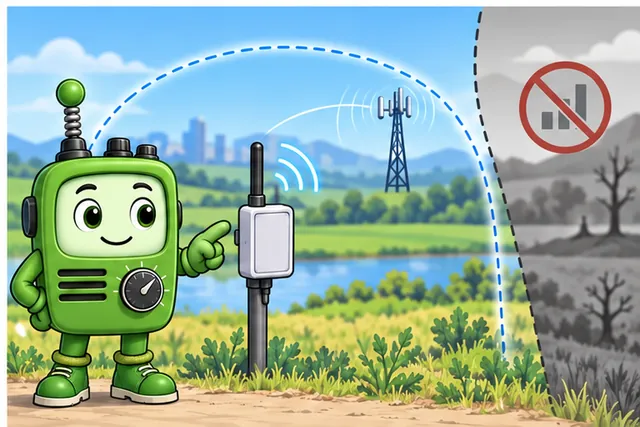
16  Cellular IoT Overview and Evolution

In 60 Seconds

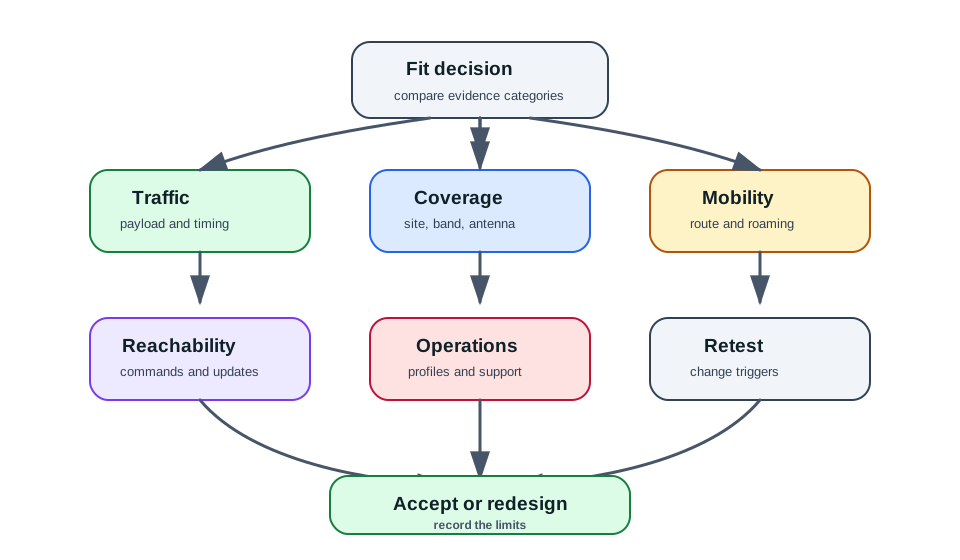
Cellular IoT (NB-IoT and LTE-M) leverages existing mobile network infrastructure to connect IoT devices without deploying private gateways, offering licensed-spectrum reliability and global roaming. Understanding the evolution from 2G through 5G and the ongoing 2G/3G sunset timeline is critical for choosing a cellular IoT technology that will remain supported throughout your device’s deployment lifetime.

Key Concepts
  • LPWAN Landscape: Cellular LPWAN (NB-IoT, LTE-M) provides licensed-spectrum, operator-managed connectivity; non-cellular LPWAN (LoRa, Sigfox) uses unlicensed spectrum with private or shared infrastructure
  • 3GPP Release 13: The 2016 standards release that introduced both NB-IoT and LTE-M, marking the start of cellular-native IoT (previously cellular IoT relied on 2G/3G)
  • Cellular IoT Evolution: 2G (GPRS/EGPRS) → 3G (HSPA for early M2M) → 4G LTE Cat-1 → LTE-M (Cat-M1) + NB-IoT → 5G mMTC/RedCap
  • 2G Sunset Risk: T-Mobile (US) sunset 2G in 2017; AT&T sunset 3G in 2022; devices on sunset networks permanently lose connectivity. New designs must use LTE-based technologies (LTE-M, NB-IoT, Cat-1)
  • Licensed vs Unlicensed Spectrum: Cellular uses licensed spectrum (guaranteed interference-free operation); LoRa/Sigfox use ISM bands (shared, potential for interference)
  • Cellular Infrastructure Requirement: Cellular IoT requires existing operator network infrastructure — no private gateway deployment; reduces per-deployment cost but creates carrier dependency
  • Data Plans for IoT: IoT-specific plans range from $0.01/MB (high volume) to $5/month flat rate (low volume); plan structure must match application data consumption to avoid waste or overage
  • Regulatory Compliance: Cellular modules require type approval (FCC Part 15, CE RED) and carrier network acceptance; approved modules can be incorporated into products without full RE testing

16.1 Learning Objectives

By the end of this chapter, you should be able to:

  • Trace cellular network evolution (2G/3G/4G/5G) and its implications for IoT deployment
  • Differentiate cellular IoT from traditional cellular in terms of power, cost, and data rate
  • Classify the key characteristics of NB-IoT, LTE-M, and 5G RedCap technologies
  • Evaluate cellular generations for IoT suitability based on mobility, coverage, and battery life
  • Assess the 2G/3G sunset timeline and plan migration strategies for existing deployments

16.2 Prerequisites

Before diving into this chapter, you should be familiar with:

  • Networking Basics: Understanding fundamental networking concepts like IP addressing, TCP/UDP protocols, and client-server architecture is crucial for working with cellular IoT modules and AT commands
  • LPWAN Fundamentals: Familiarity with low-power wide-area network principles helps you appreciate how cellular IoT (NB-IoT/LTE-M) compares with unlicensed LPWAN alternatives like LoRaWAN in terms of coverage, power, and cost trade-offs

16.3 MVU: Minimum Viable Understanding

MVU: Cellular IoT in 60 Seconds

The core concept: Cellular IoT (NB-IoT and LTE-M) uses existing mobile network towers to connect IoT devices - no gateway deployment needed.

Decision NB-IoT LTE-M
Device moves? No - stationary only Yes - full mobility
Battery target 10-15 years 5-10 years
Data rate 250 kbps max 1 Mbps max
Latency 1.6-10 seconds 10-15 ms
Voice support No Yes (VoLTE)
Best for Meters, parking sensors Trackers, wearables

The one thing to remember: Choose NB-IoT for stationary sensors needing 10+ year battery life and deep indoor coverage; choose LTE-M when devices move or need real-time response.

Cost reality: $2-10/device/year for data plans, but $0 infrastructure investment (unlike LoRaWAN which needs gateway deployment).

16.4 What is Cellular IoT?

⏱️ ~10 min | ⭐⭐ Intermediate | 📋 P09.C18.U01

Cellular IoT refers to IoT devices that use cellular networks (mobile networks) for connectivity. These technologies leverage existing cellular infrastructure (cell towers) to provide wide-area coverage for IoT devices.

Cross-Hub Connections: Cellular IoT Learning Resources

Enhance your cellular IoT knowledge with these curated learning resources:

Interactive Learning:

  • Knowledge Map: Visualize how cellular IoT (NB-IoT, LTE-M) connects to LPWAN, networking fundamentals, and IoT protocols in the broader IoT ecosystem
  • Simulations Hub: Explore cellular coverage simulators and power consumption calculators to understand PSM/eDRX battery life optimization

Assessment & Practice:

  • Quizzes Hub: Test your understanding with cellular IoT quizzes covering NB-IoT vs LTE-M selection, AT commands, coverage enhancement modes, and SIM technologies
  • Knowledge Gaps: Address common misconceptions about cellular IoT costs, coverage, and technology selection (LoRaWAN vs cellular trade-offs)

Multimedia Resources:

  • Videos Hub: Watch demonstrations of NB-IoT/LTE-M module setup, AT command usage, and real-world deployment case studies from smart cities and industrial IoT

Why these connections matter: Cellular IoT sits at the intersection of networking fundamentals, LPWAN technologies, and application protocols. Understanding protocol selection (MQTT vs CoAP over cellular) and comparing cellular with unlicensed LPWAN (LoRaWAN, Sigfox) helps you make informed architecture decisions for cost, coverage, and power trade-offs.

Cellular IoT is like giving tiny sensors their own phone plan!

16.4.1 The Sensor Squad Adventure: Tower Talk

Welcome to the world of Cellular IoT, where sensors get to use the same cell towers that power your mom’s and dad’s phones!

Tower Tina stands tall on top of a hill, just like the towers you see when driving on the highway. “I help phones make calls and watch videos,” she explains, “but I also have a special job - I talk to thousands of tiny sensors! Water meters, parking sensors, even delivery trucks check in with me every day.”

Module Max is a tiny chip inside a smart water meter buried in someone’s front yard. “I have my own SIM card, just like a phone!” he says proudly. “But I don’t watch YouTube or play games. I just send one tiny message each day: ‘Used 50 gallons today!’ Then I go right back to sleep.”

Battery Betty powers Module Max and is VERY impressed. “Max is SO efficient! He only wakes up once a day, sends his tiny message in just 2 seconds, then sleeps for 23 hours and 59 minutes. I’ve been powering him for 10 YEARS and I’m still going strong!”

Sleepy Sam demonstrates how Power Save Mode (PSM) works: “It’s like taking the world’s longest nap! I dream for almost 24 hours, then wake up just long enough to say ‘I’m okay!’ to Tower Tina, then go right back to sleep. The network remembers who I am even while I’m sleeping.”

Mobile Molly is different - she’s on a delivery truck! “I can’t sleep as long as Sam,” she explains, “because I’m always moving! When one tower gets too far away, I smoothly switch to the next tower without dropping my conversation. That’s called a HANDOVER!”

Network Nina runs the cellular network office. “Here’s the best part,” she smiles. “Nobody has to install gateways or buy routers! All those towers are already there. Just pop in a SIM card, and your sensor is connected to the whole world!”

16.4.2 Key Words for Kids

Word What It Means Like…
Cell Tower Tall tower that talks to sensors A lighthouse sending signals
SIM Card Tiny identity card for sensors A library card for the network
NB-IoT For sensors that don’t move Parking meters, water meters
LTE-M For sensors that move around Delivery trucks, pet trackers
PSM Super deep sleep mode Hibernating like a bear
Handover Switching towers while moving Passing a baton in a relay race

16.4.3 Quiz Time!

  1. Why can Battery Betty last 10 years? Because Module Max sleeps most of the time and only sends tiny messages!
  2. What’s the difference between NB-IoT and LTE-M? NB-IoT is for things that stay in one place, LTE-M is for things that move around!
  3. Why don’t cellular IoT devices need gateways? Because the cell towers are already built everywhere!

The Simple Idea

Cellular IoT uses the same cell towers that your smartphone uses, but optimized for “things” instead of people. Just like your phone connects to AT&T/Verizon towers, IoT devices (water meters, GPS trackers, sensors) can connect to the same infrastructure.

Key Analogy: “Hotel Wi-Fi” vs “Your Own Router”

Think of cellular IoT like staying at a hotel: - Wi-Fi/LoRa/Zigbee: You buy the router, install it, configure it, maintain it, troubleshoot when it breaks - Cellular IoT: You just connect (like using hotel Wi-Fi), pay monthly, operator maintains everything

Essential Terms You Need to Know

Term What It Means Example
LTE-M (Cat-M1) Cellular for mobile things GPS tracker on delivery truck, fitness watch
NB-IoT (Cat-NB1) Cellular for stationary things Water meter in basement, parking sensor
eMTC Another name for LTE-M Enhanced Machine-Type Communication
Cat-M1, Cat-NB1 Technical category names LTE Category M1, Category NB1
SIM Card Identity card for device Like your phone’s SIM, but for IoT
PSM (Power Save Mode) Deep sleep mode Device sleeps 23.99 hours, wakes for 30 seconds
eDRX Extended sleep between check-ins Check network every 10 minutes instead of every 1 second

Why Cellular IoT Matters: Real Numbers

San Francisco Smart Parking Meters (8,000 deployed, NB-IoT): - Coverage: 100% of city (uses existing AT&T towers) - Infrastructure cost: $0 (no gateways needed) - Battery life: 10+ years per meter (NB-IoT with PSM) - Data cost: $2/month/meter = $192,000/year for entire city - Alternative cost: Wi-Fi would need 2,000 access points × $500 = $1M infrastructure + $50/month/AP maintenance

Technology Selection Quick Guide

Choose Cellular IoT when:

  • Devices spread over wide areas (citywide, nationwide)
  • No existing Wi-Fi/gateway infrastructure
  • Devices need to work day 1 (zero setup)
  • Mobile devices (vehicles, wearables)
  • Global deployments (50+ countries)
  • 10+ year battery life needed
  • SIM-based security required

Choose Wi-Fi/LoRa/Zigbee when:

  • All devices in one building
  • Budget < $1/device/year (cellular = $2-10/year)
  • No cellular coverage (remote areas)
  • Extremely low data (<10 bytes/day)

Real-World Scenarios

Application Why Cellular?
Water Meters (1000 across city) NB-IoT: Coverage everywhere, 15-year battery, $3/year/meter
Delivery Truck Fleet (200 trucks) LTE-M: Mobile handover, GPS tracking, real-time updates
Smart Agriculture (500 soil sensors) NB-IoT: Deep coverage in fields, 10-year battery, $2/year/sensor
Smart Building (500 sensors) Wi-Fi cheaper: All devices in one building, use building Wi-Fi

Cost Reality Check (per device per year)

  • NB-IoT: $2-5/year (low data plans)
  • LTE-M: $5-10/year (moderate data plans)
  • LoRaWAN: $0.50-2/year (gateway cost amortized)
  • Wi-Fi: $0.10-0.50/year (if Wi-Fi already exists)

Bottom Line: Cellular IoT costs more per device but eliminates infrastructure investment. Break-even point is typically 50-100 devices spread across >1 km².

Common Misconception: “Cellular IoT is Too Expensive for Low-Budget Projects”

The Myth: Many developers assume cellular IoT costs $20-50/device/month, making it prohibitively expensive compared to Wi-Fi or LoRaWAN. This misconception leads to over-engineered LoRaWAN gateway deployments when cellular would be simpler and cheaper.

The Reality: Modern IoT-specific data plans cost $2-5/device/month for NB-IoT, not $20+ consumer cellular plans. The total cost of ownership often favors cellular for distributed deployments.

Real-World Data: San Francisco Smart Parking (2023)

Option A (LoRaWAN - What They Almost Did):

  • 5,000 parking sensors across 10 km²
  • 25 gateways needed (200 sensors/gateway) × $600 = $15,000
  • Gateway installation: 25 × $200 = $5,000
  • Gateway internet: 25 × $50/month = $1,250/month = $15,000/year
  • Sensor modules: 5,000 × $20 = $100,000
  • Year 1 Total: $135,000 | 5-Year Total: $195,000

Option B (NB-IoT - What They Actually Did):

  • 5,000 parking sensors, zero gateways needed
  • NB-IoT modules: 5,000 × $12 = $60,000
  • Data plans: 5,000 × $3/month = $15,000/year
  • Infrastructure cost: $0 (used existing AT&T towers)
  • Installation time: 2 weeks (vs 3 months for LoRaWAN gateways)
  • Year 1 Total: $75,000 | 5-Year Total: $135,000

Key Insight: Cellular IoT saved $60,000 over 5 years (31% cost reduction) because gateway infrastructure costs ($20,000 initial + $75,000 in connectivity over 5 years) exceeded the premium of cellular data plans. The break-even was 2,000 devices—above this threshold, cellular becomes cheaper than deploying and maintaining LoRaWAN infrastructure.

When the Myth is Actually True:

  • <100 devices in single building: Wi-Fi is virtually free if Wi-Fi already exists
  • 1,000+ devices in <1 km²: LoRaWAN wins (1-2 gateways serve all devices)
  • Countries without IoT data plans: Some regions only offer expensive consumer cellular plans

Lesson: Always calculate 5-year TCO including infrastructure, installation, and maintenance—not just per-device costs. Cellular’s “pay as you go” model eliminates upfront investment and operational complexity, making it cheaper for distributed, medium-scale deployments (100-10,000 devices across >5 km²).

The Misconception: 5G IoT modes will make LoRaWAN and Sigfox obsolete.

Why It’s Wrong:

  • Different economics: Cellular requires SIM, subscription, licensed spectrum
  • Power: Even NB-IoT uses more power than LoRa for equivalent range
  • Coverage: LPWAN can be deployed anywhere; cellular depends on carriers
  • Cost: $1/month/device cellular vs $0.10/month LPWAN
  • Latency isn’t always needed (most sensors are fine with minutes delay)

Real-World Example:

  • Smart agriculture: 10,000 soil sensors across 1,000 acres
  • Cellular: $10,000/month subscription + coverage gaps
  • LoRaWAN: One $500 gateway covers entire farm, $0 monthly
  • Data needs: 1 reading/hour, 10 bytes - cellular overkill

The Correct Understanding: | Factor | Cellular (NB-IoT/LTE-M) | LPWAN (LoRa/Sigfox) | |——–|————————|———————| | Best for | Mobile assets, urban | Fixed assets, rural | | Cost/device/year | $12-60 | $1-10 | | Coverage | Carrier-dependent | Self-deployed | | Power | Days-months | Years | | Bandwidth | Higher | Lower |

Both will coexist. Choose based on mobility, coverage, and cost requirements.

Geometric diagram of LTE-M Cat-M1 network architecture showing IoT device connecting via LTE-M radio to eNodeB base station, through EPC core network with MME mobility management, S-GW serving gateway, and P-GW packet gateway connecting to Internet and IoT application servers. Demonstrates how LTE-M leverages existing LTE infrastructure with optimizations for mobile IoT devices

LTE-M Connectivity Architecture
Figure 16.1: LTE-M (Cat-M1) reuses existing LTE infrastructure with optimizations for IoT mobility. The architecture supports handover between cells, enabling applications like vehicle tracking and mobile asset monitoring.

Artistic visualization of LTE-M power saving modes showing PSM Power Saving Mode where device sleeps for hours to days while maintaining network registration, and eDRX Extended Discontinuous Reception where device briefly wakes at configured intervals to check for downlink data. Comparison shows sleep current under 5 microamps for both modes, with trade-off between latency and battery life

LTE-M Power Saving Modes
Figure 16.2: LTE-M power saving through PSM and eDRX enables battery life measured in years rather than days. PSM provides deeper sleep with higher latency, while eDRX balances reachability with power consumption.

16.5 Cellular Network Architecture

The cellular IoT network architecture consists of three main layers: the IoT devices, the Radio Access Network (RAN), and the Core Network. Understanding this architecture helps you design effective cellular IoT solutions.

Cellular IoT device categories including sensors, meters, trackers, and actuators that connect to cellular networks via NB-IoT or LTE-M modules

Architecture Components:

Component Function IoT Optimization
eNodeB Base station handling radio interface Supports NB-IoT narrowband + LTE-M
MME Mobility Management Entity Handles TAU, paging, handover
S-GW Serving Gateway Routes data packets
P-GW Packet Data Network Gateway Internet connectivity, APN assignment

Geometric diagram of cellular network architecture evolution from 2G GSM through 5G showing key components: Radio Access Network (RAN) with base stations, Core Network with mobility management and gateways, and IP network connectivity. Highlights cellular IoT optimizations including NB-IoT narrowband cells and LTE-M coverage enhancement modes for IoT device support

Mobile Network Architecture
Figure 16.3: Cellular network architecture showing the relationship between radio access, core network, and IP connectivity. NB-IoT and LTE-M add IoT-optimized modes to existing infrastructure without requiring new cell sites.
Mobile cellular network architecture diagram showing hierarchical structure from mobile devices at the edge connecting via radio towers (base stations) to core network infrastructure including base station controllers, mobile switching centers, and interconnection to public switched telephone network (PSTN) and internet. Illustrates how mobile phones and IoT devices communicate through distributed cellular infrastructure to reach destination networks.
Figure 16.4: Mobile cellular network architecture
Evolution timeline of cellular technologies from 1G through 5G showing progression of capabilities. 1G (1980s) introduced analog voice. 2G (1990s) added digital voice and SMS with GSM/CDMA. 3G (2000s) enabled mobile internet with UMTS/HSPA at 384 kbps to 42 Mbps. 4G LTE (2010s) delivered high-speed data at 100 Mbps to 1 Gbps with LTE-M and NB-IoT variants for IoT. 5G (2020s) provides ultra-high-speed at 10+ Gbps, sub-1ms latency, and massive IoT device connectivity with network slicing for diverse use cases.
Figure 16.5: Evolution of cellular technologies from 2G to 5G

Cellular IoT network architecture showing IoT device with LTE-M or NB-IoT module connecting via RF signal with 1-10km range to cell tower, which connects to cellular core network, which provides internet connectivity to cloud platforms. Demonstrates direct cellular connectivity without requiring local gateways.

Cellular IoT Network Architecture
Figure 16.6: Cellular IoT Network Architecture: Device to Cloud Connectivity

Decision flowchart for selecting cellular IoT technology based on application requirements. Shows decision tree starting with mobility needs, then data rate requirements, and power constraints, leading to recommendations for NB-IoT (stationary, low data), LTE-M (mobile, moderate data), or standard LTE (high bandwidth applications).

Technology Selection Flowchart

This decision flowchart helps select between NB-IoT, LTE-M, and standard LTE based on application requirements: mobility, data rate, and power constraints.

Geometric visualization of cellular IoT network architecture showing Radio Access Network with eNodeB base stations, S1 interface to Evolved Packet Core containing MME, SGW, and PGW, and connectivity to internet and IoT platforms through PDN gateway

Cellular Network Architecture
Figure 16.7: The cellular IoT network architecture leverages existing LTE infrastructure. The Evolved Packet Core (EPC) provides mobility management, session handling, and IP connectivity. IoT-specific enhancements like Control Plane CIoT Optimization reduce signaling overhead for infrequent small data transmissions.

16.6 Cellular IoT Characteristics

  • Coverage: Nationwide/global (wherever cellular service exists)
  • Range: 1-10+ km per cell tower
  • Data Rate: 100 bps to 1+ Gbps (depending on technology)
  • Mobility: Excellent (seamless handoff between towers)
  • Infrastructure: Uses existing cellular networks (no gateway needed)
  • Cost: Subscription/data plans required

16.7 Knowledge Check: Cellular IoT Fundamentals

Test your understanding of cellular IoT concepts with these interactive questions.

Question 4: Mark each statement about cellular IoT as True (T) or False (F):
1. NB-IoT is designed for stationary devices and does NOT support handover between cell towers
2. Cellular IoT devices do not require SIM cards because they use device certificates instead
3. The 2G/3G network sunset means new IoT deployments should avoid these technologies
4. LTE-M provides higher data rates than NB-IoT but cannot achieve 10+ year battery life
1. ✓ True - NB-IoT (Cat-NB1) does not support mobility/handover. When a device moves between cells, it must disconnect and re-attach. This adds 10-30 second latency and is unsuitable for tracking applications. Use LTE-M for mobile assets. 2. ✗ False - Cellular IoT devices REQUIRE SIM cards (physical, eSIM, or iSIM) for network authentication. The SIM contains the IMSI identifier and cryptographic keys. Some advanced deployments use device certificates IN ADDITION to SIM authentication, not instead of. 3. ✓ True - Major carriers have shut down 2G/3G networks (AT&T 3G: Feb 2022, Verizon 3G: Dec 2022, T-Mobile 3G: Jul 2022, 2G: Apr 2024). Any new deployment using 2G/3G will face connectivity loss as remaining global carriers follow suit. Use LTE-M, NB-IoT, or 5G. 4. ✗ False - LTE-M CAN achieve 10+ year battery life using PSM and eDRX, similar to NB-IoT. The higher data rate (1 Mbps vs 250 kbps) doesn't prevent long battery life because the power savings come from sleep modes, not transmission speed. LTE-M with aggressive PSM settings can match NB-IoT battery performance.

IoT World Forum Reference Model showing seven layers of IoT architecture. From bottom to top: Layer 1 Physical Devices and Controllers (edge sensors, devices, machines), Layer 2 Connectivity (communication and processing units including cellular IoT, Wi-Fi, LPWAN), Layer 3 Edge Computing (data element analysis and transformation), Layer 4 Data Accumulation (storage), Layer 5 Data Abstraction (aggregation and access), Layer 6 Application (reporting, analytics, control), Layer 7 Collaboration and Processes (involving people and business processes). The diagram shows how cellular IoT fits into Layer 2 Connectivity, providing the communication link between physical devices at the edge and higher-level data processing, analytics, and application layers.

IoT World Forum 7-Layer Reference Model showing connectivity layer where cellular IoT operates

Source: NPTEL Internet of Things Course, IIT Kharagpur - This reference model shows how cellular IoT technologies (NB-IoT, LTE-M) fit into Layer 2 (Connectivity), providing the communication link between physical devices at the edge and higher-level data processing, analytics, and application layers.

16.7.1 Quick Check: Cellular IoT Basics

16.8 Cellular Technology Evolution

The following diagram illustrates the evolution of cellular technology for IoT applications, showing how technologies have been optimized for different use cases.

Timeline of cellular technology evolution for IoT from 1991 to present, showing 2G era with GSM and GPRS for early M2M, 3G era with UMTS and HSPA for mobile broadband, 4G era with LTE adding LTE-M and NB-IoT specifically for IoT in 2016, and 5G era starting 2019 for autonomous vehicles and Industry 4.0 applications with ultra-low latency and massive device connectivity.

Cellular IoT Technology Evolution Timeline
Figure 16.8: Cellular IoT Technology Evolution Timeline: 2G to 5G

Original Problem (1990s-2000s): Cellular networks were designed for human voice calls and smartphone data—continuous connections that drain batteries in hours. A typical 2G phone consumes 200-500 mW when connected, completely unsuitable for battery-powered sensors needing 10+ year lifetimes.

2G M2M Era (2000-2010): The first “machine-to-machine” deployments used GSM/GPRS modems (2.5G) for fleet tracking, vending machines, and utility meters. These consumed 1-2W during transmission, required external power, cost $50-100 per module, and data plans ran $10-30/month. Only high-value assets justified the expense.

Era Technology Data Rate Power (Tx) Module Cost Monthly Data Typical Battery Life
2G M2M GSM/GPRS 64-114 kbps 1-2W $50-100 $10-30 Days (requires external power)
3G M2M UMTS/HSPA 384 kbps-42 Mbps 1-3W $40-80 $10-25 Hours-Days
4G LTE LTE Cat-1 10 Mbps 500mW-1W $20-40 $5-15 Days-Weeks
4G IoT LTE-M (Cat-M1) 1 Mbps 100-200mW $8-15 $2-10 Months-Years
4G IoT NB-IoT (Cat-NB1) 250 kbps 20-100mW $5-12 $1-5 5-15 Years
5G 5G RedCap 150 Mbps 50-200mW $15-30 $3-10 Months-Years

LTE-M and NB-IoT (2016 - 3GPP Release 13): The breakthrough came when 3GPP designed cellular specifically for IoT with two key innovations: - Power Saving Mode (PSM): Device enters deep sleep (3 µA), wakes only to transmit—achieves 23.99 hours sleep per day - Extended Discontinuous Reception (eDRX): Instead of checking for messages every 1.28 seconds, checks every 10-40 minutes

These changes reduced average power consumption by 100-1000×, enabling coin-cell batteries to last 10+ years.

5G RedCap (2022+ - 3GPP Release 17): “Reduced Capability” 5G bridges the gap between NB-IoT simplicity and full 5G features. RedCap devices support 150 Mbps (vs 250 kbps for NB-IoT) while maintaining reasonable power consumption—ideal for wearables, industrial sensors with video, and smart city applications needing more bandwidth than LPWAN can provide.

Why This Matters: Each generation traded off data rate for power efficiency. NB-IoT achieves 10+ year battery life by sacrificing throughput (250 kbps vs 10 Gbps for 5G). Understanding this evolution helps you select the right cellular technology: - Need mobility + moderate data? → LTE-M (asset tracking, wearables) - Need 10-year battery + low data? → NB-IoT (meters, sensors) - Need higher bandwidth + reasonable power? → 5G RedCap (industrial cameras, AR glasses)

16.8.1 Cellular Standards Comparison

Technology Generation Data Rate Power Coverage Latency IoT Use Case
2G (GSM/GPRS) 2G 40-114 kbps High Wide 500-1000 ms Legacy, M2M
3G (UMTS) 3G 384 kbps-42 Mbps High Wide 100-500 ms Video, tracking
4G (LTE) 4G 100 Mbps-1 Gbps High Wide 20-50 ms High-bandwidth IoT
LTE-M (Cat-M1) 4G 1 Mbps Low Wide 10-15 ms Mobile IoT, voice
NB-IoT (Cat-NB1) 4G 250 kbps Very Low Deep 1.6-10 s Static sensors
5G 5G 10+ Gbps Variable Ultra-wide 1-10 ms Autonomous, Industry 4.0
2G/3G Sunset

Many carriers are shutting down 2G and 3G networks globally: - AT&T: 3G shutdown Feb 2022 - Verizon: 3G shutdown Dec 2022 - T-Mobile: 3G Jul 2022, 2G Apr 2024

For new IoT deployments, use LTE-M, NB-IoT, or 5G.

Artistic visualization of cellular IoT evolution from 2G M2M modules (high power, $50+ cost) through 3G/4G transitions to purpose-built NB-IoT and LTE-M standards in Release 13, and forward to 5G mMTC and URLLC modes for massive IoT and critical applications

Cellular IoT Evolution
Figure 16.9: Cellular IoT has evolved from repurposing voice-optimized 2G/3G networks to purpose-built IoT standards. NB-IoT and LTE-M (3GPP Release 13) were designed specifically for IoT use cases, offering 100x power reduction and 10x cost reduction compared to legacy M2M deployments.

16.8.2 Cellular IoT Technology Selection Guide

Use this decision flowchart to select the appropriate cellular IoT technology for your application.

Decision Summary:

If Your Device… Choose Key Reason
Moves frequently (vehicles, wearables) LTE-M Full mobility with cell handover
Stays in one place (meters, sensors) NB-IoT Best battery life, deepest coverage
Needs voice or low latency LTE-M VoLTE support, 10-15ms latency
Needs >1 Mbps data 5G/LTE Higher bandwidth capabilities
Must last 10+ years on battery NB-IoT Optimized for deep sleep modes

Table: GPRS Technology Summary

Characteristic Details
Name General Packet Radio Services (GPRS) or 2.5G
Standard protocol is based on A packet switching data transmission standard
Designed for Mobile network and an extension to GSM (Global System for Mobile Communications)
Connection range Kilometres (depends on terrain)
Data rate 64-114 Kbps
Figure 16.10

Table: LTE Technology Summary

Characteristic Details
Name LTE
Standard protocol is based on 3G cellular network system
Designed for To increase the data rates available in 3G network technologies. Long Term Evolution (LTE) is designed as a series of 4G standards. LTE architecture eliminates the need for RNC (Radio Network Controller) and uses Evolved Node B (eNB) that adds control and management functionalities to each base station
Connection range Kilometres (depends on terrain)
Data rate 150Mbps (LTE-A with 1Gbps and LTE-A pro with 3Gbps)
Figure 16.11

Sequence diagram showing LTE-M handover mechanism for mobile IoT devices, demonstrating seamless tower switching in 10-50ms as device moves between cells, with connection continuity and no data loss. Shows device communication with Source eNodeB, handover trigger, preparation with Target eNodeB, and successful connection transfer. Illustrates LTE-M full mobility support versus NB-IoT stationary operation.

LTE-M Handover Sequence
Figure 16.12: LTE-M Seamless Handover Sequence Between Cell Towers

Scenario: You’re designing a deployment and need to choose between cellular IoT (NB-IoT/LTE-M) and unlicensed LPWAN (LoRaWAN/Sigfox). Use this framework:

Step 1: Geographic Spread Analysis

  • < 1 km² concentrated: Wi-Fi or LoRaWAN (1-2 gateways covers all)
  • 1-10 km² urban: Cellular or LoRaWAN (similar TCO)
  • > 10 km² distributed: Cellular wins (gateway deployment impractical)

Step 2: Mobility Requirements

  • Stationary devices: Either technology works
  • Pedestrian speed: LTE-M only (handover required)
  • Vehicular speed (>60 km/h): LTE-M mandatory (NB-IoT drops connections)

Step 3: Latency Sensitivity

  • Daily reports: NB-IoT (1.6-10s latency acceptable)
  • Hourly updates: Either technology
  • Real-time alerts (<1s): LTE-M (10-15ms latency) or 5G

Step 4: Cost Calculation (per device over 5 years)

LoRaWAN TCO:

  • Gateway infrastructure: (Area_km² / 2) × $600 = Infrastructure
  • Gateway backhaul: (Area_km² / 2) × $50/mo × 60 = Connectivity
  • Module: $15/device
  • Total: $15 + (Infrastructure + Connectivity) / Device_count

Cellular IoT TCO:

  • Module: $10-15/device
  • Data plan: $2-5/device/year × 5 = $10-25
  • Total: $20-40/device (zero infrastructure)

Break-even calculation: LoRa wins when: Device_count × Cellular_cost > LoRa_infra + (Device_count × LoRa_module)

Example: 500 devices, 5 km² - LoRa: 3 gateways ($1,800) + connectivity ($9,000/5yr) + modules ($7,500) = $18,300 → $36.60/device - Cellular: 500 × $30 average = $15,000 → $30/device - Verdict: Cellular wins for this deployment

Break-even analysis for cellular vs LoRaWAN over 5 years with N devices in A km²:

\[\text{Cost}_\text{LoRa} = \frac{A}{2} \times (600 + 50 \times 60) + N \times 15 = \frac{A}{2} \times 3600 + 15N\]

\[\text{Cost}_\text{Cellular} = N \times (15 + 3 \times 5) = 30N\]

Break-even when \(30N = 1800A + 15N\), solving: \(N = 120A\). For 5 km², cellular wins when \(N > 120 \times 5 = 600\) devices. Below 600, LoRaWAN is cheaper.

Decision Matrix:

Your Situation Recommended Technology
1,000+ devices in 1 km² LoRaWAN (2 gateways serve all)
100 devices across 20 km² Cellular (20 gateways prohibitive)
Fleet of 50 trucks (mobile) LTE-M (only option with handover)
5,000 parking sensors citywide Cellular (deployment simplicity)
200 farm sensors on private land LoRaWAN (own infrastructure, no monthly fees)

Key Insight: Cellular’s “pay as you go” model eliminates infrastructure investment, making it cost-effective when device count is moderate (<5,000) and geographic spread is wide (>5 km²). LoRaWAN wins when you can deploy gateways once and serve thousands of devices in concentrated areas over many years.

16.9 Summary

This chapter introduced the fundamental concepts of cellular IoT and its role in connecting devices over wide areas using existing mobile network infrastructure.

Key Takeaways:

  • Cellular IoT leverages existing cellular infrastructure (2G/3G/4G/5G) to provide wide-area connectivity without requiring dedicated gateway deployment
  • Key benefits include nationwide/global coverage, zero infrastructure investment, and SIM-based security with carrier-grade authentication
  • Technology selection follows a clear decision framework: NB-IoT for stationary devices needing 10+ year battery life and deep indoor coverage; LTE-M for mobile devices requiring handover support and low latency
  • Power saving modes (PSM and eDRX) enable 10+ year battery life by allowing devices to sleep for hours between transmissions while maintaining network registration
  • Technology evolution from 2G GPRS (legacy M2M) through LTE-M and NB-IoT to 5G provides migration path balancing legacy support with future-ready capabilities
  • 2G/3G sunset requires migration to LTE-M, NB-IoT, or 5G for new deployments as carriers globally phase out legacy networks
  • Cost-effectiveness depends on deployment scale and area—cellular often wins for distributed deployments over 100 devices across >5 km2 due to zero gateway infrastructure costs

16.10 How It Works: Cellular IoT Network Architecture

From device to cloud in 7 steps:

  1. Device transmission: NB-IoT/LTE-M module sends uplink data on NPUSCH/PUSCH physical channel using SC-FDMA modulation
  2. eNodeB reception: Base station receives radio signal, decodes using repetition combining (for NB-IoT CE mode), forwards to core network via S1 interface
  3. MME processing: Mobility Management Entity handles NAS (Non-Access Stratum) signaling, authenticates device via EPS-AKA using USIM credentials
  4. Path selection: Control Plane (small data via SCEF) or User Plane (IP data via S-GW/P-GW) based on payload size
  5. Gateway forwarding: S-GW (serving gateway) routes user plane data to P-GW (packet gateway) which connects to external networks
  6. Internet delivery: Packet traverses internet to IoT platform endpoint (MQTT broker, HTTP server, etc.)
  7. Downlink acknowledgment: Platform sends ACK, reversed path delivers to device during T3324 active window

Key difference from LoRaWAN: Cellular uses licensed spectrum with carrier-operated infrastructure (zero gateway deployment), while LoRaWAN requires private gateway installation but has no recurring SIM/data costs.

16.11 Incremental Example: Smart Meter Cellular IoT Deployment

Scenario: Utility deploys 10,000 smart water meters reporting daily consumption (50 bytes/day).

Step 1: Technology selection

  • Meters stationary in basements → NB-IoT coverage (164 dB MCL) better than LTE-M (156 dB)
  • Daily reporting → PSM with T3412=24h optimal
  • 15-year target → NB-IoT 10 µA sleep vs LTE-M 15 µA sleep
  • Decision: NB-IoT

Step 2: Network registration

  • Meter powers on, searches for NB-IoT cells using NPSS/NSSS synchronization signals
  • Reads SIB1-NB/SIB2-NB for RACH configuration, selects CE Level based on RSRP measurement
  • Sends NPRACH preamble with repetitions (basement environment needs CE Level 1 = 8-16 repetitions)
  • Completes attach procedure: authentication, security mode, EPS bearer establishment (~5-10 seconds)

Step 3: Daily transmission cycle

  • Meter sleeps in PSM for 23.99 hours at 10 µA current
  • Wakes at scheduled time, resumes RRC connection (faster than full attach)
  • Sends 50-byte reading via Control Plane (NAS message through MME/SCEF), avoiding IP overhead
  • Receives ACK, enters T3324 active window (20 seconds) for potential downlink
  • Returns to PSM deep sleep

Step 4: Energy calculation

Daily consumption:
- PSM sleep: 10 µA × 86,380 s = 0.24 mAh
- Wake + TX (CE Level 1): 220 mA × 2.5 s = 0.153 mAh
- RX + active window: 40 mA × 20 s = 0.222 mAh
Total: 0.615 mAh/day

Battery life: 10,000 mAh / 0.615 mAh/day = 16,260 days = 44.5 years (theoretical)
Real-world: 12-15 years accounting for self-discharge and temperature derating

Step 5: Cost analysis (5-year deployment)

  • Modules: 10,000 × $10 = $100,000
  • SIM activation: 10,000 × $5 = $50,000
  • Data plans: 10,000 × $2/year × 5 = $100,000
  • Total: $250,000

Comparison to manual reading:

  • Manual: 12 readings/year × $1/reading × 10,000 meters × 5 years = $600,000
  • Savings: $350,000 (58% reduction) plus leak detection value

This example shows how cellular IoT’s “zero infrastructure” model scales: no gateway deployment, installation, or maintenance costs.

16.12 Concept Check

## Concept Relationships

Cellular IoT connects these fundamental wireless concepts:

  • LTE architecture - NB-IoT/LTE-M reuse eNodeB, MME, S-GW, P-GW from LTE EPC, reducing deployment costs
  • LPWAN principles - Power Saving Mode (PSM) and Extended DRX achieve 10+ year battery life like LoRaWAN/Sigfox
  • Licensed vs unlicensed spectrum - Cellular IoT operates in carrier-owned 700-2600 MHz bands, avoiding ISM band congestion
  • Network topology - Star topology (devices → eNodeB → core network) similar to Wi-Fi and LoRaWAN, versus mesh networks like Zigbee
  • Protocol layers - Uses LTE physical/MAC layers with IoT-specific optimizations, supporting IP (User Plane) and non-IP (Control Plane) data delivery

Cross-technology comparison framework: Cellular IoT trades recurring costs (SIM fees) for zero infrastructure deployment. Compare to LoRaWAN (gateway CAPEX, zero recurring) and Wi-Fi (existing infrastructure, zero cost if already deployed). Selection depends on deployment scale, area coverage, and existing infrastructure.

16.13 See Also

Technology comparisons:

Implementation guides:

Architecture deep dives:

Common Pitfalls

New cellular IoT product designs based on 2G (GPRS/EGPRS) or 3G (WCDMA/HSPA) modules face guaranteed connectivity loss as networks shut down. Europe’s GSM (2G) sunset varies by country: Switzerland ended 2G in 2020; UK ended 3G in 2024. Products with 5–10 year service life must use LTE-M or NB-IoT to survive network transitions. Never start a new IoT product design on 2G or 3G.

NB-IoT and LTE-M are not globally deployed — coverage varies dramatically by country and operator. NB-IoT: well-deployed in Europe and Asia; less coverage in Americas. LTE-M: strong in US, Japan; less in Europe (some operators chose NB-IoT only). Before designing a global cellular IoT product, audit target country coverage for each operator, checking both 5G release timing and existing LTE-M/NB-IoT deployment status with each potential carrier partner.

Cellular IoT RF performance depends critically on antenna placement, ground plane design, and device enclosure. A poorly designed PCB trace antenna can lose 6–10 dB vs a well-designed external antenna, effectively halving the link budget and reducing coverage by 50%. Antenna performance must be validated with conducted measurements (using coaxial cable), radiated measurements (in an anechoic chamber), and real-world field tests in the target environment (basements, metal enclosures) using actual production hardware.

Cellular network connectivity and IoT device management are separate concerns. Carriers provide SIM management and data routing; they do not provide: device firmware updates, health monitoring, remote configuration, or command/response interfaces. These require a separate IoT platform (AWS IoT, Azure IoT Hub, Vodafone IMPACT, Deutsche Telekom MagentaIoT). Budget for platform costs, integration development, and ongoing platform licensing separate from carrier data plan costs.

16.14 What’s Next

Next Chapter Description
NB-IoT vs LTE-M Comparison Detailed technology differences and selection criteria for choosing between NB-IoT and LTE-M
Cellular IoT Power Optimization PSM and eDRX timer configuration, signaling optimization, and battery life calculations
Cellular IoT Deployment Planning Coverage analysis, carrier selection, and real-world deployment considerations
eSIM and Global Deployment Multi-carrier strategies and international IoT connectivity management
LTE-M Interactive Lab Hands-on simulation for practical experience with cellular IoT configuration