7  NB-IoT Coverage

In 60 Seconds

NB-IoT achieves 164 dB maximum coupling loss (20 dB better than GPRS) by repeating transmissions up to 2,048 times across three Coverage Enhancement (CE) levels, enabling communication through concrete walls, basements, and underground parking at the cost of increased latency and power consumption per transmission.

Key Concepts
  • Coverage Enhancement (CE): NB-IoT and LTE-M mechanism using signal repetition and HARQ combining to extend coverage beyond normal LTE; achieves up to 20+ dB gain
  • Repetition Number: Number of times a single transport block is transmitted; NB-IoT: up to 2048 (downlink) or 2048 (uplink) repetitions in CE Mode B
  • HARQ Combining: Receiver stores multiple received copies of the same transport block and combines them (Chase Combining or Incremental Redundancy) to improve decoding probability
  • Building Penetration Loss: Attenuation added by building materials: glass window (2 dB), lightweight exterior wall (10 dB), concrete exterior wall (20 dB), reinforced concrete (30 dB), underground vault (40+ dB)
  • Link Budget: Calculation determining maximum coverage range: TX Power + TX Antenna Gain - Cable Loss - Path Loss - Shadowing Margin - Building Penetration Loss + RX Antenna Gain - Minimum RSRP = Link Budget
  • RSRP Threshold for CE Modes: NB-IoT CE Mode A: RSRP > -100 dBm; CE Mode B: RSRP -100 to -130 dBm; below -130 dBm: device may not connect
  • CE Mode A vs B: CE Mode A uses up to 32 repetitions; CE Mode B uses up to 2048 repetitions; Mode B achieves 23 dB additional link gain vs Mode A at cost of latency and energy
  • NRSRP Measurement: NB-IoT-specific reference signal received power; measured by device and reported via AT+NUESTATS for link quality assessment and CE mode selection

7.1 Learning Objectives

By the end of this chapter, you will be able to:

  • Design for Deep Coverage: Analyze MCL enhancement techniques and evaluate repetition schemes for basement/indoor scenarios
  • Calculate Link Budgets: Compute path loss and coverage margins for different deployment environments
  • Select Coverage Classes: Determine appropriate CE levels based on signal quality measurements and justify the selection
  • Optimize Deployment Strategy: Assess trade-offs between coverage depth, battery life, and infrastructure investment to formulate a deployment plan

7.2 Prerequisites

Before diving into this chapter, you should be familiar with:

  • NB-IoT Fundamentals: Understanding basic NB-IoT concepts, deployment modes, and system architecture
  • NB-IoT PSM and eDRX: Knowledge of power saving modes helps understand coverage-battery trade-offs
  • NB-IoT Channel Access: Understanding uplink configurations provides context for repetition mechanisms

Deep Dives:

Comparisons:

“NB-IoT coverage enhancement is like shouting a message over and over until someone hears you!” Sammy the Sensor explained. “If I am deep in a basement behind thick concrete walls, my signal is very weak by the time it reaches the cell tower. So I repeat my message – up to 2,048 times! Each repetition makes the signal a tiny bit clearer, like adding another piece to a puzzle.”

“Think about trying to hear someone at a noisy concert,” Lila the LED suggested. “If they say something once, you might not catch it. But if they shout the same thing ten times, your brain combines all those attempts and figures out the message. NB-IoT base stations do exactly the same thing – they combine all the repeated signals to reconstruct the original message!”

Max the Microcontroller added, “NB-IoT has three coverage levels. Level 0 is for devices with good signal – just a few repetitions needed. Level 1 is for moderate signal – dozens of repetitions. Level 2 is extreme deep coverage for underground or thick-walled buildings – up to 2,048 repetitions! I automatically detect which level I need.”

“The trade-off is time and energy,” Bella the Battery said. “More repetitions mean better coverage, but each repetition takes time and uses power. Sending a message with 2,048 repetitions can take several seconds instead of milliseconds. But for a sensor that only reports once a day, a few extra seconds is a small price to pay for being able to communicate from three floors underground!”

7.3 Getting Started: Coverage Enhancement (For Beginners)

7.3.1 Why NB-IoT Works in Basements

Analogy: Coverage enhancement is like shouting louder by repeating yourself:

  • Normal conversation: “The meeting is at 3 PM” (said once) - works in quiet room
  • Noisy environment: “The meeting is at 3 PM! The meeting is at 3 PM! The meeting is at 3 PM!” (repeat 3 times) - person hears through noise
  • NB-IoT deep coverage: Repeat message up to 2048 times - works through concrete walls, basements, underground parking

How repetition improves coverage:

Signal quality improvement:
- 1 transmission:     0 dB SNR (barely detectable)
- 10 repetitions:    +10 dB SNR (each repetition improves ~3 dB)
- 100 repetitions:   +20 dB SNR (can penetrate walls)
- 2048 repetitions:  +33 dB SNR (extreme deep coverage)

Practical benefit:
+20 dB coverage gain = penetrate 4-5 additional concrete walls
(or 10-15 km extra range in rural areas)

Real-world example: Water meter in basement

Scenario: Water meter 3 floors underground (concrete ceiling above)

Signal path loss (at 900 MHz, 500m to cell tower):
- Free space loss (500m at 900 MHz): -91 dB
  (FSPL = 20×log10(500) + 20×log10(900) + 32.45 = 145.5 dB,
   but simplified urban model accounts for ~91 dB at short range)
- 3× concrete floors: -60 dB (20 dB each)
- Wall penetration: -10 dB
Total loss: -161 dB

NB-IoT link budget:
- Device TX power: +23 dBm
- Base station RX sensitivity: -141 dBm (with max repetitions)
- Link budget: 23 - (-141) = 164 dB ✅

Margin: 164 dB - 161 dB = 3 dB (connection possible but marginal!)

Without coverage enhancement (normal GPRS):
- Link budget: 144 dB
- Required: 161 dB
❌ Connection fails (would need to be above ground)

Trade-off: Coverage vs Battery Life

Coverage level → Repetitions → Battery impact

Normal coverage (good signal):
- Repetitions: 1-2
- Message time: 2 seconds
- Battery life: 15 years ✅

Extended coverage (basement):
- Repetitions: 50-100
- Message time: 100 seconds (50× longer!)
- Battery life: 10 years ⚠️ (acceptable)

Extreme coverage (deep underground):
- Repetitions: 1000-2048
- Message time: 2,000 seconds (33 minutes!)
- Battery life: 3-5 years ❌ (may need larger battery)

Design rule: Place devices where good NB-IoT coverage exists to minimize repetitions and maximize battery life.

7.3.2 Why NB-IoT Has Better Coverage Than Wi-Fi or LoRaWAN

Three reasons: Lower bandwidth + Repetition + Licensed spectrum:

Coverage comparison (164 dB link budget):

1. Narrow bandwidth (180 kHz vs 20 MHz Wi-Fi)
   → Concentrates power in narrow band
   → +15 dB gain vs wideband

2. Repetition (up to 2048×)
   → Each repetition improves SNR by ~3 dB
   → +33 dB gain with max repetitions

3. Licensed spectrum (carrier-managed)
   → No interference (Wi-Fi/LoRaWAN share unlicensed spectrum)
   → Consistent performance

Total advantage: +48 dB vs Wi-Fi (164 dB vs 116 dB)

Practical impact:
- Wi-Fi range urban: 50-100 meters
- NB-IoT range urban: 1-5 km (10-50× farther!)
- NB-IoT penetration: +20 dB (4-5 extra walls)

7.4 Coverage Enhancement Mechanism

NB-IoT achieves 164 dB Maximum Coupling Loss (MCL), which is 20 dB better than GPRS:

7.4.1 Repetition Mechanism

NB-IoT uses message repetition to achieve deep coverage:

NB-IoT repetition mechanism sequence diagram showing coverage enhancement. Single transmission at SNR -5dB is too weak to decode. With repetition mode (CE Level 2), device sends message 3 times and base station combines signals achieving +4dB SNR for successful decode. For extreme deep coverage (164dB MCL), up to 2048 repetitions provide +33dB SNR gain through coherent combining, enabling basement/underground communication at cost of 2048× longer airtime and higher power consumption.
Figure 7.1: Message repetition for deep coverage enhancement

Coverage classes:

  • Normal coverage (CE0): No repetition or minimal
  • Extended coverage (CE1): Moderate repetitions (10-100)
  • Extreme coverage (CE2): Maximum repetitions (up to 2048)

Trade-off:

  • More repetitions = Better coverage
  • More repetitions = Higher latency
  • More repetitions = Higher power consumption

7.4.2 Coverage Comparison

Cellular IoT Maximum Coupling Loss comparison showing coverage evolution. GPRS baseline at 144 dB MCL provides 1-2km urban, 5-10km rural, 1-2 walls indoor penetration. LTE-M at 156 dB MCL (+12dB) achieves 2-4km urban, 10-15km rural, 3-4 walls. NB-IoT at 164 dB MCL (+20dB vs GPRS) reaches 3-6km urban, 15-25km rural, 5-6 walls, and B3-B4 basement levels. The +20dB gain translates to 10× coverage area and 3.2× range increase, enabling previously impossible indoor/underground deployments.
Figure 7.2: NB-IoT vs GPRS vs LTE-M maximum coupling loss comparison

Maximum Coupling Loss (MCL) explained: \[MCL = TX_{power} - RX_{sensitivity} + Antenna_{gains}\]

Example for NB-IoT:

  • Device TX power: +23 dBm
  • eNB RX sensitivity: -141 dBm (after processing gain)
  • Antenna gains: +0 dB (0 dBi each) \[MCL = 23 - (-141) + 0 = 164 \text{ dB}\]

This 164 dB budget allows for significant path loss and penetration.

Quick Check: MCL and Coverage Class

Pitfall: Forcing Maximum Repetitions (2048x) for “Guaranteed Coverage”

The Mistake: Developers request CE Level 2 with maximum repetitions for all devices, thinking “if it works in the worst basement, it works everywhere.” They override the network’s adaptive behavior and wonder why battery life drops to 6 months.

Why It Happens: Misunderstanding that coverage enhancement is a sliding scale, not an on/off feature. Each repetition multiplies transmission time and power consumption proportionally. A device with good signal (-90 dBm) forced to use 2048 repetitions wastes 2047 redundant transmissions.

The Fix: Use network-controlled adaptive repetitions (the 3GPP default behavior). The eNodeB automatically assigns CE level based on measured RSRP during RACH:

  • CE Level 0 (good signal, -90 to -100 dBm): 1-4 repetitions, 2-5 second TX
  • CE Level 1 (moderate, -100 to -120 dBm): 8-64 repetitions, 10-30 second TX
  • CE Level 2 (poor, -120 to -140 dBm): 128-2048 repetitions, 1-20 minute TX Do NOT override with AT+NCONFIG=“CR_0354_0338_SCRAMBLING”,TRUE unless you’ve verified actual signal conditions require it. Monitor with AT+CESQ to check signal quality during pilot deployment.

7.5 Interactive: NB-IoT Coverage & Battery Calculator

Explore how repetitions, signal quality, and transmission parameters affect battery life.

7.6 Deep Dive: Coverage Enhancement Techniques

Understanding Maximum Coupling Loss (MCL):

Maximum Coupling Loss represents the total signal attenuation that a system can tolerate while still maintaining communication.

Coverage Class Breakdown:

Coverage Class RSRP Range Repetitions MCL Scenario
Normal (CE0) > -108 dBm 1-4× 144 dB Outdoor, line-of-sight
Extended (CE1) -108 to -128 dBm 8-128× 154 dB Indoor, 2-3 floors penetration
Extreme (CE2) < -128 dBm 256-2048× 164 dB Deep basement, underground parking

How Repetitions Improve SNR:

Each repetition improves Signal-to-Noise Ratio (SNR) by approximately 3 dB:

Mathematical relationship:
SNR_improvement_dB = 10 × log10(N)

Where N = number of repetitions

Examples:
- 10 repetitions:  10 × log10(10)  = 10 dB gain
- 100 repetitions: 10 × log10(100) = 20 dB gain
- 1000 repetitions: 10 × log10(1000) = 30 dB gain

Why this works (coherent combining):
- Each repetition adds signal amplitude coherently
- Noise adds incoherently (random phase)
- After N repetitions, signal power increases N^2×
- Noise power increases N× (incoherent addition)
- SNR improves by N^2/N = N → 10×log10(N) dB

Let’s calculate the exact SNR improvement from repetitions using signal processing theory. With coherent combining of \(N\) repetitions:

  • Signal amplitudes add coherently: total signal amplitude = \(N \times A_{\text{signal}}\), so signal power = \(N^2 \times P_{\text{signal}}\)
  • Noise adds incoherently (random phase): total noise power = \(N \times P_{\text{noise}}\)

\[\text{SNR}_{\text{combined}} = \frac{N^2 \times P_{\text{signal}}}{N \times P_{\text{noise}}} = N \times \text{SNR}_{\text{single}}\]

In dB:

\[\text{SNR Gain (dB)} = 10\log_{10}(N)\]

This gives approximately 3 dB gain per doubling of repetitions (since \(10\log_{10}(2) \approx 3\)).

Practical example: Device at -130 dBm RSRP (below NB-IoT’s normal -114 dBm threshold). How many repetitions needed?

Required improvement: \(-114 - (-130) = 16 \text{ dB}\)

\(16 = 10\log_{10}(N)\) \(N = 10^{16/10} = 10^{1.6} = 39.8 \approx 40 \text{ repetitions}\)

At 2 seconds per transmission, 40 repetitions = 80 seconds airtime. With 200 mA TX current: \(200 \times (80/3600) = 4.44 \text{ mAh}\) per message. For a device sending 4 messages/day: \(17.76 \text{ mAh/day}\), giving 10 Ah battery 563 days = 1.5 years battery life. This explains why extreme coverage (2048 repetitions → 33 dB gain) severely impacts battery life.

Coverage Enhancement Techniques:

  1. Repetition (most important):
    • Uplink: NPUSCH repeated up to 128× per coverage class
    • Downlink: NPDSCH repeated up to 2048×
    • Control channels: NPDCCH repeated up to 2048×
  2. Narrow bandwidth concentration:
    • NB-IoT: 180 kHz (vs LTE: 1.4-20 MHz)
    • Power concentrated in narrow band - +13 dB gain
    • Formula: Gain_dB = 10×log10(BW_LTE / BW_NB-IoT)
  3. Low coding rate:
    • Turbo coding with rate 1/3 (vs normal 1/2 or 2/3)
    • More redundancy = better error correction
    • Trade-off: Lower data rate, higher reliability

Real-World Coverage Examples:

Scenario 1: Water meter in basement (3 floors underground)

Path loss calculation:
├─ Free space loss (1 km): -90 dB
├─ Building penetration: -20 dB (exterior wall)
├─ Floor 1 penetration: -20 dB (concrete/rebar)
├─ Floor 2 penetration: -20 dB
├─ Floor 3 penetration: -20 dB
Total loss: -170 dB

Can NB-IoT reach it?
├─ Device TX: +23 dBm
├─ Required at base station: -141 dBm (extreme coverage)
├─ Link budget: 164 dB
├─ Margin: 164 - 170 = -6 dB ❌ Not enough!

Solution: Deploy indoor small cell OR relocate meter one floor up
- With 2 floors: -150 dB path loss
- Margin: 164 - 150 = +14 dB ✅ Works!

Scenario 2: Parking sensor underground (1 level)

Path loss:
├─ Free space: -90 dB (1 km)
├─ Building penetration: -20 dB
├─ Underground ceiling: -25 dB
Total: -135 dB

Link budget check:
├─ Required: 164 dB
├─ Actual: 135 dB
├─ Margin: +29 dB ✅ Excellent!
├─ Coverage class: Extended (16-32 repetitions)
├─ Message time: 10-30 seconds
└─ Battery life: 12+ years

Coverage vs Power Trade-off:

Chart showing the relationship between NB-IoT signal quality (RSRP), coverage enhancement level (CE0, CE1, CE2), number of repetitions required, and resulting impact on battery life from 10+ years at CE0 to months at CE2.
Figure 7.4: Signal quality impact on coverage class and battery life

Deployment Design Rules:

To maximize battery life and minimize latency:

  1. Target RSRP > -108 dBm for normal coverage
    • Deploy small cells if needed
    • Cost: 10k-20k EUR per small cell
    • ROI: Avoids frequent battery replacements (>10 year life)
  2. Accept extended coverage (-108 to -128 dBm) where economical
    • Battery life: 8-12 years (acceptable)
    • Applications: Smart meters, asset tracking
  3. Avoid extreme coverage (< -128 dBm) for battery-powered devices
    • Battery life: 2-5 years (frequent replacement needed)
    • Better solution: Relocate device OR deploy small cell

Key Insight: NB-IoT’s +20 dB coverage advantage comes from three factors:

  1. Narrowband concentration (+13 dB)
  2. Repetition (up to +33 dB with 2048 repetitions)
  3. Low coding rate (+5 dB)

Total potential gain: +51 dB over wideband systems, enabling penetration through 5-7 additional concrete floors or reaching 50-100× farther in rural areas.


7.7 Knowledge Check

Test your understanding of NB-IoT coverage enhancement:

Question: Coverage Enhancement Trade-offs

You’re deploying NB-IoT water meters in a high-rise apartment building (15 floors). Meters are installed in:

  • Basement (3 floors underground): 50 meters
  • Ground to 5th floor: 150 meters
  • 6th to 15th floor: 200 meters

Your carrier reports NB-IoT signal quality:

  • Basement: -130 dBm (extreme coverage required)
  • Ground-5th: -100 dBm (normal coverage)
  • 6th-15th: -85 dBm (excellent coverage)
Answer & Detailed Explanation

Correct Answer: B) Use Adaptive Coverage Enhancement (network-controlled repetitions)


Understanding NB-IoT Coverage Classes

NB-IoT defines three coverage classes based on signal quality:

Coverage Class Signal Quality (RSRP) Repetitions Message Time Use Case
Normal > -108 dBm 1-4× 2-5 seconds Outdoor, good signal
Extended -108 to -128 dBm 8-128× 10-120 seconds Indoor, moderate penetration
Extreme < -128 dBm 256-2048× 3-30 minutes Deep basement, underground

Why Adaptive Coverage Enhancement is Optimal

1. Battery Life Impact by Coverage Class

Basement meters (Extreme coverage: -130 dBm)

Required repetitions: ~512× (for -130 dBm)

Message transmission time:
- Single transmission: 2 seconds
- With 512 repetitions: 512 × 2s = 1,024 seconds (17 minutes!)

Battery consumption per reading:
- Transmit time: 17 minutes
- Current: 200 mA (TX mode)
- Energy: 1,024s × 200mA = 56.9 mAh per reading

Daily readings (once per day):
- Total: 56.9 mAh/day
- Plus PSM sleep: 0.12 mAh/day
→ 57 mAh/day total

Battery life: 10,000 mAh ÷ 57 = 175 days = **0.5 years** ❌

Ground-5th floor meters (Normal coverage: -100 dBm)

Required repetitions: 2-4×

Message transmission time: 4-8 seconds

Battery consumption per reading:
- Transmit time: 6 seconds (average)
- Energy: 6s × 200mA = 0.33 mAh per reading

Daily: 0.33 + 0.12 (PSM) = 0.45 mAh/day

Battery life: 10,000 ÷ 0.45 = 22,222 days = **60 years**! ✅

6th-15th floor meters (Excellent coverage: -85 dBm)

Required repetitions: 1-2×

Message transmission time: 2-4 seconds

Battery consumption: 0.22 mAh/day (transmit) + 0.12 (PSM) = 0.34 mAh/day

Battery life: 10,000 ÷ 0.34 = 29,411 days = **80 years**! ✅

Key insight: Battery life varies 120× between basement and upper floors due to coverage differences!


Comparison of Strategies

Option A: Maximum repetitions for all meters (2048×)

Problem: Forces ALL meters to use extreme coverage mode

Battery life:
- All 400 meters: 0.5 years (unusable!)

Cost over 10 years:
- Battery replacements: 400 meters × 20 replacements × $50 = **$400,000** ❌

Why this fails:
- 87.5% of meters (350/400) have good signal but forced to waste energy
- Repetitions configured statically, can't adapt

Option B: Adaptive Coverage Enhancement

Network dynamically assigns repetitions based on signal quality:

- 50 basement meters: 512× repetitions → 0.5 year battery → replace every 6 months
- 150 ground-5th meters: 4× repetitions → 60 year battery → never replace
- 200 upper floor meters: 2× repetitions → 80 year battery → never replace

Cost over 10 years:
- Basement replacements: 50 × 20 × $50 = **$50,000**
- Other floors: $0
Total: **$50,000** (87.5% cost reduction vs Option A!)

How network adapts:
1. Device reports signal quality (RSRP) during attach
2. eNodeB assigns appropriate coverage class
3. If signal degrades, network automatically increases repetitions
4. If signal improves, reduces repetitions → saves battery

Benefit: Each meter uses MINIMUM repetitions needed for reliable delivery

Option C: Deploy indoor small cell in basement

Equipment cost:
- NB-IoT small cell (pico eNodeB): $5,000-10,000
- Installation: $2,000
- Backhaul (fiber/ethernet): $1,000
- Monthly connectivity: $50/month × 12 × 10 years = $6,000
Total 10-year cost: **$14,000-19,000**

Benefit:
- Basement meters now have excellent coverage (-85 dBm)
- Battery life: 80 years (no replacements needed)

Cost comparison vs Adaptive Enhancement:
- Small cell: $14,000-19,000 upfront
- Adaptive + replacements: $50,000 over 10 years

Winner: Small cell is cheaper if you have 50+ basement meters!

BUT: Requires building owner permission, installation complexity, ongoing maintenance

How Adaptive Coverage Enhancement Works

Network-side algorithm:

// Simplified coverage class assignment (eNodeB logic)

float rsrp = measure_rsrp_from_device();  // Signal quality in dBm

if (rsrp >= -108) {
    coverage_class = NORMAL;
    repetitions = 2;  // Minimal repetitions
    notify_device("Use normal coverage mode");
}
else if (rsrp >= -128) {
    coverage_class = EXTENDED;
    repetitions = calculate_repetitions(rsrp);  // 8-128 based on rsrp
    notify_device("Use extended coverage mode");
}
else {  // rsrp < -128
    coverage_class = EXTREME;
    repetitions = calculate_repetitions(rsrp);  // 256-2048 based on rsrp
    notify_device("Use extreme coverage mode");
    log_warning("Device in extreme coverage - consider infrastructure improvement");
}

// Device reports RSRP during attach
float measured_rsrp = measure_rsrp_from_cell();

// Network assigns appropriate repetitions
int uplink_reps = calculateRepetitions(measured_rsrp);
configure_npusch_repetitions(uplink_reps);

// Re-assess periodically (every TAU or when coverage changes)
schedule_rsrp_update(TAU_period);

Device behavior:

  • Reports signal quality during attach and TAU
  • Follows network’s repetition instructions
  • Automatically adapts to coverage changes (e.g., neighboring cell added)

7.8 Worked Example: Coverage Class Selection and Repetition Optimization

Worked Example: Coverage Class Selection and Repetition Optimization

Scenario: A smart city is deploying 8,000 NB-IoT parking sensors across downtown. Initial deployment shows 15% of sensors require extreme coverage enhancement (CE2) due to underground locations. The city wants to optimize battery life while maintaining 99.9% message delivery reliability.

Given:

  • Total sensors: 8,000 units
  • Coverage distribution (from field survey):
    • CE0 (Normal, RSRP > -108 dBm): 5,600 sensors (70%)
    • CE1 (Extended, -108 to -128 dBm): 1,200 sensors (15%)
    • CE2 (Extreme, RSRP < -128 dBm): 1,200 sensors (15%)
  • Battery: 3.6V 6Ah D-cell lithium
  • Carrier: AT&T NB-IoT (Band 4, 2100 MHz)
  • Message frequency: 8 messages/day (occupancy changes)
  • Payload: 35 bytes per message
  • Module: Quectel BC660K-GL
  • Carrier repetition config:
    • CE0: 1-2 repetitions (baseline)
    • CE1: 8-64 repetitions (adaptive)
    • CE2: 128-2048 repetitions (maximum)

Steps:

  1. Analyze current battery impact by coverage class:

    CE0 (Normal Coverage - 70% of sensors):
    TX time: 2 seconds × 2 reps = 4 seconds
    TX current: 180 mA @ +20 dBm
    Energy per message: 4s × 180 mA = 720 mAs = 0.200 mAh
    Daily (8 messages): 8 × 0.200 = 1.600 mAh
    PSM sleep: 2.5 µA × 23.99 h = 0.060 mAh
    Daily total (CE0): 1.660 mAh
    Battery life: 6,000 / 1.660 = 3,614 days = 9.9 years ✓
    
    CE1 (Extended Coverage - 15% of sensors):
    TX time: 2 seconds × 32 reps = 64 seconds
    TX current: 200 mA @ +23 dBm (max power)
    Energy per message: 64s × 200 mA = 12,800 mAs = 3.556 mAh
    Daily (8 messages): 8 × 3.556 = 28.44 mAh
    PSM sleep: 2.5 µA × 23.99 h = 0.060 mAh
    Daily total (CE1): 28.50 mAh
    Battery life: 6,000 / 28.50 = 211 days = 0.58 years ✗
    
    CE2 (Extreme Coverage - 15% of sensors):
    TX time: 2 seconds × 512 reps = 1,024 seconds (17 minutes!)
    TX current: 220 mA @ +23 dBm
    Energy per message: 1,024s × 220 mA = 225,280 mAs = 62.58 mAh
    Daily (8 messages): 8 × 62.58 = 500.6 mAh
    Battery life: 6,000 / 500.6 = 12 days ✗ (unusable!)
  2. Calculate optimized approach with infrastructure improvement for CE2:

    Option A: Deploy 6 indoor small cells for CE2 areas
    
    After small cell deployment:
    - CE2 sensors move to CE0/CE1 coverage
    - Infrastructure cost: 6 × $4,500 = $27,000
    - Maintenance: $3,000/year
    
    New coverage distribution:
    - CE0: 6,400 sensors (80%, including converted CE2)
    - CE1: 1,600 sensors (20%)
    - CE2: 0 sensors
  3. Optimize CE1 with single-tone uplink and message batching:

    Optimization 1: Single-tone 15 kHz (vs multi-tone)
    - Concentrates power into narrower bandwidth
    - Improves link budget by 4-6 dB
    - Reduces repetitions from 32 to 12
    
    New CE1 calculation:
    TX time: 4 seconds × 12 reps = 48 seconds
    TX current: 180 mA (lower due to better link margin)
    Energy per message: 48s × 180 mA = 8,640 mAs = 2.400 mAh
    
    Optimization 2: Message batching (2 occupancy events per TX)
    - Batch 2 events into single message (70 bytes vs 35)
    - Reduces messages from 8 to 4 per day
    
    Daily (4 batched messages): 4 × 2.400 = 9.60 mAh
    PSM sleep: 2.5 µA × 23.99 h = 0.060 mAh
    Daily total (optimized CE1): 9.66 mAh
    Battery life: 6,000 / 9.66 = 621 days = 1.7 years
  4. Further CE1 optimization with larger battery:

    Option: Upgrade CE1 sensors to 19Ah battery
    Cost: 1,600 × ($15 premium) = $24,000
    
    Battery life with 19Ah:
    19,000 / 9.66 = 1,966 days = 5.4 years ✓
    
    Combined fleet solution:
    - 6,400 CE0 sensors: 6Ah battery, 9.9 year life
    - 1,600 CE1 sensors: 19Ah battery, 5.4 year life
    - 0 CE2 sensors (small cells installed)
  5. Calculate 10-year total cost of ownership:

    Infrastructure investment:
    - 6 small cells: $27,000
    - Annual maintenance: $3,000 × 10 = $30,000
    - Larger batteries (CE1): $24,000
    Total infrastructure: $81,000
    
    Battery replacement costs:
    CE0 sensors (9.9 year life): 6,400 × 1 replacement × $25 = $160,000
    CE1 sensors (5.4 year life): 1,600 × 2 replacements × $35 = $112,000
    Total batteries: $272,000
    
    Alternative (no optimization):
    CE1 battery life: 0.58 years → 17 replacements × 1,200 × $25 = $510,000
    CE2 battery life: 12 days → impractical (monthly replacement)
    
    10-Year Savings: $510,000+ (avoided CE1/CE2 replacements) - $81,000 = $429,000+

Result:

Metric Before Optimization After Optimization
CE0 sensors 70% (9.9 yr battery) 80% (9.9 yr battery)
CE1 sensors 15% (0.58 yr battery) 20% (5.4 yr battery)
CE2 sensors 15% (unusable) 0% (covered by small cells)
10-year battery cost $510,000+ $272,000
Infrastructure cost $0 $81,000
Net 10-year savings - $157,000+

Key Insight: For cellular IoT deployments with significant extended/extreme coverage, optimization must address both the radio configuration (single-tone, message batching) and infrastructure (small cells for worst locations). The decision framework is: (1) If >10% of devices need CE2, install small cells rather than accepting battery drain, (2) For CE1 devices, switch to single-tone uplink and batch messages to extend battery by 3-4x, (3) Use larger batteries only for CE1 sensors where infrastructure improvement is not cost-effective. The small cell investment pays for itself within 2 years through avoided battery replacements.


7.10 Summary

  • Coverage Enhancement through message repetition (up to 2048×) enables 164 dB Maximum Coupling Loss, allowing NB-IoT to penetrate deep basements and underground locations at the cost of increased latency and power consumption
  • Coverage Classes (CE0, CE1, CE2) are automatically assigned based on measured RSRP, with each class using progressively more repetitions for devices in challenging RF environments
  • Adaptive coverage dynamically adjusts repetition levels based on signal quality (RSRP), ensuring each device uses minimum power needed for reliable delivery across different deployment environments
  • Infrastructure optimization (small cells) is often more cost-effective than frequent battery replacements for devices requiring extreme coverage enhancement
  • Single-tone uplink combined with message batching can extend battery life 3-4× for devices in extended coverage scenarios
  • Link budget calculations are essential for deployment planning to identify which devices need coverage improvement vs infrastructure investment

7.11 Concept Relationships

NB-IoT coverage enhancement integrates with multiple system aspects:

  • Repetition mechanisms work by trading latency and power for signal gain - more repetitions mean longer transmission time and higher energy consumption
  • Coverage classes (CE0, CE1, CE2) are automatically selected based on signal quality (RSRP) measurements, creating a direct link between RF conditions and power consumption
  • Link budget calculations combine transmit power, path loss, and MCL to determine feasibility - if the path loss exceeds available link budget, no amount of repetition will establish connectivity
  • Power-saving modes (PSM, eDRX) must account for coverage class - a device in CE2 draws 30-100x more energy per message than CE0, drastically reducing battery life
  • Infrastructure optimization (small cells, repeaters) can move devices from CE2 to CE0, often more cost-effective than accepting short battery life

The coverage-power trade-off is fundamental: deep coverage capability (164 dB MCL) enables previously impossible deployments, but only careful system design prevents the repetition overhead from negating the battery life advantages.

7.12 See Also

Related NB-IoT Topics:

Alternative Approaches:

Design Tools:

7.13 Knowledge Check: NB-IoT Coverage Concepts

Match each NB-IoT coverage term with its correct definition.

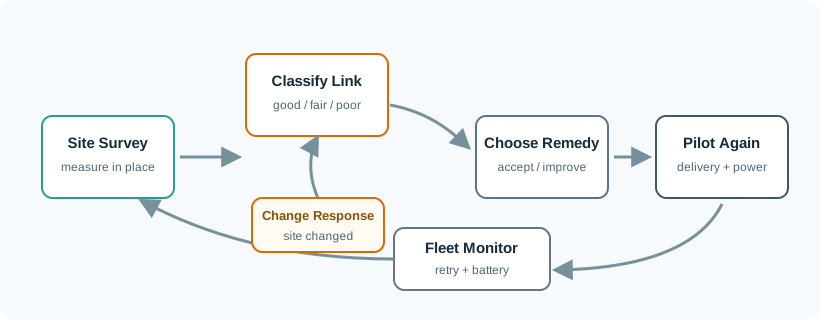
Place these deployment planning steps in the correct order for optimizing NB-IoT coverage in a building.

Common Pitfalls

Maximum Coupling Loss (MCL) is a link budget metric, not a simple range limit. 164 dB MCL translates to different physical ranges depending on: carrier frequency (900 MHz vs 1800 MHz), propagation environment (urban vs rural), antenna configuration, and building penetration loss. A device achieving 164 dB MCL outdoors may only achieve 140 dB MCL 30 meters from the antenna if there are 2 concrete walls (20 dB each + path loss) in between. Always calculate site-specific link budgets, not just compare MCL values.

NB-IoT standalone deployment on repurposed GSM spectrum (e.g., 900 MHz) provides different coverage characteristics than in-band deployment on LTE. Standalone avoids LTE interference and uses the full NB-IoT power budget, often providing 2–3 dB better performance. In-band NB-IoT must share the LTE carrier power allocation and may experience inter-carrier interference. Coverage mapping must use the specific deployment mode and frequency band that the operator uses in each target region.

Operator coverage maps show outdoor coverage probability (typically 50th or 95th percentile outdoor locations). Indoor NB-IoT devices experience additional building penetration loss: 10–30 dB depending on construction. A location shown as “good coverage” (-90 dBm outdoor) may only provide -120 dBm indoors after penetrating a concrete-block building, requiring CE Mode B. Commission a dedicated indoor coverage measurement campaign for any deployment requiring reliable deep-indoor connectivity.

Power budget calculations that only account for CE Mode A fail for devices deployed in any marginal coverage area. CE Mode B transitions (device automatically selects based on RSRP) can increase per-transmission energy by 10–100×. A device transitioning from CE Mode A to CE Mode B after installation (e.g., moved to a basement) will drain its battery in weeks instead of years. Design power budgets with coverage uncertainty margins: model 20% of devices in CE Mode B conditions and verify the battery life target is still met.

7.14 What’s Next

Build on your NB-IoT coverage knowledge with these related chapters:

Direction Chapter Focus Area
Power Modes NB-IoT PSM and eDRX Power saving timer configuration and coverage-battery trade-offs
Channel Config NB-IoT Channel Access Uplink tone configurations for coverage optimization
Hands-On NB-IoT Labs and Implementation AT command coverage configuration exercises
Review NB-IoT Comprehensive Review End-to-end NB-IoT technology review
Compare LoRaWAN Architecture Spreading factor vs repetition coverage strategies