5 NB-IoT Channel Access
More
Depth: Practitioner
Progress saves as you read. Mark sections complete as you go; your progress appears in the sidebar.
An NB-IoT meter cannot transmit merely because it has a packet ready. It first listens for access network timing and control, asks for access, receives scheduled resources, and uses assigned scheduled uplink tones. Channel access is the evidence path from a sleeping channel-access device to an acknowledged transmission.
5.1 Follow One Scheduled Uplink
This section: Follow One Scheduled Uplink — Read Figure 5.1 from the channel-access device’s access attempt through access network response, grant, scheduled uplink, and acknowledgement or retry.
Read Figure 5.1 from the channel-access device’s access attempt through access network response, grant, scheduled uplink, and acknowledgement or retry. Each labelled exchange answers a different question: can the channel-access device reach the cell, did the access network recognize the request, which resources were assigned, and did the data transfer finish? A registration icon alone cannot prove the final packet was accepted.
Figure 5.2 then shows how scheduled uplink resources can use single-tone or multi-tone arrangements. Follow the labelled frequency positions and time slots. More assigned tones can shorten a transfer when coverage and channel-access device capability allow, while a narrow single-tone allocation supports robust operation at a different rate. The access network schedules the actual resource; the application does not select a throughput from a brochure.
Use a trace with timestamps. The meter wakes at 12:00:00.000, detects cell information, starts random access at 12:00:00.400, receives its response at 12:00:00.780, obtains a scheduled uplink grant at 12:00:01.050, and finishes its scheduled transmission at 12:00:01.420. The observed access-to-finish time is . Keep retransmissions and repetitions visible because they change both delay and energy.
Two devices can choose the same random-access opportunity and collide. Backoff spreads their next attempts. In weak coverage, repetitions can improve decoding but occupy resources longer. Congestion, coverage, configuration, and access network policy therefore produce different access delays even for identical payloads.
Build the release record around the grant. Store radio conditions, band, cell, modem firmware, access attempts, granted tone mode, repetitions, payload size, completion result, and timestamps. A speed claim without those conditions is not portable evidence.
Predict three trials. In good coverage, expect one access attempt and the configured test payload to complete. Add attenuation and expect changed repetitions or retries rather than assuming the same schedule. Start several devices together and expect a wider delay distribution caused by contention and backoff. Compare the captured control trace with application acknowledgements before declaring loss.
NB-IoT scheduling is controlled by the deployed access network and modem implementation. Re-measure channel access with the target operator, band, firmware, antenna, and coverage conditions.
Separate radio access from application delivery. A completed scheduled uplink can still be rejected by the service or wait behind an access network fault. Correlate modem events, packet identity, and application acknowledgement so a missing reading is assigned to the right stage.
Battery tests should include unsuccessful attempts. Measure charge from wake through final sleep for one clean access, one backoff, and the configured failure ceiling. That comparison connects channel contention to channel-access device lifetime.
Keep payload size fixed while comparing radio conditions, then vary size separately. Changing both at once makes delay and charge evidence hard to attribute. Include a rejected or timed-out transfer in the accounting.
5.2 Overview: Channel Access Makes NB-IoT Scheduled
This section: Overview: Channel Access Makes NB-IoT Scheduled — Picture a basement meter that wakes to send one short leak report.
Measure the Wait Before the Small Message
Picture a basement meter that wakes to send one short leak report. The report itself is small, yet the device may spend most of its energy finding the cell, requesting a turn, waiting, repeating, and recovering from failure. The access record must show that full awake period.
Modulation means changing a radio signal so it can carry information. A payload means the useful content inside a message. Mark when the meter begins searching, finds the cell, requests access, receives its assigned time and radio setting, sends the report, receives the result, and returns to sleep.
Try a cold start, weak placement, a busy cell, a rejected request, repeated sending, and a lost reply. Check total awake time, number of attempts, final service delivery, and the power state after each case. A sent radio burst is not proof that the application received the report.
This trace does not predict every network or battery. The deeper sections name the physical channels, grants, repetitions, coverage changes, and field records needed to defend the access and energy claim.
NB-IoT does not let a low-power device transmit whenever it wants at whatever rate it chooses. The device first finds an NB-IoT cell, reads broadcast information, requests access, waits for a grant, sends a scheduled uplink, and then returns to its approved power state.
That sequence is why channel access belongs in the architecture review. A product can have a small payload and still waste battery if cell search, random access, grant waiting, repetitions, or retries keep the modem awake for too long.
Find the Cell
The device detects synchronization signals, reads broadcast information, and learns which access resources are available.
Use NPRACH
The device sends a random-access preamble using the repetition and hopping pattern configured by the serving cell.
Receive NPDCCH
The network grants uplink resources, including timing, tone allocation, modulation and coding behavior, and repetition behavior.
Send NPUSCH
The payload is sent on the scheduled uplink resource, then the result is validated through acknowledgements, retries, and platform delivery.
Figure 5.1 is the checkpoint for overview: channel access makes nb-iot scheduled; its purpose is to show NB-IoT access flow from synchronization and broadcast information through NPRACH, NPDCCH scheduling, NPUSCH uplink, and NPDSCH response before a field claim is accepted. Inspect cell timing beside NPBCH / SIB before the next claim.
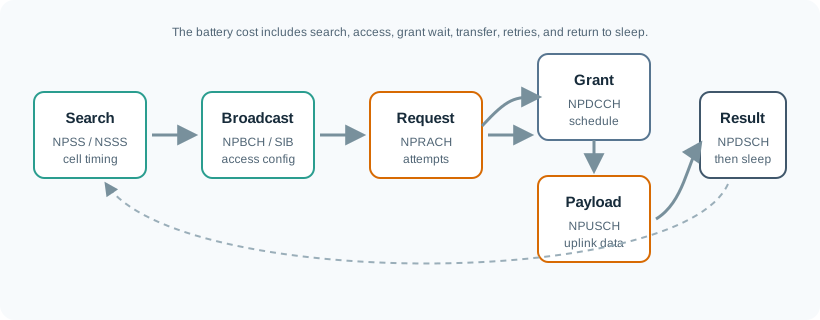
Figure 5.1 opens with Search, makes cell timing the intermediate check, and reaches NPBCH / SIB only after that check succeeds. This is the practical meaning of NB-IoT access flow from synchronization and broadcast information through NPRACH, NPDCCH scheduling, NPUSCH uplink, and NPDSCH response. It turns overview: channel access makes nb-iot scheduled into a sequence of reviewable records rather than one end-to-end assumption.
5.2.1 The Physical Pieces
The names look similar because they all belong to the NB-IoT physical layer, but they do different jobs in the access path.
5.3 Practitioner: Approve the Grant You Measure
This section: Practitioner: Approve the Grant You Measure — A deployment review should focus on what the serving network actually grants in representative locations.
A deployment review should focus on what the serving network actually grants in representative locations. Firmware settings, module capability, and operator marketing claims are inputs; they are not enough to approve a fleet rollout.
The practical workflow is to separate access evidence from payload evidence, then join both to the current trace. That exposes whether the bottleneck is cell discovery, random access, grant latency, repetitions, retries, application acknowledgement, or return-to-sleep behavior.
5.3.1 Uplink Tone Modes
The learner-facing trade-off is straightforward: fewer tones can support more coverage-oriented operation, more tones can shorten a transfer when the link and cell allow it, and repetitions improve decodability at the cost of airtime and active current.
Bring Figure 5.2 into the review before uplink tone modes. The diagram identifies NB-IoT uplink tone modes showing 15 kHz multi-tone allocations, 15 kHz single-tone operation, 3.75 kHz single-tone operation, and hopping across the narrowband carrier, which the decision record must preserve.
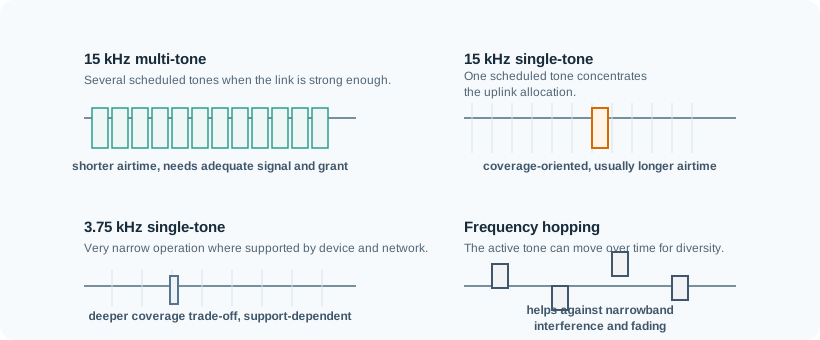
Read 15 kHz multi-tone together with shorter airtime, needs adequate signal and grant in Figure 5.2, then use One scheduled tone concentrates to test the interpretation. The visual is establishing NB-IoT uplink tone modes showing 15 kHz multi-tone allocations, 15 kHz single-tone operation, 3.75 kHz single-tone operation, and hopping across the narrowband carrier. That test is the connection to uplink tone modes: evidence, limits, and retest triggers travel with the decision.
A product team may prefer single-tone operation for weak-signal devices or multi-tone operation for stronger links, but the final uplink resource is scheduled by the network. The field log should record the granted behavior, not just the intended configuration.
5.3.2 Evidence Checklist
Start by serving cell, band, deployment mode, and operator profile. Then rSRP, RSRQ, SINR, or equivalent modem-reported radio measurements. Next cell search time after cold start and after deep sleep. After that nPRACH attempt count, backoff behavior, and access failure reasons. Continue by nPDCCH grant latency and missed-grant behavior. Continue by granted uplink tones, spacing, repetitions, and transport behavior. Continue by payload bytes at the device, network, and application platform. Continue by retries, duplicate messages, and application acknowledgement timing. Continue by current trace from wake through return to PSM or eDRX behavior. Finally worst-case results from real enclosure, antenna, and installation locations.
5.4 Under the Hood: Narrowband Gains Cost Time Awake
This section: Under the Hood: Narrowband Gains Cost Time Awake — NB-IoT gains coverage by narrowing the radio resource and allowing repeated transmissions.
NB-IoT gains coverage by narrowing the radio resource and allowing repeated transmissions. That helps a weak receiver decode a message, but it also stretches the time a device spends searching, listening, transmitting, waiting, and retrying.
For a power budget, the main question is not the theoretical peak rate. The main question is how long the modem remains in high-current states for the complete transaction under the network behavior the device actually receives.
Acquisition Cost
Cold starts, deep-sleep wakeups, and poor placement can extend synchronization and broadcast reading before any payload exists.
Collision and Backoff Cost
Random access can repeat when the device is marginal, barred, congested, or competing with many devices waking at similar times.
Listening Cost
The device may spend significant active time waiting for downlink control, especially when repetitions and coverage levels are high.
Sleep-State Cost
The transaction is not complete until acknowledgements, application policy, and modem state allow return to PSM or the next eDRX cycle.
5.4.1 Decision Record Pattern
A durable channel decision records the requirement, the observed grant behavior, the power effect, and the retest trigger. That is more useful than treating NB-IoT channel configuration as a single radio setting.
NB-IoT battery life cannot be proven from nominal uplink rate alone. Current draw depends on module state transitions, search time, access delay, repetitions, retransmissions, paging windows, firmware behavior, temperature, battery chemistry, and network grants. Use calculations for planning, but approve deployments from measured current traces and delivery logs.
5.5 Start With the Story
This section: Start With the Story — Many sleepy devices may need the same narrow channel at nearly the same time.
Many sleepy devices may need the same narrow channel at nearly the same time. The channel-access problem is the everyday question of how a meter gets a clean turn without wasting battery on failed attempts.
Start simple: treat scheduling, random access, repetition, and retries as battery and reliability decisions, not just radio mechanics.
5.6 Summary
This section: Summary — Start by NB-IoT channel access is a scheduled sequence from cell discovery through random access, grant reception, uplink transfer, and return to a power-saving state.
Start by NB-IoT channel access is a scheduled sequence from cell discovery through random access, grant reception, uplink transfer, and return to a power-saving state. Then the device can expose capabilities and log measurements, but the serving network grants the actual uplink resource. Next single-tone operation, repetitions, and hopping can improve weak-link behavior, but they also affect airtime and active current. After that rollout approval should use field evidence: access attempts, grant latency, granted tone behavior, payload delivery, retries, and current traces. Finally a channel decision needs retest triggers for operator profile, firmware, antenna, enclosure, site class, traffic density, or payload-cadence changes.
5.7 Key Takeaway
This section: Key Takeaway
NB-IoT channel access is not just a radio acronym list. It is the measured service path that determines whether a small payload can be delivered reliably without destroying the battery model.
5.8 See Also
This section: See Also
Places channel access inside the full device, radio, core, and application service chain.
Explains how repetitions and deep-coverage behavior change access delay and active current.
Connects reachability timers and sleep behavior to channel-access transactions.
Turns channel measurements into pilot gates, rollout decisions, and retest triggers.
Find help
3 reviewed answers.
Where should I start in a module?
Open the module page from the sidebar to see its chapters in order. Use the module map to return to a topic you need.
Modules and pathsReviewed
What can I try when a project does not work?
Check the symptom, then work through the diagnostic steps. Keep the error message and the smallest example that reproduces it.
When you are stuckReviewed
How do interactive examples work?
Use the interactive guide to check how examples and simulations work before changing your project.
Interactive examples guideReviewed