7 NB-IoT Metering and Telemetry
More
Depth: Practitioner
Progress saves as you read. Mark sections complete as you go; your progress appears in the sidebar.
A water meter, soil probe, and asset tracker may all use NB-IoT, yet they differ in payload timing, mobility, alarm urgency, and downlink need. Application fit comes from those physical behaviors. Sparse telemetry is a useful pattern only when its latency and reachability limits match the job.
A payload is the application data inside a message. A protocol is the rule for exchanging that message, while telemetry means measurements reported from a remote device.
7.1 Compare Metering, Agriculture, and Tracking Paths
This section: Compare Metering, Agriculture, and Tracking Paths — Begin with Figure 7.1.
Begin with Figure 7.1. Follow the modern figure from the meter register through the NB-IoT modem and mobile network to collection and billing. The meter identity, cumulative unit, observation time, and reset or rollover behavior matter more than a fast stream. A delayed batch can be acceptable if none of those records becomes ambiguous.
Next read Figure 7.2 from field probes toward irrigation or analysis. Soil moisture changes slowly, but a valve command has a physical effect. Keep measurement telemetry separate from authenticated control, and retain a local safe rule when the network is unavailable.
Finally, Figure 7.3 adds movement and changing coverage. Follow tracker position and condition through cells into the asset service. Decide whether the application needs continuous tracking, periodic location, or exception reports; those are different energy and delay contracts.
Compare concrete loads. One meter sends a 100-byte reading every hour, producing (24\times100=2{,}400) payload bytes per day before protocol overhead. A soil station sends four 100-byte sensor records each hour, or 9,600 payload bytes daily. An asset tracker reporting every five minutes sends (12\times24=288) records; at 100 bytes each, that is 28,800 payload bytes. Payload totals alone do not predict billed data or energy, because attachment, security, acknowledgements, repetitions, and coverage add work.
Create an application record with reporting interval, maximum acceptable delay, mobility, expected coverage, downlink frequency, payload schema, retention, and response to missed reports. For the meter, test rollover and a long outage. For agriculture, test stale moisture plus a denied valve command. For the tracker, cross a coverage gap and verify queued locations keep their original times.
Predict one result per architecture. Expect a twelve-hour meter outage to create twelve hourly records if local storage is sized for them. Expect the field valve to stay in its defined safe state without downlink. Expect the mobile tracker to upload stored points in order after coverage returns without presenting them as current positions.
Keep a missed-report rule for each application. A silent meter, field probe, and moving tracker imply different urgency, so their alarm windows should not be copied merely because the radio technology matches.
Preserve the application state during a radio module replacement. The new modem identity must map to the same approved asset only after installation evidence, and an old module should no longer deliver records for that asset.
7.2 Overview: NB-IoT Fits Sparse, Patient Telemetry
This section: Overview: NB-IoT Fits Sparse, Patient Telemetry — Picture a water meter that wakes once a day.
Picture a water meter that wakes once a day. It sends one small reading and then sleeps. That is a very different job from a camera or a fast remote control.
Telemetry means time-stamped reports about device state or events. A payload is the useful data carried in one message. Firmware is the software stored on the device. Start with the service promise. State how often data must arrive. State how late it may be. State whether the device must hear a quick command. Then test the final antenna, case, site, power states, and mobile service.
Use a short fit check:
- Is the device fixed in place?
- Are its messages small?
- Can it sleep for long periods?
- Can a downlink wait?
- Does the real site have service?
- Does the final case weaken the link?
- Can the battery afford retries?
- Can support spot a silent fault?
- Who owns a failed report?
- What change forces a new choice?
NB-IoT can fit this patient pattern. It does not fit every low-data job. Practitioner builds the site and support record. Under the Hood covers radio states, delayed downlink, energy cost, and operator limits. Those details may rule out a site that the simple pattern seemed to fit.
NB-IoT is a strong candidate when a device is fixed or mostly fixed, sends compact telemetry, sleeps for long periods, and can tolerate delayed downlink. Common examples include utility meters, basement leak sensors, environmental monitors, parking or waste sensors, and low-rate industrial alarms.
The application decision is not proven by the technology label. It is proven by installed-device evidence: operator service at the real location, final antenna and enclosure behavior, measured power states, payload cadence, SIM lifecycle, diagnostics, and a clear operations owner.
Start by writing the application promise in plain operational terms. A meter may promise one accepted reading per day, outage backfill, and a monthly configuration window. A leak sensor may promise rapid exception delivery but no arbitrary cloud command while asleep. A parking sensor may promise event summaries and periodic health checks, not continuous streaming. Those promises decide whether NB-IoT's sparse, delayed pattern fits.
The same use case can fail the fit when the details change. A meter that needs frequent firmware packages, a sensor that must accept immediate shutoff commands, or an asset that moves across operator regions may need LTE-M, broadband cellular, or a non-cellular local network. A good overview record therefore includes both the approved NB-IoT pattern and the boundary that would force a different technology.
Keep the support model in scope. Sparse telemetry still needs provisioning, failed-read handling, battery replacement rules, decommissioning, and evidence that the application can tell the difference between a quiet device and a broken one. The application record should state the heartbeat policy, missed-report threshold, backfill rule, and field-service response so low traffic does not become low observability.
Why pause at Figure 7.1? Its labelled evidence shows smart metering architecture with utility meter, MCU, NB-IoT module, cellular network, and utility backend, the distinction that anchors overview: nb-iot fits sparse, patient telemetry. Inspect daily reading beside battery state before the next claim.
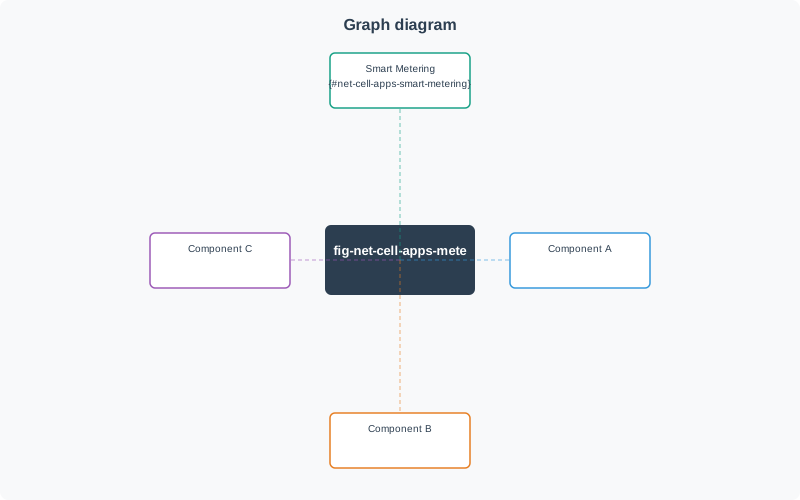
Inspect the boundary between Smart Metering Over NB-IoT and Utility Meter in Figure 7.1, then see where tamper event enters the path. Those labels make smart metering architecture with utility meter, MCU, NB-IoT module, cellular network, and utility backend concrete. The chapter connects them to overview: nb-iot fits sparse, patient telemetry through cross-layer acceptance evidence.
Good Fit
Small scheduled readings, health summaries, exception alerts, and field measurements that can buffer and retry without real-time interaction.
Conditional Fit
Mostly static assets, bins, cabinets, and remote sensors where mobility is occasional and delayed updates are acceptable.
Weak Fit
Frequent downlink, interactive control, route-level mobility, large diagnostics, voice, video, or regular firmware delivery.
Review Trigger
Reopen the selection when payload cadence, enclosure, antenna, operator path, region, power policy, or fleet operations change.
Approve the application pattern only when the use case can name its reporting cadence, downlink tolerance, power budget, installed coverage evidence, and operations owner.
7.3 Practitioner: Build the Application Evidence Record
This section: Practitioner: Build the Application Evidence Record — A practitioner should translate each use case into evidence fields before approving a pilot.
A practitioner should translate each use case into evidence fields before approving a pilot. The record should say what the device reports, how often it wakes, how long the application can wait for commands, where the antenna will sit, what the power model includes, and who handles provisioning, monitoring, failures, and retirement.
This record prevents a common mistake: treating one clean attach or one successful uplink as proof for every enclosure, basement, operator profile, sleep state, payload pattern, and support workflow.
To decide practitioner: build the application evidence record, inspect Figure 7.2 now: it makes agricultural and environmental monitoring architecture with remote sensor, cellular module, cellular network, and cloud dashboard visible before the prose turns that evidence into a release choice.
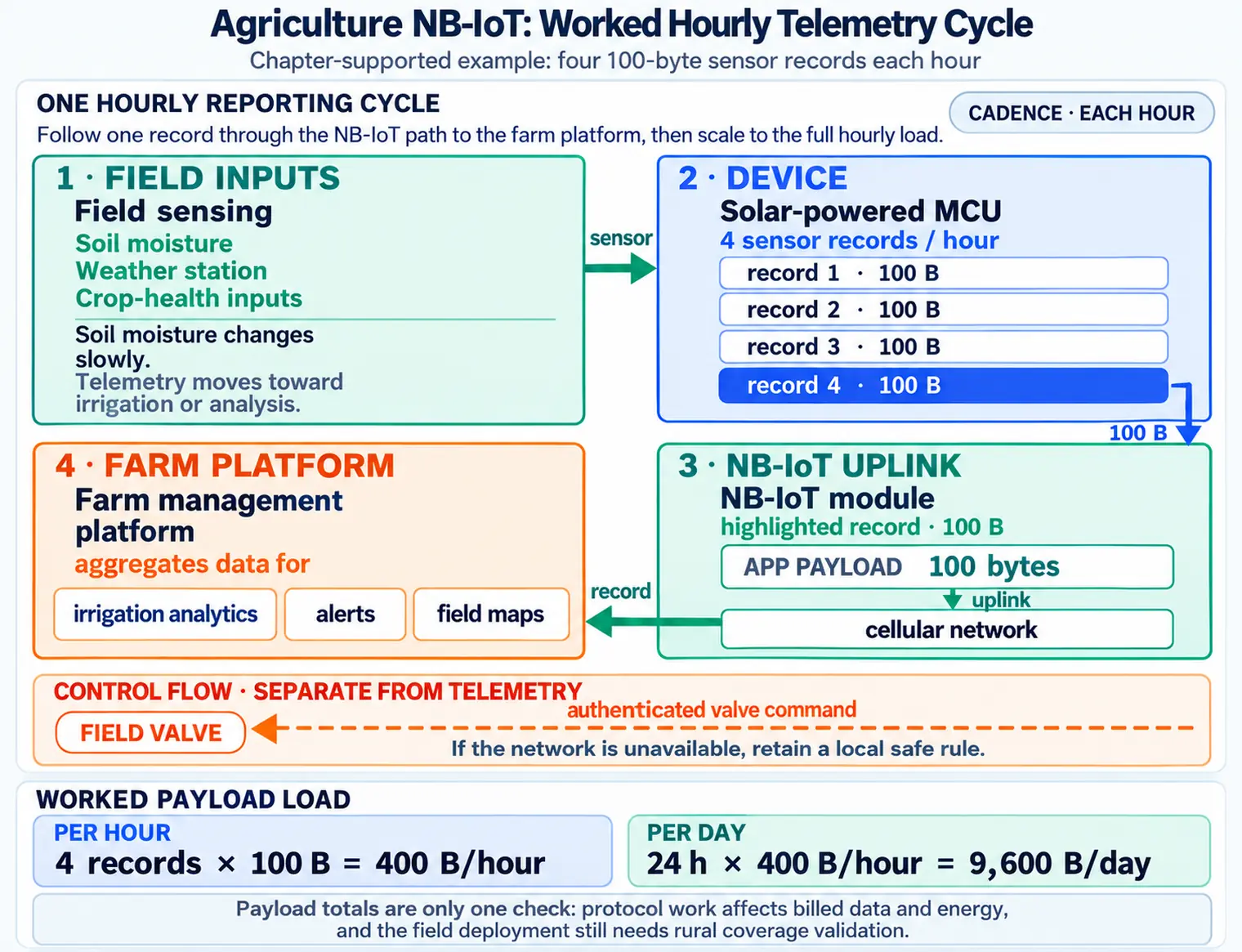
Figure 7.2 assigns separate roles to Agricultural, remote sensor, and cellular network. Reading those roles together reveals agricultural and environmental monitoring architecture with remote sensor, cellular module, cellular network, and cloud dashboard. The practical consequence for practitioner: build the application evidence record is that a local pass cannot validate the unmeasured remainder of the architecture.
7.3.1 Evidence Flow
7.4 Under the Hood: Fit Depends on State Boundaries
This section: Under the Hood: Fit Depends on State Boundaries — The most important review habit is to tie every application claim to a measured or observable state.
Under the hood, an NB-IoT application succeeds or fails at state boundaries: attach and registration, sleep and wake, coverage enhancement, retry behavior, command reachability, payload buffering, SIM lifecycle, and backend acknowledgement. A use case can look simple while those boundaries create hidden power or operations risk.
The most important review habit is to tie every application claim to a measured or observable state. If a claim depends on "the device sleeps most of the time," the evidence should show the full-board sleep current and the path back to sleep after weak coverage or server failure. If a claim depends on delayed downlink, the evidence should state when commands are acceptable and what happens when the device is unreachable.
Use Figure 7.3 to identify the state boundaries that one mobile position-and-condition record crosses before it becomes a trustworthy service output.
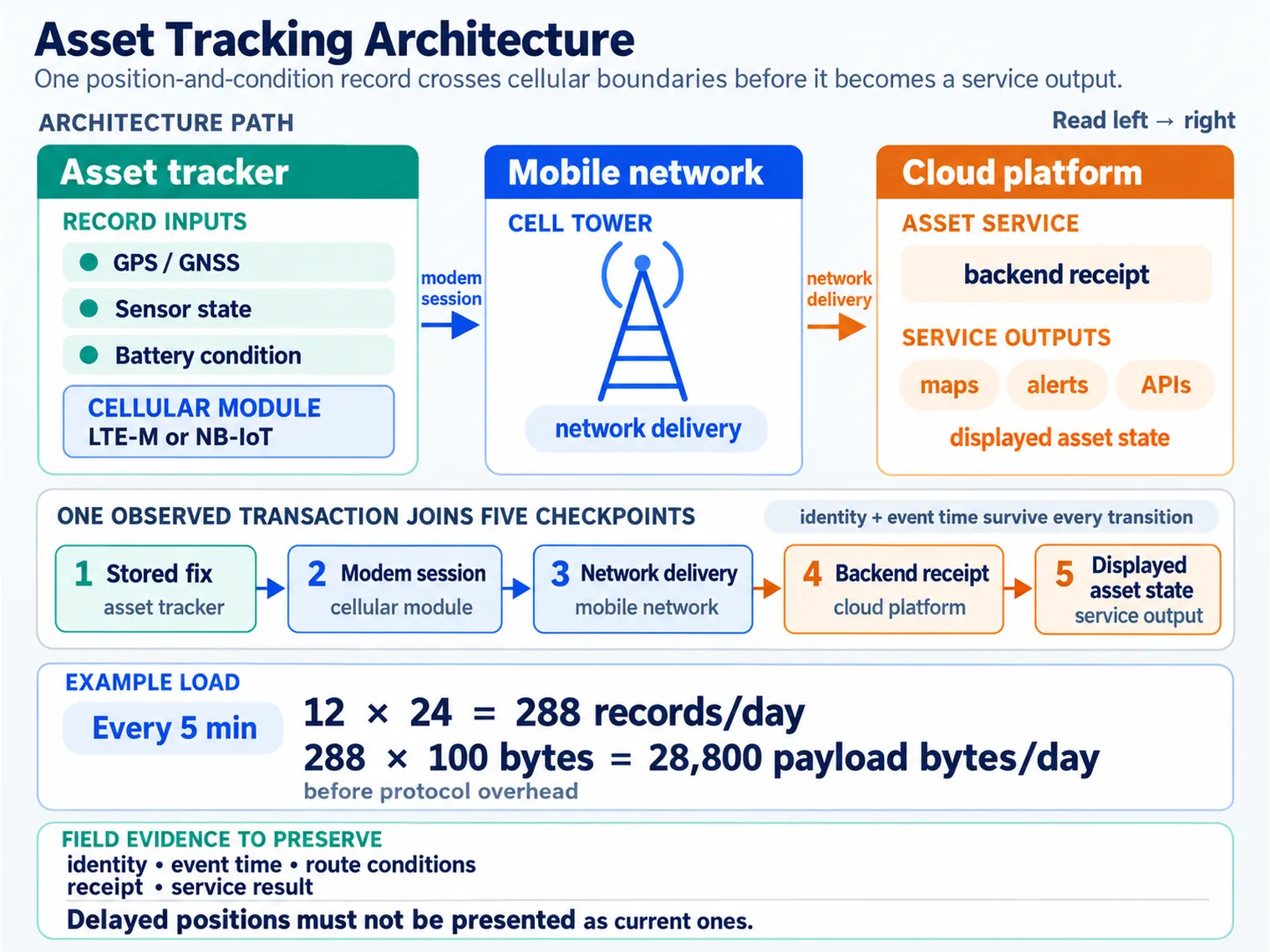
Follow one asset message. Check both ends of its route. Read Figure 7.3 from the asset tracker, where location, sensor state, and battery condition form the record, through the cellular module and mobile network to the cloud platform. The service outputs—maps, alerts, and APIs—depend on the identity and event time surviving every transition. The example cadence yields 12 × 24 = 288 records/day at five-minute intervals, and 100 bytes per record gives 28,800 payload bytes before overhead. One observed transaction should therefore join the stored fix, modem session, network delivery, backend receipt, and displayed asset state.
7.4.1 Boundary Checks
Do not approve NB-IoT from "low power" or "deep coverage" as generic claims. Approve only the measured behavior for the selected application and deployment boundary.
7.4.2 Recommendation Record
Start by naming the application behavior, payload cadence, acceptable delay, and local buffering rule. Then record the selected operator path, SIM or eSIM lifecycle, APN/profile owner, and support contact. Next attach coverage logs from representative installed sites using final hardware, antenna, enclosure, and firmware. After that attach power traces that include weak coverage, retries, receive windows, failure recovery, and return to sleep. Continue by listing rejected alternatives such as LTE-M, LoRaWAN, Wi-Fi, wired, or broadband cellular with the evidence behind the rejection. Finally define the change triggers that reopen application fit before fleet expansion.
7.5 Start With the Story
This section: Start With the Story — NB-IoT applications succeed when their data story is modest and durable.
NB-IoT applications succeed when their data story is modest and durable. A meter reading, tank level, parking state, or environmental sample can be valuable even if it is small and not urgent.
Start simple: match the application to low payloads, long sleep, deep coverage, and predictable operations before choosing NB-IoT.
7.6 Summary
This section: Summary — Start by NB-IoT fits sparse, patient telemetry better than interactive control, high-rate data, or live mobility.
Start by NB-IoT fits sparse, patient telemetry better than interactive control, high-rate data, or live mobility. Then metering, environmental sensing, parking or waste sensors, static assets, and building alarms need different evidence records. Next field approval depends on installed coverage, final antenna and enclosure behavior, measured power states, buffering, and operations ownership. After that weak coverage, retries, failed attach, delayed downlink, SIM lifecycle, and support workflow can decide whether a use case scales. Finally reopen the application decision when payload cadence, firmware, antenna, enclosure, operator path, region, fleet size, or support model changes.
7.7 Key Takeaway
This section: Key Takeaway
Treat NB-IoT application fit as a measured deployment record: sparse telemetry, tolerant reachability, installed coverage, whole-device power behavior, and operations ownership must all be visible.
7.8 See Also
This section: See Also
Find help
3 reviewed answers.
Where should I start in a module?
Open the module page from the sidebar to see its chapters in order. Use the module map to return to a topic you need.
Modules and pathsReviewed
What can I try when a project does not work?
Check the symptom, then work through the diagnostic steps. Keep the error message and the smallest example that reproduces it.
When you are stuckReviewed
How do interactive examples work?
Use the interactive guide to check how examples and simulations work before changing your project.
Interactive examples guideReviewed