14 eSIM and Global IoT Deployment

More
Depth: Practitioner
Progress saves as you read. Mark sections complete as you go; your progress appears in the sidebar.
A refrigerated container may cross three mobile networks without anyone opening its sealed tracker. An eSIM lets operations download and enable profiles, but the global device identity, bootstrap path, policy, and recovery route still need proof. Global deployment turns SIM work into a managed lifecycle.
14.1 Follow a Container Through Its Profile Change
This section: Follow a Container Through Its Profile Change — Read Figure 14.1 as a sequence rather than a set of labels.
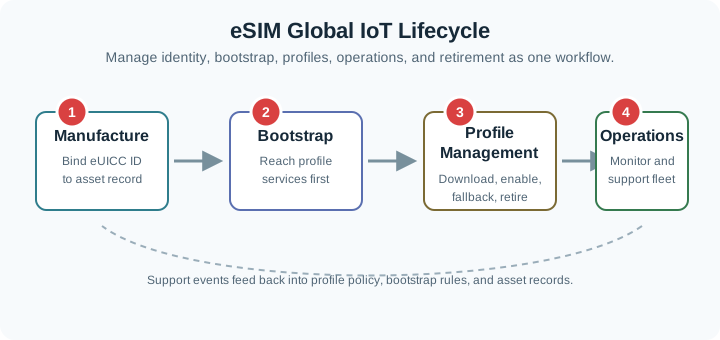
Read Figure 14.1 as a sequence rather than a set of labels. Begin with the global device’s embedded secure element and bootstrap connectivity. Continue through profile download and authenticated installation, then select or enable the intended operator profile. End at steady service, later change, and retirement. The arrows matter because a profile that cannot be downloaded on the current network cannot solve the current loss of service.
Consider tracker CT-204 leaving a factory with bootstrap profile B and operational profile U. At the port, B supplies the narrow connection used to fetch U. The eSIM platform verifies that U is authorized for this global device, installs it, and reports the result. Operations enable U only after the download is complete, then check data registration and one application message. If that check fails, policy keeps B available for recovery rather than deleting the only working route.
Identity exists at several layers. The eSIM hardware, downloaded profile, modem, tracker asset, and cloud record each have an identifier. Bind them in an inventory so an operator can answer which physical container used which profile at a given time. A profile download receipt without the tracker mapping is not enough to investigate traffic or revoke access.
Global policy should name allowed countries or networks, roaming limits, data ceilings, profile priority, and who may trigger a change. It should also state what happens when the global device is offline, asleep, low on power, or unable to attach. A mass switch sent to an unreachable fleet is a pending operation, not a completed migration.
Predict a controlled trial. With B active, expect CT-204 to download U and keep B installed. After enabling U, expect cellular registration plus one acknowledged telemetry record. Block U’s network and expect the global device to return to the approved recovery state within the chosen timeout. Finally retire the tracker and verify that operational profiles and backend credentials are disabled while the audit history remains.
Operator coverage, roaming agreements, modem firmware, and eSIM platform behavior vary. Verify lifecycle and fallback on the exact global device, countries, subscriptions, and provider service selected for deployment.
Fleet rollout should begin with a small named cohort. Check profile download, activation, application traffic, billing identity, sleep behavior, and fallback before widening the group. Keep a stop threshold for download failures or loss of recovery connectivity.
Support needs states more precise than “active.” Distinguish ordered, downloaded, installed, enabled, registered, passing application traffic, disabled, and deleted. A global device can occupy one state in the eSIM platform and another in the operator or asset service, so reconciliation must use timestamps and identifiers.
Test disposal separately from temporary suspension. Retirement should prevent the old tracker from attaching or reaching its application while preserving required audit records. Reuse of a container number must not revive the retired credential mapping.
Treat backend credentials separately from the mobile profile. Switching operator access should not duplicate cloud identities or leave an old global device token active. Trace one application record before and after migration to prove that asset continuity and network change are both correct.
Reconcile pending profile jobs after every fleet window and investigate identities that remain between states.
14.2 Overview: eSIM Moves SIM Work into Operations
This section: Overview: eSIM Moves SIM Work into Operations — Imagine a shipment tracker that leaves one country and enters another.
Imagine a shipment tracker that leaves one country and enters another. The radio may still work, yet the device can lose service if it has the wrong mobile profile, no allowed network, or no safe way to change its account.
Start with the full service life. Record the device identity, first profile, download path, allowed regions, change rule, rollback, and final removal. Then test first use, a border crossing, a failed download, no coverage, and a device reset. The support team must be able to tell which state failed.
An eSIM stores mobile access profiles in built-in secure hardware. It can make profile changes easier than swapping a card. It does not guarantee radio coverage, roaming rights, local approval, or a working download path. A remote change can also strand a device if the old and new paths both fail.
Go deeper in two steps. The Practitioner section builds the Profile Lifecycle Record. Under the Hood follows remote profile control and the events that should trigger a new test.
Give each test unit one simple state card. Show its product ID, mobile ID, current profile, allowed next profile, region, and last good contact. Add the person or team that may approve a change. This card links a remote task to one real asset.
Run the change as a set of small steps. Reach the profile service. Ask for the new profile. Check it. Enable it. Join the mobile network. Reach the product service. Report the final state. Keep the last safe state until the new path is proven.
Try the same steps with power loss and poor coverage. Check that a retry cannot fill storage or use all the battery. Check that support can see a half-finished change. Approve a market only after the device, operator, service, and support records agree.
An eSIM deployment is not simply a smaller SIM card. In IoT, the important object is an eUICC: a secure SIM element that can hold remotely managed operator profiles. That changes the lifecycle of a device fleet. A team can bind identities during manufacturing, ship devices to multiple regions, activate the right operator profile later, and change service without opening the enclosure.
That flexibility is useful only when the operating process is real. A device still needs bootstrap connectivity, a supported remote SIM provisioning workflow, a data route to the application, a record that ties eUICC identity to device identity, and a recovery path when a profile operation fails.
The overview decision should therefore separate capability from release evidence. Capability says the hardware can host profiles. Release evidence says a representative device can reach the provisioning service, download or enable the intended profile, attach in the target region, reach the application route, report its profile state, and recover when a profile change is interrupted. Those events should be visible in device logs, platform records, operator state, and the asset database.
Global fleets add one more risk: the correct answer can differ by region. A profile that works in one country may not satisfy local coverage, roaming, regulatory, billing, or support requirements elsewhere. The launch record should name which markets are approved, which profiles are allowed there, what fallback path is acceptable, and which owner updates the record when a market, operator, firmware build, or provisioning provider changes. That record should travel with the device history, because support staff often diagnose an eSIM failure months after shipment and need to know the intended profile state.
Read Figure 14.1 from manufacturing into operations. Bind eUICC ID creates the identity-to-product record before Bootstrap connectivity can obtain or activate the intended profile. Profile changes, monitoring, and retirement then remain operational responsibilities after shipment. The sequence explains why eSIM removes a physical swap without removing lifecycle ownership or evidence.
-

Remi keeps the old route while asking for a new profile.
-

The tracker downloads and checks the new profile.
-

The checked profile is enabled.
-

The tracker joins the intended mobile network.
-

The tracker proves the route to the product service.
-

The asset record must agree, or the change rolls back.
eSIM Global IoT Lifecycle initiates the path in Figure 14.1; Bind eUICC ID records the next transition, while Bootstrap marks what must be proved afterward. Together they show eSIM global IoT lifecycle from manufacturing through bootstrap, profile management, operations, and retirement. For overview: esim moves sim work into operations, this ordering tells the team where to capture logs and where to stop on failure.
14.2.1 Identity Is Bound Early
The eUICC identifier, device serial number, firmware build, customer account, and intended region must agree before the fleet leaves manufacturing.
14.2.2 Bootstrap Must Be Proven
The device needs a first path to profile-management services. Without that path, the target profile cannot be downloaded or enabled in the field.
14.2.3 Profiles Need Policy
Download, enable, fallback, suspend, replace, and retire operations need ownership rules. Otherwise platform state and device behavior drift apart.
14.2.4 Release Boundary
Approve a global eSIM design only when the plan proves the provisioning model, bootstrap route, operational profile policy, data path, support recovery, and retirement process for the intended markets. A module data sheet that says eSIM support is not enough.
14.3 Practitioner: Build the Profile Lifecycle Record
This section: Practitioner: Build the Profile Lifecycle Record
Start from the support desk and work backward. When a device is silent in another country, the team needs to know which profile should be active, whether the device reached the provisioning service, which APN and route are expected, whether the operator sees attachment attempts, and how to recover without a site visit.
The profile lifecycle record should be written as a sequence of observable states. Before shipment, the record binds eUICC ID, device serial number, firmware, customer, intended market, bootstrap profile, and allowed operational profiles. During activation, it records which platform authorized the operation, which profile state the device reported, whether the operator saw attachment, and whether the application received the first production payload. During support, it records suspension, fallback, replacement, and retirement actions so that billing state and field behavior stay aligned.
Include negative tests in the record. Force a profile download failure, a region with no preferred operator, an APN route error, and a device that reports an older profile state after reconnecting. The release is stronger when the team can show that the device buffers data, reports the failure, avoids endless retry loops, and returns to a known service path. Without those tests, a global eSIM plan may work only in the factory and fail in the first unsupported region.
Finally, assign owners by boundary. Product owns which markets are approved; connectivity operations owns profile policy and provider escalation; firmware owns local transaction handling; support owns the recovery script used with customers. The lifecycle record is the handoff between those owners. Keep the same owner names in the asset database and the provisioning platform so an incident can move from customer report to profile action without guessing which team has authority.
14.3.1 Worked Scenario: Cross-Region Tracker
A battery tracker is built in one country, activated in a warehouse, and then shipped through several regions. The release record should name the bootstrap profile, the operational profile policy for each region, the fallback path if the preferred profile cannot attach, and the event the device reports after every profile operation. During the pilot, the team should force at least one failed profile activation and prove that the device buffers measurements, reports the failure, and returns to a known service path.
14.4 Under the Hood: RSP Is a Control Plane
This section: Under the Hood: RSP Is a Control Plane
Remote SIM provisioning is a secure control plane for subscription profiles. The exact architecture depends on the supported GSMA workflow, but the engineering pattern is consistent: a protected profile is prepared by a provisioning service, delivered to the eUICC, installed, enabled, disabled, deleted, or replaced under policy, and then reconciled with the network and asset systems that depend on it.
The hard part is that profile state and radio state are different. A profile can be installed but disabled, enabled but unable to attach, attached through the wrong APN, or active in the platform while the device reports an older state. Good firmware therefore treats profile operations as transactions with observable states, retry limits, local buffering, and a fallback path.
14.4.1 Retest Trigger
Retest the eSIM lifecycle whenever a target region, operator, module firmware, eUICC supplier, provisioning platform, APN, private-network policy, or asset-system integration changes. The profile lifecycle is a chain; a change in one link can break activation or recovery even when the radio hardware is unchanged.
14.5 Start With the Story
This section: Start With the Story — Global cellular IoT turns connectivity into an operations problem.
Global cellular IoT turns connectivity into an operations problem. A device may cross borders, change operator profiles, lose roaming support, or need a SIM update long after it leaves the factory.
Start simple: treat eSIM, provisioning, roaming, and carrier fallback as lifecycle controls, not just procurement details.
14.6 Summary
This section: Summary — eSIM helps global IoT fleets because profile changes can be managed remotely, but it does not remove the need for engineering and operations proof.
eSIM helps global IoT fleets because profile changes can be managed remotely, but it does not remove the need for engineering and operations proof. The fleet still needs a supported provisioning model, bootstrap connectivity, profile policy, data routing, asset-state reconciliation, and a recovery path for failed changes.
Treat eSIM as a subscription and operations lifecycle. The right question is not “does the modem support eSIM?” but “can this fleet bootstrap, provision, attach, route data, recover, and retire profiles in every market we plan to serve?”
14.7 See Also
This section: See Also
Cellular IoT Overview and Evolution
Use this first if you need the radio-family and deployment-category context around global cellular choices.
Cellular IoT Deployment Planning
Connect eSIM profile decisions to coverage checks, pilots, operations handoff, and rollout gates.
Building Cellular IoT Devices
Translate the lifecycle plan into modem bring-up, firmware state handling, diagnostics, and field support checks.
Private 5G Networks for IoT
Compare public, private, and hybrid cellular identity models when assets move between campus and wide-area coverage.
Find help
3 reviewed answers.
Where should I start in a module?
Open the module page from the sidebar to see its chapters in order. Use the module map to return to a topic you need.
Modules and pathsReviewed
What can I try when a project does not work?
Check the symptom, then work through the diagnostic steps. Keep the error message and the smallest example that reproduces it.
When you are stuckReviewed
How do interactive examples work?
Use the interactive guide to check how examples and simulations work before changing your project.
Interactive examples guideReviewed